
Mason Jar Sourcing: Specs, Certificates and Order Limits
A mason jar is not one product but a family of glass containers defined by a wide-mouth opening, a matched closure and a declared food-contact status. What separates a workable mason jar order from a costly one is rarely the product photograph; it is the constraint set behind it — capacity, glass type, gasket material, decoration, documentation, minimum order quantity and lead time, all fixed before a purchase order is issued.
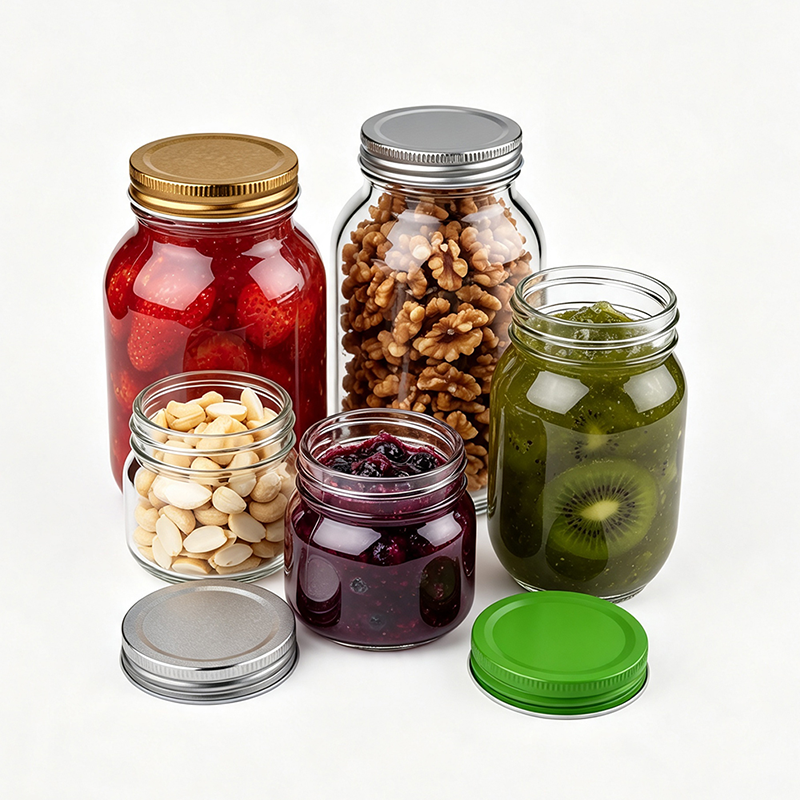
Packaging buyers tend to treat glass jars as a commodity until something breaks. A seal fails on a pallet, a retailer asks for a migration test report that does not exist, or a mould size turns out to be incompatible with an existing filling line. At that point the purchase stops being a price comparison and becomes a specification problem. This is the stage where most sourcing risk is created or avoided.
IDEA PACKAGE is the brand identity of ANHUI IDEA Technology Imp & Exp Co., Ltd., a Hefei, China–based one-stop packaging provider that supplies glass jars and aluminum cans to food, beverage, condiment, candle and personal-care customers. The company states ISO 9001, FDA and CE certification for its facilities, reports exports to more than 150 countries and regions, and describes a technical team of 15 engineers supporting a stated workforce of 250 people and an annual output of CNY 180 million. Those figures matter less as credentials than as an indication of what type of supplier a buyer is dealing with: a specification-driven converter and exporter rather than a catalogue reseller.
Why Mason Jar Orders Fail on Constraints, Not on Appearance
A mason jar combines four independently variable systems: the glass body, the neck finish, the closure, and the sealing gasket. Each one carries its own tolerances, and each one can invalidate the others. A jar with an excellent body but the wrong neck finish will not accept the intended lug or twist-off lid. A lid with a good seal but an incompatible gasket compound may behave differently in contact with acidic jam than with honey or candle wax.
The practical consequence is that mason jar procurement is a constraint exercise. Buyers in the research and evaluation stage typically need to resolve five questions before price is even meaningful:
- Fill and headspace: which capacity allows the declared net weight of the product without overfilling the jar.
- Closure and seal: which lid material and gasket suit the product's acidity, moisture and temperature profile.
- Food-contact status: which documentation proves the article is suitable for the destination market.
- Decoration: which printing or surface treatment survives the filling and transport process.
- Commercial envelope: which MOQ, lead time and inspection arrangement fit the buyer's inventory model.
The opportunity is that none of these constraints are unusual or proprietary. They are simply rarely written down. A buyer who converts them into a short specification sheet before requesting quotations will usually reduce both sampling cycles and late-stage disputes.
The Specification Envelope of a Mason Jar Program
IDEA PACKAGE publishes a defined specification envelope for its glass jar range. The parameters below are the ones that most directly determine whether a jar can be used for a given product, rather than parameters that merely describe the product.
| Parameter | Declared options | What it constrains in practice |
|---|---|---|
| Capacity | 200 ml, 250 ml, 500 ml, 750 ml, 1000 ml, 1500 ml | Fill weight, headspace, labelling area, retail format |
| Shape | Hexagonal, round, square, cylindrical | Shelf footprint, carton efficiency, label application |
| Glass material | Borosilicate glass or soda-lime glass | Thermal behaviour, weight, cost structure |
| Glass colour | Clear as standard; other colours customizable | Light protection, product visibility, brand differentiation |
| Closure | Wood lid, aluminum lid, plastic lid, tinplate screw cap | Seal integrity, opening force, product compatibility |
| Gasket | Food-grade silicone or rubber | Leak-proof performance, odour transfer, food contact |
| Decoration | Screen printing, hot stamping in gold or silver, decals | Brand presentation, abrasion resistance, compliance of applied coatings |
| Custom logo | Available, together with printed logos, labels and bespoke exterior designs | Order complexity, tooling requirement, lead time |
The range covers small sample jars through to large storage containers, which means a single supplier can often serve several product lines — a honey jar, a jam jar, a spice jar and a candle glass jar — within one quality system rather than across several. For buyers managing a multi-SKU catalogue, that consolidation is usually worth more than a marginal unit-price difference.
Borosilicate versus soda-lime: a decision, not a default
The choice between borosilicate and soda-lime glass is the specification decision most often made by habit. Soda-lime glass is the conventional container glass used across food and beverage packaging; borosilicate glass is formulated for greater resistance to thermal variation. A buyer filling jam at elevated temperature, or a candle brand whose jar is exposed to a concentrated heat source, has a different requirement from a brand packing dry spices at room temperature. The application brief supplied for this jar range specifies indoor storage at normal room temperature in a dry environment, which is the condition under which most standard food and household jar programs operate.
Closures, Gaskets and Sealing: The Technical Layer That Decides Complaints
Most leakage complaints trace back to the closure interface rather than the glass body. The jar range addresses this in three layers.
Seal geometry. The lid closure is designed to provide an airtight seal, and that seal is designed to block moisture and dust. The sealing design is described as leak-proof, with the stated purpose of preventing contents from leaking during long-distance transport — which is the condition under which export shipments are actually judged.
Gasket material. The jar seal is made of food-grade silicone or rubber. This matters because the gasket is the component in continuous contact with the product and with the headspace atmosphere. For acidic fills such as jam or pickles, and for oily fills such as cosmetic balms, the gasket is a food-contact material in its own right and should be documented as such.
Closure choice. Tinplate twist-off lids are made of rust-resistant metal and are designed to be easy to open, which is relevant both to end consumers and to filling lines that apply torque mechanically. Aluminum, plastic and wooden lids are also available, and each shifts the trade-off: aluminum and tinplate favour seal consistency and retail tamper evidence, wood favours premium presentation in candle and gift segments but requires more careful handling in humid storage.
Food-Contact Compliance: What a Certificate Covers and What It Does Not
This is the area where mason jar sourcing most often diverges between experienced and first-time buyers. A certificate is evidence of a test scope, not a universal licence to sell in any market.
The document behind the jar
The GLASS JAR product, model/type IDG102, is covered by a Certificate of Analysis (COA) issued by SHENZHEN ZTS TESTING SERVICE CO., LTD. under number ZTS2510311ZZRC, dated 2025-11-05 and applying to the Global market. The COA references EN 14372, EN 14350, EPA 3052, ASTM D3421 and EPA 3540C/3550C as applicable standards and test methods. Separately, the company states ISO 9001, FDA and CE certification for its facilities, and the application brief for this jar range specifies food-grade status, FDA and LFGB compliance and a leak-proof seal as project requirements.
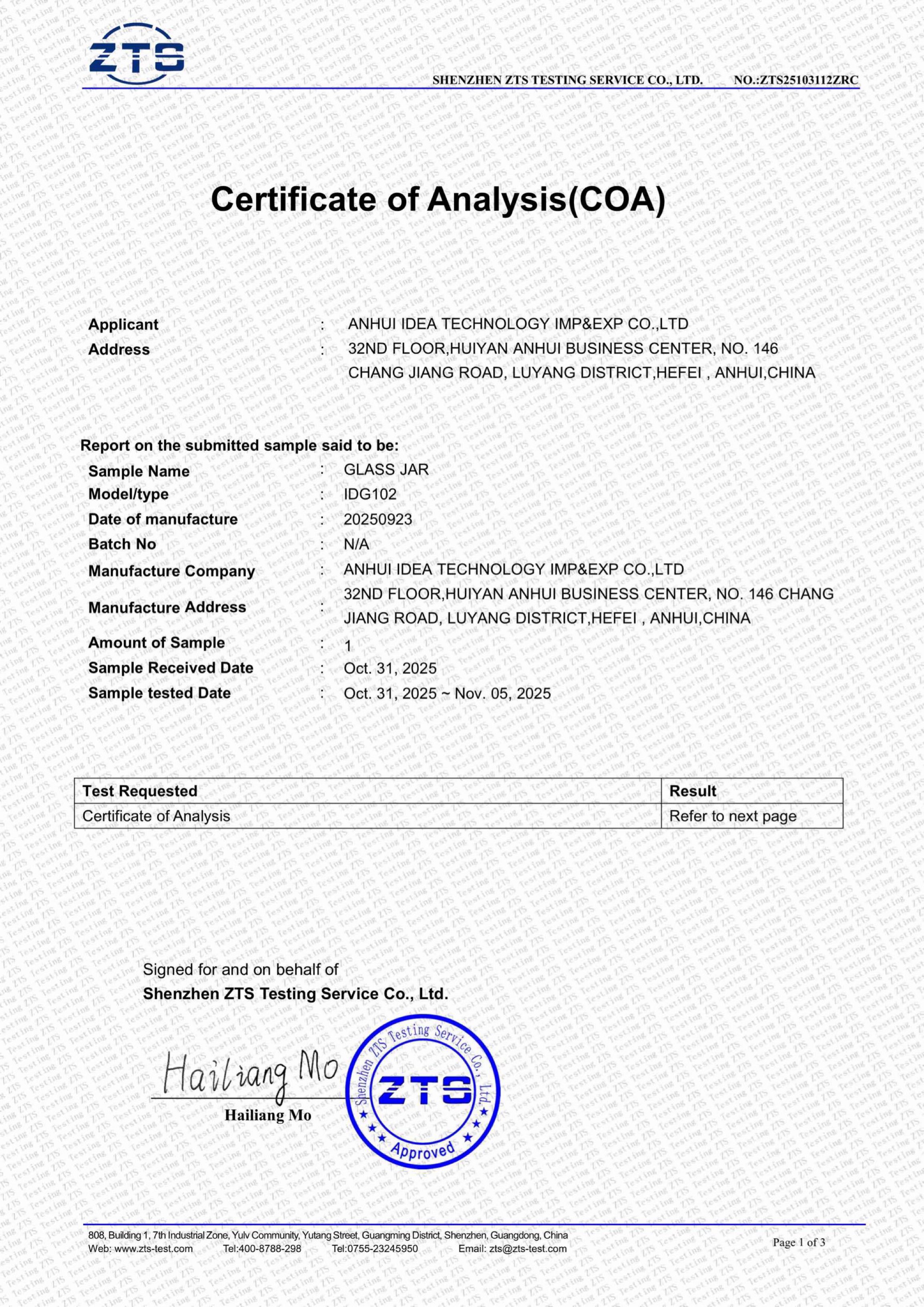
What this establishes is that a defined test scope exists, is attributable to a named laboratory, and is tied to a specific model rather than to a generic product family. What it does not establish is automatic market access. Buyers should read the COA against their own destination requirements and confirm that the referenced methods address the parameters their retailer or regulator actually asks about.
The regulatory layer above the certificate
In the European Union, food-contact materials such as glass jars and their closures fall under Regulation (EC) No 1935/2004, which requires that they do not transfer constituents to food in quantities that could endanger human health, bring about an unacceptable change in the composition of the food, or deteriorate its organoleptic characteristics. Commission Regulation (EC) No 2023/2006 adds an obligation on operators manufacturing food-contact materials, including glass containers, to operate a documented good manufacturing practice and quality assurance system.
A constraint that is frequently overlooked: the EU has not harmonised a specific EU measure for glass as a food-contact material. Compliance for glass jars therefore relies on the framework regulation, GMP requirements and national provisions rather than on an EU-wide compositional limit list for glass. Buyers selling into several member states should verify national requirements individually instead of assuming that one COA covers the whole market.
Two further layers apply depending on the product. Where organic coatings are applied to glass containers or closures, the US framework regulates resinous and polymeric coatings used as the food-contact surface under 21 CFR 175.300 — relevant to decorated and lacquered ware. China regulates glass products intended to come into contact with food through the national food safety standard GB 4806.5-2016.
End-product standards also cascade into jar specification. Honey placed on the EU market must comply with Council Directive 2001/110/EC, and jams, jellies and marmalades with Council Directive 2001/113/EC; both define reserved names and compositional requirements that constrain fill weights, headspace and labelling. A honey jar is therefore specified partly by a food standard, not only by a packaging drawing.
Commercial Constraints: MOQ, Lead Time, Payment and Inspection
Unit price for mason jars is not published, and any quotation depends on capacity, glass type, closure, decoration and order volume. What can be fixed in advance is the commercial envelope around the quotation.
| Commercial term | Declared position |
|---|---|
| Minimum order quantity | 5,000 pieces for standard mass-production pricing |
| Incoterms offered | FOB, CIF and EXW |
| Lead time | 5,000–10,000 pcs: 7 days; 10,000–50,000 pcs: 20 days; above 50,000 pcs: delivery time negotiable |
| Payment terms | 30% T/T deposit before production, 70% T/T against copy of the bill of lading |
| Inspection | Pre-shipment test before goods leave, with the test report provided; test items and AQL agreed before production starts |
| Production mode | OEM/ODM, with customization of logo, packaging, graphic, colour, surface handling, cap, size, mould and printing |
| Monthly capacity | 500,000 pieces per month |
| After-sales | Remote support |
The lead-time structure deserves attention because it is not linear. Orders between 5,000 and 10,000 pieces are quoted at 7 days; orders between 10,000 and 50,000 pieces at 20 days; above 50,000 pieces the delivery time is negotiable rather than fixed. For a buyer planning a retail launch, this means the second tier — not the smallest order — is where most standard programs sit, and the largest tier requires a planning conversation rather than a catalogue lookup.
The inspection clause is the most negotiable and the most valuable. Because test items and AQL are agreed before production, the pre-shipment test becomes a defined acceptance gate rather than a courtesy check. Buyers who skip that step and rely on a generic inspection often discover the mismatch only after the container has sailed.
Where Mason Jars Are Used, and What That Changes
The declared application scope for this jar range covers the food industry, the scented candle industry, the beauty and skincare industry, the condiment industry and home storage. Named product applications include honey, jams, pickles, spices, candies, coffee, face creams, ointments, skincare balms and general household storage. Working conditions are specified as indoor storage at normal room temperature in a dry environment, with manual or semi-automatic filling and capping, and matched equipment covering filling machines, capping machines and labelling machines.
That scope produces very different jar requirements. A pickle jar prioritises seal integrity against acidity and brine. A honey jar prioritises clean drainage and an attractive fill line. A candle glass jar prioritises heat behaviour and rim geometry. A spice jar prioritises small-capacity accuracy and label area. A candy jar or cookie jar often prioritises wide-mouth access and display value rather than barrier performance.
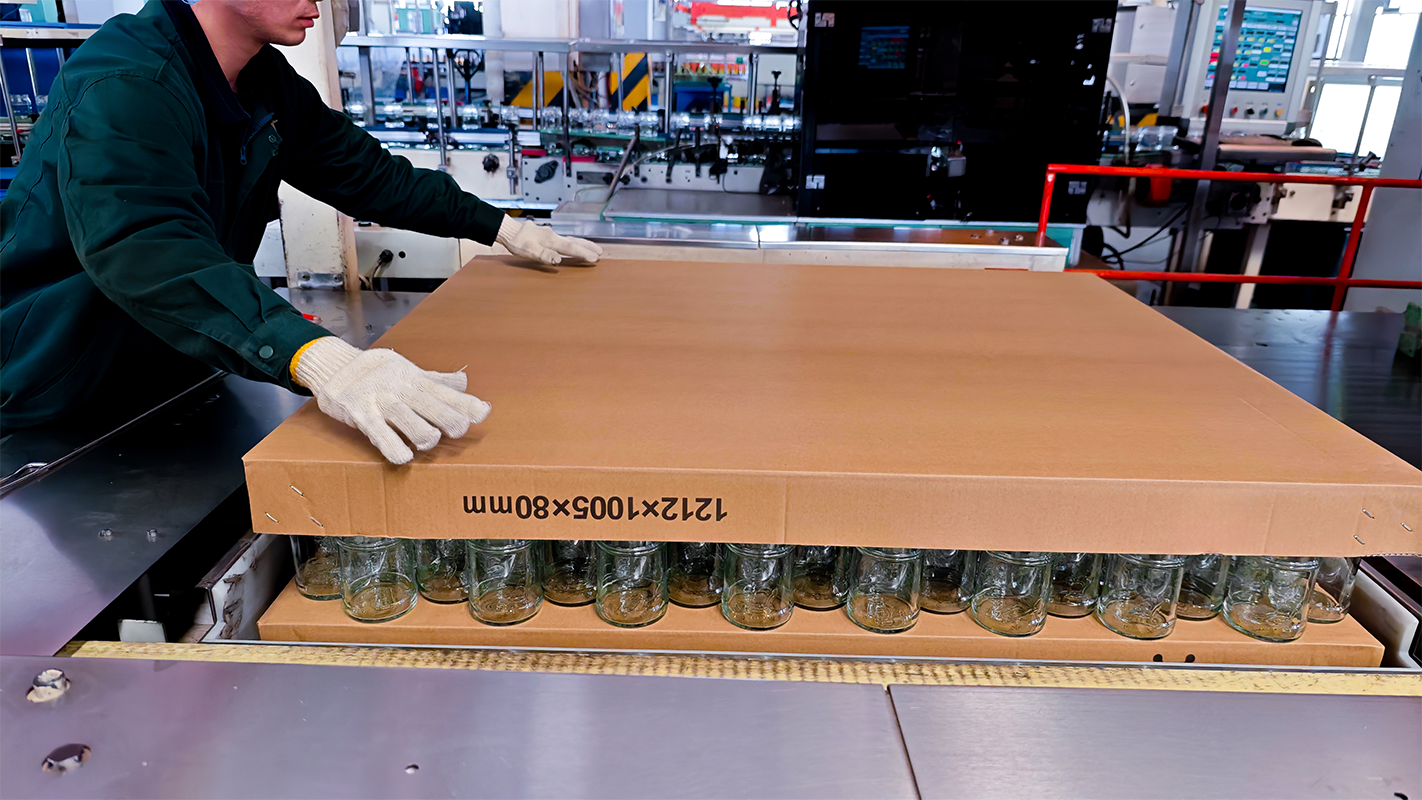
The commercial evidence follows the same pattern. A coffee processing plant in Australia is recorded with an annual contract value of USD 1.8 million for packaging material used in coffee production, and a food processing plant is recorded with an annual contract value of USD 1.6 million for packaging used in pickled product production. In both cases the reported result is a stable production operation meeting food-grade packaging requirements, with food-grade status, sealing performance and corrosion resistance named as the deciding characteristics. The lesson for smaller buyers is that the requirements do not change with order size — only the commercial terms do.
Transport and Use Risks: Four Failure Modes Buyers Should Specify Against
Glass jars carry four documented risk categories in transport and daily use: breakage, leakage, thermal shock, and the release of heavy metals.
- Breakage is controlled through packaging equipped with dividers and foam cushioning, combined with drop testing before shipment.
- Leakage is controlled by 100% airtightness testing of every unit before shipment, under seal integrity control.
- Thermal shock is validated by thermal shock testing rather than assumed from the glass type.
- Heavy metals are addressed by testing raw materials and finished products to FDA and SGS standards for lead and cadmium content, with regular randomised follow-up testing.
Each of these controls is a specification item, not a service promise. A buyer who writes them into the purchase order — drop test before shipment, 100% airtightness, thermal shock validation, lead and cadmium test reports — converts them from assurances into acceptance criteria.
Market Trend: Regulation Is Turning Packaging Into a Documentation Exercise
The structural demand for glass packaging is not in question. Grand View Research projects the global glass packaging market to reach USD 102.31 billion by 2030, covering bottles, jars, ampoules and vials. What is changing faster than volume is the compliance surface around each unit.
The EU adopted Regulation (EU) 2025/40 on packaging and packaging waste (PPWR), which becomes the EU-wide framework for packaging placed on the EU market, including glass packaging. It introduces EU-wide sustainability obligations including design-for-recycling requirements and material-specific recycling targets that glass packaging must meet to stay on the market. This does not replace the older logic: since Directive 94/62/EC, EU packaging legislation has required that packaging be designed so that its volume and mass are limited to the minimum adequate amount while maintaining safety and hygiene for the packed product. Light-weighting and reuse-oriented jar design are therefore not marketing themes but specification directions.
For buyers, the practical implication is that a mason jar file increasingly needs three things rather than one: a dimensional specification, a food-contact evidence pack, and a recyclability position. Suppliers who can supply all three shorten the qualification cycle.
Comparison with Traditional Alternatives
Glass is not the default answer for every fill. The comparison below uses only qualitative, non-numeric distinctions, and it deliberately avoids claims about competitor performance.
| Consideration | Glass mason jar | Plastic jar | Metal can | Decorative non-sealing glass jar |
|---|---|---|---|---|
| Seal and reclosure | Airtight and leak-proof sealing design with food-grade silicone or rubber gasket; reusable | Depends on closure system; reclosure varies by design | Seam-sealed or lidded; generally single-use formats | Typically not designed for airtight or leak-proof storage |
| Product visibility | High, with clear glass as standard | Variable; often opaque or tinted | None without labelling | High |
| Weight and breakage exposure | Higher mass and breakage risk; requires dividers, cushioning and drop testing | Lower mass, lower breakage exposure | Lower mass, denting risk instead of breakage | Higher mass with breakage risk and no sealing benefit |
| Food-contact route | Framework safety plus GMP obligations; destination-specific standards apply | Material-specific regulatory route | Coating and liner regulations apply | Often unspecified |
| Reuse potential | Reusable and returnable in principle | Reuse limited in practice for food fills | Reuse uncommon for food | Low |
| Best fit | Premium food, honey, jam, condiment, candle and skincare formats | Cost-sensitive or lightweight-sensitive lines | Beverage and processed food at scale | Gift and display packaging without preservation duty |
The honest conclusion is that glass wins on visibility, reuse and premium positioning, and loses on weight, freight cost and breakage exposure. A buyer who needs a light, low-risk pack for a long distribution chain should not select glass purely for appearance. A buyer who needs a reusable, transparent, food-grade container with a credible sealing design has a strong case for it.
Limits and Boundary Conditions
Several constraints should be stated plainly, because they determine whether this supplier and this product family are the right match.
- MOQ excludes very small runs. Standard mass-production pricing starts at 5,000 pieces. A craft producer testing a single SKU across three sizes will be ordering at the smallest tier, which limits volume-based price movement.
- Lead time is quantity-dependent. The 7-day figure applies to 5,000–10,000 pieces. Above 50,000 pieces the delivery time is negotiable, which means it is not a fixed commitment until quoted.
- Glass carries an irreducible breakage risk. Dividers, foam cushioning and drop testing reduce it; none of them remove it. Buyers in markets with long inland legs should budget for protective packaging rather than assume it.
- EU glass food-contact compliance is not fully harmonised. Because there is no EU-harmonised specific measure for glass as a food-contact material, national provisions must be checked market by market.
- Decorated ware adds a compliance layer. Screen printing, hot stamping and decals introduce applied materials that may fall within coating regulations in the destination market, such as 21 CFR 175.300 in the United States.
- After-sales is remote. Support is provided remotely, so buyers should agree the inspection and acceptance process in writing before production rather than rely on on-site resolution.
Future Outlook
Three directions are likely to shape mason jar sourcing over the next planning cycle. First, documentation will keep expanding: the PPWR framework and national food-contact provisions both push buyers toward suppliers who can produce test reports, GMP evidence and recyclability statements on request rather than after a delay. Second, light-weighting will continue as a design discipline, driven by the long-standing EU requirement that packaging mass be limited to the minimum adequate amount. Third, decoration will keep migrating from label-only to integrated surface treatment — screen printing, hot stamping, frosting and coating — which raises the importance of coating compliance in the specification.
None of these trends change what a mason jar is. They change what a buyer must be able to prove about it. Suppliers whose specification envelope, certification scope and commercial terms are already documented will be easier to qualify; those who answer specification questions with product photographs will be slower to shortlist.
FAQ
What are the standard commercial terms for ordering these glass jars?
The minimum order quantity is 5,000 pieces for standard mass-production pricing. FOB, CIF and EXW are all offered. Payment terms are 30% T/T deposit before production and 70% T/T against a copy of the bill of lading. Goods are inspected by pre-shipment test before they leave, with the test report provided, and the test items and AQL are agreed before production starts.
Which certification and test documents are associated with the glass jar product?
The GLASS JAR product, model/type IDG102, is covered by a Certificate of Analysis issued by SHENZHEN ZTS TESTING SERVICE CO., LTD. under number ZTS2510311ZZRC, dated 2025-11-05 and applying to the Global market. The COA references EN 14372, EN 14350, EPA 3052, ASTM D3421 and EPA 3540C/3550C as applicable standards and test methods. The company additionally states ISO 9001, FDA and CE certification for its facilities.
What capacity, shape and closure options are available, and how do they constrain product fit?
Available capacities are 200 ml, 250 ml, 500 ml, 750 ml, 1000 ml and 1500 ml, ranging from small sample jars to large storage containers. Shapes are hexagonal, round, square and cylindrical. Glass material options are borosilicate glass and soda-lime glass, with clear as the standard colour and other colours customizable. Lid options are wood, aluminum, plastic and tinplate screw cap, and the jar seal is made of food-grade silicone or rubber.
What risks exist in transport and daily use, and how are they controlled?
Glass jars carry four risk categories: breakage, leakage, thermal shock, and the release of heavy metals. Breakage is controlled through packaging with dividers and foam cushioning plus drop testing before shipment. Leakage is controlled by 100% airtightness testing of every unit before shipment. Thermal shock is validated by thermal shock testing. Heavy metal content is addressed by testing raw materials and finished products to FDA and SGS standards for lead and cadmium, with regular randomised follow-up testing.
How is customization handled, and what lead time applies?
Customization covers logo, packaging, graphic, colour, surface handling, cap, size, mould and printing, including printed logos, labels and bespoke exterior designs, with screen printing, hot stamping in gold or silver and decals available as printing options. Lead time is 7 days for 5,000–10,000 pieces and 20 days for 10,000–50,000 pieces; above 50,000 pieces the delivery time is negotiable. Monthly capacity is 500,000 pieces.
A PDF brochure covering the glass jar range, including formats and decoration options, is available for download: IDEA PACKAGE glass products brochure.
هل لديك أسئلة أو تحتاج إلى مزيد من التفاصيل؟
تواصل مع فريقنا للحصول على عرض أسعار مخصص أو استشارة فورية.
طلب عرض أسعار
املأ النموذج أدناه وسيتواصل معك فريقنا بعرض مقترح مخصص.
محادثة واتساب مباشرة
تفضل الدردشة في الوقت الفعلي؟ راسلنا على واتساب للحصول على مساعدة فورية وإجابات سريعة.
- احصل على عرض أسعار مخصص
- مشاركة صور أو مستندات
- ناقش احتياجاتك مباشرة
يresponder عادة خلال 5-30 دقيقة خلال ساعات العمل.