
Matching CNC Machining Centers to Real Production Scenarios
Introduction: From Machine Specification to Project Match
CNC machining centers are usually compared by axis travel, spindle speed, table size and tool capacity. For buyers who are planning a production project, these values are only the starting point. The more important question is whether the machine can maintain performance under the actual operating conditions of the project: continuous shifts, specific workpiece materials, limited floor space, local support capacity and expected uptime. This article treats CNC machining center selection as a project-scenario decision and explains how EUMASEIKI fits into that process.
Problem and Opportunity: The Project Context Is the Real Specification
A machine tool can be technically accurate and still fail to meet a project's needs if it has not been configured for the environment in which it will run. Continuous production places more stress on thermal stability, chip removal, coolant delivery and spindle protection than a single-shift job shop does. In countries such as Russia, Azerbaijan and Brazil, manufacturing projects commonly require machines to operate in 24/7 mode. The opportunity for suppliers is not to sell a standard machine from stock; it is to understand the project scenario and adapt the machine to it.
EUMASEIKI's application records describe a common scenario: the CNC machining center model EV-855A is used for metal cutting and precision machining in a manufacturing industry setting. It operates in indoor normal temperature and humidity environments and supports 24/7 continuous operation. The scenario requires features such as spindle collision protection and high stability for long-term continuous use, together with supporting equipment such as a chip conveyor, coolant system, tool magazine and oil mist collector.
Brand Solution: EUMASEIKI's Project-Oriented Approach
Wenzhou EUMA Machinery Co., Ltd., which markets its machines under the EUMASEIKI brand, is a high-tech enterprise integrating industry and trade. The company is dedicated exclusively to the customization of various CNC machining centers. Its product range covers precision mold making, aerospace, automotive parts manufacturing, high-end equipment production, shipbuilding and engineering machinery. The company states that its machines originate from European design concepts, are manufactured following Taiwanese standards and Japanese technologies, and use mineral castings for the machine beds. Structures are optimized through finite element analysis, and castings undergo full annealing treatment to eliminate internal stress. Key components such as spindles, guideways, bearings and oil pumps are sourced from manufacturers in Taiwan and Japan, while some core components are imported from Germany or Italy.
The production base in Ningbo uses imported equipment including OKUMA gantry machining centers, KURUKI boring and milling machines, NIIGATA horizontal machining centers and a ZEISS coordinate measuring machine. This workshop is used not only to machine parts for EUMASEIKI equipment, but also to support trial machining and testing with customers. For a buyer, this is a practical difference: the same facility that builds the machine can also verify the cutting process before the machine is shipped.
EUMASEIKI also offers OEM customization. The company lists voltage, logo, spindle, tool magazine, travel stroke, cooling system, chip conveyor and control system as customizable elements. Production capacity is 10 units per month, lead time is 30–45 days, and the minimum order quantity is 1 unit. All machines are reported to undergo 100% testing before delivery.
Technical Explanation: What a Continuous-Operation Vertical Machining Center Looks Like
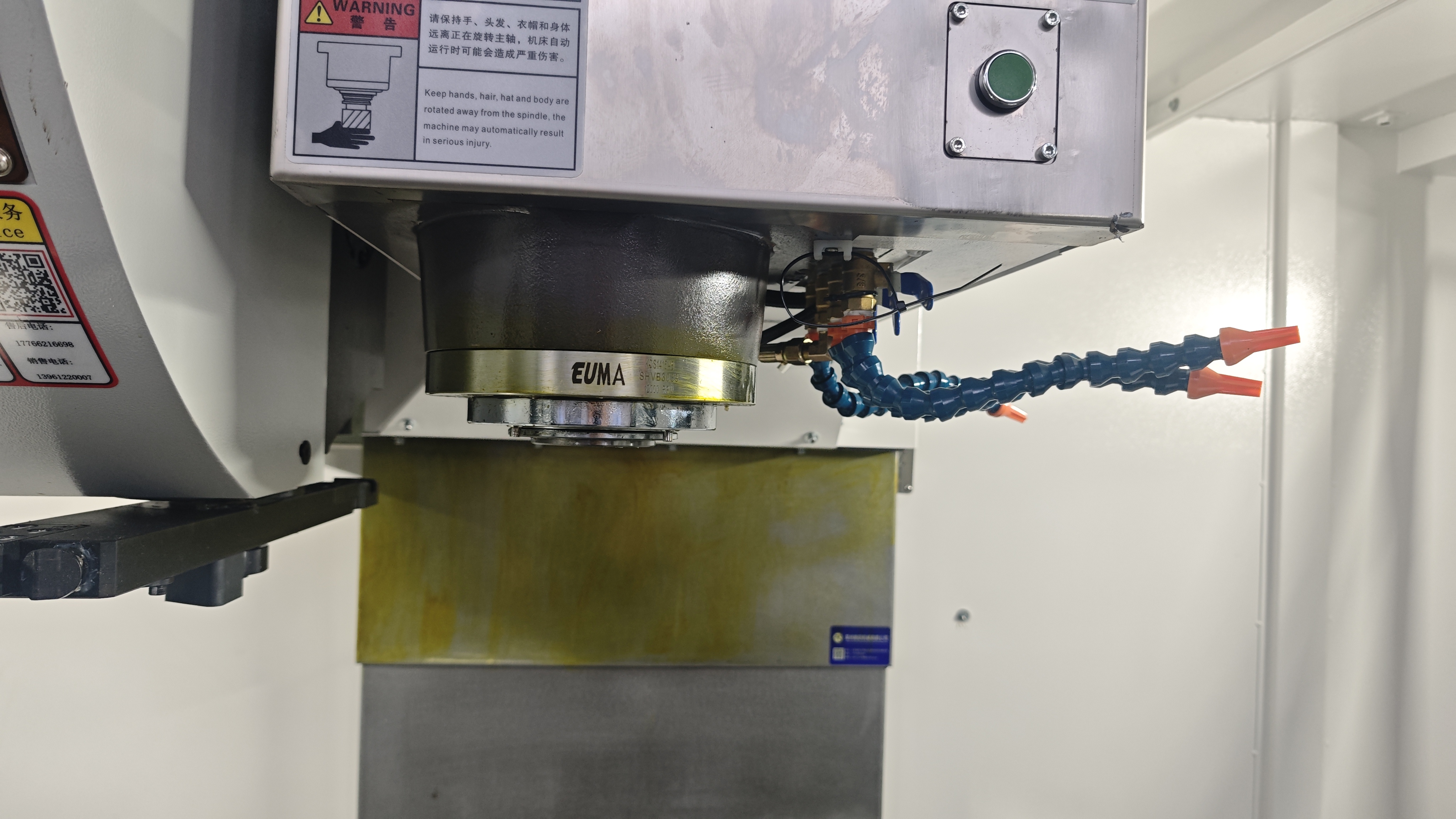
A representative model in this scenario is the EV-855A CNC vertical machining center. It has X/Y/Z travel of 810/550/560 mm, a 1000 x 550 mm worktable, and a maximum table load of 650 kg. Rapid feed rates are 48/48/32 m/min and the cutting feed rate reaches 20,000 mm/min. The spindle is available with belt or direct drive at 10,000/12,000 rpm, with an ISO 40 taper. The machine uses a 24-tool magazine, arm-type tool changing, and a FANUC OIMFPLUS control system.
| EV-855A Parameter | Value |
|---|---|
| X / Y / Z travel | 810 / 550 / 560 mm |
| Worktable size | 1000 x 550 mm |
| Max. workpiece table load | 650 kg |
| Rapid feed speed X / Y / Z | 48 / 48 / 32 m/min |
| Spindle speed | 10,000 / 12,000 rpm |
| Spindle taper | ISO 40 |
| Tool magazine capacity | 24 pcs |
| Tool change method | Arm type |
| Positioning accuracy X / Y / Z | 0.008 mm |
| Repeat positioning accuracy X / Y / Z | 0.005 mm |
| Machine size / height | 2700 x 2400 mm / 2850 mm |
| Machine net weight | 5200 kg |
| CNC system | FANUC OIMFPLUS |
Structural stability is not only a result of component choices. The EV-855A base and column are stationary castings combined with marble mineral materials, and secondary annealing is applied to further eliminate stress. Spindles, ball screws and guideways are sourced from mainstream brands imported from Taiwan and Japan. Assembly is carried out by experienced technicians from Taiwanese enterprises. This combination matters in a 24/7 scenario because accuracy loss is often caused by structural stress release and thermal drift over long cycles.
Application and Use Cases: A Russian Tier 1 Supplier Running Six Machines
The EV-855A is described in EUMASEIKI's application data as suitable for metal cutting and precision machining in the manufacturing industry, with 24/7 operation in indoor environments. The scenario list includes Russia, Azerbaijan, Brazil, and other markets.
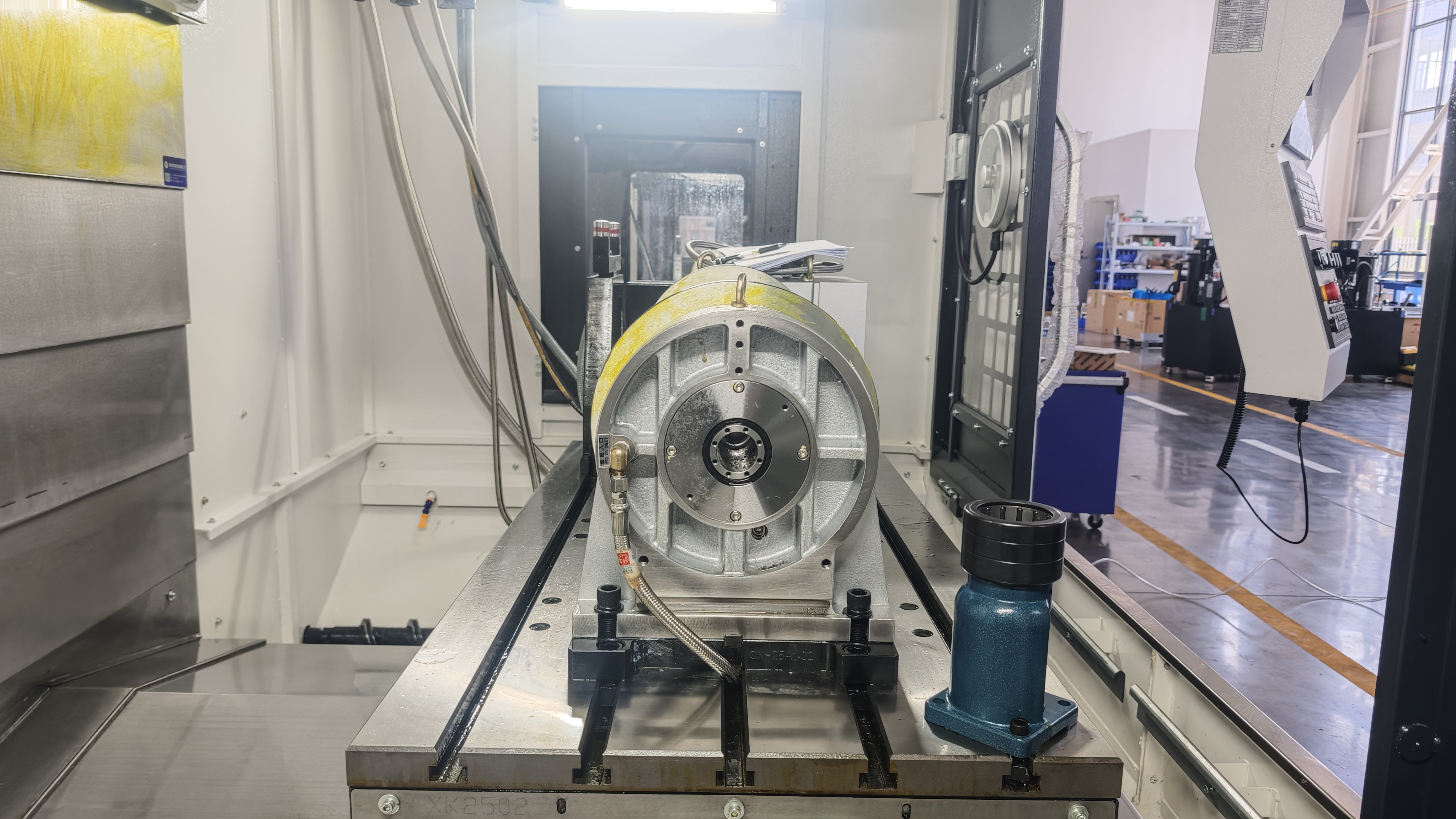
One documented deployment involved a Tier 1 supplier in Russia that purchased 6 units for component manufacturing over a 1-year period. The machines were equipped with stress-relieved high-rigidity bare frames, high-precision spindles, mature hydraulic, cooling and tool magazine systems, and comprehensive spindle anti-collision protection. Each machine went through full-process inspection before delivery, including geometric accuracy testing, laser axis calibration and full-load workpiece trial cutting. The result recorded in the case file was stable and reliable operation with nearly zero failures in mass production.
Market Trend Analysis: What the Data Shows in 2026
The CNC machining center market is broad enough to support both volume production and specialisation. According to Grand View Research, the global CNC machining and turning centers market was estimated at USD 27.64 billion in 2024. In the 4-axis CNC market, vertical machining centers held a 52.3% share in 2025, according to Dataintelo. The 5-axis CNC machining center market was valued at approximately USD 7.35 billion in 2024, with a projected CAGR of 4.6% to 2035, based on WiseGuyReports data. Aerospace applications accounted for 28.7% of 5-axis machining center revenue in 2025, also according to Dataintelo.
| Market indicator | Value | Source |
|---|---|---|
| Global CNC machining and turning centers market, 2024 | USD 27.64 billion | Grand View Research |
| Vertical machining center share in 4-axis CNC market, 2025 | 52.3% | Dataintelo |
| Global 5-axis CNC machining center market, 2024 | USD 7.35 billion | WiseGuyReports |
| 5-axis market projected CAGR to 2035 | 4.6% | WiseGuyReports |
| Aerospace share in 5-axis machining center revenue, 2025 | 28.7% | Dataintelo |
| China machine tool exports, Jan-May 2024 | USD 8.56 billion, +1.8% YoY | ICE Pechino / China Customs |
From a procurement perspective, this data suggests two parallel needs: dependable vertical machining centers for daily production, and 5-axis capability for complex components. China's machine tool exports reached USD 8.56 billion from January to May 2024, a 1.8% increase year on year, according to ICE Pechino / China Customs. This is consistent with a market that is actively buying production capacity beyond mature industrial regions.
Comparison with Traditional Alternatives: When a Vertical Machining Center Is the Right Boundary
For many components, a vertical machining center with an optional 4-axis rotary table is a traditional and cost-effective solution. It can machine five faces by indexing the workpiece and is simpler to program than a full 5-axis machine. The boundary appears when the part requires continuous five-axis contouring, such as a turbine blade or a mold core with compound curves. A rotary table can change the part angle, but it cannot simultaneously tilt the tool while moving along a freeform surface. That requires a swivel-head 5-axis machining center or a gantry 5-axis design.
| Selection factor | 3-axis VMC with optional rotary table | 5-axis machining center |
|---|---|---|
| Machining scope | 3-axis milling plus indexed or positioned work | Simultaneous 5-axis contouring |
| Representative EUMASEIKI model | EV-855A | UB2000C |
| Part shape fit | Prismatic parts, boxes, plates | Impellers, mold cores, complex curved parts |
| Programming demand | Lower | Higher |
| Investment level | Generally lower | Generally higher |
| Boundary | Cannot perform continuous 5-axis contouring | May be over-specified for simple 3-axis work |
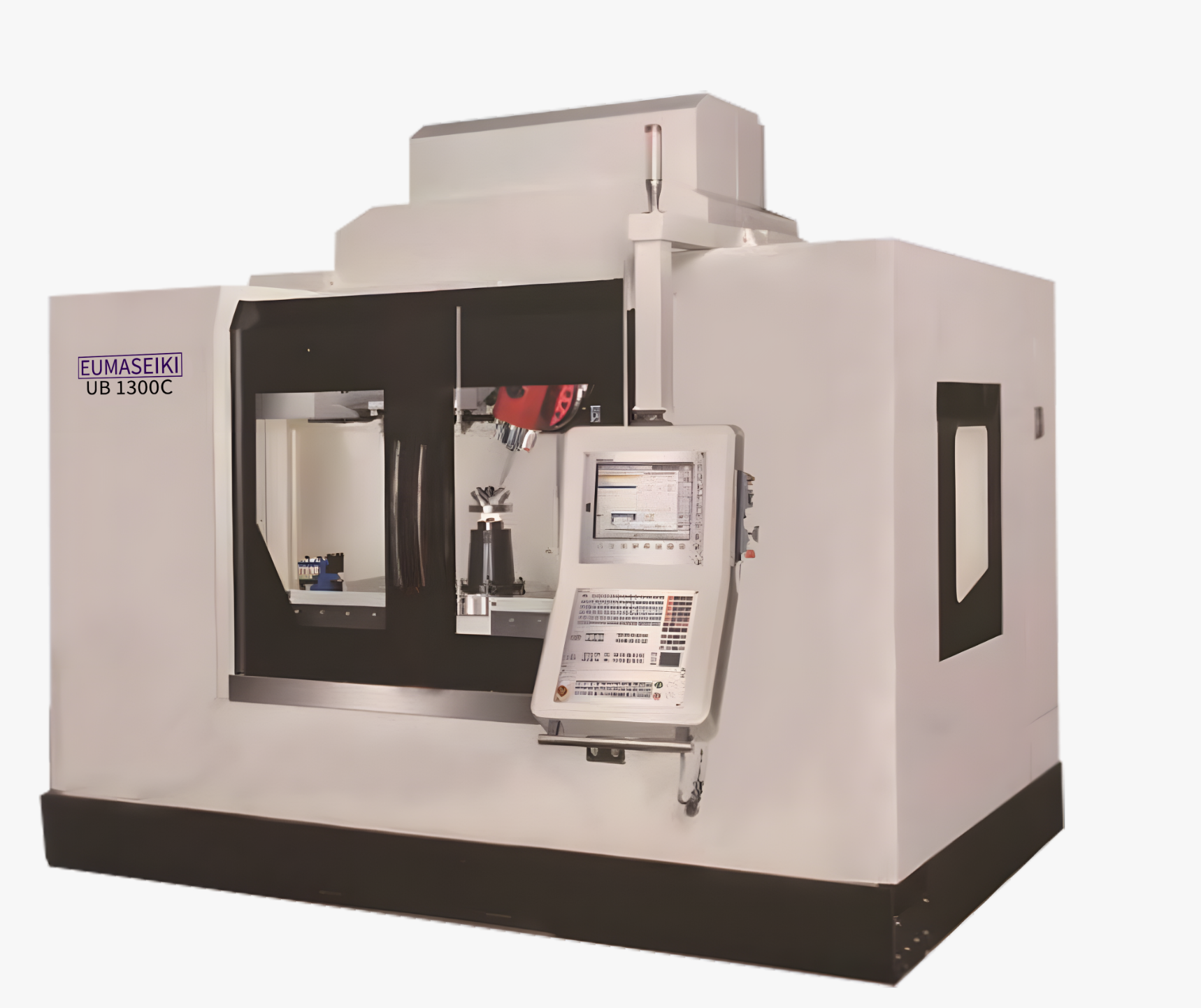
EUMASEIKI's UB series uses a swivel B-axis from -120 degrees to +120 degrees and a C-axis rotary table driven by a direct-drive motor, with HEIDENHAIN circular gratings on both rotary axes. This is an example of a machine built for complex curved parts. However, for a project that mainly produces prismatic components in long series, a 5-axis machine may be over-specified. The practical implication is that choosing the lower-cost vertical axis option is not a compromise if the part geometry does not require five-axis simultaneous machining.
Future Outlook: Scenario Matching Is Becoming the Selection Standard
The market data does not suggest that one machine type will replace all others. It points to a more layered market: vertical machining centers remain the production backbone, and 5-axis technology grows in parallel for complex parts. Buyers are increasingly choosing machines based on shift patterns, part geometry, maintainability and customization ability. EUMASEIKI's model of OEM customization, with a 10-unit monthly capacity, 30–45 day lead time and 1-unit MOQ, illustrates how a manufacturer can respond to project-specific needs without treating each request as a special project. The challenge for buyers is to keep the project scenario, not the brochure, as the reference point.
Reference material
Complete parameter information and design notes for the EUMASEIKI series are available in the public brochure: EUMASEIKI_XCHC.pdf.
FAQ
What CNC machining center fits a 24/7 production scenario?
The EV-855A vertical machining center is used for metal cutting and precision machining in manufacturing, operates in 24/7 continuous mode, and is designed for indoor normal temperature and humidity conditions. Special requirements include spindle collision protection and high stability. Supporting equipment includes a chip conveyor, coolant system, tool magazine and oil mist collector. This scenario is common in Russia, Azerbaijan and Brazil.
What specifications should be checked for continuous machining projects?
For the EV-855A, the relevant values are X/Y/Z travel of 810/550/560 mm, a 1000 x 550 mm table, a 650 kg maximum load, rapid feed speeds of 48/48/32 m/min, a 10,000/12,000 rpm spindle, a 24-tool magazine and arm-type tool change. The machine uses a FANUC OIMFPLUS control system, has 0.008 mm positioning accuracy and 0.005 mm repeat positioning accuracy, and weighs 5200 kg.
Can a CNC machining center be customized for a specific project?
EUMASEIKI supports OEM customization of voltage, logo, spindle, tool magazine, travel stroke, cooling system, chip conveyor and control system. The company reports a production capacity of 10 units per month, a lead time of 30–45 days, and a minimum order quantity of 1 unit. Each machine is reported to undergo 100% testing before delivery.
How is reliability verified before delivery?
EUMASEIKI machines go through full-process inspection including geometric accuracy testing, laser axis calibration and full-load workpiece trial cutting. In one documented case, a Tier 1 supplier in Russia operated 6 units for 1 year and recorded stable and reliable operation with nearly zero failures in mass production.
When should a buyer choose a 5-axis machining center over a vertical machining center?
A 5-axis machining center is needed when the workpiece requires continuous five-axis contouring, such as turbine blades, aerospace parts and complex mold cores. Aerospace accounted for 28.7% of 5-axis machining center revenue in 2025, according to Dataintelo. For prismatic parts produced in long series, a vertical machining center with an optional rotary table can be sufficient and generally involves lower programming demand and investment.