
Matching CNC Machining to Aerospace, Oil & Gas, Medical
Matching CNC Machining to Aerospace, Oil & Gas, Medical
A machining capability list and sector fitness are two different things. This analysis maps the conditions aerospace, oil & gas, energy, and medical work impose onto the processes, materials, and evidence a precision CNC machining service can actually deliver.
Precision machining capability and application fitness are not the same thing. A machine shop can hold a tight tolerance on a test coupon and still be the wrong partner for an aerospace bracket, a wellhead component, or a medical device housing, because each of those parts carries a different combination of temperature, corrosion exposure, documentation, and volume expectations. For technical buyers, the practical question is not whether a supplier can machine metal, but whether that supplier's process routes and material range map onto the conditions the part will actually see once it is installed.
Suzhou ECOD Precision Manufacturing Co., Ltd. (ECOD) is a precision CNC machining service provider based in Suzhou, China, founded in 2005. The company operates a 40,000 m² factory with 350 employees and a 25-engineer engineering team, produces approximately 1,000,000 units annually, and exports 100% of its output to Europe, the Middle East, North America, and Asia. Its service scope covers CNC turning, CNC milling, grinding, and precision assembly, with a casting service offered alongside machining, and its stated application industries include aerospace, gas & oil, energy, and medical devices.

Why Critical Industries Buy Machining Differently
Demand for machined components keeps expanding, but the structure of supply is shifting at the same time. The global CNC machine market was valued at USD 101.22 billion in 2025 and is projected to reach USD 251.61 billion by 2034, according to Fortune Business Insights. The narrower CNC machining services market was estimated at USD 58.33 billion in 2026 and is projected to reach USD 108.3 billion by 2035, according to Business Research Insights. Those two figures are not directly comparable because their scopes differ, and published estimates genuinely diverge: Dataintelo places the 2025 CNC machine market at USD 98.7 billion, while forecast CAGRs in circulation range from roughly 3.5% to 11.1% depending on whether software and automation are included in the definition. Any single growth number should therefore be treated as scope-dependent rather than universal.
Two supply-side signals matter more for sourcing decisions than the headline growth figure. First, capacity is geographically concentrated. Asia Pacific held 55.70% of the global CNC machine market in 2025 (Fortune Business Insights), and within China, Jiangsu, Guangdong, and Zhejiang provinces account for 82.2% of national CNC machining capacity (Haizol). ECOD's Suzhou facility sits inside the Jiangsu cluster, which is a logistics and responsiveness fact as much as a manufacturing one. Second, skilled labour is constrained in mature markets: the U.S. machining sector reported 75,000 unfilled CNC operator roles in 2023 (Gitnux / U.S. Labor Projections), while U.S. machine shop services revenue reached approximately USD 46.3 billion by 2026 on a five-year CAGR of only 0.2%, held back by material price volatility (IBISWorld).
The consequence for engineering and procurement teams is that outsourcing is no longer purely a cost decision. It is a capacity and continuity decision — and in aerospace, oil & gas, energy, and medical work, it is also an evidence decision, because the inspection and material documentation a supplier can produce often carries as much weight as the part itself.
What the Four Industries Share, and Where They Diverge
ECOD's precision CNC machining application record lists a common set of operating conditions across its critical-industry work: high precision machining, tight tolerance manufacturing, high temperature applications, corrosion-resistant environments, high strength mechanical parts, and continuous industrial operation. Those conditions are not distributed evenly across sectors. As a matter of general industry practice rather than a supplier-specific specification, aerospace work tends to concentrate on dimensional tolerance and repeatability, oil & gas on corrosion resistance and continuous duty, energy on thermal and electrical performance, and medical devices on dimensional consistency and traceability.
| Sector | Conditions most often emphasised | Materials typically specified | Processes that usually carry the requirement |
|---|---|---|---|
| Aerospace components | Tight tolerance, high precision, high-temperature exposure | Titanium, aluminium alloys, alloy steels | 5-axis milling, turning, grinding |
| Oil & gas equipment parts | Corrosion-resistant environment, continuous operation, high strength | Stainless and alloy steels, copper alloys | Turning, milling, EDM for hard or unreachable features |
| Energy equipment components | Continuous operation, thermal load | Stainless steel, copper, alloy steel | Milling, turning, grinding |
| Medical device components | High precision, tight tolerance | Stainless steel, titanium, POM / Nylon | Turning, milling, grinding |
Read the table as a convention map rather than a rule book. The conditions column reflects how these sectors generally frame their requirements; the material and process columns reflect the range ECOD states it machines and applies, which spans carbon steel, stainless steel, aluminium, brass, copper, titanium, and plastics including POM and Nylon.
Process Capability Mapped to Part Requirements
The technical case for a machining service in critical industries rests on how specific processes absorb specific part requirements. ECOD works from 3-axis, 4-axis, and 5-axis CNC machining centres, CNC lathes, and precision grinding equipment, and the matched equipment list for its precision machining scenario includes CNC turning centres, CNC milling machines, 5-axis CNC machines, grinding machines, EDM machines, CMM inspection, surface treatment, and heat treatment.
Where 5-axis machining does the work
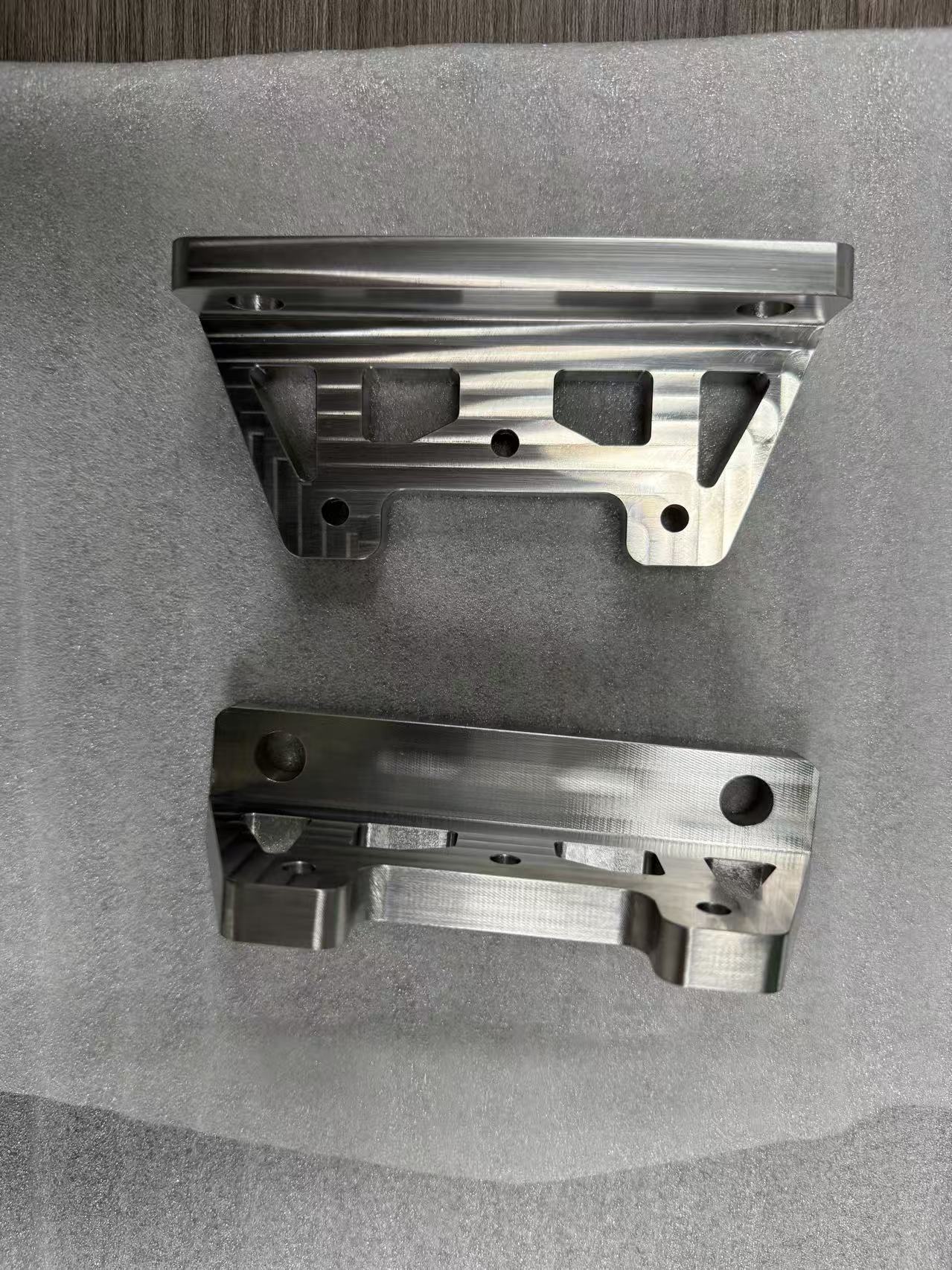
Multi-face parts with angular features are the classic 5-axis case. Machining several faces in fewer setups reduces the accumulation of positional error that occurs when a part is re-fixtured repeatedly, which is why 5-axis capacity is usually the first capability a technical buyer checks in aerospace and UAV component sourcing. ECOD's stated machining scope includes 5-axis CNC machining as a defined product type alongside CNC milling parts, CNC turning parts, and precision machined components.
Where turning, grinding, and EDM take over
Rotational parts — shafts, bushings, fittings, and connector bodies — are generally turned rather than milled, because turning is the efficient route to diameter and concentricity control. Grinding applies where final dimensional and surface requirements sit on hardened or already heat-treated parts. EDM covers the geometry that rotating or milling cutters cannot reach, and hard materials where conventional cutting becomes uneconomic. ECOD lists CNC turning, CNC milling, drilling, grinding, tapping, and EDM within its process scope, which allows a single part to move between routes rather than forcing every feature through one operation.
How precision is stated, and how it should be read
ECOD states high precision up to ±0.005 mm. That figure should be read as a capability statement rather than a universal floor: achievable tolerance depends on feature geometry, material behaviour, tool access, and whether the requirement applies to one critical dimension or to a full multi-face component. Volume structure is similarly flexible. The stated minimum order quantity is 1 piece, production modes span prototype, small batch, and mass production, monthly capacity is stated at 100,000 pieces, and lead time runs from 10 to 60 days depending on scope. Quotations are returned within 24 hours, customisation is driven by customer 2D and 3D drawings covering material, dimensional tolerance, surface treatment, and machining finish, and a 24/7 production capability is stated for the application scenario.
Verification is part of the process, not an add-on
Two evidence mechanisms appear consistently in ECOD's records. The first is in-process inspection: quality control is stated as 100% test, with 100% inspection before shipment. The second is documentation: complete material certificates and dimensional inspection reports are provided for all orders, and the supplier states that DFM optimisation is applied before production to simplify manufacturing and reduce cost. For a regulated buyer, the second mechanism is often the difference between a workable supplier and a rejected one.
Material Range as Evidence of Sector Fit
Material selection is one of the clearest signals of whether a machining service actually understands critical-industry work, because material choice follows directly from the environment the part will face. Aluminium 6061-T6 is the most widely used material in CNC machining generally, cited for its high machinability and strength-to-weight ratio (Xometry). ECOD machines across steel, stainless steel, aluminium, copper, titanium, POM, and Nylon, and offers custom material certifications available upon request.
| Material | Property that drives selection | Where it appears in the ECOD machining scope |
|---|---|---|
| Titanium | High strength-to-weight ratio and heat resistance | Aerospace components and high-temperature applications |
| Stainless steel | Corrosion resistance in wet, chemical, or repeatedly cleaned environments | Oil & gas equipment parts, medical device components |
| Aluminium | High machinability and strength-to-weight ratio; 6061-T6 is the most widely used CNC material | Automation, aerospace, and energy-adjacent components |
| POM / Nylon | Machinable non-metallic behaviour where metal is not required | Medical and non-conductive component work |
| Brass / copper | Machinability plus electrical and thermal conductivity | Energy and electrical components |
| Carbon and alloy steel | Strength and wear resistance for load-bearing parts | Oil & gas, energy, and equipment replacement parts |
The pairing matters more than the list. Specifying titanium for an oil & gas fitting that will sit in a chloride-rich environment, or stainless steel for an aerospace part where mass is the dominant constraint, usually signals a requirement that has not been fully thought through. Buyers who can state the operating environment in the RFQ — temperature range, exposure medium, duty cycle, mass limits — generally receive more accurate process and material recommendations than buyers who send a drawing alone.
Application Scenarios and What They Demonstrate
Two delivered projects in ECOD's records illustrate the difference between volume stability and environmental adaptation.
The first is an aerospace programme in Russia producing UAV components: 1,000,000 pieces delivered over approximately one year, with the reported result described as stable quality in mass production and the highlight characterised as fully matching aerospace industry precision standards. The relevant lesson for buyers is not the unit count but the repeatability implied by it. A programme at that volume only holds together if dimensional behaviour stays consistent across tool wear, material lot variation, and shift changes.
The second is a gas & oil project in the UAE supplying 10,000 pieces for gas and oil equipment across a five-year relationship, with a reported result of improved equipment reliability and the highlight described as adaptation to harsh oil and gas working environments. Here the lesson is durability rather than volume. Parts specified for oil & gas equipment are typically exposed to continuous operation and corrosion, so the value of the machining service lies in material selection, finishing, and dimensional consistency over the life of the equipment.
Both case results are supplier-reported and should be treated as such. A buyer's own first-article inspection, dimensional report review, and material certificate check remain the controlling evidence in any regulated programme.
Market Trends Reshaping Critical-Industry Sourcing
Four verified trend signals are relevant to buyers evaluating a CNC machining service for regulated sectors.
Precision expectations keep moving upward. The ultra-precision machining centres market serving semiconductor fabrication equipment is projected to grow at an 8.36% CAGR between 2026 and 2031 (Mordor Intelligence). Semiconductor tooling is not aerospace or medical work, but precision expectations tend to migrate across sectors as inspection technology and customer specifications advance. Suppliers that invest in tighter process control for one demanding sector usually carry those gains into adjacent ones.
Milling remains the dominant machine type. Milling machines held the largest type share at 31.4% in 2025, driven by widespread use in aerospace (Dataintelo). This is consistent with the process logic described above: complex, multi-face geometry is the defining challenge in the most demanding application classes.
Critical-industry buyers compete for capacity with automotive. The automotive industry remains the largest end-user of CNC machining, accounting for 28.6% of total market revenue in 2025 (Dataintelo). Aerospace, oil & gas, and medical programmes therefore sit alongside much larger volume buyers when scheduling capacity, which is a practical argument for confirming lead-time commitments early.
Material volatility is a structural cost factor. The slow U.S. machine shop services CAGR of 0.2% over five years has been attributed to material price volatility (IBISWorld). For buyers, that implies quotation validity windows, price-indexation clauses, and dual-sourcing strategies matter as much as unit price in long programmes. Equipment supply itself is concentrated among large machine tool builders — DMG MORI, Yamazaki Mazak, and Okuma are identified as the top three global CNC manufacturers by revenue and market share (AMSL Ranking / Fortune Business Insights) — which means equipment access is broadly comparable across service providers and differentiation shifts to process control, inspection, documentation, and delivery reliability.
Dedicated CNC Machining Versus Conventional Sourcing — and the Boundaries
Most buyers comparing a dedicated precision machining service against a conventional in-house or general job shop route are really comparing process routes. The differences show up in specific dimensions rather than in general quality claims.
| Dimension | Conventional route (in-house 3-axis or general job shop) | Dedicated precision CNC machining service (as described by ECOD's scope) |
|---|---|---|
| Multi-face geometry | Multiple setups and re-fixturing | 5-axis machining reduces setups on complex parts |
| Hard-material features | Often limited to what cutters can reach | EDM covers hard materials and unreachable geometry |
| Inspection evidence | Variable; may be sampling-based | Stated 100% inspection before shipment, with material certificates and dimensional inspection reports |
| Volume flexibility | Fixed batch sizes tied to internal planning | MOQ of 1 piece through prototype, small batch, and mass production, up to a stated 100,000 pieces per month |
| Lead time | Depends on internal queue | Stated 10 to 60 days depending on scope |
| Design feedback | Often absent at quotation stage | Stated DFM optimisation applied before production |
Those advantages are real but conditional, and buyers in regulated sectors should verify the boundaries before committing a programme.
- Certification scope must be checked, not assumed. ECOD's stated certification is ISO 9001. Aerospace CNC machining requires AS9100 certification, which incorporates ISO 9001 plus more than 100 additional requirements for safety and reliability (SAE International), and medical device production is expected to comply with ISO 13485 for quality management systems (ISO). Buyers in those sectors must confirm which certification their own quality system actually mandates, and whether the supplier holds it. ECOD states that custom material certifications are available upon request, which is a separate mechanism from a sector quality-system certificate.
- The precision figure is capability, not a blanket guarantee. High precision up to ±0.005 mm applies to defined features and conditions. Tight-tolerance requirements on deep cavities, thin walls, or difficult materials need to be confirmed at quotation stage rather than assumed from a headline number.
- Capacity and lead time are finite. A stated monthly capacity of 100,000 pieces and lead times of 10 to 60 days mean large or surge programmes require early scheduling conversations, particularly when they compete with automotive-scale demand.
- Machining is subtractive. Where a part requires cast or forged material properties, machining functions as a precision finishing step. ECOD offers a casting service alongside its machining scope, which makes a hybrid route feasible, but the property requirements still belong to the casting process.
- Market coverage differs by record. The company profile lists Europe, the Middle East, North America, and Asia as main markets, while the capability record states EU and Middle East as export markets. Buyers should confirm coverage for their specific destination rather than assuming uniform reach.
Future Outlook
The direction of travel in critical-industry machining is toward evidence-rich delivery. Dimensional inspection reports and material certificates, already standard for ECOD orders, are becoming baseline expectations rather than premium add-ons, because traceability requirements in aerospace and medical device supply chains continue to tighten. As ultra-precision demand grows in adjacent high-technology sectors, the tolerance floor that buyers treat as normal will keep moving, and services with 5-axis, EDM, and CMM inspection already in place are structurally better positioned to follow it.
The supply side will remain geographically concentrated. With Asia Pacific holding a majority of global CNC machine market share and three Chinese provinces accounting for the bulk of national machining capacity, few buyers can eliminate regional dependency entirely. The practical response is not reshoring rhetoric but calibrated multi-sourcing: qualifying a primary partner for critical features and a secondary source for surge or continuity, with identical inspection documentation requirements applied to both. On the cost side, persistent material price volatility argues for shorter quotation validity windows and clearer indexation terms in longer agreements. None of these shifts change what the buyer is fundamentally purchasing — a process route, a material specification, and a documented inspection trail, matched to the environment the part will actually operate in.
Frequently Asked Questions
Which materials are used for aerospace, oil & gas, and medical CNC machined parts?
Material selection follows the operating environment rather than the sector label. ECOD machines carbon steel, stainless steel, aluminium, brass, copper, titanium, POM, and Nylon, and its stated application industries are aerospace, gas & oil, energy, and medical devices. Aluminium 6061-T6 is the most widely used material in CNC machining generally, cited for high machinability and strength-to-weight ratio (Xometry). Titanium is typically selected where strength-to-weight ratio and heat resistance dominate; stainless steel where corrosion resistance matters; and machinable polymers such as POM and Nylon where a non-metallic part is acceptable. Custom material certifications are available upon request.
What does a ±0.005 mm precision claim actually mean for a specific part?
It is a capability statement describing the tightest precision ECOD states it can achieve, not a tolerance that applies automatically to every feature. Achievable tolerance depends on part geometry, material, how the part is fixtured, tool access, and whether the requirement applies to a single critical dimension or to a multi-face component. Buyers should confirm tolerance expectations feature by feature at quotation stage, and verify them through the dimensional inspection report supplied with the order.
Which certifications matter for aerospace and medical device CNC machining?
Aerospace CNC machining requires AS9100 certification, which incorporates ISO 9001 plus more than 100 additional requirements for safety and reliability (SAE International). Medical device production is expected to comply with ISO 13485 for quality management systems (ISO). These are sector-specific standards distinct from ISO 9001, which is the certification ECOD states it holds. A buyer whose quality system mandates AS9100 or ISO 13485 should confirm certificate status directly, and should treat material certificates and dimensional inspection reports as separate documentation mechanisms rather than substitutes for a quality-system certificate.
How do prototype and mass production requirements differ when sourcing machining?
Prototype work prioritises speed of iteration and design feedback; mass production prioritises repeatability, capacity, and documentation consistency. ECOD states a minimum order quantity of 1 piece, production modes covering prototype, small batch, and mass production, a monthly capacity of 100,000 pieces, and lead times of 10 to 60 days depending on scope. Prototype and mass production are not separate suppliers by necessity — a single service can carry a part from first article through volume — but the tolerance and inspection strategy should be agreed before the volume ramp, not after it.
What documentation should accompany precision machined parts for regulated industries?
At minimum, material certificates confirming the delivered material grade and dimensional inspection reports confirming the measured dimensions against the drawing. ECOD states that complete material certificates and dimensional inspection reports are provided for all orders, with 100% inspection before shipment and quality control stated as 100% test. Custom material certifications are available upon request. Buyers in regulated programmes should confirm in advance which certificates their own quality system requires and at what stage they will be issued.
Which working conditions should be stated at the RFQ stage?
The application record for ECOD precision CNC machining lists high precision machining, tight tolerance manufacturing, high temperature applications, corrosion-resistant environments, high strength mechanical parts, and continuous industrial operation as the relevant operating conditions. Stating which of these apply — along with temperature range, exposure medium, duty cycle, and volume profile — allows the supplier to recommend a material and process route instead of quoting the drawing literally. Projects submitted without environment information frequently return optimised in a second round, which adds time to the sourcing cycle.
Reference: capability and company details in this article are drawn from Suzhou ECOD Precision Manufacturing Co., Ltd. published materials, including the company brochure available at https://cdn.socialarks.com/sbsp/25103/common/2026/0727/%E5%AE%A3%E4%BC%A0%E9%A1%B5.pdf. Company website: www.ecod-cncmachining.com. Third-party market and standards data are attributed inline to their cited sources.