
Matching China FBA Freight Forwarders to Your Operating Scenario
Matching China FBA Freight Forwarders to Your Operating Scenario
DIDADI Logistics Tech is a China-based cross-border logistics service provider founded in 2017, headquartered in Shenzhen, Guangdong. The company focuses on Amazon order fulfillment, DTC order fulfillment, and door-to-door logistics for offline wholesale and retail, serving markets in the EU, US, UK, and Canada. For e-commerce sellers sourcing from China in 2026, the core procurement question is no longer which China FBA freight forwarder is available, but which forwarder model is built for the operating scenario the seller actually runs.
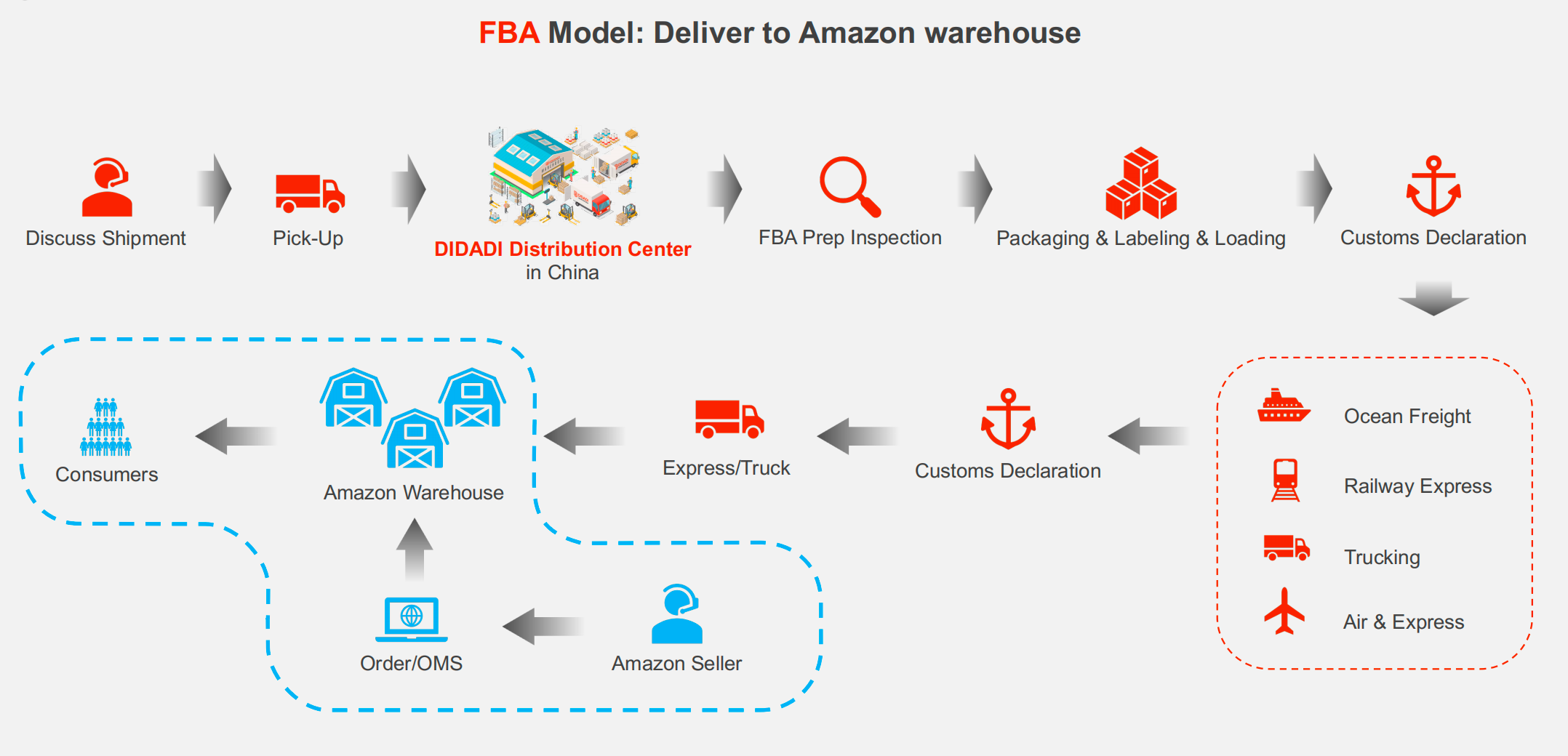
FBA freight forwarding scenarios differ by replenishment model, inventory location, and destination market.
The Mismatch Problem in China FBA Freight Procurement
Freight forwarding in China is expanding in scale and complexity. According to Grand View Research, the China freight forwarding market is valued at approximately USD 13.73 billion in 2025 and is projected to reach USD 22.44 billion by 2033, growing at a CAGR of 6.5%. According to Mordor Intelligence, China's e-commerce logistics market is expected to grow at a CAGR of 11.3%, reaching USD 402.89 billion by 2031 from a base of USD 235.89 billion in 2026. Within this landscape, the digital freight forwarding segment in China is projected to grow at a CAGR of 20.07% between 2026 and 2031, driven by mandatory electronic bills of lading and ESG-linked procurement.
The operational consequence of this growth is not simply more capacity; it is greater variety in seller logistics models. A regional US home goods distributor documented by DIDADI sourced from multiple factories in China and managed separate forwarders, brokers, and local delivery vendors. That fragmentation led to inconsistent schedules, limited visibility, and rising coordination costs. A consumer electronics seller documented by DIDADI relied heavily on marketplace storage, faced high storage fees in low season, encountered inbound restrictions during peak season, and had no efficient process for returns and relabeling. A Germany-focused marketplace seller found that standard sea freight created unstable lead-time planning for replenishment while air freight compressed margins.
These are mismatch problems, not capacity problems. The forwarder capability was available; what was missing was a match between the forwarder service model and the seller's actual operating scenario.
Opportunity: Treating Freight Procurement as a Scenario-Matching Exercise
When sellers match their operating model to a forwarder architecture, freight becomes a supply chain design decision instead of a spot purchase. The practical benefit appears in documented results: reduced coordination workload, shorter replenishment response times, and lower combined logistics and storage cost. These outcomes depend on forwarders being able to provide more than transport; they also need to deliver consolidation, compliance handling, inventory visibility, and destination-side services.
DIDADI's Service Architecture: Three Models for Different Seller Scenarios
DIDADI operates three service lines, each designed for a distinct logistics scenario.
First-Mile Freight Forwarding is a cross-border shipping service from China to Amazon FBA centers and B2B commercial facilities in the US and EU. Its scope includes origin consolidation, ocean, rail, or air freight, export and import customs clearance, Amazon FBA prep (labeling and palletizing), and final routing to FBA warehouses or B2B hubs. The documented delivery window is 15 to 45 days, depending on route and destination.
Localized Warehousing & E-Commerce Fulfillment is a 3PL service for DTC brands and marketplace sellers holding inventory in the US or EU. Its scope includes container unloading, inventory storage, API integration with e-commerce platforms, pick-and-pack, local courier dispatch, and reverse logistics. Order-to-consumer delivery runs 1 to 4 days.
End-to-End Logistics Solutions is door-to-door freight management from China origin to final US or EU destinations. The scope covers origin factory pickup in China, port drayage, international sea or rail freight (FCL or LCL), destination customs clearance, and inland trucking delivery to the final commercial address. End-to-end duration is 25 to 60 days depending on the FCL or LCL mode and the inland destination.
The infrastructure behind these services includes 60,000+ sqm of global warehouse space and 50,000 sqm of China origin consolidation warehouses. DIDADI reports self-operated warehouses in China (Shenzhen, Guangzhou, Shanghai, Ningbo, Yiwu, Chongqing, Dongguan), the United States (Los Angeles, Houston, New Jersey), Germany (Nettetal, Dortmund, Leipzig, Frankfurt), the United Kingdom (Bolton, Northampton), and France (Paris). The company holds Amazon SPN (Service Provider Network) partner status and SHEIN certified warehouse status, and its capacity data reports 1.5+ billion items shipped with a 98% on-time delivery rate.
Technical Capabilities That Enable Scenario Matching
Scenario matching is supported by technology infrastructure as much as by transport contracts. DIDADI's transportation management system (TMS) introduces AI algorithms for intelligent cargo classification and container combination optimization, which affects cost and transit time for consolidation-heavy shipments. Its warehouse management system (WMS) supports multi-platform inventory synchronization and API integration with e-commerce platforms and order management systems. The company also operates a 12-hour exception handling mechanism that monitors the end-to-end fulfillment process.
These capabilities map to seller scenarios in concrete ways. Sellers running multiple marketplaces need inventory synchronization to prevent overselling. Sellers using consolidation need AI-based container planning to reduce wasted space. Sellers with time-sensitive replenishment need real-time tracking and structured exception response. DIDADI also reports strategic cooperation with 16 of the world's major sea, land, and air carriers, supporting a 98% container space priority, and strategic cooperation with 33 customs clearance agencies in Europe and the United States.
Multi-platform sellers with synchronized inventory pools represent a distinct forwarder-matching scenario.
Application Scenarios: Matching in Practice
Four documented DIDADI projects illustrate how different seller scenarios map to different service configurations.
Scenario 1: Germany Rail Replenishment and EU Buffer Distribution
A Germany-focused marketplace seller needed a more stable replenishment option than standard sea freight, while full air freight was too expensive for routine restocking. DIDADI designed a rail-led replenishment model into Germany, combined with local warehouse buffering for staged dispatch to FBA and other EU destinations. Over a three-week setup and a five-month recurring replenishment cycle, replenishment lead-time variance was reduced by approximately 35% and emergency air shipments dropped by approximately 30%. The client noted that the rail-plus-warehouse model delivered a more workable balance between cost and delivery stability for the Germany market.
Scenario 2: US Door-to-Door Import with Multi-Supplier Consolidation
A regional US home goods distributor sourced from multiple factories in China and previously coordinated separate forwarders, brokers, and local delivery vendors. DIDADI built a door-to-door import workflow with origin consolidation, managing supplier pickup, container planning, export filing, ocean booking, customs support, and final delivery to the US warehouse. Over a two-week onboarding period and six months of ongoing monthly shipments, landed logistics cost per shipment was reduced by approximately 12%, supplier coordination workload fell by about 40%, and more than 90% of shipments arrived within the planned delivery window during the review period.
Scenario 3: European Omnichannel Inventory Pooling
A home and living eCommerce brand sold across multiple platforms but managed inventory separately, creating overselling risk, delayed stock updates, duplicated safety stock, and high manual workload. DIDADI deployed a one-pool inventory model using WMS and API connections. All stock was placed into a central inventory pool, and each connected platform pulled from the same live inventory data. Customized storage and handling rules were added for bulky products. After a three-week setup and a three-month optimization cycle, operations efficiency improved by 50%, inventory capital tied up in duplicated safety stock decreased by 20%, and overselling incidents caused by stock mismatch were effectively eliminated during the operating period.
Scenario 4: US West Coast Buffer and FBA Replenishment
A consumer electronics Amazon seller faced high marketplace storage fees, peak-season inbound restrictions, and inefficient returns handling. DIDADI designed a West Coast warehouse-centered replenishment model: bulk inventory was shipped from China to a US warehouse, then transferred to Amazon FBA in batches based on replenishment signals. Returns were redirected to the warehouse for inspection and relabeling. After a one-month setup and a four-month peak-season operation, combined logistics and storage cost was reduced by 30% during the review period, average FBA replenishment response time stayed within 48 hours, over 90% of returned units were recovered into sellable condition, and the seller's IPI score improved by more than 100 points over time.
Market Trends Reshaping China FBA Forwarder Selection
Several verified market signals are relevant for procurement decisions in 2026.
Digital freight forwarding in China is projected to grow at a 20.07% CAGR between 2026 and 2031, driven by mandatory electronic bills of lading and ESG-linked procurement (Research and Markets). This points to technology-enabled forwarders becoming the standard counterparty profile. China's e-commerce logistics market is projected to reach USD 402.89 billion by 2031 (Mordor Intelligence), which means logistics capacity will continue to be shaped by e-commerce-specific requirements.
On the compliance side, EU product safety regulations require CE marking for more than 25 product categories and a designated EU Responsible Person under Market Surveillance Regulation (EU) 2019/1020. For FBA importers shipping to Europe, documentation and product compliance are now inseparable from freight forwarding. In the United States, the CPSC mandates electronic filing (eFiling) of Certificates of Compliance via the ACE system for imported children's products and other regulated goods starting July 8, 2026 (16 CFR Part 1110). Sellers shipping regulated products to US FBA centers will need forwarder documentation workflows that support this requirement.
On the cost side, ocean DDP all-in shipping rates from China to US FBA warehouses averaged between USD 1.80 and USD 3.20 per kg for LCL shipments in early 2026. Amazon peak season surcharges for 2025/2026 ranged from USD 0.40 to USD 0.60 per package. These figures underline the importance of buffer planning and route optimization in peak-heavy seller scenarios.
Integrated Forwarder Models vs. Fragmented Vendor Chains
The alternative to an integrated China FBA freight forwarder is a fragmented chain of separate vendors: an origin agent, an international carrier, a customs broker, and a destination carrier. The documented weakness of this model is coordination burden. In the US distributor case, multiple vendors produced inconsistent schedules and rising coordination costs. By contrast, the integrated model places origin consolidation, international transport, clearance, and final delivery under one accountable chain, with a single visibility interface.
| Seller operating scenario | Core logistics need | Matching service model | Supporting capability |
|---|---|---|---|
| Direct-to-FBA marketplace seller | Predictable FBA inbound | First-Mile Freight Forwarding | Origin consolidation, FBA prep, customs handling |
| Peak-season FBA seller | Inventory buffer and staged replenishment | Localized Warehousing and FBA transfer | 48-hour replenishment response, return recovery |
| Multi-platform DTC brand | Synchronized inventory across channels | Localized Warehousing and Fulfillment | WMS API integration, one-pool inventory |
| Importer or wholesaler | Multi-supplier consolidation and door-to-door delivery | End-to-End Logistics Solutions | Origin pickup, FCL or LCL, inland trucking |
One honest limitation should be noted: an integrated full-chain model requires a minimum shipment frequency to be cost-efficient. Sellers with very small volumes, or single-SKU shipments from a single factory, may find direct carrier booking or transactional forwarding more administratively economical. The integrated model delivers its clearest advantage when the seller operates multiple suppliers, multiple platforms, or multi-stage inventory flows.
Future Outlook: From Price Lists to Scenario Architectures
The direction of the market points toward scenario-based logistics architecture. Digital freight forwarding growth indicates that digital-native, full-chain operators will increasingly become the default choice in China FBA forwarding. Compliance developments in the EU and the US make destination-side expertise part of the selection criteria. Cost volatility, including Amazon peak season surcharges and fluctuating LCL DDP rates, favors sellers who use buffer inventory and multimodal planning.
For the buyer evaluating a China FBA freight forwarder, the long-term criteria are therefore: whether the forwarder's service lines cover the seller's scenario, whether its technology supports the required visibility and synchronization, and whether its compliance infrastructure matches the destination market.
Frequently Asked Questions
Q: How do I determine which China FBA freight forwarder fits my operating scenario?
A: Map your inventory flow first. Sellers shipping directly from Chinese factories to Amazon FBA centers need a first-mile freight forwarding model with origin consolidation, export customs clearance, and destination routing. Sellers holding stock in the US or EU need a warehousing and fulfillment model with API-based inventory synchronization. Bulk importers need an end-to-end door-to-door model covering origin pickup, international freight, destination clearance, and inland trucking. These three service models correspond to DIDADI's first-mile freight forwarding, localized warehousing and e-commerce fulfillment, and end-to-end logistics solutions.
Q: What does door-to-door FBA shipping from China include?
A: Door-to-door FBA shipping consolidates origin factory pickup, port drayage, international sea, rail, or air freight, export and import customs clearance, and inland trucking to the final Amazon FBA warehouse or B2B facility. Delivery time ranges from 15 to 45 days for first-mile freight forwarding, and 25 to 60 days for full end-to-end logistics, depending on route and destination.
Q: What does FBA prep service include?
A: FBA prep service covers labeling, palletizing, and final routing to Amazon FBA centers. In documented operations, prep service also includes return inspection, relabeling, and resale recovery at destination warehouses. In one US case, more than 90% of returned units were recovered into sellable condition. Sellers using buffer inventory or handling returns typically need prep service to remain compliant with Amazon inbound requirements at the destination.
Q: When should I choose sea freight versus air freight for FBA replenishment?
A: Sea freight suits routine bulk replenishment where planned lead time is acceptable and cost per unit is a priority. Air freight suits urgent restocking where stockout risk is high. In a documented DIDADI Germany case, the seller found that standard sea freight created unstable lead-time planning while air freight compressed margins. A rail-led model with local warehouse buffering became the balanced middle option. The choice depends on whether your scenario accepts longer lead time in exchange for lower freight cost.
Q: How does customs clearance work for China-to-EU FBA shipments?
A: China-to-EU FBA shipments typically include export customs clearance in China and import clearance at the destination as part of the forwarder's service scope. Separate from transport, EU product safety rules require CE marking for more than 25 product categories and a designated EU Responsible Person under Market Surveillance Regulation (EU) 2019/1020. Sellers should verify that their forwarder's documentation process aligns with these obligations.
Q: What does DDP cover in China FBA freight forwarding?
A: DDP (Delivered Duty Paid) means the quoted rate includes transport and delivery to the destination. Buyer's local taxes and VAT are included only when DDP terms are strictly specified in the service scope. In early 2026, ocean DDP all-in rates from China to US FBA warehouses for LCL shipments averaged approximately USD 1.80 to USD 3.20 per kg. Buyers should confirm which taxes and duties are covered by the quoted rate.
Q: How do freight forwarders handle Amazon peak-season capacity constraints?
A: A documented approach is buffer warehousing: bulk inventory is shipped from China to a destination-country warehouse, then transferred to Amazon FBA in batches based on replenishment signals. In a documented US West Coast case, this model achieved a 30% reduction in combined logistics and storage cost during the peak season period, a 48-hour average FBA replenishment response time, and an IPI score improvement of more than 100 points. Given Amazon peak season surcharges of USD 0.40 to USD 0.60 per package for 2025/2026, buffer planning is relevant for Q4-heavy sellers.
DIDADI Logistics Tech
DIDADI Logistics Tech is a China-based logistics service provider offering first-mile freight forwarding, localized warehousing, e-commerce fulfillment, and end-to-end logistics solutions for Amazon and DTC sellers. The company brochure is available for public access and download: DIDADI Corporate Brochure.
Website: en.mydidadi.com | Email: ddd@mydidadi.com | Tel/WhatsApp: +86 18948712268