
Matching DTF Printers to Production Scenarios: Apparel, Promo and Industrial
A DTF printer is a digital printing machine that prints a design onto transfer film, which is then applied to fabric or another substrate with heat and pressure. Choosing one is less a question of picking a single “best” model and more a question of matching machine class — printhead count, print width, powder and curing automation, and service coverage — to the work a business actually accepts each week.
That distinction has become practical rather than theoretical. The DTF machine category now spans compact A2 all-in-one units that fit a small studio and 60 cm industrial configurations built around continuous operation. Both print the same way; they are not interchangeable in a production plan. This article sets out how apparel, promotional-product and industrial buyers should read the same catalogue differently, and which verifiable signals — configuration, compliance documentation and service structure — should drive the decision.
The Scenario Question Comes Before the Model Question
Buyers frequently begin with a machine shortlist and work backwards. The more reliable sequence runs the other way: define the production scenario, then let the scenario filter the shortlist. Four variables do most of the filtering.
- Average batch size. Whether the typical order is one piece, forty pieces or four hundred changes how much value automation creates per hour.
- Design turnover. High turnover favours a digital workflow with no setup step per design; low turnover with repeated artwork allows slower, more economical methods to stay competitive.
- Substrate mix. DTF transfers are commonly used with cotton, polyester, blends, nylon, chemical fibre, leather, diving suit material, PVC and EVA. A shop that runs three of those materials needs a workflow that does not change when the garment changes.
- Daily operating hours. An entry machine run four hours a day and an industrial system run two shifts are different engineering problems, particularly in powder handling, fume management and thermal behaviour.
None of these variables appear on a printhead specification sheet, yet together they determine which class of machine will actually hold up in service.
Market Context: Where DTF Demand Is Concentrating
The evidence base for DTF demand is now large enough to be useful for planning, provided the numbers are read with their limits in mind.
- The global Direct-to-Film printing market was valued at USD 2.7 billion in 2024, according to Grand View Research.
- Dataintelo projects the DTF printer market reaching USD 5.2 billion by 2034 at a CAGR of 12.5%.
- Growth estimates diverge materially across research firms — Grand View Research models 6.0% (2025–2030), 360iResearch models 6.77% (2026–2032), and Dataintelo models 12.5% (2026–2034). Any return-on-investment model built on a single figure carries avoidable risk.
- Europe was the leading regional market in 2024 with a 36.0% revenue share, per Grand View Research.
- China accounts for more than 45% of global DTF printer manufacturing capacity, according to Dataintelo — relevant for buyers assessing sourcing and lead time.
- T-shirts accounted for 41% of DTF printing revenue in 2024, according to KBV Research, confirming apparel as the anchor application.
- Industrial DTF printers represented 58.3% of total revenue share in 2025, reflecting high-throughput requirements, per Dataintelo.
The last two data points together explain why scenario matching matters commercially. Apparel decoration drives the volume of demand, but revenue concentrates in higher-throughput systems. A machine shortlist built only from the largest market segment will not serve a promotional-products buyer, and a shortlist built only from entry units will not survive an industrial order book.
Three Production Scenarios and What Each One Demands
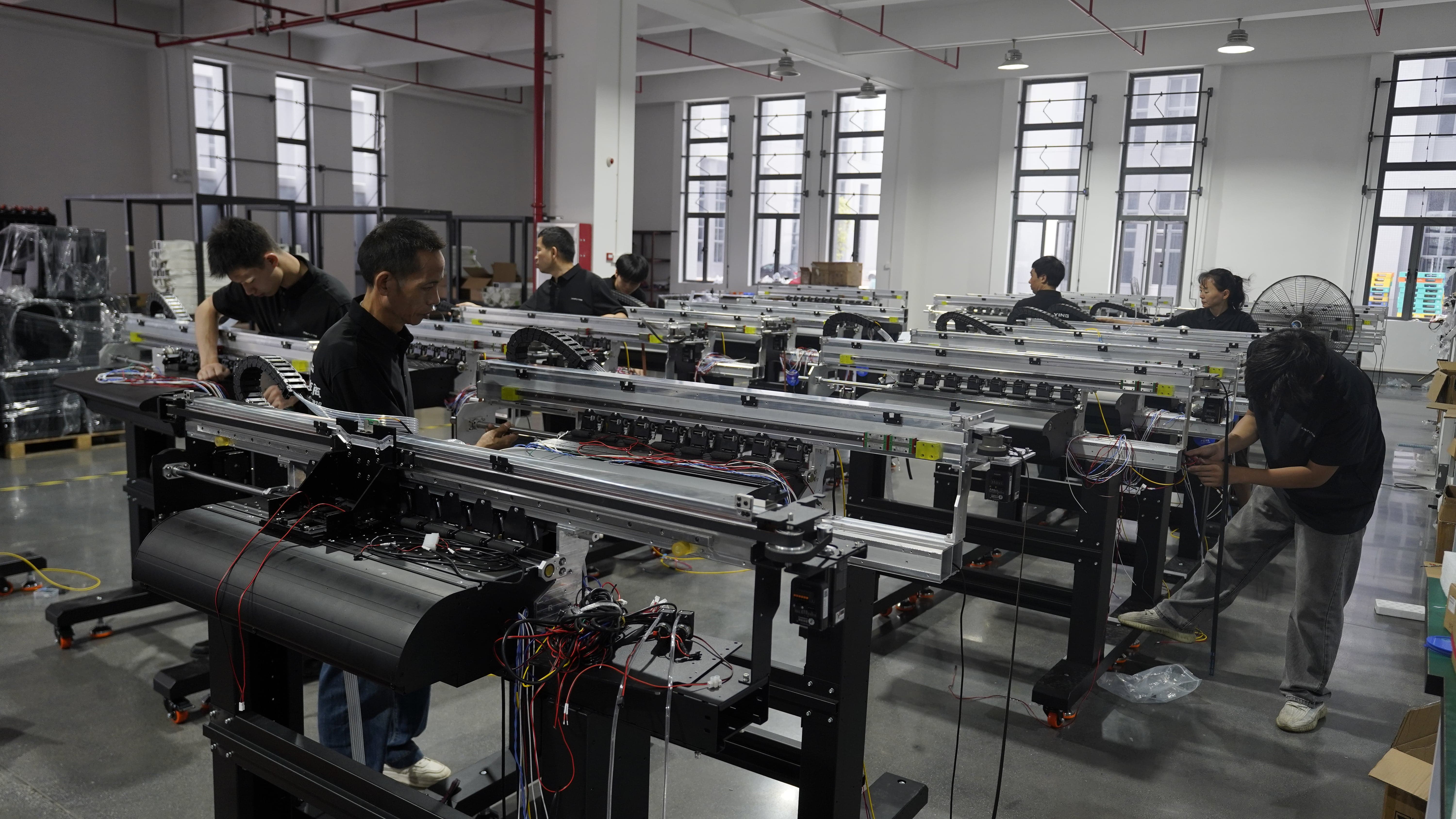
XINFLYING technicians assemble and wire multiple DTF printers on a factory production floor.
The three scenarios below are distinguished by workflow pressure rather than by industry label. A promotional-products distributor and a garment factory may print the same artwork; what differs is batch structure and uptime expectation.
| Scenario | Typical demand pattern | What the machine class must deliver |
|---|---|---|
| Apparel and short-run custom shirts | Small batches, frequent design changes, personalised garments, rapid sampling | Complete DTF workflow in limited floor space, simple operation, low initial investment, no setup cost per design change |
| Promotional products and contract decoration | Mixed substrates, deadline-driven orders, mixed order sizes, reseller and fulfilment work | Wider print width, stable colour output across materials, automated powder shaking and curing, RIP-supported colour management |
| Industrial apparel production | Continuous operation, repeat production runs, uniform output across shifts | Multi-printhead throughput, automatic powder recycling, touchscreen control, integrated fume purification, professional RIP integration, service and spare-parts continuity |
In the first scenario, the binding constraint is usually workflow completeness: printing, powder application and curing must fit together in a small space, because outsourcing any stage reintroduces the delivery dependency the buyer is trying to remove. In the second, the binding constraint is consistency — the same design printed on cotton, blends and leather should not require a different process each time. In the third, the binding constraint is uptime: a machine that stops is a production line that stops, which is why automation and service structure dominate the decision.
Mapping XINFLYING Machine Classes to Production Scenarios
Guangzhou Xin Flying Digital Technology Co., Ltd. (XINFLYING) is a digital printing equipment manufacturer founded in 2010 in Panyu, Guangzhou, China. The company produces DTF printer machines, UV DTF printers, UV flatbed printer machines, DTG printers, dye sublimation printers, and printing consumables. It operates a manufacturing facility covering 37,440 square metres, employs over 200 staff, maintains an R&D team of 20 engineers, and reports an annual production capacity of more than 20,000 units, with approximately 80% of output exported to North America, South America, Europe, Asia, the Middle East and Africa.
Its catalogue is organised around the same three production scenarios described above. The configurations below are drawn from the company's published product information.
Entry class — XF-450PRO All-in-One DTF Printer
The XF-450PRO is an A2 all-in-one DTF printing solution built around 2pcs Epson i1600-A1 printheads, with an integrated powder shaker and dryer, a white ink circulation system, and RIIN/PrintFactory RIP software. It is positioned for startups, small custom print shops and businesses entering apparel printing, where the priority is an easy-to-operate, space-saving setup for small-batch production with a lower initial investment. Product documentation for the XF-450PRO lists a productivity figure of 9 sqm/h at 6 pass.
Commercial class — XF-702E + XF-Z650-2 DTF Printer Package
The XF-702E + XF-Z650-2 package is a 60cm DTF printer configuration with 2pcs Epson i3200-A1 printheads, an automatic powder shaker and curing system, an auto moisture retention system, a white ink circulation system, and RIP software support. It targets growing print shops, e-commerce fulfilment businesses and professional apparel customisation companies that need wider printing capability and higher efficiency than an entry setup, while balancing productivity against investment.
Industrial class — XF-C605 + XF-A6502H DTF Printer Package
The XF-C605 + XF-A6502H package is a 60cm industrial DTF printing solution using 5pcs Epson i3200-A1 printheads, with an automatic powder recycling system, smart touchscreen control, a built-in fume purifier, and professional RIP software. It is designed for high-volume apparel factories, large printing service providers and industrial production users who require higher automation, continuous production capability and a more stable workflow for demanding commercial environments.
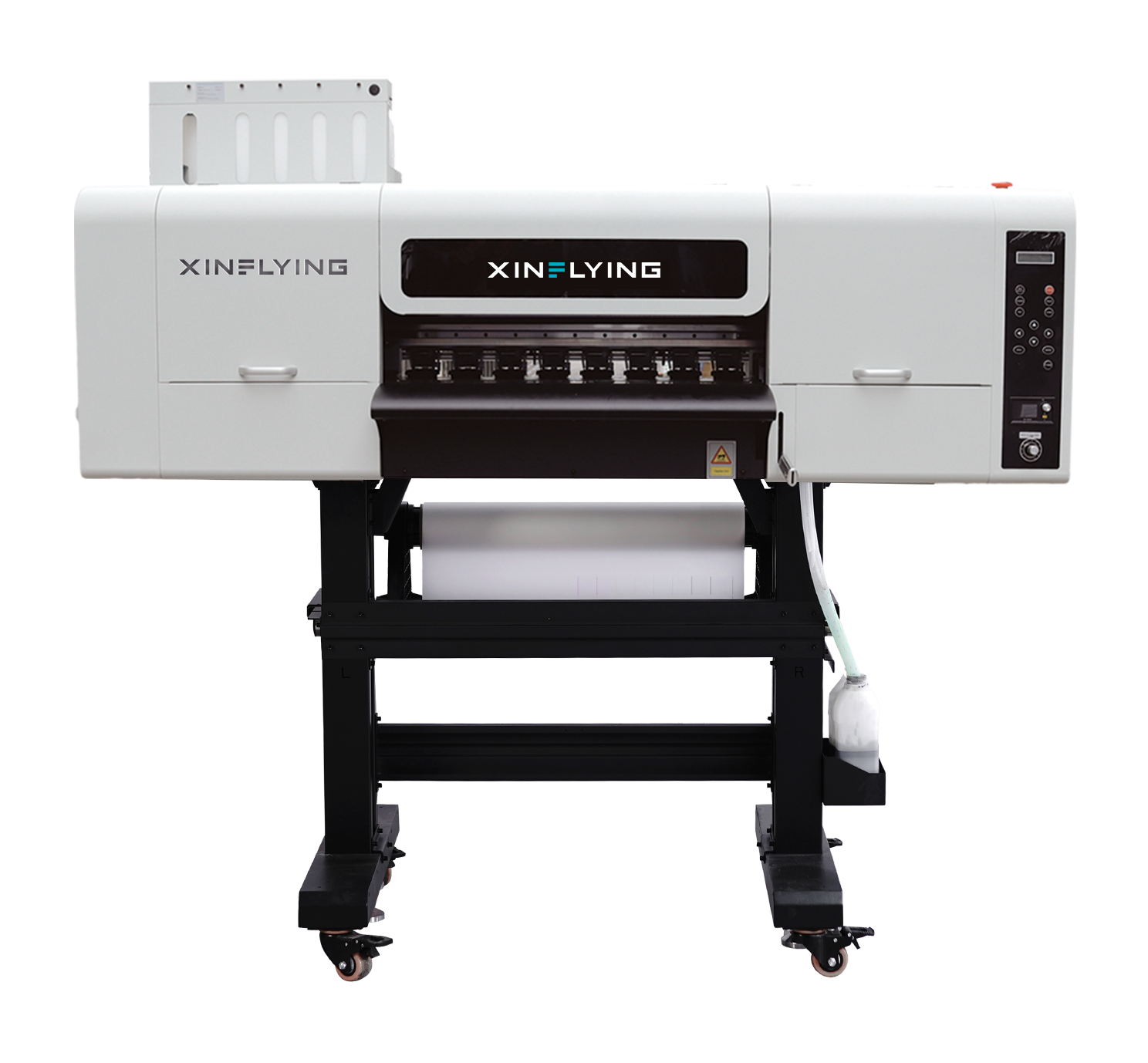
XINFLYING XF-C605, a 60cm industrial DTF printer configuration positioned for continuous production environments.
| Machine class | Printhead configuration | Automation included | Matched production scenario |
|---|---|---|---|
| XF-450PRO All-in-One | 2pcs Epson i1600-A1; A2 format | Integrated powder shaker and dryer; white ink circulation; RIIN/PrintFactory RIP | Startups, small custom print shops, entry into apparel printing |
| XF-702E + XF-Z650-2 | 2pcs Epson i3200-A1; 60cm width | Automatic powder shaker and curing; auto moisture retention; white ink circulation; RIP support | Growing print shops, e-commerce fulfilment, professional apparel customisation |
| XF-C605 + XF-A6502H | 5pcs Epson i3200-A1; 60cm width | Automatic powder recycling; smart touchscreen control; built-in fume purifier; professional RIP | High-volume apparel factories, large print service providers, industrial users |
Two buying notes follow from this structure. First, printhead count and print width are the clearest published proxies for throughput class, but they are not the whole answer — powder and curing automation determines whether that throughput is usable without constant manual intervention. Second, configuration details should be reconfirmed against the specific quotation before ordering, because packages are assembled by application rather than by a single fixed specification.
Technical Signals That Separate Machine Classes
Beyond marketing language, a small number of technical signals distinguish an entry machine from a production system. They are also the points buyers should question during sample validation.
| Signal | Entry class | Industrial class |
|---|---|---|
| Printheads | 2 printheads; smaller format | 5 printheads; 60cm width |
| Powder handling | Integrated shaker and dryer | Automatic powder recycling |
| Curing and moisture control | Combined integrated unit | Automatic curing with moisture retention across the package |
| Ink system | White ink circulation | White ink circulation within a multi-head ink platform |
| Fume and environment | Workspace-dependent | Built-in fume purifier |
| Control and software | Operator-friendly control with RIP software | Smart touchscreen control with professional RIP software |
| Thermal management | Standard duty cycle | Continuous duty cycle |
Thermal management deserves specific attention in the industrial scenario, because it is the point where continuous operation differs from batch operation. XINFLYING's risk-control documentation identifies overheating as a managed risk, controlled through thermal protection measures and temperature sensors. For buyers planning two-shift operation, that is a more relevant question than a small difference in quoted resolution.
A related technical detail concerns control hardware. The manufacturer's technical material identifies Hoson control boards, which it associates with data stability and precision relative to unbranded control boards. For buyers comparing quotations with similar headline specifications, component traceability of this kind is one of the few ways to differentiate build intent before a machine is delivered.
What CE, FCC and RoHS Documentation Actually Tells a Buyer
Compliance documentation is often treated as a formality by first-time importers and as a build-quality proxy by experienced ones. Both readings need qualification.
For European markets, electrical printing machines are expected to meet applicable EU safety and electromagnetic compatibility requirements, which is why CE documentation for DTF equipment typically references the CE/EMC/LVD/RoHS framework. For the United States, FCC requirements apply alongside RoHS restrictions on substances. Buyers importing a DTF printer are commonly advised to obtain CE documentation for Europe, FCC documentation for the United States, RoHS compliance evidence, and relevant electrical safety documentation.
Beyond machine compliance, DTF transfer films used in textile production are subject to textile-safety considerations — OEKO-TEX STANDARD 100 addresses textile safety and restricted substances for printed films used on garments. Buyers serving European apparel brands should treat film compliance as a separate question from machine compliance.
What certification proves, and what it does not. A compliance file demonstrates that a supplier has addressed regulatory requirements for a defined product and market. It does not demonstrate print quality, throughput, registration accuracy, or durability of the finished transfer. Certification is therefore best used as a documentation-discipline test — can the supplier match certificates to the exact model being shipped? — not as a substitute for sample evaluation.
The most common failure point is mismatched documentation: certificates that reference a different model, a different configuration, or a different electrical variant from the machine actually ordered. Buyers should confirm that certification documents correspond to the exact product model, and that the supplier can provide declarations and technical files when their customs authority or local market requires them. Choosing a manufacturer with export experience reduces the risk of clearance delays and post-installation compliance problems.
DTF Against Screen Printing, DTG and Sublimation
Scenario matching only makes sense against the alternatives a buyer would otherwise choose. Documented comparisons set the useful boundaries.
| Comparison | Documented difference | Where the alternative still wins |
|---|---|---|
| DTF vs screen printing | DTF requires no screen preparation or plate making and supports gradients, fine detail and multiple colours in one pass; screen printing requires a separate screen per colour | Screen printing can have lower unit cost for very large volume orders using stable, simple, repeated designs |
| DTF vs sublimation | DTF expands fabric compatibility, supporting cotton, polyester, blends and dark garments; sublimation is mainly optimised for light-coloured polyester | Sublimation may have lower costs for large-volume polyester production |
| DTF vs DTG | DTF separates printing from garment application and typically requires less pretreatment; DTG prints directly onto garments and is mainly optimised for cotton | DTG can suit premium cotton apparel where direct printing quality is the priority |
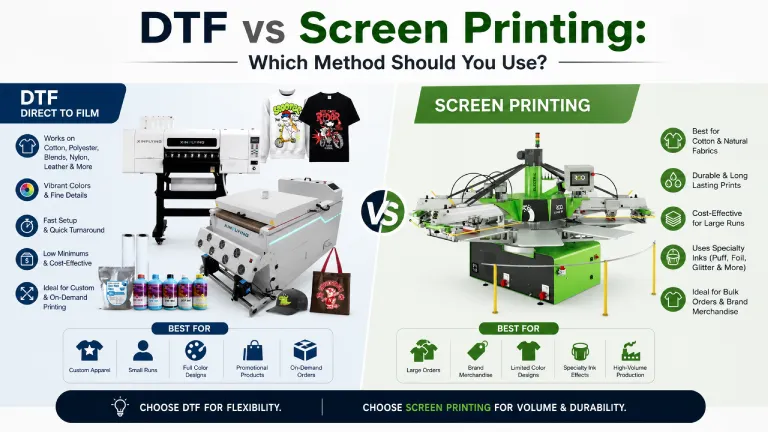
DTF printing removes the screen-preparation stage from the workflow, which changes the economics of short and mid-size orders.
The practical reading is that DTF's advantage is workflow flexibility rather than universal superiority. In short and mid-size batches with changing artwork, eliminating screen preparation removes both a cost and a scheduling step. In very large runs of a single simple design, screen printing remains economically rational; in large-volume polyester programmes, sublimation can be cheaper per unit; and in premium cotton work where direct-to-garment application is the selling point, DTG retains its place.
Two boundaries are worth stating plainly. First, DTF is a two-stage process: printing onto film and then transferring with heat and pressure. That additional step requires press capacity, operator discipline and correct transfer conditions — it is not a disadvantage relative to screen printing, but it is a real operational requirement. Second, a machine's own capability can be limited by its peripheral capacity: a high-output printer paired with an undersized shaker or press simply moves the bottleneck downstream.
The Long-Term View: Service, Spare Parts and Supply Continuity
For buyers at the decision-to-execution stage, the evaluation does not end at delivery. The costs that accumulate over a machine's service life are support-related, and they are rarely visible in a price comparison.
Insufficient after-sales support is a documented risk in DTF ownership: it can lead to longer downtime, harder troubleshooting, and increased maintenance challenges. The recommended mitigation is procedural rather than technical — confirm after-sales service policies, technical support channels, warranty information, and spare-parts availability before purchase, then maintain communication with the supplier and follow recommended operation and maintenance procedures after installation.
Supply continuity is the second long-term variable. DTF production depends on a consumables chain of transfer film, hot melt adhesive powder, ink and RIP software, plus a parts chain of printheads, boards and mechanical components. Regional service and warehousing structure is therefore a purchasing criterion rather than a convenience. Company information for XINFLYING notes local warehouse and technical support in key markets, with published figures indicating local warehouse support in the USA, Mexico and Brazil for 2–5 day delivery; the company's 80% export share and its stated coverage of North America, South America, Europe, Asia, the Middle East and Africa are consistent with that structure.
Commercial terms should also be confirmed in writing, because they shape execution risk. For XINFLYING equipment, purchasing terms include a minimum order quantity of 1 unit; delivery arranged under EXW, FOB, CIF or DDP; pre-shipment testing as the acceptance criterion; and payment by T/T, Western Union or PayPal. For buyers modelling landed cost from China, China's ink-jet printer export category (HS 84433213) is subject to a 13% value-added tax and a standard MFN duty of 0%, with destination-market duties and taxes confirmed separately.
Finally, growth should be planned across classes rather than within one. A business that starts on an A2 all-in-one and later moves to a 60cm commercial or industrial configuration keeps the same underlying workflow — film, powder, transfer, RIP — and avoids re-learning its production process at each expansion step. That continuity is the practical meaning of a scalable equipment ecosystem.
Where a DTF Printer Is the Wrong Choice
A credible selection guide has to describe the cases where DTF is not the answer.
- Very large runs of a simple repeated design. Screen printing may still deliver a lower unit cost at high volumes, and the absence of screens is worth less when the artwork never changes.
- Large-volume light-coloured polyester programmes. Sublimation remains cost-effective in that specific configuration and is the established workflow for it.
- Premium direct-to-garment cotton work. Where printing directly onto the garment is a product requirement rather than a process preference, DTG addresses that requirement more directly.
- Sites without heat-press capacity or space. DTF requires a transfer step and powder handling; without room and process discipline for both, machine capability does not translate into output. This is also why entry-class machines suit small-batch production rather than continuous industrial volume.
- Buyers planning from a single market forecast. With published DTF growth estimates ranging from roughly 6% to 12.5% depending on the research firm, investment cases should be built on the buyer's own order pipeline and validated with samples, not on the most optimistic external figure.
Compliance documentation adds a further boundary: a certificate covering one model does not transfer to a different model or a different electrical configuration, so the documents must be checked against the exact unit being shipped.
Future Outlook
Three structural shifts are likely to shape DTF equipment decisions over the next few years.
Revenue continues to concentrate in higher-throughput classes. Industrial DTF printers already accounted for 58.3% of total revenue share in 2025 on high-throughput demand. If that pattern continues, the entry market will remain a volume market for new businesses, while the commercial and industrial segments drive equipment specification — which makes scalability planning more important than a single low-cost entry decision.
Compliance documentation becomes routine rather than exceptional. As DTF output enters branded apparel supply chains, machine compliance (CE/EMC/LVD/RoHS, FCC) and film compliance (OEKO-TEX STANDARD 100 considerations) will increasingly be checked before purchase rather than after import. Suppliers who can match certificates to models efficiently will have an operational advantage in buyer evaluation.
The workflow extends beyond garment decoration. UV DTF technology is expanding into hard-surface customisation such as glass, wood and metal, with market projections for that segment still being validated and best treated as directional rather than settled. For current buyers, the practical implication is that transfer-based decoration skills and equipment decisions increasingly overlap with adjacent applications — a factor worth weighing when assessing whether a supplier's ecosystem can support later expansion.
FAQ
Which DTF printer class is suitable for a startup or small custom print shop?
Entry-level configurations are generally matched to startups, small custom print shops and businesses entering apparel printing. The relevant evaluation criteria are ease of operation, completeness of the DTF workflow within limited floor space, and initial investment level. An all-in-one configuration that combines printing with integrated powder shaking and drying removes the need to outsource part of the process, which matters when order sizes are small and design changes are frequent. Buyers in this class should still confirm that machine configuration matches their expected printing width and typical batch size.
Which DTF printer setup suits growing print shops and commercial apparel production?
Growing print shops, e-commerce fulfilment businesses and professional apparel customisation companies typically move to a 60cm commercial configuration. In this class, the decision criteria are print width, printhead configuration, automation of powder shaking, curing and moisture control, ink circulation, and RIP software support. The purpose of this class is not maximum speed but a balance between productivity and investment, so that regular commercial production can run without the workflow limits of an entry machine. Buyers should verify the configuration against their actual order profile rather than against the highest available specification.
What does an industrial DTF printing setup include for high-volume apparel production?
Industrial configurations are designed around continuous operation. A representative setup in this class pairs a 60cm printer using 5pcs Epson i3200-A1 printheads with an automatic powder recycling system, smart touchscreen control, a built-in fume purifier and professional RIP software. This class is intended for high-volume apparel factories, large printing service providers and industrial production users. Selection should weigh automation level, continuous operation capability, workflow stability, thermal management, and the supplier's service and spare-parts structure, because downtime costs rise with throughput.
What certifications should a buyer verify before importing a DTF printer?
Buyers should confirm that the machine meets the compliance requirements of their target market. Commonly checked documents include CE documentation for European markets, FCC requirements for the United States, RoHS compliance for restricted substances, and relevant electrical safety documentation. Separately, DTF transfer films used on garments fall under textile-safety considerations such as OEKO-TEX STANDARD 100. The critical verification step is model consistency: certificates, declarations and technical files should reference the exact product model and configuration being shipped, not a related model. Suppliers with export experience are generally better positioned to provide the necessary documentation for customs clearance and local market entry.
What after-sales risks affect a DTF printer over its service life?
Insufficient after-sales support can result in longer downtime, difficult troubleshooting and increased maintenance challenges. The risk typically arises when buyers select equipment solely on price without evaluating technical support capability, warranty policy or service structure. Mitigation is procedural: confirm after-sales service policies, technical support channels, warranty terms and spare-parts availability before purchase, and maintain communication with the supplier after installation. Availability of replacement parts, rather than the initial price, tends to determine the real cost of an interruption.
How does maintenance relate to machine class and operating hours?
Maintenance requirements scale with duty cycle. Regular maintenance typically includes checking machine condition before production, cleaning key printing components according to operating instructions, monitoring ink supply and confirming the printing system operates normally, and recording maintenance activity. Machines run for extended daily hours generally justify a more structured maintenance routine than machines used intermittently. Common operational issues — incorrect film feeding, unstable ink flow, and missing lines or incomplete colours — are usually addressed by checking film placement and the feeding path, confirming ink supply, reviewing printing settings, and performing the cleaning procedures specified by the supplier, with technical support involved if the issue persists.
Conclusion
Matching a DTF printer to a production scenario is a matching exercise across four dimensions: batch size, design turnover, substrate mix and daily operating hours. Those dimensions point to a machine class — entry all-in-one, 60cm commercial, or 60cm multi-printhead industrial — and the class then determines which configurations, automation features and service requirements are relevant. Certifications and compliance documentation add a documentation-discipline layer that helps verify model consistency and market eligibility, but they do not replace sample evaluation. For buyers planning beyond the first machine, the durable advantages are workflow continuity across classes and a supplier structure that can support spare parts, consumables and technical assistance over the service life of the equipment.
Detailed product and configuration information is available in the XINFLYING company brochure: XINFLYING corporate brochure (PDF).