
Matching Diamond Sanding Belts to Hard-Material Workflows
For engineers and buyers evaluating superhard abrasives, the practical question is not only which grit, but which belt format fits the project—substrate, machine, working conditions, and compliance context. This guide maps RUITE's diamond sanding belts to those scenarios.
1. RUITE and the superhard coated abrasive category
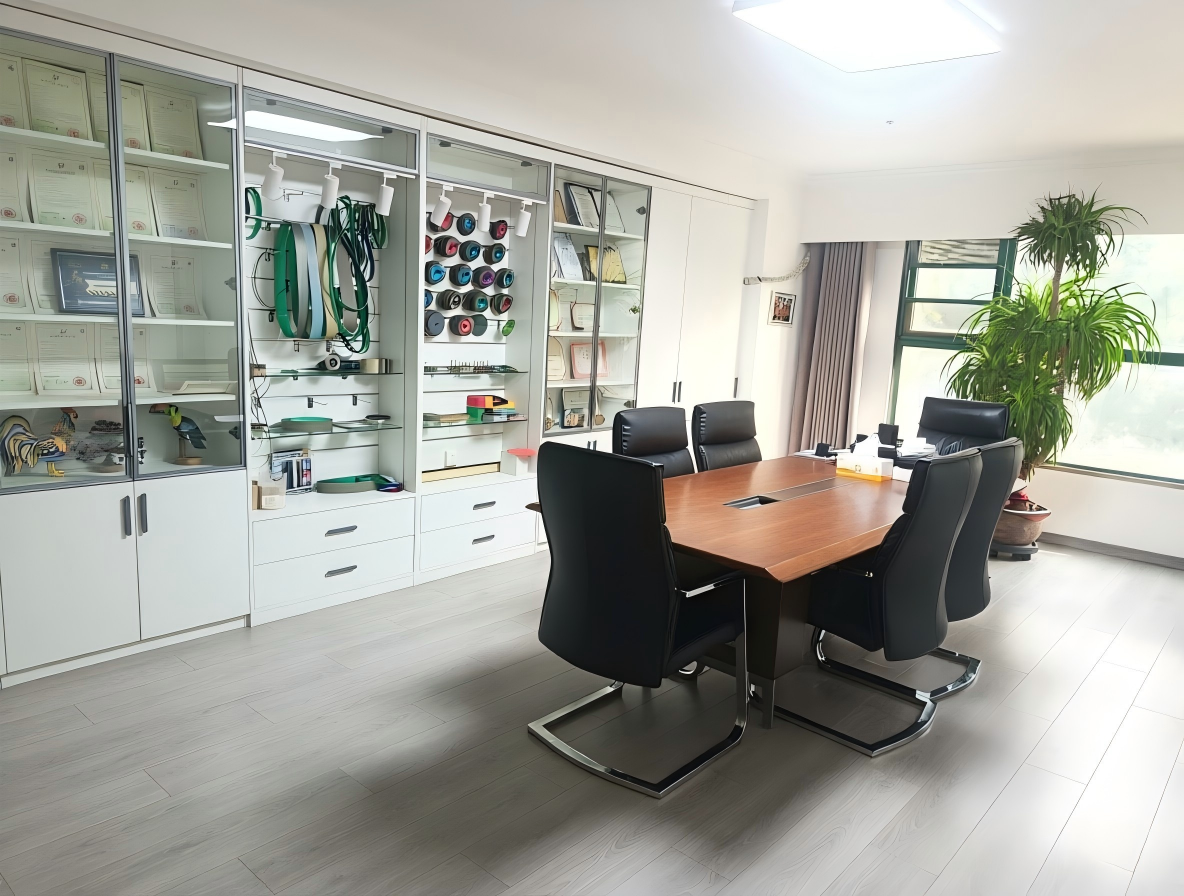
Zhengzhou Ruite Diamond Belts Co., Ltd (RUITE) is a manufacturer of superhard coated abrasives based in Zhengzhou, Henan, China, established in 2003. The company operates a 500 m² facility with 45 employees, including a five-engineer R&D team, and reports an annual output of 100,000 units, with approximately 70% of products exported to the EU and USA. Its main products are diamond belts, diamond flap discs, diamond flap wheels, diamond velcro discs, diamond hand pads, and diamond quick change discs.
RUITE states that it developed diamond sanding belts, diamond flap discs, diamond spiral bands, and diamond hand pads with independent intellectual property, and that it was among the first to research high-level super coated abrasives such as CBN belts, CBN flap discs, CBN spiral bands, and CBN hand pads. The technical rationale is that superhard material coated abrasives combine the flexibility of traditional coated abrasives with the high hardness of superhard materials. Diamond belts are therefore used for grinding and polishing complex shapes and surfaces of hard brittle materials such as stone, glass, ceramic, monocrystalline silicon, synthetic materials, and other hard materials.
2. Why hard, brittle materials change the abrasive decision
Glass, ceramics, stone, cemented carbide, monocrystalline silicon, and thermal spray coatings share two properties that stress conventional abrasives: high hardness and low fracture toughness. With aluminum oxide or silicon carbide belts, cutting grains dull quickly on these substrates, and the heat generated during grinding can damage the workpiece. The practical consequences are short belt life, inconsistent finish, and frequent process stops.
The demand context is growing. Global Market Insights values the diamond tools market—which includes abrasive belts—at USD 10.8 billion in 2024, projected to reach USD 19.5 billion by 2034. Estimates vary by scope: Fact.MR puts the 2025 market at USD 8.7 billion. For belt products specifically, the coated abrasive belt market (all materials) was valued at approximately USD 3.2 billion in 2025, with a projected CAGR of 5.3% through 2033, according to Cognitive Market Research.
One key application area is thermal spray. Mordor Intelligence projects the thermal spray coatings market to reach USD 15.28 billion by 2031. Thermally sprayed coatings—frequently tungsten carbide-based—are dense and hard, and they are a core scenario for diamond sanding belts.
3. RUITE Diamond Belts: product scope
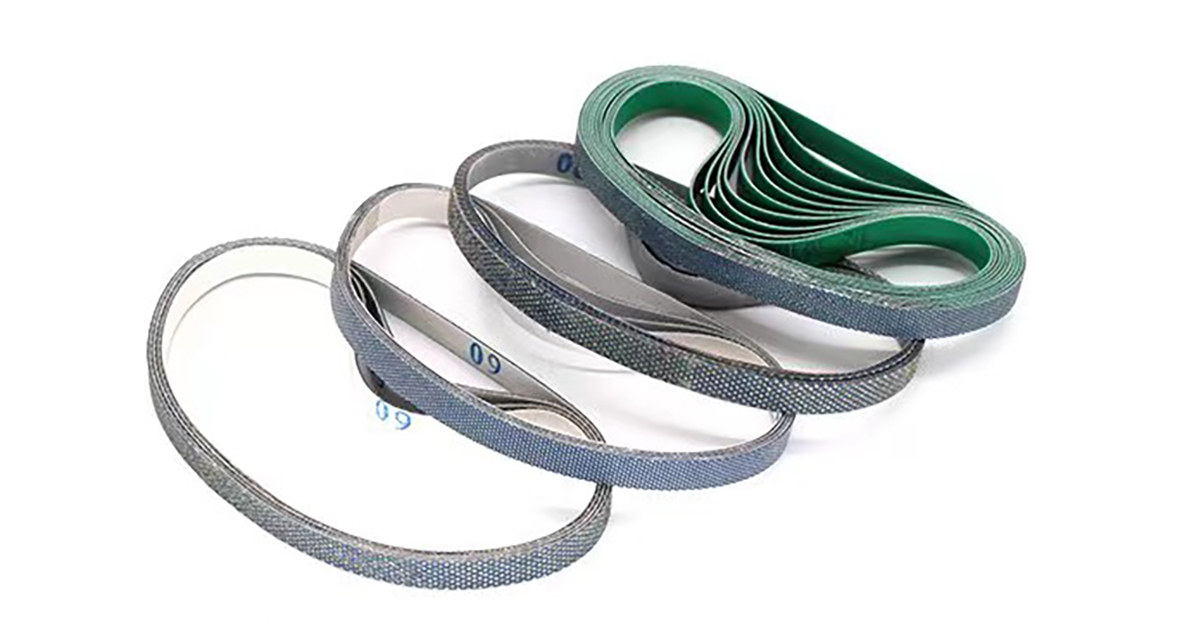
RUITE's Diamond Belts (product 5281) are superhard abrasive belts with widths from 5 mm to 350 mm and lengths from 150 mm to 5000 mm, available in grits from 40# to 5000#. The belts are manufactured in diamond or CBN material and can be customized according to the buyer's requirement.
The documented product features are high grinding efficiency, long working life, and high cost-effectiveness. The intended usage is grinding and polishing of hard brittle materials—glass, stone, ceramics, monocrystalline silicon, polycrystalline silicon, synthetic materials, and cemented carbide. Listed applicable industries are the glass industry, stone industry, thermal spray coating industry, wind power industry, porcelain industry, aeronautics & astronautics industry, and carbide tool sharpening.
4. Technology: bond types and operating modes
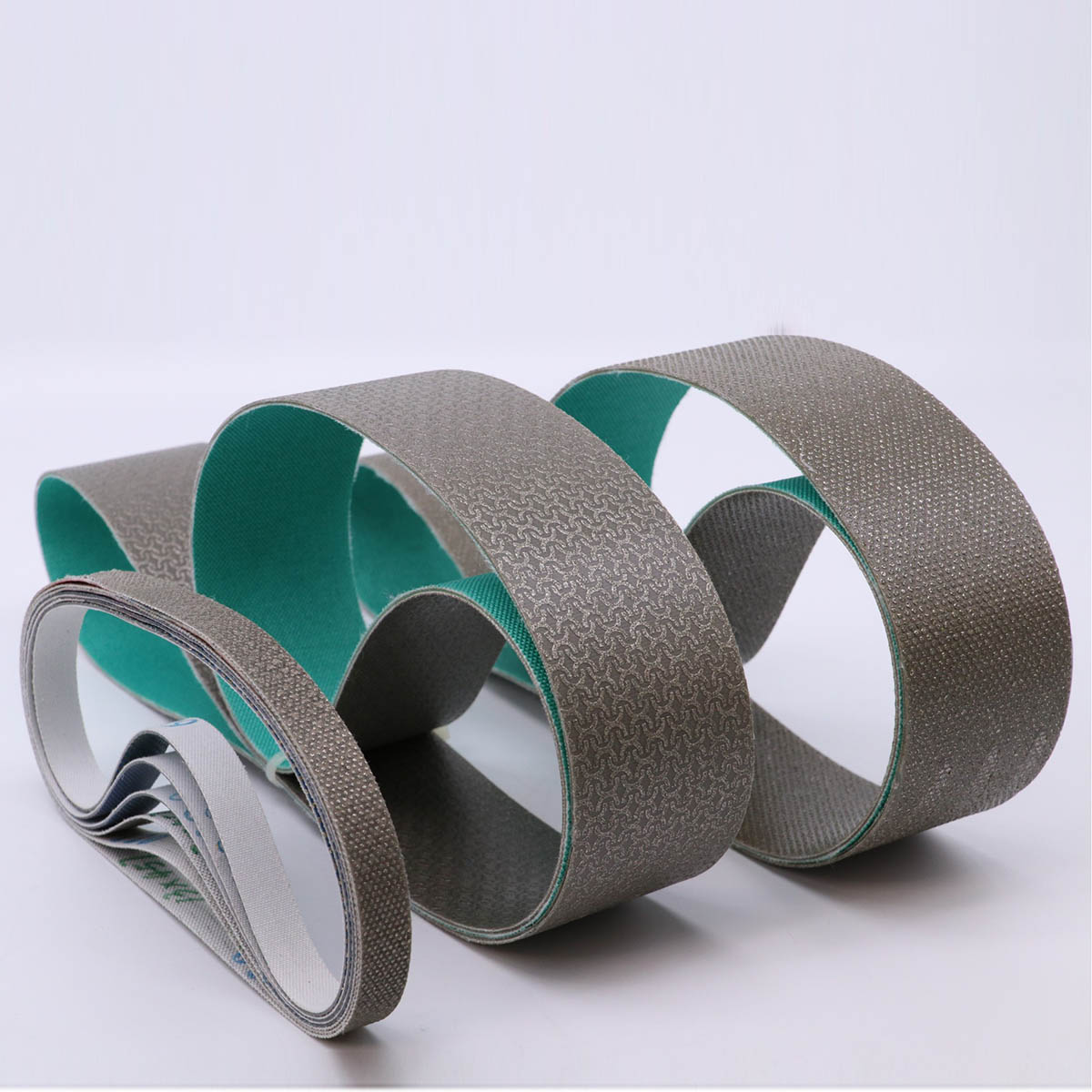
Two bond constructions appear in RUITE's diamond belt line. In a resin bond diamond belt, diamond grain is distributed through a continuous resin layer—the diamond is present all the way through the resin—so fresh grain is exposed as the resin wears. This supports a consistent cutting rate and long working life, which is why resin bond belts are a common choice for production grinding and polishing of glass, stone, ceramic, and thermal spray coating surfaces. In an electroplated diamond belt, a layer of diamond grain is bonded onto the belt surface, providing a sharp, controlled cutting layer for tasks such as edge profiling and surface conditioning.
The product is designed for abrasive machining tool projects and surface processing tool projects. It operates under dry and wet abrasive grinding conditions in high friction environments at normal ambient temperature. Two operation modes are documented:
- Handheld power tool intermittent operation.
- Stationary belt grinding machine continuous operation.
Supporting equipment such as glass process systems and sanders is required. The application documentation also notes a special requirement: precise control of speed, pressure, and time is necessary to achieve optimal results and maximum service life.
5. Application scenarios for diamond sanding belts
The scenarios below reflect the industries and working conditions documented for RUITE Diamond Belts.
| Scenario | Material / substrate | Typical task | Operating mode |
|---|---|---|---|
| Thermal spray coating finishing | Tungsten carbide and other sprayed coatings | Grinding and polishing of coating surfaces | Stationary continuous or handheld intermittent |
| Glass edging and shaping | Glass | Edge rounding, chamfering, surface conditioning | Stationary glass process systems or sander |
| Ceramic tile and porcelain processing | Ceramics, porcelain | Grinding and polishing | Stationary belt grinding machine or handheld power tool |
| Carbide tool sharpening and deburring | Cemented carbide | Sharpening, edge deburring, surface finishing | Handheld or stationary |
| Aerospace / high-temperature alloy components | High-temperature alloys, sprayed coatings | Surface finishing of components | Stationary continuous |
| Silicon substrate processing | Monocrystalline / polycrystalline silicon | Grinding and polishing | Controlled intermittent operation |
| Stone and composite materials | Stone, synthetic materials | Surface grinding and polishing | Handheld or stationary |
Thermal spray coating finishing. The thermal spray coating industry is listed as an applicable industry, together with wind power. Sprayed coatings are ground and polished to surface specification. Mordor Intelligence projects the thermal spray coatings market to reach USD 15.28 billion by 2031, indicating sustained demand for finishing tools in this segment.
Glass edging and shaping. RUITE's application documentation names glass process systems as supporting equipment and notes that this application scenario is common in Germany. Diamond belts are used for edge rounding, chamfering, and surface conditioning in dry or wet operation.
Ceramic tile and porcelain processing. The porcelain industry is listed as an applicable industry. Ceramic processing can run in stationary continuous mode or handheld intermittent mode, under high friction at normal ambient temperature.
Carbide tool sharpening and deburring. Cemented carbide appears in the product usage description, and carbide tool sharpening is listed as an applicable industry. For deburring carbide parts and sharpening carbide tools, diamond or CBN belts provide the cutting hardness that the substrate demands.
Aerospace and high-temperature alloy components. The aeronautics & astronautics industry is listed among applicable industries. Components with high-temperature alloy substrates and hard sprayed coatings can be finished in continuous operation on stationary belt machines.
Silicon substrate processing. Monocrystalline and polycrystalline silicon appear in the product usage list. These brittle substrates benefit from the flexibility of the belt format and from close control of speed, pressure, and time.
Stone and composite materials. The stone industry is listed as applicable, and synthetic materials appear in the usage list. The 40# to 5000# grit range covers the span from stock removal to polishing within this group.
6. Market trends shaping diamond belt procurement
Market growth. The diamond tools market was valued at USD 10.8 billion in 2024 and is projected to reach USD 19.5 billion by 2034 (Global Market Insights). The coated abrasive belt market (all materials) was valued at approximately USD 3.2 billion in 2025, with a projected CAGR of 5.3% through 2033 (Cognitive Market Research). Because analyst estimates vary—Fact.MR reports USD 8.7 billion for 2025—single-point figures should be treated as directional.
Additive manufacturing post-processing. Diamond-based super-abrasives are described as critical for post-processing in additive manufacturing, where cavitation abrasive surface finishing (CASF) can lower roughness below 5 µm, according to Mordor Intelligence. The growth of metal additive manufacturing adds a new demand pool for flexible superhard finishing tools.
Regulatory and trade policy. Two policy changes affect abrasive product sourcing from China. First, China's Ministry of Commerce (MOFCOM) implemented export controls on specific superhard materials—including diamond grinding wheels with tooth hardness ≤30 HRB and grain size ≤5 μm—effective November 8, 2025 (Announcement No. 55 of 2025). Second, effective April 1, 2026, China canceled the export tax rebate (previously 9–13%) for abrasive products including grinding wheels, sandpaper, and abrasive cloth/belts. Buyers should verify export scope and factor pricing adjustments into project budgets.
Safety standards. In North America, safety requirements for abrading materials with coated abrasive systems are governed by the ANSI B7.7 standard. End users specifying belts for plant-floor use should confirm that the product and machine setup meet applicable safety requirements.
Competitive landscape. Key global competitors in the super-abrasive and diamond belt market include 3M, Saint-Gobain (Norton), KGS Diamond, Hermes Schleifmittel, and Tyrolit, according to Market Research Future. With established global brands in the category, application fit and customization—grit, size, bond, packaging—are practical differentiators in project-level sourcing.
7. Diamond sanding belts vs. traditional solutions
Compared with conventional coated abrasives such as aluminum oxide and silicon carbide, diamond and CBN belts maintain cutting ability longer on hard brittle materials and reduce the heat load on the workpiece. The belt format also follows complex contours that rigid wheels cannot reach, and the flexible backing allows integration with both handheld tools and stationary belt machines.
Compared with rigid diamond grinding wheels, belts offer conformability to curved and irregular geometries and simpler integration into surface-finishing workflows. Rigid wheels, however, deliver fixed-profile precision on dedicated grinding machines, which remains the appropriate choice when geometry is defined by wheel dressing rather than belt contact.
Two limitations should be acknowledged in project evaluation. First, process control: the application requires precise control of speed, pressure, and time to achieve optimal results and maximum service life. Second, material economics: diamond belts are engineered for hard, brittle, and superhard materials; for ductile metals or soft substrates, conventional coated abrasives are generally the more economical choice.
8. Future outlook and OEM sourcing considerations
The outlook for diamond sanding belts is tied to the growth of hard-coating and hard-material processes. Thermal spray coatings—projected by Mordor Intelligence to reach USD 15.28 billion by 2031—and additive manufacturing post-processing, where cavitation abrasive surface finishing can lower roughness below 5 µm, both favor abrasives that combine superhard grain with a flexible belt format.
Trade policy is also reshaping sourcing decisions. With the April 2026 cancellation of the export tax rebate for Chinese abrasive products, belt life and process yield become more important cost levers; a longer-lasting superhard belt can offset higher upfront pricing over the life of a project.
For project-level sourcing, OEM capability is a relevant criterion. RUITE supports OEM production with PACKING/LOGO customization, a monthly capacity of 1,000 units, a minimum order quantity of 50 units, and a lead time of 30–45 days. Quality control is documented as 100% testing, and after-sales terms include a 12-month shelf-life quality warranty, free technical consultation, and replacement for defective batches.
9. FAQ: diamond sanding belts for project adoption
What is a diamond sanding belt?
A diamond sanding belt is a coated abrasive in which superhard diamond grain is bonded to a flexible backing. It combines the flexibility of traditional coated abrasives with the high hardness of superhard materials and is used for grinding and polishing complex shapes and surfaces of hard brittle materials.
Which materials can diamond sanding belts process?
The documented usage covers glass, stone, ceramics, monocrystalline and polycrystalline silicon, synthetic materials, and cemented carbide, in dry and wet grinding conditions.
Which industries typically use this product?
Listed applicable industries are glass, stone, thermal spray coating, wind power, porcelain, and aeronautics & astronautics, plus carbide tool sharpening. According to RUITE's application documentation, this application scenario is common in Germany.
What grit range is available?
RUITE Diamond Belts are available in grits from 40# to 5000#. Coarse grits are used for stock removal, fine grits for polishing, and intermediate grits for general surface finishing.
Can these belts be used with coolant or water?
Yes. The product operates under dry and wet abrasive grinding conditions at normal ambient temperature in high friction environments.
Which machines are compatible?
Two operation modes are documented: handheld power tool intermittent operation and stationary belt grinding machine continuous operation. Supporting equipment such as glass process systems and sanders is typically required.
What process parameters affect belt performance?
The documentation states that precise control of speed, pressure, and time is required to achieve optimal results and maximum service life.
What sizes can be supplied?
Widths range from 5 mm to 350 mm and lengths from 150 mm to 5000 mm. Custom sizes can be produced according to the buyer's requirement.
How do resin bond and electroplated diamond belts differ?
In a resin bond belt, diamond grain is distributed through a continuous resin layer, so fresh grain is exposed as the resin wears. An electroplated belt has diamond grain bonded onto the belt surface, providing a sharp cutting layer.
Does RUITE offer OEM production?
Yes. RUITE supports OEM projects with PACKING/LOGO customization, a minimum order quantity of 50 units, a monthly capacity of 1,000 units, and a lead time of 30–45 days. Quality control includes 100% testing, and the after-sales policy provides a 12-month shelf-life quality warranty, free technical consultation, and replacement for defective batches.
Which safety and regulatory references apply to coated abrasive systems?
In North America, ANSI B7.7 governs safety requirements for abrading materials with coated abrasive systems. For sourcing from China, MOFCOM export controls on specific superhard materials took effect November 8, 2025, and the export tax rebate for abrasive products was canceled effective April 1, 2026.
Sourcing and technical consultation — RUITE Diamond Belts
For project evaluation and OEM inquiries, RUITE provides product documentation and technical consultation. Contact: Annie (sales@ruitechn.com), Tel +0086-371-86555877, WhatsApp +86 139 2845 1015. Address: No. 1, Building 3, Longding Phase 1, Hongsong Road, Zhengzhou High-tech Industrial Development Zone, Zhengzhou, Henan, China.
Website: www.ruitechn.com | Catalog: Download RUITE product catalog (PDF)