
Matching Discs to Industries: How CNDOME's 9-Inch and 14-Inch Cutting Discs Fit Heavy Applications
Matching Discs to Industries: How CNDOME's 9-Inch and 14-Inch Cutting Discs Fit Heavy Applications
In heavy metal fabrication, the cutting disc is usually the least expensive item on the job and one of the most decisive. Diameter determines how deep a single pass can reach. Bore determines which machine the disc may legally be mounted on. Thickness determines how the cut behaves — fast and narrow, or rigid and stable. Abrasive type matters, but it rarely rescues a sizing decision that was made incorrectly at the start.
That is why matching discs to industries is a sizing exercise before it becomes a purchasing exercise. A 9-inch (230 mm) cutting disc and a 14-inch (355 mm) cutting disc appear in the same steel-structure and shipbuilding workshops, yet they belong to different machine classes, different depth ranges, and different certification footprints. This reference maps both formats to the industries that consume them, using the documented specifications, certifications, and application records of CNDOME (Changzhou Dome Abrasives Manufacture Co., Ltd.).
CNDOME is a resin-bonded abrasive manufacturer based in Changzhou, Jiangsu, China, established in 2001. The company produces cutting discs, grinding wheels, abrasive discs, ceramic grinding discs, and flap discs from a temperature- and humidity-controlled workshop of more than 20,000 m², operating 60 automated production lines and supplying more than 2,000 global tool and professional abrasive wheel brands. Around 80% of output is exported to Latin America, Europe, Africa, and Asia, supported by a 140-person workforce and a 10-person R&D team.
Why Diameter Settles More Decisions Than Abrasive Type
Three physical constraints sort cutting disc formats in heavy work: usable depth of cut, machine class, and certification scope. Each one is decided before abrasive grain or bond formulation is discussed.
Depth of cut. Usable cutting depth is a function of disc radius minus the arbor and flange area consumed by the machine. In thick plate, structural sections, and castings, a disc must clear the section in one continuous pass. When it does not, the operator repositions and re-enters the cut, which adds heat, burr formation, and handling time. Diameter is therefore the first filter, not the last.
Machine class. Rated spindle speed falls as disc diameter rises, because peripheral speed — not diameter — is the safety constraint. CNDOME's 7-inch disc (180 mm) is rated at 8500 RPM with a maximum operating speed of 80 m/s; the 9-inch disc (230 mm) is rated at 6600 RPM at the same 80 m/s ceiling; the 16-inch disc (400 mm) is rated at 3800 RPM at 80 m/s. Where a record gives no rated RPM for a format, the marked rating on the disc itself and its certification entry are the reference points. A disc may only be mounted on a machine whose no-load speed does not exceed that rating.
Certification scope. For European distribution, EN 12413:2019 specifies the safety requirements and testing procedures for rotating bonded abrasive products, including cutting and grinding wheels. MPA Hannover provides independent safety testing and certification for abrasive tools, and this certification is described as a key requirement for exporting industrial cutting discs to the EU market. Because certification is granted per dimension, it also becomes a format-selection criterion rather than a formality.
The 9-Inch (230 mm) Format: Specifications and Where It Fits
CNDOME's 9-inch cutting disc has a 230 mm diameter and a 22.23 mm bore, and is offered in three thickness options — 2.0 mm, 2.5 mm, and 3.0 mm — under the model designation 230x2.0x22.23 / 230x2.5x22.23 / 230x3.0x22.23. It is rated at 6600 RPM with a maximum operating speed of 80 m/s, is produced in T41 and T42 shapes, and is built from aluminium oxide, white aluminium oxide, and resin. The stated application industries are steel and metal processing, automobile manufacturing, shipbuilding, casting, and steel structure and construction.
In workshop terms, the 230 mm format covers the middle band of heavy portable cutting: structural sections, plate, schedule pipe, and casting gates that a 115 mm or 180 mm disc can only reach through multiple passes. The thickness options divide the work rather than duplicate it. The 2.0 mm option produces the narrowest kerf and the least material loss, which suits thin-wall tube and mid-section plate where feed speed matters most. The 3.0 mm option trades some cutting speed for rigidity, which generally helps in deep or long cuts where a thin disc would deflect under side load. The 2.5 mm option sits between the two and is commonly specified where a single disc must cover mixed work.
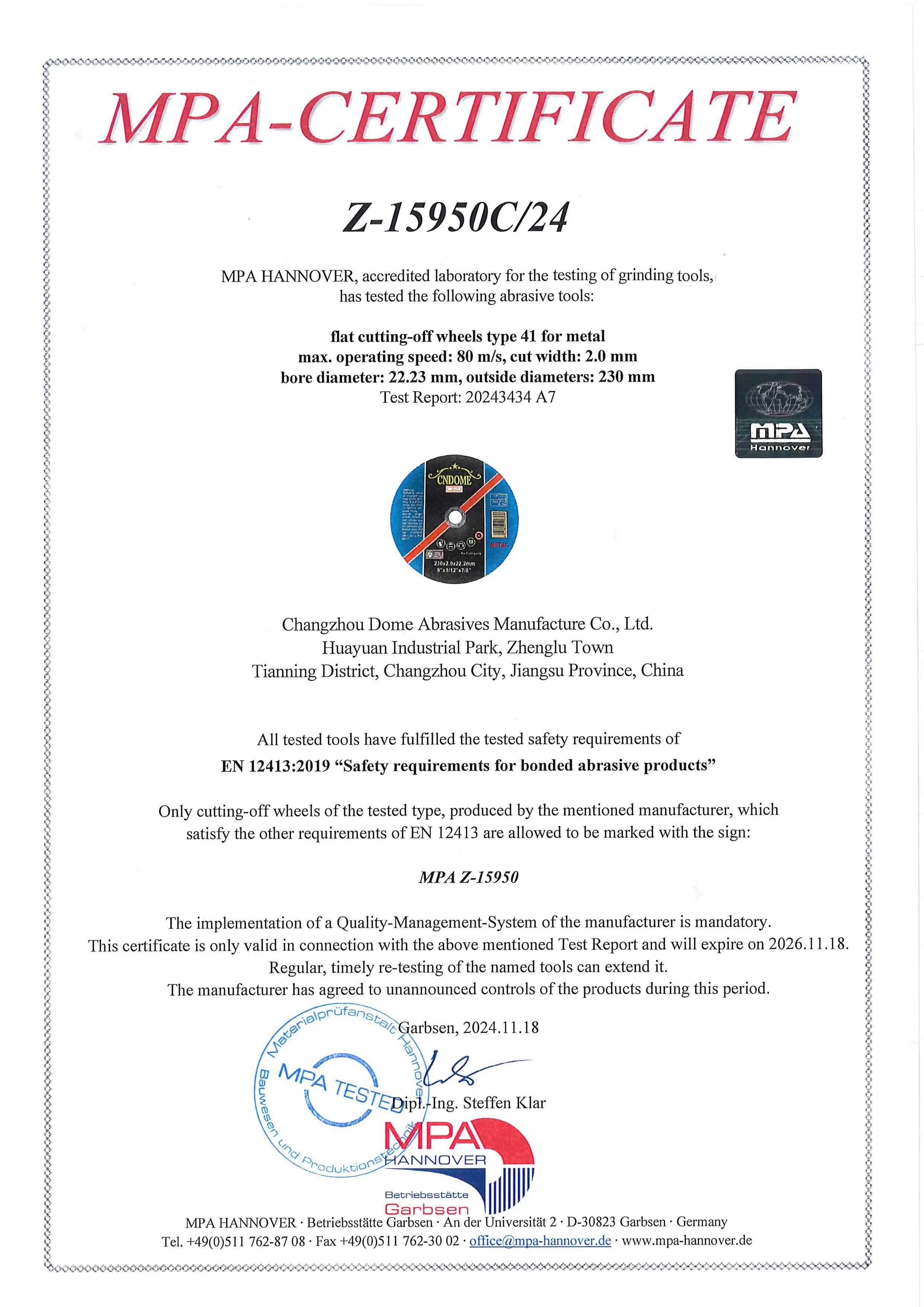
MPA Hannover certificate Z-15950C/24 covers the 230 x 2 mm dimension under EN 12413 — the 9-inch format in CNDOME's certified range.
The 14-Inch (355 mm) Format: Reach for Deep Sections
The 14-inch class in this range is built on a 355 mm diameter body. The designation most often written into purchase orders for this format is 355 x 3.2 x 25.4 mm — 355 mm diameter, 3.2 mm thickness, and a 25.4 mm (1-inch) bore, the arbor size used by machines in that class. A 355 mm disc has a radius of approximately 177 mm against approximately 115 mm for a 230 mm disc, so its usable single-pass reach is roughly half as large again before the arbor and flange area is deducted.
CNDOME holds MPA Hannover certification Z-15950D/24 under EN 12413 covering a 355 x 3 mm cutting disc, issued on 28 November 2024 and valid to 28 November 2026. Buyers specifying the 355 x 3.2 x 25.4 mm designation should confirm that the exact diameter, thickness, and bore combination appears both on the certificate entry and on the disc marking, because bonded abrasive certification is granted per dimension rather than per product family.
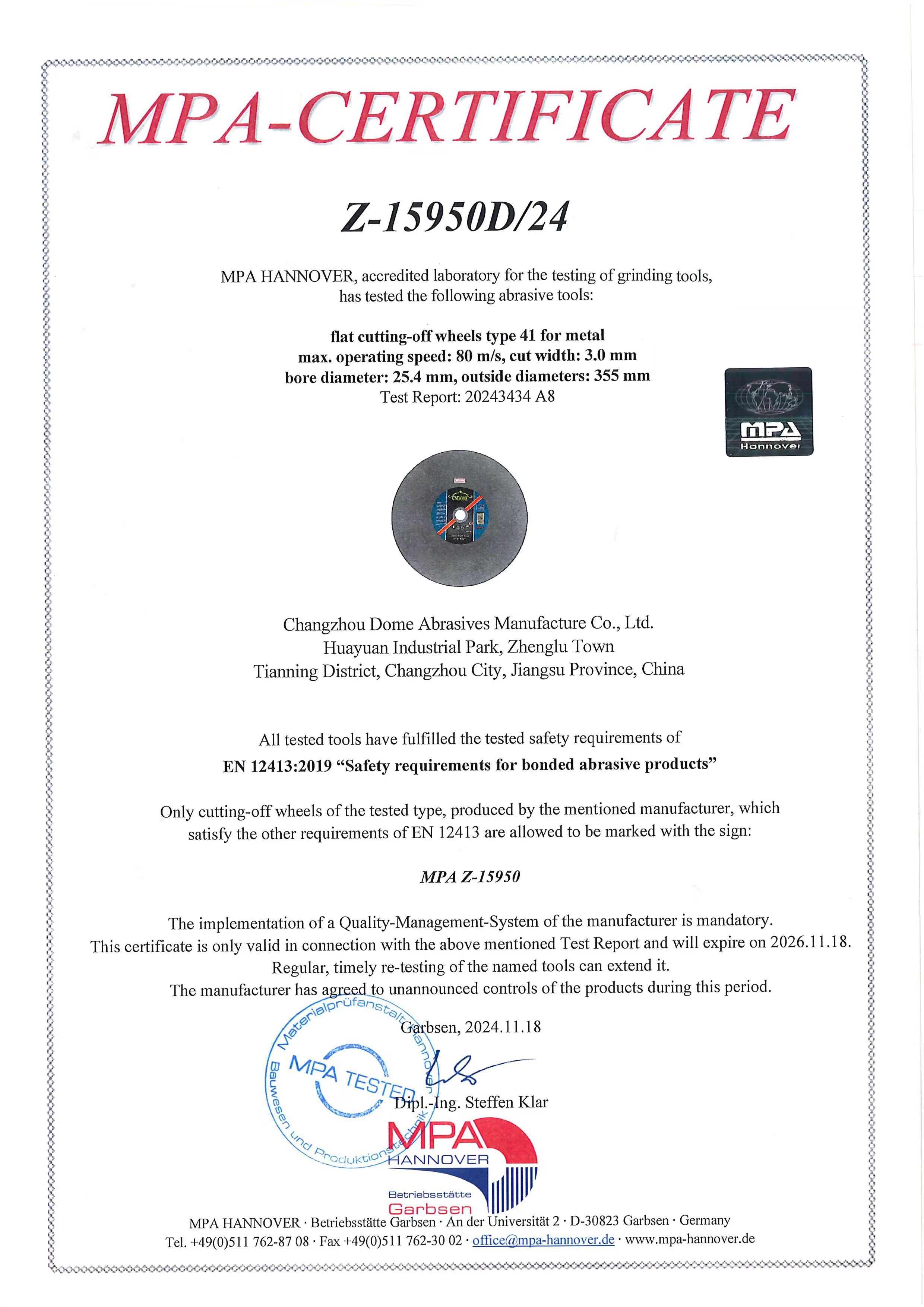
MPA Hannover certificate Z-15950D/24 covers the 355 x 3 mm dimension under EN 12413 — the 14-inch format on CNDOME's certified record.
Format Comparison: The Size Ladder Behind Heavy Applications
Heavy cutting rarely involves one format. Fabrication shops typically hold two or three diameters so that each cut is matched to section depth rather than stretched to fit an available disc.
| Format | Designation on record | Diameter | Thickness options | Bore | Rated speed | Typical heavy-duty fit |
|---|---|---|---|---|---|---|
| 7-inch | 180x1.6x22.23 / 180x2x22.23 / 180x3x22.23 | 180 mm | 1.6 / 2 / 3 mm | 22.23 mm | 8500 RPM, 80 m/s | Machining shops, mid-gauge iron and stainless parts |
| 9-inch | 230x2.0x22.23 / 230x2.5x22.23 / 230x3.0x22.23 | 230 mm | 2.0 / 2.5 / 3.0 mm | 22.23 mm | 6600 RPM, 80 m/s | Steel structure, shipbuilding, casting, construction |
| 14-inch | 355 mm class; 355x3 certified, 355x3.2x25.4 widely specified | 355 mm | 3 mm on the certified record | 25.4 mm (1 in) | Confirm marked rating and certificate entry | Deep-section plate and pipe, heavy castings, shipyard work |
| 16-inch | 400x3.5x32 | 400 mm | 3.5 mm | 32 mm | 3800 RPM, 80 m/s | Large castings, large-section steel |
Format data as recorded for CNDOME cutting discs; all formats are listed for steel and metal processing, automobile manufacturing, shipbuilding, casting, and steel structure and construction industries.
Matching Format to Industry
Steel structure and construction
Site and yard work on structural sections favours the 230 mm format in 2.0 mm and 2.5 mm thicknesses, where portability and feed speed matter more than kerf economy. Where fabricated plate is cut in a fixed yard position and section depth exceeds single-pass capability, the 355 mm format replaces multiple re-entries with one continuous cut.
Shipbuilding
Shipyard work combines thick plate, tight working envelopes, and documentation requirements tied to classification and market access. Both formats are used in the same hull and outfitting areas: 230 mm discs for framing and pipework, 355 mm discs for plate and heavy brackets. Because shipyard procurement is frequently subject to EN 12413 documentation checks, the per-dimension certificate record becomes part of the selection decision.
Casting and foundry work
Gate and riser removal on castings requires reach rather than precision. The 355 mm format, and the 400 mm format (400x3.5x32, T41, 3800 RPM at 80 m/s) where sections are larger still, are the practical choices in this application, with thicker discs used to hold a straighter cut in heavy section.
Metal processing and machining shops
Machining shops running continuous shifts usually standardise on smaller diameters with occasional large-format use. A documented example is a machining factory project serving clients in Indonesia, Japan, Thailand, and South Korea, using 7-inch class discs for cutting and polishing iron and stainless steel parts, with a project scale of 30 orders per year and support for 24-hour workshop production across multiple specifications and models.
Automotive manufacturing
Automobile manufacturing is listed alongside steel and metal processing and shipbuilding in the stated application industries for these cutting discs, where the same diameter-versus-section logic applies to chassis, frame, and fixture work.
Distribution and channel supply
For tool supermarkets and hardware distributors, an incomplete size ladder is a shelf problem. A documented tool supermarket project across Mexico, the United States, and South American countries supplies a full model range from 3 inches to 14 inches for both home DIY and professional metalworking, at a scale of 40,000,000 pieces per year over a three-year relationship.
Documented Application Records
- Cross-border brand development (global): OEM and private-label customisation for brand owners and tool brands, including Fortune 500 companies, with clients in China, Singapore, the United States, Germany, Nigeria, and South Africa. Scale: 60 orders per year over three years. Platforms served include Amazon, eBay, AliExpress, Walmart, Shopee, Lazada, TEMU, TikTok, and Shopify.
- Stainless steel pipe processing (South America): cutting and polishing of the outer and inner walls of stainless steel pipes, at 500,000 pieces per year over three years, with reported long disc life, no need for frequent replacement, no slag shedding, and high safety in the production workshop.
- Tool brand OEM (Brazil): 10,000,000 pieces per year over three years for offline hardware store distribution, with reported long service life, burr-free cutting, fast material feed, and low dust.
- Machining factory (Asia): 30 orders per year over three years, cutting and polishing iron and stainless steel parts, with ample inventory held ready for shipment.
- Tool supermarket (Americas): 40,000,000 pieces per year over three years, with reported complete model range, low noise, and burr-free cutting.
Certification Evidence Behind the Two Large Formats
For the 9-inch and 14-inch formats, the relevant compliance question is not whether a manufacturer holds ISO certification, but which dimensions appear on the MPA Hannover record under EN 12413. CNDOME's MPA entries cover dimensions from 76 mm to 355 mm.
| Certificate number | Authority | Standard | Covered dimension | Validity |
|---|---|---|---|---|
| Z-15953B/26 | MPA Hannover | EN 12413 | 230 x 1.6 mm | 26 Jan 2026 – 26 Jan 2028 |
| Z-15950C/24 | MPA Hannover | EN 12413 | 230 x 2 mm | 18 Nov 2024 – 18 Nov 2026 |
| Z-15951/24 | MPA Hannover | EN 12413 | 115 x 3 mm and 230 x 3 mm | 18 Nov 2024 – 18 Nov 2026 |
| Z-15953C/26 | MPA Hannover | EN 12413 | 300 x 3.2 mm | 26 Jan 2026 – 26 Jan 2028 |
| Z-15950D/24 | MPA Hannover | EN 12413 | 355 x 3 mm | 28 Nov 2024 – 28 Nov 2026 |
| Z-14440A-3/24 | MPA Hannover | EN 12413 | 180 x 1.6 mm | 18 Nov 2024 – 18 Nov 2026 |
| Z-15953A/26 | MPA Hannover | EN 12413 | 76 x 1.2 mm | 26 Jan 2026 – 26 Jan 2028 |
| Z-15950A/24 | MPA Hannover | EN 12413 | 115 x 1.0 / 115 x 1.2 / 115 x 1.6 mm | 18 Nov 2024 – 18 Nov 2026 |
| Z-15950B/24 | MPA Hannover | EN 12413 | 125 x 1.2 mm | 18 Nov 2024 – 18 Nov 2026 |
| Z-14440A-1/24 | MPA Hannover | EN 12413 | 125 x 1.0 mm | 18 Nov 2024 – 18 Nov 2026 |
Beyond the dimension-level entries, CNDOME holds CE certification M.2022.206.C74459 issued by UDEM under EN 12413 for cutting and grinding wheels, valid from 9 June 2022 to 9 June 2027; ISO 9001 certificate 18524Q10838R0M under GB/T19001-2016 / ISO9001:2015 for the production of resin grinding wheels, valid to 4 June 2027; ISO 14001 certificate 25024E11441R0M under GB/T24001-2016 / ISO14001:2015, valid to 19 December 2027; and amfori BSCI certification 156-025464-001 and 156-025464-000 issued by ALGI against the amfori BSCI Code of Conduct / SA8000, valid to 16 October 2027.
Procurement Terms for Large-Format Programs
Large discs are bought in production quantities rather than single units, and the commercial terms reflect that. CNDOME's recorded purchasing terms set the minimum order quantity at 10,000 pieces for sizes under 4 inches and 5,000 pieces for sizes over 4 inches — which places both the 230 mm and 355 mm formats in the over-4-inch bracket. Delivery terms are FOB or EXW, acceptance is based on pre-shipment testing, and payment terms are 30% prepayment with 70% balance on delivery. Typical production lead time is 30 days, against a monthly production capacity of 8 million pieces.
Customisation is available under OEM and ODM production, covering logo, label, packaging, abrasive formulation, and specification. Quality control is conducted through 100% AI Visual Comparison Testing, and after-sales support is offered as 24/7 online support with remote technical assistance. For distributors evaluating a large-format line, these terms define the realistic entry point: a 5,000-piece commitment per large dimension, a 30-day cycle, and a pre-shipment acceptance step rather than incoming inspection on arrival.
Market Trend: What Heavy-Format Demand Is Tracking
The global cutting discs market reached a valuation of approximately USD 7.32 billion in 2024, according to Market Research Future. That figure should be read with care: other published estimates for the same year differ substantially — Strategic Market Research places the market at USD 5.1 billion and Reports and Insights at USD 2.5 billion — because some studies count only disc consumables while others include broader cutting equipment. The scope definition matters more than the headline number when a buyer uses market data for planning.
Regional concentration is clearer. Asia-Pacific accounted for 48.28% of global revenue in the cutting equipment and tools sector in 2025, remaining the largest regional market, per Mordor Intelligence. Within that picture, the China abrasives market was valued at USD 2.29 billion in 2024, with synthetic raw materials accounting for USD 1.35 billion of that revenue, according to Intel Market Research. Cognitive Market Research identifies stainless steel cutting discs as the dominating product category within the cutting discs market, driven by demand in construction and automotive manufacturing — a medium-reliability third-party estimate rather than a settled figure.
The supplier landscape spans global brands and specialist manufacturing tiers. Major industry players listed by Market Research Future include Saint-Gobain (Norton), 3M, Robert Bosch GmbH, Tyrolit, and PFERD. For buyers, the practical consequence of this structure is that documentation and dimension-level certification increasingly differentiate suppliers more than brand recognition does, particularly for large-format discs used in regulated construction and shipbuilding projects.
How Large-Format Discs Compare with Alternative Cutting Methods
Abrasive cutting is one method among several, and the honest comparison is about fit rather than superiority.
| Method | Where it performs well | Where it is limited |
|---|---|---|
| Abrasive cutting disc (9-inch / 14-inch) | Portable, low setup, cuts ferrous and stainless steel on site, reaches deep sections in a single pass with the larger diameter | Consumable; produces dust and heat; requires a machine of the matching class and rated speed |
| Band saw / circular saw | Straight, repeated cuts in high-volume fabrication, with consistent dimensional results and lower cost per cut on long runs | Requires workholding and floor space; less portable for site and repair work |
| Plasma or thermal cutting | Contouring and non-straight geometry on conductive metals | Heat-affected zone, fume control requirements, and post-cut finishing |
The limits of large-format abrasive discs are worth stating plainly, because they shape procurement more than the advantages do.
- Machine matching is non-negotiable. A 355 mm disc requires a machine rated for that diameter. Diameter and rated speed must both match the machine's capability.
- Thickness is a trade-off, not an upgrade. Moving from 2.0 mm to 3.0 mm in the 230 mm format increases kerf width and removes more material per cut; the gain is stiffness, not efficiency.
- Certification is dimension-specific. A certificate for one thickness does not cover another thickness or bore in the same diameter.
- Resin-bonded discs are dated consumables. Bonded abrasive products generally carry a shelf life and need dry, stable storage; stock rotation matters as much as purchase price in distributor economics.
- Large formats do not suit small orders. With a 5,000-piece threshold above 4 inches and a 30-day production lead time, these formats are unsuitable for one-off purchases.
- Abrasive cutting is roughing, not finishing. Where tight tolerances are specified, secondary machining is normally required after the cut.
Future Outlook
Two forces are likely to shape how large-format cutting discs are specified over the next few years. The first is documentation: as EN 12413:2019 and independent testing such as the MPA Hannover certification remain the gateways to European distribution, dimension-level certificate coverage will increasingly be treated as a hard procurement filter rather than a supporting document. Suppliers that maintain a wide certified dimension range, including the 230 mm and 355 mm formats, will be easier to qualify.
The second is regional demand structure. With Asia-Pacific holding 48.28% of global revenue in cutting equipment and tools in 2025 and stainless steel discs identified as the dominating product category, the pressure on manufacturers is toward breadth of range and consistency of supply rather than toward new abrasive types alone. For heavy applications, the sizing logic described here — match diameter to section depth, thickness to cut behaviour, and certification to the destination market — is unlikely to change, because it is set by geometry and machine ratings rather than by market fashion.
FAQ
Which industries use 9-inch and 14-inch cutting discs?
The stated application industries for CNDOME cutting discs are steel and metal processing, automobile manufacturing, shipbuilding, casting, and steel structure and construction. Within that set, the 9-inch (230 mm) format with a 22.23 mm bore covers structural sections, plate, pipe, and general fabrication, while the 14-inch (355 mm) class covers deeper plate and heavy castings where a single-pass cut is required.
What is the difference between the 2.0 mm, 2.5 mm, and 3.0 mm thickness options on the 230 mm disc?
All three thicknesses are offered on the same 230 mm body with a 22.23 mm bore under the designation 230x2.0x22.23 / 230x2.5x22.23 / 230x3.0x22.23, at a rated 6600 RPM and a maximum operating speed of 80 m/s. Thickness changes kerf width and disc stiffness: thinner discs generally cut faster with less material loss but tolerate less side load, while thicker discs are stiffer for deep or long cuts. The MPA Hannover entries reviewed cover 230 x 1.6 mm, 230 x 2 mm, and 230 x 3 mm.
Can a 14-inch cutting disc be fitted to a standard angle grinder?
No. A disc may only be mounted on a machine rated for that diameter and whose no-load speed does not exceed the disc's marked maximum RPM. The 355 mm format requires a machine of the corresponding class. The record reviewed does not list a rated RPM for the 355 mm disc, so the marked rating on the disc and its EN 12413 certification entry are the reference points for compatibility.
What certification should a European buyer check on a large-format cutting disc?
EN 12413:2019 specifies the safety requirements and testing procedures for rotating bonded abrasive products, including cutting and grinding wheels, and MPA Hannover provides independent safety testing and certification for abrasive tools, described as a key requirement for exporting industrial cutting discs to the EU market. CNDOME holds CE certification M.2022.206.C74459 issued by UDEM under EN 12413 for cutting and grinding wheels, valid from 9 June 2022 to 9 June 2027, alongside dimension-specific MPA Hannover entries.
What are the minimum order quantity and lead time for large cutting discs?
Recorded purchasing terms set a minimum order quantity of 10,000 pieces for sizes under 4 inches and 5,000 pieces for sizes over 4 inches, with delivery terms of FOB or EXW, acceptance based on pre-shipment testing, and payment of 30% prepayment with 70% balance on delivery. Typical production lead time is 30 days against a monthly production capacity of 8 million pieces.
Does CNDOME offer OEM and ODM customisation on 230 mm and 355 mm cutting discs?
Yes. OEM and ODM production services are provided, with customisation covering logo, label, packaging, abrasive formulation, and specification. Quality control is conducted through 100% AI Visual Comparison Testing, and after-sales support is offered as 24/7 online support with remote technical assistance.