
Matching Dosing Pump Types to Project and Site Conditions
In industrial fluid handling, the real test of a dosing pump is not the datasheet but the ability to stay accurate in a specific process environment—under changing pressure, aggressive chemicals, humidity, and 24/7 operation. Buyers evaluating a dosing pump, whether solenoid, diaphragm, piston, or digital, therefore need more than a model number; they need a project-oriented selection logic. This article provides that logic and uses WRS PTE LTD as a reference for what a full-line dosing pump supplier should be able to document.
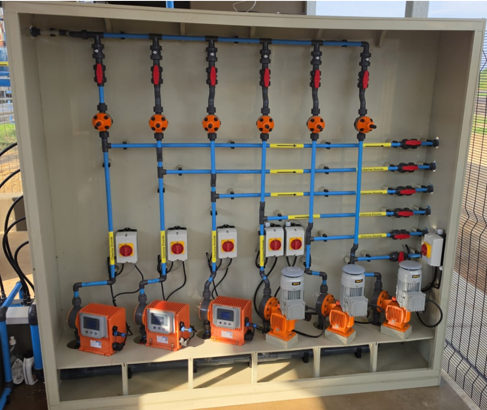
Why Projects Fail When Pump Selection Stops at the Datasheet
Selecting a dosing pump based only on maximum flow rate or price is a common failure point. In real plants, the same pump may need to operate against varying back-pressure, dose corrosive chemicals, communicate with a PLC, and remain stable in dusty or humid conditions. Missing one of these parameters often leads to unstable dosing, valve failure, or premature diaphragm wear.
The opportunity for a buyer is to move from “which pump is cheapest” to “which pump concept fits the duty.” That shift is especially visible in water treatment, chemical processing, mining, food and beverage, and new energy applications, where automation and traceability are becoming standard requirements.
Beyond the pump, a chemical dosing system includes suction lines, injection points, check valves, pulse dampeners, and sometimes instrumentation such as streaming current monitors. Each component must be specified for the same chemical and pressure conditions. This is why a buyer evaluating a dosing pump should also review the supplier's ability to provide a complete dosing loop, not only the pump head.
What a Full-Line Dosing Pump Supplier Should Cover
WRS PTE LTD, with manufacturing base ZHEJIANG WRS MACHINERY EQUIPMENT CO., LTD in Hangzhou, China, can serve as a reference for the product breadth and manufacturing rigor that help buyers match pumps to applications. The Hangzhou facility covers 15,000 square metres, employs around 120 people, and produces approximately 30,000 units per year. A 15-engineer R&D team supports product development, while exports go to Southeast Asia, Russia, and South America. The company also states that it has local after-sale service in more than 10 countries, including Singapore, Thailand, Malaysia, Vietnam, South Korea, Japan, Russia, Chile, South Africa, Angola, and Turkey.
The product range is deliberately broad: metering pumps, solenoid dosing pumps, diaphragm dosing pumps, piston dosing pumps, digital dosing pumps, check valves, pulse dampeners, chemical dosing systems, streaming current monitoring systems, and chemical injection pumps. For buyers, this breadth matters because a complete dosing system usually involves more than the pump itself.
On the capability side, WRS lists ODM production and voltage customization as standard options. Monthly capacity for the product group is about 5,000 units, standard lead time is around 3 days, and the MOQ is 1 unit. Quality control includes 100% testing before shipment. These facts give an evaluation team a starting point for asking the right supplier questions—especially when the project is not a one-off but a long-term supply relationship.
Project-fit evaluation should verify three things: the hydraulic duty, the chemical path, and the control/environment interface. A full-line supplier can usually provide all three in one documentation set.
Technical Framework for Matching Dosing Pumps to Duty
WRS's application guidance says that flow rate is the most important selection parameter; the pump is selected by comparing the required flow with the maximum flow at the site. Once flow is satisfied, pressure, pump head material, and motor specifications are used to refine the choice. This simple hierarchy forces the project team to define the hydraulic duty first, then apply material and control compatibility.
Pump Families and Their Operating Windows
| Pump family | Flow and pressure range | Wetted materials | Typical strengths | Important limits |
|---|---|---|---|---|
| Solenoid dosing pump (ML / EML) | 1–20 L/H; 1–10 bar | PVC, PVDF, SS316 | 1% dosing accuracy; double-ball check valve; IP65; remote control option; simple and economical | Best suited to low-flow injection |
| Digital dosing pump (EMML / EMGP / EMAP) | 60, 200, or 1000 L/H; 4 bar | PVC, PVDF, SS316 / SS316L | <1% precision; 1:1000 turndown ratio; full PTFE diaphragm; 4–20 mA / pulse / Modbus-RS485 communication | Pressure rated at 4 bar, so mainly for low-pressure dosing lines |
| Mechanical diaphragm dosing pump (MG / MA / MB) | 15–1800 L/H; 5–10 bar | PVC, PVDF, SS316 | Multi-layer diaphragm; corrosion-resistant; smooth flow adjustment while running and idle; easy parts replacement | Pressure ceiling around 10 bar; not for very high pressure duties |
| Piston dosing pump (PM / PD) | 600 L/H; 8 bar | SS316 | Robust; high efficiency; suitable for high-viscosity pumping; frequency and explosion-proof motor options | More moving parts, so seal and packing maintenance is more important |
| Hydraulic metering pump (HS / HL) | 2 L/H at 200 bar to 1600 L/H at 6 bar | SS316 | Zero-leakage design; suitable for toxic and hazardous media; optional diaphragm rupture sensor; high-viscosity capability | Higher complexity and initial cost than simpler pump designs |
Each of these families has a natural application zone. The project question is not “which type is best” but “which type is best for this specific combination of flow, pressure, chemical, and control requirement.”
Chemical Compatibility and Materials
For highly corrosive media, WRS's application guidance recommends PVDF pump head material; different media have different material options. The wetted path also includes valves, seals, and diaphragms, so material selection should cover the entire fluid path. In WRS's mechanical diaphragm and solenoid lines, PVC, PVDF, and SS316 are the available wetted materials. For high-purity or aggressive applications, the digital pump family uses a full PTFE diaphragm to improve chemical resistance.
Control and Environment
Many projects now require the dosing pump to accept an external control signal. WRS's solenoid and digital pump lines support 4–20 mA or pulse signals and Modbus-RS485 communication, with direct flow rate display. Enclosure protection is typically IP65. In a Russian livestock application, the project specified an automatic system with IP67 protection; WRS supplied a configuration based on the EMML0060FP1E digital pump and the ML0008PR1C solenoid pump to meet the 24/7 nutrient dosing duty in a humid environment. This example illustrates that environment protection is as important as hydraulic performance.
At the system level, accessories such as dosing pump check valves and pulse dampeners protect accuracy. A check valve prevents reverse flow when the pump is off, while a pulse dampener smooths pressure spikes at the injection point. In highly automated water treatment plants, a streaming current monitoring system can close the control loop by adjusting the dosing pump output based on real-time process demand.
A Simple Evaluation Workflow
Project teams can use a five-step workflow to turn operating requirements into a pump specification:
1. Define the fluid: chemical name, concentration, temperature, and viscosity.
2. Set the hydraulic envelope: required flow rate at maximum and minimum operating pressure, then compare with pump curves.
3. Choose materials: use compatibility guidance; for strong corrosive liquids, PVDF is generally recommended.
4. Define control: manual, 4–20 mA, pulse, or Modbus, and verify the pump's communication options.
5. Check mechanical and environmental constraints: space, IP rating, ambient humidity, and duty cycle.
These steps are not one-time calculations. They should be reviewed when the project moves from preliminary design to detailed engineering, and again during supplier evaluation.
Application Evidence from the Field
A documented wastewater treatment reference involves an Australian engineering company that purchased 20 WRS units. The client reported stable operation over five years, and the reasons cited were high quality and easy maintenance. This kind of long-term stability is the operational result that project teams are actually buying.
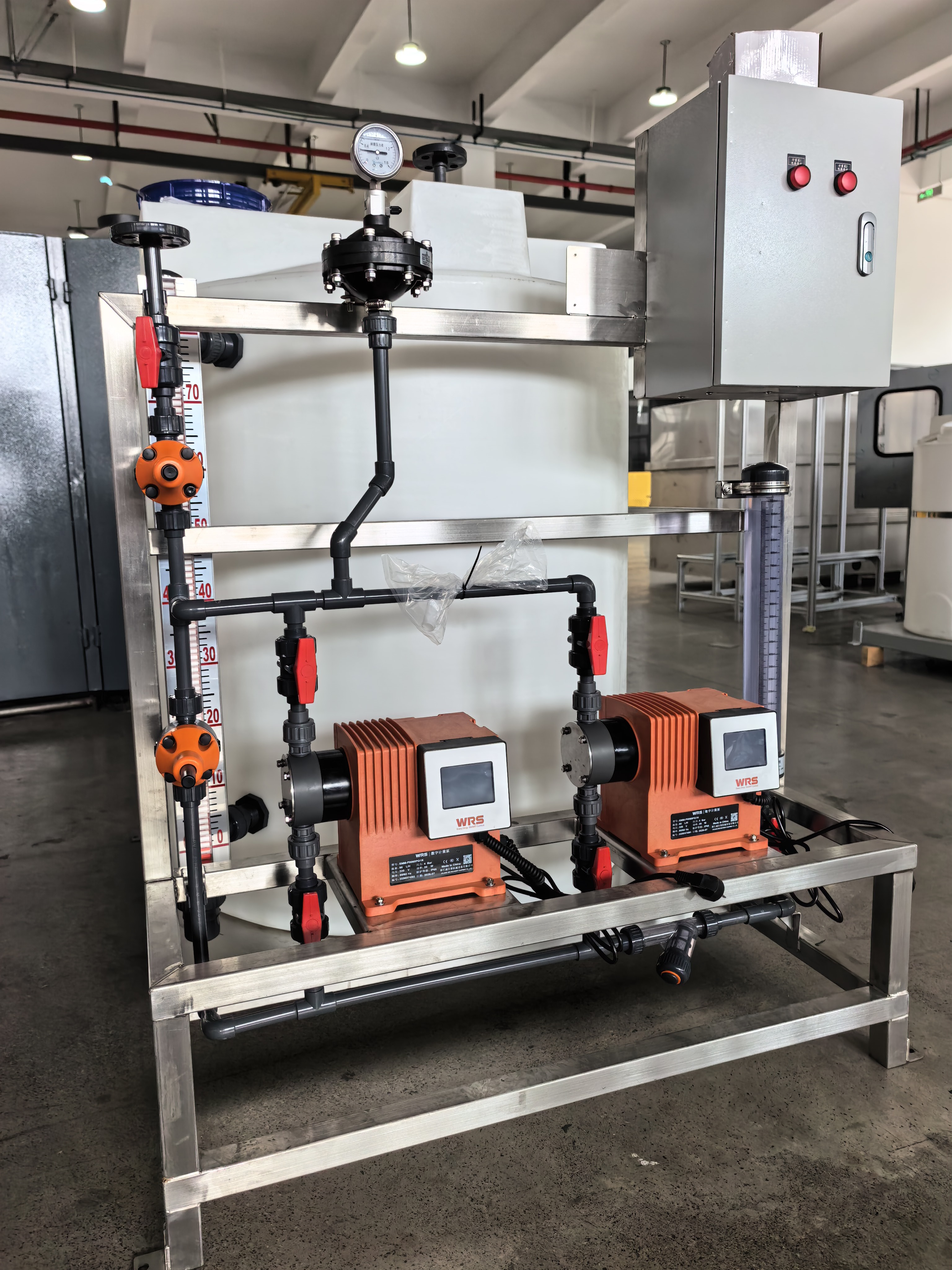
The livestock project in Russia adds another dimension: harsh humidity, round-the-clock operation, nutrient solution, and automatic control. There, the pump configuration combined the precision of a digital pump with the simplicity of a solenoid pump, delivered as an automatic system. This is a practical example of project-fit selection: the pump is chosen not for its headline numbers but for its behaviour under the site's constraints.
Market Trends That Influence Pump Choice
The broader market context supports a move toward purpose-matched dosing equipment. Grand View Research estimates the global dosing pump market at approximately USD 8.86 billion in 2024, with diaphragm pumps accounting for 55.7% of revenue. Water and wastewater treatment represents 23.2% of metering pump applications, making it the largest application category. The same source reports that Asia Pacific held a 41.8% revenue share in 2024, while OEC data put China's liquid pump exports at about USD 14.3 billion in 2024.
On the drive side, Mordor Intelligence shows motor-driven metering pumps held a 54.45% revenue share in 2025, while solenoid-driven dosing pumps are projected to grow at a CAGR of 5.88% through 2031. These numbers point to a market with a large motor-driven installed base and an emerging digital and automatic segment. For buyers, the implication is that a supplier should be able to support both conventional and connected architectures, because projects vary widely in automation maturity.
Note: market size estimates vary by definition of scope; the figures above are directional and cited to their original sources.
Comparison with Traditional Dosing and System-Level Trade-offs
Compared with manual dosing or gravity feeding, an automated dosing pump reduces operator exposure and improves repeatability. But it is not a fit for every situation. Automated systems depend on correct line design, pressure conditions, and maintenance of valves and diaphragms. A pump that is oversized or undersized for the actual pressure curve will not deliver the labelled accuracy.
Within pump families, the same boundary logic applies. Solenoid pumps are economical and simple for low-flow injection but are not designed for high-viscosity or high-pressure duties. Mechanical diaphragm pumps are corrosion-resistant and easy to maintain, but their practical pressure ceiling is lower than that of hydraulic metering pumps. Digital pumps provide exceptional turndown and remote communication, yet their 4 bar pressure rating limits them to low-pressure injection lines. Piston pumps handle higher viscosity but involve more moving parts and therefore more seal and packing maintenance. Hydraulic diaphragm pumps offer zero-leakage handling for dangerous fluids, at the cost of higher complexity and initial investment. These trade-offs do not disqualify any family; they simply mean the pump must be matched to the project's actual constraint set.
Future Outlook
Dosing pump selection is becoming a system engineering exercise. Plants want pumps that talk to controllers, report operational health, and maintain accuracy under variable demand. WRS states that its dosing pump series has completed a digital and intelligent upgrade across the whole range, incorporating high precision, data integration, and information linkage for complex working conditions. This is consistent with a broader industry shift toward instrumentation-centric dosing systems, where the pump is one node in an automated loop that may include streaming current monitoring, pH control, and remote supervision.
For procurement teams, the future vendor scorecard will include not just hydraulic performance but communication protocol support, ease of maintenance, local service capability, and the ability to customise voltage and system configuration. The project-fit approach described here is a way to evaluate those factors before buying.
FAQ
Q: What is the first parameter to check when selecting a dosing pump for a project?
In WRS's selection guidance, flow rate is the most important parameter; the pump should be selected by comparing the required flow with the maximum flow at the site. Pressure, pump head material, and motor specifications are then used to narrow the choice.
Q: Which pump head material should be used for strong corrosive liquids?
For highly corrosive media, PVDF pump head material is recommended. Different media have different material options, so the pump head material should be matched to the chemical being dosed.
Q: What is the difference between solenoid, mechanical diaphragm, and digital dosing pumps?
Solenoid dosing pumps cover low flow rates around 1–20 L/H and pressures of 1–10 bar, making them suitable for simple and small dosing tasks. Mechanical diaphragm pumps cover larger flows, for example up to 1800 L/H, at 5–10 bar, and are designed for corrosive liquids. Digital dosing pumps offer accuracy below 1 percent, a 1:1000 turndown ratio, and remote control via 4–20 mA, pulse, or Modbus, but are rated at 4 bar pressure.
Q: What should I check if dosing flow rate drops or becomes unstable?
A common cause is a blocked inlet or outlet. The strainer, tubing, and valves should be checked, and cleaned or replaced if necessary.
Q: What accessories are usually needed in a chemical dosing system?
Typical accessories include dosing pump check valves, pulse dampeners, foot valves, injection valves, and safety valves. In WRS's range, check valves and pulse dampeners are offered as part of the fluid dosing system, and solenoid pumps often include accessories such as PE tube, foot valve, weight, injection valve, and safety valve.
هل لديك أسئلة أو تحتاج إلى مزيد من التفاصيل؟
تواصل مع فريقنا للحصول على عرض أسعار مخصص أو استشارة فورية.
طلب عرض أسعار
املأ النموذج أدناه وسيتواصل معك فريقنا بعرض مقترح مخصص.
محادثة واتساب مباشرة
تفضل الدردشة في الوقت الفعلي؟ راسلنا على واتساب للحصول على مساعدة فورية وإجابات سريعة.
- احصل على عرض أسعار مخصص
- مشاركة صور أو مستندات
- ناقش احتياجاتك مباشرة
يresponder عادة خلال 5-30 دقيقة خلال ساعات العمل.