
Matching Dosing Pumps to Corrosive Fluids in Water Treatment
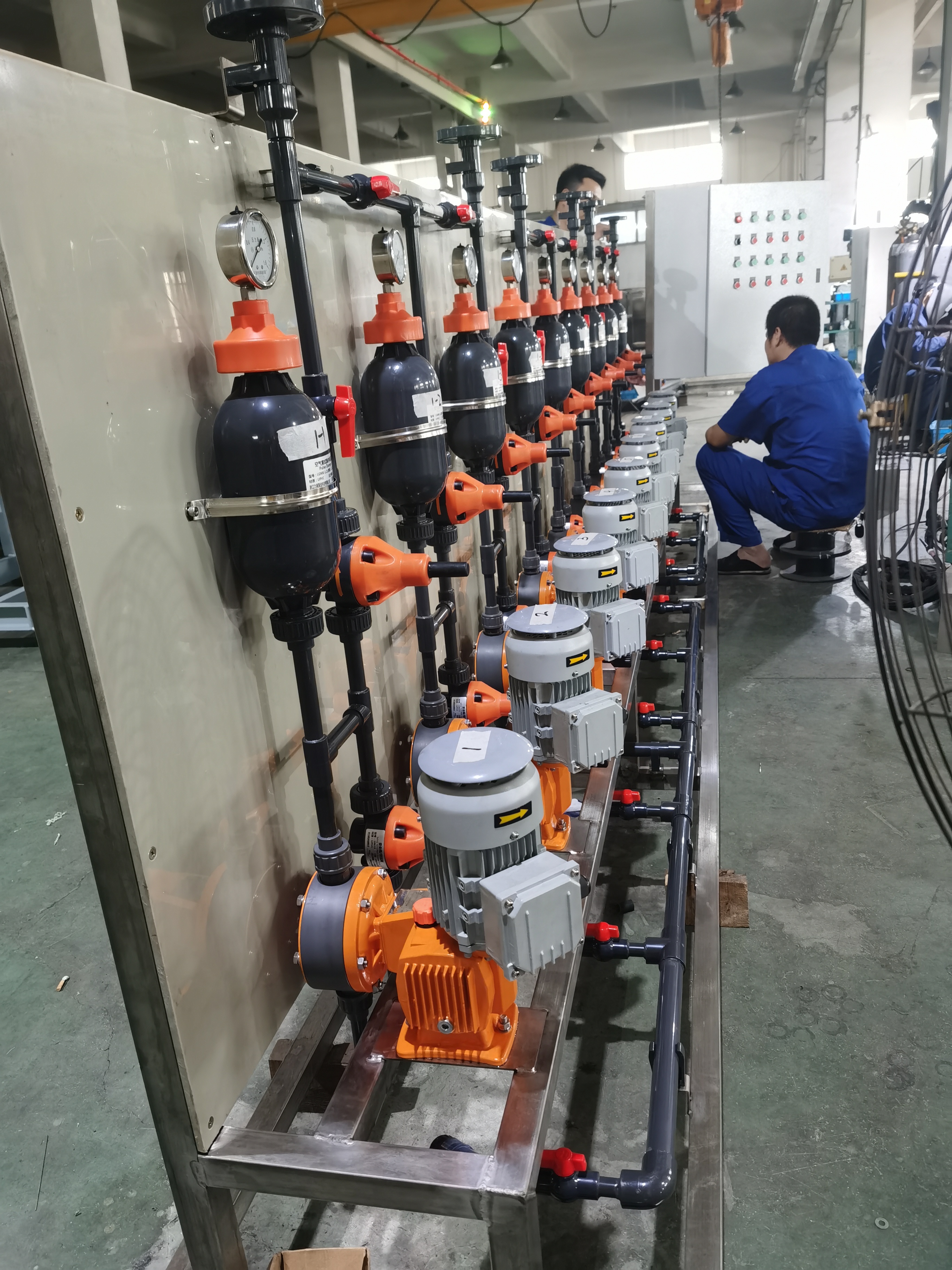
Device workshop: dosing and metering equipment preparation area. The wetted end of the pump — not the motor — is where most corrosion-related decisions are made.
Industrial water treatment is a chemical logistics problem before it is a mechanical one. Coagulants in clarification, acid and caustic for pH correction, oxidants for disinfection and antiscalants ahead of membranes all have to be introduced into a flowing stream in controlled quantities — and most of those chemicals are aggressive toward the equipment that doses them. Matching a dosing pump to that duty is therefore a two-part decision: selecting an actuation principle that fits the pressure and flow envelope, and selecting wetted materials that can live with the fluid.
This article examines how that decision plays out between hydraulic metering pumps and solenoid dosing pumps in industrial water treatment and chemical injection duty, and why material selection — not drive type — usually determines how long the installation lasts.
- Corrosive duty changes the selection order: flow rate, then pressure, then pump head material, then motor.
- Solenoid dosing pumps cover low flow at moderate pressure, with PVC, PVDF or SS316 wetted parts available in the same envelope.
- Hydraulic metering pumps extend the pressure envelope into high-pressure injection, with SS316 wetted parts.
- Check valves, pulse dampeners and tubing carry the same corrosion risk as the pump head, and are frequently the first point of failure.
Corrosion Decides the Wetted Path, Not the Motor
The failure that takes a dosing pump out of service in a water treatment plant is rarely the motor or the control electronics. It is usually the wetted path: a pump head that has been chemically attacked, a check valve that no longer seats, or a diaphragm that has hardened and stopped flexing predictably. Corrosive fluids act on the parts they touch, so the practical question at specification stage is not how robust the machine is, but which materials in the fluid path can hold their properties for the service life of the asset.
Material availability across this equipment range is a useful starting point. Dosing pump heads and wetted sets are offered in PVC, PVDF and SS316/SS316L depending on the model. For highly corrosive media, the material guidance attached to this product family recommends a PVDF pump head. That recommendation is the single most consequential corrosion-related decision in a water treatment dosing duty, because flow rate, pressure rating and control mode are all undermined if the head degrades early.
The selection order follows from that logic. Product-selection guidance for this family places flow rate first: the required dosing flow is compared against the maximum flow rate at the site, and pressure, pump head material and motor are then refined around that figure. In corrosive duty the material step carries more weight than it does in benign duty, because it determines the service interval rather than merely influencing it.
Hydraulic and Solenoid Actuation Cover Different Duty Envelopes
Actuation principle determines what a pump can do hydraulically, and in this product family the two most relevant platforms for chemical dosing in water treatment and chemical injection are solenoid dosing pumps and hydraulic metering pumps. Piston dosing pumps occupy the metal-wetted middle ground between them.
Solenoid dosing pumps: low flow, moderate pressure, flexible wetted materials
A solenoid dosing pump uses an electromagnetic coil to actuate the diaphragm directly. That keeps the unit compact, removes the need for a gear motor and hydraulic circuit, and makes the wetted-material choice the dominant variable. Two models illustrate the envelope:
- ML0008PR1C — solenoid dosing pump, flow rate 1–20 L/H, pressure 1–10 bar, manual control, 220V/110V input, IP65 protection, wetted materials in PVC, PVDF or SS316.
- EML0020PR1C — solenoid dosing pump, flow rate 1–20 L/H, pressure 1–10 bar, remote control, 220V/110V input, IP65 protection, wetted materials in PVC, PVDF or SS316.
Because the same hydraulic envelope is available in three wetted material sets, the solenoid platform is where material matching is easiest to apply in practice: one pump body can be specified for a benign coagulant or for more aggressive chemistry by changing the head material. This is also the platform most commonly encountered in low-flow duties such as pH correction and disinfection support dosing, where flow requirements are modest and pressure demand is set by the injection point rather than by the process line.

Solenoid dosing pump platform: the same 1–20 L/H envelope can be supplied with PVC, PVDF or SS316 wetted parts, which is what makes material selection the decisive step for corrosive fluids.
Hydraulic metering pumps: high pressure, low flow, metal wetted parts
Hydraulic metering pumps use a motor-driven hydraulic circuit to actuate the diaphragm. That arrangement buys discharge pressure far beyond what a solenoid platform provides, at the cost of flow range and mechanical simplicity. Two models define the family:
- HS008S0P01S11 — hydraulic metering pump, 2 L/H at 200 bar, DN6 bevel end welding tube connection, 0.37 kW motor, SS316 wetted material, available with frequency and explosion-proof motor options.
- HL090S0P01F11 — hydraulic metering pump, 1600 L/H at 6 bar, DN50 flange connection, 1.5 kW motor, SS316 wetted material, available with frequency and explosion-proof motor options.
The practical reading is straightforward. Hydraulic metering pumps are the family to consider when a dosing line has to inject against high process pressure — a duty that sits outside the solenoid envelope entirely. At low pressure and low flow, by contrast, the hydraulic platform is more machine than the application requires, and the material issue is narrowed to stainless steel grades because that is what the wetted set offers.
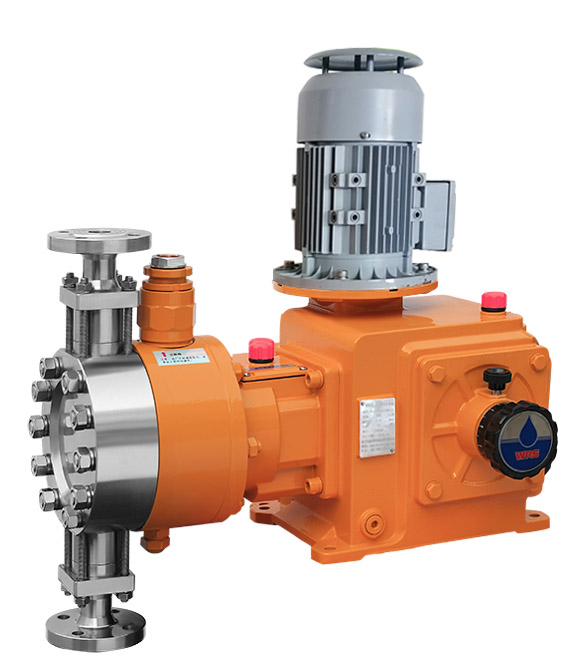
Hydraulic metering pump platform: pressure capability well above solenoid designs, with SS316 wetted parts and a duty envelope concentrated at low flow.
Piston dosing pumps: a rigid metal displacement element
Piston dosing pumps replace the flexible diaphragm with a rigid displacement element in the fluid path, which changes both the sealing arrangement and the way the pump interacts with the medium:
- PM060SS1PFN11 — piston dosing pump, 600 L/H at 8 bar, DN25 flange connection, 0.75 kW motor, SS316 wetted material.
- PD105SS1PFN11 — piston dosing pump, 600 L/H at 8 bar, DN50 flange connection, 4.0 kW motor, SS316 wetted material.
Both models are available with frequency and explosion-proof motors. The boundary matters here: piston and diaphragm designs tolerate fluids differently, and for a given aggressive medium the appropriate construction has to be confirmed against the actual fluid rather than assumed from the material grade alone.
Duty envelopes side by side
| Family | Representative models | Specified duty envelope | Wetted materials offered |
|---|---|---|---|
| Solenoid dosing pump | ML0008PR1C, EML0020PR1C | 1–20 L/H; 1–10 bar | PVC, PVDF, SS316 |
| Hydraulic metering pump | HS008S0P01S11 | 2 L/H; 200 bar | SS316 |
| Hydraulic metering pump | HL090S0P01F11 | 1600 L/H; 6 bar | SS316 |
| Piston dosing pump | PM060SS1PFN11, PD105SS1PFN11 | 600 L/H; 8 bar | SS316 |
| Digital dosing pump | EMML0060FP1E, EMGP0200FP1C, EMAP1000PQ1C | 60, 200 and 1000 L/H at 4 bar | PVC, PVDF, SS316L |
Matching Material to Fluid — and to the Whole Wetted Loop
Material selection does not stop at the pump head, and this is where many corrosive-duty installations fail in practice. A PVDF head installed on a pump whose check valve seats, gaskets, tubing or fittings are in a less resistant material simply relocates the corrosion problem downstream. The wetted loop has to be evaluated as one system: head, valves, seals, tubing and injection point.
Two boundaries deserve to be stated plainly. First, there is no universal corrosion-proof dosing pump: the PVDF recommendation applies to highly corrosive media, and material choice remains medium-specific, because the same chemical at a different concentration or temperature can behave differently toward a polymer or a stainless grade. Second, material resistance is not the only constraint — the enclosure and installation environment matter as well. In one livestock nutrient-solution dosing application recorded for this equipment range, the site conditions were a harsh, humid farm environment with 24/7 operation and an automatic system, and the stated project requirement was IP67 protection, beyond the IP65 rating of the standard models listed above. Site conditions add requirements that a material datasheet alone will not capture.
Check Valves, Pulse Dampeners and Monitoring: The System Layer
A chemical dosing system is more than a pump, and the accessory layer is where corrosion and flow-stability problems typically surface first. Dosing pump check valves govern whether the pump holds pressure and meters accurately; a check valve that has been chemically attacked will leak back and distort the dose. Dosing pump pulse dampeners smooth the pulsation inherent to positive-displacement dosing, which improves the reliability of downstream measurement and control, particularly where a streaming current monitoring system is used to track coagulant performance.
The troubleshooting pattern in the attached product knowledge is instructive because it is so common in water treatment. When discharge flow rate drops or becomes unstable, the documented first cause is a blocked inlet or outlet; the documented response is to check the strainer, tubing and valves, cleaning or replacing them as necessary. Material degradation and mechanical blockage often present the same symptom, which is why material selection and maintenance practice belong in the same conversation during specification.
Where Each Family Fits in Industrial Water Treatment
Applied to real water treatment duties, the matching logic resolves into recognisable patterns:
- Coagulant and flocculant dosing in clarification and settling stages: low flow, low injection pressure, continuous operation — solenoid and digital dosing pumps.
- pH correction with acid or caustic: modest flow but elevated material risk, where PVDF or an appropriate alternative head material carries more weight than hydraulic capability.
- Disinfection and oxidation dosing: aggressive oxidants, low flow, where the wetted set and the accessory materials determine service interval.
- Antiscalant and chemical injection into pressurised lines: higher injection pressure, where hydraulic metering pumps are the appropriate platform.
- Higher-flow transfer and process dosing: piston dosing pumps at 600 L/H and 8 bar, or digital dosing pumps at 60, 200 and 1000 L/H with 4 bar capability, depending on the control and material requirement.
The application scope declared for this equipment range extends beyond municipal and industrial water treatment into electroplating and surface treatment, chemical industry, oil and gas, hydrogen power generation, paper and pulp production, semiconductor, mining and livestock. The common thread is the same one that governs water treatment: a controlled volume of a chemically active liquid has to enter a process at a defined rate, and the fluid path has to survive the contact.
Market Trend Analysis: Where the Corrosion Question Is Heading
Water and wastewater treatment remains one of the largest application segments for metering pumps, according to Grand View Research, which means the material decisions taken in water treatment plants shape a substantial share of the global installed base. Diaphragm dosing pumps hold the largest product-segment share of the dosing pump market in the same analysis — and because the diaphragm is by definition the barrier between the mechanism and the fluid, the industry's central corrosion interface is the diaphragm and its surrounding wetted materials.
Mordor Intelligence analysis of the metering pump market indicates that motor-driven metering pumps account for the largest share of revenue, while solenoid-driven dosing pumps are the segment projected to grow at a steady pace through the early 2030s. The implication for buyers is that both platforms will remain standard options for years, so the selection discipline described here — envelope first, materials second — is unlikely to be replaced by a single dominant design.
Regulation is tightening in parallel. The EU Machinery Regulation, which repeals and replaces 2006/42/EC from 2027, requires CE marking for metering pump units placed on the European market. API 675 remains the primary international standard for positive displacement reciprocating pumps with integrated controlled capacity, and ISO 14847:1999 specifies technical requirements for rotary positive displacement pumps. Together these frameworks push material declarations, rated limits and compliance evidence earlier into the procurement process — a shift that favours suppliers able to document what is actually in the fluid path. Asia Pacific, for context, accounts for the largest regional share of dosing pump revenue according to Grand View Research, so the documentation practices established in that supply base will influence global buying expectations.
Long-Term Fit: What Corrosive Duty Reveals About a Supplier
Corrosion is a slow failure mode, which means it evaluates suppliers over years rather than at commissioning. A pump that performs well in a benign duty for twelve months says little about how a supplier behaves when a corrosive medium starts attacking a head at month eighteen. Three supplier characteristics matter more in corrosive duty than in ordinary dosing: material documentation, spares continuity, and service proximity.
WRS PTE LTD — the brand under which ZHEJIANG WRS MACHINERY EQUIPMENT CO., LTD manufactures and supplies dosing and metering equipment from Hangzhou, Zhejiang, China — offers a useful reference point for how these factors are structured. The company was founded in 2016, operates a 15,000 m² facility with around 120 employees and a 15-engineer R&D team, and reports an annual output of 30,000 units, with approximately 20% directed to export markets in Southeast Asia, Russia and South America. Its stated positioning spans metering pumps, solenoid, diaphragm, piston and digital dosing pumps, check valves, pulse dampeners, chemical dosing systems, streaming current monitoring systems and chemical injection pumps.
On lifecycle support, the company reports local after-sales service in more than ten countries, including Singapore, Thailand, Malaysia, Vietnam, South Korea, Japan, Russia, Chile, South Africa, Angola and Turkey. For a water treatment operator running a fleet of dosing points, that footprint matters less as a sales argument than as a spares and response question — the practical test is whether a replacement head or check valve can be obtained before a dosing line is shut down for an extended period.
Commercial terms also shape long-term fit. The purchasing terms recorded for this equipment include a minimum order quantity of one unit, FOB delivery terms, pre-shipment testing as the acceptance criterion, and 100% payment in advance. A single-unit minimum is relevant to corrosive-duty evaluation because it allows a buyer to validate material performance on one aggressive duty before committing a plant-wide standard. The boundary here is equally clear: a one-unit trial validates a specific material-fluid pairing under specific site conditions, and it does not by itself certify the same configuration for a different chemical, concentration or temperature.
Standardising on a single platform across a plant is another long-term decision worth taking seriously. A mixed fleet multiplies spare-part inventories and complicates material documentation, whereas a common platform makes it easier to keep track of which head material is installed where — and, in corrosive service, that record is what prevents a maintenance technician from replacing a PVDF head with whatever is on the shelf.
Comparison with Traditional Solutions and Where the Boundaries Are
Against non-metering alternatives, the case for dedicated dosing equipment rests on control rather than on raw capacity. Product-comparison data associated with this pump family places dosing pumps ahead of screw pumps on dosing accuracy in small-flow duties, with lower cost at small flow rates, less maintenance and higher efficiency. In small-flow chemical dosing, that combination is the reason positive-displacement dosing pumps displaced simpler transfer solutions in the first place.
The boundaries, however, are real and worth stating before a specification is fixed:
- Solenoid dosing pumps are not high-pressure machines. Their specified envelope is 1–10 bar. A duty that must inject into a high-pressure line is not a solenoid application regardless of how favourable the material options look.
- Hydraulic metering pumps are not high-flow machines at high pressure. The high-pressure model in this range delivers 2 L/H at 200 bar; where larger volumes are needed, the operating pressure in the family drops to 6 bar at 1600 L/H, and piston models sit at 600 L/H and 8 bar.
- Digital control does not change wet-end chemistry. Digital dosing pumps improve repeatability and integration, but a PVC head in an incompatible medium will still degrade.
- Material compatibility is medium-specific and must be verified. The PVDF recommendation applies to highly corrosive media generally; it is not a blanket approval for every aggressive chemical, and the rest of the wetted loop must be reviewed alongside it.
- Installation and maintenance can mask material problems. A blocked strainer, tube or valve produces the same unstable-flow symptom as a degraded check valve, so diagnosis has to separate mechanical blockage from chemical attack.
Future Outlook
Two directions are reshaping how dosing pumps are matched to corrosive duties. The first is digitalisation. WRS states that its entire dosing pump line has been upgraded to digital and intelligent operation, under the design concept summarised as "Every Drop. SMART Control" — simpler design, easier application, and a closer fit to complex fluid-addition processes. Digital control does not alter material compatibility, but it does make dose records, alarm signals and integration with plant control systems more accessible, and better records make it easier to detect when a wetted component is starting to drift.
The second is instrumentation-led dosing. Streaming current monitoring systems allow coagulant performance to be observed as it happens rather than inferred from downstream turbidity, which shifts the pump's role from timed injection toward a controlled response. As that pattern spreads, the pressure on material selection increases rather than decreases: a pump that must modulate continuously is exposed to its chemical environment more of the time than one running at a fixed rate.
Regulatory documentation is likely to follow the same trajectory. With CE marking obligations for metering pump units tightening in the EU from 2027 and API 675 and ISO 14847:1999 providing established reference frameworks for positive displacement pump specification, buyers should expect material declarations and rated-limit evidence to become routine tender attachments rather than optional extras. The practical consequence for procurement teams is straightforward: ask which wetted materials are in the head, the check valves and the seals, and ask for that answer in writing before the order is placed — not after the first head is replaced.
FAQ
Which pump head material is recommended for highly corrosive chemicals?
For highly corrosive media, a PVDF pump head material is recommended. Across this equipment range, pump heads are available in PVC, PVDF and SS316/SS316L depending on the model, and the correct choice is medium-specific rather than universal, because different chemicals interact differently with the same material.
What is the first parameter to compare when selecting a dosing pump?
Flow rate is treated as the most important parameter. The selection process compares the required dosing flow against the maximum flow rate available at the site, and then refines the choice using pressure, pump head material and motor specification.
The discharge flow rate has dropped or become unstable. What should be checked first?
The documented first cause is a blocked inlet or outlet. The recommended check covers the strainer, tubing and valves, cleaning them or replacing them as necessary. Because chemical attack on a check valve or head can produce the same symptom, material condition should be inspected at the same time.
When is a hydraulic metering pump a better fit than a solenoid dosing pump?
A hydraulic metering pump is the appropriate platform when the dosing line must inject against high process pressure. In this range, hydraulic metering pumps are specified at up to 200 bar at low flow with SS316 wetted parts, while solenoid dosing pumps are specified within 1–20 L/H and 1–10 bar. Where pressure demand is modest, the solenoid platform offers the same flow envelope with a wider choice of wetted materials.
How does corrosive duty change the way a long-term supplier is evaluated?
Corrosion is a slow failure mode, so suppliers are effectively evaluated over the service life of the wetted components rather than at commissioning. Relevant factors include a documented after-sales service footprint — this manufacturer reports local service in more than ten countries — replaceable spares such as heads and check valves, and model continuity that keeps those spares available years after the initial purchase.
What commercial terms apply to an initial order?
The recorded purchasing terms for this dosing pump range are a minimum order quantity of one unit, FOB delivery terms, pre-shipment testing as the acceptance criterion, and 100% payment in advance. The single-unit minimum allows a buyer to validate one specific material-fluid pairing on site before standardising a larger installation.
Conclusion
In corrosive duty, the pump is not really the product being selected — the wetted material set is. Hydraulic metering pumps and solenoid dosing pumps cover different pressure and flow envelopes, and the choice between them should follow the hydraulic requirement first. What determines whether the installation survives, however, is whether the head, valves, seals and tubing were matched to the actual fluid rather than to a chemical family name, and whether the supplier behind them can still provide the same materials years later. Further technical detail on pump head construction is available in the diaphragm separator reference document, and additional application notes are published at wrsdosing.com.
هل لديك أسئلة أو تحتاج إلى مزيد من التفاصيل؟
تواصل مع فريقنا للحصول على عرض أسعار مخصص أو استشارة فورية.
طلب عرض أسعار
املأ النموذج أدناه وسيتواصل معك فريقنا بعرض مقترح مخصص.
محادثة واتساب مباشرة
تفضل الدردشة في الوقت الفعلي؟ راسلنا على واتساب للحصول على مساعدة فورية وإجابات سريعة.
- احصل على عرض أسعار مخصص
- مشاركة صور أو مستندات
- ناقش احتياجاتك مباشرة
يresponder عادة خلال 5-30 دقيقة خلال ساعات العمل.