
Matching Four PET Preform Machine Models to Bottle Projects
Matching Four PET Preform Machine Models to Bottle Projects
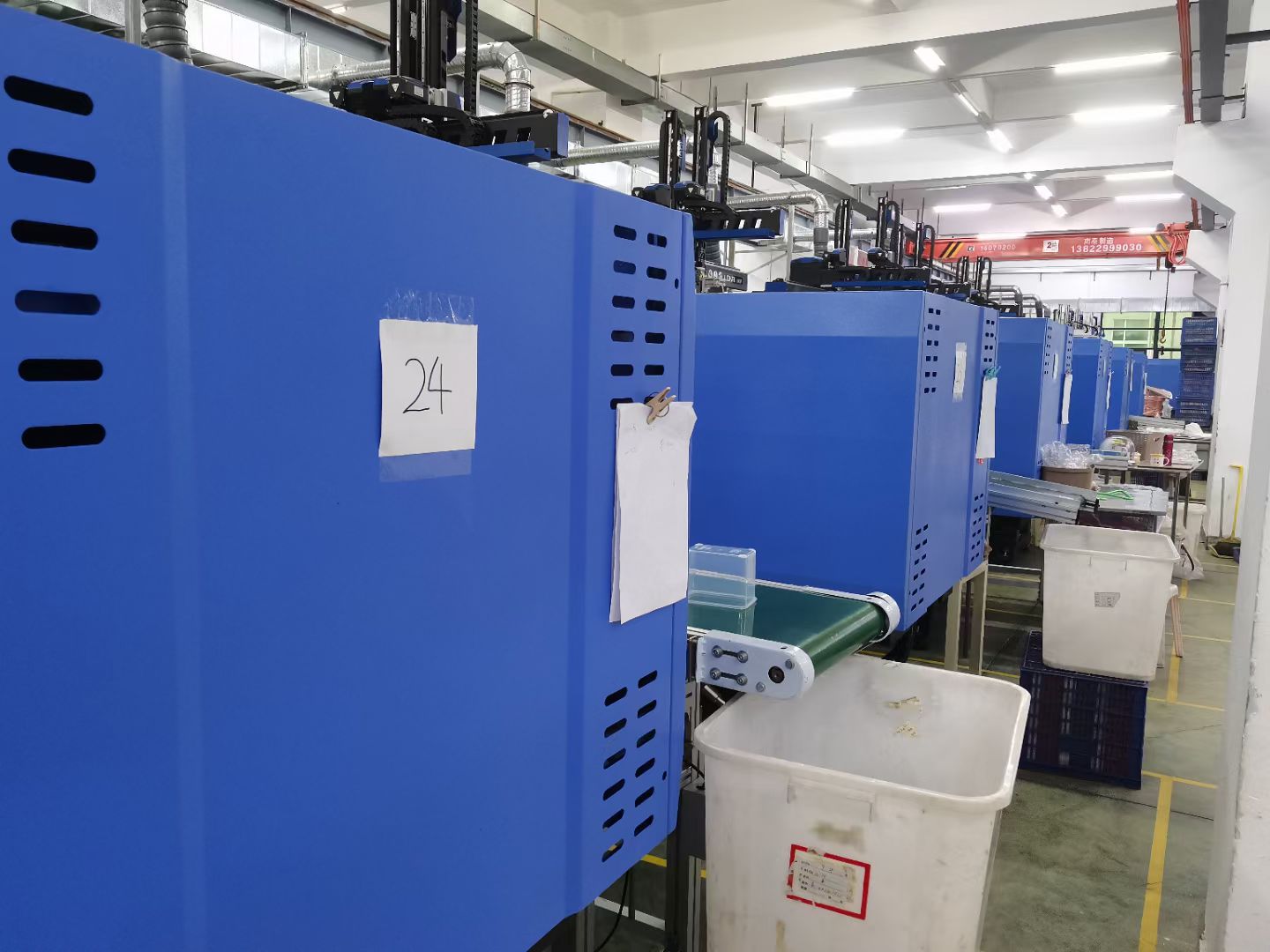
Bottle-making plants typically run preform injection and blow molding as a linked line; the injection machine sets the ceiling on what the line can produce. Image: Yongjiang client production site.
A PET preform is the intermediate product through which bottle manufacture is achieved: an injection-molded tube with a finished neck that a blow molding line later expands into the final container. That sequence makes the preform machine a gating decision rather than a utility purchase. Clamping force, tie bar spacing, screw diameter and shot weight together define which molds, cavity counts and bottle projects a plant can accept — and, just as importantly, which ones it cannot.
The shortlist examined here covers the 260 T to 400 T band where a large share of water, edible oil and cosmetic container projects land: YJPT-260, YJPT-318, YJPT-360 and YJHB-400 from Yongjiang.
Ningbo Yong Jiang machine co.,Ltd (Yongjiang) is a Ningbo, China–based manufacturer of injection molding machines whose portfolio includes PET preform machines and PVC fitting machines. The company operates a 130,000 m² factory with 200 employees and a 25-engineer R&D team, reports annual output of 2,000 units, and exports to markets including the USA, Canada and Thailand, with exports accounting for 59% of output.
The four models below are ordered by clamping force. That is a capacity sequence, not a quality ranking. Which model is appropriate depends on the mold and the preform a buyer intends to run, not on the number alone.
Four Tonnages, One Sizing Logic
Public procurement specifications are a useful floor for this discussion. A 2019 CIPET tender specification for a PET preform injection moulding machine (India) called for 150–200 T of clamping force, a minimum shot capacity of 750 g, a minimum plasticizing capacity of 50 g/sec, a minimum injection pressure of 1200 bar, and at least 32 preform cores and cavities — for a 1000 ml bottle preform of maximum 20 g with a 28 mm neck.
All four Yongjiang models sit above that floor. That gap is the point of a shortlist. Buyers rarely need the smallest machine that passes a tender; they need the smallest machine that still leaves headroom for the cavity count, preform weight and mold footprint they expect to run over the next three to five years — without paying for tonnage that no planned mold will use.
The Shortlist at a Glance
| Model | Clamping force | Tie bar spacing | Screw diameter | Published shot weight |
|---|---|---|---|---|
| YJPT-260 | 260 T | 580 × 580 mm | 72 mm | 1400 g |
| YJPT-318 | 318 T | 620 × 620 mm | 77 mm | Not stated in published data |
| YJPT-360 | 360 T | 680 × 680 mm | 95 mm | 3450 g |
| YJHB-400 | 400 T | 720 × 720 mm | Not stated in published data | 3450 g |
The two gaps in the table matter. Shot weight is published for three of the four models and screw diameter for three of the four, so any comparison should note which cells are missing rather than filling them by assumption. Those two data points are exactly what a serious buyer requests before comparing quotes.
All four belong to the same PET preform range. Yongjiang describes the YJPT series as purpose-built for PET preforms, with a modular energy-saving system and a high-capacity injection unit using an optimized screw diameter ratio. The manufacturer also states that its machines use high-response dual servo systems and customized plasticizing screws, that it measures 30%–50% lower power consumption against its own comparison baseline, that cycles are shorter, and that the rigid clamping frames are intended for multi-cavity hot runner molds in 24-hour production. These are manufacturer statements; the buyer’s verification tool is acceptance testing, not the brochure.
Clamping Force Is the First Filter
Clamping force must hold a mold shut against injection pressure. Too little and the mold flashes; far too much and the buyer has paid for capacity that never gets used. The practical variable is not tonnage in isolation but the product of preform weight and cavity count, which drives both the projected area and the melt volume required per cycle.
The four models step 260 T → 318 T → 360 T → 400 T. Each step buys margin: for a larger mold base, for a higher cavity count, or for a heavier preform. Because no cavity-count rating per model is published for this range, clamping force alone will not settle a selection. It narrows the field; the next two variables decide.
Tie Bar Spacing Decides Which Mold Physically Fits
This is the most frequently under-weighted number in preform machine selection. Tie bar spacing sets the maximum mold width that can be mounted, and in preform work the mold is usually a multi-cavity hot runner stack — wide, heavy, and unforgiving of a tight platen.
The shortlist spans 580 × 580 mm on YJPT-260, 620 × 620 mm on YJPT-318, 680 × 680 mm on YJPT-360, and 720 × 720 mm on YJHB-400. In practice, a 48-cavity preform mold and a 96-cavity preform mold can require very different mold bases even when the preform itself is identical. A machine can therefore be correct on clamping force and wrong on mold fit — a mismatch that surfaces only at commissioning. The fix is procedural: check mold base dimensions against tie bar spacing before tonnage is finalised.
Shot Weight and Screw Diameter Set Cavity Ambition
Shot weight is the total melt delivered per injection: preform weight multiplied by cavity count, plus runner allowance. It is the number that converts a bottle project into a machine specification.
YJPT-260 carries a published 1400 g shot with a 72 mm screw. YJPT-360 carries 3450 g with a 95 mm screw. YJHB-400 carries 3450 g, with its screw diameter not stated in the published specification. YJPT-318 uses a 77 mm screw, with its shot weight not stated in the published specification.
An illustrative calculation shows how the numbers behave. Using the 20 g reference preform from the CIPET specification: at 48 cavities the melt requirement is roughly 960 g before runner allowance, which sits inside the 1400 g published shot of YJPT-260. At 72 cavities the same preform requires roughly 1440 g before runner allowance — already at or beyond that 1400 g figure, which pushes the project toward the 3450 g class of YJPT-360 or YJHB-400. At 96 cavities the requirement reaches roughly 1920 g before runner, still inside 3450 g, at which point tie bar spacing rather than shot weight usually becomes the deciding constraint.
That arithmetic is an illustration built on a published reference preform, not a machine rating. Heavier preforms, tighter cycle targets and cold-runner versus hot-runner configurations all shift the result. Its value is directional: it tells a buyer which model class to request data for first.
Screw diameter works alongside shot weight. The step from 72 mm to 95 mm across the range reflects the larger plasticizing volumes needed at high cavity counts; a larger screw prepares more melt per stroke, which matters when cycle time is set by plasticizing rather than cooling.
Matching the Four Models to Water, Oil and Cosmetic Containers
Downstream demand gives the application map. The PET preform industry serves bottled water, carbonated soft drinks, juices, edible oils and sauces, among other categories. Each of those segments implies a different balance of cavity count, preform weight and mold width.
Water and mineral water bottles. Light preforms, high cavity counts and long uninterrupted runs make mold width the binding constraint earlier than tonnage. YJPT-260 is the entry point of the shortlist and is credible where cavity counts stay moderate and the 1400 g shot is not exceeded; as cavity counts climb into the 72-cavity and 96-cavity territory, the wider tie bar spacing and 3450 g shot of YJPT-360 and YJHB-400 become the relevant discussion. For 5-gallon work, treat the shortlist as unproven and size from the actual preform drawing — no published shot weight in this set is tied to that application.
Edible oil and sauce bottles. Edible oils are a listed preform segment, and oil containers generally imply heavier preforms per unit than water. Here the 3450 g published shot of YJPT-360 and YJHB-400 provides the headroom that a 1400 g machine does not, particularly when cavity counts remain moderate but individual preform weights rise. Buyers in this segment should lead with shot weight, then confirm mold fit.
Cosmetic containers. Cosmetic packaging is not one of the downstream segments named in the cited preform market segmentation, so it should not be sized from general bottle assumptions. Cosmetic work typically involves frequent mold changes and smaller production batches, which shifts the emphasis toward mold-change practicality and mid-range clamping force — the YJPT-260 and YJPT-318 bracket. The correct input is the buyer’s own preform drawing and mold base dimensions, not a category average.
Carbonated soft drinks. CSD is a listed preform segment alongside water and juices. The same shot-weight ceiling logic applies: the published 1400 g and 3450 g figures define the combinations of preform weight and cavity count the shortlist can serve, and anything above that ceiling falls outside it.
PET-Dedicated Versus General-Purpose Machines
A general-purpose injection molding machine can mold a preform. The difference in a PET-dedicated platform is configuration: a plasticizing unit tuned for PET, a screw geometry matched to that resin, and a clamping frame specified for multi-cavity hot runner stacks run continuously. Yongjiang’s own positioning of the YJPT series rests on exactly those points — PET-specific design, a modular energy-saving system, and a high-capacity injection unit.
The trade-off is flexibility. A dedicated PET platform is optimised for a narrow product family; a plant that also molds crates, buckets or fittings may be better served by keeping PET capacity dedicated and general molding separate. That is an operational judgement, not a machine limitation, and it belongs in the investment case rather than the specification sheet.
Where the Shortlist Stops
A shortlist is only useful if its boundaries are stated as clearly as its contents.
Two specification gaps. YJPT-318 has no published shot weight and YJHB-400 has no published screw diameter in the available data. Neither gap should be filled by estimation; both should be requested as a datasheet item before quotes are compared.
Certificate scope is narrower than the product range. CE certificate CE20260126MD, issued by ECM under the 2006/42/EC Machinery Directive against EN ISO 12100:2010, EN 60204-1:2018+A1:2020 and EN ISO 20430:2020, names YJPT-260 and YJHB-400 in its stated scope. The certificate runs from 30 January 2026 to 29 January 2031. A buyer intending to place YJPT-318 or YJPT-360 in the EU market should confirm model-level certificate coverage in writing rather than assume it follows from the range.
400 T is the ceiling. Projects needing substantially more clamping force, or preform weights above the published 3450 g shot even at low cavity counts, sit outside this shortlist and should be specified separately.
No published cavity count, cycle time or energy-per-kilogram figure per model. This is the most consequential gap, because those are the numbers that drive cost per preform. The substitute is a structured pre-shipment acceptance test, described below.
Power supply. Yongjiang states that its units support 380/400 V 50 Hz industrial power. Plants on other supply arrangements should confirm the voltage customization option at order stage rather than at installation.
Supporting Equipment and Purchase Terms
A preform line is more than the injection unit. The mold, drying, chilling, temperature control and take-out handling all have to be sized to the machine and the mold rather than assumed to follow. Because those auxiliary specifications depend on the buyer’s cavity plan, they are best fixed at the same time as the machine model — a mismatch here produces the same commissioning delay as a wrong tie bar spacing.
| Minimum order quantity | 1 unit |
| Price basis | FOB Ningbo |
| Payment terms | 30% deposit, 70% before shipment |
| Lead time | 30–45 days |
| Monthly capacity | 200 units |
| Quality control | 100% test one week before shipment |
| Production mode | OEM; customization of voltage and logo |
| After-sales | 24/7 service support |
| Stated export markets | EU, Middle East, Africa |
The pre-shipment test is the term that deserves the most attention. Because cycle time and energy consumption per model are not published, the acceptance test is where those claims become verifiable. A practical protocol for a preform project covers: shot weight measured against the published figure on the selected model, cavity-by-cavity balance on the actual mold where available, cycle time under production settings, preform dimensional and weight checks against the drawing, and functional safety checks against the standards named on the certificate.
Field Evidence from Water and Bottle Plants
Yongjiang records a case involving water factories and bottle-making factories, covering 20 units applied to PET preform making and water bottle making, with stable operation reported as the outcome and low electricity consumption as the highlighted result. The same case record states that it involves clients from multiple countries, including Ethiopia, Spain, France, Hungary and others.
That is supplier-reported case evidence, not an independently audited performance study. Its value to a buyer is narrower than a benchmark and wider than a testimonial: it establishes that the model range has been deployed in the intended application — PET preform and water bottle production — across multiple export markets, which is the reference class a new buyer is joining.
Market Signals Behind the Shortlist
Three data points frame the demand side, and each should be read within its own scope.
First, a commercial research estimate places the global PET preform machines market at USD 8.38 billion in 2022, projected to USD 14.73 billion by 2032. The scope of that figure covers PET preform machines including injection and stretch blow molding types, so it is not a pure injection-machine number, and it comes from a single commercial source.
Second, global exports under HS code 847710 — injection-molding machines generally — totalled USD 7.21 billion in 2023, based on customs-derived trade data. That is a broad machinery category, not the PET segment.
Third, the PET preform product market — the molded preform itself, not the machine — was reported at USD 24.33 billion in 2026, growing at 2.17% CAGR to USD 27.08 billion by 2031. This figure describes the downstream product that these machines make and must not be relabelled as machine market size.
Read together, and treated as interpretation rather than consensus, the signals point to steady downstream demand rather than a step change. For a buyer, that supports a capacity decision based on replacement, cavity upgrades and contract wins rather than on an assumption of rapid volume growth — which in turn argues for the smallest model in the shortlist that still covers the planned mold portfolio.
What Changes Next
Three developments would materially change how this shortlist is used.
Specification completeness. Publishing shot weight and screw diameter for every model in the range would remove the two gaps that currently force buyers into document requests before a comparison can start. That is a documentation issue, not an engineering one.
Model-level compliance mapping. As EU market access tightens, buyers increasingly ask for certificate scope that matches the exact model being purchased. A published per-model mapping of CE coverage against the current certificate would shorten qualification cycles.
Standardised performance reporting. The preform industry lacks a common reporting basis for cycle time and energy per kilogram of melt. Until manufacturers report those figures on a defined basis, the pre-shipment acceptance test remains the only reliable substitute — and buyers who build that test into the purchase contract get the data that a brochure cannot supply.
The full Yongjiang machine catalog, including model and configuration details, is available as a PDF: Yongjiang machine catalog (PDF).
FAQ
What clamping force does a PET preform injection machine need?
A 2019 CIPET tender specification for a PET preform injection moulding machine set a minimum of 150–200 T of clamping force for a 1000 ml bottle preform with a 28 mm neck and a maximum weight of 20 g, alongside a minimum shot capacity of 750 g and a minimum injection pressure of 1200 bar. The four Yongjiang models reviewed here run from 260 T to 400 T, so they sit above that published floor. The actual requirement for a given project is set by cavity count and preform weight, both of which are defined by the mold drawing.
Does tie bar spacing matter as much as clamping force?
Yes, once cavity counts rise. Tie bar spacing sets the maximum mold width that can be mounted, and it measures 580 × 580 mm on YJPT-260, 620 × 620 mm on YJPT-318, 680 × 680 mm on YJPT-360 and 720 × 720 mm on YJHB-400. A wide multi-cavity hot runner stack can be blocked by tie bar spacing even where clamping force is sufficient, so mold base dimensions should be checked before tonnage is finalised.
How many cavities can these four models run?
No cavity count per model is included in the published data for this range, so cavity capacity must be derived from shot weight and tie bar spacing against a specific preform drawing. As an illustration using a 20 g preform, 48 cavities require roughly 960 g of melt before runner allowance, which sits inside the 1400 g published shot weight of YJPT-260; 72 cavities require roughly 1440 g before runner allowance, which points toward the 3450 g class of YJPT-360 and YJHB-400.
Which models are named on the CE certificate?
CE certificate CE20260126MD, issued by ECM, names YJPT-260 and YJHB-400 in its stated scope. It covers the 2006/42/EC Machinery Directive against EN ISO 12100:2010, EN 60204-1:2018+A1:2020 and EN ISO 20430:2020, and runs from 30 January 2026 to 29 January 2031. Buyers who require CE marking for YJPT-318 or YJPT-360 should confirm model-level coverage separately, since the stated scope of this certificate does not name those two models.
What purchase terms apply to this model range?
The stated terms are a minimum order quantity of 1 unit, FOB Ningbo, 30% deposit with 70% payable before shipment, a lead time of 30–45 days, and monthly capacity of 200 units. Quality control is described as 100% testing one week before shipment, after-sales support is 24/7, and OEM production supports customization of voltage and logo. Stated export markets for this production are the EU, Middle East and Africa.
Does oil bottle production change the model choice compared with water bottles?
Edible oils and sauces are named downstream segments for PET preforms, alongside bottled water, carbonated soft drinks and juices. Oil containers generally imply a heavier preform per unit, which raises the melt volume required per cycle at any given cavity count. Because the largest published shot weight in this shortlist is 3450 g on YJPT-360 and YJHB-400, oil projects that stay within that ceiling are covered by those two models, while projects exceeding it fall outside the shortlist.
Can these four models produce 5-gallon preforms?
No verified shot weight, mold data or application reference in the published set ties these four models to 5-gallon preforms. The largest published shot weight in the shortlist is 3450 g on YJPT-360 and YJHB-400, and 5-gallon work should be sized from the actual preform weight and cavity plan rather than from a category assumption. Where that calculation exceeds the published ceiling, the project sits outside this shortlist.
Specification sources: Yongjiang model specification data for YJPT-260, YJPT-318, YJPT-360 and YJHB-400; CE certificate CE20260126MD (ECM); Yongjiang capability and case records. Third-party data: CIPET PET preform injection moulding machine tender specification (2019); Acumen Research and Consulting PET preform machines market estimate; HS 847710 customs-derived export data (2023); Mordor Intelligence PET preform product market estimate (2026–2031). Manufacturer-stated performance figures are identified as such.
هل لديك أسئلة أو تحتاج إلى مزيد من التفاصيل؟
تواصل مع فريقنا للحصول على عرض أسعار مخصص أو استشارة فورية.
طلب عرض أسعار
املأ النموذج أدناه وسيتواصل معك فريقنا بعرض مقترح مخصص.
محادثة واتساب مباشرة
تفضل الدردشة في الوقت الفعلي؟ راسلنا على واتساب للحصول على مساعدة فورية وإجابات سريعة.
- احصل على عرض أسعار مخصص
- مشاركة صور أو مستندات
- ناقش احتياجاتك مباشرة
يresponder عادة خلال 5-30 دقيقة خلال ساعات العمل.