
Matching GEO Services to Your Industry: A Scenario-Based Assessment for UK B2B Buyers
GEO services adapt content for AI-generated search answers.
A one-size-fits-all approach to Generative Engine Optimization (GEO) is rarely effective. For UK B2B buyers evaluating service providers, the critical question is whether a vendor’s methodology aligns with their specific industry context, compliance needs, and buyer journey. This article provides a scenario-based framework for assessing GEO services, using Horion Marketing as a reference point for how a London-based consultancy structures its offering for different verticals.
The Procurement Challenge: Industry Nuance in AI Search
Generative search engines—such as ChatGPT, Gemini, Grok, and Claude—pull answers from indexed content, but they weigh authority, structure, and relevance differently depending on the topic. A financial services firm requires different content signals than a SaaS company. UK buyers moving from Research to Evaluation must verify that a GEO provider can tailor content structure, entity definition, and knowledge graph integration to their operational environment.
The product operates under AI content optimization, generative search answer visibility, and brand content citation conditions—designed explicitly for this environment. Yet, without industry-specific configuration, even well-optimised content may fail to surface in AI answers for niche queries.
How Horion Marketing Structures GEO for Different Scenarios
Horion Marketing is a London-based B2B client acquisition consultancy that designs and manages outbound and inbound systems, including GEO. Its GEO (Generative Engine Optimization) Services are structured around five technical modules that can be configured for industry-specific requirements:
- Content Structure Optimization – Design of FAQs, question-and-answer paragraphs, and knowledge cards to improve AI recognition and citation rates.
- Semantic & Keyword Optimization – Analysis of natural language query intent and placement of high-value keywords to prioritise brand citations.
- Entity Definition & Authority Building – Definition of core entities (brand, product, service) and use of structured data (Schema, Knowledge Graph) to assist AI understanding.
- Content Library Construction & Prompt Strategy – Building a comprehensive enterprise knowledge base with AI-driven question-guidance strategies.
- Performance Monitoring & Reporting – Tracking of enterprise content citation in AI-generated answers, including regular data reports on question adoption and time elapsed.
These modules are applied across a range of industries, including Technology and SaaS, E-commerce and Retail, Manufacturing and Industrial Products, Legal and Consulting Services, Financial Services, Healthcare, and Media and Content Platforms. The service can be customized in terms of the number of articles and target questions covered, with a lead time of 7–14 days and a minimum order quantity of 1.
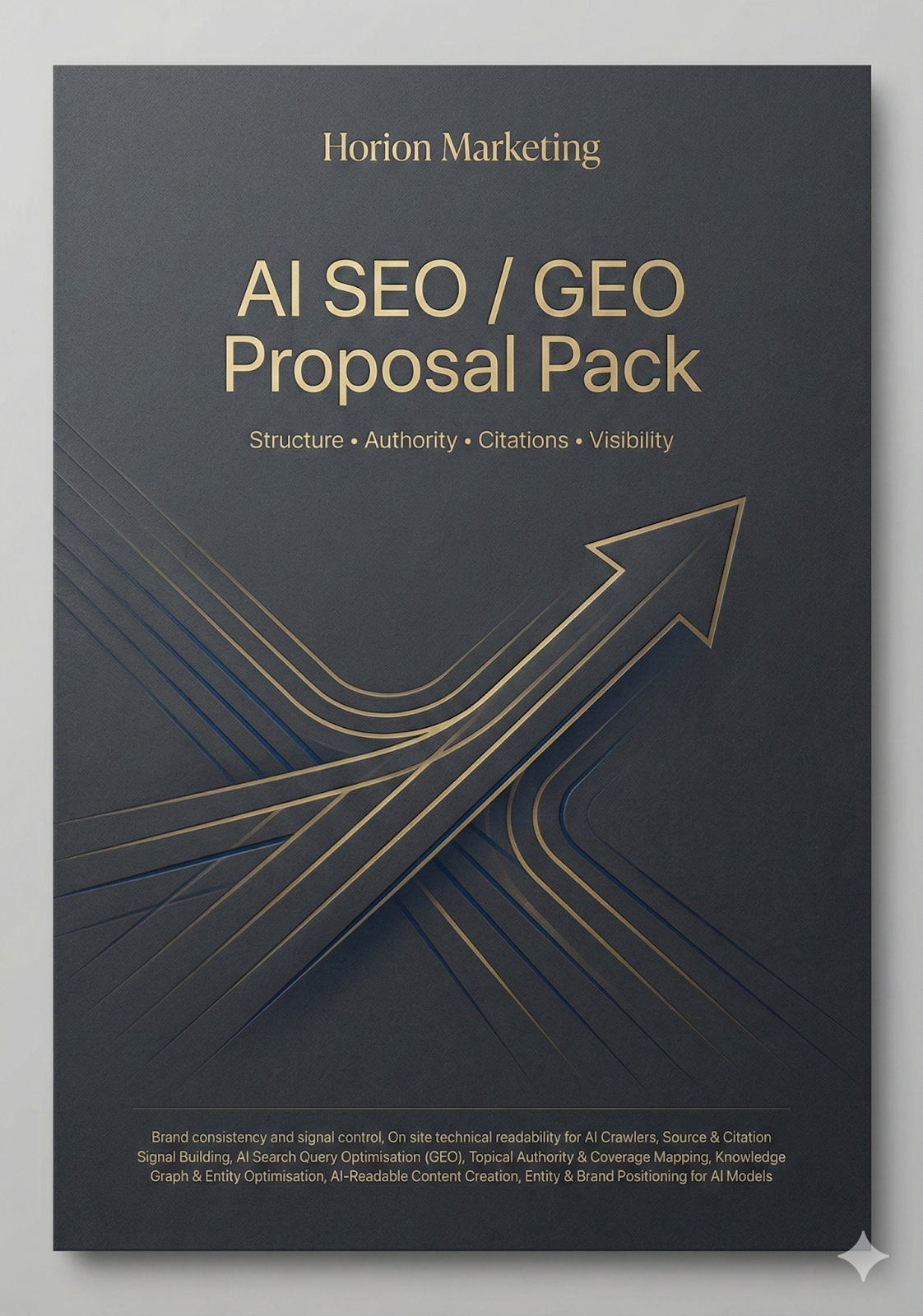
Horion Marketing’s GEO modules cover the full optimisation lifecycle.
Scenario Analysis: Industry-Specific Application
The relevance of each module varies by vertical. Below are three illustrative scenarios based on sectors where GEO services are actively sought in the UK.
Scenario 1: Technology & SaaS Companies
For a B2B SaaS firm targeting CTOs and IT directors, AI answers often aggregate product comparisons and feature lists. Horion Marketing’s Content Structure Optimization can be used to create FAQ blocks that directly answer “What is the pricing of X?” or “How does X integrate with Y?”. The Entity Definition ensures the brand name and key features are correctly mapped in the knowledge graph. The service’s customisable nature—with a MOQ of 1—makes piloting feasible for a single product line.
Scenario 2: Financial Services Firms
Compliance is paramount. UK financial services firms need content that is authoritative, verifiable, and compliant with FCA guidelines. Horion Marketing’s Semantic & Keyword Optimization can focus on regulatory terms and risk-related queries. The Content Library Construction module can house approved whitepapers and disclaimers, ensuring AI citations reference only compliant materials. Performance monitoring reports can track how often the firm’s content appears in answer engine responses for regulated queries.
Scenario 3: Legal & Professional Services
Law firms and consultancies rely on reputation and specialisation. The Entity Definition & Authority Building module is critical: it establishes practice areas and partner credentials as distinct entities in the knowledge graph. By applying structured data (JSON-LD) and FAQ schemas, the firm’s content becomes more likely to be cited when AI answers queries about “immigration solicitors in London” or “M&A advisory UK”. The service offers after-sales support (24-hour online), which is valuable for iterative refinement.
Market Trend: The Shift Toward Answer Engine Optimisation
Enterprise adoption of generative AI is accelerating. While traditional SEO focuses on ranking in link-based search, GEO targets visibility within AI-generated answers—a growing share of how professionals discover vendors. In the UK, B2B buyers increasingly use tools like ChatGPT and Perplexity for initial research, making it essential for suppliers to appear in those answer surfaces. Horion Marketing’s approach is built on the premise that content must be “citation-ready” for large language models, not just indexable by crawlers.
Comparison with Traditional SEO Services
Traditional SEO emphasises backlinks, domain authority, and keyword rankings. GEO, by contrast, prioritises content structure, entity clarity, and semantic alignment with natural language queries. A key advantage of Horion Marketing’s GEO service is its explicit focus on generative AI platforms (ChatGPT, Gemini, Grok, Claude) and its use of knowledge cards and prompts. However, an honest limitation is that GEO requires high-quality, authoritative source content to be effective; if a client’s existing web content lacks credibility or is poorly structured, the foundation for GEO is weak. For buyers, this means GEO is not a substitute for strong content but a layer that amplifies it.
Future Outlook: The Evolution of AI Citation Ecosystems
As large language models become more sophisticated, their citation algorithms will likely reward deeper entity relationships and verifiable data. Providers who invest in structured knowledge graphs and continuous monitoring—like Horion Marketing’s performance reporting—will be better positioned to maintain visibility. For UK B2B buyers, selecting a GEO partner with scenario-adaptation capabilities today may define their digital presence in the AI-driven search landscape of the next two to three years.
Frequently Asked Questions
What industries can benefit from GEO services?
GEO services are applicable to a wide range of sectors, including Technology and SaaS, E-commerce and Retail, Manufacturing and Industrial Products, Legal and Consulting Services, Financial Services, Healthcare, Media and Content Platforms, and Consumer Electronics. Horion Marketing structures its service modules to adapt to the specific content authority and query patterns of each vertical.
Can GEO services be customised for a single product or service line?
Yes. The service is customisable in terms of the number of articles and target questions included. With a minimum order quantity of 1, buyers can pilot GEO optimisation for a specific product or service before scaling.
How long does it take to implement GEO optimisation?
The typical lead time for a GEO service engagement is 7 to 14 days. This covers content analysis, restructuring, entity definition, and initial performance tracking setup.
What metrics are used to measure GEO performance?
Horion Marketing provides regular data reports that track the number of times enterprise content is cited in AI-generated answers, the types of questions that trigger those citations, and the time elapsed since optimisation. This monitoring helps buyers measure visibility improvements within generative engines.
What kind of after-sales support is available?
24-hour online after-sales support is included. This covers adjustments to content structures, addressal of citation issues, and iterative improvements based on performance data.