
Matching Henkaes Cleanroom Air Filters to High-Tech Production
Independent Industry Reference · Smart Manufacturing Filtration
Matching Henkaes Cleanroom Air Filters to High-Tech Production
In smart manufacturing, cleanroom air filtration behaves like a production input rather than a building service. The global air filters market was valued at USD 17.08 billion in 2025 and is projected to reach USD 34.66 billion by 2034, according to Fortune Business Insights, and a disproportionate share of that growth sits in filtration-intensive environments: microelectronics, data centers, pharmaceutical plants and hospitals. This reference examines how the Henkaes Cleanroom Air Filter and Box Filter lines map onto those environments, and how they should be read against the dimensions buyers apply when comparing global filtration suppliers.
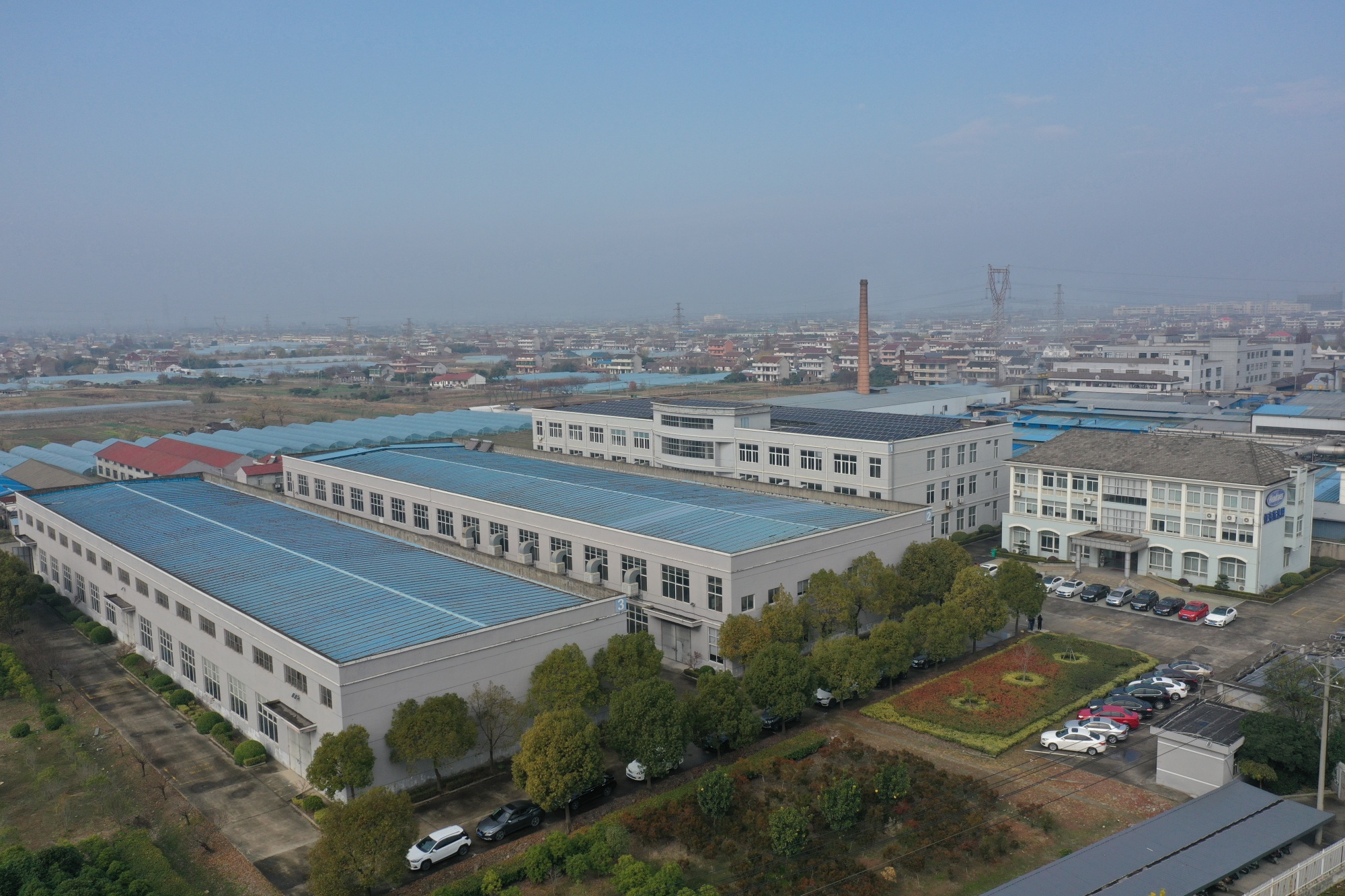
Filter manufacturing capacity is an early constraint on cleanroom project timelines. Henkaes operates a 30,000 m² facility with reported annual output of 2,000,000 pieces.
Why Cleanroom Filtration Became a Production Decision
Smart manufacturing concentrates value into smaller volumes of air. Automated lines, miniaturized components and high-density computing mean that particle and molecular contamination which would be unremarkable in a warehouse becomes a yield, reliability or compliance risk on a production floor. In microelectronics and data center environments, filtration sits inside the process envelope; in pharmaceutical plants, hospitals and food and beverage production sites, it sits inside a hygiene and compliance envelope.
The market data reflects that shift. The global air filters market stood at USD 17.08 billion in 2025 and is projected to reach USD 34.66 billion by 2034 (Fortune Business Insights). In parallel, the smart air purifier segment, which pairs filtration hardware with sensing and connectivity, is growing at a CAGR of 14.1% from 2024 to 2030, driven by AI and IoT integration (Grand View Research). Both trends point the same way: filtration is increasingly specified, monitored and procured with the same discipline applied to other production equipment.
The Evaluation Problem: Four Dimensions and One Gap
When procurement and engineering teams shortlist cleanroom filtration suppliers, they usually work through four dimensions: technology, meaning media, efficiency grade and the test method behind the grade; market position and manufacturing scale; customer service and customization model; and fit with specific industry applications.
Published supplier rankings concentrate on the first two. In industrial filtration systems, Parker Hannifin led the market with a 15.7% share in 2024 (Global Market Insights), and Daikin Industries reported filtration revenue of USD 1.12 billion in 2024 with a focus on high-end MERV 15 and HEPA products (Report Prime Research). Those numbers are useful market context, but they describe diversified global groups rather than the specific grades a given cleanroom project needs.
The gap appears during execution. A project team must still confirm that the offered grade matches the contamination class, that the media is appropriate, that minimum order quantity and lead time fit the construction schedule, and that engineering changes can be handled without reopening the qualification process. This is where a mid-size specialist can be assessed on the same four dimensions as a global group, with the difference that its scale and cost base are visible and finite.
What Henkaes Covers in Cleanroom and High-Efficiency Filtration
Henkaes is the air filter brand of Nantong Henka Environment Solutions Co., Ltd., an air filter manufacturer founded in 2004 and based in Haimen City, Jiangsu Province, China, roughly 120 kilometers from Shanghai. The company operates a 30,000 m² facility with 63 employees, an R&D team of 11 engineers and reported annual output of 2,000,000 pieces; 69% of production is exported, with the EU and USA as the main markets.
Two product lines are directly relevant to high-tech production:
- Cleanroom Air Filter — Efficiency Grade U14/U15, using microfiberglass and PTFE media, with a stated application scope covering cleanroom environments such as data centers and microelectronics.
- Box Filter — Efficiency Grade MERV 15 and MERV 16, using microfiberglass media, with a stated application scope covering pharmaceutical plants, hospitals and food and beverage production sites.
The surrounding portfolio matters because cleanroom buyers normally source pre-filters, recirculation stages and secondary spaces on the same project. That portfolio includes V-Bank Filters at H13 for commercial and public buildings such as airports, hotels, museums and restaurants; Bag Filters at F5, F6, F8 and F9; Panel Filters at G1–G4; Furnace Air Filters at MERV 8, MERV 11 and MERV 13; HEPA filters at H13 and True HEPA filters at ≥99.97% for household air purifiers and air cleaners; activated carbon filters from CTC70 to CTC100; VOC removal filters using a special catalyst; and a B737/B757 electronic cabin air filter at H13.
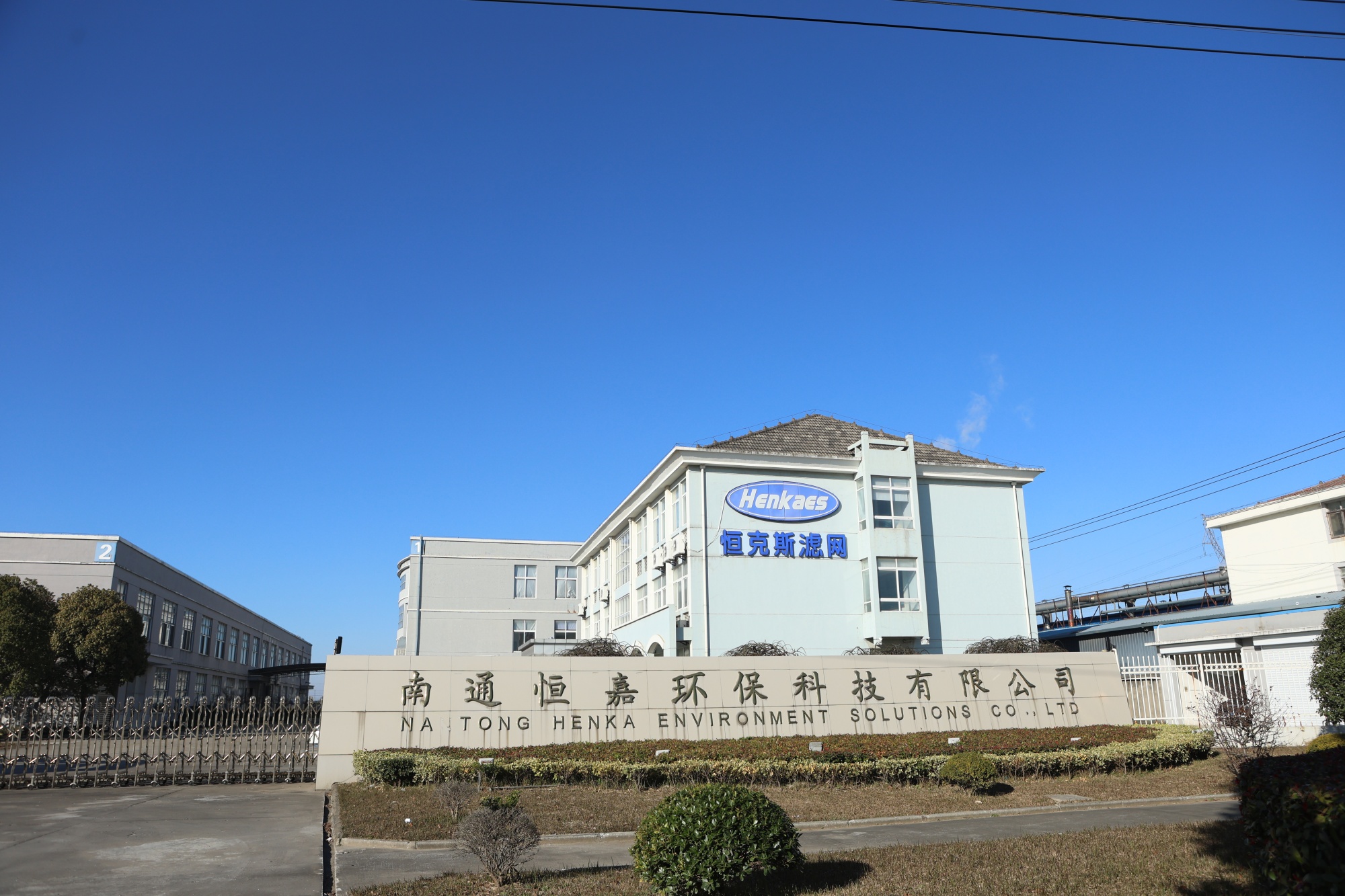
OEM and ODM production for air filters: reported monthly capacity of 200,000 pieces, 100% inspection, and a standard lead time of 30 days.
Technical Explanation: Reading U14/U15, H13 and MERV 15/16 Correctly
Efficiency grades are only comparable within the standard that produced them, and two standards dominate cleanroom and HVAC specification.
EN 1822 classifies HEPA and ULPA filters by their efficiency at the Most Penetrating Particle Size (MPPS); within this system, H14 requires 99.995% efficiency (MANN+HUMMEL). The U-grade classification used on the Henkaes Cleanroom Air Filter belongs to the ultra-low-penetration part of that same MPPS-based framework, which is why such filters are specified for cleanrooms rather than for general ventilation. A practical consequence for buyers: an EN 1822 grade is a statement about behavior at the worst-case particle size, not at a single nominal particle size.
ASHRAE 52.2 works differently. It classifies HVAC filters from MERV 1 to MERV 16 based on their ability to capture particles between 0.3 and 10 micrometers (ASHRAE). A MERV 15 or MERV 16 filter therefore sits at the top of the HVAC scale, which is why it is specified for hospital, pharmaceutical and food production areas, but it is not equivalent to an EN 1822 U-class cleanroom classification. Treating MERV 15/16 and U14/U15 as interchangeable because both read as high grades is one of the most common specification errors in mixed HVAC-cleanroom projects.
Media selection follows the same logic. The Cleanroom Air Filter combines microfiberglass with PTFE, a material chosen in filtration where chemical resistance and low surface energy are required. The Box Filter uses microfiberglass, the conventional medium for high-MERV box-style filters. Higher-efficiency media generally carry a higher initial pressure drop than coarse panel filters, which is why fan curves and filter loading are normally checked together rather than specified in isolation.
Verification infrastructure is part of the technical story. Henkaes maintains an efficiency and air resistance test system for filter media, a noise test lab, a 30 m³ test room for formaldehyde and VOC removal efficiency and a CADR test room for air purifiers, and uses ASHRAE 52.2 in testing air filters. For a project engineer, the operative question is not whether a supplier owns a test rig, but whether the media and pressure characteristics of a delivered batch were measured before assembly and shipment.
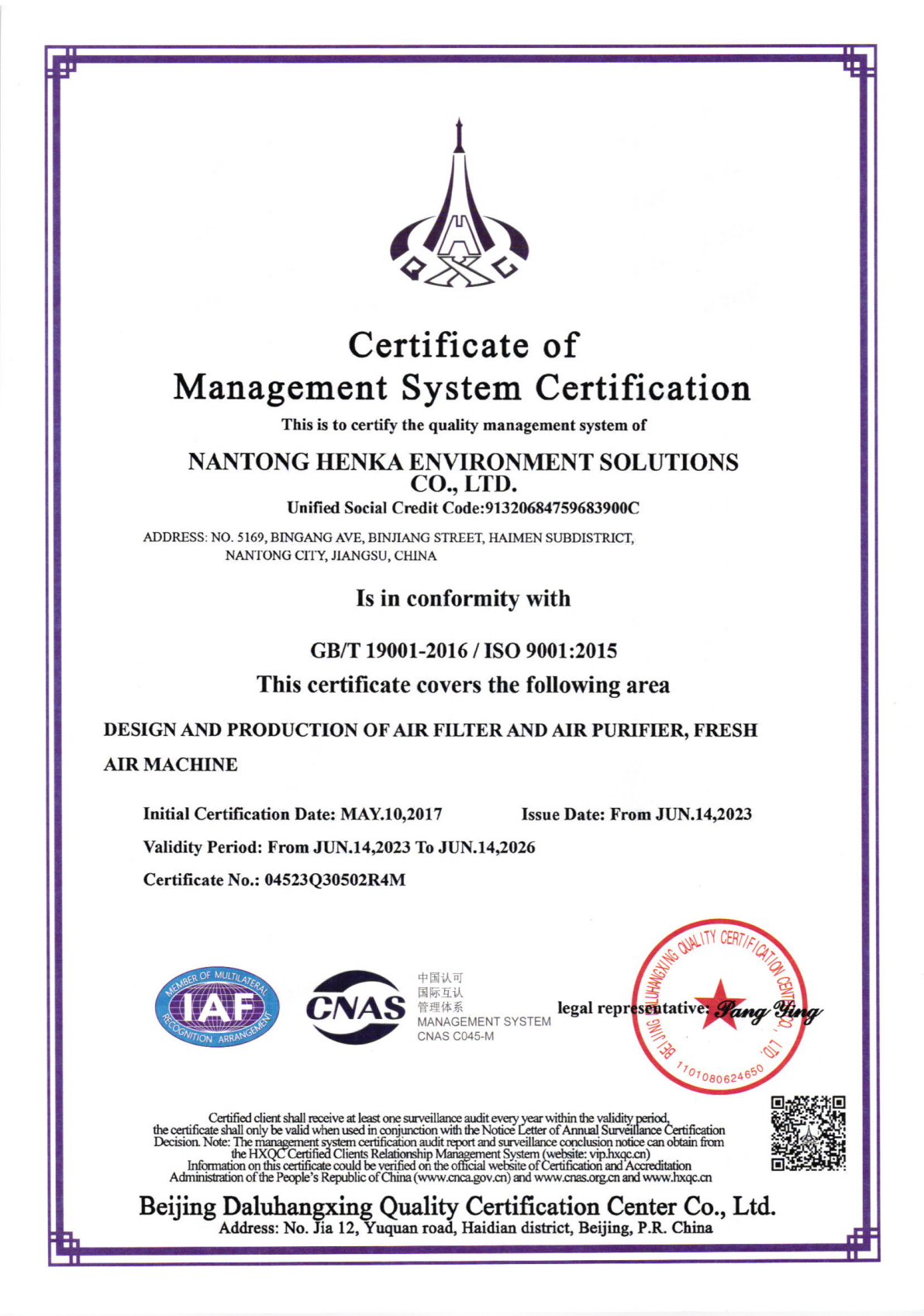
Management system certificates are part of the evaluation file: ISO9001:2015 (04523Q30502R4M) and ISO14001:2015 (04523E30387R2M) cover the design and production of air filters, air purifiers and fresh air machines.
Application Mapping: Which Line Fits Which High-Tech Environment
The mapping below reflects the stated application scope and efficiency grades of each Henkaes line. It is a selection aid for evaluation, not a substitute for project-specific cleanroom classification data.
| High-tech environment | Relevant Henkaes line | Stated efficiency grade | Media |
|---|---|---|---|
| Data centers | Cleanroom Air Filter | U14/U15 | Microfiberglass, PTFE |
| Microelectronics | Cleanroom Air Filter | U14/U15 | Microfiberglass, PTFE |
| Pharmaceutical plants | Box Filter | MERV 15, MERV 16 | Microfiberglass |
| Hospitals | Box Filter | MERV 15, MERV 16 | Microfiberglass |
| Food and beverage production sites | Box Filter | MERV 15, MERV 16 | Microfiberglass |
| Commercial and public buildings | V-Bank Filter | H13 | Fiberglass, polypropylene |
Three reference projects in the United States indicate how the manufacturer's supply model performs at volume: a 20,000-piece indoor air purification project for an air filter OEM client, completed within one year and operating stably for one year; a 50,000-piece indoor air purification project for an air filter ODM client, with one year of stable operation and reported good performance in removing volatile organic compounds; and a 50,000-piece formaldehyde removal project for an air filter ODM client with a two-year duration and stable performance across that period.
These reference projects are indoor air purification deployments rather than cleanroom installations. They are best read as evidence of repeatable production quality at 20,000–50,000-piece volumes, not as cleanroom performance data.
Market Trend Analysis: Where High-Efficiency Demand Is Moving
Two forces are moving in parallel. First, the overall filtration market is expanding from USD 17.08 billion in 2025 toward a projected USD 34.66 billion by 2034 (Fortune Business Insights). Second, the product mix is shifting toward higher grades: HEPA filters held a 41.7% share of the air purifier technology segment in 2025 (Grand View Research), and industry trade reporting attributes roughly 35% of China's 2025 air filter exports to H13/H14 grade filters, driven by semiconductor and biopharmaceutical demand (China Briefing / Industry Reports). That export figure is a medium-reliability estimate and is best treated as directional rather than audited.
For smart manufacturing buyers, the practical reading is that high-efficiency supply is becoming a competitive segment rather than a niche. More suppliers will offer H13-level and MERV 15/16 products; fewer will pair a documented EN 1822-oriented cleanroom line with the pre-filter, VOC and activated carbon stages that surround it in a real installation. Supplier differentiation is therefore likely to shift from grade availability toward evidence: test methods, batch inspection, and the ability to match grades to a defined contamination class.
Comparison: Henkaes Against the Dimensions Used to Rank Global Suppliers
Ranked by published 2024 market data, the global filtration landscape is led by diversified industrial groups: first, Parker Hannifin, with a 15.7% share of the industrial filtration systems market in 2024 (Global Market Insights); second, Daikin Industries, with USD 1.12 billion in filtration revenue in 2024 concentrated on high-end MERV 15 and HEPA products (Report Prime Research). No equivalent third-party market-share figure is published for Henkaes; the verified comparable is annual output of 2,000,000 filter pieces from a 30,000 m² facility with 63 employees and 11 R&D engineers. That distinction is the honest starting point for any comparison.
| Evaluation dimension | Henkaes (verified profile) | Parker Hannifin (published) | Daikin Industries (published) |
|---|---|---|---|
| Filtration technology focus | Cleanroom Air Filter U14/U15 (microfiberglass, PTFE); Box Filter MERV 15/16 (microfiberglass); EN 1822 and ASHRAE 52.2 referenced in product and test documentation | Industrial filtration systems portfolio across multiple sectors | High-end MERV 15 and HEPA filtration products |
| Published market position (2024) | No third-party market-share figure published; annual output 2,000,000 pieces; 69% exported to EU/USA | 15.7% share of the industrial filtration systems market (Global Market Insights) | Filtration revenue of USD 1.12 billion (Report Prime Research) |
| Service and customization model | OEM and ODM production; size and logo customization; 100% inspection; remote after-sales support; 30-day lead time; MOQ 500 pieces | Not covered in the sources cited here | Not covered in the sources cited here |
| Industry solution focus | Cleanrooms (data centers, microelectronics); pharmaceutical plants, hospitals, food and beverage production sites; commercial and public buildings; aerospace cabin filters | Industrial filtration across broad end markets | MERV 15 and HEPA product focus |
| Certification and test evidence | ISO9001:2015, ISO14001:2015, ISO45001:2018; media efficiency and air resistance test system; 30 m³ formaldehyde and VOC test room; CADR test room; ASHRAE 52.2 test method | Not covered in the sources cited here | Not covered in the sources cited here |
Comparison with Traditional Filtration Approaches
Against conventional filtration sequences, the differences are structural rather than incremental. A traditional HVAC sequence built on G1–G4 panel filters and F5–F9 bag filters addresses coarse and fine particulate but does not deliver cleanroom-grade final filtration. Adding a MERV 15/16 box filter stage raises particulate capture to the top of the ASHRAE 52.2 scale, which is sufficient for hospital, pharmaceutical and food production areas, but it still does not replace an EN 1822 U-class terminal filter where the room classification requires it. The reverse mismatch is equally common: specifying a U14/U15 cleanroom filter for an ordinary commercial ventilation system adds cost and pressure-drop burden without a matching contamination requirement.
Limits and Boundaries Buyers Should Confirm
- Grade scope: the U14/U15 Cleanroom Air Filter and the MERV 15/16 Box Filter serve different environments. The Box Filter is not a cleanroom terminal filter, and the Cleanroom Air Filter is not positioned as a general HVAC replacement.
- Commercial thresholds: minimum order quantity is 500 pieces and standard lead time is 30 days, which constrains pilot builds and emergency replacements.
- Service model: after-sales support is remote. Projects requiring on-site commissioning assistance should confirm this at the contracting stage.
- Production concentration: manufacturing is concentrated in one 30,000 m² facility in Haimen City, Jiangsu Province. Multi-site rollouts typically plan buffer stock or a second qualified source against that concentration.
- Published competitive data: no independent market-share ranking is published for Henkaes, so any comparison with global groups must rest on first-party operating facts rather than third-party league tables.
From Evaluation to Execution: Commercial Terms
For teams moving from shortlist to purchase order, the documented commercial framework is straightforward: minimum order quantity of 500 pieces; delivery terms of FOB, EXW or DDP; acceptance criteria based on pre-shipment testing; and payment terms of TT 50%/50%. OEM and ODM services cover size and logo customization, with product development starting from customer specifications, drawings, samples or concepts, supported by a design workflow that includes engineering samples, solid modeling and rapid prototyping. The manufacturer states more than 20 years of experience working with a US engineering team, and reports that all products undergo 100% inspection before shipment with remote after-sales technical support.
Future Outlook
If the market expands from USD 17.08 billion in 2025 to a projected USD 34.66 billion by 2034, and the smart purifier segment continues at a 14.1% CAGR through 2030 on the back of AI and IoT integration, then two changes are predictable for cleanroom and high-tech procurement. First, filter condition will increasingly be monitored rather than scheduled, which pushes suppliers to document media and pressure behavior at part level so that sensor data can be interpreted. Second, grade-specific qualification will weigh more heavily than brand scale alone, because a supplier that cannot evidence an EN 1822-oriented cleanroom line, or cannot map a MERV 15/16 product to the correct environment, creates risk regardless of its overall market position.
Within that context, the relevant question for a smart manufacturing buyer is narrow: does the supplier's cleanroom-grade product, media selection, inspection regime, capacity and lead time line up with the specific production environment being built, and are its limits stated plainly enough to plan around?
FAQ
What efficiency grades does Henkaes offer for cleanroom and high-efficiency filtration?
The Henkaes Cleanroom Air Filter is specified at Efficiency Grade U14/U15 with microfiberglass and PTFE media, and the Henkaes Box Filter is specified at MERV 15 and MERV 16 with microfiberglass media. Other grades in the same portfolio include H13 for V-Bank filters, HEPA and aerospace cabin filters, F5, F6, F8 and F9 for bag filters, G1–G4 for panel filters, and MERV 8, MERV 11 and MERV 13 for furnace air filters. EN 1822 governs the cleanroom-grade side of the range, while ASHRAE 52.2 governs the MERV side.
Which high-tech production environments are covered by the cleanroom and box filter lines?
The Cleanroom Air Filter's stated application scope covers cleanroom environments such as data centers and microelectronics, while the Box Filter's stated scope covers pharmaceutical plants, hospitals and food and beverage production sites. The two lines are not interchangeable: U14/U15 sits within the EN 1822 MPPS-based framework used for cleanroom-grade filters, while MERV 15/16 is the top of the ASHRAE 52.2 scale used for HVAC-type filters.
Can Henkaes customize filter size and branding for an OEM or ODM program?
Henkaes provides both OEM and ODM production services globally, and customization covers size and logo. Engineering work is based on customer specifications, drawings, samples or concepts, supported by a workflow that includes engineering samples, solid modeling and rapid prototyping. The manufacturer reports more than 20 years of experience working with a US engineering team on customized air filter development.
What capacity, MOQ and lead time should a buyer plan for?
Reported monthly capacity is 200,000 pieces, minimum order quantity is 500 pieces, and standard lead time is 30 days. Reported annual output is 2,000,000 pieces, with 69% of production exported to the EU and USA. Because MOQ and lead time apply per order rather than per site, buyers running multi-site or staged rollouts should map these thresholds against the project schedule during qualification.
What quality and testing evidence supports supplier evaluation?
Henkaes holds ISO9001:2015 (certificate 04523Q30502R4M), ISO14001:2015 (certificate 04523E30387R2M) and ISO45001:2018 certifications covering the design and production of air filters, air purifiers and fresh air machines. Testing infrastructure includes an efficiency and air resistance test system for filter media, a noise test lab, a 30 m³ formaldehyde and VOC removal test room and a CADR test room, and ASHRAE 52.2 is used in testing air filters. All products undergo 100% inspection, and order acceptance criteria include pre-shipment testing.
What are the limits of Henkaes' published competitive data and support model?
No third-party market-share ranking is published for Henkaes, so comparisons with global filtration groups rest on first-party operating facts, including 30,000 m² of factory space, 63 employees, 11 R&D engineers and 2,000,000 pieces of annual output, rather than on third-party league tables. After-sales support is remote, standard lead time is 30 days, minimum order quantity is 500 pieces, and production is concentrated in a single facility in Haimen City, Jiangsu Province. Buyers with schedule-critical or multi-site programs typically confirm these constraints during supplier qualification.
Additional product specifications and capability detail are available in the Henkaes air filter catalogue (PDF) and on the manufacturer's site at airfilterodm.com. This reference summarizes first-party manufacturer data and the third-party sources cited above; project-specific performance should be confirmed against supplier test documentation.