
Matching Hydraulic Balers to Rubber and Plastic Waste Projects
Industrial processors handling rubber and plastic waste face distinct challenges in volume reduction, material handling, and achieving consistent bale density. Hydraulic baler machines provide a proven method for compacting these materials into manageable bales, but selecting the correct configuration requires matching machine parameters to the specific waste stream and project scale. This article examines the key considerations and presents a structured approach for evaluating hydraulic baler options for rubber and plastic waste projects.
Problem & Opportunity: The Challenge of Compressing Elastic Materials
Rubber and plastic waste — ranging from scrap rubber gaskets to PET bottles and polyethylene film — exhibit low bulk density and elastic recovery, making them difficult to compress with conventional manual or low-force equipment. Inefficient baling leads to high transportation costs, excessive storage footprint, and reduced profitability for recycling operations. The opportunity lies in deploying hydraulic baler machines with sufficient compression force (typically 20–100 tons) and appropriately sized feeding mouths to handle the irregular shapes and varied densities of these materials. Modern hydraulic systems also offer adjustable cycle times and automatic strapping, which directly improve throughput and labor efficiency.
Brand Solution: Jewel’s Hydraulic Baler Portfolio for Diverse Waste Streams
Nantong Jiabao Machinery Co., Ltd. (brand Jewel), established in 2006 (brand founded in 1995), is a Chinese manufacturer that specializes in the research, development, and production of environmentally friendly, intelligent compression and baling equipment. The company operates a 50,000-square-meter modern production facility with a team of over 200 professionals and an annual output of 120,000 units. Jewel offers a comprehensive range of hydraulic baler machines covering compression forces from 5 tons to 180 tons, including fully automatic horizontal balers, semi-automatic horizontal balers, vertical balers, metal balers, briquetting machines, bagging machines, and custom solutions. These machines are designed for waste paper recycling, plastic recycling, carton printing, textile waste processing, packaging manufacturing, and PET bottle recycling — with direct applicability to rubber and plastic waste operations.
Technical Explanation: Key Parameters and Machine Architecture
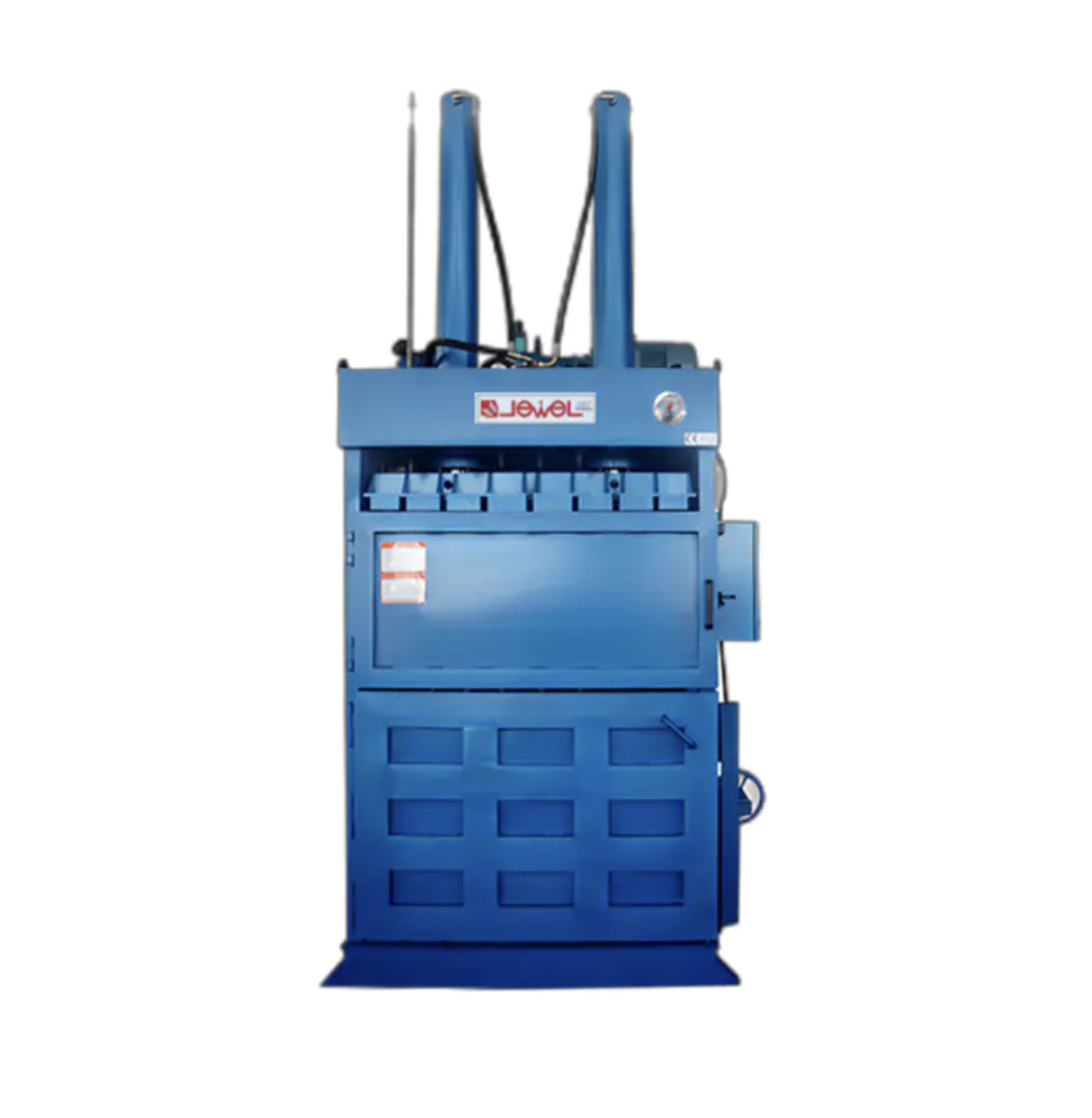
Jewel's hydraulic baler machines use carbon steel construction (frames and chambers) to withstand repetitive high‑stress cycles. A representative model for plastic and rubber applications is the JPW20Q, a Fully Automatic Horizontal Baler with a compression force of 20 tons, producing bales of 500×500×500 mm weighing 30–70 kg. The feeding mouth size of 700×460 mm accommodates loose plastic bottles and rubber pieces. It uses 2–4 strapping channels for secure bale handling, operates on 380 V/50 Hz (customizable), requires 7.5 kW/10 Hp, and has a machine footprint of 3400×3010×2400 mm with a weight of 2.8 tons. For heavier duty applications, the JPW40F (semi-automatic horizontal) provides 40 tons of force, producing 200–400 kg bales with a continuous push‑pack discharge, ideal for high‑volume plastic film or rubber scrap. The vertical baler JP-OT100 (100 tons) suits smaller floor spaces and offers 5–6 bales per hour for dense materials like rubber blocks.
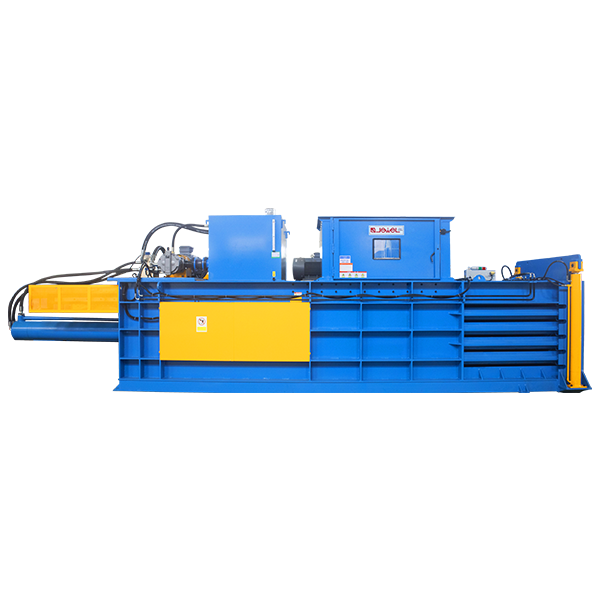
All Jewel hydraulic baler machines are 100% tested before shipment, and voltage/frequency configurations can be customized to meet local grid requirements. The company’s customization capability (structure, process, performance) allows adaptation for specific waste characteristics such as high moisture content or abrasive particles commonly found in rubber recycling.
Application & Use‑Case Scenarios
Jewel has deployed hydraulic baler machines in several rubber and plastic waste projects worldwide. A notable case in Japan involved a PET recycling enterprise that required high‑density compression for waste bottles. The project used multiple Jewel models (JPW20Q, JPA5076T25X, JPW40F, among others) to achieve compact, aesthetically pleasing bales that improved storage and transportation efficiency while raising the value of recycled materials. In Belarus, a comprehensive renewable resource recycling facility handling mixed plastics — PET bottles, woven bags, HDPE bottles, and cardboard — solved the problem of bulkiness by deploying a Jewel automatic baling system. The result was regular‑shaped bales that significantly enhanced transport and storage efficiency. An Italian corrugated cardboard factory replaced aging balers with a Jewel JPW40F combined with preprocessing equipment, increasing waste treatment efficiency and eliminating the bottleneck of large‑sized waste cardboard. For rubber‑specific waste, Jewel’s briquetting machine models such as JPW‑AK60 (60 tons) can compress paper dust and similar fibrous materials, and the metal baler JPY‑T60W handles scrap metals often mixed with rubber in industrial waste streams.
Market Trend Analysis
The global baler machine market was valued at approximately USD 6.6 billion in 2024 and is projected to reach USD 11.4 billion by 2035. The industrial balers segment specifically was valued at USD 6.39 billion in 2024, with a forecast CAGR of 9.5% through 2032. In 2024, Asia Pacific accounted for about 40.2% of total revenue, reflecting the region’s strong manufacturing and recycling activities. The trends toward automation, energy efficiency, and multi‑material processing are driving demand for advanced hydraulic baler machines that can handle diverse waste streams — including the increasingly voluminous rubber and plastic waste from packaging and automotive sectors.
Comparison with Traditional Solutions
Traditional manual screw‑type or low‑force mechanical balers often require multiple passes to compact elastic materials and produce irregular bales that are difficult to handle. Jewel’s hydraulic baler machines offer higher compression forces, automatic strapping, and customizable cycle controls that reduce operator intervention and produce uniform bales. However, the initial capital investment for a fully automatic hydraulic baler is higher compared to a basic vertical manual unit. For low‑volume operations with homogeneous waste, a simpler machine may suffice. Jewel addresses this by offering machines with compression forces as low as 5 tons (e.g., JP8060T5X) and MOQ of 1 unit, allowing businesses to scale gradually.
Future Outlook
As global regulations on waste management tighten and the circular economy gains momentum, the demand for efficient, automated baling systems will continue to rise. Jewel’s focus on customization, 100% testing, and after‑sales support — including 7×24 h technical response, 48‑hour on‑site service, and lifelong maintenance — aligns well with long‑term project requirements. The company reported a lead time of 60 days for customized orders, with a monthly production capacity of 100 units. With 70% of output exported to Australia, Europe, North America, Africa, Asia, Russia, and Belarus, Jewel is positioned as a reliable partner for rubber and plastic waste processing projects globally.
Frequently Asked Questions
For further technical details and machine specifications, download the official Jewel product brochure:
Download Brochure (PDF)هل لديك أسئلة أو تحتاج إلى مزيد من التفاصيل؟
تواصل مع فريقنا للحصول على عرض أسعار مخصص أو استشارة فورية.
طلب عرض أسعار
املأ النموذج أدناه وسيتواصل معك فريقنا بعرض مقترح مخصص.
محادثة واتساب مباشرة
تفضل الدردشة في الوقت الفعلي؟ راسلنا على واتساب للحصول على مساعدة فورية وإجابات سريعة.
- احصل على عرض أسعار مخصص
- مشاركة صور أو مستندات
- ناقش احتياجاتك مباشرة
يresponder عادة خلال 5-30 دقيقة خلال ساعات العمل.