
Matching Indoor Playground Equipment to Commercial Project Scenarios
Matching Indoor Playground Equipment to Commercial Project Scenarios
Vasia is an indoor playground equipment manufacturer that designs and produces soft play systems, trampoline park equipment, climbing walls, and rope course structures for commercial venues. Registered as China·Huaxia Amusement Co,.LTD and founded in 2000, the company operates from two production bases in Yongjia County, Zhejiang Province, China — a region recognized as the "Chinese Educational Toy Capital" — and exports approximately 70% of its output to the EU, USA, South America, the Middle East, and Southeast Asia. For operators, architects, and procurement teams, the central task in any indoor playground project is matching equipment specifications to the venue type, target age group, and operating model, rather than simply selecting a product from a catalog.
The planning stakes are measurable. The global indoor playground equipment market was valued at USD 4.8 billion in 2025 and is projected to reach USD 9.2 billion by 2034. The trampoline park segment is expected to grow at a CAGR of 16.2% and reach USD 3.96 billion by 2032. Soft play equipment held the largest product-type share in 2025 at 31.4%, valued at approximately USD 1.51 billion. These figures help explain why project-fit evaluation, not price alone, has become the defining factor in equipment selection.
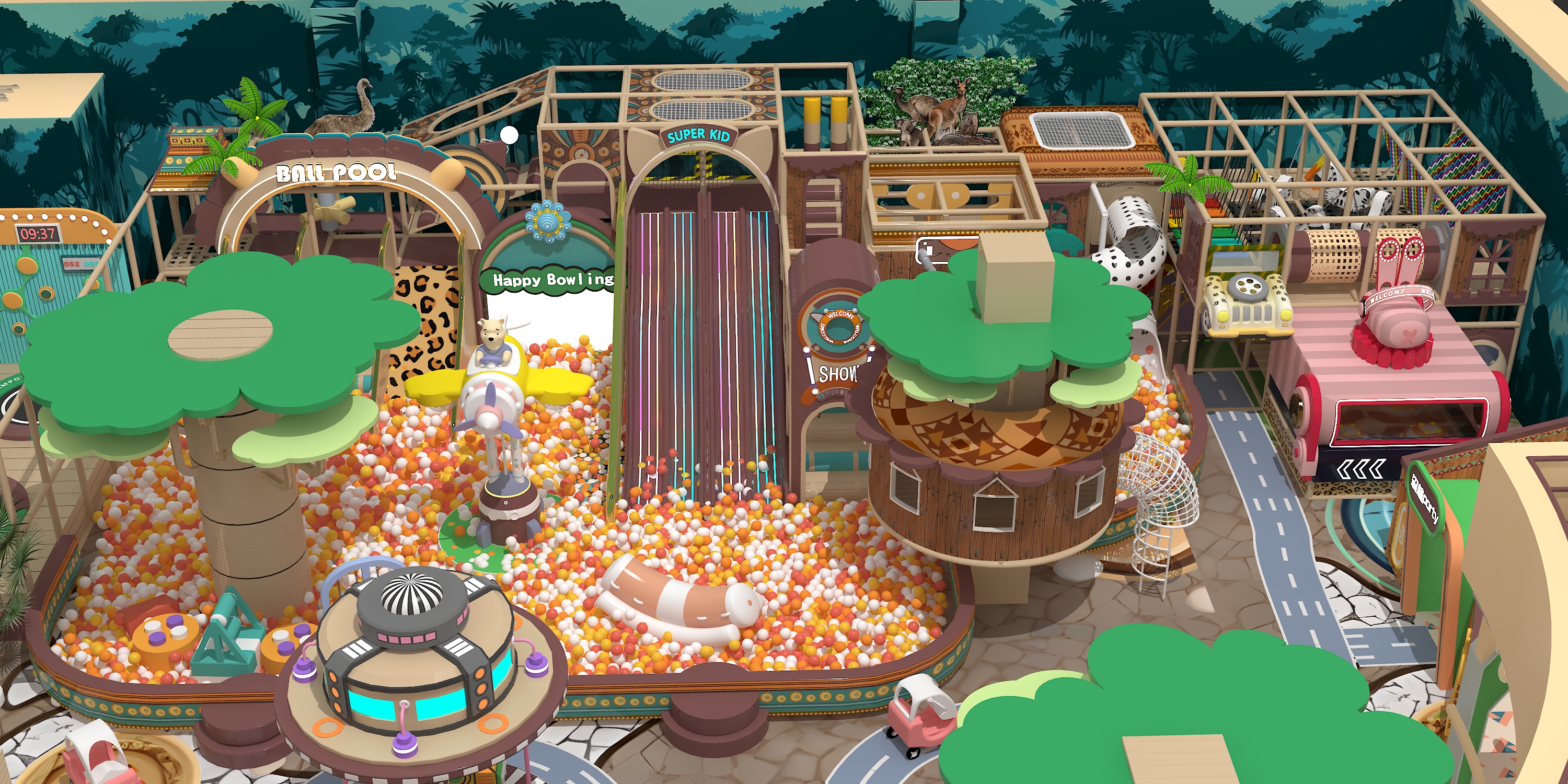
Why Scenario Fit Determines Equipment Selection
Commercial play projects are not interchangeable. A shopping-mall soft play area, a kindergarten playroom, a dedicated trampoline park, and a family entertainment center (FEC) operate under different space constraints, age profiles, supervision models, and revenue expectations. Equipment that performs well in one setting may be over-specified for another or under-protected for a high-traffic mall floor.
Scenario requirements typically include compliance with ASTM safety standards, non-toxic materials, fire-resistant and anti-corrosion components, UV resistance, rounded corners, impact absorption, easy-to-clean surfaces, child-safe design, and customizable theming. The weight given to each factor shifts by venue: a kindergarten prioritizes low-height platforms and soft padding, while a trampoline park needs reinforced frames and high-traffic jump surfaces.
The opportunity is equally clear. With soft play holding the largest category share and trampoline parks growing at the fastest rate among active-play formats, venues that match equipment architecture to a defined operational model can capture demand across age groups while controlling maintenance and supervision costs. The risk is in treating these product families as interchangeable.
Vasia: A Manufacturer Aligned With Commercial Play Projects
Vasia (China·Huaxia Amusement Co,.LTD), founded in 2000, is a manufacturer of amusement equipment, sports facilities, and preschool supplies based in Qiaoxia Town, Yongjia County, Wenzhou — widely recognized as the "Chinese Educational Toy Capital" and "Chinese Educational Toy Export Base." The company operates production bases in the Yangwan Industrial Zone and the Xi'ao Industrial Zone, with a factory area of 30,000 square meters, an R&D team of 30, and approximately 200 employees. Its main product lines cover indoor playgrounds, outdoor playgrounds, trampoline parks, and rope courses.
The company's production capability is structured around OEM/ODM work. Customization covers indoor children's play equipment, outdoor children's play facilities, color, voltage, and logo. Monthly capacity is 8,000 units, lead times range from 15 to 45 days, and the minimum order quantity is 1 unit. After-sales support includes remote technical assistance, a one-year warranty, and lifetime service.
From a buyer's standpoint, the 1-unit MOQ matters: it allows a pilot project or a single-zone build before scaling a multi-zone FEC. The 15 to 45 day lead time and 8,000-unit monthly capacity are relevant planning parameters for operators coordinating construction schedules and seasonal openings.
Technical Specifications Across the Equipment Range
Indoor playground equipment from Vasia is grouped into four structural families: kids soft play structures, trampoline systems, climbing walls, and indoor rope courses. Each family uses a different frame architecture and is tested against specific material standards.
| Product family | Representative models | Key structural parameters |
|---|---|---|
| Kids soft play structures | VS1-230518-4-60, VS1-250414-780-D1-77, VS1-25011002-230-2-49, VS1-250519-2250-3-60 | Galvanized steel tube φ48×2 mm uprights; cast steel 48# couplers (GB/T 228.1-2021); PE safety net, 30×30 mm mesh (GB 6675.4-2014); PA nylon ties and buckles; PVC sleeves with EPE pearl cotton lining |
| Trampoline systems | VS6-180326-400a-2-40, VS6-190301-1980A-13-29 | Q235 galvanized rectangular steel: upright posts 80×80×2.0 mm, connecting frame 50×80×2.5 mm, reinforcement 40×40×1.5 mm; PP jumping mat 500D×500D; EPE pearl cotton 70 mm; Plato PVC-coated mesh 0.52 mm, 1300×1300D (EN 71-2:2020 flammability); carbon steel wire 82B springs, 180 mm |
| Climbing wall | VS-2659 | Q235 galvanized rectangular steel tube 40×40×1.5 mm; 15 mm plywood meeting E0 grade requirements of GB/T 5849-2006; EPE pearl cotton 10 mm; Plato PVC-coated mesh |
| Indoor rope course | VS1-250522-1900B-30 | Q235 tubes 50×80×3.0 mm, 40×80×2.0 mm, 40×40×2.0 mm (GB/T 228.1-2021); 15 mm plywood (E0, GB/T 5849-2006); printed PVC flooring; climbing holds; electronic timer; safety mat: 28 kg/m³ foam 10 mm + EPE pearl cotton 140 mm |
For the complete soft play range, Vasia also publishes cross-model specifications. Main frames use φ48 mm galvanized steel pipe with 2.0 mm wall thickness and 15 mm anti-collision sleeves; expanded structures use φ140 mm pipe with 4.0 mm thickness. Platforms are typically 800×800 mm cold-rolled steel plates or perforated steel plates of 91×91 cm or 116×116 cm. Soft play platforms use a composite of 1.8 cm multilayer board, 2 cm EPE foam, and 0.45 mm PVC leather. Standard trampoline mats measure 1800×1800 mm with a static load capacity of 600 kg and dynamic load capacity of 130 kg; professional mats measure 2130×4260 mm and use stronger nylon webbing. Fasteners are stainless steel, with protective plastic caps or anti-loosening washers where children might make contact. Slides are made of imported engineering plastics or 196 resin; carpet wear resistance reaches 80,000 rubs; exposed wood is mainly corrosion-resistant Scots pine.
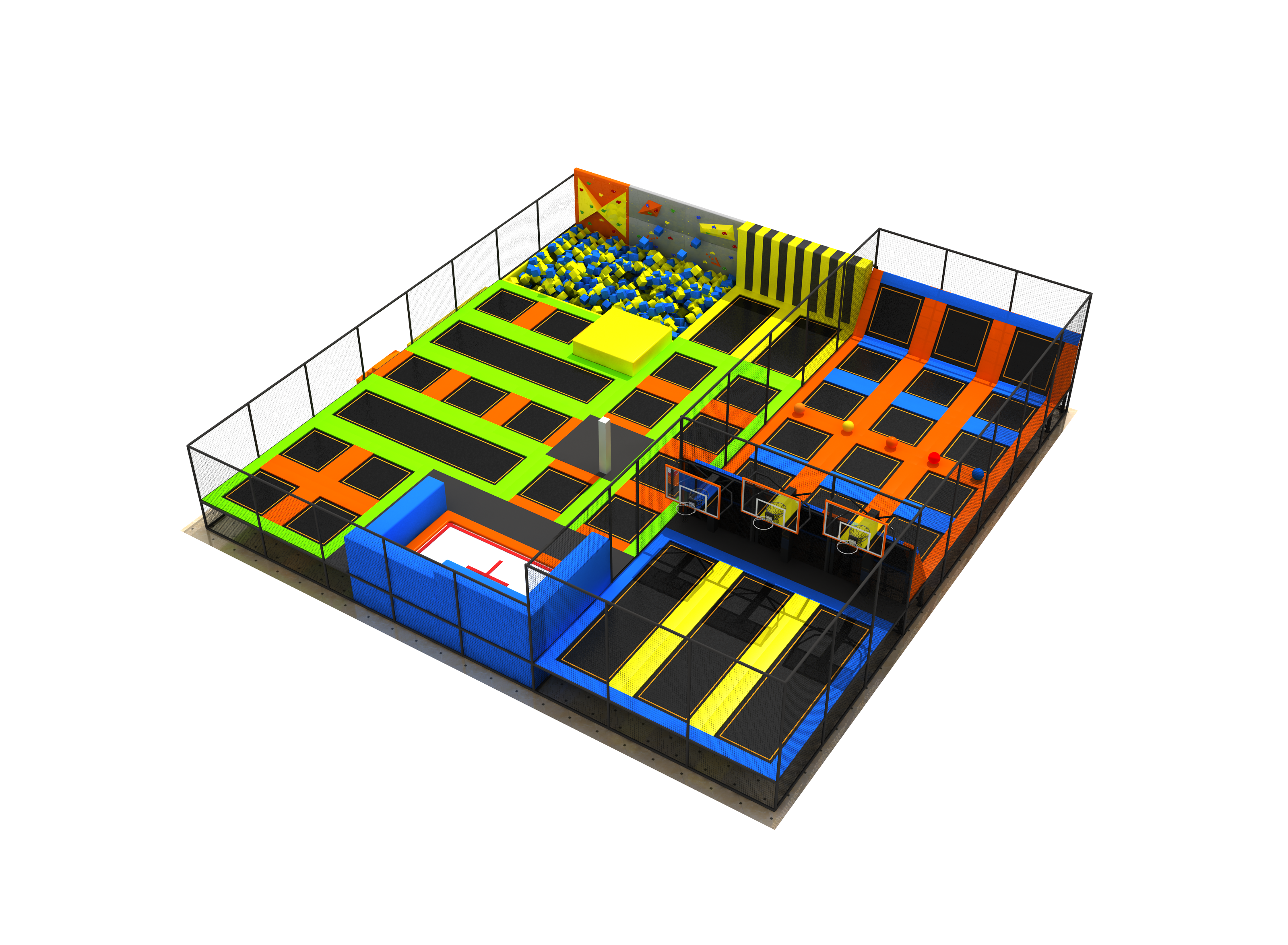
These specifications are the basis of project fit. They allow engineers to verify whether a structure can handle the traffic load, the cleaning regime, the fire-safety requirements, and the age range of a specific venue before committing to a purchase order.
Scenario-Based Application of Vasia's Equipment Line
The application data for this equipment family defines its operating envelope: Vasia's indoor playground equipment is designed to function as indoor playground, soft play area, trampoline park, kids' obstacle course, themed playground, and daycare play equipment. It operates under indoor/outdoor, all-weather conditions, is safe for high-traffic areas, is suitable for shopping malls, kindergartens, and amusement parks, and runs in a 24/7-available, manual-supervision, low-maintenance mode designed for continuous daily use.
| Project scenario | Recommended product family / models | Fit factors |
|---|---|---|
| Shopping mall soft play zone | Indoor Playground Equipment VS1-250503; Indoor Playground VS1-230518-4-60 | Continuous daily use, high-traffic durability, easy-to-clean composite padding, impact absorption |
| Kindergarten / daycare | Kids Play Structure VS1-250414-780-D1-77; Indoor Playground VS1-230518-4-60 | Age range mainly 3–15 (some soft play products suited to ages 2–8), low-height platforms, color theming, rounded corners |
| Trampoline park | Indoor Trampoline Park VS6-180326-400a-2-40; Trampoline Park Equipment VS6-190301-1980A-13-29 | All-age coverage of newer trampoline parks, reinforced Q235 frames, EN 71-2-compliant flame-retardant jump mat fabric, tested spring systems |
| Family entertainment center (multi-zone) | FEC Equipment VS1-25011002-230-2-49 | Multi-zone programming combining soft play, obstacle, and themed areas |
| Rope course / climbing venue | Indoor Rope Course Equipment VS1-250522-1900B-30; Climbing Wall for Playground VS-2659 | Challenge programming, electronic timing, impact-absorbing safety mat construction |
In all scenarios, the same requirement set recurs: compliance with ASTM safety standards, non-toxic materials, fire-resistant and anti-corrosion properties, UV resistance, rounded corners, impact absorption, easy cleaning, child-safe design, and customizable theming.
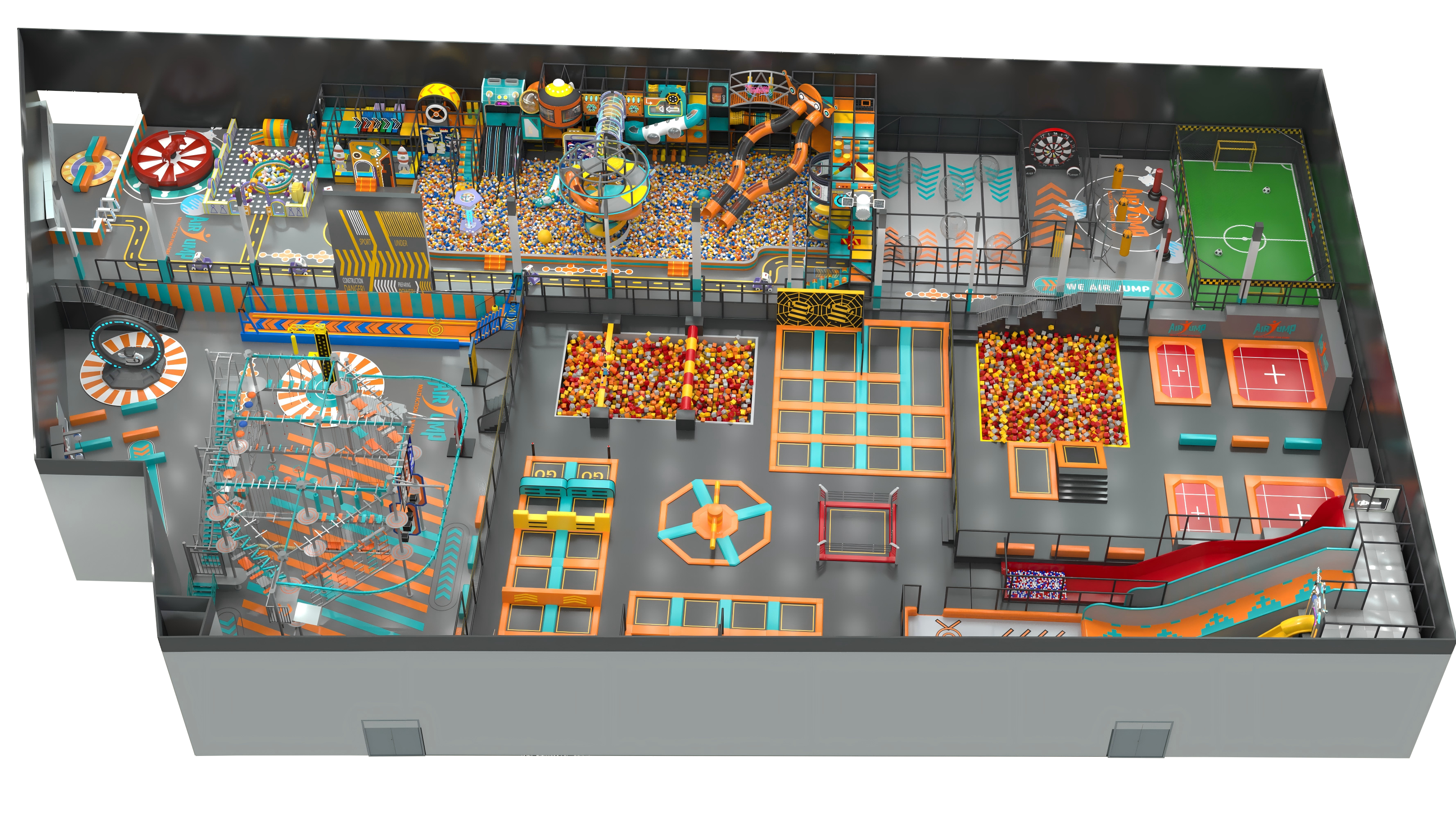
A documented reference case in the company's portfolio is a 3,000 square meter end-customer project in Spain. After 5 years of operation, the project continues to run with stable income; the operator's evaluation highlighted long lifespan and low maintenance as the defining outcomes. For buyers in the evaluation stage, this type of long-duration reference supports lifecycle and maintenance planning.
Market Trends Shaping Equipment Procurement
Several verified market signals are relevant to project-specific equipment selection.
First, overall demand is growing. The global indoor playground equipment market was valued at USD 4.8 billion in 2025 and is projected to reach USD 9.2 billion by 2034. Second, category mix matters: soft play equipment holds the largest product-type share at 31.4%, approximately USD 1.51 billion in 2025. Third, regional demand is led by Asia Pacific, which accounted for 38.6% of revenue in 2025, followed by North America and Europe. Fourth, the trampoline park segment is expanding faster than the overall market at a projected CAGR of 16.2%, reaching USD 3.96 billion by 2032.
Compliance architecture is also converging. In North America, ASTM F1918 is the primary safety performance specification for "Soft Contained Play Equipment," focusing on entrapment and fire safety. In Europe, EN 1176 is the harmonized standard for playground equipment, and Part 10 specifically covers fully enclosed play equipment (soft play areas). Buyers planning multi-market rollouts should verify that equipment certifications map to both frameworks. Market profile data also lists Vasia among manufacturers exporting to 80+ countries with TUV, CE, and ASTM certifications.
Non-Powered Systems vs. Traditional Electric Amusement Equipment
A central architectural decision for commercial projects is whether to build the play offer around non-powered systems (soft play, trampolines, climbing, rope courses) or traditional electric amusement equipment. Non-powered play systems have structural advantages for venue operation: they contain no motor-driven components in the play zone, which reduces energy consumption, removes a class of mechanical failure points, and allows continuous daily use with manual supervision. The composite material construction — galvanized steel frames, EPE padding, and PVC-coated mesh — aligns with the cleaning and maintenance routines of high-traffic venues.
The honest limitation of non-powered equipment is scope of experience. Electric and mechanical rides deliver high-thrill experiences at scale that non-powered structures cannot fully replicate. Venues positioning for teen and adult thrill-seekers may need to supplement a non-powered core with electric attractions or plan for a hybrid layout. For most family-oriented formats — malls, kindergartens, daycares, and mixed FECs — non-powered systems cover the primary demand curve with lower operating complexity.
Future Outlook: What Operators Should Plan For
The available data points to a multi-zone, standards-driven future for indoor playground projects. The projected compound growth of the trampoline park segment (16.2%) is a strong signal that active-play formats will continue to expand, while soft play retains the largest share of the overall equipment market. Operators evaluating projects should plan for several developments: multi-zone designs that combine soft play, trampoline, climbing, and rope course elements; certification as a procurement baseline rather than a differentiator; OEM customization as a standard expectation, supported by low minimum order quantities; and production capacity and lead time as formal decision criteria. Supply-side parameters such as a 15–45 day lead time and an 8,000-unit monthly capacity are the types of figures that determine whether a project timeline is feasible.
Frequently Asked Questions
Q1. What types of indoor playground equipment are suitable for shopping mall projects?
Soft play systems such as the Vasia Indoor Playground Equipment VS1-250503 and Indoor Playground VS1-230518-4-60 are designed for indoor playgrounds, shopping malls, kindergartens, and amusement parks. These products function as indoor playground, soft play area, themed playground, and daycare equipment, and operate under indoor/outdoor, all-weather conditions safe for high-traffic areas with low maintenance requirements.
Q2. What safety standards apply to commercial indoor playground equipment?
In North America, ASTM F1918 is the primary safety performance specification for soft contained play equipment, covering entrapment and fire safety. In Europe, EN 1176 Part 10 covers fully enclosed play equipment. Material-level requirements typically include non-toxic materials, fire-resistant fabric, anti-corrosion and UV-resistant finishes, rounded corners, and impact-absorbing padding.
Q3. Can indoor playground equipment be customized to a specific venue layout?
Yes. Vasia operates OEM/ODM production, with customization available for indoor children's play equipment, outdoor children's play facilities, color, voltage, and logo. The minimum order quantity is 1 unit.
Q4. What are the lead time and production capacity for commercial orders?
Vasia's typical lead time is 15–45 days, with a monthly production capacity of 8,000 units. Both parameters are commonly used in project scheduling and phased delivery planning.
Q5. How do trampoline park systems differ structurally from soft play structures?
Trampoline systems use Q235 galvanized rectangular steel frames (upright posts 80×80×2.0 mm) with PP jumping mats (500D×500D), 70 mm EPE padding, and 180 mm carbon steel 82B springs. Soft play structures use galvanized steel round tubes φ48×2 mm, cast steel 48# couplers, PE safety netting with 30×30 mm mesh, and PVC/EPE protective sleeves. Test standards include GB/T 228.1-2021, GB 6675.4-2014, and EN 71-2:2020 flammability clauses.
Q6. What age ranges do indoor playground equipment lines cover?
Most products are designed for children aged 3–15; some soft play products suit ages 2–8; newer trampoline park systems cover all age groups. Age range should be matched to the venue's target demographic profile during project planning.
Q7. How durable is the equipment in continuous commercial use?
The equipment is designed for continuous daily use with manual supervision and low maintenance. A documented reference project of 3,000 square meters in Spain recorded stable operation and stable income over a 5-year period, with long lifespan and low maintenance highlighted as operating outcomes.
Manufacturer Information
China·Huaxia Amusement Co,.LTD (Vasia) — indoor playground equipment, trampoline park equipment, climbing walls, and rope courses. Address: Yangxia Industrial Zone Park Road, Qiaoxia Town, Yongjia County, Wenzhou City, Zhejiang Province.
Email: huaxiatoys@huaxiatoys.com | Tel: 86-189 6887 6888 | WhatsApp: 8618968876888