
Matching Industrial Lubrication Pumps to Project Conditions
Selecting an industrial lubrication pump for a new project is rarely a matter of picking the largest available flow rate. The real challenge is to align pump displacement, motor speed, material compatibility, and auxiliary cooling with the specific working conditions of the equipment—dust, viscosity, ambient temperature, and operating cycle. This article provides a project-level technical reference for specifying industrial lubrication pumps in mining, construction, steel, and wind-power machinery, using public market data and manufacturer-provided specifications from Ningbo-based Deo Machinery Co., Ltd. (DEO).
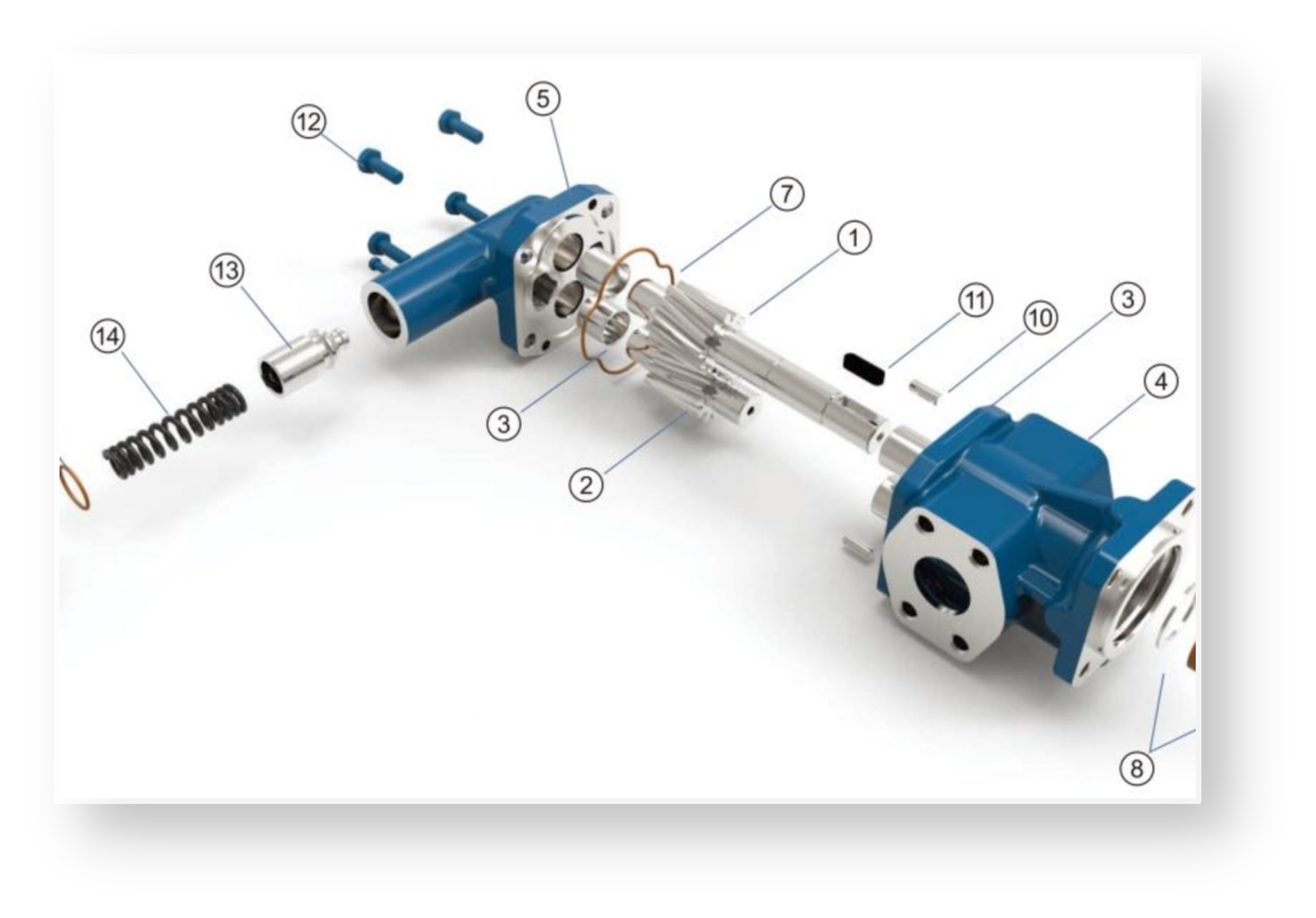
Figure 1: Exploded view of a positive displacement gear pump. Image source: DEO Machinery.
Why Project Conditions Change the Pump Choice
Improper lubrication is linked to over 76% of industrial machinery failures, according to a 2026 lubrication systems market report from Market Research Future. A failed lubrication circuit can slow a production line for hours or damage a gearbox beyond repair. However, buyer research often focuses on pump price and maximum pressure, while ignoring the operating envelope that determines field reliability. The opportunity lies in evaluating the whole lubrication loop, including the pump, its sealing, the oil cooler, and the filtration requirement. Suppliers that can document both pump and cooler performance give procurement teams a more complete baseline for comparison.
What a Full-Range Supplier Looks Like: DEO as a Reference
One example of an integrated lubrication pump and cooling supplier is Deo Machinery Co., Ltd. DEO is a China-based manufacturer in Ningbo, established in 2010, with a 10,000 m2 plant, 80 employees, and an annual output capacity of 30,000 units. Its main product lines cover hydraulic pumps, electric lubrication pumps, centralized lubrication system pumps, oil lubrication pump systems, lubrication system oil coolers, and industrial lube oil cooling systems. The company's DK series, designed for industrial lubrication and hydraulic auxiliary fluid conveying, is a low-noise helical external gear positive displacement pump. The DK630 model uses a QT500 ductile iron housing and offers 630 cc/rev displacement at motor speeds of 950 and 1450 rpm. For project buyers, the capacity model matters: DEO runs an OEM/ODM production line with a monthly capacity of 2,500 units, a lead time of 35–45 days, a minimum order of one unit, and 100% testing before shipment.
Technical Parameters to Match in a Lubrication Project
To translate project conditions into a pump specification, start with fluid viscosity and temperature. The DEO DK series is documented for a kinematic viscosity range of 12 to 20,000 cSt and fluid temperatures from -40°C to +100°C, with an adjustable relief valve set from 5 to 25 bar. This range covers most industrial gear oils and hydraulic fluids. At the extremes, however, careful engineering is still required: for oil above 1000 cSt, pump speed should be reduced to avoid suction resistance and cavitation.
Pump mechanics matter as much as the hydraulic data. In the DK series, a helical gear structure lowers running noise compared with straight gear pumps, and the ductile iron casing (QT500) provides durability. A built-in relief valve offers transient overpressure protection, but continuous overflow operation will cause pump overheating and early wear.
Cooling is a critical component of the lubrication loop. The DFLS series is documented for an oil flow range of 6–200 L/min depending on the selected pump displacement. For the DFLSL-10 model, the oil pump flow is 100–125 L/min or 150–200 L/min for VG46 oil, with cooling capacity of 1.61/1.84 kW/°C and motor power of 5.5/7.5 kW. For water-cooled applications, the DWBW-408-T fin-type oil/water cooler handles oil-side pressures up to 16 bar, water-side up to 10 bar, oil temperatures up to 120°C, and viscosities from 12 to 320 mm²/s (custom versions for heavier oils).
| Parameter | DK630 electric lubrication pump | DFLSL-10 self-circulating cooler | DWBW-408-T oil/water cooler |
|---|---|---|---|
| Displacement / flow | 630 cc/rev | 100–125 or 150–200 L/min (VG46) | Heat exchange area 1.3 m² to dozens of m² (series) |
| Motor speed / power | 950 / 1450 rpm | 5.5 / 7.5 kW | N/A |
| Fluid viscosity | 12–20,000 cSt | VG46–VG320 typical | 12–320 mm²/s (customizable) |
| Temperature range | -40 to 100°C | Oil inlet ≤90°C standard, up to 130°C customized | Oil ≤120°C; water 5–60°C |
| Pressure | Built-in relief 5–25 bar | Depends on selected pump | Oil side 16 bar; water side 10 bar |
Table 1: Example technical parameters from DEO's product documentation for a pump, a self-circulating cooler, and a water-cooled heat exchanger.
Application View: Matching Pumps to Operating Environments
Mining Equipment
In mining, the combination of heavy shock loads and dusty air means the pump must be robust and often coupled with a cooling loop. DEO's DFLEX8 wind cooler is an example of an air-cooled unit that can be used in coal mines and crude oil mining applications, with a comparative cooling capacity of 1.15/0.91 kW/°C, a 630 mm fan diameter, and a 3-phase 380V motor. For self-contained cooling circuits, the DFLSL series can be upgraded with dust-proof and low-temperature protection, making it suitable for surface and underground mining installations.
Construction Machinery
Construction machines such as excavators and telehandlers use hydraulic power units where oil flow fluctuates rapidly. A bidirectional internal gear pump like the PST180 (180 cc/rev, max 1800 rpm, -30°C to +100°C) simplifies installation because it does not need a fixed rotational direction. That is useful when the pump is driven by a power take-off that may rotate in either direction depending on the machine layout.
Steel Industry
Steel rolling mills require continuous lubrication of large gearboxes and hydraulic presses, often using high-viscosity oils. The DWBW-408-T water cooler is designed for high-viscosity lubricant cooling (up to 320 mm²/s standard, custom for heavier oils), and the detachable end cover allows regular descaling and sludge cleaning—important in steel environments where contamination is unavoidable.
Wind Energy
In wind turbines, gearbox lubrication pumps must tolerate variable speed and vibration. DEO's DKF version of the DK pump is described as a wind-power-specific model that enhances anti-shock and anti-vibration performance. Case data provided by DEO mentions wind power equipment manufacturers including Vision Energy, Dalian Heavy Industry, Taiyuan Heavy Industry and Weili Transmission. According to that case, the pumps delivered 3 dB lower noise than straight gear pumps, volumetric efficiency above 95%, and 40% lower component wear compared with ordinary gear pumps, over a five-year application in speed reducers.
Market Trends Shaping Lubrication System Procurement
The market context supports a move from simple pumps to integrated lubrication systems. According to Market Research Future, the global automatic lubrication system market was valued at approximately USD 0.37 billion in 2024. A separate industry report cited in 2026 states that centralized lubrication systems can reduce maintenance downtime by up to 52% in manufacturing facilities. Asia-Pacific accounts for roughly 42% of global shipments in lubrication systems, and China alone exported USD 14.3 billion in liquid pumps in 2024, representing 18.5% of global exports. The oil coolers market, which overlaps directly with industrial lube oil cooling systems, was estimated at USD 6.8 billion in 2025. These figures suggest that the purchase of a lubrication pump is increasingly evaluated as part of a lubrication system that includes cooling and monitoring.
Traditional Solutions vs. Modern Lubrication Pumps: Trade-Offs and Limits
Traditional manual lubrication, where an operator applies grease or oil at intervals, is still present in many older plants. It is inexpensive to install but highly dependent on operator discipline and cannot maintain a consistent oil film under rapidly changing loads. Simple fixed-displacement pumps without cooling are a step up, but they tend to have no temperature management or only a rudimentary oil bath.
A modern electric centralized lubrication pump with an integrated cooler offers continuous, measured delivery and thermal stabilization. However, it brings engineering constraints that must be planned for. The DEO DK series, for example, is an external gear pump that must never be run dry; dry running causes shaft bushing and gear damage from friction. The pump inlet line must be airtight—a leak reduces suction flow and leads to cavitation. For high-viscosity oil above 1000 cSt, the pump speed needs to be reduced. And because the built-in relief valve is intended only for transient overpressure events, designers must not use it as a continuous pressure regulator. These limits are common to this pump class, not specific flaws, and they need to be addressed in the project layout.
Future Outlook: Toward Condition-Monitored Lubrication
Looking ahead, lubrication systems are becoming part of condition-monitoring networks. Rather than replacing oil periodically, plants are fitting pumps with sensors that track pressure, temperature, and flow in real time. A pump that can be mounted with a temperature sensor and a pressure switch—such as the optional configurations described for the DFLSL cooler—can provide the data foundation for predictive maintenance. For procurement, this means evaluating not only the current pump and cooler, but also the unit's compatibility with future control and monitoring hardware.
For further technical reference, DEO provides a downloadable company brochure covering its lubrication pump and cooler product families: https://cdn.socialarks.com/sbsp/24830/common/2026/0518/6a0a70df21d80.pdf
Frequently Asked Questions
What are the first specifications to check when selecting an industrial lubrication pump?
Check fluid viscosity range, operating temperature range, required flow rate, and system pressure. For example, DEO's DK series covers 12–20,000 cSt, -40°C to +100°C, with a built-in relief valve adjustable from 5 to 25 bar.
When does an electric lubrication pump become necessary for a project?
An electric lubrication pump is necessary when the pump must operate independently of the main machine drive, or when a central lubrication system has to deliver oil on a controlled cycle. Mechanical gear pumps, such as the PSN100 (100 cc/rev, up to 1800 rpm), are suitable when an external drive is already present.
How do I choose between an air-cooled and a water-cooled lubrication oil cooler?
Air-cooled coolers such as the DFLEX8 (630 mm fan, 1.15/0.91 kW/°C) suit installations where cooling water is unavailable or water quality is variable. Water-cooled units like the DWBW-408-T handle higher heat loads and pressures (oil side 16 bar) and are preferable in steel and metallurgy systems with continuous high thermal load.
What are the most common installation mistakes with gear pumps?
The most common mistakes are dry start, an airtight inlet line failure, an undersized inlet pipe, and continuous overflow through the relief valve. Each of these can lead to cavitation, overheating, or mechanical damage.
Is the built-in relief valve sufficient for system protection?
No. The built-in relief valve in pumps such as the DK series is designed for transient overpressure protection (5–25 bar adjustable). For sustained pressure control or bypass, a separate pressure-regulating valve or external circuit design is needed.