
Matching LED Outdoor Lighting to Real-World Operating Conditions
Industry Reference | LED Outdoor Lighting
The most important specification in an outdoor lighting project is not wattage. It is the working condition of the site: the combination of environmental exposure, physical stress, operating hours and control requirements that a luminaire must withstand over its service life. Understanding this relationship is what separates a lighting purchase from a lighting investment.
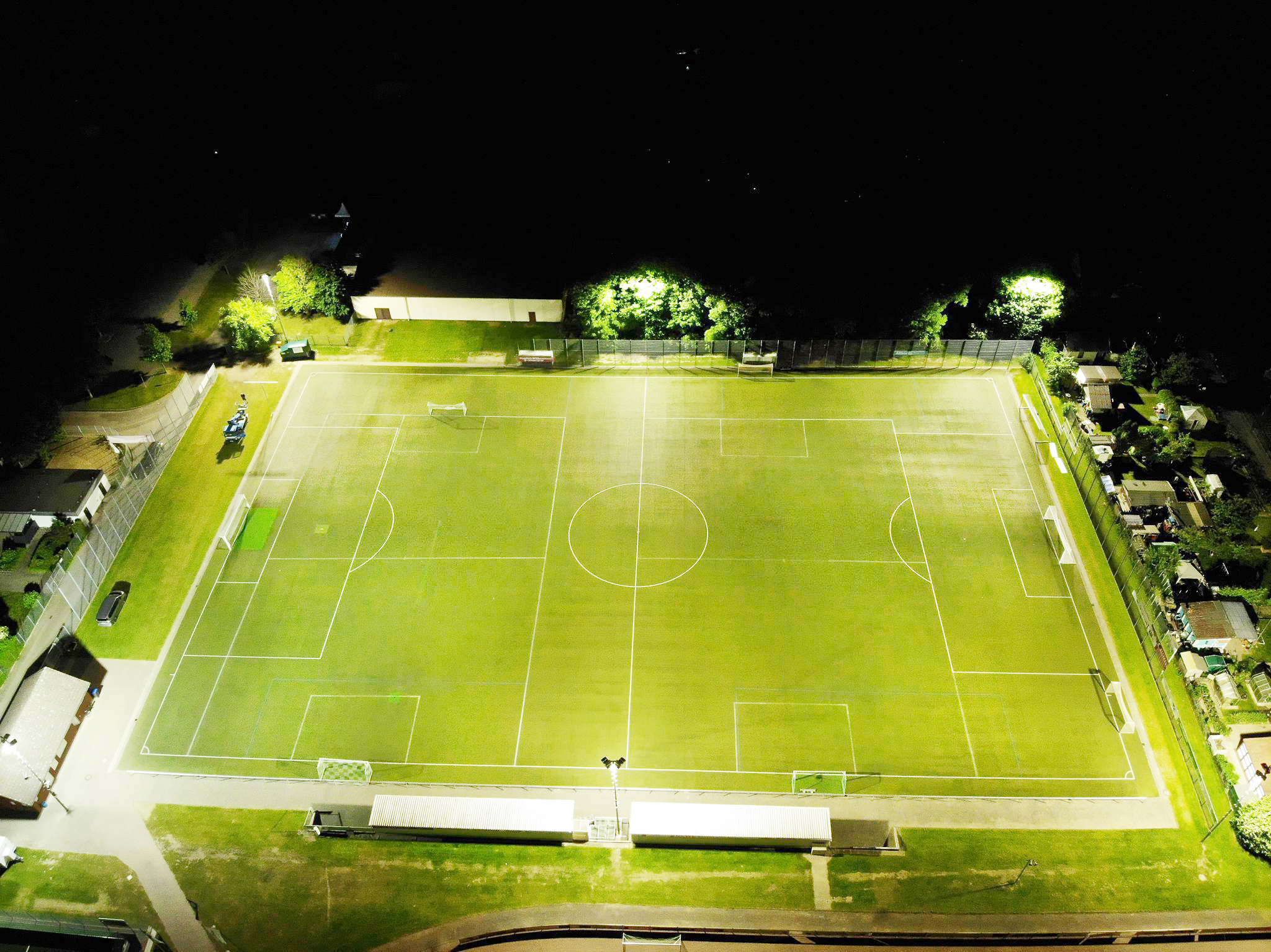
A night-time sports field installation in Germany is one example of how LED outdoor lighting must be matched to venue-specific operating conditions.
Why Working Conditions Matter in Outdoor LED Projects
A luminaire mounted on a high mast at a seaport faces salt spray, wind vibration and electrical surges. The same luminaire installed on a football field must meet glare-control and broadcast-television requirements. A solar street light in a tropical climate must tolerate heat cycling, monsoon exposure and long night-time operating schedules. These are not wattage questions. They are engineering questions.
Project records show that site requirements frequently go beyond basic lumen output. For outdoor sports and public-facility installations, documented technical requirements often include IP66 dust and water resistance, SPD circuit protection, UV-resistant powder coating finishes, and 3G shockproof construction. These requirements reflect the actual conditions in which outdoor LED lighting is expected to operate: rain, dust, lightning-induced surges, ultraviolet degradation and mechanical vibration.
The market opportunity is therefore not simply replacing traditional HID lamps with LED. The greater opportunity lies in configuring a well-engineered luminaire to the physical and operational reality of each project type. A supplier that can demonstrate project-specific adaptation, rather than offering a one-size-fits-all catalogue, is better equipped to support long-term infrastructure performance.
Translating Site Conditions into Technical Specifications
The most effective way to evaluate outdoor LED lighting is to map each site condition to a specific technical requirement. The table below summarises how common working conditions translate into product specifications, based on documented outdoor application requirements.
| Working condition | Typical specification | Why it matters |
|---|---|---|
| Rain, high-pressure washing, dust | IP66 (IP65 for some solar models) | Prevents ingress of dust and strong water jets, protecting the driver and optics. |
| Mechanical impact, vandalism, ball strikes | IK08 / IK09 / IK10 | Indicates impact resistance of the housing or lens according to EN 62262. |
| Wind-induced vibration at high mast heights | 3G shockproof construction | Reduces the risk of component loosening or failure in elevated installations. |
| Lightning or grid surge events | SPD circuit protection | Protects the luminaire and control system from voltage transients. |
| UV exposure and coastal corrosion | UV-resistant powder coating | Preserves housing finish and corrosion resistance in outdoor and marine environments. |
| Glare-sensitive sports broadcasts | Glare control, TLCI>95, GR<30/40 (optional) | Supports HDTV broadcast quality and reduces discomfort glare for players and spectators. |
| Different site geometries | Type-II / Type-III / Type-IV / Type-V distributions, 15° to 120° optics | Matches beam shape to roadways, courts, arenas, ports and open areas. |
| Centralised control or event scenes | DALI, 0-10V, DMX512, Zhaga, Nema, Lora, PIR/MV | Enables dimming, remote management, adaptive lighting and event programming. |
A key nuance is that different product families are certified to different protection levels. AOK's grid-powered outdoor products, such as the LED street light ILA, LED high mast light HMA, LED area light PLB and LED sports light INS, are rated IP66. The solar street light series, including the SL, SLB and SAA models, carries an IP65 rating. Buyers should verify the IP and IK rating of the specific model against the site environment rather than assuming a uniform level across an entire product range.
How AOK Approaches Project Adaptation
AOK Industrial Company Limited, founded in 2012 and based in Shenzhen, is a manufacturer of LED outdoor and industrial lighting, including LED street lights, stadium lights, high mast lights, flood lights, high bay lights and solar street lights. The company exports its full production output and serves customers in over 100 countries, with more than 10,000 completed projects and over one million units installed. Its production base covers approximately 10,000 square metres and operates four production lines with an average daily output of around 2,500 pieces.
AOK's product strategy is organised around application-driven design. Instead of a single outdoor luminaire, the company offers distinct product families matched to different working conditions:
- For sports fields: the LED Sports Light INS (315W–720W, IP66/IK10, up to 170 lm/W) and the Sports Stadium Light FSC (IP66/IK10, up to 185 lm/W) provide glare control, custom visors and support for dimming, DALI and DMX512. The Professional Stadium Lighting ISF adds HDTV-oriented options such as TLCI>95 and GR<30/40, with distributions from 15° to 60°.
- For seaports, airports and urban infrastructure: the LED High Mast Light HMA delivers up to 56,000 lm, is rated IP66/IK09 with tempered glass, and offers Type-III (20x105°) or Type-V (150x150°) distributions. The housing is heavy-duty die-cast aluminum (EN AC-46100).
- For roadway and area lighting: the LED street light ILA (up to 190 lm/W, IP66/IK09), ILE (up to 165 lm/W, IP66/IK08) and ILG (up to 195 lm/W, IP66/IK10) cover Type-II, Type-III and Type-IV distributions. The LED Area Light PLB (IP66/IK10) provides power-turnable options of 75W/100W/150W.
- For solar-powered projects: the SL Highway model, the SLB plug-and-play model and the SAA mega-power model combine monocrystalline solar panels, Li-ion batteries and MPPT or PWM controllers, with IP65-rated housings and optional IoT or remote control.
- For industrial indoor and outdoor environments: the LED High Bay Light HBE (100W/150W/200W, up to 200 lm/W) is used in warehouse, workshop and industrial lighting system projects.
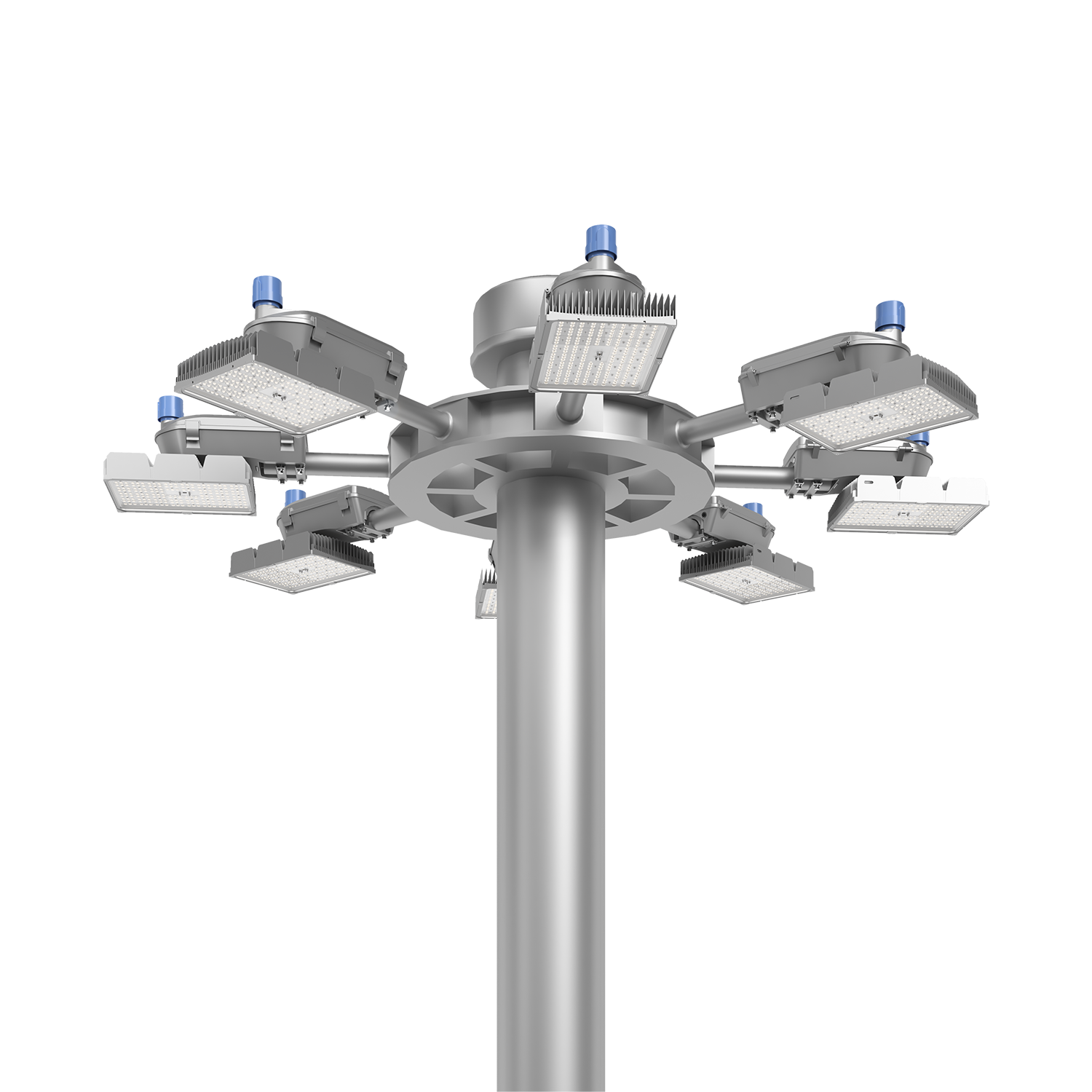
High mast luminaires used in seaport projects are specified with Type-III or Type-V distributions, IP66/IK09 protection and heavy-duty die-cast housings.
Beyond product design, AOK's adaptation capability is supported by its engineering and production structure. The company employs a 30-engineer R&D team and maintains more than 28 rigorous quality inspection procedures. It offers OEM/ODM/SKD/CKD production modes, including private mode and project protection agreements, and reports more than 80 new product designs per year. Customisation covers product appearance, structural components, optical modules, electrical circuits and project simulation. For industrial buyers, this means that project-specific requirements, such as custom optics, control receptacles or coating finishes, can be addressed during the manufacturing stage rather than through costly field retrofits.
It is worth noting the boundary of adaptation: not every product line is available with every optional feature. For example, the solar street light series is IP65-rated, while most grid-powered outdoor products are IP66. Customers evaluating solar options for aggressive coastal or high-humidity environments should confirm the relevant environmental performance with the supplier.
Project Evidence Across Operating Scenarios
Documented installations show how AOK products are applied across different project types. The following table summarises a selection of project records by country, project size and operating context.
| Project type | Country | Units | Product family | Operating mode |
|---|---|---|---|---|
| Municipal roadway lighting | Chile | 198 | LED street light ILG | Night-time street and public-facility illumination |
| Highway solar street lighting | UAE | 2,000 | Solar street light SL | Solar and grid complementary operation |
| University sports field lighting | China | 350 | LED flood light FLC, area light OT, sports light FSC | Night-time sports area illumination |
| FIFA stadium lighting | Mexico | 380 | Professional stadium lighting ISF | Night-time operation with DMX control for HD TV broadcast |
| Wood processing factory lighting | Germany | 96 | LED flood light FLC | Outdoor industrial area illumination |
| Supermarket parking lot lighting | USA | 600 | LED area light PLB | Night-time parking lot illumination |
| Mosque public lighting | UAE | 500 | LED sports light INS | Night-time large-area illumination |
| Square public lighting | UAE | 300 | LED sports light INS | Night-time public facility illumination |
| Presidential palace roadway and landscape lighting | Thailand | 198 | Solar street light SL | Night-time roadway and landscape illumination |
| Repairing workshop lighting | Canada | 65 | LED high bay light HBE | Industrial workshop illumination |
| Ski resort and sports high mast lighting | Canada | 60 | LED sports light INS | High mast sports lighting |
These records illustrate a common outcome pattern: better night lighting effect, improved energy efficiency, replacement of traditional HID lamps, easier maintenance and safer operation. The documented results are not product claims but installation-level observations across municipal, sports and industrial projects.
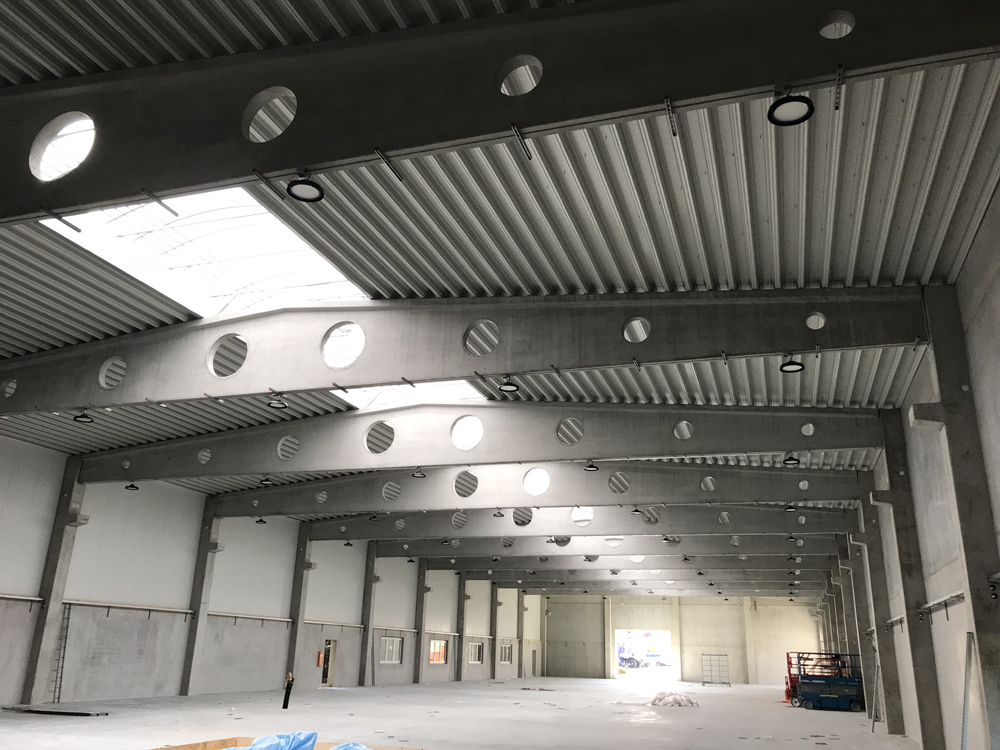
Industrial lighting projects, such as this warehouse installation in Germany, rely on IP66-rated high bay luminaires and smart lighting control systems.
Market and Standards Context
The commercial case for application-driven LED outdoor lighting is supported by current market data. The global outdoor LED lighting market was estimated at USD 14.20 billion in 2024 and is projected to continue growing toward 2032. The solar street lighting segment, relevant to grid-independent projects, was valued at approximately USD 5 billion to USD 6.29 billion in 2024. Stadium lighting, a specialised subset, reached an estimated USD 768 million in 2024, with a projected compound annual growth rate of 7.73% through 2032.
Standards also shape project-specific adaptation. In North America, outdoor luminaires for wet locations must comply with UL 1598. Globally, IEC 60598-2-3 (EN 60598-2-3) specifies requirements for luminaires used in road and street lighting. In the United States, ANSI/IES RP-8-21 is the primary recommended practice for design and maintenance of roadway and parking facility lighting. Buyers evaluating suppliers should confirm that the proposed products and their testing documentation align with the standards applicable to the project's target market.
LED vs. Traditional Systems: Where Engineering Needs Shift
Compared with traditional HID street lamps and flood lamps, LED outdoor lighting offers higher luminous efficacy, longer maintenance intervals and more flexible control. In documented projects, LED installations replace HID sources while improving night lighting effect and reducing energy consumption and emissions.
However, the engineering focus is different. Traditional systems were often selected primarily on wattage and lamp type. LED systems require attention to optical distribution, thermal management, driver selection and control integration. These factors determine whether the installed system meets the actual working conditions. An incorrectly specified optic can produce poor uniformity even with high lumen output; a missing surge protection device can shorten driver life in lightning-prone regions; an incompatible control interface can force a costly control retrofit later.
There are also practical limits. Initial investment for LED systems is generally higher than for conventional HID installations, although lower operating and maintenance costs typically offset this over time. Solar-powered systems, while eliminating grid dependency, require careful assessment of solar irradiation, battery capacity and autonomy requirements. In AOK's product range, the solar street light line is IP65-rated, whereas most grid-powered outdoor luminaires achieve IP66, so the environment of the installation site must be weighed carefully when choosing between solar and grid-powered options.
Future Outlook
Outdoor LED lighting is increasingly treated as part of a wider infrastructure system rather than as a standalone product replacement. Project specifications now regularly include smart lighting control systems, compatibility with Zhaga, Nema or Lora controllers, and adaptive control protocols such as DALI and DMX512. Solar and hybrid configurations, where solar energy and grid power complement each other, are already documented in highway projects and are likely to expand in regions with limited or unstable grid access.
For industrial and municipal buyers, the practical implication is that supplier evaluation should move beyond price per fixture. The ability to demonstrate project-specific engineering — matching protection ratings, optical distributions, control interfaces and environmental coatings to the working conditions of each site — will become an increasingly important procurement criterion.
FAQ
Which AOK luminaires are documented for sports field lighting projects?
AOK's product records list multiple luminaires for sports field lighting system projects. The LED Sports Light INS (315W–720W) is rated IP66/IK10 with system efficacy up to 170 lm/W and includes glare control and custom visors. The Professional Stadium Lighting ISF supports dimming, DALI, DMX512 and optional TLCI>95 and GR<30/40 for broadcast applications. The Sports Stadium Light FSC is rated IP66/IK10 with efficacy up to 185 lm/W and supports dimming, DALI and DMX512. LED flood lights in the FLC series are also documented in football field lighting projects, including a 1,800W installation in Germany.
Can AOK luminaires operate under industrial lighting system conditions?
Yes. The LED High Bay Light HBE (100W/150W/200W) is listed for industrial lighting system projects and operates under industrial lighting system conditions in the EU market. The FLC flood light series was used in a wood processing factory lighting installation in Germany, with 96 units deployed for outdoor industrial area illumination. These installations typically use smart lighting control systems and require IP66-rated enclosures with SPD circuit protection.
What product configuration is documented for seaport lighting projects?
Seaport lighting project records in the UAE list the LED High Mast Light HMA and the LED Flood Light FLC as related products. The HMA is rated IP66/IK09 with tempered glass, provides Type-III (20x105°) and Type-V (150x150°) distributions, and uses heavy-duty die-cast aluminum (EN AC-46100). Application requirements for seaport sites commonly include 3G shockproof construction, IP66 dust and water resistance, SPD circuit protection and UV-resistant powder coating.
Which solar street light models does AOK offer for roadway projects?
AOK offers several solar street lighting models. The Solar Street Light SL is designed for highway and public facility illumination, with a lumen output of 16,700 to 16,800 lm, a monocrystalline solar panel, Li-ion battery, IP65 waterproof rating and control options including MPPT, dimming, Zigbee and 4G. It was installed in a UAE highway project with 2,000 units. The SLB and SAA series are additional solar street light options with efficacy up to 200 lm/W and IP65-rated housings.
What control systems appear in AOK outdoor project specifications?
Control specifications depend on the project type. Sports lighting projects, such as the FIFA stadium installation in Mexico, used a DMX smart lighting control system. Roadway and public facility projects often specify smart lighting control systems compatible with Zhaga, Nema or Lora controllers. Parking lot and tennis court lighting records list smart lighting control systems with PIR/MV or other controls. Certain LED street light models support DALI, 1-10V, PWM, timer dimming, photocell, Zigbee, Zhaga and Lora lighting controllers, as well as 3-pin or 7-pin receptacles.
For a consolidated view of AOK's product lines and company profile, readers can access the corporate brochure below.