
Matching LED Warning Light Types to Vehicle Application Scenarios
Warning lighting is frequently bought as a category rather than specified as a component matched to the vehicle it will be mounted on. The category is not uniform. A roof-mounted lightbar, a rotating beacon, a hideaway strobe, an ultra-slim lighthead and a central controller solve different visibility, mounting and regulatory problems. In practice, none of them substitutes cleanly for another, and the selection logic changes with each operating environment.
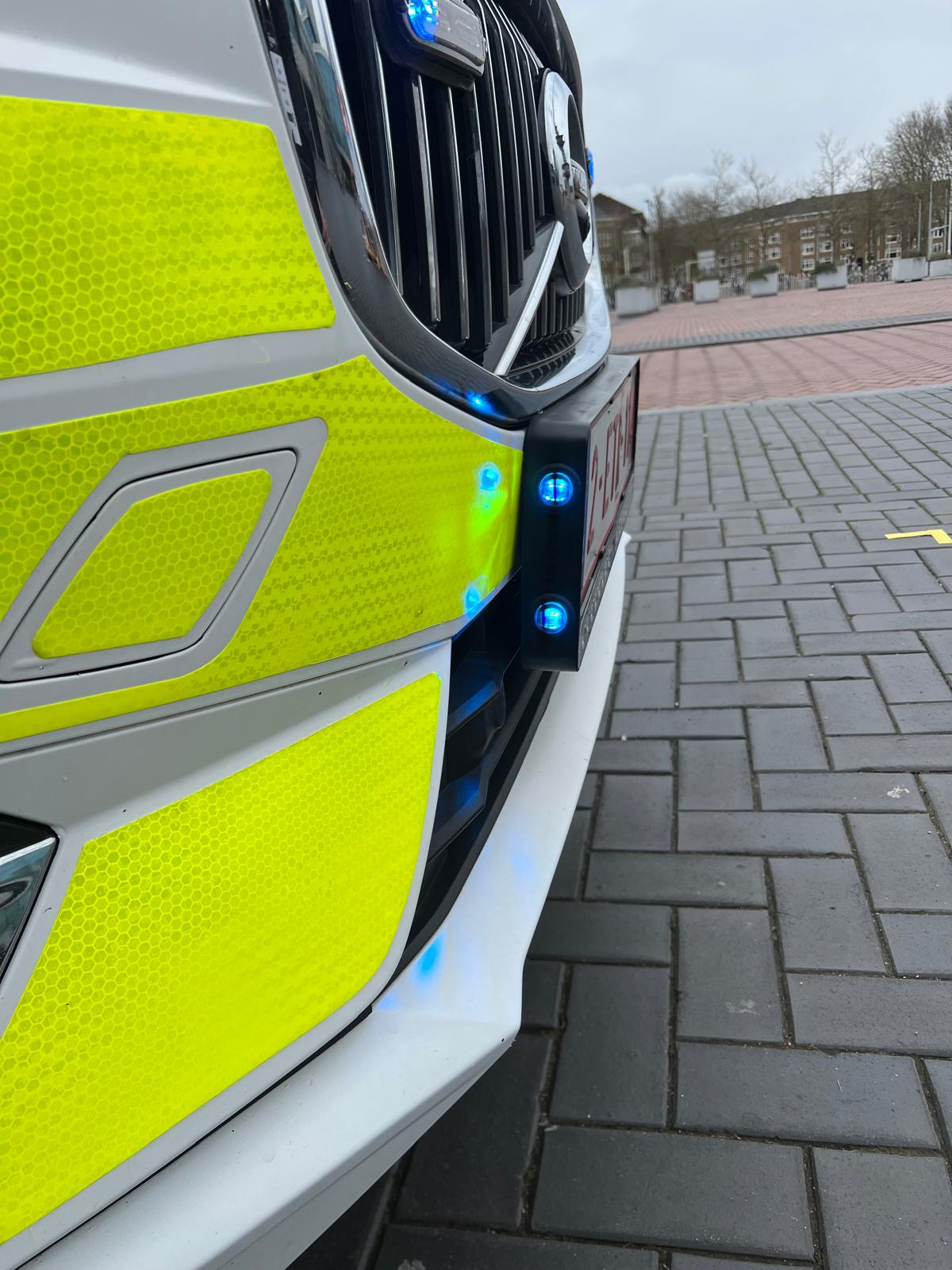
A hideaway warning light installed at a low, discreet position. Mounting location is often the first constraint that decides which warning light type is viable.
Why one warning light design cannot cover every vehicle scenario
Vehicle warning lighting is conditioned by four variables that rarely line up: the viewing angle the vehicle must be seen from, the mounting space the body allows, the regulatory class the application falls into, and the environmental load the fixture will absorb.
Common operating conditions documented for professional warning lighting include daytime and nighttime operation, low-light conditions, heavy rain, snow, fog, dust and mud, high humidity, outdoor operation, extreme temperatures, high UV exposure, highway and urban road operation, construction sites, roadside operations, high-vibration environments, long-duration or 24/7 fleet operation, and limited installation space. A single fixture configuration cannot be optimal across that spread.
The practical consequence is that the procurement question shifts. Instead of asking which warning light is brightest or cheapest, the buyer has to ask which fixture type fits the vehicle, the task and the exposure profile, and whether the control layer around it can support the intended behaviour. That framing is what separates an application-appropriate specification from a catalogue order.
Five warning light types and the operating envelope each one actually covers
The SIGROCK portfolio illustrates how the category splits. Each product type occupies a distinct position rather than representing an upgrade or downgrade of the others.
| Type | Model | Typical mounting | Ingress protection | Documented compliance options |
|---|---|---|---|---|
| Full-size warning lightbar | LB01 | Bracket mount, roof-level | IP65 | ECE R65, ECE R10 |
| Rotating LED beacon | BH18 | Bolts, DIN or magnetic mount | IP67, IP69K | ECE R10, ECE R65 Class 2, SAE J595 Class 1 |
| Hideaway strobe light | T43 | Flush mount or tube flush mount | IP67 / IP69K | ECE R65, ECE R148, ECE R10, RoHS, CE |
| Warning light module | E6 | Surface mount or bracket mount | IP67 / IP69K | ECE R65 Class 2, SAE J595 Class 1, ECE R10 options |
| Warning light controller | SC7X | 3M VHB, suction cup bracket, surface mount | IP67 | ECE R10 |
The table already reveals one non-obvious boundary. The lightbar and the four smaller fixtures do not share the same ingress classification. LB01 is rated IP65, while BH18, T43 and E6 carry IP67 or IP67/IP69K. That difference is not a quality ranking; it is a specification difference that has direct consequences for fleets with specific cleaning routines, and it is one of the clearest examples of why product type should follow the operating environment rather than the other way around.
Mounting position drives visibility and optical choice
Where a fixture sits on the vehicle determines which directions it can be seen from, and that in turn constrains which product type is realistic.
Roof-level mounting
A lightbar mounted at roof height produces the widest off-axis coverage of any single fixture because it is elevated above the body and visible from the sides as well as front and rear. The LB01 is available in 600, 800, 1000, 1200, 1400 and 1600 mm lengths at 40.5 mm high, with bracket mounting, a PC lens, 10 selectable flash patterns and single, dual or combination colour configurations. Its LED counts scale with length, from 78 pieces at 600 mm to 198 pieces at 1600 mm, and its published power figures run from 76 W at 600 mm to 124 W at 1200 mm and above.
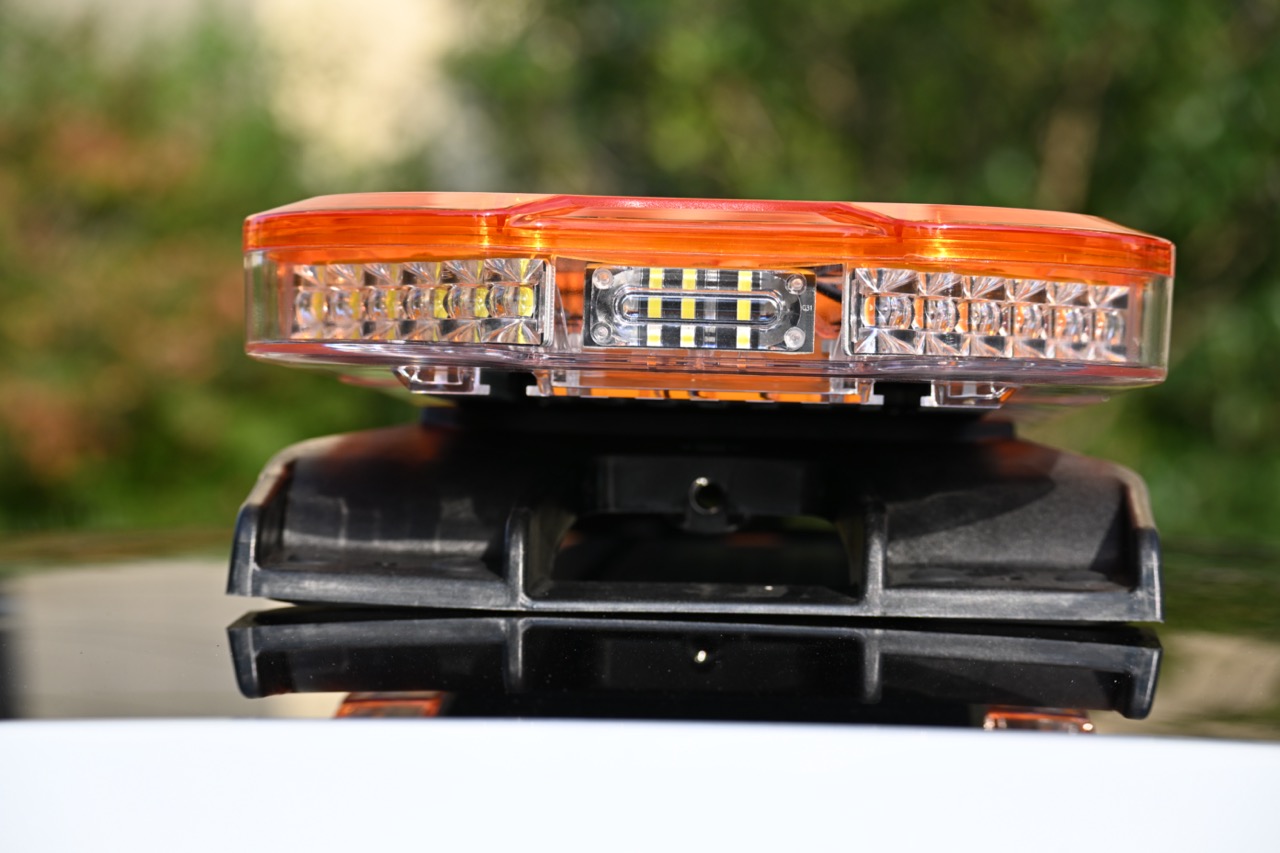
A full-size lightbar in side profile. Elevated mounting is what gives this format its cross-directional visibility, and it also sets its exposure profile.
Standalone and transferable mounting
A beacon occupies a different slot. The BH18 supports bolts, DIN or magnetic mounting, which matters for vehicles that need warning capability without permanent body modification, and for fleets that rotate equipment between units. Its 3 W × 18 LED array, 10 selectable flash patterns and 10–33 V DC wide-voltage input make it usable across 12 V and 24 V vehicle systems.
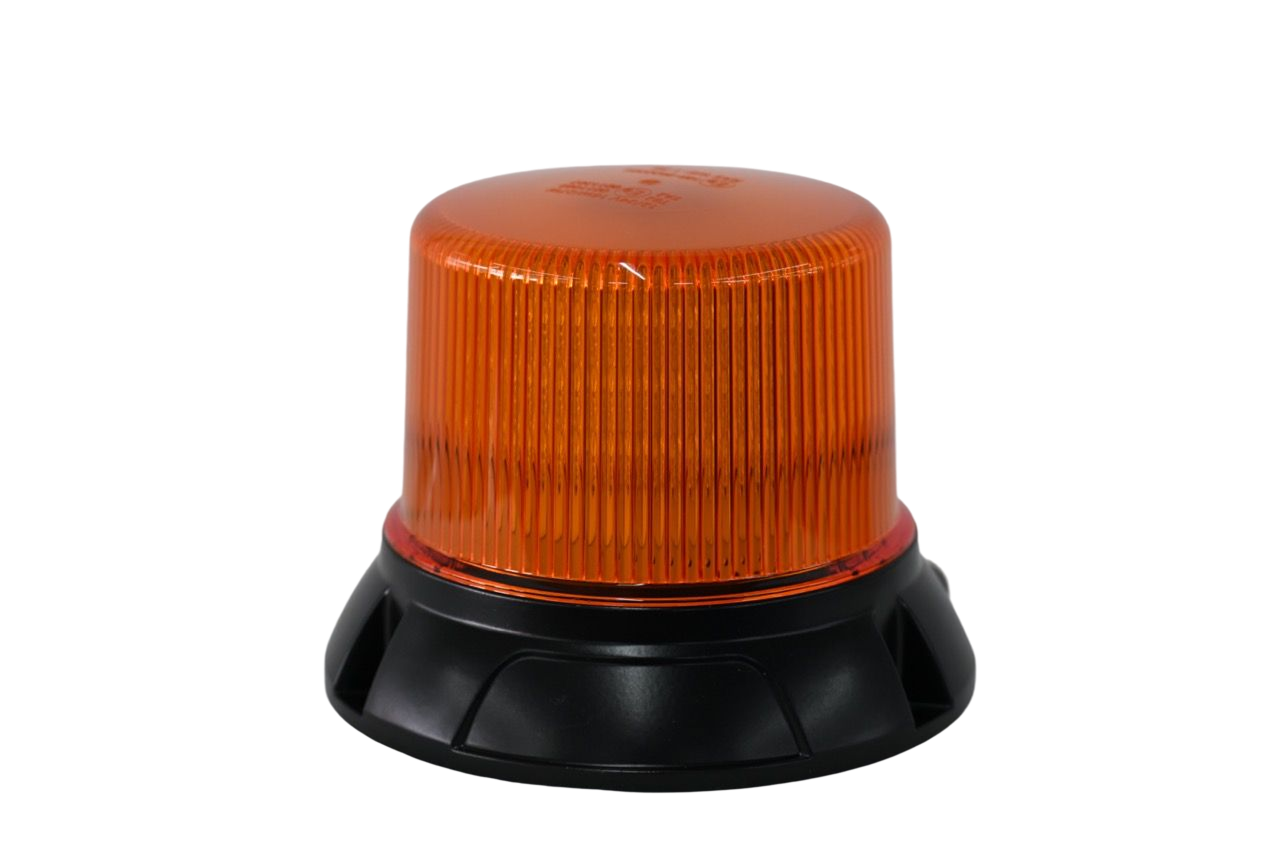
A standalone beacon. The mounting options, rather than the optical output, are often the deciding factor for vehicles that cannot take a fixed installation.
Flush and concealed mounting
The T43 hideaway light measures 18.5 × 18.5 × 21.57 mm and installs through a rubber grommet using flush mount or tube flush mount. Its purpose is discreet vehicle integration rather than maximum frontal output. It also combines warning and position lighting functions, which makes it relevant where a vehicle needs to be marked and lit simultaneously without adding visible hardware.
Panel and grille mounting
The E6 module is 118 × 25 × 7 mm with a black bezel and surface or bracket mounting. Its value is the 7 mm profile: it can be recessed into a body panel, grille or mounting frame where a full fixture would be impractical. The E6 is offered in single, dual, triple and split colour configurations, which allows a single form factor to serve different signalling requirements on the same platform.
Optical design: what Fresnel and hybrid actually tell a buyer
The portfolio uses two named optical approaches. The E6 module specifies Fresnel optical design. The LB01 lightbar and the T43 hideaway light use hybrid optical design. The wider application requirement set also references TIR, Fresnel and linear optics as available categories.
For procurement purposes, the practical reading is narrower than the terminology suggests. Optical architecture describes how light is shaped and distributed from the LED source to the lens surface; it does not by itself establish that one product will be more visible than another in a given installation. A 7 mm module and a 40.5 mm lightbar are solving different geometric problems, and the module's Fresnel approach is part of how it maintains output within that constraint.
The more useful buyer question is whether the chosen optical design, mounting position and flash pattern together produce the coverage the application needs. A lightbar at roof height and a module recessed into a grille will not be seen from the same angles regardless of which optical design each one uses.
Environmental exposure: what IP65, IP67 and IP69K mean in a selection decision
Ingress protection is where application matching becomes concrete. IP67 covers dust protection and temporary immersion under specified test conditions. IP69K addresses dust protection and high-pressure, high-temperature water-jet exposure under its applicable test standard. Neither rating alone guarantees suitability for every environment, and the appropriate rating depends on actual cleaning methods and exposure conditions rather than on a general preference for a higher number.
Applied to the portfolio, this produces a genuine selection fork:
- LB01 lightbar — IP65. Suited to the general weather exposure a roof-mounted lightbar encounters in normal road operation.
- BH18 beacon, T43 hideaway, E6 module — IP67 or IP67/IP69K. Suited to applications where the fixture is exposed to directed water, high-pressure washing or heavier contamination.
- SC7X controller — IP67. Rated for in-cab mounting positions where incidental moisture is possible.
A fleet that pressure-washes vehicles after every shift is describing a different requirement from a fleet that operates in rain and dust only. In the first case the IP69K-capable fixtures are the specification match; in the second, IP65 may be adequate and the buyer can prioritise other attributes. All five products share an operating temperature range of −30 °C to +70 °C, so thermal tolerance is not the differentiator here — water and particulate exposure is.
Matching fixture type to vehicle operating environment
The following mapping follows the application categories documented for this product family: emergency and public safety, road and traffic management, commercial and utility vehicles, and construction and industrial use.
Emergency and public safety vehicles
Police vehicles, fire trucks, ambulances, rescue vehicles and emergency response vehicles need warning that is visible from multiple approach angles and that behaves predictably under low-light conditions. The documented role of the E6 module in this segment is emergency warning, and the product is specified for use with warning light controllers and programmable controllers, with custom flash patterns identified as an application requirement.
That controller dependency is a procurement point, not a footnote. A module is not a standalone system. Where a vehicle upfitter specifies E6 units across a grille or body panel, the control layer has to be designed at the same time, which is where a unit such as the SC7X enters the specification.
For emergency applications the certification class also carries weight. The BH18 is documented with ECE R65 Class 2 and SAE J595 Class 1, and the E6 is available with ECE R65 Class 2, SAE J595 Class 1 and ECE R10 options. ECE R65 Class 2 requires dual-level intensity control, operating at maximum brightness during the day and dimming at night. For a patrol vehicle or ambulance working across a full shift, that day-night behaviour is part of the functional requirement rather than an optional refinement.
Road and traffic management vehicles
Road maintenance, traffic management, highway maintenance, roadside assistance and traffic enforcement vehicles operate in a different exposure set. The documented role of the BH18 in this context is traffic guidance, and the product is specified for operation under snow and fog conditions and for emergency vehicle upfitting projects.
Amber is the conventional colour for this segment, and it is available across the lightbar, beacon, module and hideaway ranges. The lightbar format is the natural fit where the vehicle needs to be seen by approaching traffic from a distance, while the beacon supports temporary or transferable deployment on shorter jobs. SAE J595_202108, the recommended practice for directional single-colour flashing optical warning devices, explicitly covers devices used on authorised emergency, maintenance and service vehicles, which places road maintenance squarely inside that standards conversation.
Commercial and utility vehicles
Tow trucks, service vehicles, utility vehicles, maintenance vehicles and fleet vehicles present the tightest mounting constraints. Limited installation space is a documented working condition for this product family, and the two smallest fixtures answer it directly: the T43 at 18.5 × 18.5 × 21.57 mm and the E6 at 118 × 25 × 7 mm.
The T43 is described as designed for discreet vehicle installation, combining warning and position lighting functions and suitable for 12 V and 24 V vehicle systems. For a utility truck that must be marked at night without altering its silhouette, that combination is more relevant than raw output.
Distributor behaviour reflects this. Buyers Products, a U.S. supplier of vehicle equipment and accessories, carries the T43 in its product portfolio and sells it through its official online store. Valostore, a Finnish specialist retailer, carries the SQ4, T43, E4 and E12 across compact warning lights, hideaway lights and LED warning lightheads. A portfolio spanning multiple fixture types is what allows a single distributor to serve different vehicle segments, which is consistent with the idea that each type has its own application rather than a shared one.
Fleet retrofit and aftermarket replacement projects
Fleet retrofits and aftermarket replacement differ from OEM builds in one important way: the mounting points already exist, and the specification has to work within them. In these projects the control layer frequently determines what is achievable. The SC7X provides seven programmable buttons operating in momentary or ON/OFF mode, automatic night-time backlight dimming, a 10–30 V DC input, a 40 A maximum current output, and either 2 × 10 A or 4 × 5A outputs, with a 300 mm cable harness and IP67 protection.
The control layer: how fixture types become one system
A vehicle fitted with a lightbar, a pair of modules and a set of hideaway lights is not automatically a coordinated warning system. What makes it one is the control layer, and the documented operating modes for this application family — manual control, central controller control, CAN bus control, programmable flash patterns and synchronised operation — all depend on it.
The SC7X is the controller in this portfolio. Its automatic night-time backlight dimming matters in a cab environment, and its output configuration determines how many fixtures a single unit can drive: two 10 A channels support fewer, higher-draw loads, while four 5 A channels support a wider spread of smaller fixtures. Both configurations are available.
One detail deserves attention during system design. The SC7X input voltage range is 10–30 V DC, while the warning lights in the portfolio are rated 10–33 V DC. On standard 12 V and 24 V vehicle systems this is not a practical conflict, but in a system where the supply is expected to run at the upper end of the lighting range, the controller's narrower window should be verified against the actual vehicle electrical specification before approval.
A practical selection checklist
The documented selection criteria for this product family can be used directly as a procurement checklist. Each item should be answered before a model is fixed.
- Vehicle type and intended application. Emergency response, road maintenance, utility service and general fleet work each imply different colour conventions, visibility angles and duty cycles.
- Mounting space and required visibility. Roof, standalone, flush, panel and grille positions are not interchangeable. The mounting constraint usually eliminates one or more fixture types before output is even discussed.
- Applicable regulatory approvals. Confirm the class and edition that applies to the market and vehicle category, and request the model-level certificate rather than the company-level statement.
- Operating voltage and environmental protection. Confirm the fixture is rated for the vehicle's 12 V or 24 V system, and match the ingress rating to the actual cleaning and exposure routine rather than to a preference.
- Required colours, flash patterns and customisation. Single, dual, triple and split colour configurations exist across the portfolio, and custom flash patterns are documented as an application requirement in emergency use.
Limits that application matching has to respect
An honest selection process has to acknowledge where each format stops. The following boundaries follow directly from the published specifications.
- IP classification is not uniform across the portfolio. The LB01 lightbar is rated IP65 while the beacon, hideaway and module are rated IP67 or IP67/IP69K. A buyer who needs high-pressure washdown capability cannot assume the lightbar carries the same protection as the smaller fixtures.
- Compact fixtures are not scaled-down lightbars. The T43 measures 18.5 × 18.5 × 21.57 mm and is designed for discreet installation. It does not reproduce the cross-directional coverage of a 600–1600 mm roof-mounted bar, and it is not intended to.
- Modules are not standalone systems. The E6 is documented as requiring warning light controllers and programmable controllers. Specifying modules without designing the control layer leaves an incomplete system.
- Compliance is model-specific. Company-level statements reference ECE, SAE, CE, R10, R65 and IP67/IP69K, but applicability depends on the product. Certificate numbers, test reports and issuing bodies should be requested for the exact model being specified.
- Controller capacity is finite. The SC7X supports either 2 × 10 A or 4 × 5 A outputs at a 40 A maximum. A vehicle with a large fixture count needs the load calculation completed before the controller is confirmed.
Market context behind application-driven specification
Two market signals support the shift toward application-specific selection. The global emergency warning light market is projected to grow at a compound annual growth rate of 3.6% from 2025 to 2031, according to Lucintel's emergency warning light market report. The broader emergency lighting market, which includes vehicle warning kits, was valued at USD 7.5 billion in 2023, per Global Market Insights.
A more mature growth profile tends to reward specification quality over volume expansion. In that environment, differentiation shifts toward compliance class and protection rating rather than raw output. ECE R65 Class 2's dual-level intensity requirement illustrates the direction: the standard is not asking for more light, it is asking for light that behaves correctly across day and night conditions.
The LED transition reinforces the same point. Global Market Insights estimates the LED segment at a 74.4% share of the commercial landscape and outdoor lighting market in 2026, which means LED is no longer the differentiator — how the LED fixture is configured, protected and controlled is.
Future outlook
The direction of travel is toward finer application segmentation rather than broader product lines. Three pressures point that way. First, ingress classification is increasingly specified against real cleaning procedures rather than a generic preference for water resistance. Second, control integration is becoming part of the lighting specification, with programmable flash patterns, synchronised operation and CAN bus control moving from premium features to expected capabilities in fleet projects. Third, customisation is broadening — logo, flash pattern, optical design, cable length and LED colour are all documented customisation options, and OEM/ODM cooperation for vehicle warning and signalling lights is supported subject to project-by-project confirmation of feasibility, order quantities, timelines and certification requirements.
The practical implication for buyers is that the fixture and the vehicle platform will increasingly be specified together. Treating warning lighting as a line item added at the end of an upfit is likely to produce mismatches that neither a higher-output fixture nor a lower price can fix.
Frequently asked questions
Which LED warning light type suits a road maintenance vehicle?
Road maintenance and traffic management applications generally call for amber warning, high visibility to approaching traffic, and operation in weather conditions that include snow and fog. The LED beacon in this portfolio is documented as suitable for traffic guidance under snow and fog conditions and for emergency vehicle upfitting projects, with ECE R65 Class 2, SAE J595 Class 1 and ECE R10 certification and IP67/IP69K protection. A full-size lightbar offers the widest elevated coverage where roof mounting is available, and modules or hideaway lights cover positions the bar cannot reach.
When is a hideaway LED warning light more appropriate than a beacon or lightbar?
A hideaway light fits applications where mounting space is limited or where the vehicle must retain a discreet appearance. The T43 measures 18.5 × 18.5 × 21.57 mm, installs through a rubber grommet using flush or tube flush mounting, and combines warning with position lighting. It is designed for discreet vehicle installation and works on 12 V and 24 V systems. It does not replace the cross-directional coverage of a roof-mounted lightbar, so the choice depends on whether concealment or maximum visibility is the priority.
Is IP65 sufficient for a utility vehicle warning light?
It depends on the exposure routine. IP67 covers dust protection and temporary immersion under specified test conditions, and IP69K addresses dust protection and high-pressure, high-temperature water-jet exposure under its applicable test standard. Where a fleet uses high-pressure washing, an IP69K-rated fixture is the closer specification match. Where exposure is limited to rain, dust and normal road operation, IP65 can be adequate. Neither rating alone guarantees suitability for every environment, and the decision should follow the actual cleaning method and exposure conditions.
Can one control panel manage several warning light types on the same vehicle?
Yes, within its rated capacity. The SC7X controller provides seven programmable buttons in momentary or ON/OFF mode, automatic night-time backlight dimming, a 10–30 V DC input and a 40 A maximum output, configurable as either 2 × 10 A or 4 × 5 A outputs, with IP67 protection and a 300 mm cable harness. The load calculation should be completed first, since the channel arrangement determines how many fixtures the panel can drive.
What does ECE R65 Class 2 mean for an emergency vehicle warning light?
ECE R65 Class 2 requires dual-level intensity control, operating at maximum brightness during the day and dimming at night. For emergency vehicles working across full shifts, that behaviour is a functional requirement rather than an optional feature. It should be verified against the specific model's certification, since class and applicability vary by product within a portfolio.
What should be verified before a warning light model is approved for a project?
Verify the vehicle type and intended application, the available mounting space and required visibility, the applicable regulatory approvals for the market, the operating voltage and environmental protection rating, and the required colours, flash patterns and customisation. Request model-level certificates and test reports rather than relying on company-level compliance statements, and confirm that any module-based installation includes a compatible controller in the system design.
Reference material. For procurement teams reviewing the full fixture range described in this article, the SIGROCK standard edition catalogue is available here: SIGROCK Catalogue — Standard Edition.
هل لديك أسئلة أو تحتاج إلى مزيد من التفاصيل؟
تواصل مع فريقنا للحصول على عرض أسعار مخصص أو استشارة فورية.
طلب عرض أسعار
املأ النموذج أدناه وسيتواصل معك فريقنا بعرض مقترح مخصص.
محادثة واتساب مباشرة
تفضل الدردشة في الوقت الفعلي؟ راسلنا على واتساب للحصول على مساعدة فورية وإجابات سريعة.
- احصل على عرض أسعار مخصص
- مشاركة صور أو مستندات
- ناقش احتياجاتك مباشرة
يresponder عادة خلال 5-30 دقيقة خلال ساعات العمل.