
Matching Label Printing Machines to Production Scenarios
The global label printing machines market was valued at USD 8.58 billion in 2025 and is projected to reach USD 14.36 billion by 2034, according to The Insight Partners. Behind those figures lies a procurement shift that matters more than the headline numbers: buyers are increasingly selecting presses based on the range of label scenarios they must serve — daily-use products, chemicals, wristbands, wine, food, cosmetics, and pharmaceuticals — rather than on speed specifications alone.
The Core Challenge: Matching Press Capability to Job Mix
Most label converters do not operate a single production scenario. Their order book typically mixes short-run jobs with longer repeat orders, film labels with paper labels, and simple die-cut shapes with decorative finishing requirements.
Traditional equipment evaluation tends to focus on what a press can do in isolation: maximum printing speed, web width, total power. The more useful question is whether the machine can handle the entire production mix with acceptable changeover time, registration stability, and process flexibility.
For buyers in the research and evaluation stage, that requires a scenario-based assessment framework rather than a feature checklist.
Intermittent vs. Full-Rotary: What the Architecture Choice Means
One of the first architectural decisions in label press selection is the difference between intermittent (semi-rotary) and full-rotary operation.
Intermittent presses advance the material in steps, so repeat length can be changed without replacing cylinders. This gives them a natural advantage in short-run, multi-version production. Full-rotary presses run the web continuously at high speed and are best suited to long, stable runs.
CAISHENG's CS-JQ350G-6C demonstrates a combined approach: a maximum speed of 60 m/min in intermittent mode and 158 m/min in full-rotary mode, with a maximum full-rotary printing area of 350mm × 419mm and an intermittent printing area of 350mm × 380mm. The 10-color CS-JQ350G-10C version carries 34kW main power and 13.5kW LED UV dryers.
The dual-mode logic extends to finishing equipment. The CS-350 high-speed die-cutting machine also supports both modes, with an intermittent speed of 60 m/min and a full-rotary speed of 160 m/min, in maximum areas of 350mm × 420mm and 350mm × 460mm respectively.
For a buyer, the key question is not which mode is faster, but which mode will dominate their actual job mix.
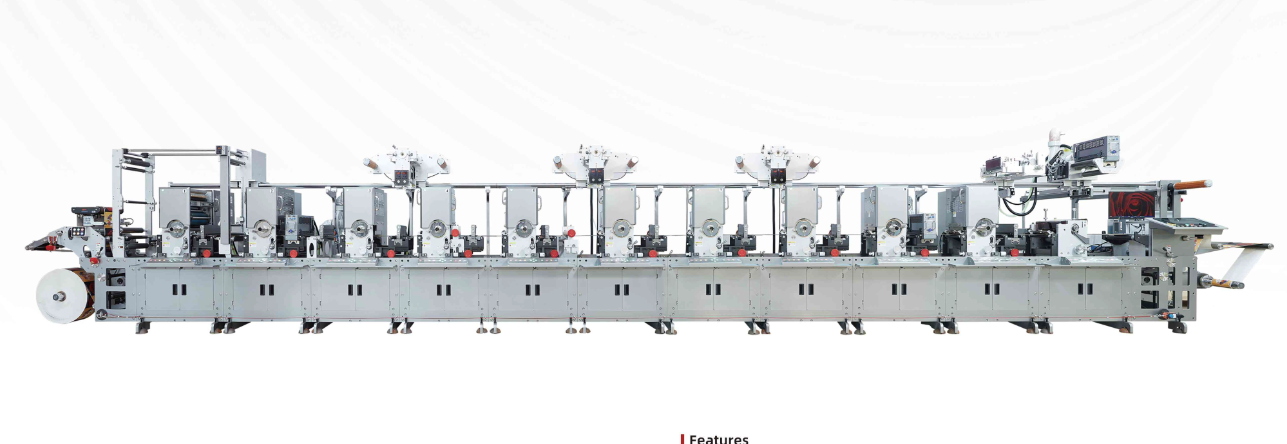
CS-JQ350G Intermittent & Full rotary high speed label printing machine
Flexo vs. Letterpress: Selecting the Printing Principle for the Job
Flexographic printing remains the most commonly used process in label production. According to Smithers, flexography accounts for approximately USD 13.3 billion of label output value. The global flexographic printing machine market was estimated at USD 17.57 billion in 2024 and is projected to grow at a CAGR of 9.7% through 2030, per Grand View Research.
Letterpress remains a preferred technology for fine text, sharp dot reproduction, and layered ink coverage — characteristics commonly required in cosmetics, wine, and premium food labels. In CAISHENG's product family, both technologies are available across different series, which makes the comparison a practical one rather than a brand-preference question.
- CS-J380F-4C and CS-J380F-7C: intermittent flexo presses with a maximum full-rotary printing area of 360mm × 419mm and a top speed of 60 m/min.
- CS-Q370F-6C and CS-370F-8C: full-rotary flexo presses reaching 150 m/min, with printing areas of 370mm × 200mm or 370mm × 600mm.
- CS-220, CS-300, and CS-320 series: intermittent letterpress machines with web widths from 220mm to 320mm and a rated speed of 40 m/min.
Choosing between flexo and letterpress is fundamentally a scenario decision. A converter serving long-run orders on standard substrates may optimize for flexo speed and plate cost. A converter handling premium short-run labels may prefer letterpress for print sharpness. The availability of both architectures from a single manufacturer reduces the risk of a wrong choice, because the comparison can be made against the same engineering and service standards.
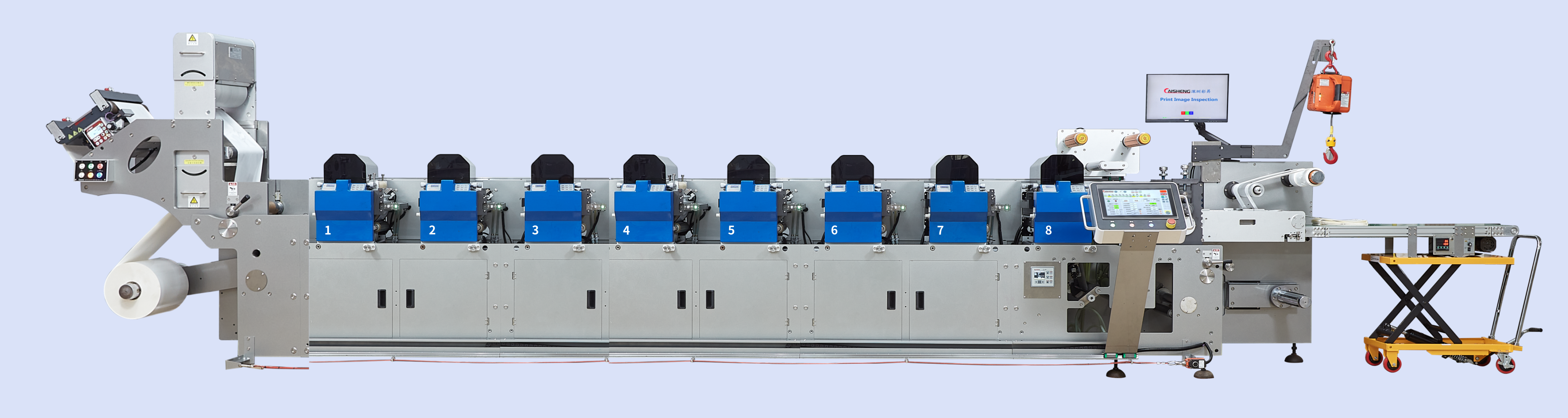
CS-Q370-8C full-rotary flexo printing machine
Integrated Finishing: Turning a Press into a Complete Production Line
Labels are rarely finished at the printing station. Die-cutting, varnishing, lamination, foil stamping, embossing, slitting, and sheet cutting all contribute to the final product. The degree to which these processes can be integrated into a single press line is one of the strongest indicators of scenario fit.
CAISHENG's ODM capability list documents a broad set of customization options: color stamping, glue-side printing frames, cold foil stamping, lamination, offline/online UV varnishing, flatbed die-cutting, rotary die-cutting, sheet cutting, slitting, corona treatment, dust cleaning, static elimination, full-rotary screen printing, hot foil stamping, and embossing.
The application scenario for this equipment is described as a one-stop solution for adhesive label printing technology issues, helping printing factories complete multi-process printing on one machine and produce finished products in a single run.
The production logic is straightforward: when the web remains in one line from unwinding to finished label, registration consistency improves and manual handling between processes disappears. The buyer-side trade-off to review is whether the process combinations in their own order book justify the mechanical complexity of an integrated machine.
CAISHENG's finishing range also illustrates the same platform logic outside the printing unit. The CS-Q380V high-speed corona varnish machine is designed for digital print finishing, with a maximum web width of 360mm and a speed of 100 m/min. The VS-250W full-rotation screen printing multifunctional machine combines screen printing with rotary die-cutting and optional hot foil stamping, embossing, or flatbed die-cutting, at a maximum web width of 250mm.
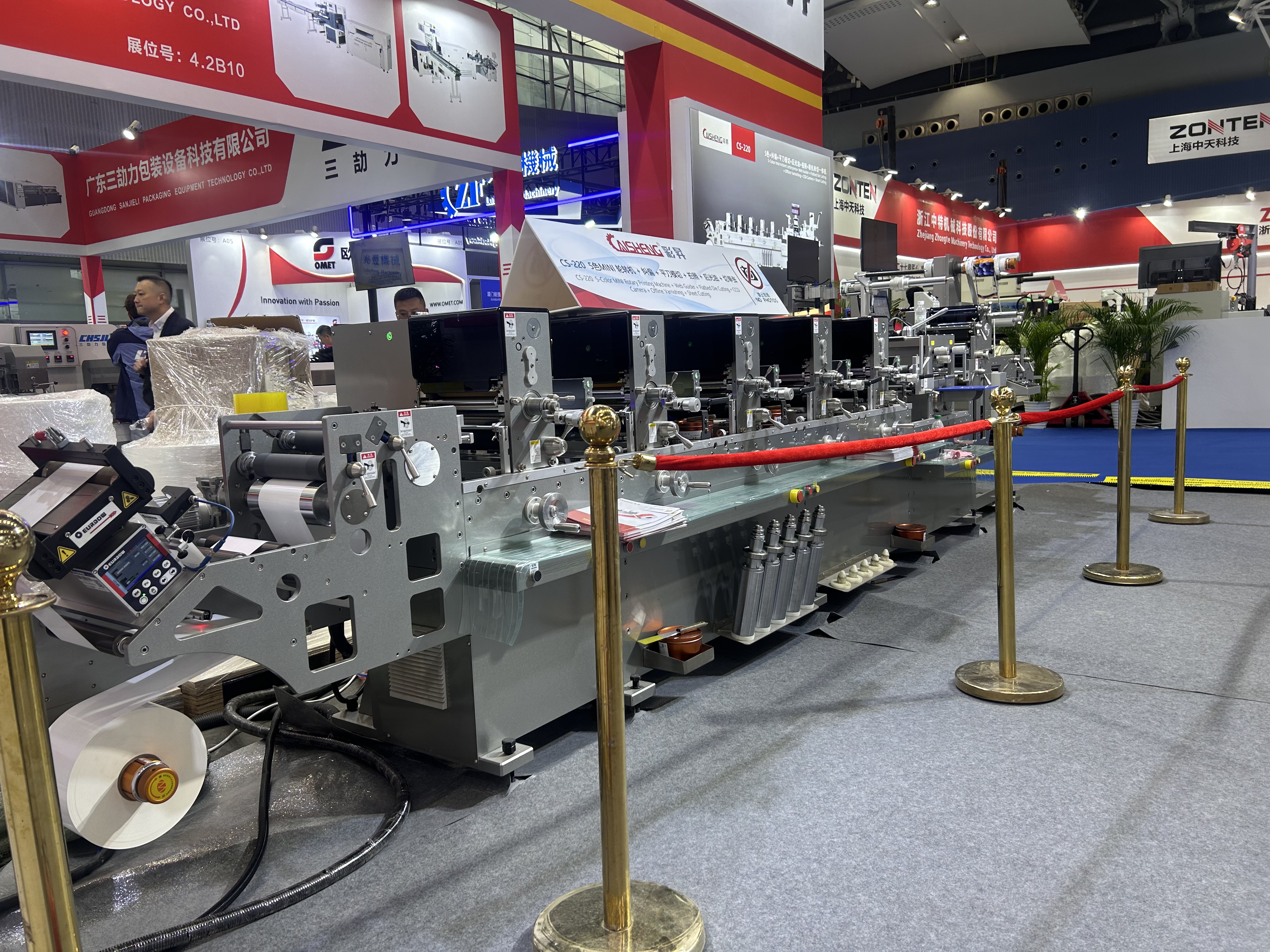
CS-220-5-color letterpress printing machine + flatbed die-cutting + offline varnish + sheet cutting
Application Scenarios: What Different Label Categories Demand
CAISHENG's documented application scenarios cover self-adhesive labels for daily products, chemicals, wristbands, wine, food, cosmetics, and pharmaceuticals. For evaluation purposes, these categories can be grouped by production demand:
- Food and pharmaceutical labels: registration stability, batch consistency, and reliable substrate handling across film and paper.
- Cosmetics and wine labels: decorative processes such as cold foil, hot foil, lamination, varnishing, and embossing.
- Daily chemical and industrial labels: durability, varnish resistance, and glue-side printing capability.
- Wristbands: precise die-cutting and print durability in a compact format.
The ability to switch between these demands without major reconfiguration is the defining feature of a scenario-flexible press.
Operating-environment requirements are part of the fit as well. The documented application conditions specify normal room temperature operation, with no constant-temperature workshop required. Supporting equipment includes a servo system, air cooling system, water cooling system, and UV drying lamps. For converters planning floor space and infrastructure, these conditions reduce installation cost and complexity.
Evidence from Production: Registration, Stability, Expandability
Two documented installations help translate specifications into evaluation criteria.
A renowned Asian trademark design and printing company in Taiwan purchased a CS-320 press for high-quality label printing. After two years of use, the client highlighted superior printing precision, stable production performance, and flexible process expansion capabilities as the machine's strengths.
Donnelley & Sons (RRD), a leading global provider of commercial printing, packaging, and multi-channel marketing communication solutions, has been operating a CS-300 machine for three years. The company recognized stable registration accuracy, excellent print quality, and reliable equipment performance. After the equipment entered production, it contributed to improved production efficiency and product quality, and the two parties established a long-term cooperative relationship.
These cases demonstrate the criteria that matter after a press is installed: precision in daily operation, stability over time, and the ability to expand into new processes or label categories.
A Scenario-Fit Assessment Framework for Buyers
The following sequence can help buyers move from specification research to scenario evaluation:
- Define the label mix — the label categories, substrates, typical run lengths, and finishing requirements expected over the next 12 to 24 months.
- Separate short-run from long-run demand — determine whether intermittent or full-rotary performance will drive utilization.
- Map finishing requirements — decide which processes must be inline and which can remain offline.
- Confirm environmental fit — floor space, power supply, cooling, and workshop conditions.
- Compare supply conditions — ODM capability, lead time, MOQ, quality testing, and after-sales support.
CAISHENG's documented production capability provides a benchmark for the last point: monthly capacity of 18 units, lead time of 45 to 60 days, minimum order of 1 unit, and 100% testing before delivery. Export markets include Southeast Asia, the EU, the Middle East, and the United States, with remote assistance and a one-year warranty on major components as the documented after-sales standard.
| Assessment Dimension | What to Compare | Reference Example (CS-JQ350G-6C) |
|---|---|---|
| Machine architecture | Intermittent vs. full-rotary operation | 60 m/min intermittent; 158 m/min full-rotary |
| Printing process | Flexo vs. letterpress suitability | Both architectures available in the product range |
| Finishing integration | Inline vs. offline process scope | Die-cutting, varnishing, lamination, foil, screen printing |
| Operating conditions | Workshop and infrastructure needs | Room temperature; servo, air/water cooling, UV lamps |
| Supply conditions | Lead time, MOQ, testing | 45–60 days; MOQ 1 unit; 100% testing |
- List the label categories you expect to serve in production
- Separate short-run and long-run demand
- Identify must-have inline finishing processes
- Verify substrate compatibility for paper, film, and specialty materials
- Check registration precision requirements per product family
- Confirm the operating environment: power, cooling, room temperature
- Compare supplier terms: lead time, MOQ, testing protocol
- Review after-sales support and warranty conditions
Market Trends: Why Flexibility Is Becoming the First Criterion
Asia-Pacific accounted for 41.8% of label printing machines market revenue in 2025, according to Data Bridge Market Research. As the largest regional market, it shapes global supply expectations: shorter delivery times, more configuration options, and closer manufacturer-buyer collaboration.
The narrow-web segment illustrates the growing demand for flexible presses. Spherical Insights projects the global narrow web label printing machines market to grow from USD 1.43 billion in 2024 to USD 3.21 billion by 2035. Narrow-web presses are the typical format for the multi-process, self-adhesive label work discussed in this article; their projected growth reflects a structural shift toward versatility.
Compliance remains a fixed part of scenario fit. ISO 12643-2:2023 defines safety requirements for graphic technology equipment including label presses. In the EU, machinery must comply with the Machinery Directive 2006/42/EC and carry CE marking, with safety signs following EN ISO 7010. Buyers should verify that the machine configuration under consideration — including installed finishing modules — still satisfies the safety and compliance profile of the destination market.
Integrated Press vs. Traditional Multi-Machine Lines: A Balanced View
An integrated multi-process press reduces handling, labor, and floor space, and it improves registration consistency because the web is not re-threaded between separate machines. These benefits are strongest when a converter's job mix is diverse and process changes are frequent.
A traditional line — separate printing, die-cutting, and varnishing machines — still retains a clear role. Dedicated machines are simpler to operate and maintain, and each station can run independently. For a converter with a narrow product range and stable high-volume orders, dedicated equipment can be more cost-effective. Integrated multi-process printing necessarily adds mechanical complexity, increases setup work per job, and concentrates operational risk in one line: when one station requires maintenance, the entire line stops.
This boundary is worth stating plainly in any equipment evaluation. The best press for a diversified label converter may be the wrong choice for a single-product manufacturer.
Future Outlook: From Equipment Supply to Scenario-Adaptive Systems
The label printing equipment market is moving toward scenario-adaptive design. The projected expansion of the narrow-web segment and the sustained dominance of flexography suggest that buyers will continue to seek presses that combine multiple processes with efficient changeover. Digital printing will keep expanding its role in short-run label production, but for medium and large runs, multi-process analog presses remain the primary production platform.
Supplier-side integration is becoming part of the equipment evaluation. CAISHENG — founded in 2011, headquartered in Shenzhen, operating a 6,000m² factory with 65 employees and an annual output of approximately 200 units — represents a manufacturing model in which an in-house R&D team of 8 engineers supports continuous product development and configuration requests. Roughly 50% of the company's output is exported, with main markets in Southeast Asia, Europe, the Middle East, and the United States. For buyers, this matters because scenario fit now includes the capacity to customize, test, deliver, and support equipment across borders.
For procurement decision-makers, the practical implication is straightforward: document the production scenarios you intend to serve, verify how each candidate press handles those scenarios, and compare supply-chain capabilities with the same rigor as technical specifications.
For buyers who want to review the full machine lineup and configuration options, CAISHENG's corporate brochure is available for public access and download: CAISHENG Company Brochure (PDF). The company's website: www.caishengmachinery.com.
FAQ
What is the difference between intermittent and full-rotary label printing machines?
Intermittent presses advance the web in steps, which allows repeat-length changes without cylinder changes and suits short-run, multi-version work. Full-rotary presses run the web continuously at higher speed for long, stable runs. CAISHENG's CS-JQ350G series combines both modes: intermittent up to 60 m/min and full-rotary up to 158 m/min.
How should a buyer assess whether a label printing machine fits their production scenario?
The assessment should start with the label mix — categories, substrates, run lengths, and finishing requirements — then compare machine architecture, speed modes, integrated processes, operating conditions, and supplier delivery terms. In CAISHENG's documented application scenario, the equipment runs at normal room temperature and requires a servo system, air cooling, water cooling, and UV drying lamps as supporting equipment.
Which types of self-adhesive labels can be produced on a multi-process label printing machine?
Documented application scenarios include self-adhesive labels for daily products, chemicals, wristbands, wine, food, cosmetics, and pharmaceuticals. These categories differ in substrates, finishing requirements, and quality demands, which makes multi-process integration a practical advantage.
What finishing processes can be integrated into a label printing line?
CAISHENG's customization list includes color stamping, glue-side printing, cold foil stamping, lamination, offline/online UV varnishing, flatbed die-cutting, rotary die-cutting, sheet cutting, slitting, corona treatment, dust cleaning, static elimination, full-rotary screen printing, hot foil stamping, and embossing.
What are the typical supply conditions for a customized label press?
CAISHENG's capability data documents a monthly capacity of 18 units, a lead time of 45 to 60 days, a minimum order quantity of 1 unit, and 100% testing before delivery.
What after-sales support can buyers expect?
Documented after-sales support includes remote assistance and a one-year warranty on major components. Export markets are Southeast Asia, the EU, the Middle East, and the United States.