
Matching Musical Fountain Configurations to Venue Types
A musical fountain is not one product with one specification. It is a family of structural configurations — dancing, dry deck, floating, water screen projection, fire water, digital water curtain and cold fog — and the configuration, more than the visual style, determines whether a system performs reliably in a given venue.
For buyers in the awareness and research stages, the practical question is rarely which fountain is best in absolute terms. It is which configuration fits this site, this audience and this operating schedule. A city square, a theme park and a resort forecourt place different demands on hydraulics, structural support, electrical protection and daily running hours. Settling that match early avoids the most expensive type of correction: rebuilding a fountain that has already been installed.
This reference guide maps the structural configurations of an outdoor musical fountain to the venues they are engineered for — city squares, landscape parks, theme parks, tourist waterfronts, hotels and resorts, commercial complexes, events and celebrations, scenic multimedia shows, and private estates — and explains what each match changes in technical and procurement terms.
Why Venue Type Should Drive the Configuration Decision
A musical fountain is best understood as a synchronized system rather than a decorative object: pumps, valves, nozzles, lighting and audio are driven by a shared control layer so that water moves with music. Advanced musical fountains use DMX512 lighting protocols and Programmable Logic Controllers (PLCs) to synchronize water jets with music, according to Cognitive Market Research. That control architecture is broadly similar from project to project. The physical structure around it is not.
Rainbows Fountain is the musical fountain design and engineering brand of Guangzhou Shuiguang Fountain Equipment Co., Ltd., a Chinese manufacturer established in 2012 with more than 25 years of industry experience, whose range covers Musical Dancing Fountain, Multimedia Water Show, Water Screen Media, Laser Fountain, Floor Fountain and Dry Fountain. Its outdoor musical fountain family shows how wide a single product category can be: the same family supports pump power from 1.5 kW to 110 kW and nozzle lift from 1 m to 100 m, with exact figures confirmed at project level. A configuration that works in a hotel courtyard and one that works across a lake may come from the same product line, but they are not interchangeable on site.
That is why the venue brief should be written before the equipment brief. Three questions decide the match: where the water is contained (a pool, the ground itself, or a lake), who watches it and from how far, and how often the system is expected to run.
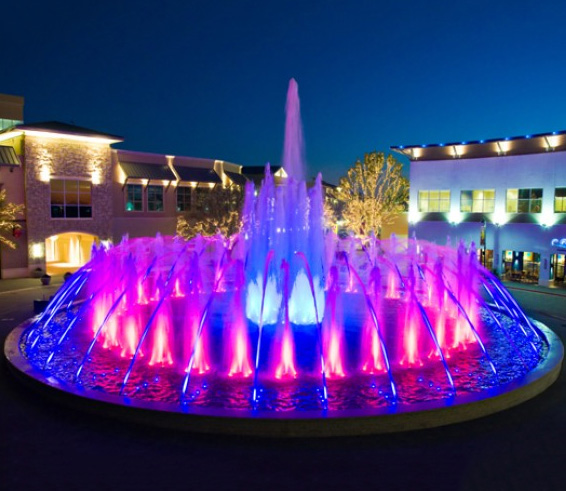
A pool musical fountain is one of several containment strategies: the venue determines whether water sits in a basin, beneath a walkable deck, or on a floating platform. Image: Rainbows Fountain.
The Seven Structural Configurations and Their Natural Venue Fit
Rainbows Fountain lists the structural configurations of its outdoor musical fountain and multimedia water show as dancing fountains, dry deck fountains, floating fountains, water screen projection, fire water fountain, digital water curtain and cold fog fountain. Each configuration is engineered around a different relationship between water, structure and audience.
| Configuration | Venue types it is usually matched to | What the match changes on site |
|---|---|---|
| Musical dancing fountain | City squares, landscape parks, public attractions, entertainment venues | Water is contained in a visible basin or pool; water movements are precisely programmed and synchronized with music and colored lighting |
| Dry deck interactive musical fountain | Public plazas, parks, commercial spaces | The fountain system is installed underground beneath a walkable deck, so visitors can interact with the water while the surface stays usable when the show is off |
| Lake floating musical dancing fountain | Natural or artificial lakes, waterfront landmarks, tourism projects | Mounted on a modular floating platform; requires floating structure design, anti-corrosion and saltwater treatment, and waterproof electrical and safety protection |
| Water screen projection musical fountain | Theme parks, tourism projects, public events, nighttime attractions | Adds a high-definition water screen for video, laser and multimedia projection on top of programmable water effects |
| Fire water fountain | Theme parks and grand events | Brings fire features into the same synchronized performance as water, music and lighting |
| Digital water curtain | Scenic multimedia shows and indoor water feature decoration | Grouped with the multimedia configuration set, where water, lighting and digital content are programmed as one performance |
| Cold fog fountain | Scenic multimedia shows and nighttime ambiance | Produces a cold fog effect that extends the visual composition of a show beyond the water jets themselves |
Configuration-to-venue mapping as described in Rainbows Fountain product and application documentation. Image: 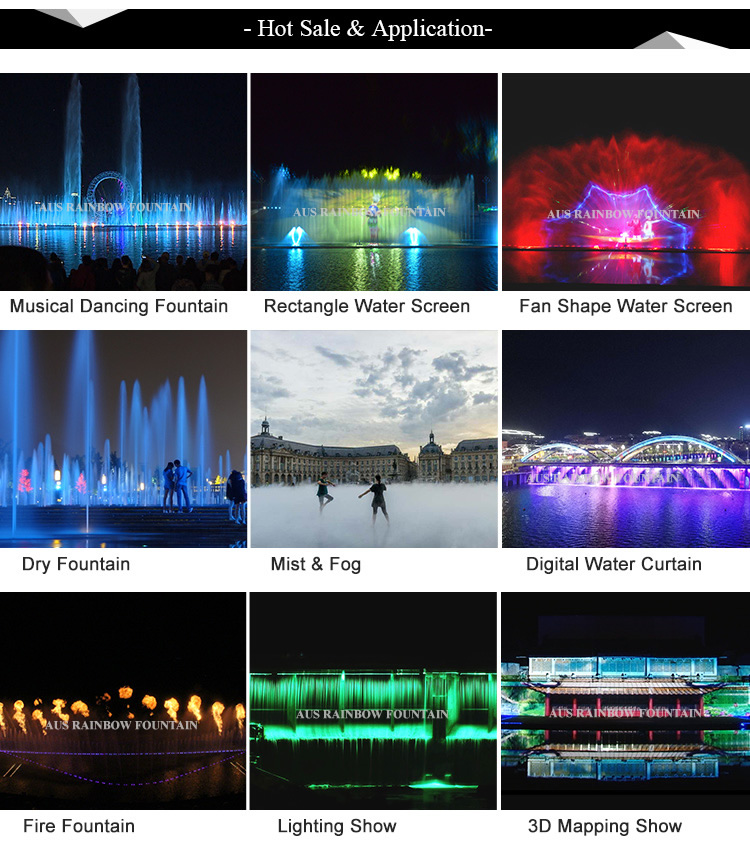
Model designations in this family are project-specific. Rainbows Fountain cites Large Outdoor Floating Water Fountain AZCH-01 and MF-01 for the large musical fountain as examples. Structures are fabricated mainly from stainless steel 304 components combined with waterproof electrical and lighting equipment, and the published specification also allows AISI 304 or 316/316L stainless steel.
City Squares: Dancing Fountains and Dry Deck Interactive Fountains
City squares are the classic venue for the musical fountain, and they impose two conditions that shape the configuration choice. The square is a public asset that must remain usable when no show is running, and the audience arrives on foot, often standing close to the water.
Two configurations address those conditions directly. A city square musical fountain is created for urban plazas and civic landmarks, combining precision fountain technology, colorful lighting and music synchronization in a programmable dancing water display that supports community events. A dry deck interactive musical fountain is designed for public plazas, parks and commercial spaces, with an underground fountain system that combines programmable water jets, colorful LED lighting and synchronized music, allowing visitors to safely interact with dynamic water performances.
The practical difference between them is civil engineering rather than artistry. A dry deck configuration places the entire hydraulic and electrical system beneath a walkable surface, so the plaza keeps its footprint for daily use and gains a performance asset after dark. That arrangement requires the deck structure, drainage and maintenance access to be coordinated with the fountain design before construction, which places more design responsibility on the fountain contractor and the site structural team than a basin installation does. The dancing fountain in a visible basin is the simpler structural proposition, and it contributes a water surface to the daytime landscape as well as a show at night.
Both configurations can be driven by the same control method — music controller, DMX512 or programmable — and the same nozzle options, including vertical adjustable or digital robot nozzles. The venue, not the control system, decides which one is appropriate.
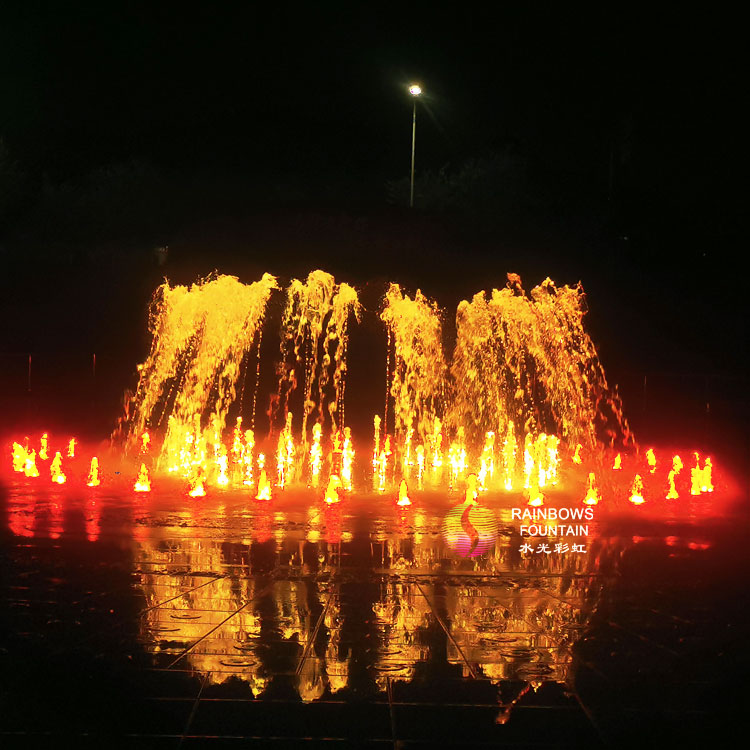
A musical dancing fountain for public attractions and entertainment venues: precisely programmed water movements synchronized with music and colorful lighting. Image: Rainbows Fountain.
Parks, Lakes and Waterfronts: Floating Fountains
For landscape parks and natural or artificial lakes, the governing constraint changes. There is often no basin to excavate, and the audience may be standing hundreds of meters away on a promenade or shoreline.
The lake floating musical dancing fountain is installed on a modular floating platform. High-powered water jets, programmable lighting and synchronized music create large-scale water shows for waterfront landmarks and tourism projects. Because the platform floats, the configuration avoids a major civil basin; because it floats, it also carries specific requirements. Rainbows Fountain application data lists anti-corrosion and saltwater treatment, floating lake structure design, and waterproof electrical and safety protection as the special requirements of these installations.
Scale is another factor. With pump power within the family reaching 110 kW and nozzle lift reaching 100 m at project level, a floating installation can be engineered for visibility across open water — but those figures are confirmed project by project rather than selected from a catalogue. Where the venue is a park rather than a lake, the pool musical fountain and the park landscape musical dancing fountain cover the smaller end of the range, complementing gardens, lakes and recreational spaces so that the landscape becomes an attraction for visitors both day and night.
Theme Parks and Grand Events: Water Screen Projection and Fire Water Fountains
Theme parks and large public events ask for the opposite of subtlety. The audience is mobile, the competing visual environment is intense, and the fountain is expected to function as a scheduled attraction rather than as background scenery.
The water screen projection musical fountain combines programmable water effects with a high-definition water screen for video, laser and multimedia projection, where synchronized music, lighting and digital content create an immersive visual experience for public events, tourism projects and nighttime attractions. In procurement terms this configuration behaves like a media platform: the hydraulics provide the canvas, while the projectors, laser, audio and control systems provide the show. The buyer is therefore acquiring a content-driven system as much as a water feature.
A multimedia musical fountain show integrates dancing water, synchronized music, programmable LED lighting, laser effects, fire features and digital projection into one performance, and is designed for city landmarks, tourism destinations and large public events. The fire water fountain applies the same logic where fire forms part of the choreography, bringing fire features into a single synchronized performance with water, music and lighting. Venue data for this configuration points to theme parks and grand events, which is consistent with the events and celebrations category in the product's intended-use list.
One operational detail matters for buyers at this stage. Rainbows Fountain states the operating mode for multimedia water shows as continuous operation. For a theme park or a nightly event program, that is the design assumption: the system is expected to run as a scheduled attraction rather than as an occasional spectacle, which shifts weight onto pump duty, IP68 underwater components, control reliability and spare-part planning.
Scenic Multimedia Shows: Cold Fog and Digital Water Curtain
Scenic multimedia shows are usually continuous environments rather than ticketed performances with a fixed start time. Visitors move through the site, view it from different angles, and expect the water, lighting and digital elements to remain coherent throughout the evening.
The cold fog fountain and the digital water curtain belong to this group. Cold fog configurations produce a fog effect that extends the visual composition beyond the water jets, and digital water curtains sit within the multimedia set where water, lighting and digital content are programmed together. Both are listed among the configurations supported by the same outdoor musical fountain family, and both fall under the multimedia show operating mode — continuous operation.
For procurement, the measurable part of a content-driven configuration is the control and media layer. Matched equipment for these projects includes DMX/PLC controllers, RGBW underwater LED lighting, full-color laser and beam lights, water-screen projectors, audio systems, an industrial PC running control software, and a filtration system. The water structure has to be engineered to hold all of it, and the working-condition notes in the same documentation include indoor water feature decoration alongside outdoor pools and lake installations — relevant for scenic venues that combine interior and exterior elements.
Hotels, Commercial Complexes and Private Estates
Not every musical fountain is a landmark. A substantial share of demand comes from venues where the fountain supports a commercial or hospitality environment rather than a public event program.
The hotel musical fountain is designed to enhance luxury hotels, resorts and hospitality venues with water choreography, synchronized music and colorful LED lighting, creating a memorable atmosphere and adding value to the guest experience. The pool musical fountain is installed in decorative pools, public squares, hotels and commercial landscapes, delivering fountain performances while enhancing the surrounding environment. The product is intended for commercial landscapes, luxury resorts and private estates as well as public venues.
Third-party data supports the commercial weight of these venues: commercial end-users, including luxury hotels and shopping malls, held the largest market share at 42.8% in 2025, according to Dataintelo. That concentration matters for configuration matching, because hospitality and retail venues generally optimize for a compact footprint, low visual noise and repeatable short sequences rather than for maximum jet height.
The matching logic for this group is therefore reasonably conservative. A pool or basin configuration at a scale that respects the architecture, with music and lighting programmed for short, repeatable sequences, is the usual answer. A dry deck interactive configuration, by contrast, is positioned for spaces where the public walks across the water feature, which is rarely the requirement in a private estate.
Trade-offs Buyers Should Accept Before Choosing a Configuration
No configuration is universally better than another; each trades one advantage for a constraint that the buyer has to accept.
- Dry deck: preserves the plaza surface and enables interaction, but requires an underground fountain system, coordinated civil works and maintenance access beneath a walkable deck.
- Floating: avoids basin construction, but adds modular floating platform design plus anti-corrosion and saltwater treatment, and waterproof electrical and safety protection where the installation demands them.
- Water screen projection, fire water and multimedia show configurations: add projectors, laser, audio and control software, so the delivered scope includes digital content and control infrastructure that must be operated, updated and supported over time.
- Continuous operation: the multimedia show operating mode assumes sustained duty, so components acceptable in a seasonal fountain may not be appropriate for a nightly attraction.
- Project-specific parameters: nozzle types, pump head, flow rate, pump power, LED and laser configuration, and DMX/PLC control all require project-level confirmation. A model number is a starting point, not a final specification.
Compared with a traditional static fountain, the structural and waterproofing fundamentals are similar — stainless steel 304 or 316/316L construction and IP68 underwater components are common expectations across the category, and standards guidance commonly cites ISO 9001:2015 quality management together with IP68 waterproof ratings for underwater components such as LED lights and pumps. What a programmable musical fountain adds is a control, lighting, audio and content layer that has to be operated as a system. If a venue cannot support that operating commitment, a simpler water feature may deliver more value for the same site.
Market Signals Behind Configuration Demand
Dataintelo estimates the global musical fountain market at USD 2.51 billion in 2025, projected to reach USD 5.23 billion by 2034, with a compound annual growth rate of 8.5% from 2025 to 2034. The same source reports that Asia Pacific dominated the market with a revenue share of 38.5% in 2025, driven by urbanization in China and Southeast Asia — a distribution consistent with where much of the design and manufacturing capability for these systems sits.
The control layer is growing as a market in its own right. SNS Insider valued the music fountain control system market at USD 1.34 billion in 2024 and expects it to reach USD 2.89 billion by 2032. Growth in the control and content segment at that order of magnitude is a meaningful signal for configuration matching: what differentiates one installation from another is increasingly the programming, synchronization and media capability rather than the hydraulics alone.
Market figures should be read with care. Estimates vary significantly by report scope, and narrower water show segments are valued considerably lower than the full musical fountain category. The consistent signal across available reporting is directional rather than precise: demand continues to move from static decorative water features toward programmable, content-driven attractions tied to tourism, commercial real estate and public space investment.
What to Verify for Each Configuration
Once a configuration has been matched to a venue, the verification checklist is largely shared across the family:
- Site and structure: containment method (basin, underground chamber or floating platform), maintenance access, and, for lake installations, floating structure design, anti-corrosion and saltwater treatment, and waterproof electrical and safety protection.
- Hydraulics: nozzle types, pump head, flow rate and pump power. The family range covers 1.5 kW to 110 kW of pump power and 1 m to 100 m of nozzle lift, with exact values confirmed at project level.
- Electrical protection: working voltage of 380V, 220V or 110V at 50–60 Hz, IP68-rated underwater components, and waterproof cabling consistent with outdoor or in-water installation.
- Control: DMX512 or PLC intelligent linkage, with music controller or programmable operation; multimedia configurations additionally require an industrial PC with control software and integration with projection, laser and audio equipment.
- Materials: stainless steel 304 components as the standard build, with AISI 304 or 316/316L stainless steel available where corrosion exposure is higher.
- Design deliverables: CAD engineering drawings, 3D visualizations and fountain effect simulations, so the buyer can confirm the intended performance before production. Rainbows Fountain's design resource includes 45 engineers and 12 designers.
- Delivery and support: overseas installation and commissioning capability. Rainbows Fountain reports an overseas engineering team of more than 20 engineers, an export ratio of 80% with main markets in the Middle East, Africa and South Africa, a 4,500 m² factory and an annual production capacity of 50 units.
Future Outlook
Configuration matching is likely to become more integrated rather than more standardized. As control and media systems account for a growing share of project value, fountains in theme parks, scenic areas and commercial destinations will increasingly be specified alongside AV, lighting and show-control infrastructure instead of as standalone landscape elements.
For buyers, the practical implication is that the venue question should be answered first and in writing: what kind of space is this, who uses it, and how often will the water run? From that brief, the configuration follows — dancing or dry deck for squares and plazas, floating for lakes and waterfronts, water screen projection and fire water for theme parks and grand events, cold fog and digital water curtain for scenic multimedia shows, and basin or pool configurations for hotels, commercial complexes and private estates. Verified control, materials and protection grades then determine whether the chosen configuration performs to expectation over its service life.
FAQ
What is the difference between a dancing fountain and a dry deck fountain?
Both are listed configurations of the same outdoor musical fountain family. A musical dancing fountain uses precisely programmed water movements synchronized with music and colored lighting, typically inside a visible basin or pool. A dry deck interactive musical fountain places the fountain system underground beneath a walkable surface, so visitors can interact with the water jets while the deck remains usable when the show is off. The difference lies in structural containment and how the public uses the space, not in the control method.
Which configuration is the better match for a city square?
City squares are typically matched with a city square musical fountain or a dry deck interactive fountain. The first gives the plaza a visible water surface and a programmable dancing display for civic events; the second preserves the walkable area of the square and adds an interactive element for daily use. The deciding factor is usually whether the square must remain fully usable by pedestrians at all times, and whether the site can accommodate the underground fountain system that a dry deck design requires.
What does continuous operation mean for a multimedia water show?
Rainbows Fountain states that the operating mode for multimedia water shows is continuous operation. In procurement terms this is a duty assumption rather than a single performance length: pumps, underwater LED lighting, projectors and control hardware are specified to run as a scheduled attraction rather than for occasional use. Buyers evaluating theme park or scenic show configurations should therefore compare components on sustained reliability, protection rating and spare-part availability rather than on peak effect alone.
Which configurations are used for theme parks and grand events?
Water screen projection and fire water configurations are matched to theme parks, tourism projects, celebrations and large public events. A water screen projection musical fountain adds a high-definition water screen to programmable water effects for video, laser and multimedia projection, with synchronized music and lighting. Fire features are integrated into multimedia performances where fire forms part of the choreography. Both rely on the same synchronized control layer used by the other configurations in the family.
What should buyers verify before confirming a configuration?
Buyers should verify containment and structure, hydraulics, electrical protection, control and materials. Published parameters for this product family include pump power from 1.5 kW to 110 kW, nozzle lift from 1 m to 100 m, working voltage of 380V, 220V or 110V, IP68-rated underwater components, and DMX512 or PLC control. Exact specifications are confirmed at project level, so a configuration should be validated against site drawings, CAD documentation and effect simulation before production begins.
Reference material: The 2026 Rainbows Fountain brochure, covering musical fountain configurations, engineering scope and project delivery, can be downloaded at 2026 Rainbows Fountain brochure. Company information: www.rainbowsfountain.com.