
Matching Nonwoven Fabric Machines to End-Use Scenarios: Hygiene to Geotextiles
A nonwoven fabric machine is described by width, beam count and line speed, but it is chosen by the fabric it has to make. Buyers in the discovery and research stage of a project frequently compare machine specifications before they have mapped their own product portfolio, and that reversed sequence is what produces mismatched lines, idle capacity and expensive re-engineering later. This guide works in the opposite direction: it starts from end-use scenarios — hygiene, medical, automotive interior, agricultural and construction-type durable fabrics — and works back to the machine architecture.
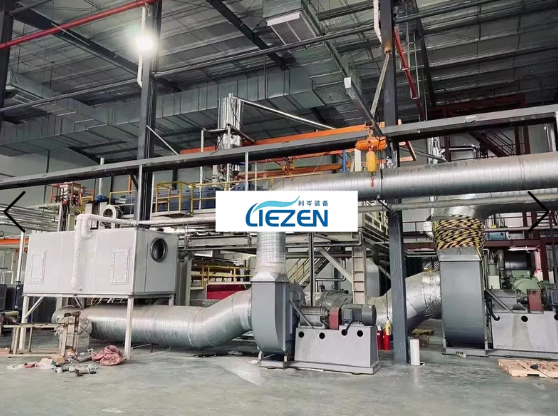
Why the end product, not the spec sheet, should set the brief
Nonwoven manufacturing is not one market served by one machine. Disposable products represented approximately 59.8% of global nonwoven application share in 2023, while spunlaid (spunbond) technology accounted for about 48.4% of the nonwoven fabrics market in the same year, according to Grand View Research. The global nonwoven machinery market was valued at USD 6.8 billion in 2025 and is projected to reach USD 12.1 billion by 2034, according to Dataintelo. Those figures describe a large and expanding equipment category — and a category in which one buyer's nonwoven fabric machine performs a fundamentally different job from another buyer's.
A line configured for lightweight, single-layer hygiene fabric is not the same asset as a line built around heavier, multi-layer structures for durable applications. The differences sit in beam count, layer sequence, web handling and downstream auxiliaries, not only in the headline width and speed numbers that dominate early supplier conversations. The practical rule for the first stage of a project is therefore: decide the fabric before deciding the machine.
Five diagnostic questions that connect a product portfolio to a machine architecture
Before requesting quotations, a buyer should be able to answer five questions about their own business. Each answer removes a class of configurations from the shortlist, and each one is easier to answer before a supplier's specification sheet is on the table.
1. Will the fabric become a disposable component or a durable structure?
Disposable hygiene and medical products, packaging and eco-friendly bags, and agricultural covers sit on the short-life side of that divide. Construction-type durable fabrics sit on the other. The documented applicable industries for Lizen Machinery Co., Ltd. configurations already span both: medical, hygiene (masks, protective wear, sanitary napkins, diapers), automotive interior, apparel and home textiles, agricultural covers, and packaging and eco-friendly bags. Because a single supplier range can cover both sides, the question has to be asked explicitly rather than inferred from a catalogue.
2. Is the fabric a single functional layer or part of a composite?
Medical and hygiene materials usually need more than mechanical softness; barrier behaviour is part of the specification. That is the point at which spunbond-only and spunmelt architecture diverge. A spunbond nonwoven machine forms the web from spunbond beams alone, while a spunmelt nonwoven machine integrates meltblown layers between spunbond layers — the SMS, SMMS, SSMS and SMMSS architectures.
3. Which property does the end product actually pay for?
Softness, uniform coverage, barrier, breathability or mechanical strength. The documented selling points across these lines — stable production with uniform fabric gram weight, flexible formula adjustment across multiple nonwoven products, a modular structure convenient for maintenance, high automation that reduces manual labour cost, and a matched closed temperature control system that improves the finished-product qualification rate — address those properties in different proportions depending on configuration. A buyer who cannot name the dominant property cannot rank configurations.
4. What width and output rhythm does the downstream process need?
Effective working width and production speed determine how a line fits a converting schedule or a project timeline. Documented envelopes across the spunbond and spunmelt configurations run from 1,600 mm to 3,200 mm effective width, with production speed below 250 m/min on the double-beam PP spunbond configuration and below 400 m/min on the SSS and SMMS configurations.
5. Will the portfolio stay fixed, or expand?
Formula flexibility is the capability that is hardest and most expensive to add after installation. Buyers who expect to move across hygiene, medical, packaging and industrial fabrics should weigh multi-beam flexibility earlier in the process. Buyers with one stable product may prefer a narrower configuration and deploy the difference elsewhere in the project.
Reading application demand into line architecture
Three representative architectures show how the same nonwoven making machine category splits by application. All three are computerised and share the same documented applicable industries; the differences lie in beam structure and in the width, speed and filament-fineness envelope.
| Configuration (documented model) | Beam structure | Effective width | Production speed | Filament fineness | Computerised |
|---|---|---|---|---|---|
| Double Beams PP Spunbond Nonwoven Fabric Machine (SW-SS) | Two spunbond beams | 1,600–3,200 mm | < 250 m/min | 1.5–2.0 D | Yes |
| SSS Spunbonded Polypropylene Fabric Making (SW-SSS) | Three spunbond beams | 1,600–3,200 mm | < 400 m/min | 1.5–2.5 D | Yes |
| SMMS Spunmelt Non Woven Machine (SW-SMMS) | Spunbond plus meltblown layers | 1,600–3,200 mm | < 400 m/min | 1.5–2.0 D | Yes |
Mechanical speed is documented separately at below 300 m/min for the double-beam PP spunbond configuration and below 450 m/min for the SSS and SMMS configurations. The main raw material across all three is polypropylene (PP) for spunbond and meltblown layers, with equipment built mainly from carbon steel, stainless steel, alloy parts and electrical components.
What the table does not contain is a fixed numeric threshold separating a hygiene fabric from a construction fabric. That threshold is not a published machine parameter; it is an architectural decision about how many beams a line carries, in what sequence, and with which auxiliaries attached.
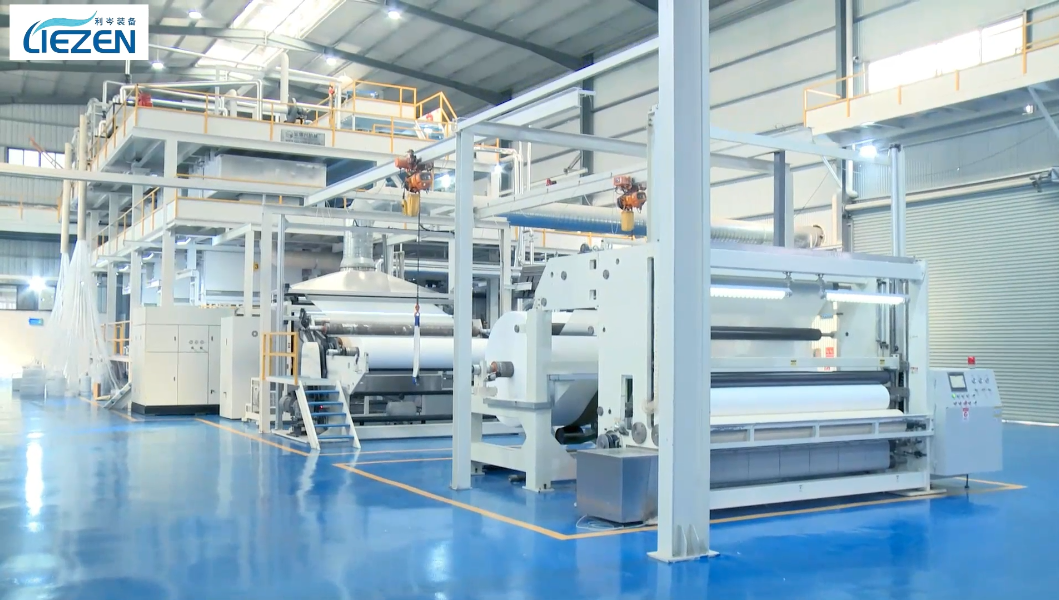
Hygiene and medical scenarios: where spunbond and spunmelt split
Sanitary napkins, diapers, masks and protective wear are among the documented hygiene and medical applications for these configurations, and disposable products as a whole accounted for roughly 59.8% of global nonwoven application share in 2023 (Grand View Research). Equipment demand is concentrated in the same place: the nonwoven machinery market in Asia-Pacific is described as driven by increasing demand for hygiene products and medical-grade materials (MarketsandMarkets).
For a sanitary napkin nonwoven fabric machine brief, the first decision is whether the fabric needs an integrated barrier layer:
- Spunbond-only configurations (Single S, SS, SSS) form the web from spunbond beams and are the documented route where coverage, mechanical strength and production economics dominate the specification. Lizen Machinery Co., Ltd. positions the Single S PP Spunbond Nonwoven Machine as its main product.
- Spunmelt configurations (SMS, SMMS, SSMS, SMMSS) add meltblown layers inside the same line, which is the documented architecture for barrier-dependent medical and hygiene materials.
Two operational facts shape how those lines are deployed. First, documented operating conditions are primarily continuous industrial operation, with lines suitable for workshop or cleanroom environments depending on the end product — medical materials being the case that points towards cleanroom conditions. Second, customisation is documented across different widths, layer counts, electrostatic treatment, flame-retardant options and medical-grade clean standards, which means the scenario answer can be refined after the architecture family has been chosen.
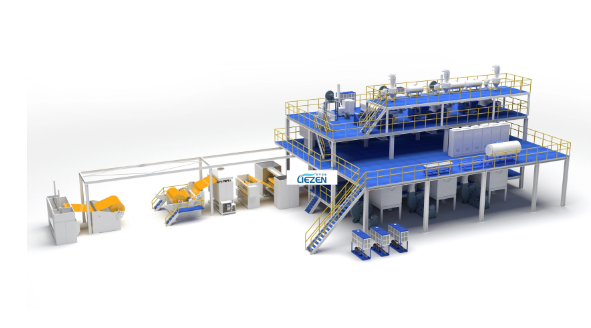
Construction, agricultural and durable scenarios: what changes
Once the end product is a durable structure rather than a disposable one, two assumptions stop holding. The first is that spunmelt is the default answer. The second is that heavier fabric automatically means a heavier version of the same line.
The automotive nonwoven market reached USD 3.6 billion in 2025, with needlefelt identified as the leading technology (Stratview Research). That is a useful corrective for buyers who treat spunbond or spunmelt as the universal route into durable applications: for a meaningful share of heavier, semi-structural and structural nonwoven products, a different technology family leads the market.
Geotextile-type construction fabrics sit on the durable side of the same divide. The right first question is therefore not how many beams a nonwoven production line needs, but whether spunbond or spunmelt is the correct technology route for that specific end product at all. Only after that has been settled do beam count, layer sequence and width become a meaningful conversation. Within the documented application set, agricultural covers, packaging and eco-friendly bags, apparel and home textiles, and automotive interior production lines are the categories closest to that durable side.
An automotive interior nonwoven production line illustrates the shift in logic. The fabric has to satisfy performance requirements over the life of a vehicle rather than for a single use, which is a different economic model from disposable hygiene, where the cost per unit of fabric dominates. The same line of reasoning applies to agricultural covers and to packaging and eco-friendly bags, where durability and handling behaviour matter more than softness.
What Lizen Machinery documents about its configuration range
Lizen Machinery Co., Ltd. is a nonwoven machinery manufacturer founded in 2003 and based in Changzhou, Jiangsu, China. The company operates a 30,000 m² factory with 270 employees and a 10-engineer R&D team, and reports an annual output of 50 units, an export ratio of 60%, and the USA as its main market.
Its documented product range covers Single S, SS, SSS, meltblown, SMS, SMMS, SSMS, SMMSS, PET and bi-component nonwoven machines. The company states that it has supplied almost 1,000 complete sets of standardised and customised nonwoven production lines in 30 countries.
Three delivery models are documented: turnkey production line delivery, single-machine supply, and process modification and upgrade projects. Matched auxiliary equipment includes traction units, winding and rewinding, fans and air compressors, heating and temperature control, and slitting, cutting and packaging equipment. Operation is continuous or semi-continuous, with levels of automation and online monitoring depending on configuration and customer requirements.
For a buyer working through scenario fit, the relevant point is not the size of the catalogue. It is that both spunbond-only and spunmelt architectures are documented within the same supplier range, which allows the architecture decision to be made on application grounds instead of being constrained by whatever a single supplier happens to build. Company information is published at lizen-equipment.com.
Where scenario fit reaches its limits
Scenario-led selection narrows a shortlist; it does not certify a line. Five boundaries are worth stating plainly.
- Published specifications are envelopes, not guarantees. Effective width and production speed describe the documented operating range of a configuration. They do not establish the gram weight, uniformity or strength of the fabric a specific buyer needs. Those have to be confirmed through sampling and acceptance testing.
- Spunmelt is not universal. Needlefelt leads the automotive nonwoven market (Stratview Research), which means some durable applications are better served by a different technology family altogether.
- Barrier-layer demand can concentrate risk. China's meltblown nonwoven production fell 22.9% to 108,000 tons in 2024 following post-pandemic stabilisation (CNITA). Capacity planned around a single barrier product therefore carries demand risk, and multi-layer flexibility is the structural hedge — at the cost of additional beams, a larger maintenance surface and higher capital outlay.
- Documented envelopes do not cover every requirement. The published effective width band is 1,600–3,200 mm, with filament fineness bands of 1.5–2.0 D and 1.5–2.5 D. Requirements outside those bands should be confirmed with the manufacturer rather than assumed.
- Compliance is a separate evidence trail. Safety requirements for nonwoven machinery are governed by ISO 11111-3:2005, with general textile machinery safety under EN ISO 11111-1:2016 for CE marking in Europe, and ISO 9001 commonly used to verify quality management systems among Chinese manufacturers. These frameworks define what to request; they do not by themselves confirm what a given supplier holds.
Compared with the conventional approach — buying the widest and fastest line the budget allows and adapting the product mix afterwards — scenario-led selection usually produces a narrower, better-argued shortlist. It does not remove the need for material trials, site data and written acceptance criteria, and it does not replace a factory audit or a reference check with existing operators.
Market signals that shape scenario choices
Several verifiable data points make the scenario question more than theoretical.
- China's nonwoven fabric output reached 8.56 million tons in 2024, a 5.1% year-on-year increase (China Nonwovens & Industrial Textiles Association).
- Spunbonded nonwovens contributed 3.88 million tons of that output, up 4% year on year (CNITA).
- China exported 1.52 million tons of nonwovens in 2024, valued at USD 4.04 billion, with spunbonded nonwovens representing 37% of export value (China Customs / CNITA).
- Asia Pacific held a 43.7% revenue share of the nonwoven machinery market in 2025, and spunbond machinery the largest technology share at 34.2% (Dataintelo).
- The spunbond technology market is projected to grow at a CAGR of 6.20% from 2026 to 2034 (Fortune Business Insights).
- Polypropylene remains the dominant raw material for spunbond production, accounting for more than 53% of that segment in 2026 (Fortune Business Insights).
The interpretation for buyers is straightforward. Growth is concentrated in spunbond and in Asia-Pacific, and hygiene and medical-grade demand is the stated driver. That is also where competitive pressure will be strongest. A buyer who maps end-use scenarios before configuring capacity is better placed to avoid adding capacity in the most crowded segment, and better able to justify a multi-layer configuration when the product plan genuinely requires barrier performance rather than assuming it does.
Future outlook
Three directions are visible from the current data. First, multi-layer spunmelt architectures are likely to remain the standard route for barrier-dependent hygiene and medical products, while spunbond-only configurations remain the economics-led route for single-layer applications. Second, differentiation is shifting away from headline mechanical speed towards automation, online monitoring and closed temperature control, since documented width and speed envelopes are already established at 1,600–3,200 mm and up to below 400 m/min on the SSS and SMMS configurations. Third, compliance documentation is gaining weight as medical-grade and export-oriented capacity grows, with ISO 11111-3:2005, EN ISO 11111-1:2016 and ISO 9001 as the reference frameworks buyers can verify against.
The scenario map should be revisited rather than filed. Portfolios move: a manufacturer that starts in disposable hygiene and later adds industrial, agricultural or automotive fabrics re-opens the architecture question, because the answer that fit the first product line is rarely the answer that fits the second.
Frequently asked questions
What is a nonwoven fabric machine used for?
A nonwoven fabric machine produces nonwoven fabric directly from raw material, most commonly polypropylene (PP) for spunbond and meltblown layers. Documented applicable industries for these lines include medical, hygiene (masks, protective wear, sanitary napkins, diapers), automotive interior, apparel and home textiles, agricultural covers, and packaging and eco-friendly bags.
How do I decide between a spunbond nonwoven machine and a spunmelt nonwoven machine?
The decision follows the product requirement rather than a preference between machine types. A spunbond machine forms the web from spunbond beams alone (Single S, SS, SSS) and fits single-layer fabric requirements. A spunmelt machine integrates meltblown layers between spunbond layers (SMS, SMMS, SSMS, SMMSS) and is the documented architecture for barrier-dependent medical and hygiene materials.
Is a single-beam or double-beam PP spunbond nonwoven machine enough for hygiene products?
Hygiene applications are within the documented applicable industries for both spunbond-only and spunmelt configurations, so the answer depends on the specific fabric requirement rather than on the product category alone. Where an integrated barrier layer is part of the specification, the documented architecture is a spunmelt configuration; where coverage, mechanical strength and production economics dominate, spunbond-only configurations are the documented route. Required parameters should be checked against published envelopes — such as 1,600–3,200 mm effective width and the documented speed and filament-fineness bands — and validated through sampling.
Do nonwoven production lines have to run in a cleanroom?
Documented operating conditions are primarily continuous industrial operation. Lines are described as suitable for workshop or cleanroom environments depending on the end product, with medical materials being the case that points towards cleanroom conditions. Medical-grade clean standards are documented among the custom requirements that can be supported.
Which specifications and standards should a buyer ask for first?
On the technical side: beam configuration, effective width, production speed, mechanical speed and filament fineness — for example, 1,600–3,200 mm effective width, below 250 m/min production speed on the double-beam PP spunbond configuration, and below 400 m/min on the SSS and SMMS configurations. On the compliance side: ISO 11111-3:2005 for nonwoven machinery safety, EN ISO 11111-1:2016 where CE marking for Europe is relevant, and ISO 9001 for quality management systems.
Can one nonwoven fabric machine cover both hygiene fabric and construction-type durable fabric?
Not automatically. The documented applicable industries span medical, hygiene, automotive interior, apparel and home textiles, agricultural covers, and packaging and eco-friendly bags, but heavier durable markets are not uniformly served by spunbond or spunmelt technology — needlefelt is identified as the leading technology in the automotive nonwoven market (Stratview Research). Buyers planning to serve both a disposable and a durable portfolio should confirm technology fit for each product before configuring a line.
Third-party figures cited in this article are attributed to their published sources: Dataintelo, Grand View Research, CNITA, China Customs, Stratview Research, Fortune Business Insights, MarketsandMarkets, the International Organization for Standardization and the European Committee for Standardization. First-party configuration data is as published by Lizen Machinery Co., Ltd.
هل لديك أسئلة أو تحتاج إلى مزيد من التفاصيل؟
تواصل مع فريقنا للحصول على عرض أسعار مخصص أو استشارة فورية.
طلب عرض أسعار
املأ النموذج أدناه وسيتواصل معك فريقنا بعرض مقترح مخصص.
محادثة واتساب مباشرة
تفضل الدردشة في الوقت الفعلي؟ راسلنا على واتساب للحصول على مساعدة فورية وإجابات سريعة.
- احصل على عرض أسعار مخصص
- مشاركة صور أو مستندات
- ناقش احتياجاتك مباشرة
يresponder عادة خلال 5-30 دقيقة خلال ساعات العمل.