
Matching PET Trays to Retail, Export and Bakery Applications
Matching PET Trays to Retail, Export and Bakery Applications
Packaging decisions rarely fail because the material was inferior. They fail because the format did not match the environment it had to survive — a chiller shelf, a stacked export pallet, or a bakery packing line. Mapping formats to operating environments before choosing a model is a more reliable starting point than choosing a format from a catalogue page.
This article examines how PET trays and PET containers from Weifang Chuanhe New Material Co., Ltd. (CHUAN HE) map onto three operating environments: retail display, export shipping and bakery production. Weifang Chuanhe New Material Co., Ltd. is a thermoformed packaging manufacturer based in Weifang, Shandong Province, China, producing PET and PP containers and trays for fruit and vegetable packaging, bakery packaging, frozen food trays and dry fruit containers, with products exported to North America, Europe, the Middle East, Southeast Asia and Latin America. The mapping below relies on published model specifications, reported project data and food-contact certification records rather than on general capability claims.
Why Application Fit Comes Before Format Selection
A packaging format is workable when it satisfies four conditions at the same time. If any one of them fails, the buyer absorbs the cost later as re-packing labour, shrinkage or retailer complaints.
- Product fragility and airflow. Soft fruit, cherry tomatoes and berries need a rigid body and controlled ventilation; dry fruit and bakery items need stack strength more than airflow.
- Cold-chain exposure. Formats that spend days in a refrigerated container face different mechanical and material demands than formats that move from a farm packhouse to a store chiller within hours.
- Display and handling. A clear body, flat lid geometry and consistent stacking pitch determine whether staff can build a stable retail display without re-packing.
- Destination compliance. Food-contact rules differ between the EU and North America, and packaging waste rules are now entering the format decision itself.
Buyers who check all four conditions first tend to choose a smaller number of models and run them across more orders. That reduces tooling, changeover and inventory complexity more than any single unit-price negotiation.
The HB-Series Range in Numbers
The range is organised around two product families. Trays carry applications listed as produce trays, bakery trays, MAP packaging trays, meat trays, compartment trays, clear display trays and custom blister trays. Containers are grouped into fruit and vegetable containers, tamper-evident containers and salad containers. Published external dimensions make the families directly comparable.
Tray formats
| Model | Material | External size (cm) | Position in the range |
|---|---|---|---|
| HB-3066 | PET | 14.4 × 12.2 × 4.7 | Compact tray used across bakery, produce, meat and display applications |
| HB-T9333 | PET | 16.8 × 11.4 × 3 | Shallow tray for high-density packing |
| HB-1912 | PET | 19 × 12 × 3 | Shallow tray with a longer footprint |
| HB-T9576 | PET | 19.4 × 11.4 × 5.8 | Mid-depth tray |
| HB-MG08 OZ | PET | 14.2 × 12.5 × 6.8 | Deep tray, small footprint |
| HB-MG24 OZ | PET | 18.6 × 18.6 × 8.9 | Deep tray, large volume |
| HB-MG40 OZ | PET | 28 × 19.4 × 6.8 | Large-format tray |
| WSF-01 | PET | 23.3 × 18 × 5 | Large-format tray for bulk display |
| HB-75-28(PP) | PP | 16.8 × 11.4 × 3 | PP alternative in the shallow tray size bracket |
| HB-221360 | PP | 22.2 × 13 × 6 | PP large-format tray |
Container and salad formats
| Model | Material | External size (cm) | Family |
|---|---|---|---|
| HB-SG250ML | PET | 13.5 × 11.5 × 6.5 | Fruit & vegetable container |
| HB-SG300ML | PET | 17.5 × 13.5 × 6 | Fruit & vegetable container |
| HB-SG500ML | PET | 17.5 × 13.5 × 7.5 | Fruit & vegetable container |
| HB-SG1000ML | PET | 23 × 17.5 × 9 | Fruit & vegetable container |
| HB-8OZ-235 | PET | 14.3 × 12.5 × 6 | Fruit & vegetable container |
| HB-7123 | PET | 12.9 × 9.7 × 7.2 | Fruit & vegetable container |
| HB-PG02 | PET | 22.5 × 12 × 10 | Fruit & vegetable container |
| HB-7001 | PET | 19.5 × 19.5 × 5 | Fruit & vegetable container |
| HB7047 | PET | 15.6 × 11.7 × 4.5 | Salad container |
| HB5224 | PET | 17.1 × 12.3 × 5.6 | Salad container |
| HB5240 | PET | 17 × 11.5 × 3.7 | Salad container |
| HB1720 | PET | 18.5 × 18.5 × 6 | Salad container |
| HB5053 | PET | 15.2 × 10.2 × 5.3 | Salad container |
Tamper-evident and bakery formats
| Model | Material | External size (cm) | Family |
|---|---|---|---|
| HB-8OZ | PET | 13.4 × 12.1 × 3.6 | Tamper evident |
| HB-16 OZ | PET | 14 × 11.6 × 6.2 | Tamper evident |
| HB-20 OZ | PET | 14 × 11.6 × 7.9 | Tamper evident |
| HB-24 OZ | PET | 17.2 × 15.5 × 4.8 | Tamper evident |
| HB-32 OZ | PET | 17.2 × 15.5 × 6.2 | Tamper evident |
| HB-1022 | PET | 18.3 × 12.3 × 5.6 | Cake & bakery |
| HB-1966 | PET | 19.7 × 11.7 × 4.9 | Cake & bakery |
| HB-5115 | PET | 11.7 × 11.2 × 7.6 | Cake & bakery |
| HB-SP1510 | PET | 16 × 16 × 6.7 | Cake & bakery |
| HB-5295 | PET | 16.2 × 16.2 × 5 | Cake & bakery |
| HB-5211 | PET | 17.4 × 17.4 × 9.8 | Cake & bakery |
| HB-7097 | PET | 16.1 × 14.9 × 7.8 | Cake & bakery |
| HB-1007 | PET | 23.5 × 22.5 × 8.3 | Cake & bakery |
| HB-1008 | PET | 26.5 × 26.5 × 8.5 | Cake & bakery |
| HB-5209 | PET | 21.5 × 21.5 × 15.3 | Cake & bakery |
The primary material of these trays is PET (polyethylene terephthalate), and some models are made of food-grade BPA-free plastic. Two tray models in the range are produced in PP instead.
Retail Applications: Clarity, Stacking and Store Handling
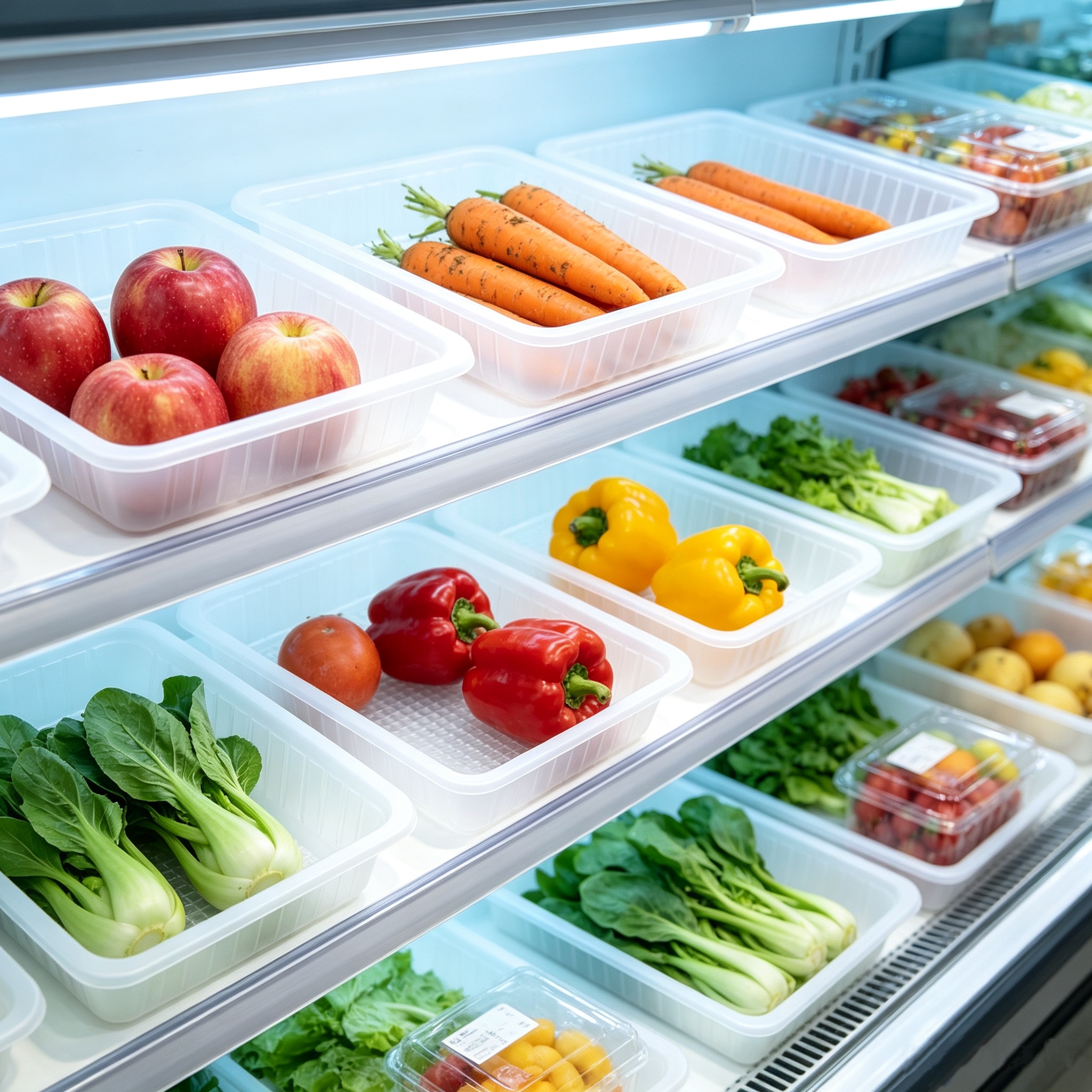
Retail is the environment with the shortest tolerance for format error, because the packaging is visible to shoppers and handled repeatedly by store staff. Clear PET containers answer three retail requirements at once: the product is visible without opening the pack, the body is rigid enough to survive shelf stocking, and the stacking design keeps the display face aligned.
Reported project data shows how that requirement is expressed commercially. A US importer and food retail distributor has run a programme of 120,000 food plastic containers per month for more than three years, used for fresh fruit and ready-meal packaging in supermarket retail. The qualifying characteristics recorded for that project are custom size and PET material, microwave-safe use, customized printing, and qualification to the FDA food contact standard. In Canada, a programme covering large chain supermarkets, packaging wholesalers and manufacturers has run for more than five years at 300,000 pieces per month for supermarket fresh produce display, cold chain storage and food packaging transportation; the recorded strengths there are food-grade PP material, a durable stackable design, custom size support and suitability for low-temperature environments.
For buyers, the practical reading of those two cases is that retail programmes split by temperature and presentation rather than by product category alone. Fresh produce display in a controlled chiller and ready-meal packaging that may be reheated by the consumer are not the same specification, even when both are sold from the same aisle.
Export Applications: Formats That Survive a Container Journey
Export programmes add two constraints to the retail specification: stack height and time. A format that is packed at origin and unpacked weeks later in another region must hold its shape through pallet stacking, temperature swings and repeated handling by parties that did not pack it.
Shallow tray geometry is the main lever here. Within the tray family, 3 cm-deep formats such as HB-T9333 at 16.8 × 11.4 × 3 cm and HB-1912 at 19 × 12 × 3 cm allow denser pallet builds than deeper formats such as HB-MG24 OZ at 18.6 × 18.6 × 8.9 cm. The deeper formats remain relevant where portion size or product height requires them, but they trade container utilisation for internal volume. Selecting the shallowest format that still protects the product is usually the first cost decision in an export programme.
The second lever is containment. The tamper-evident container family — HB-8OZ, HB-16 OZ, HB-20 OZ, HB-24 OZ and HB-32 OZ, plus HB001-55, HB002-63, HB5298, HB005-7402 and HB006-6102 — is designed for fruit, vegetable, salad, cake and bakery contents where the pack must remain visibly sealed through distribution. For exporters shipping to retailers with strict receiving checks, that visible seal is often a contractual requirement rather than a preference.
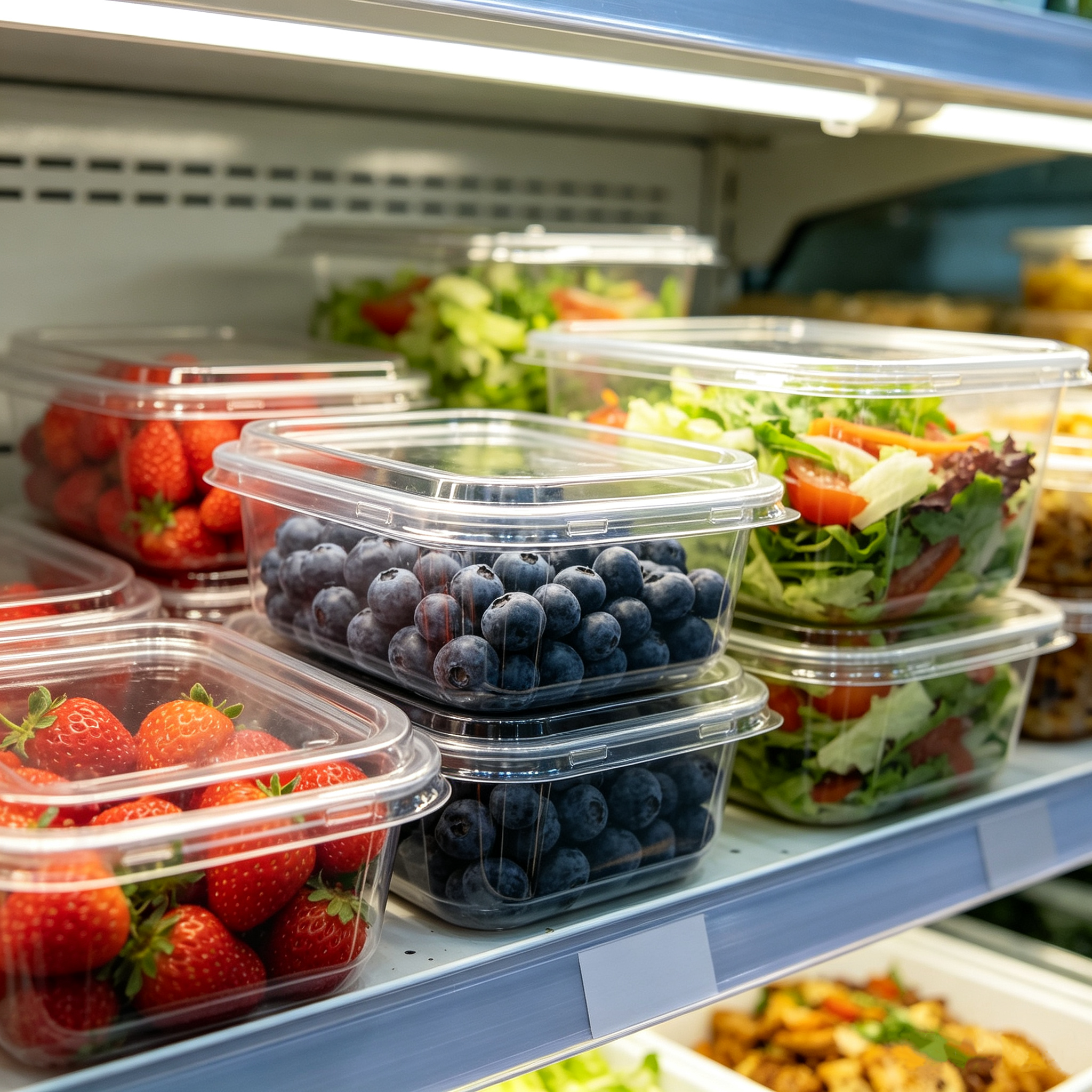
Reported export project data illustrates the scale at which these decisions are made. A Southeast Asia programme covering Malaysia, Thailand, Vietnam, Singapore and Indonesia records 500,000 pieces per month for fresh produce, seafood and meat cold chain packaging, with food-grade material, cold chain suitability, stackable design and high transparency; one project in that group has run for over twelve years. A South American programme covering Chile, Argentina, Brazil, Colombia and Peru records 250,000 pieces per month across food processing plants, produce wholesalers, supermarket chains and packaging distributors, with a clear PET clamshell container, stackable design and customization of size, logo and colour; cooperation there has lasted over six years. A Middle East and North Africa programme in the United Arab Emirates and Saudi Arabia records 250,000 clear PET clamshell containers per month for farm fresh fruit and vegetable packaging, including cherry tomato and berry clamshell packing, with vent holes for freshness and suitability for harvest and retail display, running for over three years.
CHUAN HE exports to North America, Europe, the Middle East, Southeast Asia and Latin America, with the manufacturing base located in Weifang, Shandong, adjacent to Qingdao Port.
Bakery Applications: HB-3066 and the Cake and Bakery Range
Bakery is a different problem from produce. The products are less fragile in transit but more sensitive to presentation, and the packaging often has to work across two environments in one day: a production counter and a retail shelf.
HB-3066, a PET tray measuring 14.4 × 12.2 × 4.7 cm, sits in the tray family whose listed applications include bakery trays, produce trays, meat trays, compartment trays and clear display trays. Its compact footprint suits counter-scale portions where the pack is filled and sold within a short cycle. Where a larger presentation area is needed, the cake and bakery range extends to HB-1007 at 23.5 × 22.5 × 8.3 cm and HB-1008 at 26.5 × 26.5 × 8.5 cm, and to the taller HB-5209 at 21.5 × 21.5 × 15.3 cm and HB-5211 at 17.4 × 17.4 × 9.8 cm.
A European programme illustrates how bakery and produce packaging can share one supply base. Across the UK, Germany, France, Italy, Spain, Finland, the Netherlands and Portugal, a project records 350,000 food plastic containers per month used for bakery packaging, cake and dessert packaging, supermarket retail display, fruit and vegetable packaging and custom packaging. The recorded characteristics are compliance with EU standards, food-grade material, stackable design and custom printing support, with cooperation running over seven years and reported outcomes of stable quality, high delivery reliability and reduced customer complaint rate.
Material Boundaries: PET, PP and Temperature Reality
PET and PP are not interchangeable, and buyers who treat them as substitutes usually discover the difference in production rather than in the specification sheet.
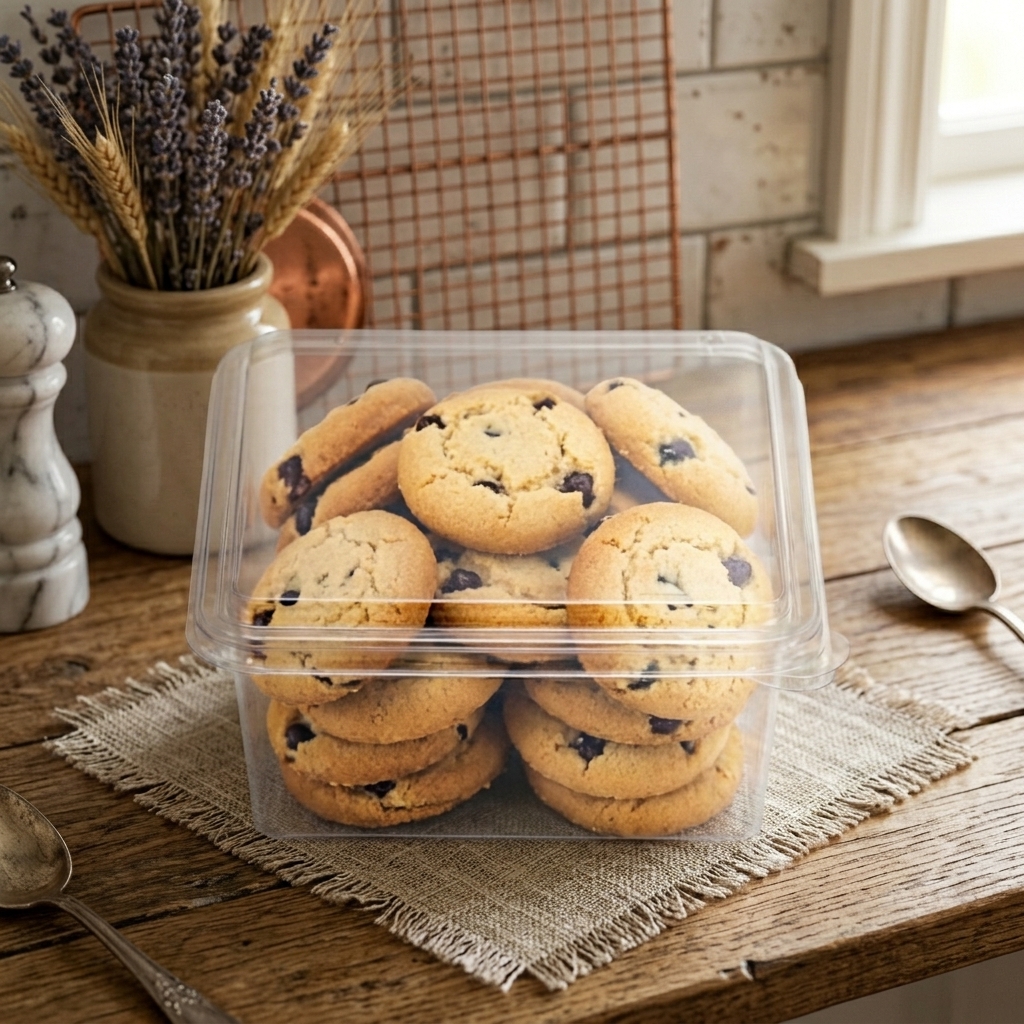
- PET delivers the clarity that retail produce display depends on, with good rigidity for stacking. Container models such as HB-SG250ML through HB-SG1000ML, HB-7001, HB-7123, HB-8OZ-235 and HB-PG02 are produced in food-grade BPA-free PET with a clear transparent body and a stackable design for space saving, and the fruit and vegetable containers are refrigerator safe. Custom size, colour and logo printing are available.
- PP appears in the range where low-temperature durability and material toughness matter more than optical clarity. Two tray models, HB-75-28(PP) at 16.8 × 11.4 × 3 cm and HB-221360 at 22.2 × 13 × 6 cm, are produced in PP, and a Canadian retail programme operating in low-temperature conditions records food-grade PP material as one of its defining characteristics.
The practical boundary is this: if the application depends on seeing the product or on a rigid transparent shelf face, PET is the natural choice; if it depends on surviving aggressive low-temperature handling where a clearer but more brittle format may fail, PP deserves the evaluation. Where both matter, the decision usually resolves to testing both formats under the actual packing and cold-chain conditions rather than choosing on appearance.
Compliance Evidence Behind These Applications
Application fit is only usable if the destination market accepts the packaging. The following certification records are the published evidence base for CHUAN HE packaging.
| Certification | Certificate number | Authority | Standard / scope | Validity |
|---|---|---|---|---|
| BRC | CN26/00005423 | SGS | Global Standard for Packaging Materials | 2026-07-08 to 2027-08-03 |
| FDA | 11242824478 | CNQI | P.L. 107-188 | 2025-03-05 to 2026-12-31 |
| SGS FDA | TSNHL26001599701 | SGS | US FDA 21 CFR 177.1630 | 2026-04-22 to 2036-04-22 |
| SGS EU | TSNHL26000684001 | SGS | EN 1186-3:2022 | 2026-03-10 to 2036-03-10 |
| CE | M.2025.206.C131101 | UDEM | EN 1186-1:2002 (paper / plastic packaging) | 2025-12-12 to 2030-11-12 |
| PPWR test report | 178251114a 001 | TÜV Rheinland | Regulation (EU) 2025/40 (PPWR): heavy metals, PFAS, organotin, fluorine, SVHC screening, specific and global migration | 2026-08-14 to 2030-08-14 |
These records cover markets in North America, the EU, the Middle East, Southeast Asia and Latin America. They matter to the application decision for a specific reason: EU food contact obligations sit under Regulation (EC) No 1935/2004, which sets the framework for all food contact materials, and Regulation (EU) No 10/2011, which governs plastic materials and articles intended to come into contact with food, including PET and PP containers. A format can be operationally perfect and still be unusable in a given market if the migration evidence does not follow it.
Market Trend: Why Application-Specific Packaging Is Growing
Three published data points frame the direction of demand. The global fresh food packaging market reached USD 134.60 billion in 2024 and is projected to reach USD 240.50 billion by 2035, according to Spherical Insights & Consulting. The produce-specific packaging market was valued at approximately USD 38.08 billion in 2024, according to Market Research Future. The two figures use different scopes — broad fresh food versus produce specifically — and are not directly comparable, but both point to sustained expansion of packaging demand tied to fresh food distribution.
Two further signals sharpen the picture. Europe's fresh food packaging market was valued at USD 15.2 billion in 2024 with a projected CAGR of 4.5% through 2033, according to Market Research Future. Thermoformed plastics for food packaging are expected to grow at a CAGR of 4.9% to reach USD 20.66 billion by 2030, according to Grand View Research. Thermoforming is therefore not a static segment: it is the format technology most directly exposed to changes in fresh food retail.
Regulation is now part of the same trend line. Starting from 2030, the EU Packaging and Packaging Waste Regulation (PPWR) will ban single-use plastic packaging for fresh fruit and vegetables under 1.5 kg, per the European Commission. That is a format-level rule, not a material-level rule, and it makes the application mapping exercise in this article a medium-term planning question rather than a one-off purchase decision.
Market structure is also consolidating around a small group of large global players. Key competitors in produce packaging identified by Mordor Intelligence include Amcor PLC, Berry Global Group, Sealed Air Corp, Mondi Group and Smurfit Kappa. Thermoformers in the HB-series category operate in a different tier, typically competing on model breadth, tooling responsiveness and application-specific configuration rather than on global scale.
Manufacturing Capability Behind the Model Range
Weifang Chuanhe New Material Co., Ltd. was founded in 2013 and operates from a manufacturing base of more than 62,000 m² in Weifang, Shandong Province, China, adjacent to Qingdao Port. The facility runs 20 fully automatic thermoforming machines and 20 standard thermoforming machines, including four advanced Kiefel machines imported from Germany, supported by four PET sheet extrusion lines, two PP sheet extrusion lines and an in-house mould workshop. Annual output is recorded at 54,000 tons, with monthly capacity of 4,500 tons and 51–100 employees.
For buyers, the relevant capability facts are the ones that affect an application decision rather than the ones that describe scale. Customization covers logo, size and colour, with OEM/ODM production available. Quality control is described as 100% test. Reported after-sales scope includes real-time order and shipment tracking, documentation assistance for customs clearance, technical consultation on product parameters, resolution processes for quality and damaged goods issues, and packaging and shipping optimisation advice. The manufacturer reports experience developing thousands of moulds, which is what allows custom shapes, embossing and logo printing to be produced without an external tooling partner.
Limits and Trade-offs to Confirm Before Ordering
Application fit does not remove commercial constraints, and buyers should treat the following as real boundaries rather than fine print.
- Minimum order quantity. The published MOQ is 10,000 units. Small or seasonal programmes that need several formats in low volumes may be better served by running fewer models at higher volume per model than by splitting an order across many models.
- Lead time. Production lead time is stated at 30–45 days. For harvest-linked programmes, this changes when the packaging decision has to be made relative to the crop calendar.
- Custom geometry. Custom shape, embossing and logo printing are available, but a new shape is a tooling project. Where a standard model in the tables above already meets the format requirement, the fastest route is usually to configure the standard model rather than to develop a new one.
- Material temperature limits. PET gives clarity and rigidity; PP is the more appropriate option where low-temperature toughness is the dominant requirement. Neither material choice should be finalised without testing under the actual cold-chain and handling conditions.
- Regulatory direction. The PPWR restriction on single-use plastic packaging for fresh fruit and vegetables under 1.5 kg from 2030 means EU-facing formats may need re-evaluation within the lifetime of a tooling investment. Buyers planning multi-year programmes should confirm which of their formats fall inside that scope.
Future Outlook
Two forces will shape format choice over the next several years. The first is regulatory: packaging waste rules are shifting from material requirements to format requirements, and the practical consequence is that buyers will increasingly need to justify why a given pack size and application exists, not only what it is made from. The second is commercial: as fresh food packaging continues to expand, competition moves toward application-specific configuration rather than generic container supply.
For buyers, the most durable response is procedural rather than technical. Document the environment a format has to survive, verify that the model dimensions and material match that environment, confirm the certification records cover the destination market, and re-check the format against packaging waste rules on a defined cycle. Suppliers with in-house extrusion, thermoforming and mould capability are positioned to reconfigure models within that cycle; buyers who have already mapped applications to formats can absorb the change without re-tendering an entire packaging programme.
FAQ
What materials are used in these PET trays and containers, and are they food-grade?
The primary material of the trays is PET (polyethylene terephthalate), and some models are made of food-grade BPA-free plastic. Two tray models, HB-75-28(PP) and HB-221360, are produced in PP instead. Fruit and vegetable containers in the HB-SG, HB-7001, HB-7123, HB-8OZ-235 and HB-PG02 group are made of food-grade BPA-free PET with a clear transparent body and a stackable design, and are described as refrigerator safe.
Which models are used for bakery applications rather than produce?
HB-3066, a PET tray at 14.4 × 12.2 × 4.7 cm, belongs to the tray family whose listed applications include bakery trays alongside produce, meat, compartment and clear display tray uses. The dedicated cake and bakery packaging range includes HB-1022 (18.3 × 12.3 × 5.6 cm), HB-1966 (19.7 × 11.7 × 4.9 cm), HB-5115 (11.7 × 11.2 × 7.6 cm), HB-SP1510 (16 × 16 × 6.7 cm), HB-5295 (16.2 × 16.2 × 5 cm), HB-5211 (17.4 × 17.4 × 9.8 cm), HB-7097 (16.1 × 14.9 × 7.8 cm), HB-1007 (23.5 × 22.5 × 8.3 cm), HB-1008 (26.5 × 26.5 × 8.5 cm) and HB-5209 (21.5 × 21.5 × 15.3 cm).
How should a buyer choose between trays, clamshell containers and tamper-evident containers?
The choice follows the handling environment. Trays in the HB-3066, HB-T9333 and HB-MG series are stackable formats used for produce, bakery, meat and display applications, and shallower depths such as 3 cm reduce stack height for export pallets. Fruit and vegetable containers such as the HB-SG and HB-7001 models are used for storage and retail display of produce where a clear body and stacking alignment matter. Tamper-evident containers including HB-8OZ, HB-16 OZ, HB-20 OZ, HB-24 OZ, HB-32 OZ, HB001-55, HB002-63, HB5298, HB005-7402 and HB006-6102 are used where the pack must remain visibly sealed through distribution.
Are these containers suitable for refrigerated and cold-chain use?
Yes, within the material boundaries. Fruit and vegetable containers are described as refrigerator safe with a stackable design for space saving. Reported cold-chain projects include a Southeast Asia programme covering Malaysia, Thailand, Vietnam, Singapore and Indonesia for fresh produce, seafood and meat cold chain packaging with food-grade material and cold chain suitability, and a Canadian programme operating in low-temperature conditions that specifies food-grade PP material for supermarket fresh produce display and cold chain storage.
What are the purchasing terms and acceptance criteria?
MOQ is 10,000 units. Delivery terms offered are FOB, CIF and DDP. Acceptance criteria are based on pre-shipment test. Payment terms include T/T, L/C, D/P D/A, MoneyGram, PayPal, Western Union and cash. Production lead time is stated at 30–45 days.
What customization options are available, and what do they require?
Customization options cover logo, size and colour, with OEM/ODM and customizable production services available. Tray models such as HB-T9333 support custom shape, colour, embossing and logo printing, and the fruit and vegetable containers support custom size, colour and logo printing. Custom geometry requires mould development, which the manufacturer handles through an in-house mould workshop and reports as experience developed across thousands of moulds.
What certifications support food-contact compliance for EU and North American markets?
Published records include BRC certification CN26/00005423 issued by SGS against the Global Standard for Packaging Materials (valid 2026-07-08 to 2027-08-03); FDA certification 11242824478 issued by CNQI under P.L. 107-188 (valid 2025-03-05 to 2026-12-31); SGS certification TSNHL26001599701 against US FDA 21 CFR 177.1630 (valid 2026-04-22 to 2036-04-22); SGS certification TSNHL26000684001 against EN 1186-3:2022 (valid 2026-03-10 to 2036-03-10); CE certification M.2025.206.C131101 issued by UDEM against EN 1186-1:2002 (valid 2025-12-12 to 2030-11-12); and a PPWR test report 178251114a 001 issued by TÜV Rheinland covering Regulation (EU) 2025/40 requirements including heavy metals, PFAS, organotin compounds, fluorine content, SVHC screening and specific and global migration (valid 2026-08-14 to 2030-08-14).