
Matching Press Fittings to Your Industry: Water, Gas, and HVAC
Direct answer: a press fitting is matched to an industry through three variables — the elastomer inside the joint, the stainless-steel grade, and the pressure and temperature envelope — not through the fitting shape or its nominal diameter alone.
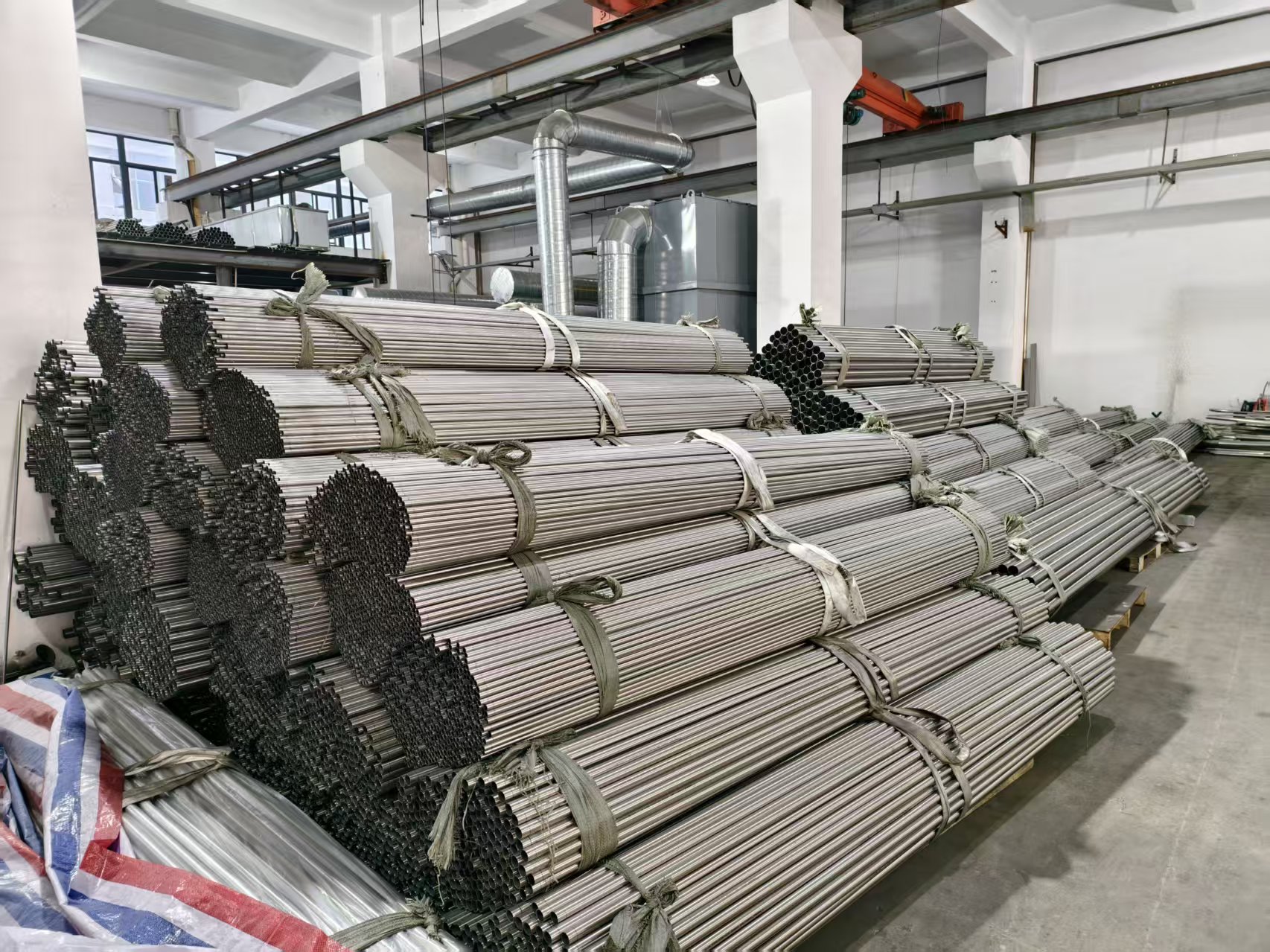
Press fittings are produced as one family but specified as several different products, depending on the medium and the installation context.
Press fittings are usually presented as a single category with a single datasheet. In practice the category splits the moment an application is named. A joint used on a direct-drinking water riser in a residential tower is not automatically the right joint for a gas distribution line, and neither is identical to what an HVAC contractor expects from a heating and cooling circuit.
This guide matches one product family — stainless steel press fittings in elbow, coupling and tee formats — to the four application groups that dominate European procurement: direct-drinking water systems, urban residential buildings, gas supply, and public constructions. It also sets out where press-fit stops being the right answer, and what current market data says about where demand is heading.
Key points for evaluation-stage buyers
- The same press-fit range covers DN15 (φ16) to DN100 (φ108), with 1.6 MPa cold-water and 1.0 MPa hot-water ratings.
- Seal selection, not fitting shape, is the decisive application variable: food-grade silicone (FDA certified) or EPDM (temperature and oil resistant).
- 304 and 316L stainless steel are both offered for this range, with 316L carrying molybdenum in its designation.
- Press-fit has a temperature ceiling; above roughly 120 °C, socket weld remains the reference connection method.
Why the application decides the fitting, not the catalogue
The parameters that do not change across this family are worth stating first, because they are the ones most often misread during evaluation. Wenzhou Zhengxin Pipe Industry Co., Ltd. — a Chinese manufacturer of stainless steel press fittings founded in August 2013 — builds its EN Standard Series press fittings in 304 stainless steel (06Cr19Ni10) and 316L stainless steel (022Cr17Ni12Mo2), for pipe outer diameters from DN15 (φ16) to DN100 (φ108). Working pressure is 1.6 MPa for cold water and 1.0 MPa for hot water at up to 95 °C. Working temperature is −20 °C to 95 °C for the ordinary model, and −40 °C to 120 °C for a high-temperature resistant model that requires replacement of the sealing ring.
Sealing material is either food-grade silicone with FDA certification, or EPDM, which is temperature and oil resistant. Both options sit inside the same fittings. That is precisely why a general catalogue entry is a weak basis for a procurement decision: the buyer is not choosing a product, but a combination.
The opportunity for buyers at evaluation stage is that this combination is knowable. The risk is that an order is released on a default configuration that happens to be correct for one application and wrong for the next.
One product family, four industry requirements
The matrix below is not a ranking of products but a matching framework: it shows what each industry pulls out of the same range.
| Application | Seal to specify | Stainless grade in the range | Envelope from the specification |
|---|---|---|---|
| Direct-drinking water systems | Food-grade silicone, FDA certified | 304 / 316L | DN15–DN100, 1.6 MPa cold water |
| Gas supply systems | EPDM (temperature and oil resistant) | 304 / 316L | DN15–DN100, leak-proof requirement |
| HVAC circuits | EPDM, or silicone where potable contact applies | 304 / 316L | 1.0 MPa hot water ≤95 °C; −40 °C to 120 °C with high-temperature seal |
| Urban residential buildings and public constructions | Depends on the medium carried; systems often combine both | 304 / 316L | 24/7 operation, corrosion-resistant, leak-proof |
What actually changes between drinking water, gas and HVAC
The seal is the first decision
Food-grade silicone with FDA certification is the seal associated with systems where the water is consumed, because the material that touches the medium is the material that carries the hygienic claim. EPDM, described in the specification as temperature and oil resistant, is the seal associated with gas supply and with circuits where temperature swings and hydrocarbon contact are part of normal operation. A buyer who accepts whichever seal ships by default has effectively skipped the only component that touches the medium directly.
Grade choice: 304 or 316L
Both grades are produced in this range. The material designations — 06Cr19Ni10 for 304 and 022Cr17Ni12Mo2 for 316L — show the difference in composition, with molybdenum present in the 316L specification. In evaluation practice, 316L is normally specified where the environment or the medium is expected to be more aggressive, while 304 is the more common default for standard building services. The decision belongs in the project specification, not in the purchase order notes.
Pressure and temperature envelope
The published envelope is 1.6 MPa for cold water and 1.0 MPa for hot water at up to 95 °C. The ordinary model operates from −20 °C to 95 °C. Beyond 95 °C, the high-temperature resistant model extends the range to −40 °C to 120 °C, but only with a replacement sealing ring. That single sentence resolves most specification disputes early: if a project cannot state its hot-side temperature, the seal cannot be fixed, and the fitting cannot be confirmed.
Profile geometry in the European market
M Profile and V Profile are the two dominant pressing geometries in Europe. According to Eurotubi technical documentation, M Profile is available up to 168.3 mm diameter, and both profiles are valid and comply with the same regulations — the choice between them is often a matter of habit rather than of standards. For a buyer, that means profile selection should follow the tooling already in the contractor fleet, not the fitting catalogue alone.
Installation discipline
Press-fit performance depends as much on the jointing as on the joint. The documented sequence is: cut the pipe squarely, deburr the inner and outer edges thoroughly, mark the insertion depth, insert the pipe fully to the mark, place the correct jaws at the fitting groove, press until the jaws close completely, then pressure-test the system. Skipping the deburring or under-inserting the pipe are the two most common ways a correct product becomes a defective installation.
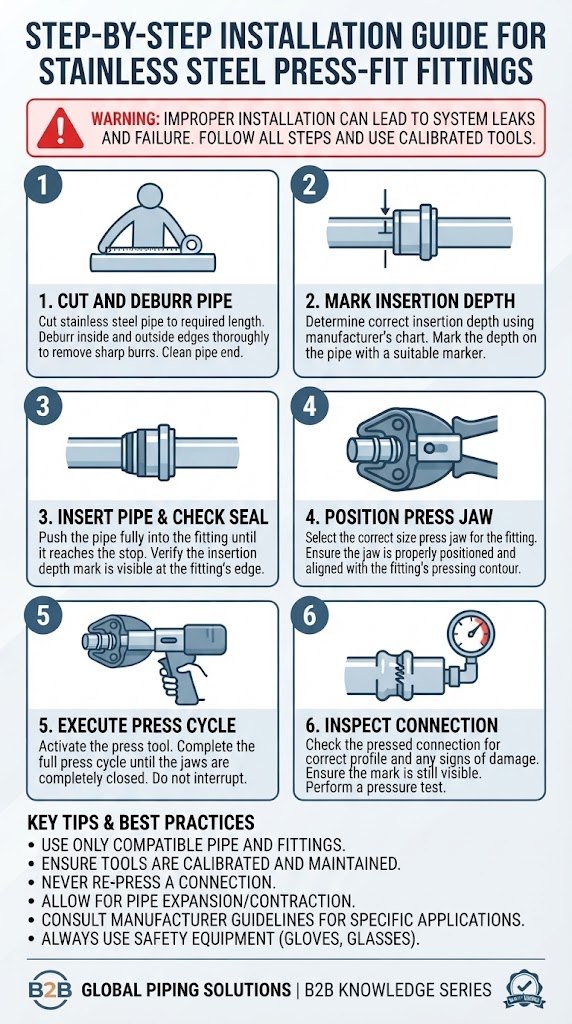
The documented press-fit sequence: square cut, deburring, depth marking, full insertion, correct jaw position, complete closure, pressure test.
Direct-drinking water systems
Direct-drinking water is the application where hygienic requirements are written into the specification rather than assumed. The relevant configuration in this range pairs 304 or 316L press fittings with the food-grade silicone seal that holds FDA certification, and the requirement carried through the project is a leak-proof, corrosion-resistant pipeline with potable-water hygienic conformity.
Field evidence exists for this exact use case. A potable water plumbing project using the European standard press fittings series involved 12,000 pieces supplied to plumbing distributors and construction contractors, and has remained in operation for more than 15 years, with installations across Australia, Belarus, Germany, Spain, France, the UK, Indonesia, Italy, Russia, Thailand and Taiwan. The recorded characteristics of that installation are fast installation, no welding, and a long service life, with corrosion-resistant and leak-free pipeline operation as the result.
Gas supply systems
Gas supply shifts the emphasis from hygiene to containment. The specification for these systems lists gas transmission among the working conditions, with EPDM sealing gaskets as matched equipment because the material is temperature and oil resistant. The performance language a buyer should expect to see is the same as for water lines — leak-proof and corrosion-resistant — but the consequence of a poor joint is different, which is why the pressure test is not optional on gas work.
The same 304 or 316L fittings and the same DN15 (φ16) to DN100 (φ108) size coverage apply. What changes is the seal, and the discipline around verification. Gas supply is also explicitly listed among the applicable industries for both the European standard press fittings series and the GB double-press fittings series, which means a project can stay within one supplier relationship while using two different press systems.
HVAC and building services circuits
HVAC is the application where the temperature envelope, not the medium, drives selection. Heating and cooling circuits in this range sit inside the hot-water rating of 1.0 MPa at up to 95 °C. Where a circuit runs hotter, the high-temperature resistant model reaches 120 °C, but the sealing ring must be changed accordingly — a substitution that has to be decided at specification stage, because it cannot be improvised on site.
For HVAC Press Fittings, the practical evaluation question is whether the profile used in the specification matches the pressing jaws already held by the installing contractor. In European practice, M Profile and V Profile both remain in active use, and both are described as valid and compliant with the same regulations. A project that specifies the profile first and checks tooling second creates avoidable site delays.
Public constructions and urban residential buildings
Residential buildings and public constructions — hotels, hospitals, schools and similar facilities — are the environments where several media meet inside one building: potable water distribution, gas conveying, and heating or cooling circuits, often operating 24/7. The listed applicable industries for this range include urban residential buildings and public constructions alongside direct-drinking water and gas supply.
For a buyer, that overlap is the strongest argument for fixing the configuration per system rather than per project. A single building may legitimately require two seal materials and two verification conversations with the same supplier.
Where Wenzhou Zhengxin sits in this picture
Wenzhou Zhengxin Pipe Industry Co., Ltd. is a manufacturer of press-fit pipe fittings based in Wenzhou, China, founded in August 2013, operating a 9,000 m² facility with 70 employees, a 10-engineer R&D team, and an annual output of 1,000,000 units. The company reports an export ratio of 70% with Europe as its main market, and states that its products are CE-certified; it has also introduced the QS9000 production management system and passed ISO 9001:2000 quality management system certification.
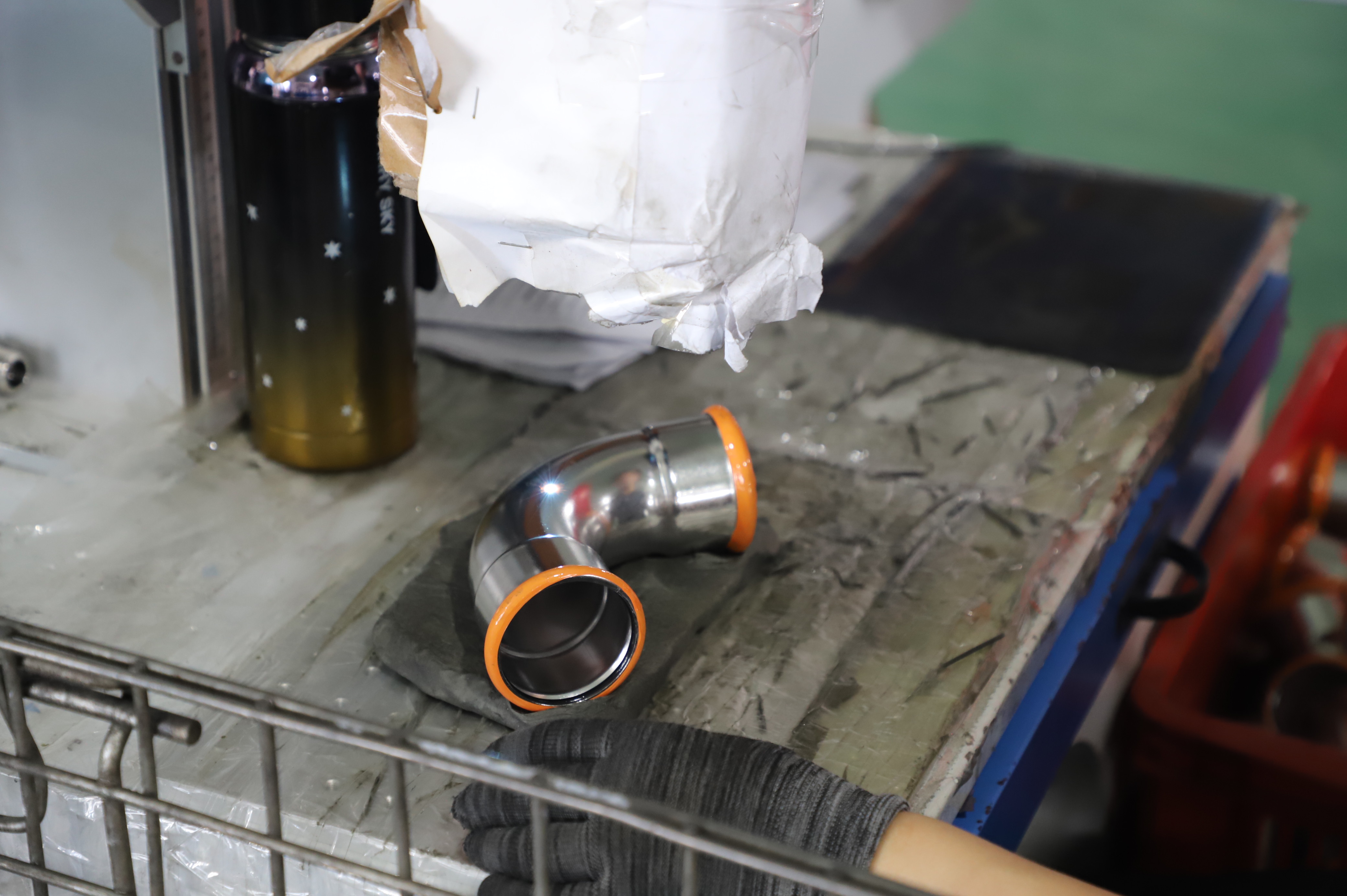
Marking and identification at the production stage: OEM and ODM orders can specify logo, size, material and packaging.
For European buyers, the most checkable document is the CE-PED Verification of Conformity held by the company — certificate ICR/VC/HS260548, issued by ICR Polska for the EU market, referencing EN1092-1:2018, issued on 13 May 2026 and valid to 12 May 2031. Its stated scope covers stainless-steel press-fit pipeline components across the full size range DN15–DN250, which is wider than the DN15 (φ16) to DN100 (φ108) coverage of the EN Standard Series product described in this article. Buyers comparing scope statements should note that difference rather than assume they are the same figure.
On the supply side, the company operates OEM and ODM production with customization of logo, size, material and packaging, a monthly capacity of 83,000 pieces of fittings and 83 tons of pipes, lead times of 25–40 days, a minimum order quantity of 100 pieces, and quality control based on 100% visual inspection plus pressure testing. Export markets listed are the EU, Southeast Asia and the Middle East, with after-sales support provided as remote technical support and installation guidance.
A ranked shortlist of checks before releasing an order
Ranked by the risk each one removes, these are the questions that most reliably separate a correct order from a corrected one:
- System temperature on the hot side. It sets the seal and decides whether the ordinary model or the high-temperature resistant model applies.
- Medium and seal material. Food-grade silicone with FDA certification for drinking water; EPDM for gas and temperature or oil exposure.
- Stainless grade. 304 or 316L, decided against the environment rather than by availability.
- Profile and tooling. M Profile or V Profile, matched to the jaws the installing contractor already owns.
- Size range against the actual drawing. DN15 (φ16) to DN100 (φ108) in this series, with pressure ratings of 1.6 MPa cold and 1.0 MPa hot water.
- Conformity documentation. Certificate scope, issuing body, standard referenced and validity dates, checked rather than assumed.
Market trend: what the demand signals show
The stainless steel press fitting market is not a static category. Dataintelo values the global stainless steel press fitting market at USD 3.8 billion in 2025 and projects it to reach USD 6.4 billion by 2034, at a CAGR of 6.0%. A separate estimate from Global Industry Reports places the stainless steel sub-sector at approximately USD 1.03–1.30 billion for 2024, accounting for 29%–38% of the total press fittings market, with an independent figure of USD 1.07 billion.
Those two figures should not be treated as directly comparable: one addresses the total market in 2025, the other a sub-sector with a different base year and definition. The useful reading is directional — the stainless segment is a substantial minority of a market that is still expanding, which supports the observation that specification-led demand, rather than price-led substitution, is driving volume.
On the standards side, the reference framework for European work remains stable. Welded stainless steel tubes for pressure purposes are manufactured in accordance with EN 10217-7, and plumbing applications reference EN 10312, with DVGW W541 specifications also cited in technical documentation. For buyers, that stability is an advantage: compliance arguments can be settled by standard number rather than by supplier preference.
Where press-fit is not the answer
A credible matching guide has to state the boundary. Press-fit in this range is a DN15 (φ16) to DN100 (φ108) system, with a hot-water rating of 1.0 MPa at up to 95 °C and a high-temperature ceiling of 120 °C using a replacement sealing ring. Above that envelope — and particularly for steam or high-temperature process service — socket weld remains the reference method.
Socket weld fittings are available in types including 90° elbow, full coupling and equal tee, manufactured according to ASME B16.11 and GB/T 14383-2021 in forged 304 or 316L stainless steel, with pressure classes from 3000# to 9000#, sizes from DN6 to DN100, and a working temperature range of −20 °C to +450 °C for water, oil, gas and steam.
The practical conclusion for an evaluation-stage buyer is not that one method wins. It is that a building project often needs both, and that the fitting choice should follow from the medium and the temperature — not from the connection method a contractor happens to prefer.
Future outlook
Three developments are likely to shape how press fittings are matched to industries over the next cycle. First, hygienic documentation for drinking water systems will continue to move from a marketing statement to a specification line, which favours suppliers who can name the seal material and its certification precisely. Second, prefabrication in residential and public construction increases the value of a consistent profile decision made early, because tooling mismatches become more expensive once assemblies are built off site.
Third, conformity verification is becoming a document exercise rather than a trust exercise: certificate numbers, issuing bodies, referenced standards and validity dates are now routinely checked by buyers. Manufacturers who keep that documentation current will find fewer obstacles at the qualification stage — and buyers who build the check into their first evaluation round will spend less time correcting orders later.
FAQ
What is the difference between a press-fit elbow, coupling and tee, and when is each used?
All three belong to the same press-fit family and share the same materials, size coverage, pressure and temperature parameters. The difference is geometric function: an elbow changes the direction of the pipeline, a coupling joins two pipe ends in a straight run, and a tee creates a branch. Selection is therefore driven by the routing drawing, while seal, grade and envelope are driven by the medium and the operating conditions.
Which sealing material should be specified for drinking water and which for gas?
Food-grade silicone with FDA certification is the seal associated with direct-drinking water systems, where the material in contact with the medium carries the hygienic requirement. EPDM, described as temperature and oil resistant, is the seal associated with gas supply systems and applications exposed to temperature variation or oil contact. Both options are available within the same fitting range, so the choice is made at specification stage.
What pressure and temperature limits apply to stainless steel press fittings?
For this range, working pressure is 1.6 MPa for cold water and 1.0 MPa for hot water at up to 95 °C. The ordinary model operates between −20 °C and 95 °C. A high-temperature resistant model extends operation from −40 °C to 120 °C, but requires replacement of the sealing ring. Applications beyond that envelope fall outside the press-fit specification and normally move to welded connection methods.
Should a project specify 304 or 316L stainless steel?
Both grades are produced in this range: 304 as 06Cr19Ni10 and 316L as 022Cr17Ni12Mo2, the latter including molybdenum in its designation. The selection is normally made against the corrosivity of the environment and the medium rather than against availability. Because both grades sit inside the same dimensional and pressure specification, the choice does not change the size range from DN15 (φ16) to DN100 (φ108).
M Profile or V Profile — which geometry should a European project choose?
Both are dominant pressing geometries in Europe. M Profile is available up to 168.3 mm diameter, and according to Eurotubi technical documentation both profiles are valid and comply with the same regulations, with the choice between them often being a matter of habit. Because the profiles require different pressing jaws, the practical decision criterion is the tooling already used by the installing contractor.
How is European conformity verified for these fittings?
For Wenzhou Zhengxin Pipe Industry Co., Ltd., the relevant document is a CE-PED Verification of Conformity, certificate ICR/VC/HS260548, issued by ICR Polska for the EU market and referencing EN1092-1:2018. It was issued on 13 May 2026 and is valid to 12 May 2031, with a stated scope covering stainless-steel press-fit pipeline components across the full DN15–DN250 size range. The company also holds ISO 9001:2000 certification and has introduced the QS9000 production management system.
What causes leakage after pressing, and how is it corrected?
Leakage after installation usually results from installation error rather than product failure. Documented causes include burrs left on the pipe end scratching the sealing gasket, insufficient pipe insertion depth, wrong or misaligned pressing jaws, a damaged or aging gasket, and visible deformation of the pipe or fitting. Correction requires depressurising the system, inspecting the joint and jaw usage, disassembling the connection, replacing any damaged gasket, cutting the pipe squarely, removing all burrs, marking the insertion depth, reinstalling to standard procedure and repeating the pressure test. Secondary pressing on an already deformed fitting is not an acceptable fix.
When is socket weld a better choice than press-fit?
Socket weld is the reference method where the operating envelope exceeds that of press-fit. Socket weld fittings are available as 90° elbow, full coupling and equal tee, manufactured to ASME B16.11 and GB/T 14383-2021 in forged 304 or 316L stainless steel, with pressure classes from 3000# to 9000#, sizes from DN6 to DN100 and a working temperature range of −20 °C to +450 °C for water, oil, gas and steam. Press-fit remains the more suitable choice within its own DN15 (φ16) to DN100 (φ108) range and temperature limits.
The full product catalogue, including the EN Standard Series press fittings described in this article, is available for download: Product Catalog (PDF).