
Matching Resistance Bands to Training Scenarios: Mini Loops vs Power Loops
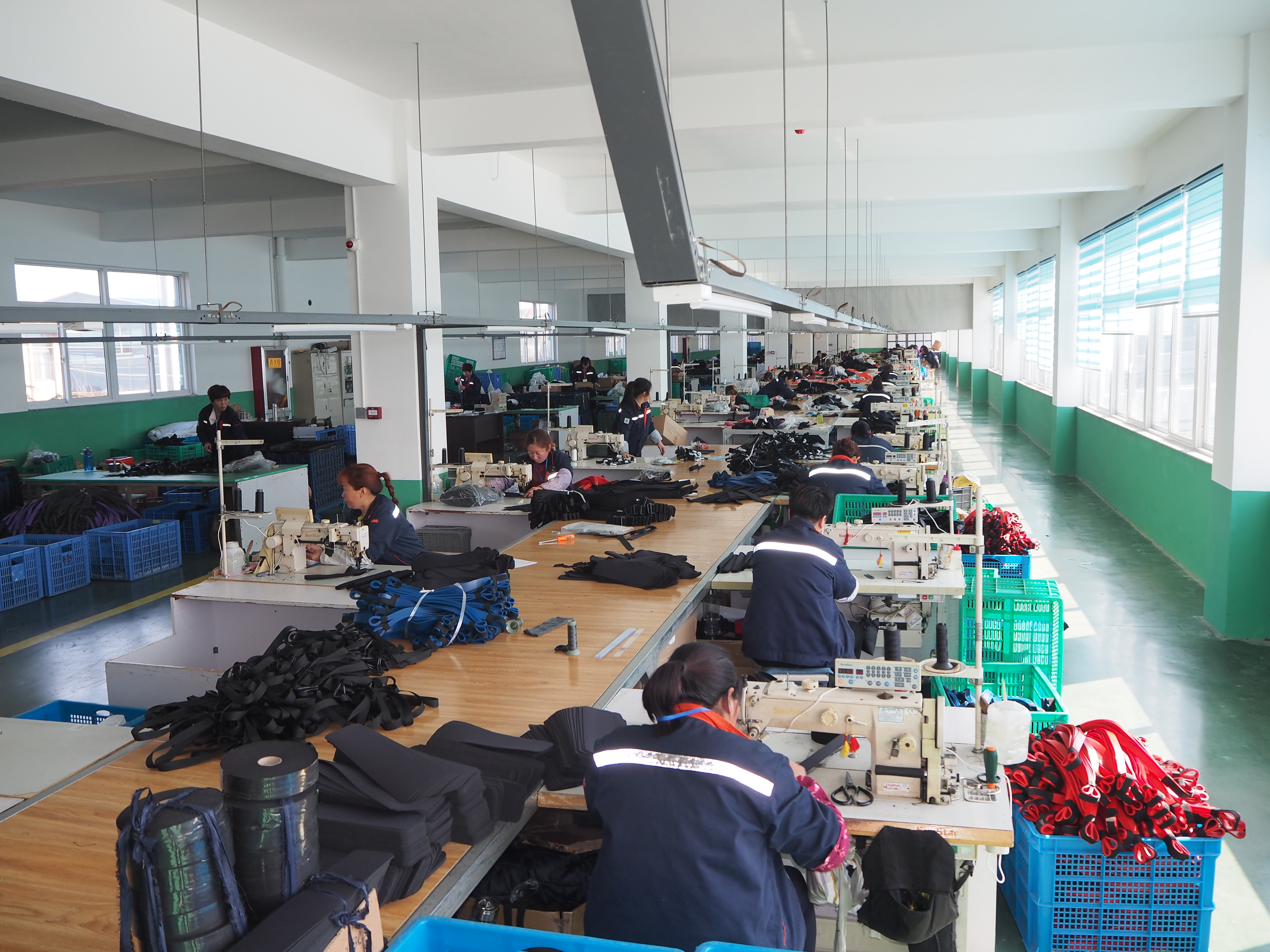
Loop band sewing and assembly at the Haiyang Libenli Body-Building Apparatus Co., Ltd. facility, Qingdao, China. Image: Libenli.
Why Band Selection Starts With the Training Scenario
The resistance band category has grown past the point where a single product can serve every user. The global resistance bands market was valued at approximately USD 1.7 billion in 2024 and is projected to reach USD 2.9 billion by 2030, growing at a CAGR of 9.9% from 2025 to 2030, according to Grand View Research. Within that market, health and sports clubs held the largest revenue share at 70.6% in 2024, while individual home use is the fastest-growing segment.
That divergence creates a practical procurement problem. A commercial gym, a physiotherapy clinic, and a home-fitness retailer all buy "resistance bands," but they are not buying the same performance profile. Mini loop bands and power loop bands solve different problems: one is built around controlled, lower-tension movement; the other around progressive, higher-tension loading. The selection question is therefore not which band is better, but which band belongs in which program.
This guide is written for distributors, gym operators, clinic buyers, and brand owners who are finalising a resistance band range. It focuses on how to match loop type to training scenario, using two production lines from Libenli — ZLQ-1 and ZLQ-03 — as reference points.
The Cost of Treating Every Loop as the Same Product
When buyers treat loop bands as interchangeable, the mismatch shows up at the point of use.
- In rehabilitation settings, a band with too much tension forces patients to compensate with poor form, which works against the purpose of graded loading.
- In strength environments, a band with too little tension cannot provide meaningful overload, so it becomes an afterthought rather than a training tool.
- In retail assortments, a single-type range limits the ability to serve both the rehab customer and the strength customer, which reduces attachment rates across a catalog.
The result is predictable: returns, negative reviews, and a band that sits unused in a drawer. Matching type to scenario is the step that prevents this, and it begins before the order is placed.
Decision rule: choose the loop type by the load range and movement pattern of the target program, not by unit price. A cheaper loop that does not fit the scenario becomes a replacement cost, not a saving.
Two Loop Lines, Two Training Logics: ZLQ-1 and ZLQ-03
Libenli, formally Haiyang Libenli Body-Building Apparatus Co., Ltd., is a manufacturer and exporter of latex tubing and latex resistance bands founded in 1997 and based in Qingdao, China. The company operates 24 dedicated production lines for dipped latex tubing and 2 exclusive production lines for latex bands, within a facility spanning 50,000 m² and a workforce of more than 300 employees. Its quality system includes ISO 9000:2000 certification (2005) and ISO 9001:2008 certification (2010), and most products are SGS-tested against international environmental and safety requirements.
Within its resistance band range, two product lines map to the two dominant training logics:
| Line | Loop Type | Primary Training Scenarios | Core Selection Logic |
|---|---|---|---|
| ZLQ-1 | Mini loop band | Yoga & Pilates, Hip & Glute Training, Sports Rehabilitation, Physical Therapy | Controlled, lower-tension loading across short ranges |
| ZLQ-03 | Power loop band | Fitness Gym, Home Workout, Sports Rehabilitation, Outdoor Training | Progressive, higher-tension loading across full ranges |
The distinction is functional. ZLQ-1 is positioned for scenarios where the band supports alignment, activation, and graded resistance. ZLQ-03 is positioned for scenarios where the band contributes meaningful load to a strength or conditioning session. Buyers who stock both lines can serve a wider customer base without forcing either group into the wrong product.
What the Specifications Actually Mean for Scenario Fit
Product claims only matter if they translate into a training outcome. For loop bands, four specifications drive scenario fit: elongation, tension accuracy, fatigue resistance, and surface stability.
1. Elongation defines the usable range
Libenli latex bands provide up to 600% elongation, compared with roughly 300% for traditional TPE bands. In a rehab scenario, a longer usable range means resistance can be applied progressively without the band reaching its limit. In a gym scenario, it means the band can be stretched through a full movement path while still maintaining tension.
2. Tension accuracy defines predictability
Tension accuracy is measured as a margin of error. Libenli reports a ±2% tension error margin, compared with a ±15% industry average for synthetic alternatives. In physical therapy, where small changes in load matter, this reduces the risk of a session being harder or easier than intended. In strength training, it supports repeatable programming.
3. Fatigue resistance defines replacement cycles
Libenli bands are rated for 10,000+ stretch cycles with less than 3% deformation, compared with fewer than 2,000 cycles for many synthetic alternatives, which can show significant permanent deformation. For a gym or clinic, this affects how often a band must be replaced and how consistent tension remains between replacements.
4. Surface stability defines the user experience
Libenli bands carry an anti-oxidation coating that is described as producing zero powdering and 90% fewer breakage incidents during high-frequency use compared with synthetic alternatives. Powdering is a common complaint in loop bands, particularly in studio and clinical settings where bands are handled frequently.
Taken together, these four specifications are what allow one supplier to run both a mini loop line and a power loop line with consistent behaviour across them. They are also the figures a buyer should request when comparing suppliers.
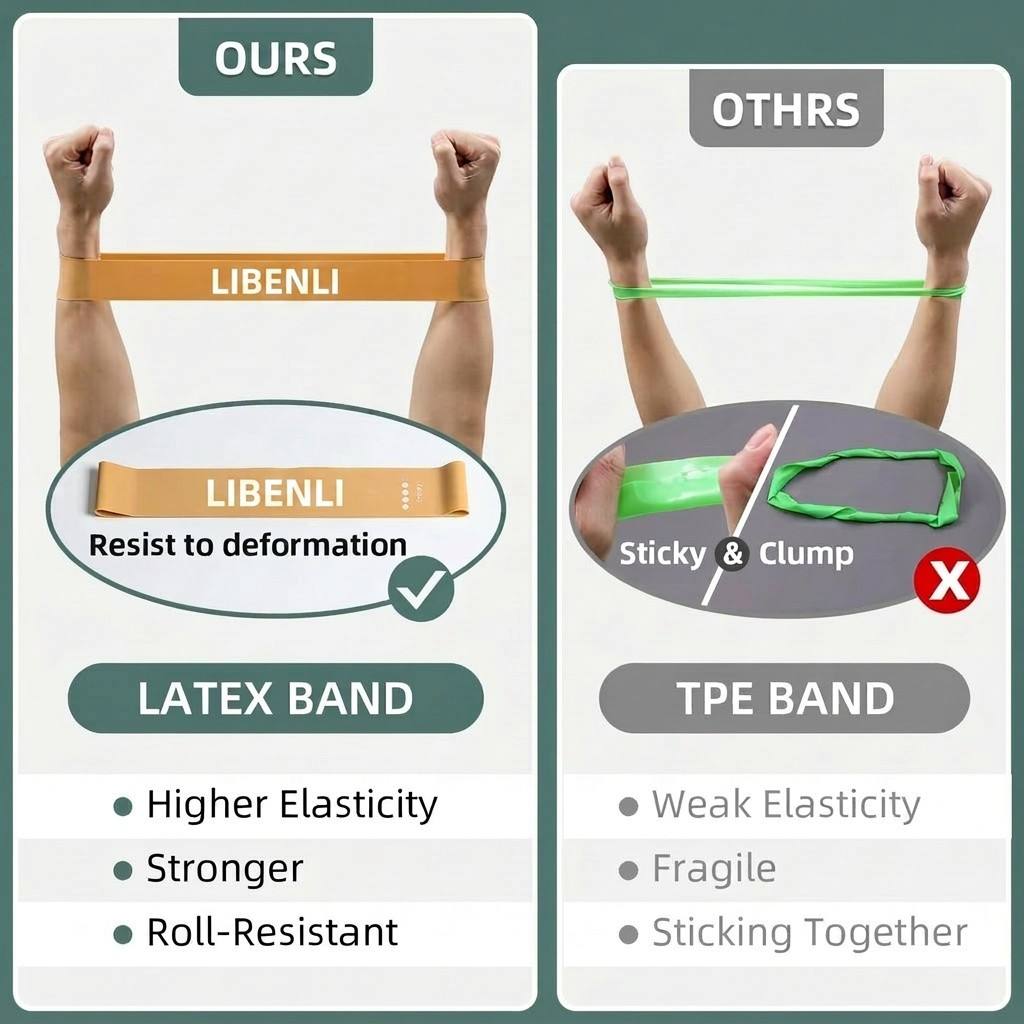
Latex and TPE band materials behave differently under repeated stretch. Image: Libenli.
Scenario Mapping: Where Each Loop Belongs
The most reliable way to select a loop type is to work backwards from the program. The following mapping reflects how the two Libenli lines are positioned.
ZLQ-1 mini loops in practice
- Yoga & Pilates: short loops are used around the thighs or ankles to add light resistance to alignment and stability work without disrupting controlled movement.
- Hip & Glute Training: mini loops are a standard tool for lateral and rotational activation work, where the goal is sustained tension rather than maximum load.
- Sports Rehabilitation: short-range, lower-tension loading supports early-stage return-to-movement programs.
- Physical Therapy: graded resistance allows a clinician to progress load in small, measurable steps.
ZLQ-03 power loops in practice
- Fitness Gym: power loops add accommodating resistance to compound and accessory movements, and support assisted variations.
- Home Workout: power loops provide a higher-tension option for users training without machines or racks.
- Sports Rehabilitation: power loops are used at the later stages of rehabilitation, where higher loads and longer ranges are appropriate.
- Outdoor Training: power loops are applied in group and field settings where durability and resistance range matter more than portability.
Overlap note: Sports Rehabilitation appears in both lines. That is intentional. Early-stage rehabilitation leans toward ZLQ-1, while later-stage strength restoration leans toward ZLQ-03. Buyers serving clinics should treat the two as a progression rather than a conflict.
Market Trend: Demand Is Splitting, Not Consolidating
Two market signals support a two-line approach.
First, the customer base is diversifying. Health and sports clubs still hold the largest share of resistance band revenue — 70.6% in 2024 — but individual home use is the fastest-growing segment, according to Grand View Research. Institutional buyers and home users have different needs, and a single band type cannot serve both well.
Second, therapy and exercise bands account for approximately 50% of the total global resistance bands market as of 2024/2025, based on Market Research Future. That figure reflects the scale of the rehab and wellness segment relative to pure performance training. For suppliers, it argues for treating mini loops as a distinct line rather than a smaller version of a power loop.
The practical implication is that scenario-specific product lines are becoming the default structure of a competitive resistance band catalog. Suppliers that only offer one loop type increasingly compete on price; suppliers that document scenario fit compete on program value.
How Latex Loop Bands Compare With Traditional Alternatives — and Where the Limits Are
The material choice behind a loop band affects both its performance and its boundaries. Libenli's bands are made from natural latex and positioned against traditional TPE bands and low-grade synthetic latex products.
| Dimension | Libenli Latex Bands | Traditional TPE / Low-Grade Synthetic |
|---|---|---|
| Elongation | Up to 600% | Around 300% |
| Tension accuracy | ±2% error margin | ±15% industry average |
| Fatigue resistance | 10,000+ cycles, <3% deformation | Under 2,000 cycles, significant permanent deformation |
| Surface behaviour | Anti-oxidation coating, zero powdering | Powdering and higher breakage in high-frequency use |
| Cost structure | 15–20% higher initial cost; roughly 50% lower total cost of ownership over time | Lower initial cost, shorter lifespan |
Limitation 1 — Higher upfront unit cost. Libenli latex bands carry an initial acquisition cost roughly 15–20% higher than TPE alternatives. The manufacturer's position is that total cost of ownership is about 50% lower because the band lifespan is 3–5 times longer, but that depends on realistic usage assumptions. A buyer with very short product cycles may not recover the premium.
Limitation 2 — Natural latex is not suited to every user. Latex allergy is a genuine constraint. Libenli addresses this by offering latex-free TPE alternative bands for allergic individuals, but those alternatives do not carry the same elongation and tension-accuracy profile. In other words, the latex-free option solves a safety problem, not a performance-equivalence problem.
Limitation 3 — Scenario fit is not universal. Neither ZLQ-1 nor ZLQ-03 is the right answer for every program. A buyer looking for one universal band will not find it here; the value of the two-line structure is that it accepts this reality rather than hiding it.
Risk Controls Buyers Should Ask About
Scenario matching is only durable if the products behave consistently at scale. Libenli's stated control measures include 100% raw material inspection before production, full physical performance testing covering stretch, tension, and fatigue for all finished goods, and unified production parameters to keep linear resistance efficiency stable. For defective products, the company offers unconditional free return and replacement as a measure to reduce customer after-sales risk.
For procurement teams, these are the questions worth putting in writing: What is the test protocol per batch? What is the rejection threshold? And what is the replacement policy when a batch fails in the field?
Procurement Checklist for Scenario-Matched Loop Bands
Before finalising a range, buyers can run the following check against each candidate product line.
- Does the line specify which training scenarios it is designed for?
- Is elongation documented, and does it cover the longest movement in the target program?
- Is tension accuracy stated as a margin of error, not just a range?
- Is fatigue life expressed in cycles, with a deformation threshold?
- Is surface behaviour documented, including powdering and breakage under high-frequency use?
- Is there a latex-free option for allergic users, and is it described as a different performance profile?
- Is there a replacement policy for defective units?
Future Outlook
The resistance band market is projected to reach USD 2.9 billion by 2030, growing at roughly 9.9% per year from 2025 to 2030. If that trajectory holds, the pressure on buyers will not be finding bands — it will be matching them. Scenario-specific lines, documented specifications, and clear progression logic between rehab and strength products are likely to become standard expectations rather than differentiators.
For suppliers, the practical work is to document scenario fit as clearly as they document tension ranges. For buyers, the practical work is to stop asking which band is best and start asking which band belongs in this program. That single change in framing resolves most of the mismatch errors that show up in returns data.
FAQ: Choosing Between Mini Loops and Power Loops
What is the difference between a mini loop band and a power loop band?
Mini loop bands are short, continuous loops used for lower-tension work around the hips, thighs, or ankles. Power loop bands are longer and heavier, used for higher-tension and full-range resistance work. The difference is load range and movement pattern, not colour or branding.
Which loop type should a rehabilitation clinic stock first?
It depends on the patient population. Early-stage rehabilitation typically favours mini loops because lower tension and shorter range support controlled activation. Later-stage strength restoration typically favours power loops because higher loads and longer ranges are appropriate. Clinics that serve both stages can treat the two as a progression rather than a choice.
Can power loop bands be used for home workouts?
Yes. Power loop bands are positioned for home workout and outdoor training scenarios where users need meaningful resistance without machines or racks. Their value in a home setting comes from resistance range and durability rather than portability.
Are natural latex resistance bands suitable for people with latex allergies?
No. Natural latex bands are not suitable for latex-allergic users. Libenli addresses this by offering latex-free TPE alternative bands for allergic individuals, though those alternatives have a different elongation and tension profile from the latex range.
How should buyers compare suppliers for scenario-specific loop band programs?
Request four figures per product line: elongation percentage, tension accuracy margin, fatigue-cycle rating, and surface behaviour under repeated use. Then map those figures to the target scenario. A supplier that provides the numbers per line is easier to evaluate than one that lists them only for a single flagship product.
Does latex band quality justify a higher unit price?
That depends on usage intensity. Libenli latex bands cost roughly 15–20% more upfront than TPE alternatives, with the manufacturer stating that total cost of ownership is about 50% lower because the lifespan is 3–5 times longer. Buyers with high replacement frequency are more likely to recover the premium than buyers with short product cycles.
For detailed specifications, line configurations, and OEM options, the Libenli product catalog is available here: Libenli Resistance Band Catalog (PDF).