
Matching Sludge Dewatering Equipment to Project Conditions
Shanghai Fuchan Machinery Technology Co., Ltd. (SFC Machinery) is an environmental equipment manufacturer and solution provider established in 2007 and located in Pudong New Area, Shanghai, China, that produces sludge dewatering equipment, sludge thickening equipment, deep sludge dewatering equipment, sludge drying equipment, and polymer preparation systems. The practical rule behind the product range is simple: sludge dewatering equipment is selected project by project. The right machine for a plant depends on feed suspended solids, sludge composition, treatment capacity, site constraints, and the final moisture target set by disposal or recovery plans. This article maps SFC Machinery's product families to the project scenarios in which they are applied and consolidates the market data that procurement teams and consultants use to benchmark the category during research and evaluation.
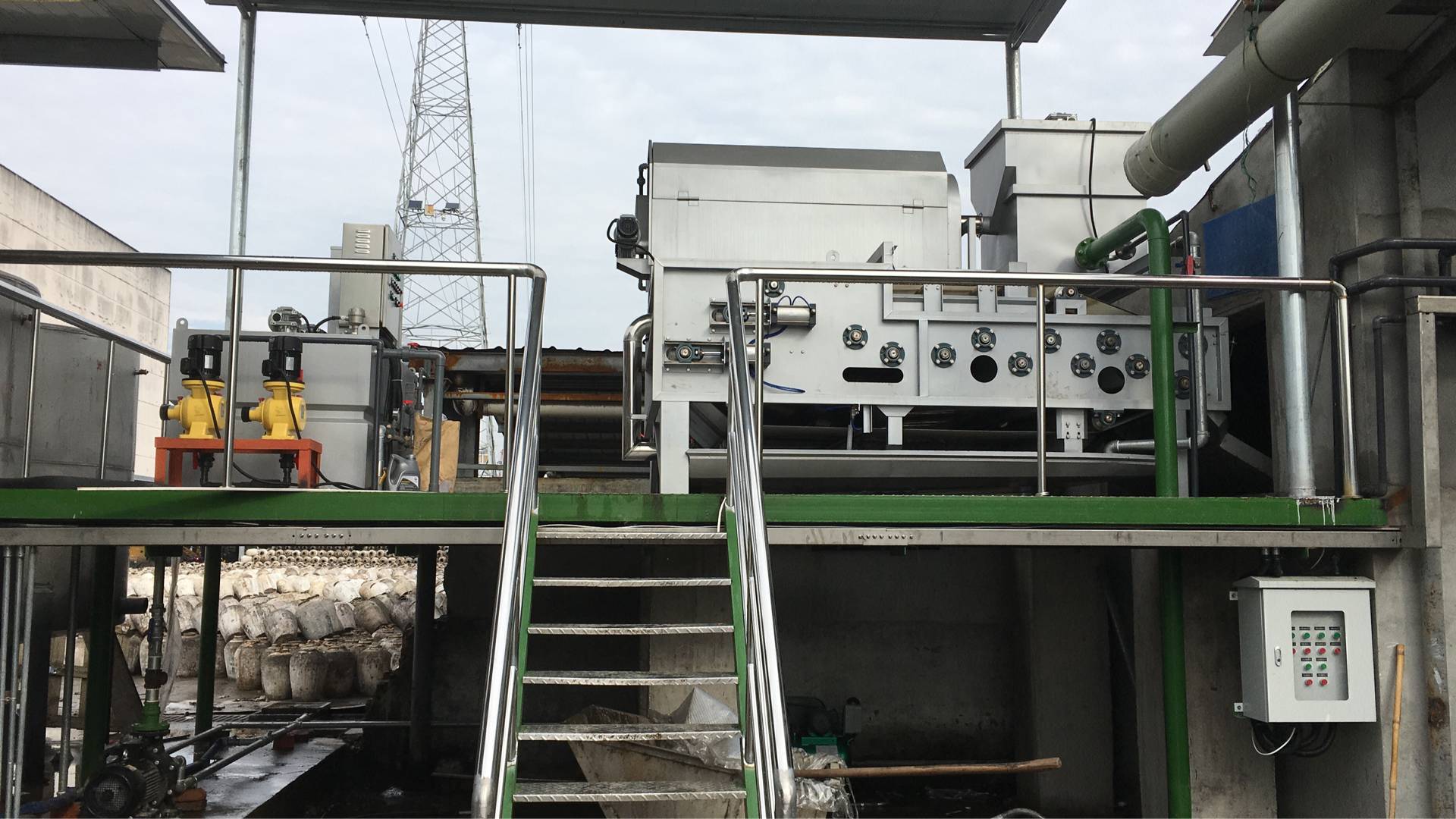
Why Project Fit Decides Dewatering Performance
Project fit determines dewatering performance because sludge entering a dewatering line varies widely in composition and consistency. Municipal excess sludge is commonly fed at very high moisture content — one SFC city sewage plant reference processed sludge at 99.2% moisture. Industrial streams add further constraints: oily and sticky sludge, high-inorganic-content sludge, corrosive electroplating waste, high-organic distillery sludge prone to fermentation and odor, and chemically complex pharmaceutical residues. Each working condition changes which dewatering mechanism is suitable and how the rest of the treatment line should be configured.
Across SFC's project references, the moisture range is broad. A food processing plant in Malaysia fed sludge at 98.5% moisture into a rotary drum belt press; a vegetable oil processor dewatered sludge from 97% to 77%; a pharmaceutical wastewater station reduced moisture from 99% to below 85%; an automotive component plant dried 75% moisture filter cake to below 25%. The economic logic is consistent: every percentage point of water removed before transport or disposal reduces downstream cost, and the fastest route to that reduction is a correctly matched machine.
The commercial opportunity around this fit is substantial. The global sludge dewatering equipment market was valued at USD 5.19 billion in 2024 and is projected to reach USD 10.16 billion by 2032 (Fortune Business Insights). Asia Pacific accounted for 37.57% of market revenue in 2024, and China's segment was expected to reach USD 0.87 billion by 2025. With municipal and industrial sludge volumes continuing to grow, buyers are evaluating equipment not as a commodity purchase but as a long-term operating-cost decision.
The Product Lineup: From Thickening to Drying
SFC Machinery covers the complete sludge management chain: sludge reduction, thickening, dewatering, deep dewatering, drying, chemical dosing, and system integration. At the front of the line, the HCP Smart Flow™ Sludge Reduction System is designed to reduce sludge generation at the source, lowering the load on downstream treatment. The core dewatering and drying families are:
- Screw Press Sludge Dewatering Machine (DL Series) — multi-disc screw press using fixed rings, moving rings, a screw shaft, and a volute filter. Inlet consistency S.S. 0.6–5.0%; dried sludge output 1.5–900 kg/h; cake moisture 75–85%; screw sizes from Ø85×1 to Ø400×4; screw motor power 0.18–1.5 kW.
- Wear-Free Multi-Disc Screw Press (SRD Series) — designed for low-concentration, sticky, oily, and high-inorganic-content sludge. Dried sludge output 25–900 kg/h; cake moisture 75–85%; screw sizes from Ø270×1 to Ø370×4; driving motor 0.55–1.1 kW.
- Belt Thickening and Dewatering Machine (GDY Series) — gravity belt thickening combined with belt press dewatering. Inlet S.S. 0.6–1.5%; treating capacity 15–90 m³/h; dried sludge 90–1050 kg/h; cake moisture 75–80%; belt widths 1000–3000 mm.
- Rotary Drum Sludge Dewatering Machine (FTB Series) — rotary drum thickening plus belt press dewatering for small and medium projects; inlet S.S. 1.5–2.5%; capacity 3.0–30 m³/h; dried sludge 45–450 kg/h; cake moisture 75–85%.
- Rotary Drum Type Sludge Thickening and Dewatering Machine (FTE Series) — the same principle for medium and large continuous projects; inlet S.S. 0.6–1.5%; capacity 12–90 m³/h; dried sludge 90–975 kg/h.
- Belt Sludge Thickener (FBT Series) — gravity belt thickener raising outlet consistency to 2.5–8%; capacity 12–95 m³/h; solid capture rate 98%.
- Rotary Drum Sludge Thickener (FRDT Series) — enclosed drum thickener with 30–80 mesh filter; capacity 7.5–100 m³/h; outlet consistency 2.5–8%; solid capture rate 95%.
- High-Pressure Belt Deep Sludge Dewatering Machine (SD Series) — secondary deep dewatering after primary dewatering; inlet S.S. 15–20%; dried sludge 60–760 kg/h for 65–75% water content targets, or 70–920 kg/h for 60–70% targets.
- Sludge Dryer (SFC-BSD Series) — low-temperature belt dryer; inlet S.S. 15–25% or 25–35%; treating capacity 0.8–57 t/h or 1–90 t/h; final water content 10–50%; system power consumption 23–506 kW; fully enclosed modular design in SS304.
- Sludge Dryer (SFC-TR Series) — low-temperature reciprocating circulation dryer; batch size 1000–9000 L; water extraction capacity 21–360 kg/h; unit power consumption 0.4–0.55 kWh/kg water; sludge volume reduction up to 70%.
- Automatic Polymer Preparation and Dosing Systems — PAM and PAC preparation and dosing units for precise chemical feeding.
| Series | Machine Type | Inlet S.S. | Capacity | Cake / Outlet Moisture |
|---|---|---|---|---|
| DL | Multi-disc screw press | 0.6–5.0% | 1.5–900 kg/h | 75–85% |
| SRD | Wear-free screw press | 0.6–5.0% | 25–900 kg/h | 75–85% |
| GDY | Belt thickening + dewatering | 0.6–1.5% | 15–90 m³/h | 75–80% |
| FTB | Rotary drum + belt press | 1.5–2.5% | 3–30 m³/h | 75–85% |
| FTE | Rotary drum + belt press | 0.6–1.5% | 12–90 m³/h | 75–85% |
| SD | High-pressure deep dewatering | 15–20% | 60–920 kg/h dried sludge | Secondary dewatering |
| BSD | Low-temperature belt dryer | 15–25% / 25–35% | 0.8–57 / 1–90 t/h | Final 10–50% |
| TR | Low-temperature batch dryer | Dewatered cake | 21–360 kg/h water extraction | Up to 70% volume reduction |
| FBT | Gravity belt thickener | 0.6–1.5% | 12–95 m³/h | Outlet 2.5–8% |
| FRDT | Rotary drum thickener | 0.6–1.5% | 7.5–100 m³/h | Outlet 2.5–8% |
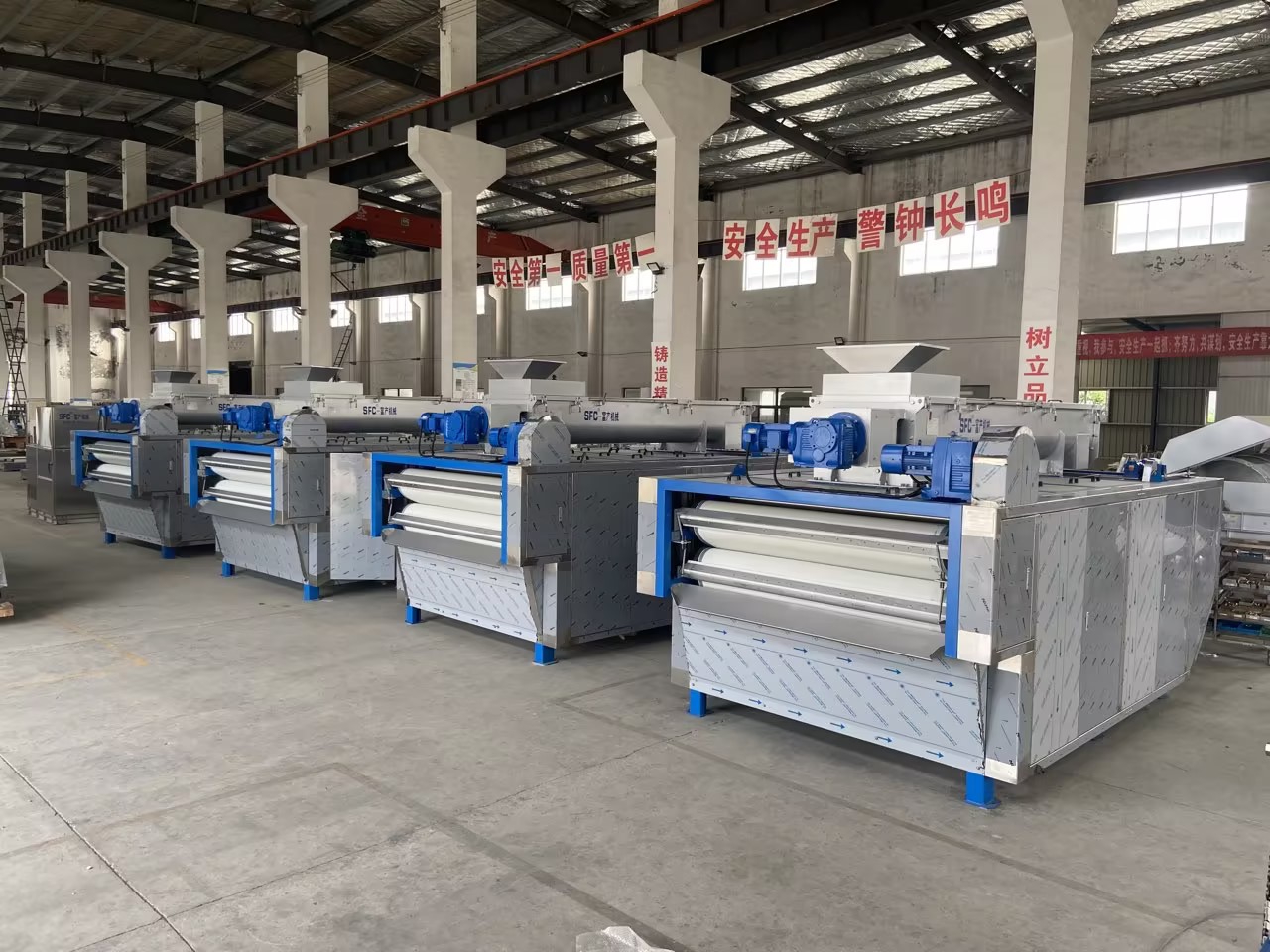
SFC Machinery's manufacturing base is sized for both volume and project flexibility: a 25,000 m² facility in Shanghai, a dedicated R&D team, an annual output of 500 sets, and approximately 30% of production exported to Southeast Asia, Russia, South America, and the Middle East. The company also operates an OEM/ODM program with a monthly capacity of 40 sets, lead times of 30–60 days, a minimum order quantity of one unit, and 100% testing before delivery. Customization options cover equipment type and model selection, processing capacity, dimensions and footprint, PLC automation level, power configuration, modular design for dryers, and auxiliary equipment integration.
How the Technologies Work in a Project Line
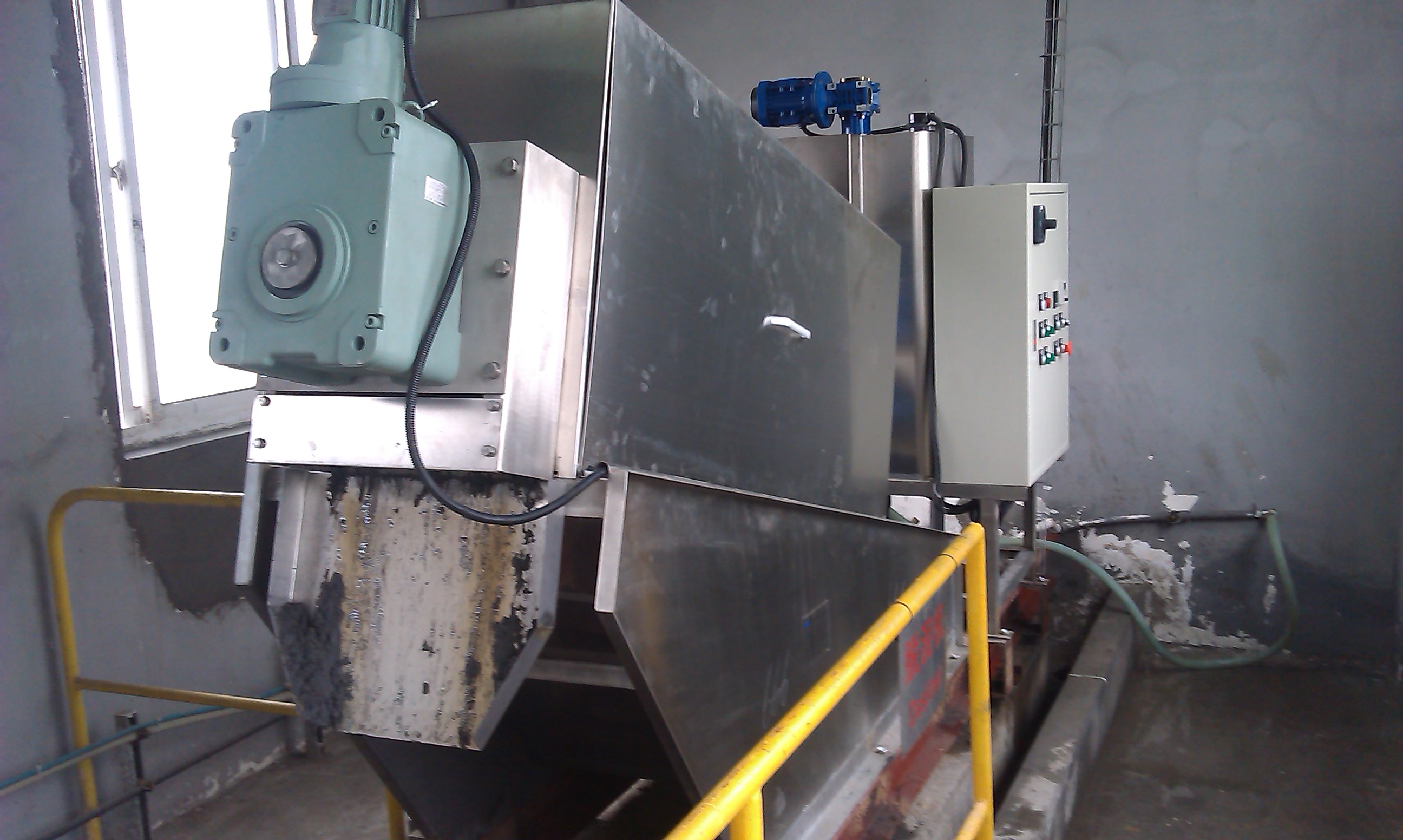
Multi-disc screw presses separate water by combining a rotating screw with a stack of fixed and moving rings. Sludge is conveyed forward by the screw while water filters through the ring gaps; the moving rings continuously clean the gaps, which reduces clogging. Because filtration and conveying happen in one body, the press can accept feed at S.S. 0.6–5.0% without a separate pre-thickener in many cases. The DL Series keeps screw motor power at 0.18–1.5 kW, and the wear-free SRD variant targets abrasive, sticky, or high-inorganic sludge with a conveying and dewatering interface designed to reduce screw-to-ring wear risk.
Belt systems follow a different logic: gravity dewatering on a screen, followed by pressure squeezing between two belts. The GDY integrated thickener-dewaterer processes 15–90 m³/h of 0.6–1.5% S.S. sludge continuously, and the FTB/FTE drum-plus-belt machines add an enclosed rotary drum ahead of the belt press. These machines suit medium to large continuous projects and, as SFC's project documentation states, they require stable flocculation, adequate wash water, and correct belt tension to perform consistently.
Thickeners sit upstream of dewatering. The FRDT rotary drum thickener is an enclosed, low-speed unit (about 10 rpm) with a 30–80 mesh filter that raises 0.6–1.5% S.S. feed to 2.5–8% outlet consistency with a 95% solid capture rate; the FBT gravity belt thickener reaches a 98% capture rate at belt speeds of 3–18 m/min. Thickening directly reduces the hydraulic load on the dewatering machine and, as a municipal case shows, improves the performance of downstream high-pressure equipment.
Deep dewatering is a second mechanical stage. The SD Series accepts sludge already dewatered to S.S. 15–20%, adds chemical conditioning through a sludge mixer (2.2–5.5 kW), and applies a high-pressure belt to produce dried sludge at 60–760 kg/h for 65–75% water content targets, or 70–920 kg/h for 60–70% targets. Supporting drives include the main motor (0.55–3.0 kW), a distribution spiral (0.25–1.5 kW), and a crushing screw (0.37–0.75 kW).
Low-temperature drying completes the line. The SFC-BSD belt dryer is fully enclosed and modular in SS304, reaches a final water content of 10–50%, and can be integrated with waste heat recovery systems. The SFC-TR reciprocating circulation dryer runs in batches of 1000–9000 L with unit power consumption of 0.4–0.55 kWh per kg of water removed. Around these core units, SFC supplies screw conveyors, sludge storage silos, lime silos, air blowers, aeration systems, and customized auxiliary systems, with PLC control and PAM/PAC preparation stations automating polymer feeding. For projects that require traceable moisture verification, ISO 11465:2025 provides the international standard for the determination of dry residue and water content in sludge and solid environmental matrices.
Application Scenarios: Matching Equipment to Working Conditions
Palm oil industry. Palm oil mills generate palm oil mill effluent (POME) and empty fruit bunch residues that require integrated sludge reduction, dewatering, and drying. SFC's related equipment includes the DL screw press, SRD wear-free screw press, FTB rotary drum dewatering machine, SD deep dewatering system, and BSD dryer. The operating model is unattended continuous operation, with corrosion-resistant, explosion-proof, energy-efficient, and odor-free design to support zero-discharge targets.
Distilleries and breweries. High-organic-load wastewater sludge from alcohol production typically carries 95–99.8% moisture, ferments readily, and generates odor, so enclosed and corrosion-resistant equipment is required. SFC proposes sludge thickening plus screw press dewatering plus thermal drying, with the FTB-2000 drum thickening belt filter press as a matched unit. The output is a dry, stable biomass suitable for co-incineration, land application, or alternative fuel use, with minimized odor emissions.
Automotive parts manufacturing and electroplating. Electroplating and surface finishing produce corrosive heavy-metal sludge. SFC applies a dewatering and drying package built around the FTB-500 rotary drum concentrator belt press, operating fully automatically. Corrosion resistance, energy efficiency, and odor control are the defining requirements.
Pharmaceutical industry. Pharmaceutical wastewater sludge is high in organic and chemically complex residues. SFC's package combines the DL-201 screw press with deep dewatering and thermal drying to stabilize residues and reduce biological activity, converting hazardous sludge into a dry, stable material suitable for incineration, safe landfill disposal, or further resource recovery.
Oil refining and petrochemical industry. Refractory sludge from petrochemical coking wastewater needs an explosion-proof, corrosion-resistant process that runs automatically and continuously. SFC's integrated thickening, dewatering, and drying package uses equipment such as the FTE3-2000 belt dewatering machine, FRDT rotary drum thickener, DL/SRD screw presses, and BSD dryer under PLC control, with a PAM preparation and dosing system. The SFC-SD deep dewatering system (Product 5179) is also used in chemical plant applications to reduce sludge moisture.
Municipal wastewater treatment. A municipal wastewater treatment plant in China operated eight FRDT rotary drum thickeners to pre-concentrate raw sludge from 99.4% down to 97% moisture content, raising solids to 3% and improving the performance of downstream plate-and-frame filter presses. In another city sewage treatment plant, two GDY integrated thickener-dewaterers processed 99.2% moisture sludge to a final cake of below 80% moisture in unattended continuous operation.
| Project | Equipment | Starting Moisture | Final Moisture | Operating History |
|---|---|---|---|---|
| Vegetable oil processing | Screw press | 97% | 77% | 8 years |
| Pharmaceutical wastewater | Screw press | 99% | Below 85% | 10 years |
| Food processing (Malaysia) | FTB-1000 | 98.5% | Below 80% | 8 years |
| Specialty chemicals plant | FTB-1500L | 99% | Below 80% | 5 years |
| Advanced manufacturing | BSD-2000 belt dryer | 85% | Below 30% | 6 years |
| Automotive parts | SFC-TR dryer | 75% | Below 25% | 5 years |
| City sewage plant | GDY integrated thickener-dewaterer | 99.2% | Below 80% | 5 years |
| Municipal WWTP | FRDT rotary drum thickener (8 units) | 99.4% | 97% (3% solids) | 1 year |
Market Context for Buyers
The sludge dewatering equipment market remains a growth category, and several verified data points frame the current landscape. The global sludge dewatering equipment market was valued at USD 5.19 billion in 2024 and is projected to reach USD 10.16 billion by 2032 (Fortune Business Insights). Asia Pacific led with a 37.57% revenue share in 2024, and China's market revenue was expected to reach USD 0.87 billion by 2025. Research firms differ on some estimates — the 2024 global figure varies by roughly USD 0.17 billion across leading analysts, and forecast CAGR figures range from about 8.3% to 12.6% depending on assumptions — so buyers should treat market-sizing data as directional rather than precise.
At the supplier level, the top five global players — Andritz, Xylem, Alfa Laval, Suez, and Veolia — collectively held 35% of the market in 2025, and Veolia alone was identified as the leader with over 9% share (Global Market Insights). The belt filter press segment is projected to grow at a CAGR of 8.8% from 2025 to 2033, largely driven by municipal wastewater applications (Grand View Research). For a procurement team, the implication is that the market below the top five remains fragmented, which gives mid-size manufacturers with integrated engineering and customization capabilities room to compete on project fit rather than on scale alone.
How the Main Dewatering Technologies Compare
The main mechanical alternatives — multi-disc screw press, belt filter press, plate-and-frame filter press, and centrifuge — each have a distinct operating profile:
- Multi-disc screw press: continuous operation, low energy demand, self-cleaning ring stack, no wash-water circuit, and direct handling of low-concentration feed. Cake dryness is typically moderate, in the 75–85% range.
- Belt filter press: high continuous throughput and a broad municipal track record, but requires stable flocculation, continuous wash water, and periodic belt replacement.
- Plate-and-frame filter press: can reach higher cake dryness in batch operation, but has higher labor intensity, polymer demand, and a lower automation level compared with continuous machines.
- Centrifuge: high throughput with a small footprint, but with higher energy consumption and wear on rotating parts, and generally higher noise levels.
The honest limitation of the screw press class is that mechanical dewatering typically stops at 75–85% cake moisture; a project targeting lower moisture needs a downstream stage such as the SD deep dewatering system or a low-temperature dryer. Conversely, a plant with very high continuous flow may find belt or centrifugal equipment better suited to its hydraulic profile. These are sizing and process-design trade-offs, and they are exactly the decisions SFC Machinery addresses during project engineering. Buyers should also note that feed characteristics and polymer selection must be confirmed before final sizing — SFC's project documentation consistently recommends sludge sample testing and polymer jar tests before model selection.
Outlook: Toward Integrated, Automated Sludge Lines
Three tendencies are visible in the sludge treatment projects SFC documents. First, buyers increasingly specify integrated lines — thickening, dewatering, deep dewatering, and drying — rather than standalone machines, because disposal costs are driven by final volume. Second, automation is becoming a default: PLC-controlled operation and PAM/PAC preparation systems reduce chemical consumption and allow unattended continuous running, which is a stated requirement in palm oil, beverage, and petrochemical scenarios. Third, low-temperature drying with waste-heat integration is gaining attention as plants seek to reduce the carbon footprint of sludge handling; the BSD series is designed as a fully enclosed system that can accept waste heat recovery.
Regulatory and sustainability pressures — including zero-discharge goals in palm oil processing and stricter industrial waste rules in petrochemical and pharmaceutical sectors — are likely to continue pushing sludge management from a disposal cost into a resource-recovery decision. In that environment, the machines that fit the project's actual sludge and site conditions will retain a measurable operating-cost advantage.
Frequently Asked Questions
How do I choose sludge dewatering equipment for my project?
Selection starts with the working condition: feed suspended solids content, sludge type, required capacity, final moisture target, and site constraints. SFC's equipment selection guidance is based on sludge characteristics and treatment capacity, and the company's project documentation notes that the final moisture target and sludge feeding condition must be confirmed before model selection. A sludge sample test and polymer jar test are recommended before final sizing.
What is the difference between a screw press and a belt press for dewatering?
A multi-disc screw press (DL/SRD Series) accepts inlet consistency of S.S. 0.6–5.0% directly, uses a self-cleaning ring stack, and produces cake at 75–85% moisture with low motor power. A belt-type system such as the GDY thickens and dewaters 0.6–1.5% S.S. sludge at higher continuous flows of 15–90 m³/h, producing 75–80% cake moisture, but requires stable flocculation, adequate wash water, and correct belt tension during operation.
Can the equipment handle oily, sticky, or high-inorganic sludge?
Yes. The SRD wear-free screw press is designed specifically for low-concentration, sticky, oily, and high-inorganic-content sludge, with dried sludge output of 25–900 kg/h and cake moisture of 75–85%. The DL screw press is also listed for oily sludge and decentralized sludge treatment projects.
What final moisture content can be achieved?
Mechanical dewatering typically produces 75–85% cake moisture on screw presses and rotary-drum belt presses, and 75–80% on the GDY integrated machine. For lower targets, the SFC-SD high-pressure belt deep dewatering system takes sludge at S.S. 15–20% and produces dried sludge at 60–760 kg/h for 65–75% water content targets, or 70–920 kg/h for 60–70% targets. The SFC-BSD low-temperature belt dryer reaches a final water content of 10–50%, and the SFC-TR batch dryer achieves up to 70% sludge volume reduction.
Is chemical conditioning required before dewatering?
Most screw and belt press applications are designed with a polymer preparation and dosing system (PAM or PAC) to condition the sludge before dewatering. Automatic preparation and dosing systems are part of SFC's process packages, and they are intended to reduce polymer consumption while improving treatment efficiency. For deep dewatering, conditioning chemicals and project-specific sludge testing are required.
Can the equipment be customized to my site and capacity?
SFC operates an OEM/ODM program that covers equipment type and model selection based on sludge characteristics and treatment capacity, processing capacity, dimensions and footprint, control system configuration (PLC automation level), power configuration, modular design options for dryers, and auxiliary equipment integration. The program has a monthly capacity of 40 sets, lead times of 30–60 days, a minimum order quantity of one unit, and 100% testing before delivery.
Which industries have deployed SFC sludge dewatering equipment?
Documented applications include municipal wastewater treatment plants, city sewage treatment plants, vegetable oil processing, pharmaceutical wastewater, food processing, specialty chemicals, automotive parts manufacturing, and the palm oil, distillery/brewery, and oil refining/petrochemical sectors. The SFC-SD deep dewatering system is further used in chemical plant applications to reduce sludge moisture.
Shanghai Fuchan Machinery Technology Co., Ltd. (SFC Machinery) supplies sludge dewatering equipment, thickening systems, deep dewatering systems, low-temperature dryers, and polymer preparation systems for municipal and industrial projects worldwide.
Email: sales@fuchanjx.com | Tel / WhatsApp: +86 138-1673-2007
Website: www.sfceco.com | Address: Room 1201, 1122 Xinjinqiao Rd, Pudong New District, Shanghai, PRC China