
Matching Ultrasonic Machines to Production Scenarios: A Buyer's Perspective
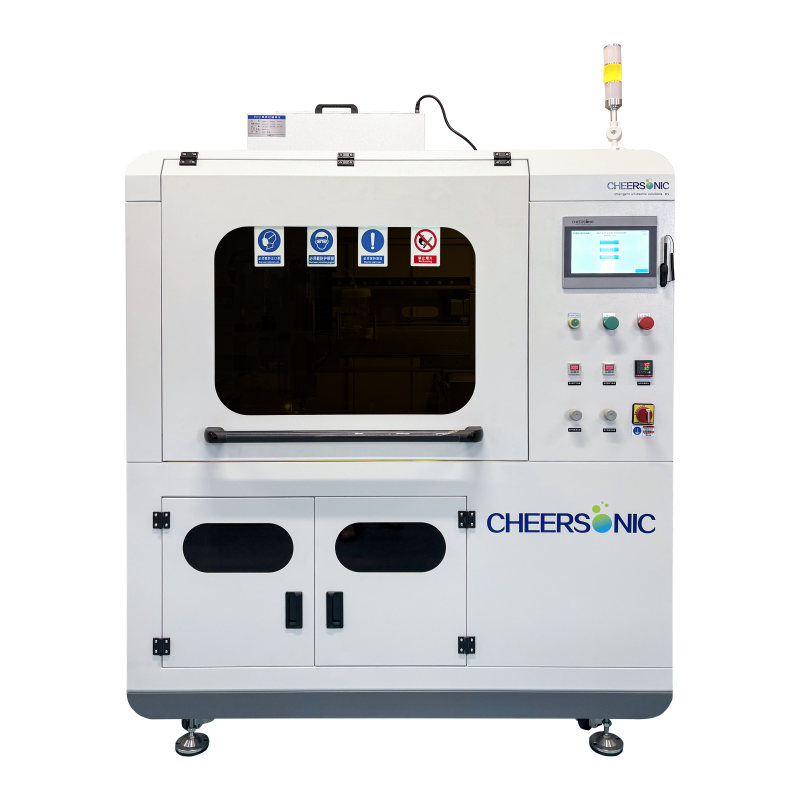
An ultrasonic machine is not a single product category. It is a process platform that can cut food, slice frozen desserts, deposit thin functional films, atomize liquids, solder dissimilar materials, and bond textiles. For buyers, the practical question is not whether ultrasonic technology is useful, but which configuration fits a specific production scenario.
What buyers actually mean when they search for an ultrasonic machine
Search queries containing “ultrasonic machine” usually carry an unspoken process problem. A bakery may need clean slices of mousse cake without smearing cream. A dairy plant may need fixed-weight portions of frozen cheese without thawing. A medical device manufacturer may need a uniform drug coating on a stent or balloon without damaging the substrate. An energy company may need a catalyst layer on a fuel cell membrane with precise loading and minimal precious metal loss.
These are different projects. They share a common energy source, but the machine architecture, nozzle or blade design, control system, and environmental requirements differ. A manufacturer that treats “ultrasonic machine” as one model risks buying hardware that is technically ultrasonic but poorly matched to the product state, line speed, or regulatory environment.
The project-fit gap: three questions before a model number
Before comparing specifications, buyers should define three process-level parameters:
- Material state: Is the product sticky, frozen, brittle, high-viscosity, heat-sensitive, or cleanroom-sensitive? This determines whether cutting, spraying, welding, or dispersion is the correct process.
- Outcome metric: Is the target defined by slice accuracy, portion weight, film thickness uniformity, material utilization, surface integrity, or production yield? Different metrics lead to different machine configurations.
- Production environment: Does the line require IP65 washdown, Class 100/1000 cleanroom conditions, GMP compliance, low-temperature operation, or inert gas atmosphere? This affects sealing, materials, and integration options.
Companies that skip this step often compare generator power and blade size before defining the process requirement. In practice, the same ultrasonic supplier can serve baked goods, fuel cells, and blood collection tubes, but the machine configuration is different.
Cheersonic as a project-level supplier
Cheersonic — formally Hangzhou Cheersonic Ultrasonics Equipments Co., Limited — is a high-tech enterprise founded in 2014 and based in Fuyang District, Hangzhou. It integrates research and development, manufacturing, sales, and service, with core products in ultrasonic cutting and ultrasonic spraying. According to the company profile, Cheersonic holds 31 patents and 3 software copyrights, and has obtained ISO9001, EU CE, and US FDA certifications. Its factory covers 7,150 square meters, employs about 100 people including 20 R&D engineers, and reports an annual output of 1,200 units. About 50% of output is exported, with main markets in Asia, the EU, and North America.
For project-specific procurement, Cheersonic supports OEM and ODM production. Customization can include equipment size, cutting specification, operating voltage, control program, machine appearance, brand logo, functional modules, and production-line docking structure. The stated MOQ is one unit. Lead time is 7–15 days for standard models and 30–45 days for customized models.
Technical foundations: cutting, spraying, bonding
Ultrasonic cutting and slicing
Ultrasonic cutting systems use a blade vibrating at approximately 20 kHz. The high-frequency micro-vibration reduces friction between blade and product, lowers downward mechanical force, and helps prevent sticking. This is why ultrasonic cutting is used for soft, sticky, layered, or frozen food products where conventional blades deform the item or leave residue on the cutting surface.
Cheersonic's ultrasonic cutting equipment line covers manual, semi-automatic, and fully automated systems. Published specifications include a working frequency of 20 kHz, power range of 800–1,600 W, cutting width up to 600 mm, and production capacity of 50–1,500 pieces per hour. Standard processing temperature is –14°C to 40°C, while documented frozen dessert applications support cutting at –20°C without pre-thawing. The machines are designed with titanium or stainless-steel food-grade contact parts and IP65 washdown rating.
Ultrasonic spray coating and atomization
Ultrasonic spray systems generate fine droplets through high-frequency vibration rather than high-pressure air. Cheersonic's ultrasonic nozzles operate at 25–180 kHz, produce droplets from 18 to 200 microns, and support flow rates from 0.001 to 50 mL/min. Coating film thickness can be controlled from 20 nanometers to 100 microns, depending on the liquid and substrate.
This low-pressure atomization is useful for thin, uniform coatings on heat-sensitive or fragile substrates. It also reduces overspray compared with conventional air atomization, and the non-clogging nozzle design helps maintain stable operation when using nano-slurries, catalyst inks, or solvent-based medical coatings.
Ultrasonic soldering and welding
Ultrasonic machine capability extends beyond cutting and coating. Cheersonic also supplies fluxless ultrasonic soldering systems that operate at 20–60 kHz and 200–450°C, enabling metallurgical bonding of dissimilar materials such as aluminum, ceramics, glass, and graphite. Ultrasonic welding systems for textiles operate at 35 kHz and require a minimum synthetic fiber content of approximately 60% for stable bonding.
Application evidence by scenario
Project-fit decisions are easier to evaluate when documented by industry scenario. The following table summarizes how ultrasonic machines are deployed across food, medical, semiconductor, energy, and joining applications.
| Industry scenario | Typical requirement | Equipment family | Documented project evidence |
|---|---|---|---|
| Dairy and cheese processing | Fixed-weight or fixed-size portioning of soft, hard, and frozen cheese; low raw-material loss | CWM100, UFM8100C, UFM2200C, UFM1000C, UFM3100W, UFM2300W | A dairy manufacturer in Ireland uses 4 units for wheel cheese cutting, achieving over 70% space improvement and 70% production time reduction. A dairy processor in Venezuela uses 3D scanning and AI intelligent cutting with weight error controlled within ±1g and appearance scrap rate reduced by 90%. |
| Bakery and frozen desserts | Clean slices of mousse cake, cheesecake, layered cakes, and filled pies without deformation | HFM2300, HFM3100, UFM1000P, UFM1000R, UFM2200, UFM3100P, UFM3300, UFM5000, UFM6000, UFM8000, UFM8101 | A baking and pre-made food enterprise in Russia uses 3 units for automated cutting of filled pies, reporting a 200% production capacity increase, 98% product qualification rate, and 35% raw material loss reduction. |
| Confectionery | Anti-stick cutting of caramel, chocolate, nougat, and high-sugar products | UFM series ultrasonic slicing and cutting machines | A confectionery manufacturer in France has used 2 units for caramel bar slicing for 8 years, with stable continuous operation and standardized product size. |
| Medical device coating | Uniform drug or functional coating on stents, balloons, catheters, and blood collection tubes | UAM4000, UAM6000, ultrasonic nozzles, ultrasonic atomizers | Medical coating applications are deployed in low-temperature dust-free cleanrooms under GMP-compliant conditions, with coating thickness controlled from sub-micron to tens of microns and high material utilization. |
| Semiconductor and electronics | Conformal photoresist coating on MEMS wafers, 3D structures, and advanced packaging | USP6000, USP6000WS, UAM series, ultrasonic nozzles | MEMS wafer lithography projects report reduced deep-trench defect rates and photoresist consumption savings compared with spin coating, with coating thickness tolerance around ±0.5 μm in documented cases. |
| Energy and fuel cells | Catalyst coating on PEM or AEM membranes, electrolyzer components, and solar cell films | UAM4000, UAM6000, UAM8000, ultrasonic spray pyrolysis systems | A global industrial contractor in Germany uses 10 units for PEM and AEM dual-route CCM double-sided spraying, achieving 98.5% CCM yield, a 60% increase in daily production per unit, and 45–55% reduction in precious metal consumables. |
| Joining and assembly | Fluxless soldering of dissimilar materials, airtight textile seams, and medical filter welding | USE series ultrasonic soldering, USM series ultrasonic welding | Ultrasonic soldering is used in semiconductor equipment, thermal management, photovoltaic, and aerospace projects. Ultrasonic welding is used for sportswear, protective textiles, and medical filtration products. |
The pattern in these records is consistent: ultrasonic equipment delivers the highest value when the product or process creates a measurable constraint such as stickiness, deformation, frozen-state processing, membrane fragility, or material cost sensitivity.
Market trends shaping procurement
Third-party market data supports the widening use of ultrasonic machines in manufacturing. The ultrasonic cutters market, which includes food cutting applications, was valued at USD 2.8 billion in 2025 with a projected CAGR of 7.2% through 2033, according to Dataintelo. The ultrasonic spray systems market was valued at USD 0.5 billion in 2024 and is projected to reach USD 1.2 billion by 2034, according to Market Research Future.
Medical device coatings are also expanding, with the global market estimated at USD 16.27 billion in 2025 and anti-microbial coatings accounting for 31.8% of revenue, according to Grand View Research. This creates demand for precise, low-waste deposition methods that can handle biological and pharmaceutical materials without high-temperature or high-pressure damage.
Regionally, Asia Pacific represented approximately 25% to 38% of global revenue across different ultrasonic technology sub-segments in 2025, according to Fortune Business Insights. Cheersonic's export pattern into Asia, the EU, and North America aligns with this regional procurement base, but buyers should still validate equipment performance against their own line conditions rather than rely on regional averages.
Ultrasonic vs. conventional processing: a measured comparison
Compared with traditional mechanical cutting, ultrasonic cutting reduces blade friction and mechanical extrusion. This is particularly visible on soft cakes, sticky candies, frozen dairy, and filled products. Compared with high-pressure air spraying, ultrasonic spraying creates smaller, more uniform droplets with less overspray and lower impact on fragile substrates. Compared with flux-based soldering, ultrasonic soldering removes oxide layers through cavitation and can join materials without flux residue.
| Process step | Conventional approach | Ultrasonic alternative |
|---|---|---|
| Portioning soft or sticky food | Manual knife, mechanical blade, or wire cutting | 20 kHz vibrating blade with low friction and anti-stick surface |
| Thin-film coating | Air-atomized spraying, spin coating, or dip coating | 25–180 kHz ultrasonic nozzle with 18–200 μm droplets and non-clogging atomization |
| Joining dissimilar materials | Flux-based soldering, brazing, or adhesive bonding | Fluxless ultrasonic soldering at 200–450°C, compatible with aluminum, ceramics, glass, and dissimilar metals |
| Textile and nonwoven bonding | Stitching, gluing, or heat sealing | Ultrasonic welding at 35 kHz for synthetic fibers above approximately 60% content |
The boundary is equally important. Ultrasonic systems are not always the most economical choice. For homogeneous products that do not deform, stick, or require frozen-state processing, a conventional blade or wire cutter can deliver adequate performance at a lower initial investment. For coating lines where film thickness tolerance is not critical and overspray is not a cost driver, standard air spraying may be sufficient. A defensible buying decision starts with a measurable process problem, not with the technology label.
Future outlook
The next phase of ultrasonic machine procurement is likely to be shaped by three factors. First, data-driven process control is becoming a selection criterion. Project records already show 3D scanning, AI-based cutting optimization, and fully digital parameter storage in dairy and bakery applications. Buyers increasingly expect traceability of cutting patterns, coating loads, and process parameters.
Second, clean energy manufacturing is creating repeatable, large-volume ultrasonic coating requirements. Electrolyzer and fuel cell projects require catalyst coatings with tight loading consistency across large membrane areas. Modular ultrasonic coating units that can be networked and expanded are more useful than single-purpose laboratory machines.
Third, suppliers that support OEM/ODM customization and integration with existing production lines will have an advantage in project-driven procurement. The ability to modify equipment size, control software, operating voltage, and line-interface structure is often as important as the ultrasonic frequency specification.
Frequently asked questions
What is an ultrasonic machine used for?
An ultrasonic machine is used to convert high-frequency mechanical vibration into a process action. Common applications include ultrasonic cutting and slicing of food, ultrasonic spray coating and atomization for thin films, ultrasonic soldering for fluxless joining, and ultrasonic welding of synthetic textiles.
How do I decide between ultrasonic cutting and ultrasonic spray coating equipment?
If the goal is portioning solid products such as cakes, cheese, confectionery, or frozen desserts, ultrasonic cutting is the relevant process. If the goal is depositing a thin functional film on a substrate such as a stent, wafer, membrane, or glass surface, ultrasonic spray coating is the relevant process. The product state, outcome metric, and production environment determine which machine family is appropriate.
What specifications matter most for an ultrasonic spray coating system?
Key specifications include operating frequency, droplet size, flow rate, film thickness range, liquid viscosity compatibility, atomization reliability, and cleanroom or GMP compatibility. For example, Cheersonic ultrasonic nozzles operate at 25–180 kHz, produce droplets of 18–200 microns, and support flow rates from 0.001 to 50 mL/min.
Which industries commonly use ultrasonic spray coating?
Ultrasonic spray coating is used in semiconductor manufacturing, medical device manufacturing, electronics, fuel cell production, battery manufacturing, solar cell production, glass and optics, automotive, aerospace, and R&D laboratories. Medical and energy applications often place the strictest demands on coating uniformity and material utilization.
Can ultrasonic cutting handle frozen desserts without thawing?
Yes. Documented applications support cutting frozen desserts at –20°C without pre-thawing, with dimensional error controlled within ±1mm. This reduces production cycle time and prevents quality loss caused by melting and refreezing.
Are there disadvantages to ultrasonic machines?
Ultrasonic systems generally involve higher initial investment than simple mechanical blades or air-atomizing spray guns. They are most justified when conventional methods create measurable problems such as product deformation, sticking, overspray, film non-uniformity, or material loss. For less demanding products, conventional equipment may provide a more cost-effective solution.