
Matching VF Paddlewheel Aerators to Farm Conditions
Equipment that matches the pond, not just the power rating, is becoming the real purchasing benchmark in intensive aquaculture. In high-density shrimp and fish farming, aerators are expected to run continuously through tropical heat, high humidity, saline or brackish water and unstable rural grid voltage. For procurement teams moving from research into evaluation, the practical question is which variable frequency paddlewheel aerator design fits their specific farm scenario.
Why Pond Conditions Are More Demanding Than Rated Power
Intensive shrimp and fish ponds are managed at high biomass levels, which means dissolved oxygen must be maintained around the clock. The working environment of a pond aerator is rarely a controlled industrial setting. It is a high-density intensive farming pond located in a tropical climate with high temperature and humidity, often filled with saline or brackish water, and powered by a rural electricity grid where voltage can swing unpredictably from 150V to 430V. Equipment that works well in one environment may fail quickly in another.
Traditional paddlewheel aerators with gearbox-driven induction motors still dominate many farms because they are familiar and relatively inexpensive at first purchase. But their operational limits become visible under intensive farming conditions. Gearboxes need oil, sealing and periodic replacement of worn parts; oil leakage can pollute the water body and stress shrimp or fish. Induction motors are also sensitive to voltage fluctuations, and phase loss or deep voltage dips can burn out the motor windings. In a farm context where a single night of low dissolved oxygen can lead to stock loss, the resilience of the aeration system matters more than headline power figures.
The opportunity, therefore, is not simply to sell a higher-powered machine. It is to match three variables that define a real farm scenario: continuous 24/7 operation, environment resistance, and electrical adaptability. That is where variable frequency technology, permanent magnet motors and direct-drive design have entered the market as a credible response rather than a premium novelty.
A Field-Oriented Approach: The Variable Frequency Paddlewheel Aerator
Over the past decade, Chinese equipment manufacturers have become the central testing ground for intensive aquaculture tools. China accounts for a dominant share of global aquaculture output, and the equipment used in its high-density farms has been refined through commercial-scale production. One manufacturer in this space, SUNOLTA, offers a useful lens for understanding how the product category is adapting to farm-level conditions.
SUNOLTA, the aquaculture equipment brand of Wuxi Sunolta Technology Co., Ltd., is based in Wuxi, Jiangsu Province, China. The company was established in 2006 and operates a manufacturing facility of approximately 12,000 square meters. It develops and produces variable frequency paddlewheel aerators, impeller aerators, surge aerators, variable frequency water pumps and related aquaculture machinery. Its export markets include Southeast Asia, Central Asia, South America and the Middle East, with exports accounting for about 45% of output. For international buyers, the practical relevance of SUNOLTA is not the brand story but the product engineering that comes from supplying farms across different climate zones.
SUNOLTA's variable frequency paddlewheel aerator series is built around the same core approach: permanent magnet synchronous motor (PMSM) direct drive, a gearless structure with no oil leakage, and a frame and float system designed for pond environments. The series covers three power levels, each positioned for a different pond area:
| Model | Rated Power | Oxygenation Capacity | Recommended Pond Area | Impellers |
|---|---|---|---|---|
| SNT-SC-0.75KW | 0.75–1.5 kW (380V three-phase) | ≥ 2.2 kg/h | 1–5 Mu (approx. 0.16–0.8 acre) | 2 high-efficiency paddles |
| SNT-SC-1.5KW | 1.5 kW (380V three-phase) | ≥ 2.3 kg/h | 4–5 Mu (approx. 0.66–0.82 acre) | 4 paddles |
| SNT-SC-2.2KW | 2.2 kW (380V three-phase) | ≥ 3.2 kg/h | 5–7 Mu (approx. 0.82–1.15 acre) | 6 paddles |
All three models use a 304 stainless steel frame with heavy-duty PE floats, and the motor system is a permanent magnet direct drive with 100% gearless construction. The operating logic is continuous: the aerator runs 24/7 with variable-frequency speed adjustment and automatically adapts aeration intensity based on real-time dissolved oxygen levels. This design directly responds to the three farm-level challenges mentioned earlier — continuous operation, environmental corrosion and energy cost.
Technical Explanation: What Makes a VF Paddlewheel Aerator Field-Ready
For buyers evaluating technical proposals, five engineering choices deserve attention.
1. Gearless PMSM Direct Drive
The conventional gearbox is the most failure-prone component in a paddlewheel aerator. It contains lubricating oil, seals and gears that wear over time. A gearless direct-drive design removes the gearbox from the system entirely. The permanent magnet motor drives the impeller shaft directly, eliminating oil leakage risk and removing the need for gear maintenance. In an aquaculture pond, this has a direct water-quality benefit: no gear oil enters the water. It also simplifies spare parts management because there is no gearbox to overhaul.
2. Dissolved-Oxygen-Based Speed Regulation
Variable frequency control is not only about starting softly. In this application, the aerator operates continuously and adjusts its speed according to real-time dissolved oxygen levels. When oxygen demand is high, the motor runs at higher speed; when demand drops, it slows down. This is the mechanism behind the energy-saving claims of PMSM variable frequency aerators. Industry procurement reference data indicates that compared with traditional induction-motor units with gearboxes, PMSM-based variable frequency aerators can reduce energy consumption by up to 40%. For farms that run aerators all night, every night, this is a measurable operating cost difference.
3. Wide-Voltage Adaptability and Electrical Protection
Rural aquaculture farms often experience grid instability. The application requirements for this equipment include wide-voltage operation across 150V–250V for single-phase input and 230V–430V for three-phase input, along with overload, phase-loss and short-circuit auto-protection. This is what prevents a voltage dip from turning into a burned motor. The 380V three-phase models in the paddlewheel series are designed for farms with three-phase supply, while the wider voltage tolerance covers the realistic fluctuations found in rural distribution networks.
4. IPX7 Structural Waterproofing
Aerators work at the water-air interface, and rain, splashing and accidental submersion are normal risks. The application specification calls for IPX7 structural waterproofing that can survive full submersion up to 300 hours. This level of protection is crucial for tropical fish and shrimp farms where heavy rain and pond overflow are part of the seasonal cycle. It also reduces installation risk: the motor housing does not fail after a single accidental immersion.
5. Corrosion-Resistant Materials
Saltwater and brackish water environments accelerate corrosion. The paddlewheel series responds with an extra-long 304 stainless steel frame and heavy-duty PE floats. The stainless steel frame resists rust in saline conditions, while the PE floats provide buoyancy and are less prone to cracking than ordinary plastics. Buyers evaluating equipment for coastal shrimp farms should compare not only the motor but the material grade of the frame, the shaft and the floats, because those determine how long the machine remains serviceable in salt air and saline water.
Application Scenarios: Matching Models to Farm Profiles
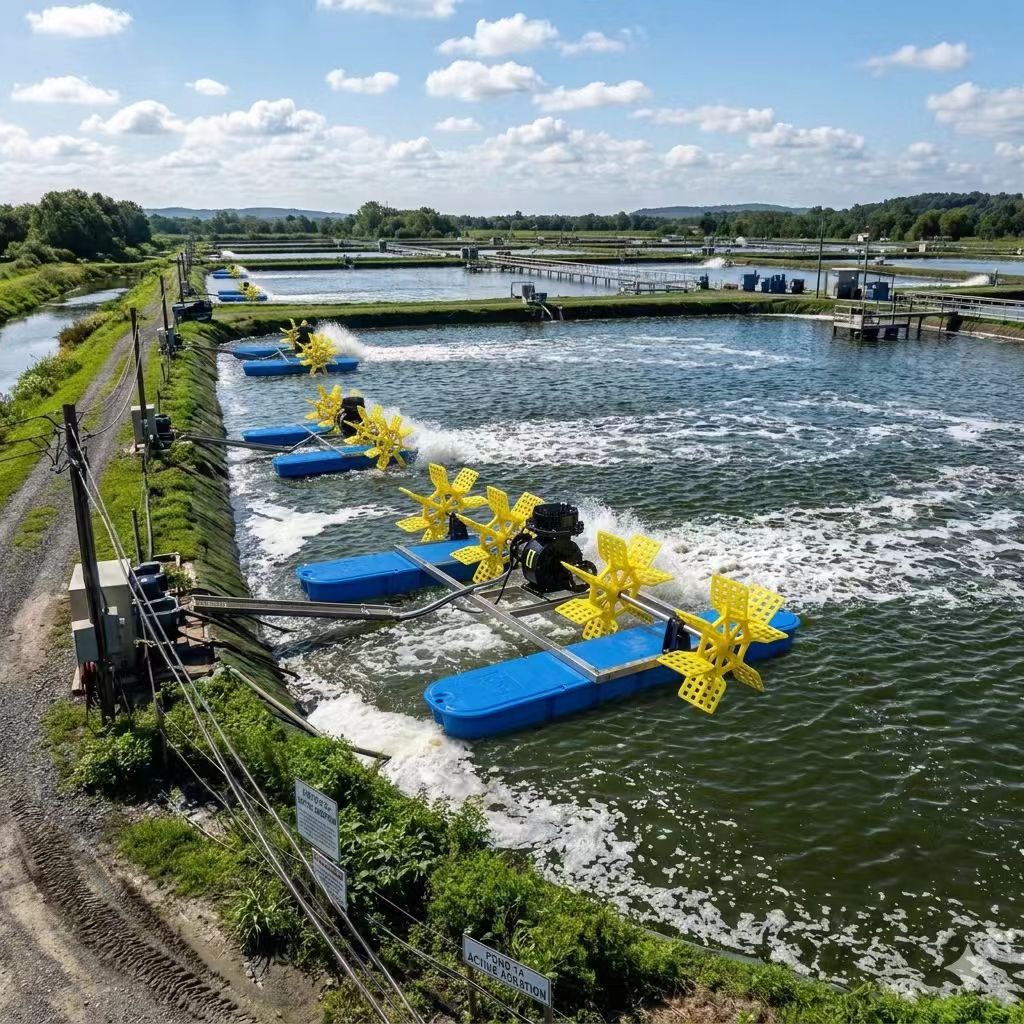
A variable frequency paddlewheel aerator deployed for continuous pond aeration in intensive aquaculture.
The selection of a specific model should follow the farm profile, not just farmer preference. Three common scenarios show how the SUNOLTA series maps to real operating conditions.
Small-Holder Ponds and Low-Density Fish Ponds
For ponds of 1 to 5 Mu (approximately 0.16 to 0.8 acre), the SNT-SC-0.75KW with two high-efficiency paddles is positioned as the entry unit. It is suited to smaller fish ponds and lower-density shrimp farms where the total oxygen demand is modest. In this segment, the buyer is often replacing an old aerator because of high electricity bills or frequent motor failures. The variable frequency drive still delivers the energy-saving benefit, but the capital outlay is lower than for the larger models.
Medium-Size Intensive Shrimp Ponds
The SNT-SC-1.5KW model is rated for 4 to 5 Mu (approximately 0.66 to 0.82 acre). It is designed for intensive shrimp farming and large fish ponds where stocking density is high enough to require stronger water flow. The four-paddle configuration provides wider aeration and stronger horizontal water movement than the two-paddle unit, which is important for circulating oxygen-rich surface water to deeper areas.
Large-Scale Commercial Aquaculture
For larger ponds of 5 to 7 Mu (approximately 0.82 to 1.15 acre), the SNT-SC-2.2KW with six paddles delivers the highest oxygenation capacity of the series at ≥ 3.2 kg/h. It is targeted at intensive shrimp farming and large commercial aquaculture operations. In very large farms, multiple units are typically installed around the pond perimeter so that aerated water circulation covers the entire water body.
Reference Case: A 50-Hectare Intensive Shrimp Farm
One documented reference involves a large-scale intensive shrimp farm in a Southeast Asian country, with operations in Vietnam, India, Indonesia, Thailand and Malaysia. The farm replaced more than 100 traditional aerators across a 50-hectare intensive shrimp farming site. Over three complete breeding cycles, approximately 1.5 to 2 years of operation, the farm reported zero gear maintenance and a 40% reduction in monthly electricity bills. The equipment operated in 24/7 continuous high-efficiency aeration mode. The key outcomes cited were permanent magnet motor energy savings, completely oil-free operation and the elimination of gearbox maintenance. This case illustrates how the technology behaves not in a test lab but in commercial-scale production.
Market Trend Analysis: Why the Industry Is Moving Toward VF Aeration
The broader market context supports the adoption of more efficient aeration equipment. The global aquaculture equipment market was valued at USD 22.55 billion in 2025 and is projected to reach USD 42.17 billion by 2034, according to Straits Research. This growth is driven partly by intensification of production, which increases demand for reliable aeration, water treatment and monitoring equipment.
Regional dynamics are even more visible. Industry monitoring data suggests that shipments of variable frequency aerators to Southeast Asia and South America grew by approximately 22% year-on-year in 2025, supported by intensive shrimp farming expansion. These are regions where water temperature, salinity and grid instability place heavy demands on equipment, so the shift to more robust electronic controls and corrosion-resistant materials is not surprising.
Buyers should interpret this trend carefully. The move toward variable frequency paddlewheel aerators is not purely a technology upgrade; it reflects a change in how farm economics are calculated. Electricity is often the second-largest operating cost after feed, and the 40% energy reduction potential of PMSM-based variable frequency systems changes the total cost of ownership equation for farms running aerators continuously. That economic logic is likely to become stronger as energy prices rise and as hatcheries and export-oriented shrimp farms face stricter sustainability requirements.
Comparison with Traditional Solutions: Gearbox-Driven vs Gearless Direct Drive
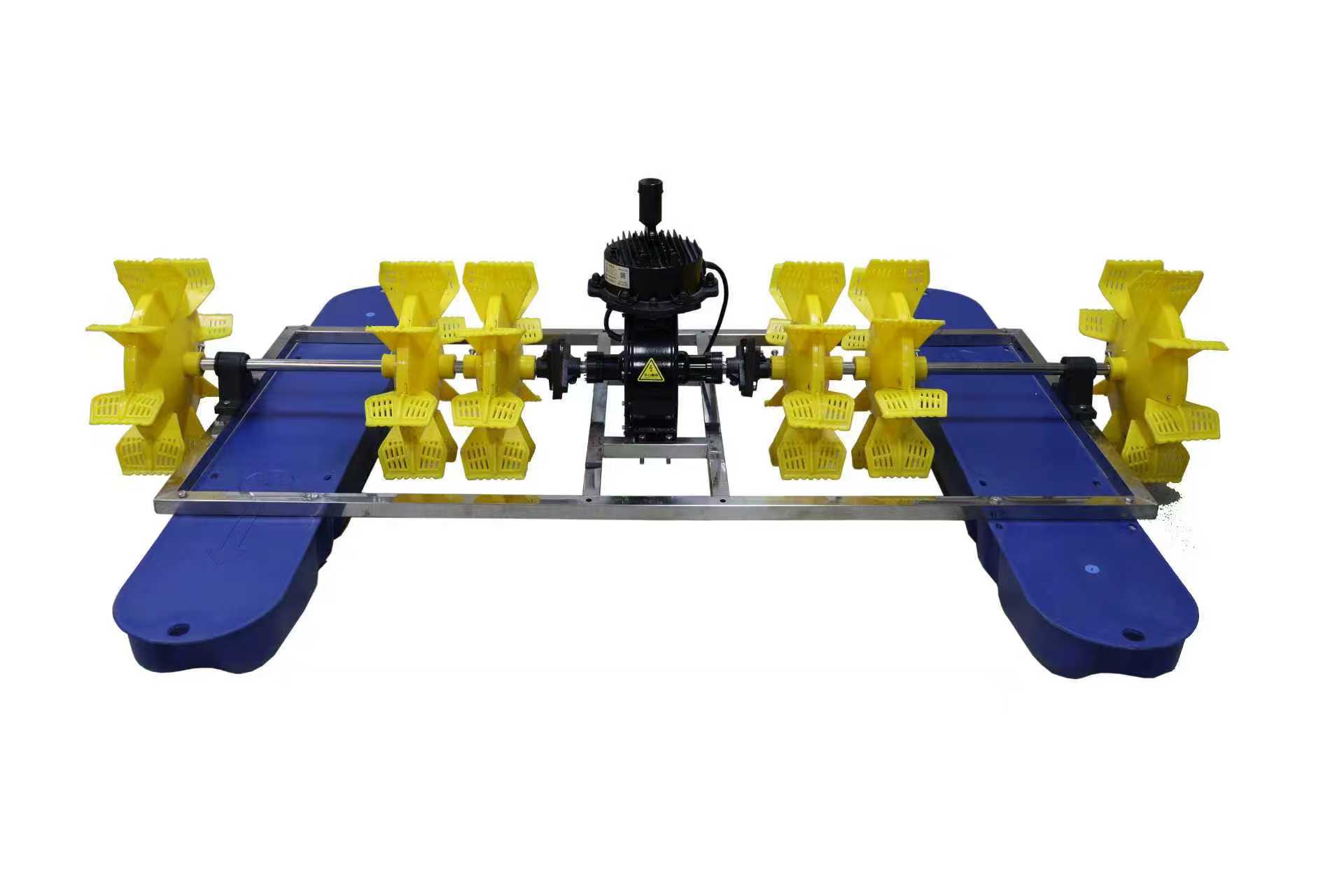
SUNOLTA SNT-SC-2.2KW six-impeller variable frequency paddlewheel aerator.
| Comparison Dimension | Traditional Gearbox-Driven Aerator | Gearless VF PMSM Paddlewheel Aerator |
|---|---|---|
| Motor drive | Induction motor with gearbox | Permanent magnet synchronous motor, direct drive |
| Oil pollution risk | Present — gear oil can leak | Zero — no gearbox, no oil |
| Maintenance requirement | Periodic gear oil change, seal and gear inspection | No gearbox maintenance; daily pond-side inspection still needed |
| Energy efficiency | Baseline | Up to 40% energy reduction reported in industry procurement reference data |
| Grid voltage tolerance | More sensitive to voltage dips and phase loss | Wide-voltage control capability with overload, phase-loss and short-circuit protection |
| Initial purchase cost | Typically lower | Higher upfront cost |
| Repair ecosystem | Commonly understood by local mechanics | Requires technician familiarity with inverter electronics |
No assessment is complete without acknowledging the boundaries of the comparison. A traditional gearbox-driven aerator remains a practical choice for farms with low electricity costs, limited capital and easy access to mechanical repair services. In such settings, the upfront cost difference can be difficult to justify, and the simpler mechanical structure of a conventional aerator may be an advantage. The VF PMSM system is most compelling when aeration runs continuously, energy costs are high, water quality protection is a priority and the farm has enough technical support to manage electronic controls. Buyers should therefore evaluate not only the aerator itself but also their own operating conditions.
Future Outlook: From Replacement Option to Standard Equipment
The evidence from both market data and operational cases suggests that variable frequency paddlewheel aerators are moving from a replacement option toward a standard specification in intensive aquaculture. The driving factors are stable: energy cost pressure, stricter environmental expectations around water pollution, and the need for equipment that can survive increasingly hostile pond environments.
The next stage of evolution is likely to be deeper integration with farm management systems. The same platforms that control variable frequency drives can connect to dissolved oxygen probes, remote monitoring dashboards and automated alarm systems. When a farm already relies on electronic control, adding monitoring sensors is a small incremental step. Over the next replacement cycle, buyers in high-density shrimp farming regions will probably treat variable frequency operation and gearless construction as baseline requirements rather than optional upgrades.
For a complete overview of SUNOLTA's aquaculture equipment lineup and company background, readers can download the corporate brochure: https://cdn.socialarks.com/sbsp/24586/0/2026/0410/69d858508385f.pdf
Frequently Asked Questions
What size pond is a variable frequency paddlewheel aerator designed for in high-density shrimp farming?
The SUNOLTA variable frequency paddlewheel aerator series maps to specific pond sizes. The SNT-SC-0.75KW is positioned for 1–5 Mu (approximately 0.16–0.8 acre), the SNT-SC-1.5KW for 4–5 Mu (approximately 0.66–0.82 acre), and the SNT-SC-2.2KW for 5–7 Mu (approximately 0.82–1.15 acre). In practice, pond depth, stocking density and water temperature also affect oxygen demand, so these figures are intended as starting points rather than absolute limits. High-density shrimp farms often combine multiple units per pond to ensure complete water circulation.
Can a variable frequency paddlewheel aerator work in saltwater and brackish water?
The equipment was designed for use in saline and brackish water environments, not only freshwater ponds. The construction addresses corrosion directly: the frame is made of extra-long 304 stainless steel and the floats are heavy-duty PE. Buyers sourcing for coastal farms should still verify the material grade of all submerged components, including bolts and drive shaft, because corrosion resistance depends on the complete assembly rather than the frame alone.
How much energy can an energy-saving variable frequency paddlewheel aerator actually save?
Industry procurement reference data indicates that variable frequency aerators using permanent magnet synchronous motor technology can reduce energy consumption by up to 40% compared with traditional induction-motor units with gearboxes. The savings come from two mechanisms: higher motor efficiency and speed adjustment according to real-time dissolved oxygen demand. In a documented 50-hectare shrimp farm case, the operator reported a 40% reduction in monthly electricity bills after replacing traditional aerators with the VF PMSM system.
What does a gearless maintenance-free paddlewheel aerator mean in daily farm use?
Gearless means the permanent magnet motor drives the impeller directly, with no gearbox between the motor and the paddle shaft. This removes the need for gear oil changes, seal replacements and gearbox overhaul. In the reference case, the farm reported zero gear maintenance over multiple breeding cycles. Daily pond-side checks of cables, floats and impellers are still necessary, and the motor housing should not be considered completely maintenance-free in all aspects.
What is the role of IPX7 submersible waterproofing in a pond aerator?
IPX7 is an ingress protection rating indicating that the device can withstand temporary full immersion in water. The application specification for this equipment calls for IPX7 structural waterproofing that can survive full submersion up to 300 hours. This matters in tropical farms where heavy rain, pond overflow and accidental submersion are realistic events. It does not mean the aerator is intended to operate underwater constantly, but it provides an important margin of safety against water damage.
Why are 304 stainless steel frames and anti-corrosion PE floats important for coastal ponds?
Salt air and saline water corrode ordinary steel frames quickly, which shortens equipment life and increases structural failure risk. A 304 stainless steel frame resists rust in brackish and saltwater conditions, while heavy-duty PE floats maintain buoyancy and resist UV damage better than lower-grade plastics. For farms in coastal Southeast Asia or other saltwater regions, frame and float material specifications can be as important as motor power.
How does wide-voltage smart control help when the farm electricity grid is unstable?
Rural aquaculture areas often suffer from voltage fluctuation. The equipment application requirements include wide-voltage compatibility of 150V–250V for single-phase and 230V–430V for three-phase, with overload, phase-loss and short-circuit auto-protection. For the 380V three-phase paddlewheel models, this means the drive can tolerate voltage swings commonly seen in rural distribution networks without immediately shutting down or burning the motor. Farms relying on single-phase supply should confirm the specific model's voltage configuration with the supplier before purchasing.
What certifications are relevant for a variable frequency paddlewheel aerator?
Certification requirements vary by target market. For the Chinese domestic market, the SUNOLTA 2.2KW variable frequency paddlewheel aerator has obtained a national CAMTA agricultural promotion certificate, number T202332320296, valid until 2028, issued by the Jiangsu Provincial Agricultural Machinery Testing Station. Buyers exporting to Europe or other regulated markets should request the relevant conformity documentation, such as CE, as part of the contract rather than relying on general marketing claims. Certification evidence should always match the specific model under evaluation.