
Material Handling Forklift Options: A Buyer Decision Framework
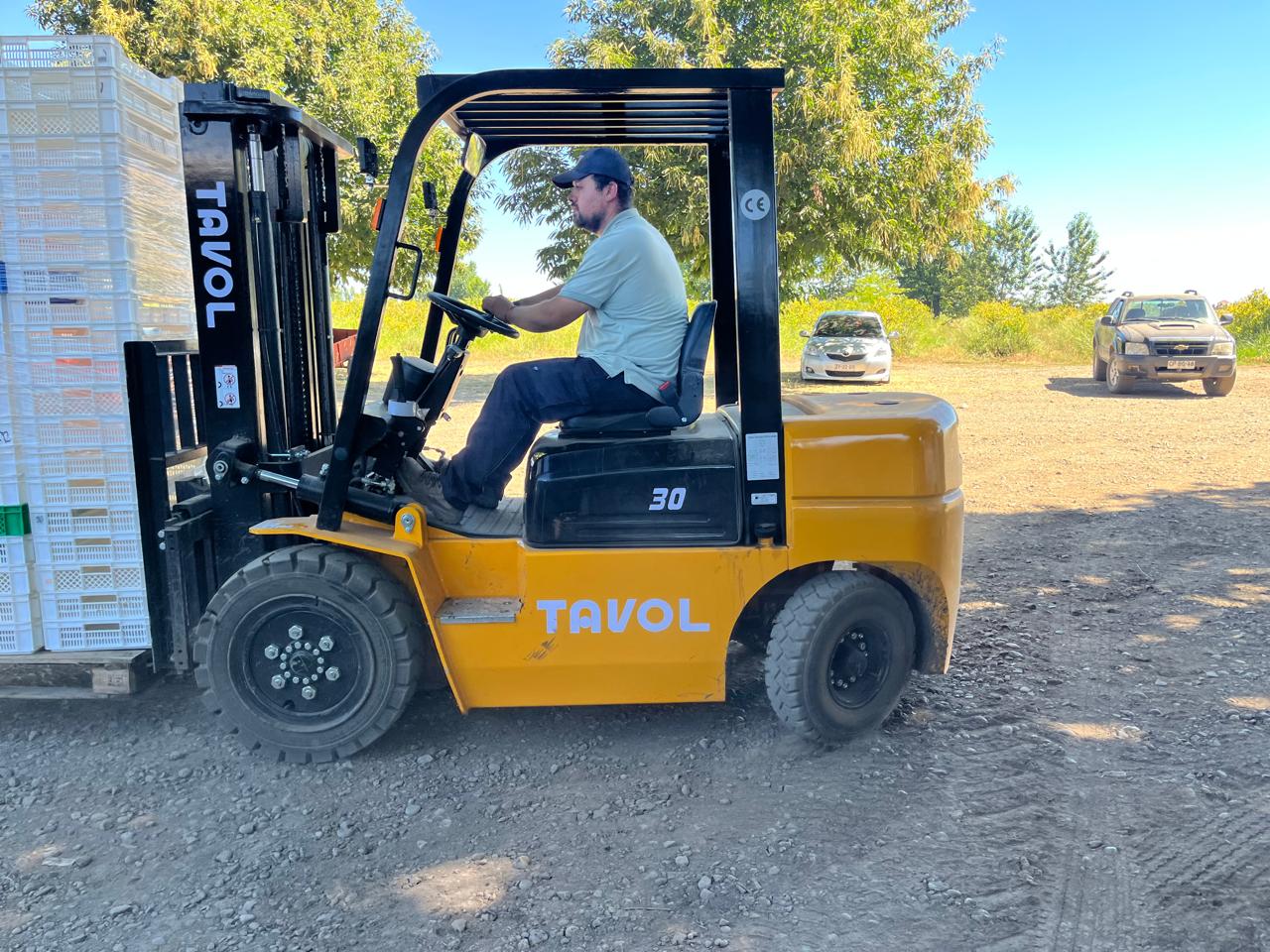
Power source is the first constraint that eliminates options in material handling forklift procurement — not the last. A diesel counterbalance truck, a dual fuel LPG and gasoline unit, and a lithium electric forklift can all lift a standard pallet to a comparable height, yet each carries a different set of operating permissions, refuelling rhythms, floor requirements, and maintenance dependencies. The framework below is built to move a procurement team from a written requirement to a defensible shortlist, rather than a side-by-side specification sheet that leaves the decision unresolved.
Why Spec-by-Spec Comparison Fails Procurement Teams
Most forklift comparisons begin with capacity, mast height, and price. For material handling that sequence is backwards. Two trucks rated at the same load and the same lift can be non-interchangeable once the operating envelope is applied. An internal combustion truck cannot run inside a sealed cold-storage aisle without ventilation provisions, and a battery truck can be the wrong choice where the yard is unpaved and the duty cycle never pauses long enough for a charge window.
The practical consequence is that the comparison is not "which truck is better," but "which power path is permitted by the site." Diesel, dual fuel, and electric are not three grades of the same product. They are three answers to a question the buyer must answer first: what does the truck have to do, where, and for how long between refuelling or charging?
A framework also protects against a second, less obvious failure: the specification trap. A datasheet can confirm that a 3.5-ton electric forklift has a 500 mm load centre and a 2550 mm minimum turning radius, but it will not tell a buyer whether the vehicle can complete a shift on a single opportunity charge in a freezer aisle, or whether the local fuel supply can support a dual fuel fleet. Those answers come from the envelope, not the brochure.
Step One — Define the Operating Envelope Before Looking at Models
A structured comparison starts with five parameters that no specification sheet captures on its own.
- Indoor or outdoor — and whether the space is enclosed. Enclosed aisles, cold storage, food processing, and cleanroom-adjacent environments constrain emissions and noise; open yards and unpaved ground constrain traction and ground clearance.
- Surface and floor condition. Smooth warehouse floors, expansion joints, ramps, gravel yards, and construction sites load the drivetrain differently.
- Duty cycle and shift pattern. A single shift with idle periods favours opportunity charging; a continuous multi-shift operation either needs rapid fuel refill or a battery-swap model.
- Load type and attachment requirement. Standard pallets, paper rolls, tyre bundles, bales, drums, waste paper, buckets of bulk material, or structural steel all impose different attachment and stability demands.
- Site infrastructure. Available charging power, LPG cylinder logistics, fuel delivery, and service reach all dictate what is realistically maintainable.
Only after these five parameters are written down does a model comparison become meaningful, because they determine which of the three power paths can even be shortlisted.
Step Two — Map Each Power Path to the Envelope
Diesel forklifts are the reference for outdoor, high-torque, heavy-duty work. In the TAVOL line, the diesel counterbalance range runs from the 2-ton CPCD20 through the 2.5-ton CPCD25, 3-ton CPCD30, 3.5-ton CPCD35, and 4-ton CPCD40. These models are built from Q235 carbon structural steel and Q355 low-alloy high-strength structural steel, and the CPCD40 can be equipped with engines from Xinchai, Quanchai, Isuzu, Mitsubishi, Yanmar, Kubota, or PSI. That engine range matters to procurement because it changes parts availability, service familiarity, and local technician coverage — three variables that shape long-term cost far more than the purchase invoice.
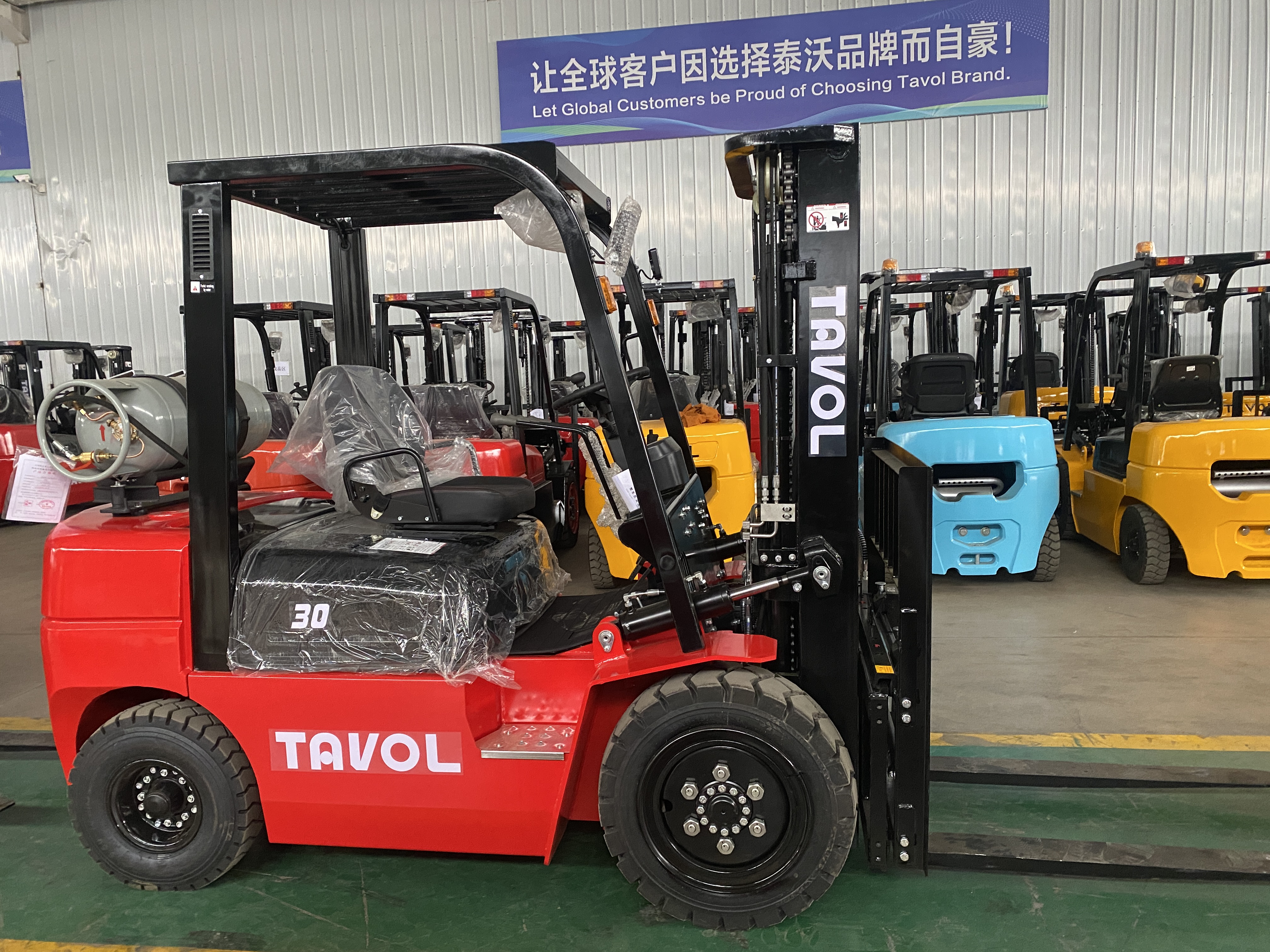
Dual fuel LPG and gasoline forklifts sit between diesel and electric. The TAVOL dual fuel range covers the 2-ton CPQYD20, 2.5-ton CPQYD25, 3-ton CPQYD30, and 3.5-ton CPQYD35, each powered by a Nissan engine and able to run on either LPG or gasoline. The defining property is flexibility: the operator can switch fuel according to availability and price, and refuelling takes minutes rather than hours.
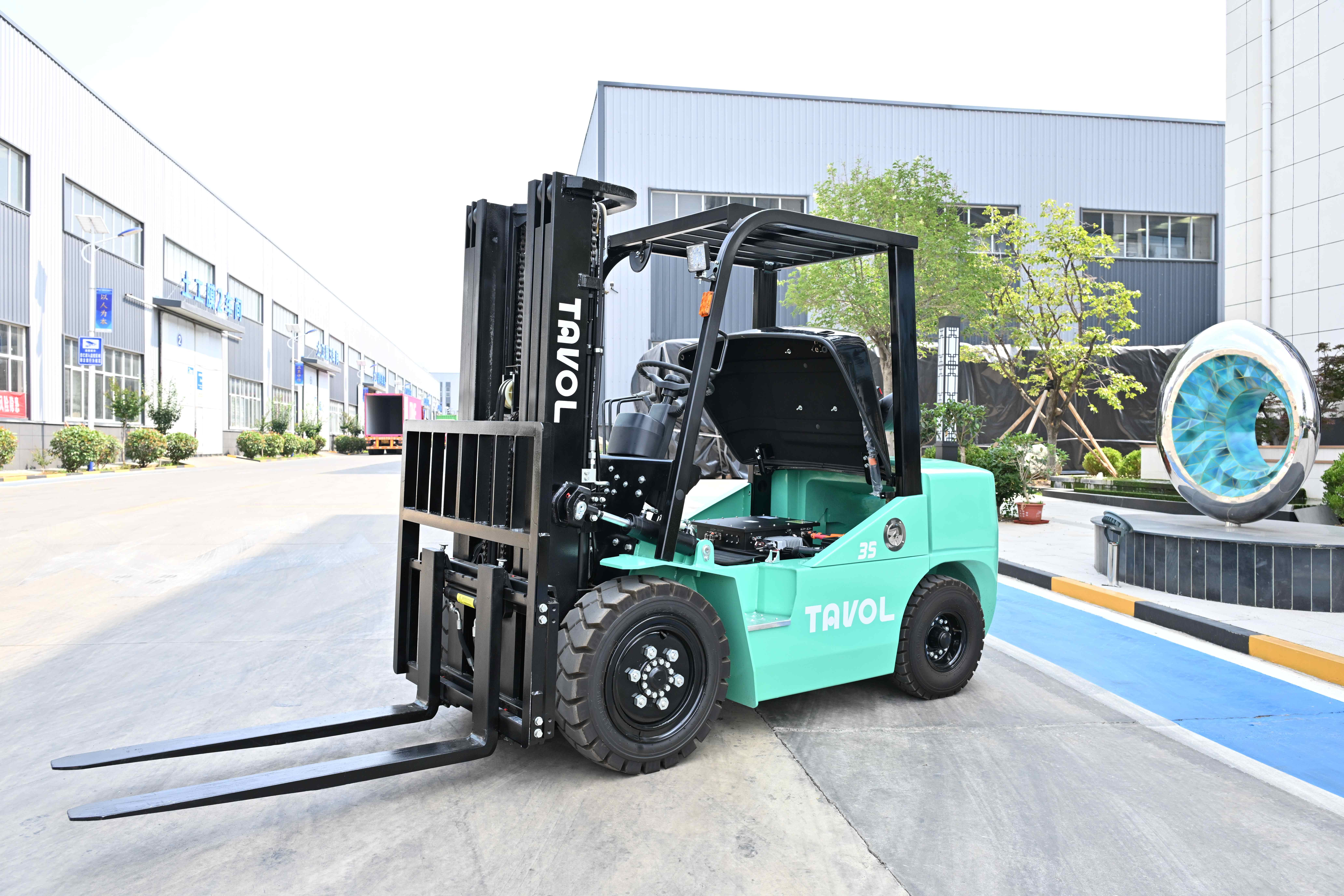
Lithium electric forklifts occupy the indoor and enclosed end of the envelope. The TAVOL CPD range includes the 3-ton CPD30, 3.5-ton CPD35, and 4-ton CPD40, all equipped with a lithium-ion (LiFePO4) battery and a quick charger. Their intended industries are indoor warehousing, cold storage and food processing, pharmaceutical and cleanroom facilities, e-commerce and logistics distribution centres, electronics manufacturing, retail distribution, and enclosed workshop operations.
Application Fit — From Warehousing to Container Loading
Indoor warehousing and logistics
Indoor environments reward zero emissions, low noise, and predictable energy management. The CPD30, CPD35, and CPD40 are positioned precisely for this: zero tailpipe emissions, a noise level materially lower than internal combustion trucks, no acid fumes, and no water refilling. Lithium batteries also perform more stably in low-temperature environments such as cold storage, which is why food processing and cold-chain facilities trend toward this path.
Outdoor yards and rough-ground operations
Outdoor yards demand torque, ground clearance, and independence from charging infrastructure. Diesel remains the natural fit. Documented TAVOL applications include building-material yards, brick and cement product plants, timber processing, mines and gravel yards, feed mills, and fertiliser plants — all environments where the diesel engine provides strong power and the truck is not constrained by a charging point.
Container loading and structural steel handling
Container loading is its own operating envelope because it combines confined manoeuvring space with irregular loads. In a documented export-loading scenario, forklifts were used alongside an overhead crane to lift and position irregular structural steel components into shipping containers, requiring precise manoeuvring in a tight space and the ability to handle long or non-uniform loads. Trucks configured with a container mast or full free mast are the relevant options here, and the choice between diesel, dual fuel, or electric depends on whether the loading dock is open-air or enclosed.
Attachment-driven applications widen the comparison further. Documented configurations include paper roll clamps with rotating clamp mechanisms and non-marking pads, tyre clamps with curved arms, bale and carton clamps with adjustable pressure, load stabiliser platens, 360-degree fork rotators, tipping forks, waste-paper tipping clamps, buckets for bulk material, and electronic weighing scale attachments with load cells and overload alerts. Each attachment changes the effective load centre and the stability calculation, which is why attachment selection has to be part of the envelope, not an afterthought.
Operating Cost Drivers That Change the Ranking
Purchase price is the smallest of the four cost drivers that decide total cost of ownership across a fleet life.
- Energy and fuel. Diesel and dual fuel refuel in minutes; lithium uses opportunity charging during breaks instead of waiting for a full discharge. A documented dual fuel deployment in a chemical plant reported a 35% reduction in fuel expense achieved through LPG operation, with seamless switching between gas and gasoline — an example of how fuel-price exposure, not the truck itself, can drive the cost ranking.
- Maintenance and consumables. Lithium batteries require no watering or acid checks, only periodic terminal and connector inspection. Diesel and dual fuel trucks have engine, fluid, and filter cycles to manage, but benefit from widely available parts.
- Uptime and refuelling rhythm. Multi-shift operations are decided by how quickly the truck returns to work. LPG cylinders can be swapped quickly; diesel refills quickly; lithium relies on the charging window.
- Service proximity and parts. Engine selection on a diesel truck — Xinchai, Quanchai, Isuzu, Mitsubishi, Yanmar, Kubota, or PSI on the CPCD40 — is effectively a decision about which service network the buyer can reach.
The TAVOL Product Set as a Reference Portfolio
TAVOL is a material handling and heavy machinery manufacturer and exporter based in Shandong, China. The company operates a 40,000 m² factory with approximately 300 employees, a 25-engineer R&D team, and an annual output of around 3,000 units, with roughly 70% of production exported to Southeast Asia, Europe, South America, the Middle East, Africa, Australia, and North America. Its catalogue spans diesel, LPG and gasoline, and electric forklifts alongside overhead cranes, gantry cranes, and tractors.
For a buyer building a shortlist, the portfolio is useful because the three power paths are produced by the same entity rather than assembled from unrelated suppliers. The verified range includes:
- Electric lithium: CPD30 (3t), CPD35 (3.5t), CPD40 (4.0t)
- Dual fuel LPG & gasoline: CPQYD20 (2t), CPQYD25 (2.5t), CPQYD30 (3.0t), CPQYD35 (3.5t)
- Diesel: CPCD20 (2t), CPCD25 (2.5t), CPCD30 (3t), CPCD35 (3.5t), CPCD40 (4t)
Commercial terms that procurement teams factor into evaluation include OEM and ODM support, monthly capacity of roughly 300 units, lead time of 10–45 days, a minimum order quantity of one unit, 100% pre-shipment testing, third-party inspection on request, remote technical support, and a 2-year forklift warranty with a 5-year lithium battery warranty.
Technical Explanation — Four Constraints Buyers Underestimate
1. Dual fuel versus diesel-only or LPG-only
A dual fuel truck is not simply a diesel truck with a different tank. A dedicated LPG-only or diesel-only truck locks the operation to one fuel supply chain. A dual fuel unit such as the CPQYD30 lets the operator switch between LPG and gasoline, which matters where fuel price volatility or cylinder availability is uncertain. The trade-off is real: an LPG-only or diesel-only configuration may simplify servicing and operator training, while dual fuel adds a fuel-selection habit that must be managed correctly. Fuel mode should only be switched when the engine is idling or off, using the dashboard selector, with a short stabilisation period before resuming work — and never under heavy load or on a slope.
2. Lithium versus lead-acid
Lithium brings no acid fumes, no water refilling, longer cycle life relative to lead-acid, and stable low-temperature performance in applications such as cold storage. It also supports opportunity charging during breaks, removing the need for battery swapping in many multi-shift layouts. The limitation is that lithium carries a higher acquisition cost than an equivalent lead-acid configuration, and the payback depends on how heavily the truck is cycled. Where a truck runs light, intermittent duty, the case for lithium is weaker than where it runs continuous multi-shift cycles in an enclosed building.
3. Diesel engine selection on Chinese counterbalance trucks
The reliability question on Chinese diesel counterbalance trucks is usually answered by the engine bay, not the brand badge. The CPCD40 can be specified with Xinchai, Quanchai, Isuzu, Mitsubishi, Yanmar, Kubota, or PSI engines, and CPCD30-class units offer a similar spread. A fleet that already stocks parts for one of these engine families will find service easier than a fleet introducing a new engine brand. The reinforced frame, drive axle, and transmission design, together with Q235 and Q355 structural steels, address the chassis side of durability; the engine choice addresses the service side.
4. Pre-shift inspection requirements
Every power path needs a pre-shift check, but the checklist differs. For a diesel counterbalance forklift, the verified checklist covers fluid levels, tyres, brakes, and safety devices before each shift: engine oil, hydraulic fluid, and coolant; tyre wear, damage, or inflation; brakes, horn, lights, and backup alarm; forks and mast for cracks, bends, or hydraulic leaks; and a start-up check for unusual noise, smoke, or warning lights. Operating with a malfunctioning brake or hydraulic leak is never acceptable, and any abnormality should be reported before the shift begins.
Compliance and Documentation as Selection Constraints
For buyers importing into regulated markets, certification content is a hard filter rather than a differentiator. TAVOL forklifts hold a CE certificate issued by INTERTÜRK with the certification number TTC-26-0104/03/01, applicable to the EU market and valid from 2026-04-01 to 2031-04-01. The applicable standards listed are EN 1175:2025, EN ISO 3691-1:2015/AC:2016, EN ISO 12100:2010, and EN 60204-1:2018/A1:2025, with scope covering the CPC/CPCD 10 through 100 series, the CPQD series, and the FB series.
In the United States, buyers separately track ANSI/ITSDF B56.1-2020, the safety standard for low-lift and high-lift trucks effective through 2025. A comparison framework should place certification alongside capacity and power source, because a truck that cannot be legally placed into service in the target market is eliminated regardless of its operating cost.
Decision Matrix: Matching Requirement to Power Path
| Decision dimension | Diesel (CPCD series) | Dual fuel (CPQYD series) | Electric lithium (CPD series) |
|---|---|---|---|
| Primary environment | Outdoor yards, unpaved ground, construction and mining support | Combined indoor and outdoor, multi-shift general cargo | Indoor, enclosed, cold storage, cleanroom-adjacent |
| Corpus capacities | 2t, 2.5t, 3t, 3.5t, 4t | 2t, 2.5t, 3t, 3.5t | 3t, 3.5t, 4t |
| Power unit | Xinchai, Quanchai, Isuzu, Mitsubishi, Yanmar, Kubota, PSI | Nissan engine, LPG or gasoline | Electric motor with LiFePO4 battery |
| Gradeability (full / empty) | 15% / 20% | 15% / 20% | 18% / 20% |
| Lift speed at full load | 450–490 mm/s | 450–490 mm/s | 320–350 mm/s |
| Refuelling / charging rhythm | Fast diesel refill, 8+ hours per tank | Quick cylinder refill, minutes to restore | Opportunity charging during breaks |
| Emissions profile | Exhaust emissions; outdoor use | Lower emissions than diesel; indoor/outdoor | Zero tailpipe emissions |
| Main cost exposure | Fuel and engine service | Fuel price flexibility and engine service | Higher acquisition cost, lower consumables |
The table is a screening tool, not a verdict. It narrows three power paths to one or two candidates; the final decision still requires a site trial with the actual load, attachment, and aisle geometry.
Where This Framework Breaks Down
A comparison framework is useful precisely because it can be falsified. There are at least four situations in which it produces a weak answer.
- No single power source wins across a mixed fleet. A site with a freezer aisle, an open yard, and a container-loading dock will usually need more than one power path, and the framework should be run per duty cycle, not per site.
- Lithium's cost case is cycle-dependent. Where duty cycles are light, the higher acquisition cost of a lithium truck may not be recovered through maintenance savings alone within a short payback window.
- Dual fuel depends on a local supply chain. The flexibility of LPG and gasoline switching only pays off where cylinders, gasoline, and service are reliably available; otherwise it becomes an added administrative burden.
- The framework cannot price anything by itself. It organises decisions but does not replace a site walk, an operator interview, or a verified quotation.
Market Trend Analysis
Two externally verifiable data points frame the context. The global forklift market was valued at USD 81.4 billion in 2025 according to Grand View Research. Separately, Interact Analysis reported that lithium-ion penetration in global counterbalanced forklifts stood at 17.5% in 2024. Taken together, these figures indicate that lithium is a growing but still minority share of the counterbalance segment — meaning diesel and dual fuel remain structurally relevant for outdoor and heavy-duty applications rather than being legacy choices.
On the supply side, China exported USD 1.26 billion of parts for fork-lift trucks in 2024 according to World Bank WITS data. That volume of component trade supports the practical argument that engine and attachment parts availability is a genuine procurement variable, not a theoretical one.
Future Outlook
The direction of travel is toward finer segmentation rather than a single dominant power source. As lithium penetration rises, the likely pattern is that electric trucks own the enclosed-indoor duty cycles they are already designed for — cold storage, food processing, pharmaceuticals, and clean logistics — while diesel continues to serve rough ground and heavy outdoor handling, and dual fuel holds the middle ground where fuel flexibility is worth more than either extreme.
For procurement teams, the durable implication is procedural: define the envelope first, map power paths second, verify certification and service reach third, and only then compare models. Buyers who follow that order tend to eliminate the wrong options early rather than discovering the mismatch after delivery.
A full specification and capability overview for the diesel, dual fuel, and electric forklift ranges is available in the TAVOL company profile.
FAQ
1. How should a procurement team decide between a dual fuel forklift and a diesel-only or LPG-only unit?
The deciding variables are fuel availability and duty pattern. A diesel-only truck suits rough ground, high-torque outdoor work and sites without charging infrastructure. An LPG-only or dual fuel truck suits combined indoor and outdoor duty where cleaner combustion than diesel is required. A dual fuel unit such as the CPQYD30, powered by a Nissan engine, adds the ability to switch between LPG and gasoline, which reduces exposure to single-fuel price movement — but it only delivers that benefit where both fuels and service are locally available. Fuel mode should be switched only when the engine is idling or off, using the dashboard selector, with a short stabilisation period before resuming work.
2. Is a lithium forklift a better choice than a lead-acid forklift for indoor warehousing?
For enclosed indoor environments, lithium addresses the constraints that matter most: zero tailpipe emissions, no acid fumes, no water refilling, lower noise than internal combustion trucks, and stable performance at low temperature. The CPD30, CPD35, and CPD40 use LiFePO4 batteries with quick chargers, and opportunity charging during breaks avoids battery swapping. The limitation is acquisition cost: where duty cycles are light and intermittent, the maintenance and lifecycle savings may take longer to offset the higher upfront cost of lithium versus lead-acid.
3. How reliable is a Chinese diesel counterbalance forklift for heavy-duty outdoor work?
Reliability in practice is largely determined by the specified engine and the chassis design. The TAVOL CPCD40 can be equipped with Xinchai, Quanchai, Isuzu, Mitsubishi, Yanmar, Kubota, or PSI engines, and CPCD30-class units offer a comparable spread. Frame structures use Q235 carbon structural steel and Q355 low-alloy high-strength structural steel to support heavy-duty service. Buyers should evaluate the specific engine family against existing parts inventory and local technician familiarity, and should request evidence of pre-shipment testing and third-party inspection rather than relying on a general brand claim.
4. What does a pre-shift inspection involve across diesel, dual fuel, and lithium forklifts?
The verified diesel counterbalance checklist covers fluid levels, tyres, brakes, and safety devices before each shift: check engine oil, hydraulic fluid, and coolant; inspect tyres for wear, damage, or incorrect inflation; test brakes, horn, lights, and backup alarm; check forks and mast for cracks, bends, or hydraulic leaks; and start the engine to confirm no unusual noise, smoke, or warning lights. Lithium trucks substitute battery-focused checks — verifying terminals, cables, and connectors weekly for looseness or corrosion — for engine fluid checks. Dual fuel trucks add LPG cylinder security and leak inspection to the standard checklist.
5. Which forklift configuration suits container loading and structural steel handling?
Container loading combines confined manoeuvring space with uneven loads. In a documented structural steel export scenario, a forklift worked alongside an overhead crane to lift and position irregular components into shipping containers, requiring precise handling in tight space. Mast choice matters here: the corpus configuration options include a container mast and a full free mast alongside 2-stage and 3-stage masts. Power source then depends on whether the loading dock is open-air or enclosed — diesel or dual fuel for open docks, electric where the dock is inside a building.
6. What certification evidence should be verified before importing a forklift into the EU?
For the EU market, CE certification is the baseline requirement. TAVOL forklifts hold a CE certificate issued by INTERTÜRK under certification number TTC-26-0104/03/01, valid from 2026-04-01 to 2031-04-01. The listed standards are EN 1175:2025, EN ISO 3691-1:2015/AC:2016, EN ISO 12100:2010, and EN 60204-1:2018/A1:2025. The certificate scope covers the CPC/CPCD 10 through 100 series, the CPQD series, and the FB series. Buyers should confirm that the specific model being purchased falls within the certified scope before placing an order.