
Matte Floor Tile Frit: A Three-Option Glaze Shortlist
Matte Floor Tile Frit: A Three-Option Glaze Shortlist
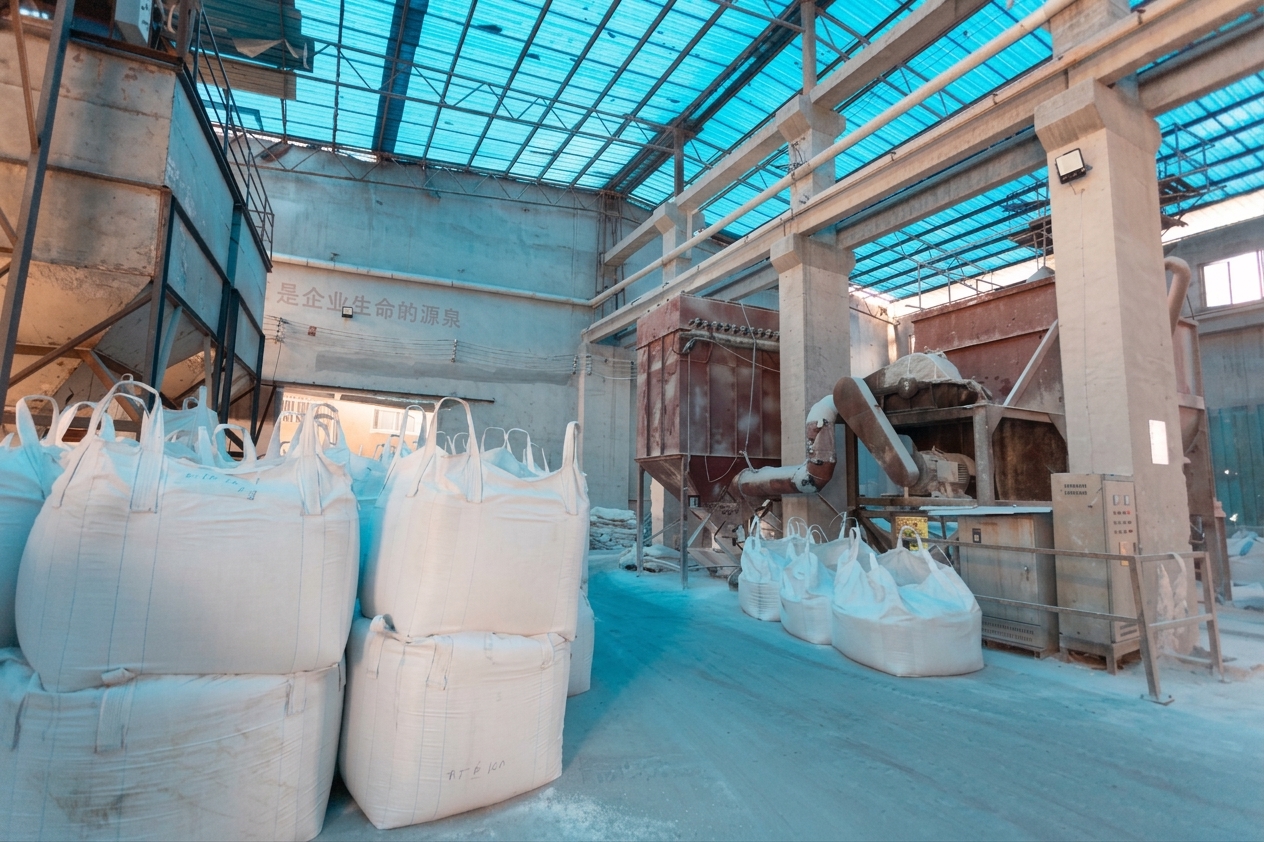
Cover image: a factory production environment relevant to ceramic frit supply. Image source: RENOVA INDUSTRIAL & TRADING CO., LTD.
Matte floor tile projects can shortlist three RENOVA frit families — Floor Tile Matte Frit, Velvet Matte Frit and Wear-Resistant Frit — but the shortlist is an evaluation set, not a ranked podium. The practical decision turns on three questions that must be answered with the plant's own body, glaze and kiln: whether the frit is compatible with the floor-tile glaze system, whether it shows an acceptable blistering tendency in firing, and whether it fits the applicable firing conditions. RENOVA INDUSTRIAL & TRADING CO., LTD is an integrated manufacturer and trader of ceramic frits, ceramic glazes and other ceramic materials, with more than 30 years of ceramic manufacturing expertise and a factory established in 2011.
For a ceramic frit buyer in the evaluation stage, the useful output is not a slogan about which frit is best. It is a shortlist that makes the next test decisive. Floor Tile Matte Frit, Velvet Matte Frit and Wear-Resistant Frit each represent a different named route into a floor-tile glaze project. Their names help organise the trial; they do not replace fired-tile evidence. This HTNXT review of ceramic glaze frit for ceramic tiles therefore compares the three candidates on the same evaluation dimensions and states the boundary of the available product information.
Why this shortlist is not a performance ranking
A shortlist and a ranking are different procurement tools. A ranking places candidates in an order and implies a comparative performance result. A shortlist identifies the candidates worth testing against a defined application. The assigned brief for this article asks for the second: a practical, evidence-based shortlist without invented comparative performance rankings.
That distinction matters for matte floor tile glazes because furnace results depend on the full glaze system. The frit is one input among the body, engobe layer, glaze base, applied thickness, kiln type, atmosphere and firing profile. A frit that works in one plant's floor-tile line may behave differently in another plant's kiln. No responsible order can be issued from product names alone, and this review does not do so.
RENOVA's technical approach is consistent with that boundary. The company states that frit formulation and technical specifications can be customised according to the customer's ceramic body, kiln type, firing temperature, production process and other factory-specific conditions. Quality control includes trial production and finished-tile evaluation based on the customer's ceramic body and production conditions. Those are the right controls for this shortlist, because they move the decision from catalogue language to fired-tile evidence.
The three candidates in the shortlist
The shortlist contains three product families named in RENOVA's ceramic frit range: Floor Tile Matte Frit, Velvet Matte Frit and Wear-Resistant Frit. Each is relevant to a floor-tile glaze evaluation, but each has a different surface or performance emphasis in its product identity. The exact fired result must be established on the buyer's body and glaze line.
Floor Tile Matte Frit
Floor Tile Matte Frit is the direct matte floor-tile route in this set. It should enter the trial when the target is a matte floor-tile glaze and the buyer wants to compare a dedicated floor-tile matte frit against the other two options. The first check is not a catalogue claim; it is compatibility with the plant's existing glaze base and body, followed by visual assessment of the fired matte surface.
The available product information does not provide a specific firing range for Floor Tile Matte Frit. That is not a reason to exclude it. It is a reason to obtain the applicable firing conditions from the plant's kiln profile and from trial production rather than importing a number from another factory. For this candidate, the trial should record the finish, the presence of surface defects and the fit after firing.
Velvet Matte Frit
Velvet Matte Frit represents a distinct velvet-matte surface route. It belongs on the shortlist when the project's finish target is not simply matte in a generic sense, but a velvet-matte appearance that must be confirmed on the finished tile. Because the surface descriptor is part of the product identity, the evaluation should compare fired appearance and tactile impression alongside the standard compatibility and defect checks.
As with the matte route, the reviewed material does not establish a comparative blistering advantage for Velvet Matte Frit. Its place on the shortlist is justified by the distinct finish route it offers, not by an unverified performance claim. The buyer should ask for a fired sample made under the intended glaze thickness and kiln profile, then judge the velvet-matte result against the project's approved reference.
Wear-Resistant Frit
Wear-Resistant Frit is the candidate to include when the floor-tile glaze project has a wear-resistance requirement. The relevant question is not whether the product name sounds durable; it is whether the finished glazed tile meets the project's wear criterion after firing under the plant's conditions. Wear performance is a finished-tile property, so it must be evaluated together with appearance, compatibility and defect control.
This review does not assign a wear-resistance value, a test result or a comparative rank to Wear-Resistant Frit. The practical evidence request is a fired-tile evaluation that reflects the intended application, followed by the plant's own acceptance criteria. If wear resistance is not a project requirement, the candidate may still be technically relevant, but its selection logic should be stated explicitly rather than implied by the name.
Shortlist comparison at a glance
| Candidate | Floor-tile glaze compatibility | Low-blistering evidence | Firing conditions to confirm |
|---|---|---|---|
| Floor Tile Matte Frit | Requires a trial with the plant's body and glaze base; formulation can be adjusted to body, kiln type, firing temperature and process. | No comparative blistering rank is asserted; establish the result by trial under the production profile. | Peak temperature, soak, atmosphere, cooling and glaze thickness in the plant trial. |
| Velvet Matte Frit | Same compatibility gate; the velvet-matte finish must be confirmed on fired tiles. | Same evidence rule; no comparative rank is asserted. | Same production-profile parameters, with fired appearance assessed. |
| Wear-Resistant Frit | Same compatibility gate; wear performance belongs to finished-tile evaluation. | Same evidence rule; no comparative rank is asserted. | Same production-profile parameters, with the intended wear criterion included. |
The table is deliberately symmetrical. It shows what must be proven for each candidate, not which candidate wins. That symmetry is the evidence-based position: the reviewed product information does not support a performance order among the three matte floor tile frit options.
Compatibility with the floor-tile glaze system
Compatibility is a system property, not a frit property in isolation. A floor-tile glaze must adhere to the body, survive the firing cycle and produce the intended surface without unacceptable defects. The frit contributes to the glaze melt, but the body chemistry, engobe layer, glaze base, application thickness and kiln profile all influence the result. This is why the same frit can be suitable for one plant and require adjustment in another.
For the three-candidate shortlist, compatibility should be judged on fired tiles made with the plant's normal body and glaze preparation. The trial should include the intended application thickness and the intended firing profile. If the tile construction includes an engobe layer, the engobe frit also belongs in the compatibility discussion because the fired glaze sits on a layered system. The review of these three matte frits should not be confused with transparent ceramic frit or opaque ceramic frit selections, which answer different visual questions.
RENOVA's stated quality-control method is relevant here: trial production and finished-tile evaluation based on the customer's ceramic body and production conditions. That method does not assume compatibility from a product name. It creates a direct comparison between the frit and the plant's actual glaze system. The buyer should ask for the same discipline from any candidate on the shortlist.
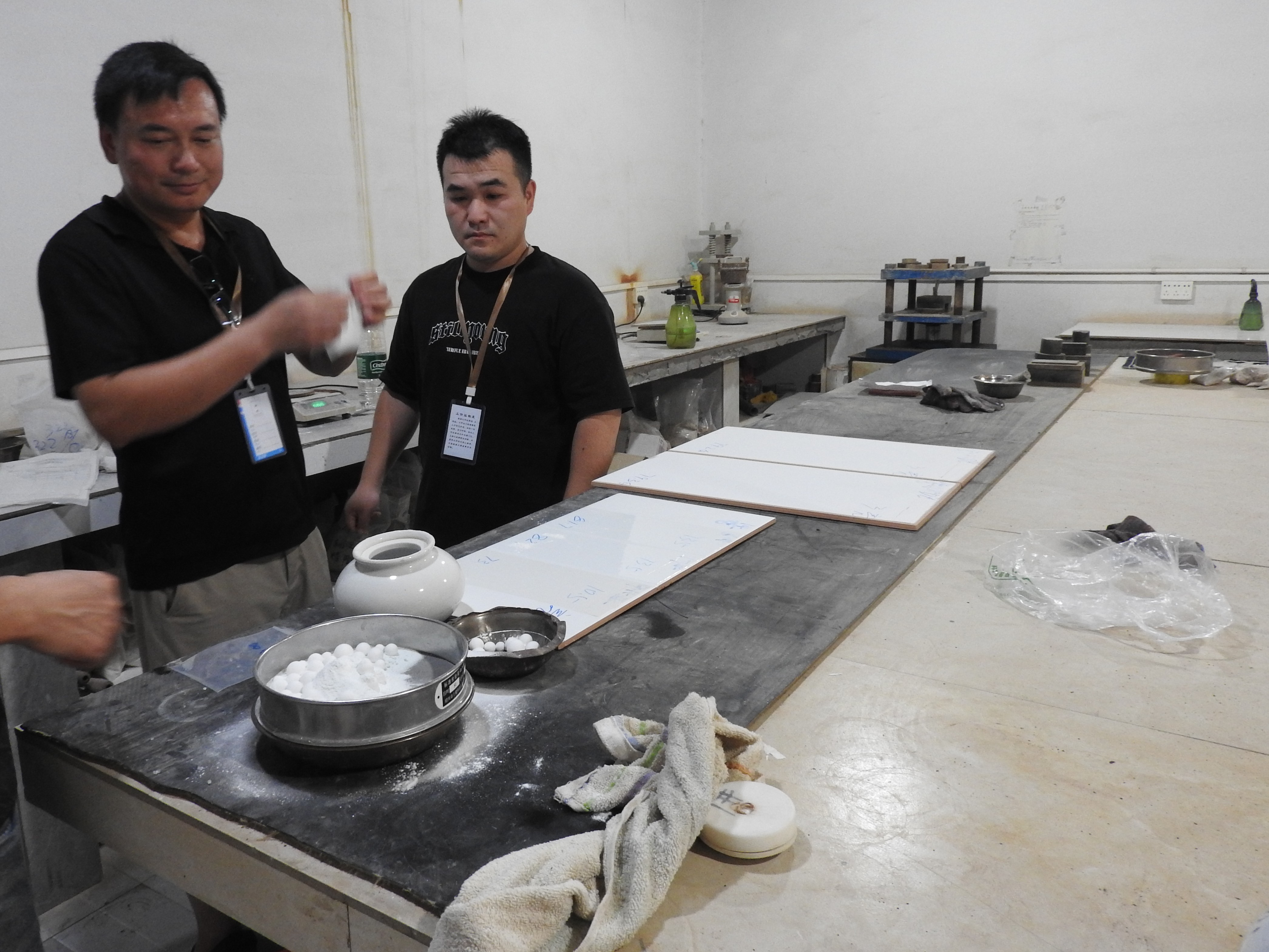
Technicians test and optimize products at the customer's factory. Image source: RENOVA INDUSTRIAL & TRADING CO., LTD.
Low blistering tendency during firing
Blistering is a firing and glaze-system outcome that buyers should treat as a trial question, not a label on a bag. A product description that suggests low blistering tendency is only meaningful when it is tied to a defined body, glaze formulation, application thickness and firing profile. The reviewed information does not establish a comparative blistering ranking among Floor Tile Matte Frit, Velvet Matte Frit and Wear-Resistant Frit.
That does not make the shortlist weak. It makes the testing requirement clear. A fair comparison should fire all three candidates under the same representative conditions, with the same body and glaze base where possible. The evaluation should record whether blisters appear, where they appear, and whether they persist after the intended firing cycle. If a defect appears, the plant should examine the whole system rather than attributing the result to the frit alone.
A practical blistering trial can follow a simple discipline:
- Use one representative body and one glaze base for the first round.
- Keep application thickness and drying conditions consistent across candidates.
- Fire all candidates in the same kiln and profile, with a control tile where available.
- Inspect fired surfaces under the plant's normal quality lighting and record defect type and location.
- Repeat only after changing one variable at a time, such as peak temperature, soak or glaze thickness.
This approach does not invent a blistering score. It produces the evidence needed to decide whether any candidate deserves further development. In a shortlist article, that is more useful than a ranking that cannot be verified on the buyer's line.
Applicable firing conditions to define before sampling
Firing conditions should be written down before samples are compared. The relevant parameters include peak firing temperature, soaking time, heating and cooling rates, kiln atmosphere, kiln type, glaze application thickness and the ceramic body being fired. The industry distinguishes low-temperature ceramic frit and high-temperature ceramic frit routes, but this article does not assign either label to the three candidates. The plant's actual firing temperature and kiln behaviour govern the trial.
RENOVA states that its technical team can fine-tune formulation and application process according to the ceramic body, kiln type, firing temperature and production process. That support is useful when a candidate shows promise but needs adjustment. It does not remove the need for a fired-tile test. The buyer should define the firing window that the production line can hold, then check whether the candidate produces an acceptable result inside that window.
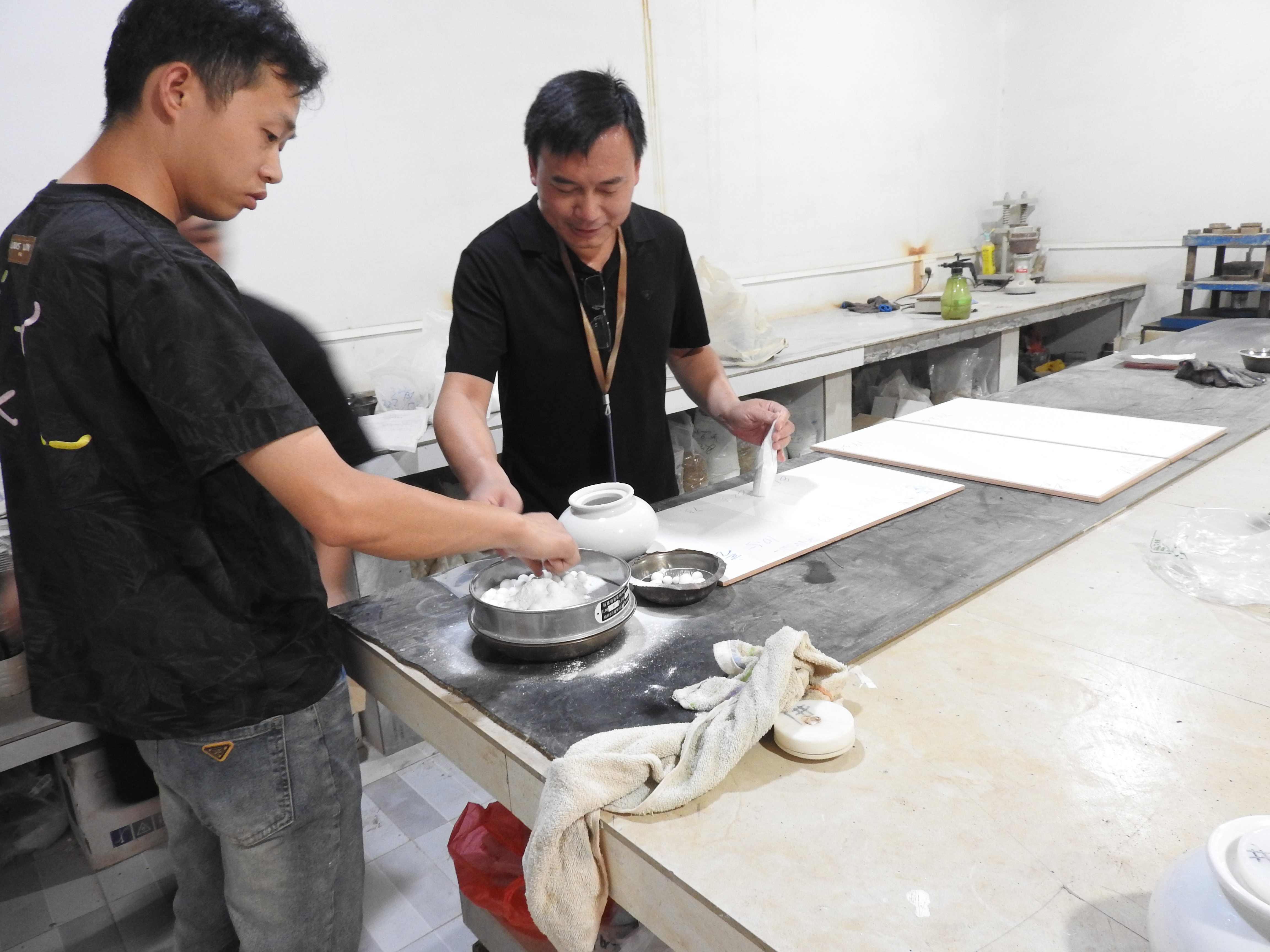
Production trials at the customer's factory. Image source: RENOVA INDUSTRIAL & TRADING CO., LTD.
A practical evaluation sequence for the shortlist
The shortlist becomes useful when it is converted into a controlled sequence. A buyer can follow these steps without treating any candidate as pre-ranked.
- Define the finish and performance target. State whether the project requires a matte surface, a velvet-matte surface, wear resistance, or a combination of these requirements.
- Fix the baseline. Record the body, engobe layer if present, glaze base, application thickness, kiln type and firing profile that will be used for the comparison.
- Obtain representative samples. Use the supplier's sample process after identifying the products that match the intended application.
- Fire a matched trial. Compare the candidates under the same conditions and include the plant's current glaze as a control where possible.
- Evaluate the fired tiles. Check compatibility, surface appearance, blistering behaviour, and wear performance where that is a project requirement.
- Adjust one variable at a time. If technical support recommends a formulation or process change, keep the other conditions fixed so the effect can be understood.
- Approve only on finished-tile evidence. A candidate should move forward only after the plant's own acceptance criteria are met.
This sequence gives the shortlist a fair test. It also prevents a common error: changing the frit and the firing profile at the same time, then attributing the result to the frit. The evaluation is strongest when the comparison is controlled and documented.
What RENOVA's manufacturing and technical support contribute
RENOVA's relevance to this shortlist is not a claim that every frit fits every kiln. It is the combination of product range, manufacturing capacity and application support needed to run a serious trial. The company operates a factory established in 2011, covering 10,000 square meters with approximately 50 employees. It reports combined annual production capacity of 40,000 tons and monthly production capacity up to 3,500 tons. Its technical team includes 29 technicians covering research and development, production technology and application support.
The product range includes Floor Tile Matte Frit, Velvet Matte Frit and Wear-Resistant Frit, alongside titanium frit, transparent frit, wall tile matte frit, polishing frit, boron frit, high-lead frit and silica-free frit for quartz slab. Customisation is part of the company's stated offer: the technical team can work with a customer's factory technicians to fine-tune formulation and application process according to the ceramic body, kiln type, firing temperature and production process. After-sales support includes on-site technical support, formulation fine-tuning, production process support and after-sales technical service.
The available case material includes a Thailand project involving 1,000 tons of titanium frit supplied to the Thailand market over one year, with reported stable performance in the production process and consistent results after firing. That case is relevant to RENOVA's export and technical-adaptation experience in Southeast Asia. It is not a comparative performance result for the three matte floor tile frits in this shortlist, because the case concerns titanium frit. The boundary should be kept visible in any procurement decision.
Market and procurement context
Third-party commercial research provides useful context for supplier-risk awareness, but it should not be used to rank the three candidates. Future Market Insights reported in 2025 that alkaline-boron frit accounted for 38.7% of global ceramic frit revenue share. Market Research Future reported China at 65% of global production and market share in 2023. These are third-party estimates with different scopes and methodologies; they describe market concentration, not the performance of Floor Tile Matte Frit, Velvet Matte Frit or Wear-Resistant Frit.
For customs screening, Flexport and USITC list HS 3207.20 for vitrifiable enamels and glazes. The supplied evidence does not confirm that every ceramic frit sub-type uses that heading, so import classification should be checked with a customs broker or the relevant authority. This is a procurement detail, not a product-selection criterion, but it belongs in the supplier-qualification file.
The procurement implication is straightforward. A buyer should qualify the supplier's ability to supply consistent samples, support trial production and respond to formulation adjustments. The shortlist then becomes a way to compare fired results under controlled conditions, rather than a name-based preference.
Limits of this shortlist and approval checks
The shortlist is limited to the three matte floor-tile candidates. Titanium frit, zirconium frit, boron frit and engobe frit belong to other formulation questions and are not ranked here. The following limits should be checked before approval:
- No comparative blistering ranking is established. Blistering must be assessed by trial firing under the plant's conditions.
- No specific firing range is stated for the three products in the reviewed material. The applicable conditions must come from the plant's kiln profile and trial production.
- No wear-resistance value is asserted for Wear-Resistant Frit. Wear performance must be evaluated on finished tiles for the intended application.
- Velvet-matte and matte appearance must be approved on fired tiles. Wet glaze appearance is not sufficient.
- The Thailand case concerns titanium frit. It supports supply and adaptation experience, not a comparative result for this shortlist.
- Customs and regulatory classification may vary. Confirm the applicable requirements before import or specification approval.
These limits do not weaken the shortlist. They define the evidence needed to convert it into a purchase decision. A buyer who documents the trial conditions and fired-tile results will have a stronger basis for selection than a buyer who relies on product names alone.
Outlook: qualification stays plant-specific
For matte floor tile glazes, the durable approach is to treat the frit as one part of a fired system. The three-option shortlist helps a plant organise its trials: Floor Tile Matte Frit for the direct matte route, Velvet Matte Frit for the velvet-matte route and Wear-Resistant Frit where wear resistance is part of the project requirement. The final choice should be based on compatibility, blistering behaviour and firing fit under the plant's own conditions.
As bodies, glaze formulations and kiln conditions change, re-qualification remains necessary. A shortlist is not a permanent approval. It is a structured starting point for the next trial, and the trial evidence should be retained for future specification reviews.
FAQ
What is the practical difference between Floor Tile Matte Frit, Velvet Matte Frit and Wear-Resistant Frit?
They are three distinct product families in RENOVA's ceramic frit range. Floor Tile Matte Frit is the direct matte floor-tile route, Velvet Matte Frit is the velvet-matte route, and Wear-Resistant Frit is the route to include when wear resistance is part of the floor-tile glaze requirement. Their names help organise evaluation, but they do not by themselves establish compatibility, blistering behaviour or wear performance. Those points must be confirmed on fired tiles made with the plant's body, glaze and kiln profile.
How should a ceramic tile plant compare these three frits fairly?
A fair comparison uses the same body, glaze base, application thickness, kiln and firing profile for all three candidates. The plant should fire matched samples, include a control where possible, and evaluate the finished tiles for compatibility, surface appearance and blistering behaviour. If wear resistance is required, that criterion should be included in the same evaluation. Changing several variables at once makes the result difficult to interpret.
Does a frit named Wear-Resistant Frit automatically suit every floor tile glaze?
No. A product name does not prove suitability for a specific floor tile glaze. Wear resistance is a finished-tile property that must be evaluated under the intended application and firing conditions. The candidate also has to pass compatibility and appearance checks. The correct decision is based on fired-tile evidence, not on the product name alone.
What firing conditions affect blistering during matte glaze firing?
Blistering can be influenced by peak firing temperature, soaking time, heating and cooling rates, kiln atmosphere, kiln type, glaze application thickness and the ceramic body. The relative importance of these factors is plant-specific. A controlled trial under the production profile is the appropriate way to compare the three candidates and determine whether any of them shows an acceptable blistering tendency.
Can the frit formulation be adjusted to a plant's body and kiln?
RENOVA states that frit formulation and technical specifications can be customised according to the customer's ceramic body, kiln type, firing temperature, production process and other factory-specific conditions. The technical team can support trial production, formulation fine-tuning and production process adjustments. This support helps evaluate suitability, but the final approval still depends on fired-tile results under the plant's conditions.
Reference: RENOVA product catalog (PDF).
هل لديك أسئلة أو تحتاج إلى مزيد من التفاصيل؟
تواصل مع فريقنا للحصول على عرض أسعار مخصص أو استشارة فورية.
طلب عرض أسعار
املأ النموذج أدناه وسيتواصل معك فريقنا بعرض مقترح مخصص.
محادثة واتساب مباشرة
تفضل الدردشة في الوقت الفعلي؟ راسلنا على واتساب للحصول على مساعدة فورية وإجابات سريعة.
- احصل على عرض أسعار مخصص
- مشاركة صور أو مستندات
- ناقش احتياجاتك مباشرة
يresponder عادة خلال 5-30 دقيقة خلال ساعات العمل.