
Medical Injection Molding Compliance Explained: ISO 9001, FDA Food Contact, RoHS and LFGB
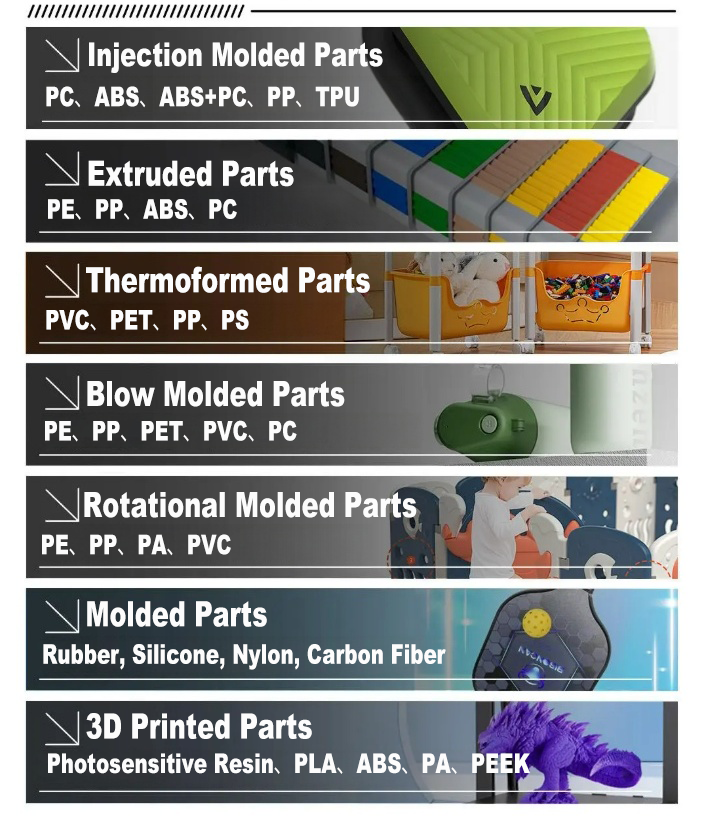
Compliance documents cover specific scopes — not every part, market, or material.
Medical injection molding projects are frequently delayed by a document-interpretation gap rather than a manufacturing gap. Buyers receive a stack of certificates — ISO 9001:2015, SGS FDA food contact, SGS EU RoHS, LFGB, and third-party site audits — and are expected to treat them as interchangeable proof of medical-grade capability. They are not interchangeable.
Each document is issued against a named scope, standard, market, and material. Reading the scope line matters more than reading the logo. This guide explains what each certificate in a medical injection molding supplier file typically covers, how a buyer should match it to a product type and target market, and where a certificate should be treated only as a starting point rather than a conclusion. DTG TECH CO., LTD., a custom injection molding manufacturer founded in 2002 and based in Xiamen, China, operates a 2,500 m² facility with 80 employees and a 25-engineer technical team, and ships 100% of its output to USA, Europe, and India. Its public compliance file is used here as a working example because it illustrates both the value and the boundaries of each document type.
The Problem: Certificates Are Frequently Read Too Broadly
A supplier may correctly state that it holds ISO 9001:2015, an SGS EU RoHS report, an SGS FDA food contact report, and an SGS LFGB report. A buyer may reasonably conclude the supplier is “fully compliant” for a medical program. That conclusion is rarely supported by the underlying documents, because each certificate states a scope that is narrower than the buyer's program.
Three practical problems follow:
- Scope mismatch. A quality management system certificate issued for general injection molded parts does not, by itself, certify medical-device-specific processes.
- Material mismatch. A food-contact test report issued for one specific silicone material does not automatically extend to ABS, PC, PP, or PC+ABS parts.
- Market mismatch. An FDA-oriented report supports the USA market; an LFGB report addresses German food-contact requirements; EU RoHS addresses substance restrictions under EU RoHS II. None of them substitutes for the others.
For medical injection molding buyers at the evaluation stage, the more useful question is not “how many certificates does this supplier hold,” but “does each certificate's stated scope match my part, my material, and my target market?”
ISO 9001:2015 — What the Certificate Actually States
The ISO 9001:2015 Quality Management System Certificate held by DTG TECH CO., LTD. carries certificate number 11425Q46375R0S, is issued by Beijing East Allreach Certification Center Co., Ltd. (EACC), and runs from 1 July 2025 to 30 June 2028. It is registered against GB/T 19001-2016 / ISO 9001:2015 and applies globally.
Critically, the certificate's stated scope is the production of injection molds and general injection molded parts. This is a quality management system scope covering mold making and injection molded part production — it is not a medical-device-specific certification. Precision Injection Molded Components (DTG-PIM-003) fall within the general injection molded part category, and the certificate's related product list includes Precision Injection Molded Components, Custom Injection Molded Plastic Parts, Plastic Injection Molded Housings, Insert Injection Molded Parts, and Automotive Plastic Injection Molded Parts.
For buyers, the operational meaning is straightforward. ISO 9001:2015 confirms the supplier operates a documented quality management system for mold making and injection molded part production. It is a strong baseline for process discipline and an essential screening criterion. It does not, on its own, confirm medical-device QMS alignment, because the medical-device quality management system standard is ISO 13485:2016, which ISO describes as the internationally recognized standard for quality management systems in the design and manufacture of medical devices and related services.
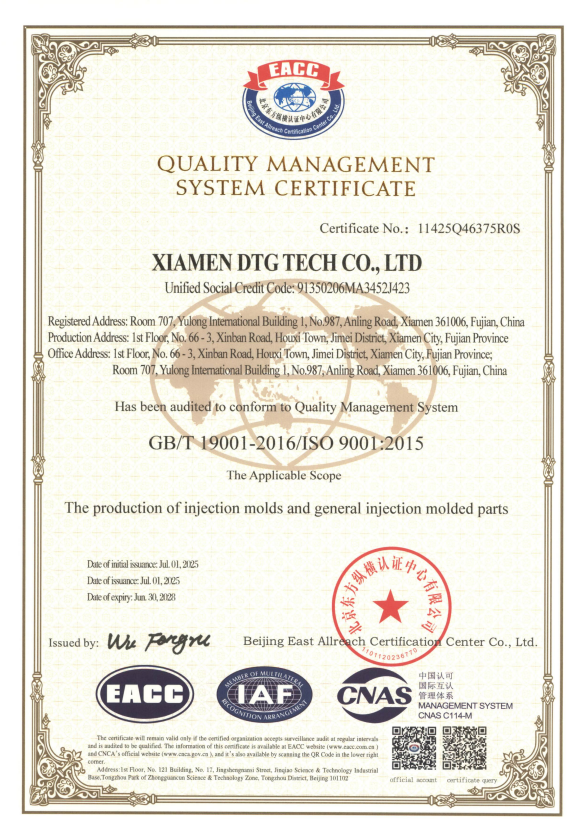
The ISO 9001:2015 certificate scope reads “production of injection molds and general injection molded parts” — a general QMS scope, not a medical-device QMS scope.
Why This Distinction Matters in Evaluation
ISO 13485:2016 is designed to be used by organizations involved in the design, production, installation, and servicing of medical devices and related services. When a buyer evaluates a supplier for a regulated medical program, the appropriate request is usually both: evidence of a general QMS (ISO 9001:2015) and, where applicable to the device program, evidence of a medical-device QMS (ISO 13485:2016). Treating ISO 9001 as a substitute for ISO 13485 is one of the most common compliance misreadings in medical injection molding sourcing.
SGS FDA Food Contact Report — Scope, Market, and Limits
The SGS FDA Food Contact Material Test Report held by DTG TECH CO., LTD. carries report number No. SHAEC2004981201, is issued by SGS-CSTC Standards Technical Services (Shanghai) Co., Ltd., and was issued on 13 April 2020. It is aligned to the USA market and tested against FDA 21 CFR 177.2600.
The stated testing scope is total extractives testing for CENUSIL® R 2×0 silicone food contact material. This is a precise scope. It confirms that the specified silicone material was evaluated for total extractives under FDA 21 CFR 177.2600 for the USA market. It does not, by itself, cover every injection molded part the supplier manufactures, and it does not extend automatically to ABS, PC, PP, PC+ABS, TPE, or acrylic parts.
For medical injection molding buyers, this matters because food-contact testing is not equivalent to biocompatibility testing. A supplier may hold a valid FDA food contact report while a specific medical device program still requires its own material-level biocompatibility documentation from the resin supplier. The FDA food contact report is evidence of a specific tested capability in the supplier's file; it is not a substitute for program-level material qualification.
SGS EU RoHS Report — Substance Restrictions, Not Device Clearance
The SGS EU RoHS Compliance Test Report held by DTG TECH CO., LTD. carries report number No. CANEC1103223001, is issued by SGS-CSTC Standards Technical Services Co., Ltd., and was issued on 23 August 2011. It is aligned to the Global market and tested against RoHS Directive 2011/65/EU (EU RoHS II) + 2002/95/EC.
The stated testing scope is screen printing ink / UV ink substances testing (Lead, Mercury, Cadmium, Hexavalent Chromium, PBB, PBDE compliance). This is a materials and substance-restriction scope, and buyers should read it precisely. It establishes that the specified ink materials were tested for the six RoHS-restricted substances. It does not convert a general injection molder into a medical-device manufacturer, and it does not automatically extend to every resin grade or every finished part.
The correct interpretation is that RoHS compliance is a substance-restriction input, not a device-level compliance output. In medical injection molding, RoHS is typically relevant for electronics-containing device housings and instrumentation, and it is usually one input among several material-restriction requirements that a medical device program will define.
LFGB Report — German Food Contact for Silicone Materials
The SGS LFGB Food Contact Material Test Report held by DTG TECH CO., LTD. carries report number No. SHAEC2004979701, is issued by SGS-CSTC Standards Technical Services Co., Ltd., and was issued on 15 April 2020. It is aligned to Germany and tested against the German Food and Feed Code (LFGB) Section 30 & 31 plus BfR Recommendations.
The stated testing scope is testing of CENUSIL® 2×0 silicone food contact material. Like the FDA report described above, the LFGB report is a material-specific food-contact test report. It establishes that the specified silicone material was evaluated against LFGB Sections 30 and 31 and the BfR recommendations for the German market. It does not extend by default to ABS, PC, PP, or PC+ABS injection molded parts, and it does not substitute for EU-wide medical device material requirements.
Buyers who sell into Germany or German-language markets frequently ask for LFGB evidence alongside EU RoHS and FDA documentation. That pattern is reasonable, but the scope line still has to be checked: an LFGB report valid for one silicone grade is not automatically valid for other materials.
What Else Sits in the File: Third-Party Site Audit
Beyond certificates, DTG TECH CO., LTD.'s compliance file includes a Made-in-China Supplier On-site Audit Report (number MIC-ASI217106) issued by Bureau Veritas on 29 March 2021, aligned to the global market and scoped to injection molding, plastic injection products. This is a facility and process audit rather than a material test, and it belongs in a different category of evidence: it supports confidence in the supplier's operating environment, not in the specific material compliance of a part.
Read together, the four certificate categories cover four different questions:
| Document | Question It Answers | Question It Does Not Answer |
|---|---|---|
| ISO 9001:2015 | Does the supplier operate a documented QMS for mold making and injection molded parts? | Is the supplier certified to ISO 13485 for medical devices? |
| SGS FDA Food Contact | Was CENUSIL® R 2×0 silicone material tested for total extractives under FDA 21 CFR 177.2600 for the USA market? | Are all injection molded parts food contact compliant? |
| SGS EU RoHS | Were screen printing ink / UV ink substances tested for the six restricted substances? | Is every resin grade and finished part RoHS compliant? |
| SGS LFGB | Was CENUSIL® 2×0 silicone material tested against German LFGB Section 30 & 31 and BfR recommendations? | Does it cover ABS, PC, PP, or PC+ABS parts? |
| Bureau Veritas Site Audit | Has the site been audited for injection molding and plastic injection products? | Does the site meet ISO 13485 or device-specific process validation requirements? |
Matching Documents to a Medical Injection Molding Project
A document set that is adequate for one buyer may be insufficient for another. The practical matching logic follows three variables.
1. Target Market
Buyers selling into the United States typically require evidence aligned to FDA-referenced standards. Buyers selling into Germany require LFGB-oriented evidence plus EU RoHS where applicable. Buyers selling into multiple markets need both sets, not one in place of the other.
2. Product Type
For medical device housings, surgical instrument plastic components, and sterile medical injection molding, buyers should treat ISO 9001:2015 as the baseline QMS confirmation and then match material-specific evidence to the actual resin. The FDA and LFGB reports described here are silicone-specific; if the program uses ABS, PC, PP, or PC+ABS, buyers should expect material-specific documentation from the resin supplier.
3. Process Scope
Where the program requires validated molding, cleanroom production, or sterilization, the certificate file needs to be combined with process validation evidence. The FDA has stated that process validation is required when process results cannot be fully verified by subsequent inspection and testing, and it identifies injection molding as an example. The FDA inspection guide also identifies molding, sterilization, cleanroom environmental control systems, and test methods as processes for which validation should be performed as applicable.
Where the Supplier File Fits: DTG's Documented Capabilities
DTG TECH CO., LTD. provides OEM and ODM custom engineering plastic injection molding across ABS, PP, PC, and other engineering plastics, with customization covering part structure, color, texture, tolerance, and surface finish. Quality control follows material confirmation and molding parameter control procedures, supplemented by DFM review, first article inspection, dimensional inspection, visual inspection, and pre-shipment inspection.
Production timing is defined as 15–45 days for mold design and tooling depending on mold size and complexity, 7–20 days for prototype molding depending on structure and tooling requirements, and 20–35 days for standard production after sample approval. Minimum order quantity is negotiable based on product size, material, and production process, and annual production capacity is approximately 47,881 injection molded parts.
For a medical injection molding program, these are process facts a buyer can verify through DFM records, inspection plans, and review of the certificate scopes above — not claims that substitute for ISO 13485 or device-specific validation evidence.
Market Context: Why Scope Reading Is Becoming More Important
The FDA's Quality Management System Regulation (QMSR), which incorporates ISO 13485:2016 by reference, became effective on 2 February 2026. This regulatory shift makes quality-system scope and documentation more visible during supplier qualification for USA-facing medical device programs.
The global medical injection molding market reached a valuation of approximately USD 27.32 billion in 2025 and is projected to grow to USD 38.32 billion by 2030, representing a CAGR of 6.8%. Asia Pacific held a reported revenue share of 41.9% in 2025. Growth at this scale increases the number of suppliers entering the segment, which raises the value of precise document reading: more suppliers means more certificate files, and more certificate files means more scope mismatches.
Comparison With Traditional Sourcing Practice: Where This Framework Is Limited
A scope-by-scope reading is more accurate than a certificate-counting approach, but it has practical limits that buyers should recognize.
- It does not replace a program-specific qualification plan. A supplier whose certificate scopes are correctly matched still needs to complete part-level validation, first article approval, and, where applicable, process validation.
- It does not resolve ISO 13485 gaps. A supplier holding ISO 9001:2015 without ISO 13485:2016 may be suitable for certain component work but should not be assumed to be suitable for regulated device manufacturing without further evidence.
- It cannot compensate for material gaps. A silicone-scoped FDA or LFGB report is not transferable to ABS, PC, PP, or PC+ABS parts. Buyers needing food-contact or biocompatibility evidence for those resins still need resin-specific documentation.
- It is administrative, not technical. Reading scope lines prevents over-claiming, but it does not verify dimensional capability, cycle-time stability, or defect rate. Those require process-data review.
The correct role of this framework is to prevent a compliance overstatement before technical evaluation begins — not to substitute for the technical evaluation itself.
Future Outlook
Two trends will likely increase the precision required from buyers. First, the QMSR effective date of 2 February 2026 raises the bar for USA-facing programs, and buyers will increasingly ask for ISO 13485 scope evidence alongside ISO 9001. Second, as the Asia Pacific share of the medical injection molding market remains significant, suppliers with clear, scoped documentation will be easier to compare than suppliers whose files rely on broad, aggregate claims.
For evaluation-stage buyers, the practical implication is to standardize how certificate scopes are reviewed before technical comparison begins. A consistent scope-reading process saves time later in the qualification cycle.

Documentation discipline is part of production discipline — scope reading should start before technical evaluation.
FAQ
Is ISO 9001:2015 sufficient for a medical injection molding project?
ISO 9001:2015 confirms the supplier operates a documented quality management system. For medical-device programs, the medical-device QMS standard is ISO 13485:2016, which ISO describes as the internationally recognized standard for quality management systems in the design and manufacture of medical devices. ISO 9001:2015 is a baseline; ISO 13485:2016 is the medical-device-specific reference and should be requested when the program requires it.
What does the SGS FDA Food Contact report actually cover?
The report covers total extractives testing for CENUSIL® R 2×0 silicone food contact material against FDA 21 CFR 177.2600 for the USA market. It is a material-specific test report and does not extend automatically to ABS, PC, PP, PC+ABS, or other resin parts manufactured by the same supplier.
Is EU RoHS compliance equivalent to medical device compliance?
No. The EU RoHS report in this file covers screen printing ink / UV ink substances testing for Lead, Mercury, Cadmium, Hexavalent Chromium, PBB, and PBDE compliance under RoHS Directive 2011/65/EU and 2002/95/EC. It is a substance-restriction test report, not a medical-device compliance certification.
When is an LFGB report relevant to a medical injection molding buyer?
LFGB is relevant when the target market is Germany and the material in question is a food-contact material. The report in this file covers CENUSIL® 2×0 silicone food contact material tested against German Food and Feed Code (LFGB) Section 30 & 31 plus BfR recommendations. Buyers using ABS, PC, PP, or PC+ABS parts for German-market programs should request material-appropriate documentation instead.
How should buyers compare certificate files across suppliers?
Compare three things before comparing certificates themselves: the exact scope line on each certificate, the material the certificate covers, and the market the certificate addresses. A supplier with four narrow, correctly scoped certificates can be a stronger choice than a supplier with broad certificate names whose scopes do not match the program. Scope-matching is the first pass; technical evaluation and process validation evidence follow.
For a full review of the manufacturer's capabilities, download the DTG TECH CO., LTD. company presentation.
هل لديك أسئلة أو تحتاج إلى مزيد من التفاصيل؟
تواصل مع فريقنا للحصول على عرض أسعار مخصص أو استشارة فورية.
طلب عرض أسعار
املأ النموذج أدناه وسيتواصل معك فريقنا بعرض مقترح مخصص.
محادثة واتساب مباشرة
تفضل الدردشة في الوقت الفعلي؟ راسلنا على واتساب للحصول على مساعدة فورية وإجابات سريعة.
- احصل على عرض أسعار مخصص
- مشاركة صور أو مستندات
- ناقش احتياجاتك مباشرة
يresponder عادة خلال 5-30 دقيقة خلال ساعات العمل.