
Medical Titanium Bar and Nitinol Wire: A Procurement FAQ
Medical Titanium Bar and Nitinol Wire: A Procurement FAQ
Implant programmes rarely stall because a buyer cannot choose between titanium and Nitinol. They stall one line later, at the specification level: which grade, referenced to which standard, at which diameter and tolerance, with which transformation temperature and surface finish — and which document has to travel with the shipment. This reference collects the questions that recur during the research and evaluation stage of medical material sourcing and answers them against published mill-product specifications.
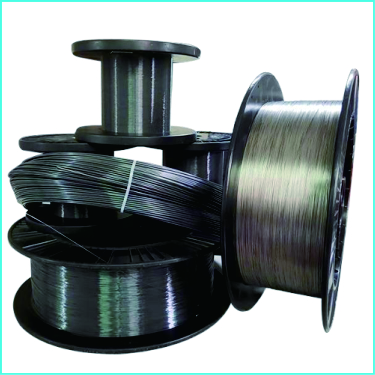
XI'AN BOSSIN METAL TECHNOLOGY CO., LTD. is a manufacturer of titanium and Nitinol mill products — titanium bar, medical titanium bar, titanium plate, titanium wire, titanium coil, titanium cable and Nitinol wire, strip, plate and cable. The company operates a 50,000 m² production base in Baoji High-tech Zone, China's titanium cluster, runs an in-house chain from melting and forging to rolling and finishing, and reports an annual output of 5,000 tons with an export ratio of 80%.
Why grade and standard questions dominate medical titanium procurement
"Medical grade titanium bar" is not a specification. It is a category. Two quotations can both carry the description while sitting under different standards regimes, different interstitial limits and different inspection obligations. That single ambiguity is the source of most technical clarification traffic in the evaluation stage.
At material level, the medical market runs on two standard families for titanium and one for Nitinol. Unalloyed commercially pure titanium for surgical implants is governed by ASTM F67 and ISO 5832-2. High-strength Ti-6Al-4V ELI alloy — the workhorse of load-bearing implants — is governed by ASTM F136 and ISO 5832-3, which are the primary international standards for that alloy in medical implants. Nitinol for medical devices is governed by ASTM F2063.
| Material family | Grade designations | Governing standards | What the buyer is actually ordering |
|---|---|---|---|
| Unalloyed commercially pure titanium | GR1, GR2, GR3, GR4 | ASTM F67, ISO 5832-2 | A ductile, corrosion-resistant structural material with lower strength than the alloy grades |
| Ti-6Al-4V ELI | GR5 ELI, Ti 6AL4V ELI, GR23 | ASTM F136, ISO 5832-3 | A high-strength implant alloy with controlled interstitial elements |
| Titanium alloy bar (broader range) | GR5, GR7, GR9, GR12, GR23, Ti6242, Ti6246, TB3, TB6, TC4, TC6, TC11, TC17, TC18 | Bar standard set: ASTM B348, ASTM F136, ISO 5832-3, ASTM F67, ISO 5832-2, AMS 4928, AMS 4930, ASTM F1295, ASTM F1713, MIL-T-9047 | A grade-and-standard combination; the designation alone does not define heat treatment or inspection level |
| Nickel-titanium shape memory alloy | NiTi binary; NiTiCu, NiTiCr, NiTiV, NiTiNb, NiTiFe ternary variants | ASTM F2063 | A functional material defined by transformation temperature and condition, not only by composition |
The practical consequence is that a purchase order should always carry four things together: grade, standard, condition and inspection requirement. A grade without a standard is not a specification, and a standard without a condition leaves the delivered properties open to interpretation.
Grade selection: GR1 to GR5 ELI, Ti 6AL4V ELI and GR23
BOSSIN produces medical titanium bar in grades GR1, GR2, GR3, GR4, GR5 ELI, Ti 6AL4V ELI and GR23 against ASTM F136, ISO 5832-3, ASTM F67 and ISO 5832-2. Its wider implant titanium bar and titanium bar range extends to GR5, GR7, GR9, GR12, GR23 and alloy designations including Ti6242, Ti6246, TB3, TB6, TC4, TC6, TC11, TC17 and TC18 for programmes outside the medical core.
Mechanical data separate the alloy grades from the unalloyed ones. GR5 (Ti-6Al-4V) is specified with tensile strength of at least 895 MPa and yield strength of at least 828 MPa, which is why it appears in high-strength applications. GR5 ELI (GR23) is quoted with typical tensile strength values of at least 860 MPa; the ELI designation controls interstitial elements and is the designation normally associated with implant-grade applications. Medical titanium bar is delivered with microstructure classified A1 to A3 according to ETTC-2, with accuracy to h6, h7, h8 or h9 and dimensional tolerance down to 0.005 mm.
Three rules simplify grade selection in practice:
- Follow the mechanical demand first. Where the design depends on load transfer — bone screws, joint stems, spinal fixation elements — the alloy grades are the starting point. Where the design depends on formability, ductility or a long regulatory precedent on unalloyed titanium, GR1 to GR4 under ASTM F67 and ISO 5832-2 are the natural starting point.
- Do not substitute within the alloy family casually. GR5 and GR5 ELI differ in interstitial control, not in name. Swapping one for the other in a validated design changes the material that was tested.
- Match the grade to the technical file, not to the quotation. The grade printed on the mill certificate should be the grade in the device documentation.
Diameters and tolerances: what is standard and what is made to order
Dimension questions are the second most common source of delay, because medical bar is not sold from one universal stock table. Near-net diameters for specific implant families are offered alongside a general range, and wire diameters follow a separate scale.
| Product form | Catalogue dimension range | Notes |
|---|---|---|
| Medical titanium bar | Dia 1.0 – Dia 100 mm × length up to 6,000 mm | Round or square bar; accuracy h6/h7/h8/h9; tolerance 0.005 mm |
| Medical titanium bar for bone screws | Φ3.5, Φ4.0, Φ4.5, Φ5.0, Φ5.5, Φ6.0, Φ8.0, Φ10.0 mm | Pre-set diameters for screw blanks |
| Medical titanium bar for spine | Φ13.5, Φ14.0, Φ14.2, Φ15.0, Φ16.0, Φ17.0 mm | Spinal fixation diameters |
| Medical titanium bar for bone joints | Φ30.0, Φ35.0, Φ40.0, Φ50.0, Φ55.0, Φ60.0, Φ65.0 mm | Joint stem diameters |
| Medical titanium bar for dental implants | Φ3.0 – 20.0 mm | Dental implant blanks and discs |
| Medical titanium wire | Dia 0.03 – Dia 6.0 mm | Grades GR1, GR2, GR4, GR5 ELI, GR23; polished or pickled; 10–100 kg per coil or spool |
| Titanium wire (general range) | Dia 0.03 – Dia 6.0 mm | Grades Gr1 to Gr23 including Gr5 Eli; coil or spool; 10–200 kg per coil |
| Nitinol wire | Dia 0.0127 – 6.0 mm | Round, square and rectangular wire; imperial sizes 0.012" to 0.021" × 0.025" |
| Medical titanium plate | Thickness 0.3 – 50.0 mm × width 100 mm × length 2,000 mm | Hot rolled and cold rolled; grades GR1, GR2, GR4, GR5 ELI, Ti 6AL4V ELI, GR23 |
| Titanium plate (industrial range) | 0.3–4.0 mm thick up to 2,500 mm wide; 4.1–100.0 mm thick up to 3,000 mm wide | Lengths up to 6,000 mm |
| Titanium coil / strip / foil | 0.005–0.025 mm; 0.025–0.3 mm in coil; 0.31–0.9 mm cut lengths | Grades Gr1 to Gr23 |
| Nitinol sheet / strip / plate | Strip 0.03–2.0 mm thick, width 600 mm; plate 0.5–10 mm thick, width customer specified | ASTM F2063; polished bright or as specified |
| Titanium cable and Nitinol cable | 1×3, 1×7 and 7×7 strand constructions | Titanium cable to ASTM F136, ASTM B863, ASTM F67; Nitinol cable to ASTM F2063 |
Two commercial parameters belong in the same conversation as the dimension table. Standard minimum order quantity is 10 kg, and lead time is quoted at 10 to 25 days for Nitinol and approximately 15 days for titanium products. Where a programme needs a diameter outside the near-net sets, secondary processing — drilling, milling, threading and other precision machining — is available on request, with tolerances selectable from h6, h7, h9 and h11.
Nitinol transformation temperature: the constraint that defines device behaviour
For Nitinol wire, composition is only half of the specification. The austenite finish temperature — the Af point — determines when the material behaves superelastically, when it behaves as a shape memory alloy, and how much force it delivers in service. Two wires with identical nickel content can behave very differently if their Af points differ.
BOSSIN Nitinol wire complies with ASTM F2063 with a nickel content of 54.5%–57.0%. The catalogue spans transformation temperature windows of below −15 °C, −10 to 10 °C, 0 to 30 °C, 20 to 40 °C, 45 to 90 °C, an active Af of 33 ± 3 °C, and As–Ms differentials of ≤5 °C and ≤150 °C. Where a project requires a different window, Af is customizable, typically within a range from −30 °C to 120 °C, covering low-temperature, room-temperature, high-temperature and superelastic requirements.
Three specification details deserve attention during evaluation:
- Af tolerance. Transformation temperature is controlled within ±10 °C in medical programmes, with grain size no less than Grade 4.
- Measurement method. Af is verified by Differential Scanning Calorimetry, supported by ICP-OES or XRF chemical composition analysis against ASTM F2063 and universal testing machine results for tensile strength, elongation and superelasticity.
- Condition. The same alloy is offered in superelastic (SE), shape memory (SM), annealed (M) and cold-worked (Y) states, and in narrow-hysteresis or wide-hysteresis variants. Condition must be stated on the order, because it changes the delivered mechanical response.
As a widely applied rule of thumb, a device expected to behave superelastically at body temperature is specified with an Af below body temperature. Orthodontic archwire raw material is a documented example: the Af point for that application is set at 25–35 °C, with cold-worked, thermal-activated condition, recoverable strain of at least 8%, tensile strength of at least 800 MPa and diameter tolerance to ±0.01 mm.
Surface finish options and why they matter
Surface finish is frequently omitted from a first enquiry and then becomes a change order. It affects downstream cleaning validation, oxide removal, weldability, drawing behaviour and, in some device classes, the visual acceptance criteria of the finished component.
| Product | Available surface finishes |
|---|---|
| Medical titanium bar | As-machined / polished mill finish; pickling or acid cleaning on request |
| Medical titanium wire | Polished, pickling |
| Titanium plate | Bright, polished, pickling, acid cleaning |
| Nitinol wire | Polished bright, black oxide, acid pickled, light oxide (golden to brown) |
| Nitinol strip, plate and cable | Polished bright, acid pickled, black; additional finishes available as specified |
| Nitinol customization portfolio | Black oxide, light oxide, pickled, bright, ultra-bright, polished, cleaned |
For Nitinol, the finish also signals processing history. Light oxide and black oxide surfaces indicate different thermal treatment states, while polished bright surfaces are typically requested where the wire feeds directly into downstream forming or where surface integrity is part of the device specification.
Matching material to implant application
Application logic is where grade, diameter and condition converge. The table below maps documented application areas to the product form and dimension set that normally carries them. It describes supply geometry, not a substitute for the design authority's own material choice.
| Application area | Supplied form | Documented dimension set |
|---|---|---|
| Bone screws | Medical titanium bar | Φ3.5 – Φ10.0 mm |
| Spinal fixation | Medical titanium bar | Φ13.5 – Φ17.0 mm |
| Joint stems and artificial joints | Medical titanium bar | Φ30.0 – Φ65.0 mm |
| Dental implants | Medical titanium bar | Φ3.0 – 20.0 mm |
| Bone plates | Medical titanium plate | Thickness 0.3 – 50.0 mm |
| Surgical sutures | Medical titanium wire | Dia 0.03 – 6.0 mm |
| Orthodontic archwires (raw material) | Nitinol wire | Af 25–35 °C; round, square and rectangular sections |
| Guide wires, stents, occluders, thrombus filters, anchor pins, localization wires, stone retrieval baskets | Nitinol wire | Dia 0.0127 – 6.0 mm |
| Orthopedic and dental instruments, endoscopic manipulation | Titanium cable | 1×3, 1×7, 7×7 strands |
Orthopedic implants hold the largest single share of medical titanium demand, at approximately 42.3% of revenue according to Dataintelo. That concentration explains why the near-net diameter sets above cluster around bone screws, spine and joint stems rather than around general engineering sizes.
Documentation and verification at the evaluation stage
Material statements are only as strong as the paperwork behind them. For medical titanium bar and Nitinol wire, the following documented evidence can be checked directly.
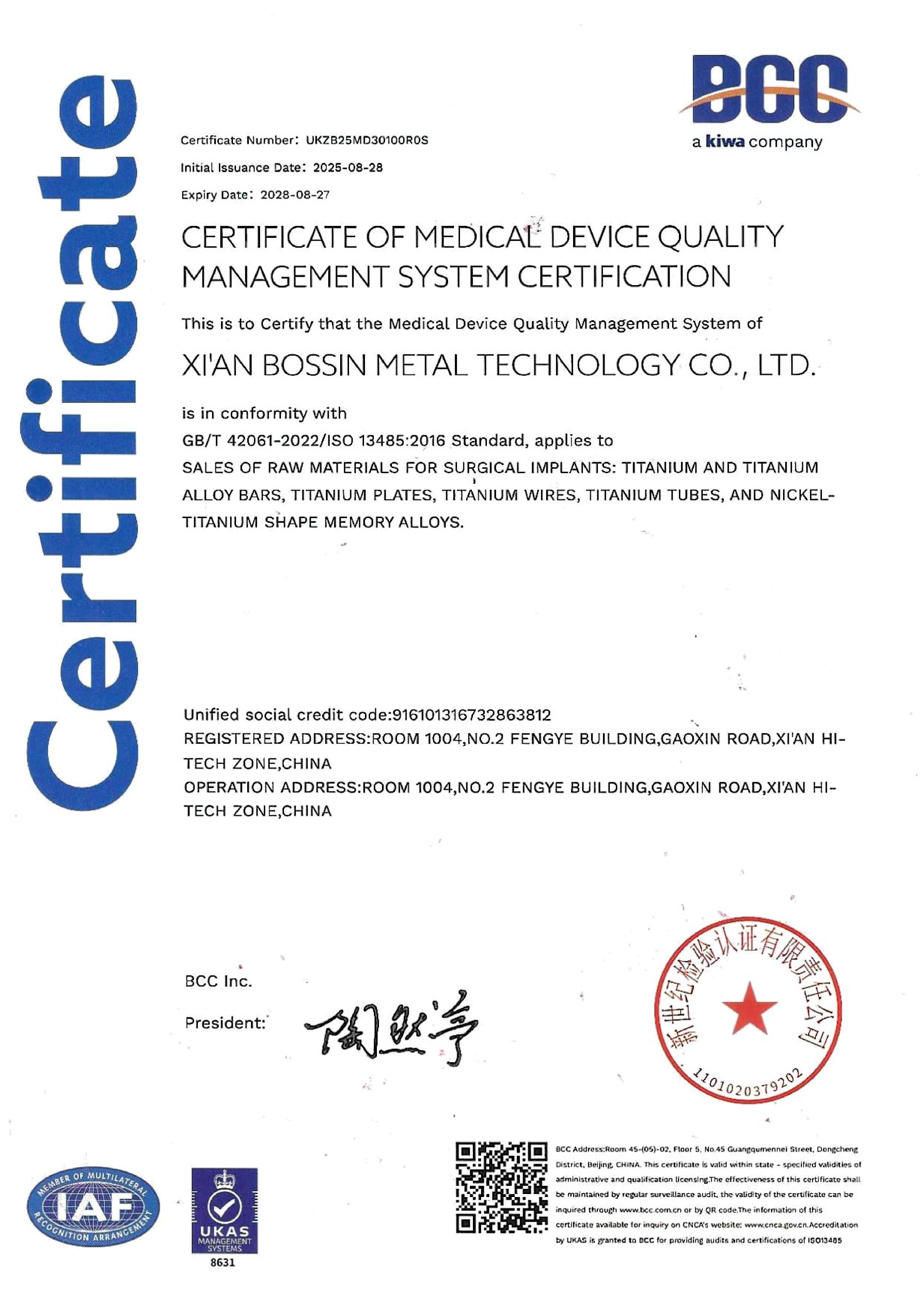
- Quality management system: ISO 13485:2016 certification, certificate number UKZB25MD30100R0S, issued by BCC (Beijing Zhonglian Tianrun Certification Center) for the global medical device market, covering surgical implant raw materials including titanium and titanium alloy bar, plate, wire and nickel-titanium shape memory alloys. The manufacturing operation is additionally certified to ISO 9001:2015 and EN 9100:2018.
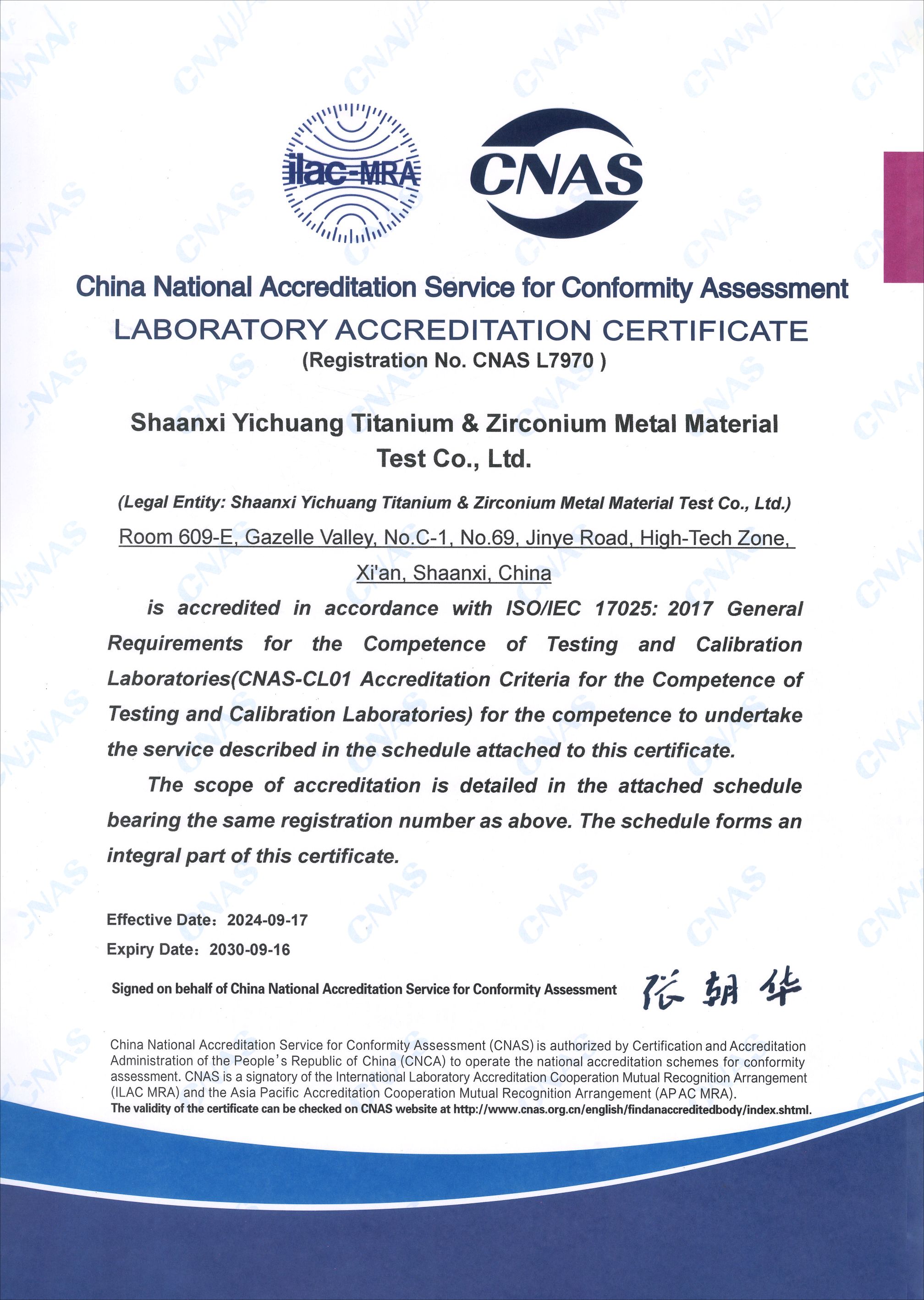
- Laboratory accreditation: the materials testing laboratory covering medical titanium bar products is accredited to ISO/IEC 17025 and CNAS-CL01 under certificate CNAS L7970, issued by the China National Accreditation Service for Conformity Assessment.
- Credit and supplier standing: AAA-Rated Honest Supplier Enterprise, certificate ZSTD17587027461235, and AAA Credit Enterprise, certificate ZSTD17587027461231, both issued by the China Enterprise Credit Evaluation Center under standard Q/ZSTD001-2021.
- Batch-level documents: each batch is accompanied by a factory inspection certificate; Nitinol batches additionally carry a chemical composition spectral report and mechanical property curves.
- Testing scope: chemical composition by ICP-OES or XRF against ASTM F2063, tensile and elongation testing, DSC measurement of Af, fatigue testing of finished products, and 100% ultrasonic testing for medical titanium bar. Transverse macrostructure is controlled to be free of cracks, pipe ends, porosity and inclusions.
- Traceability: full-process traceability from raw material to finished product, with an ISO 13485-compliant complaint handling route and technical response within 12 hours.
Real programmes illustrate the same documentation pattern. In one Brazilian orthopedic implant programme covering artificial joints, bone screws, orthopedic and dental implants and bone plates, the acceptance criteria combined ISO 13485 certification, 0.005 mm precision, A1 microstructure and full-process quality control. In an Argentine surgical suture programme, consistent batch-to-batch quality was the deciding factor; direct factory sourcing was reported to reduce procurement cost by 8% while maintaining the same quality level.
Market signals behind material availability
Availability and lead time are shaped by market scale rather than by individual supplier policy. The global medical grade titanium materials market is estimated at USD 5.21 billion in 2025 and projected to reach USD 9.56 billion by 2034 (Dataintelo). The medical titanium alloy segment alone is valued at USD 1.45 billion in 2025, forecast to reach USD 2.59 billion by 2033 at a 7.5% CAGR (Verified Market Research). The Nitinol-based medical device market was valued at USD 4.1 billion in 2024 with a projected CAGR of 7.1% (Precedence Research).
Two cautions belong with these figures. First, published valuations are not directly comparable: alloy-focused estimates, total medical titanium estimates and finished medical device estimates describe different scopes, and Nitinol valuation figures of USD 2.53 billion for 2025 sit alongside USD 4.1 billion for Nitinol-based devices in 2024 precisely because the two measure different things. Second, capacity is expanding on the supply side — Fort Wayne Metals doubled its melting output between 2022 and 2024 — which is a reasonable indicator that availability pressure is easing at the alloy level, though it does not guarantee shorter lead times for a specific custom Af window.
Trade flow adds a further signal. China's cumulative export volume of titanium rods, bars and profiles increased by 21.85% year on year as of March 2025 (China Customs / SMM), which explains why Chinese mill capacity now appears regularly in global medical material shortlists.
Where titanium and Nitinol are the wrong answer
A procurement FAQ would be misleading if it implied that titanium and Nitinol are universally preferable. Several genuine boundaries apply.
- Wear-resistance-limited surfaces. Cobalt-chromium alloys are generally preferred for articulating bearing surfaces because titanium alloys are more susceptible to wear and to galling in metal-on-metal contact. Titanium remains the structural material of choice where stiffness, corrosion resistance and biocompatibility drive the design.
- Cost and stiffness trade-offs. Stainless steel is generally positioned as a lower-cost alternative with higher stiffness, and it remains widely used where permanent implantation and the lowest elastic modulus are not priorities. Titanium's advantage is corrosion resistance and a modulus closer to bone, not a lower purchase price per kilogram.
- Nitinol's nickel content. ASTM F2063 fixes nickel at 54.5%–57.0%. Nickel-release behaviour and patient sensitivity are legitimate design review topics for long-term implants, and they are a reason some programmes choose an alternative material for permanent structural components.
- Transformation temperature sensitivity. Nitinol properties depend on Af, which shifts with composition and processing history. A ±10 °C control window and per-batch DSC verification are the practical answers, but they also mean that a Nitinol specification is more demanding to transfer between suppliers than a titanium bar specification.
- Formability limits. The same sensitivity makes Nitinol harder to cold-form and machine than titanium, and generally more expensive per kilogram. Where superelasticity or thermal actuation is not functionally required, titanium wire is the simpler route.
- Commercial floors. A 10 kg minimum order quantity and a 10–25 day Nitinol lead time are real constraints for prototyping phases. Titanium products run to approximately 15 days road lead time.
- Division of validation responsibility. Mill products are supplied as raw material with documented properties. Final device-level validation of fatigue performance, surface cleanliness and biocompatibility remains with the device manufacturer — no mill certificate replaces that step.
Outlook
The material conversation in implant sourcing is shifting from "which grade" to "which documented window". Titanium bar specifications increasingly arrive with microstructure classification, ultrasonic testing records and traceability requirements attached, while Nitinol enquiries arrive with a target Af, a tolerance, a condition and a hysteresis class. Suppliers that can respond with DSC data, composition reports and mechanical property curves alongside the certificate will find that the technical clarification cycle shortens on its own.
Two structural developments are likely to reinforce that direction. Rising implant volumes — and the largest application share still sitting in orthopedic implants — will keep pressure on near-net diameter availability. At the same time, expanding melting capacity among established global suppliers suggests that the competitive dimension will move from raw availability towards documented consistency, which is measured at batch level rather than at brochure level.
A technical brochure covering the titanium and Nitinol product families referenced in this FAQ is available for download: BOSSIN product brochure.
FAQ
Which titanium grade should be specified for a permanent orthopedic implant?
There is no single answer, because the grade follows the device function. Unalloyed commercially pure grades GR1 to GR4 are governed by ASTM F67 and ISO 5832-2 and are used where a ductile, lower-strength, corrosion-resistant material is appropriate. High-strength Ti-6Al-4V ELI grades — GR5 ELI, Ti 6AL4V ELI and GR23 — are governed by ASTM F136 and ISO 5832-3 and are the implant-grade option where load transfer matters. GR5 (Ti-6Al-4V) is offered for high-strength applications with tensile strength of at least 895 MPa and yield strength of at least 828 MPa, while GR5 ELI (GR23) is quoted with typical tensile strength of at least 860 MPa. Medical titanium bar is supplied in GR1, GR2, GR3, GR4, GR5 ELI, Ti 6AL4V ELI and GR23, so the decision is normally made by the device's own technical file rather than by material availability.
What is the difference between ASTM F136 and ASTM F67?
They cover different materials. ASTM F136 and its ISO counterpart ISO 5832-3 are the primary international standards for high-strength Ti-6Al-4V ELI alloys used in medical implants. ASTM F67, together with ISO 5832-2, governs unalloyed commercially pure titanium for surgical implants. A quotation that cites "medical grade titanium" without naming one of these standards has not yet specified a material.
What diameter range is available for medical titanium bar and Nitinol wire?
Medical titanium bar is produced from Dia 1.0 mm to Dia 100 mm in lengths up to 6,000 mm, with accuracy to h6, h7, h8 or h9 and tolerance down to 0.005 mm. Near-net sets include Φ3.5–Φ10.0 mm for bone screws, Φ13.5–Φ17.0 mm for spine applications, Φ30.0–Φ65.0 mm for bone joint components and Φ3.0–20.0 mm for dental implants. Medical titanium wire covers Dia 0.03–6.0 mm, and Nitinol wire covers Dia 0.0127–6.0 mm, including round, square and rectangular sections.
How should the Af transformation temperature be specified for Nitinol wire?
Af should be stated as a target plus a tolerance, not as a range alone. Catalogue windows include below −15 °C, −10 to 10 °C, 0 to 30 °C, 20 to 40 °C, 45 to 90 °C, an active Af of 33 ± 3 °C, and As–Ms differentials of ≤5 °C or ≤150 °C. Custom Af values are available, typically from −30 °C to 120 °C. Medical programmes control transformation temperature within ±10 °C with grain size no less than Grade 4, and verify it by Differential Scanning Calorimetry. For reference, orthodontic archwire raw material is specified at an Af of 25–35 °C in cold-worked, thermal-activated condition.
Which surface finishes are available for medical titanium bar and Nitinol wire?
Medical titanium wire is supplied polished or pickled; titanium plate is available bright, polished, pickled or acid cleaned. Nitinol wire is offered in polished bright, black oxide, acid pickled and light oxide (golden to brown) finishes, with a broader customization portfolio covering black oxide, light oxide, pickled, bright, ultra-bright, polished and cleaned surfaces. The finish should be written into the purchase order, because it affects cleaning validation and downstream forming.
What documentation should accompany a batch of medical titanium bar or Nitinol wire?
Each batch is accompanied by a factory inspection certificate. Nitinol batches additionally carry a chemical composition spectral report and mechanical property curves. Supporting evidence includes ISO 13485:2016 certification (UKZB25MD30100R0S, issued by BCC), ISO/IEC 17025 and CNAS-CL01 laboratory accreditation (CNAS L7970, issued by the China National Accreditation Service for Conformity Assessment), chemical composition analysis by ICP-OES or XRF against ASTM F2063, DSC measurement of Af, tensile and elongation testing, fatigue testing of finished products, and 100% ultrasonic testing for medical titanium bar, all under full-process traceability.
Are titanium and Nitinol interchangeable in implant design?
No. Titanium bar is a structural material chosen for strength, corrosion resistance and biocompatibility; Nitinol is a functional material chosen for superelasticity or shape memory behaviour, and its performance is defined by transformation temperature rather than by composition alone. Nitinol also carries 54.5%–57.0% nickel under ASTM F2063 and is generally harder to cold-form and machine than titanium. The two materials are commonly used alongside each other in a single device family, but they answer different design requirements and should be specified separately.