
Medical Wristband Dossiers: Turning Claims into Evidence
Medical Wristband Dossiers: Turning Claims into Evidence
Patient wristband specifications are written in adjectives; qualification files are written in documents. A hospital reviewing medical wristbands usually receives a sheet of terms — water-resistant, tear-resistant, disposable, durable, printable, RFID-ready — and is expected to decide from it. None of those terms is false, and none of them is evidence. A qualification dossier is the controlled file that turns each term into something a procurement officer, an infection-control reviewer or an internal auditor can check against a named document.
This reference sets out how to build that file for patient identification bands. It maps the product descriptions published for the thermal, PVC, Tyvek and RFID lines discussed below to purchasing terms a hospital can enforce, and it keeps two questions apart: what the supplier has documented, and what the buyer still has to confirm.
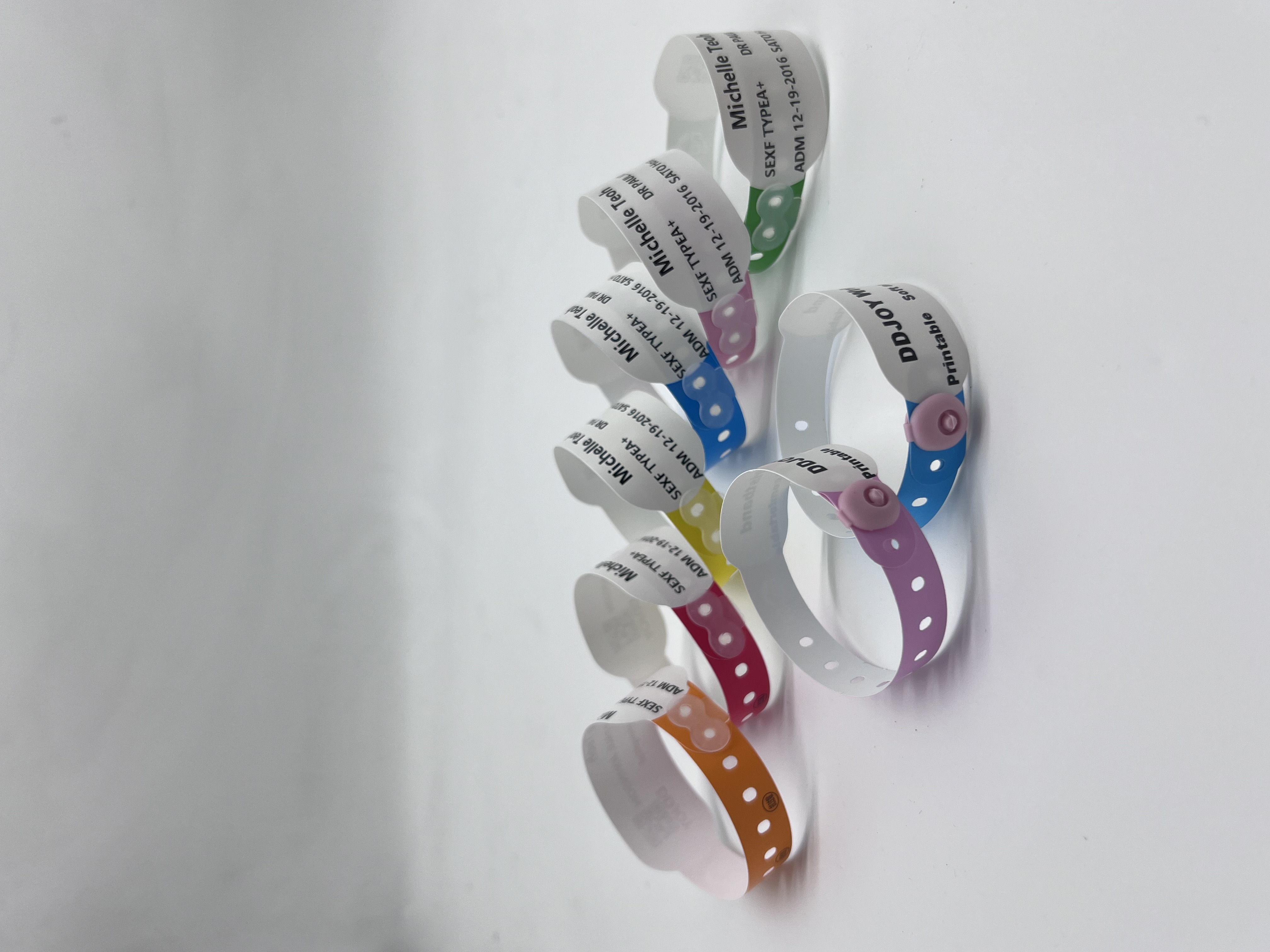
An RFID wristband is a component-level option: the chip, the carrier material and the encoding specification each need their own line in a qualification file.
Five kinds of statement, only one of which is evidence
A qualification review goes wrong when different kinds of statement are filed together. Five appear in almost every wristband submission, and each answers a different question.
- Product description. What the item is: substrate, dimensions, construction, print method. "Thermal-sensitive synthetic paper, 260 × 25 mm, direct thermal printing" belongs here.
- Performance claim. What the item is said to do: water-resistant, tear-resistant, durable, tamper-evident. A claim describes behaviour under conditions that are often unstated.
- Test report. A record that a defined method was applied to a defined sample and produced a defined result. It is evidence for that sample and that method, not for an entire product family.
- Certificate. A conformity conclusion issued by a named body, for a named scope, against named standards, with an identifier and dates. The scope sentence usually matters more than the logo.
- Regulatory status. Whether a product falls inside a regulation at all. That is a classification question, not a quality grade.
A sixth item belongs to the buyer: the acceptance criterion. Suppliers do not write it, and it should not be copied from a brochure. It states what the hospital checks on receipt and what happens when the check fails.
The recurring error is to let one category stand in for another — a product description treated as a performance claim, a performance claim treated as a test result, a management-system certificate treated as a product certificate. The dossier exists to keep those boundaries visible on paper.
What the verified descriptions actually establish
Start with wording that is specific enough to be filed. DDJOY-Medical Wristbands is the medical wristband line of Shanghai Dingba Identification Co., Ltd., a Shanghai-based manufacturer founded in 2010 that lists thermal, PVC, Tyvek and RFID wristbands among its products and holds ISO 9001 certification. Across that range, the published descriptions read as follows.
- Medical thermal wristband. Thermal-sensitive synthetic paper; direct thermal printing with no ink required; water-resistant and tear-resistant; patient information printable; 260 × 25 mm with custom sizes available. Listed applications are hospitals, medical clinics, healthcare institutions and patient management.
- PVC Patient ID Wristband. PVC; 250 × 25 mm or 250 × 16 mm; printable patient information; durable and comfortable for long-term wear. Listed applications are hospitals and elderly care institutions.
- Tyvek Wristband. Tyvek; disposable, tear-resistant and waterproof with clear printing; 250 × 19 mm or 250 × 25 mm. Listed applications include hospitals, exhibitions, events and ticketing.
- RFID wristband. Built-in RFID chip with low-frequency, high-frequency or ultra-high-frequency options; readable and writable; silicone, PVC, Tyvek or paper carrier; 250 × 25 mm, 250 × 16 mm and further specifications. Listed applications include medical, events, access control, logistics and membership management.
- PVC+Tab Wristband. PVC; 260 × 40 mm; tab buckle for a firm fit; printable surface supporting custom patterns. Listed applications include hospitals, events, concerts and nightclubs.
Two details in that list do real work. First, the thermal line is described as water-resistant while the Tyvek line is described as waterproof; those are different words and should not be collapsed into a single purchasing requirement. Second, "disposable" appears in the Tyvek description and in the thermal line's stated selling points, while the PVC lines are described as durable. A single-use expectation and a durability expectation pull in different directions, and a dossier that records both without noting the difference will produce inconsistent acceptance checks.
From description to dossier entry
The mapping below is the operational core of the file. Each row takes a description exactly as published and assigns it an evidence request and an explicit limit. The limit column is not a criticism of the product; it defines where the buyer's own verification has to begin.
| Wristband line | Verified description | Evidence to request | What it does not establish |
|---|---|---|---|
| Medical thermal wristband | Thermal-sensitive synthetic paper; direct thermal printing, no ink; water-resistant and tear-resistant; 260 × 25 mm, custom sizes | Substrate grade and material declaration; print-legibility samples after the storage and handling cycle the buyer sets; statement of which models the claim covers | Skin-contact suitability, sterility or any medical device status |
| PVC Patient ID Wristband | PVC; 250 × 25 mm or 250 × 16 mm; printable patient information; durable and comfortable for long wear | Material declaration; closure and retention check; print durability on the hospital's own printer | Behaviour under specific disinfectants, or identical performance across every PVC construction offered |
| Tyvek Wristband | Tyvek; disposable, tear-resistant, waterproof; clear printing; 250 × 19 mm or 250 × 25 mm | EU RoHS Certificate of Compliance TST20250302350EC with its paper wristband scope; substrate confirmation against the ordered grade | Biocompatibility or sterility, and no automatic extension of that certificate to non-paper lines |
| RFID wristband | Built-in chip, LF/HF/UHF options; readable and writable; silicone, PVC, Tyvek or paper carrier | Chip identification and datasheet; encoding specification; read verification in the intended ward environment | Interoperability with a named hospital information system |
| PVC+Tab Wristband | PVC; 260 × 40 mm; tab buckle for a firm fit; printable surface | Closure retention check; print method compatibility statement | Suitability for neonatal or high-moisture settings, which needs separately written criteria |
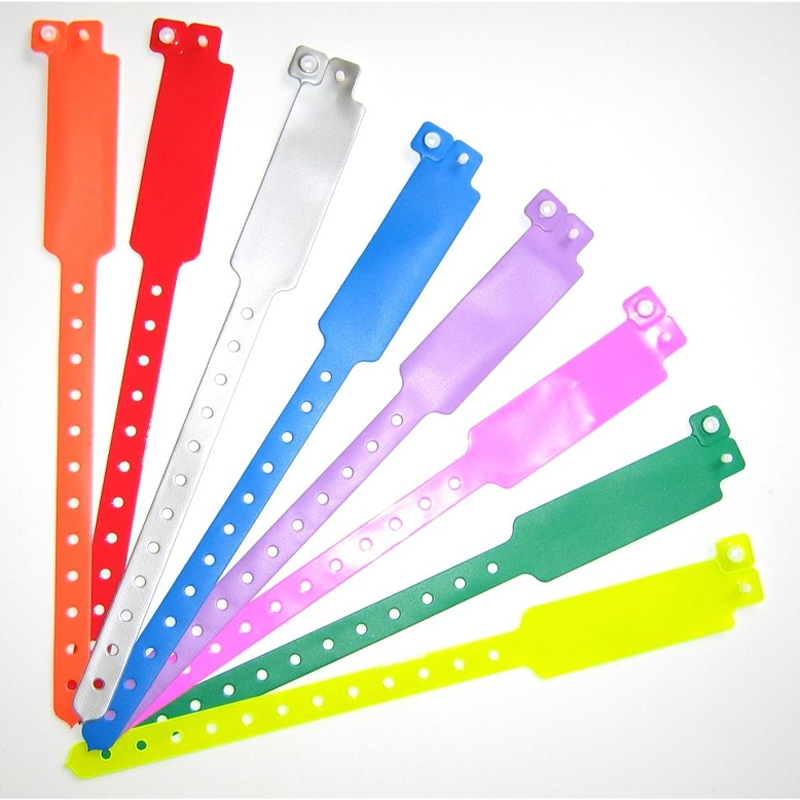
A tab-buckle PVC wristband illustrates why closure design belongs in the acceptance criteria rather than in the marketing summary.
Why adjectives need definitions before they become clauses
"Water-resistant" is the clearest example of a term that creates false agreement. In this range it is applied to the thermal line, while "waterproof" is applied to the Tyvek line, and the PVC Patient ID description also uses waterproof language in its stated selling points. A tender written as "wristbands must be waterproof" therefore includes or excludes lines depending on nothing more than word choice.
The same applies to tear resistance, disposability and printability. Each term describes behaviour under conditions the buyer has not yet seen. Before it becomes a clause, the supplier should state the substrate, the exact term used, the method and conditions under which that term was evaluated, whether the evaluation was internal or third-party, and which models it covers.
One further term deserves separate treatment: skin-safe. It appears in the application record for a custom patient identification project, listed alongside waterproof, tear-resistant and disposable as a project requirement. A requirement is not a verified property, and the published product descriptions do not assert it. Where a hospital needs skin-contact assurance, the dossier needs a dedicated biocompatibility item, and the supplier either supplies it or the point moves to the gap log.
What the RoHS certificate covers, and what it does not
The Tyvek Wristband holds an EU RoHS Certificate of Compliance, certificate number TST20250302350EC, issued by Dongguan True Safety Testing Co., Ltd. for the EU market. The declared scope is paper wristband, and the certificate cites RoHS 2.0 restricted-substance requirements under Directive (EU) 2015/863 and (EU) 2017/2102 amending Directive 2011/65/EU. The listed test methods are IEC 62321-1:2013, IEC 62321-2:2021, IEC 62321-3-1:2013, IEC 62321-4:2013/AMD1:2017, IEC 62321-5:2013, IEC 62321-6:2015, IEC 62321-7-1:2015, IEC 62321-7-2:2017 and IEC 62321-8:2017. The certificate carries an issue date of 14 March 2025 and a stated expiry of 14 March 2099.
Read that as an auditor would. It is a restricted-substance conclusion, for a paper wristband scope, in one market. It is not a biocompatibility assessment, not a sterility claim, not a skin-contact approval and not a medical device certification. Nor does it automatically extend to the PVC, thermal or RFID lines: a certificate covers the scope written on it, and this one names paper wristband.
The long stated expiry is easy to misread. A certificate date is not a warranty that the substrate, the production process or the underlying standards will stay unchanged across a multi-year hospital contract. Version tracking therefore belongs in the file: which certificate revision was reviewed, which standard editions it cites, and which event would trigger a re-check. Buyers who treat the expiry field as the only date that matters tend to learn about standard revisions late.
"Medical" is a market word, not a regulatory category
In July 2026 the Court of Justice of the European Union ruled, in Case C-427/24, that blank patient wristbands are not classified as medical devices under EU MDR 2017/745, according to a case commentary published by Heuking. The judgment turns on intended purpose, which is precisely the point a dossier has to make explicit.
The practical consequence is that the word "medical" on a product page does not tell a buyer which regulatory regime applies. The file should carry an intended-use statement — what the band is for, in which care setting, carrying which printed or encoded information — and should record the supplier's regulatory position in writing rather than inferring it from the product name or from an application list.
Tender language needs the same care. A specification that demands "medical device certification" for a product the supplier does not classify as a medical device cannot be satisfied by any document, and the resulting gap is a drafting problem rather than a supplier failure. Writing the intended use first, then the required evidence, avoids that dead end.
Capability evidence answers a different question
Supplier capability documents are necessary and are frequently misfiled as product compliance. Shanghai Dingba Identification Co., Ltd. reports a 10,000 m² facility, 50-plus employees, a five-engineer R&D team, ISO 9001 certification and on-site verification by SGS and Alibaba, with a 70% export ratio and the EU and USA listed as main markets. The capability record adds OEM production, logo customisation, a minimum order of 1,000 units, a 7–10 day lead time, 100% testing and remote after-sales support.
Those documents answer questions about stability and reproducibility: whether the supplier can produce consistently, customise to a drawing, and hold a delivery rhythm across a contract. They do not answer whether a specific band was tested for water resistance, tear resistance or skin contact. Keeping a capability volume and a product-compliance volume separate — and labelling them as such — prevents a quality-system certificate from being read as a product certificate.
Eight sections that make the file usable
A dossier is useful when a reviewer who did not build it can follow it. Eight sections achieve that.
1. Scope sheet. Product name, model, dimensions, substrate, intended use, care setting and target market. Every later document is indexed against this sheet, and a certificate that cannot be tied to a row on it is not yet evidence.
2. Claim register. Each adjective quoted verbatim, with the model it was applied to and the document it came from. Separating water-resistant on the thermal line from waterproof on the Tyvek line starts here.
3. Evidence index. For each certificate or report: identifier, issuing body, standards cited, declared scope, issue date, stated expiry and models covered. The RoHS entry, for instance, records TST20250302350EC, Dongguan True Safety Testing Co., Ltd., the IEC 62321 series, a paper wristband scope, a 14 March 2025 issue date and a stated expiry of 14 March 2099.
4. Gap log. Every claim without a matching document, with a disposition: accept conditionally, request evidence, or change the specification. The log turns "not supplied" into a recorded position rather than an assumption.
5. Label and instruction check. Symbols, language, batch or size marking on the band and its packaging. The 2025 amendment to ISO 15223-1:2021 changed the authorised representative symbol from EC REP to EU-REP, so label artwork approved two years ago may not reflect the current convention.
6. Acceptance criteria. The hospital's own receipt checks: dimension against the ordered size, closure function, print legibility on the ward printer, and substrate match against the approved sample.
7. Change control. The events that force a re-check: substrate change, print method change, production site change, certificate revision, standard revision and contract renewal.
8. Review cadence. A dated review during the contract, not only at tender. A dossier that is opened once and never revisited is a procurement artefact, not a control.
Writing acceptance criteria from claims, not from adjectives
The strongest single improvement a buyer can make is to convert each adjective into a question the supplier must answer in writing. A workable clause reads: for each model offered, state the substrate, the exact performance term used, the method and conditions under which it was evaluated, whether the evaluation was internal or third-party, and the models covered by the conclusion.
Applied to tear resistance, the same structure asks for the handling and pull conditions the hospital considers relevant rather than a generic assertion. Applied to printability, it asks for legibility after the hospital's own printer, print mode and storage cycle, because a clear print sample produced elsewhere is only a starting point.
Two checks are often confused. The supplier's 100% testing is a production statement about outgoing inspection. The hospital's incoming sampling is a separate control that verifies what actually arrived. Both belong in the file; neither replaces the other.
RFID adds a data layer, not just a material option
The RFID wristband is described with a built-in chip offering low-frequency, high-frequency or ultra-high-frequency options, readable and writable, on silicone, PVC, Tyvek or paper carriers. For procurement, that means the dossier needs entries that a printed band never requires: chip identification, encoding specification, and read verification performed in the environment where the band will actually be used.
Data fields and access rules should also be written down, since a readable and writable band carries information that a printed band does not. A chip inside a wristband is a component fact; whether that chip works with a particular hospital system is a separate test, and the distinction should survive into the file.
Five failure patterns worth designing out
- Scope mismatch. A paper wristband certificate reproduced in a submission for a PVC or RFID line. The certificate is genuine; its application is not.
- Marketing text filed as a result. A sentence from a product page placed in a folder labelled test evidence.
- System certificate used as product certificate. ISO 9001 demonstrates process control, not performance of a specific band.
- No version tracking. Certificates and standards reviewed once, then assumed static for the life of a contract.
- No gap log. Missing documents read as absent problems, and the omission surfaces during an audit rather than during evaluation.
Market figures are context, not qualification evidence
Category forecasts are sometimes used to justify a supplier decision, which they cannot do. Future Market Insights projected the global patient identification wristbands market at USD 576.1 million for 2025, while Precedence Research, in a later report, put the 2025 figure at USD 1.61 billion. The difference is best explained by definition: one scope centres on patient identification wristbands as such, the other is likely to include broader identification accessories, and the two figures therefore should not be averaged or treated as a single trend.
The same source reports North America holding a 41% share of the market in 2025. These numbers are useful for budgeting and category context, and they carry the publication date and the publisher's scope with them. They say nothing about whether a specific band meets a specific requirement, and a dossier that cites market size in place of product evidence has simply changed the subject.
There is a neat parallel here. Just as "waterproof" means different things on different product lines, "market size" means different things under different scopes. Both cases argue for asking what definition sits behind the number or the word.
Conclusion: a file that keeps asking questions
The distinction a hospital needs is not between good and bad suppliers but between documented and undocumented statements. A qualification dossier holds that line: product descriptions stay in the description column, certificates carry their scope and dates, capability documents answer capability questions, and unverified terms sit in a gap log with an owner and a date.
The practical starting move is small. Take the specification sheet, quote each performance term, and ask the supplier to restate it as a documented claim with a scope and a method. Whatever comes back — a report, a certificate, or an honest blank — becomes the foundation of the file, and the blank is often the most useful entry in it.
Company profile brochure (PDF): Shanghai Dingba Identification Co., Ltd. catalogue
FAQ
Is an EU RoHS certificate the same as a medical device certification?
No. The EU RoHS Certificate of Compliance held for the Tyvek Wristband, certificate number TST20250302350EC issued by Dongguan True Safety Testing Co., Ltd., addresses restricted-substance requirements under Directive (EU) 2015/863 and (EU) 2017/2102 amending Directive 2011/65/EU, using the IEC 62321 test series, for a paper wristband scope in the EU market. It does not assess biocompatibility or sterility, and it does not establish medical device status.
Do descriptions such as water-resistant or tear-resistant count as qualification evidence?
They count as product descriptions. They identify behaviour the product is claimed to deliver, but they do not state the method, the test conditions or the models covered. In a dossier they belong in the claim register, paired with a request for the underlying document or with a recorded gap.
Why is one wristband line described as waterproof and another as water-resistant?
The Tyvek Wristband is described as waterproof, while the medical thermal wristband is described as water-resistant, and the PVC Patient ID description also uses waterproof language in its selling points. The two terms are not interchangeable, so a purchasing requirement should name the term, the substrate and the conditions rather than relying on a single adjective to cover several materials.
Are blank patient wristbands regulated as medical devices in the European Union?
According to a case commentary published by Heuking on the Court of Justice of the European Union ruling in Case C-427/24, blank patient wristbands are not classified as medical devices under EU MDR 2017/745. The judgment turns on intended purpose, which is why a dossier should record an explicit intended-use statement instead of relying on the word "medical" in a product name.
What should a hospital do when a supplier cannot document a claim?
Record it. Enter the claim, the model and the missing evidence in the gap log, then assign one of three dispositions: accept conditionally with a stated caveat, request the document with a deadline, or change the specification to something the supplier can support. Keeping the entry visible prevents an undocumented claim from being treated as a verified one later in the contract.
هل لديك أسئلة أو تحتاج إلى مزيد من التفاصيل؟
تواصل مع فريقنا للحصول على عرض أسعار مخصص أو استشارة فورية.
طلب عرض أسعار
املأ النموذج أدناه وسيتواصل معك فريقنا بعرض مقترح مخصص.
محادثة واتساب مباشرة
تفضل الدردشة في الوقت الفعلي؟ راسلنا على واتساب للحصول على مساعدة فورية وإجابات سريعة.
- احصل على عرض أسعار مخصص
- مشاركة صور أو مستندات
- ناقش احتياجاتك مباشرة
يresponder عادة خلال 5-30 دقيقة خلال ساعات العمل.