
Medical and Food Handling: Reviewing Molded Pulp Trays
Molded pulp trays are increasingly specified in the two handling environments where packaging failures are least tolerated: food service and medical device logistics. This review compares tray configurations in both sectors against the physical demands each imposes, using published specifications and general industry knowledge rather than certification claims.
The two sectors rarely meet in the same procurement conversation, yet they converge on the same packaging format for a similar reason. Both handle items that must be positioned, separated and protected between the point of production and the point of use. Both operate under contamination-control expectations that rule out loose particulate, unsealed foam dust and unmanaged surface residue. And both are under pressure to move away from expanded polystyrene and thermoformed plastic.
For buyers, the practical question is not whether molded pulp is an environmentally attractive material. It is whether a fiber tray can meet the handling requirement of a specific regulated workflow — and where its physical limits sit. This article addresses that question directly, comparing molded pulp tray configurations rather than promoting the category.
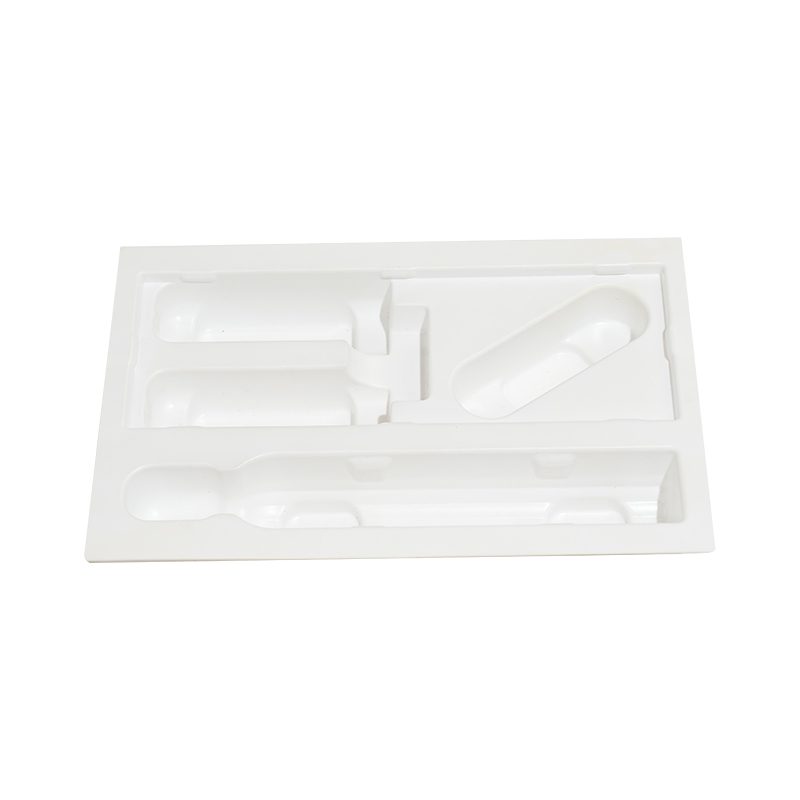
A molded fiber tray with formed cavities for handling nursing supplies — the configuration logic that also underpins medical device and food service trays.
1. Why Two Regulated Sectors Choose the Same Fiber Format
Molded pulp — also described as molded fiber — is a packaging material formed from plant fiber slurry into a three-dimensional shape. The tray is created by depositing fiber onto a shaped mold, dewatering it, and drying or hot-pressing the result. The outcome is a one-piece tray with integrated cavities, ribs and edges, rather than an assembly of folded board.
Three material properties explain the format's traction in food and medical handling:
- One-piece geometry. Cavities are formed, not cut and glued, so the tray positions a specific item with no secondary insert to shift during transit.
- Fiber cushioning. Interwoven natural fibers distribute impact across the tray body, which supports drop and vibration resistance for fragile contents.
- Low particulate behavior in the finished, treated state. Where surface finishing is applied, molded trays can be produced with low dust and no shedding, which matters in clean handling areas.
None of these properties is unique to one supplier. What differs between configurations is how the fiber body is engineered — material choice, wall thickness, pressing method, surface treatment and cavity tolerance. That is where a buyer comparison becomes useful.
2. The Physical Profile Buyers Should Read First
Before comparing sectors, buyers should be able to read a molded pulp specification sheet as a physical-performance document. The figures below are the material parameters published for general molded pulp tray production, and they apply across food grade and medical device configurations unless a specific product states otherwise.
| Parameter | Published range | What it tells a buyer |
|---|---|---|
| Raw material | Sugarcane pulp, bamboo pulp, wood pulp; recycled paper fiber | Determines fiber length, surface finish, color and strength behavior |
| Thickness | 0.8–5.0 mm, customizable | Wall thickness drives cushioning depth and cavity rigidity |
| Wet pressure (density) | 0.15–0.25 g/cm³ | Indicates forming density before finish pressing |
| Dry pressure (density) | 0.28–0.45 g/cm³ | Higher dry density generally gives a denser, smoother tray surface |
| Moisture content | ≤8–12% | Residual moisture affects dimensional stability and storage behavior |
| Edge crush strength | 3–8 kN/m | Relevant to pallet stacking and edge loading in cartons |
| Compressive strength | 2–8 MPa | Indicates resistance to top-load pressure in stacked storage |
| Temperature range | −20 °C to +80 °C (standard); −20 °C to +120 °C for food grade use | Defines the cold-chain and hot-fill envelope a tray can serve |
Two of these parameters carry disproportionate weight in regulated handling. Moisture content governs whether a tray will hold its cavity dimensions through humid storage and cold-chain condensation. Temperature range governs whether the same tray can move from a chilled environment to a heated service point without deformation.
3. Where Food Handling and Medical Handling Diverge
The two sectors share a material but not a risk model. Food handling is primarily concerned with contact suitability, moisture and grease management, and temperature cycling across service. Medical device handling is concerned with particulate control, cavity precision, drop resistance and compatibility with downstream processing steps such as gas sterilization and clean-area presentation.
| Requirement area | Food service and food processing | Medical device handling |
|---|---|---|
| Primary contamination concern | Contact suitability, moisture and oil transfer, microbial growth linked to retained moisture | Particulate generation, fiber dust, surface residue, cavity cleanliness |
| Temperature exposure | Chilled storage through hot service; food grade trays published to −20 °C to +120 °C | Ambient storage and transport, with processing steps outside the tray's own thermal range |
| Cavity precision | Moderate — separation and drainage matter more than micron-level fit | High — cavities shaped to probes, handles, catheters and surgical instrument components |
| Surface treatment | Water and oil resistance treatments, calendering for a smoother surface | Low-dust, no-shedding surfaces; virgin pulp options free of fluorescent agents |
| End-of-life expectations | Food-contact waste streams, composting and recycling routes | Hospital waste segregation, recycling where plastic taxes apply to alternatives |
A tray developed for one column does not automatically satisfy the other. A food grade tray with an oil-resistant treatment is not a substitute for a low-particulate medical configuration, and a medical cavity geometry optimized for a catheter does not deliver drainage for fresh produce.
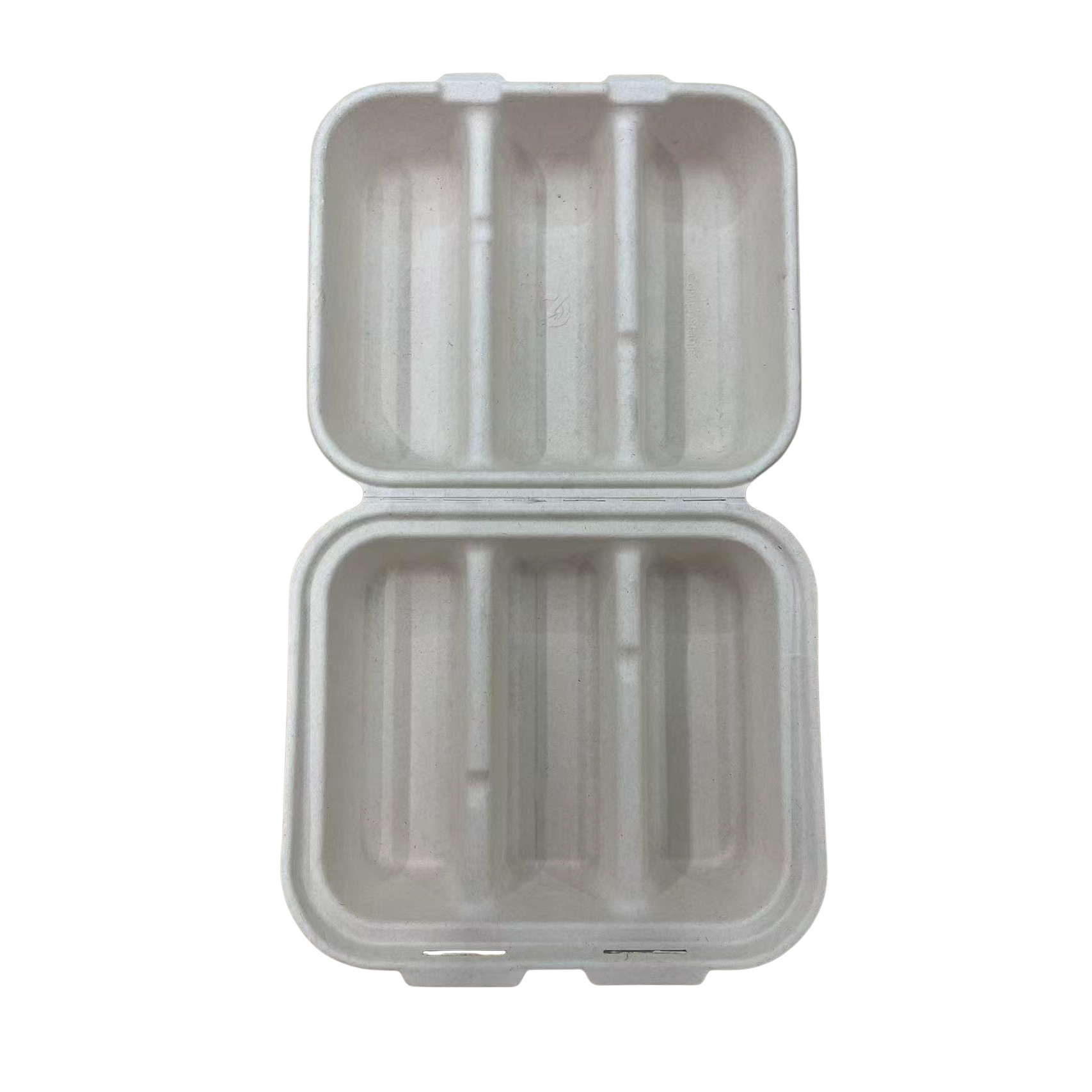
A food service configuration: the same forming principle applied to a different risk profile, with water and oil resistance taking priority over particulate control.
4. Configuration Comparison: Food Grade and Medical Device Trays
Within the molded pulp category, two named configurations are commonly quoted in regulated tenders. Both share the base material system — sugarcane pulp, bamboo pulp or wood pulp, with color available in natural, white or yellow and customization on request — but they diverge in structure and surface intent.
| Configuration | Structural emphasis | Documentation and process notes | Typical buyer |
|---|---|---|---|
| Food Grade Molded Pulp Trays | Food-safe material, cushioning and compression resistance, wide temperature adaptability, customizable size and color | Published for use from −20 °C to +120 °C; water and oil resistance treatments available | Food service operators, fresh produce packers, catering and meal assembly |
| Medical Device Pulp Trays | One-piece molding with precise positioning, shockproof and drop-resistant geometry, low dust and no shedding | Virgin wood pulp free of fluorescent agents, produced in a clean workshop, supplied with a material inspection report; supports ethylene oxide (EO) sterilization | Medical device manufacturers, sterile packaging integrators, surgical instrument suppliers |
A supporting detail matters for medical buyers: the tray is a positioning and protection component, not a sterile barrier system in itself. Its role is to hold a device through handling, sterilization processing and presentation, while the sterile barrier is provided by the pouch or wrap around it. Configurations that reference EO sterilization should be read in that context.
5. How Tonghe Paper Co., LTD Approaches the Two Sectors
Tonghe Paper Co., LTD is a molded pulp manufacturer based in Dongguan, Guangdong Province, China, converting recycled paper and bagasse fiber, together with sugarcane pulp, bamboo pulp and wood pulp, into formed fiber packaging. The company operates a 23,000 m² facility with 160 employees and 12 engineers, and reports an annual output of 12,000 tons with monthly capacity of up to 1,000 tons across automated production bases equipped for forming and hot pressing.
Three capabilities are directly relevant to a food or medical tray program:
- In-house mold development. Cavity geometry, ribs and edge profiles are developed internally, which is what allows multi-specification and irregular integrated structures rather than only conventional formats. For medical devices, cavities can be shaped to probes, handles, catheters and surgical instrument components.
- Surface and material options. Calendering improves surface smoothness and reduces paper scraps — a relevant point where particulate control matters. Water and oil resistance treatments are available for food-contact programs, and modified pulp can be produced as an anti-static version for electronic or component handling.
- Material segregation. Virgin wood pulp options free of fluorescent agents are produced in a clean workshop with a material inspection report, which allows a medical program to be separated from recycled-fiber lines.
For buyers evaluating continuity rather than a single order, the company reports a 50% export ratio with customers in the EU, USA, Australia, Saudi Arabia, Malaysia and Brazil. The practical implication is that export documentation routines and specification dialogue in English are already part of the operating pattern — not an added service layer.
6. Limits and Boundaries of Molded Pulp in Regulated Handling
A credible comparison has to state where the material stops working. Molded pulp has four boundaries that matter in food and medical programs.
- It is not hermetic. Fiber trays are porous by nature. They do not provide a moisture or microbial barrier on their own, which is why medical configurations are used inside a separate sterile barrier and food configurations rely on the tray's role as a mechanical carrier rather than a seal.
- Moisture is the governing variable. Published moisture content sits at ≤8–12%. Trays held in high-humidity storage, or in direct contact with free liquid over long periods, can lose strength and dimensional stability. Water and oil resistance treatments reduce this risk but do not remove it.
- Dimensional tolerance is looser than thermoforming. Wet-press fiber forming produces excellent overall fit but not the same repeatability as a thin-gauge thermoformed cavity. Programs requiring very tight tolerances should validate with samples rather than rely on drawings alone.
- Every new geometry carries tooling. Because the cavity is formed by a mold, a design change means mold work. Buyers planning multiple SKU variants should confirm how many cavities can be carried in one tool before committing to a format.
7. Use Cases Across the Two Sectors
Molded pulp trays are used in static storage and passive protective packaging, typically downstream of a packaging assembly line. In food handling, that means disposable food pulp trays, meal and lunch box formats, cutlery trays, fresh produce trays and egg trays, where the tray separates items, allows airflow and manages surface moisture. In medical handling, it means device trays with formed cavities for instruments and consumables, presented in clean assembly areas and moved through sterilization processing.
Adjacent categories follow the same logic and are often quoted alongside: cosmetic packaging pulp trays for insert-fit presentation, protective molded pulp packaging for electronics and lighting, and heavy duty molded pulp trays for heavier industrial contents. Buyers comparing configurations across these categories should expect the same base specification and a different cavity and finishing plan.
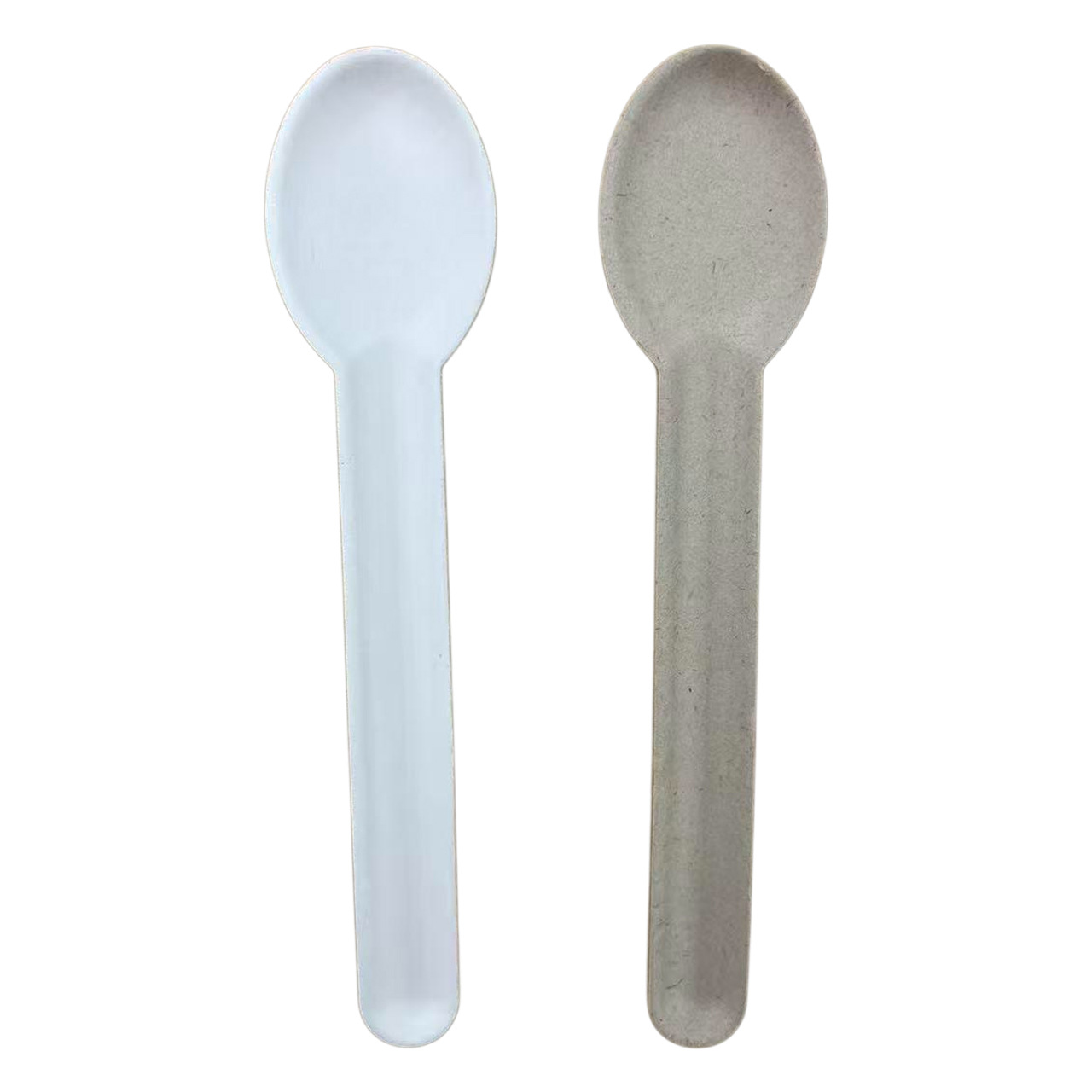
Cutlery and small-item cavities show how a single fiber tray can separate multiple components — a requirement shared by meal kits and instrument kits.
8. Market Signals Behind the Shift
The category is expanding on both a volume and a regulatory basis. According to Grand View Research, the global molded pulp packaging market was valued at USD 6.2 billion in 2025 and is projected to reach USD 10.2 billion by 2033. The same source reports that Asia Pacific held a 41.0% revenue share in 2025, with China holding the largest market share, and that the tray segment alone accounted for over 41.0% of global revenue in 2025.
The regulated end of the market is growing faster than the category average. Mordor Intelligence projects molded pulp for healthcare and medical devices to grow at an 8.6% CAGR, citing sterilization standards and hospital plastic bans as drivers. On the regulatory side, the European Packaging and Packaging Waste Regulation (EU) 2025/40 entered into force on 11 February 2025 and requires all packaging to be recyclable by 1 January 2030 — a direction that favors fiber formats over multi-material laminates.
For buyers, the read-through is straightforward: the supply base for molded pulp trays is deepening in Asia Pacific, the tray format is the dominant product structure, and the medical segment is the fastest-moving regulated niche. That combination usually shortens the distance between a trial order and a standard specification.
9. Molded Pulp Compared with Traditional Tray Materials
Buyers rarely compare molded pulp in isolation. It is usually measured against expanded polystyrene foam, thermoformed PET or PVC, and corrugated board inserts. The comparison below is qualitative and based on material behavior rather than on any single supplier's performance.
| Criterion | Molded pulp / molded fiber | EPS foam | Thermoformed PET/PVC | Corrugated insert |
|---|---|---|---|---|
| Recyclability | Recyclable as paper fiber and biodegradable in composting conditions | Limited take-back infrastructure in most markets | Recyclable where collection exists; often multi-material | Recyclable as paper fiber |
| Particulate behavior | Low dust and no shedding in finished, calendered medical configurations | Can shed beads and dust | Low dust, but static attraction is common | Cut edges can release fiber dust |
| Cushioning geometry | Formed cavities in one piece; no secondary insert | Formed cavities, high cushioning | Shallow cavities; deeper draws need thicker sheet | Requires folding and inserts |
| Moisture resistance | Hygroscopic; treatments reduce but do not eliminate absorption | High | High | Low without coating |
| Dimensional repeatability | Good overall fit; looser than thermoforming | Moderate | High | Low for complex cavities |
| Tooling implication | Mold required per cavity geometry | Mold required | Mold required | Die cutting only |
The honest conclusion is that molded pulp wins on end-of-life and on particulate behavior in treated medical configurations, holds parity on cushioning when the cavity is well designed, and loses to plastic formats on moisture resistance and on the tightest tolerance bands. Programs that require a barrier should plan for one — either a treatment, an inner liner, or a separate sterile barrier.
10. A Buyer Evaluation Sequence
For teams at the research stage, the following sequence works for both sectors and avoids the most common evaluation error, which is testing a tray outside its intended handling conditions.
- Define the risk model first. Food contact suitability and moisture management, or particulate control and cavity precision. The answer determines the configuration before any supplier is contacted.
- Write the physical requirement as numbers. Thickness within 0.8–5.0 mm, moisture content target inside the ≤8–12% band, edge crush within 3–8 kN/m and compressive strength within 2–8 MPa.
- Confirm the temperature envelope. Standard trays are published to −20 °C to +80 °C; food grade configurations to −20 °C to +120 °C. Cold-chain and hot-service steps should both be listed.
- Request samples and test the actual failure mode. Drop, vibration and stacked storage testing on a physical sample answers more than a specification sheet.
- Ask how the cavity was developed. In-house mold capability determines how quickly a variant or a design correction can be delivered.
- Agree on the documentation set. For medical configurations, the material inspection report and the clean-workshop production route are part of the specification, not an optional extra.
11. Future Outlook
Two trajectories are likely to shape molded pulp tray specifications through the rest of the decade. The first is the medical segment's growth rate, which sits above the category average and pulls tray design toward tighter cavity precision, cleaner production routes and better particulate control. The second is the recyclability deadline embedded in EU packaging regulation, which pushes food service away from multi-material formats and toward mono-material fiber.
Both trajectories put pressure on the same technical frontier: moisture and barrier performance. Fiber trays will keep improving through surface treatments, calendering and fiber selection, but the material's porous nature is a defining property rather than a defect. Buyers should expect the strongest near-term progress in cavity design and surface finishing, and should continue to specify a separate barrier wherever a barrier is genuinely required.
12. FAQ
What distinguishes a food grade molded pulp tray from a standard molded pulp tray?
A food grade configuration is specified for food contact and published with a wider temperature envelope: −20 °C to +120 °C, compared with −20 °C to +80 °C for standard use. It is produced from sugarcane pulp, bamboo pulp or wood pulp with no harmful chemical additives, and can be supplied with water and oil resistance treatments. Standard trays share the same base material but are specified for non-contact protective packaging.
Can molded pulp trays be used where medical devices undergo EO sterilization?
Medical Device Pulp Trays are documented as supporting ethylene oxide sterilization. The tray's function in that process is positioning and mechanical protection — it holds the device through handling, sterilization and presentation. The sterile barrier itself is provided by the pouch or wrap around the tray, not by the fiber body.
Do fiber trays create dust or particulate contamination in clean handling areas?
Finished medical configurations are specified as low dust and no shedding, and calendering is used to improve surface smoothness and reduce paper scraps. Cut-edge corrugated inserts behave differently and can release fiber dust. Particulate behavior should be confirmed on a physical sample for the specific finishing route.
Which physical parameters should be verified before approving a tray?
Thickness (0.8–5.0 mm, customizable), moisture content (≤8–12%), edge crush strength (3–8 kN/m), compressive strength (2–8 MPa), and wet and dry density (0.15–0.25 g/cm³ and 0.28–0.45 g/cm³). Moisture content and temperature range are the two parameters most likely to determine whether a tray holds its cavity dimensions in service.
Are molded pulp trays suitable for frozen and hot food service?
Food grade configurations are published for use from −20 °C to +120 °C, which covers chilled, frozen and hot service points. Standard molded pulp is published to +80 °C. Grease and moisture management still depends on the applied water and oil resistance treatment rather than on the fiber alone.
What customization is possible in a molded pulp tray program?
Material can be selected across sugarcane pulp, bamboo pulp and wood pulp; color is available in natural, white or yellow and can be customized; thickness, size and cavity geometry are made to order; and multi-specification or irregular integrated structures can be developed where in-house mold capability exists. Anti-static versions are also possible through modified pulp.
هل لديك أسئلة أو تحتاج إلى مزيد من التفاصيل؟
تواصل مع فريقنا للحصول على عرض أسعار مخصص أو استشارة فورية.
طلب عرض أسعار
املأ النموذج أدناه وسيتواصل معك فريقنا بعرض مقترح مخصص.
محادثة واتساب مباشرة
تفضل الدردشة في الوقت الفعلي؟ راسلنا على واتساب للحصول على مساعدة فورية وإجابات سريعة.
- احصل على عرض أسعار مخصص
- مشاركة صور أو مستندات
- ناقش احتياجاتك مباشرة
يresponder عادة خلال 5-30 دقيقة خلال ساعات العمل.