
Meeting Global Standards: Parking Lift Compliance Essentials
Meeting Global Standards: Parking Lift Compliance Essentials
Compliance for a parking lift is rarely a single document or a single certificate. For equipment such as a 2 post parking lift, a 4 post parking lift, or a hydraulic car parking lift, compliance is the sum of verifiable parameters — rated lifting capacity, allowed vehicle envelope, drive mode, electrical specification and installation envelope — combined with the quality-management and safety standards under which the equipment is designed and manufactured. Buyers who understand those parameters early can qualify a supplier and a configuration before engineering drawings and civil works begin. Buyers who treat compliance as a final paperwork step often discover a mismatch after the pit has been dug or the power supply has been ordered.
This guide is an industry reference, not a certification statement. It explains how parking lift compliance is assembled from published equipment data, using specifications published by Mutrade Industrial Corp. (brand: MUTRADE), a Chinese manufacturer of mechanical parking equipment established in 2009, together with third-party market and standards references.
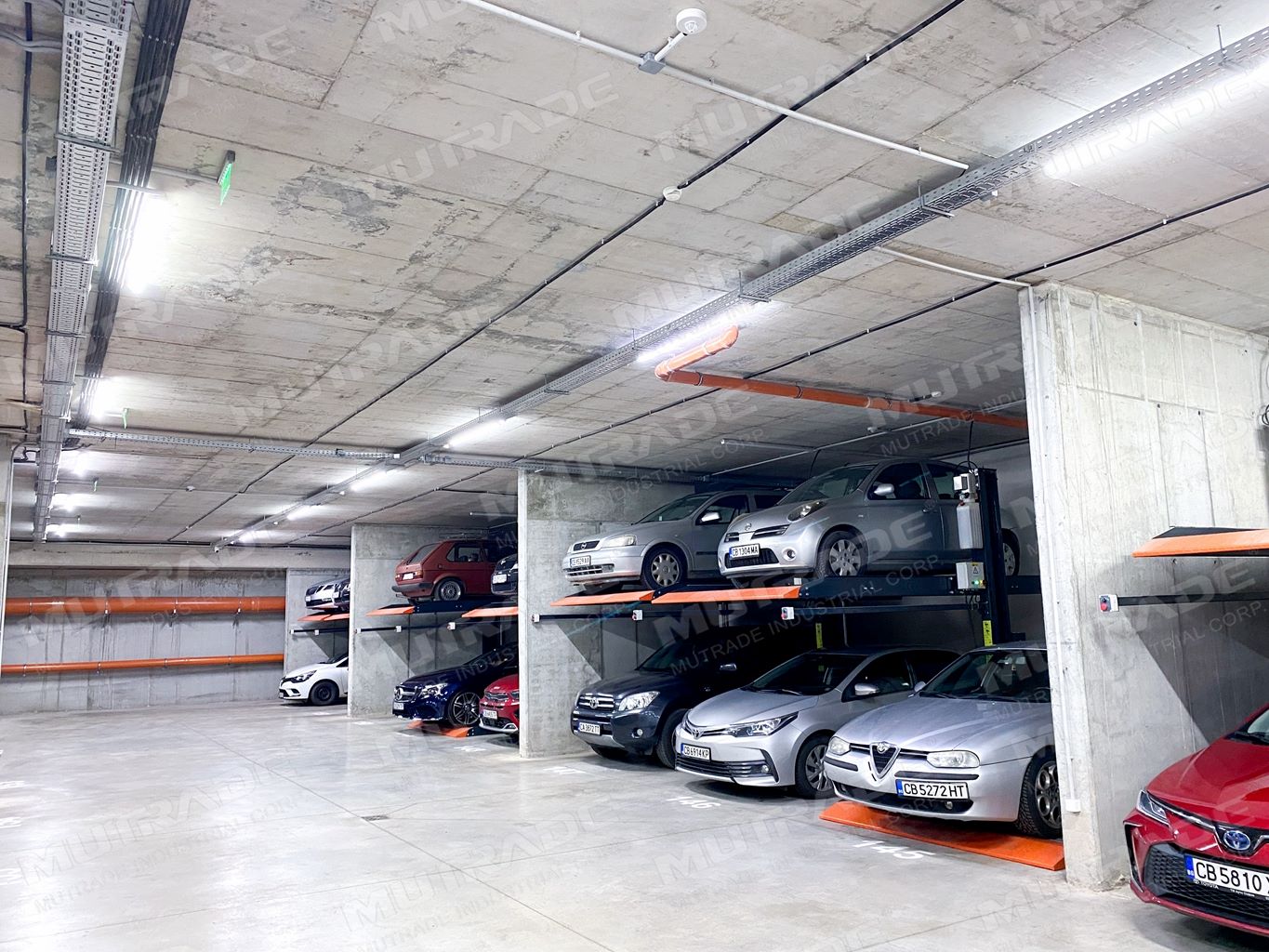
A two-level parking lift in a completed installation. Project-level compliance starts with matching published equipment parameters to the actual site.
Why Compliance Is a Parameter Problem Before It Is a Paperwork Problem
A car parking lift system is installed equipment, and most of the compliance questions a buyer faces are technical rather than administrative. Four failure modes account for a large share of project delays:
- Capacity mismatch. The rated lifting capacity of a unit is defined for a specific vehicle size and weight. If the heaviest vehicle scheduled for a platform exceeds the rated capacity, or exceeds the allowed vehicle envelope, the configuration has to be changed.
- Electrical mismatch. A parking lift built for one market's supply voltage cannot simply be connected to another market's grid. Where the power supply is described as bespoke, the motor, control panel and hydraulic power unit are specified at the order stage.
- Envelope mismatch. Pit-type and low-ceiling products are defined by required pit depth and required ceiling height. A site that cannot provide either has fewer options, not more.
- Documentation mismatch. Quality-management and safety standards sit alongside product parameters, but they do not replace them.
The opportunity is straightforward: because the parameters are published, they can be checked before purchase rather than after delivery.
The Five Parameter Groups That Define Parking Lift Compliance
Across the product categories used in residential, commercial, public and industrial parking projects, compliance-relevant data falls into five groups.
- Load and capacity parameters — rated lifting capacity and the number of vehicles parked per unit.
- Vehicle envelope parameters — allowed car length, width and height.
- Drive and control parameters — hydraulic cylinder with chains, hydraulic cylinder with wire rope, hydraulic cylinder with cable, and operation via key switch, push buttons, code and ID card, or IC card and touch screen.
- Electrical parameters — supply voltage and frequency, and whether the supply is fixed or bespoke.
- Installation envelope parameters — required pit depth, required ceiling height, indoor or outdoor use, and ambient temperature range.
Material specification belongs to this picture as well: across the parking lift range described in the company's published data, structural steel is consistently specified as carbon steel, with grade Q235 stated for the great majority of models, and customization listed as acceptable.
Compliance-Relevant Parameters: Representative MUTRADE Parking Lift Models
| Model | Vehicles per unit | Rated lifting capacity | Allowed vehicle envelope (L × W × H) | Drive mode | Power supply |
|---|---|---|---|---|---|
| Hydro-Park 1127 & 1123 (2 post parking lift) | 2 | 2700 kg (1127) / 2300 kg (1123) | 5000 × 1850 × 2050 mm | Hydraulic cylinder + chains | Bespoke, 110–480 V, 50/60 Hz |
| TPTP-2 (tilting, low ceiling) | 2 | 2000 kg | 5000 × 1850 × 1550 mm | Hydraulic cylinder | Bespoke, 220 V, 50/60 Hz |
| Hydro-Park 2136 (4 post parking lift) | 2 | 3600 kg | 4566 × 2560 × 2442 mm | Hydraulic cylinder + cable | Bespoke, 110–480 V, 50/60 Hz |
| Hydro-Park 3130 (triple stacker) | 3 | 3000 kg | 6772 × 2070 × 2000 mm | Manual with handle | Bespoke, 208–480 V, 50/60 Hz |
| Hydro-Park 3230 (quad stacker) | 4 | 3000 kg | 8912 × 2100 × 2000 mm | Manual with handle | Bespoke, 208–480 V, 50/60 Hz |
| Hydro Park 2525 & 2625 (3 car lift) | 3 | 2500 kg (2F) / 2000 kg (3F) | 5060 × 2802 × 2050 mm | Hydraulic cylinder + chains | Bespoke, 110–480 V, 50/60 Hz |
| Starke 2127 (underground / pit) | 2 | 2700 kg | 5000 × 2050 × 1700 mm | Hydraulic cylinder + chains | Bespoke, 200–450 V, 50/60 Hz |
| Starke 2227 (underground / pit, double unit) | Double unit | 2000 kg or 2500 kg | 5000 × 1850 × 1550 or 2050 mm | Hydraulic cylinder + wire rope | Bespoke, 380 V, 50/60 Hz |
| Hydro-Park 1027 (single post) | 2 | 2700 kg | 4148 × 2679 × 2000 mm | Hydraulic cylinder + chains | Bespoke, 110–480 V, 50/60 Hz |
| S-VRC-2 (scissor lift platform) | 2 | 3000 kg | 2000–6000 × 2000–3000 × 2000–6000 mm | Hydraulic cylinder | Bespoke, 208–480 V, 50/60 Hz |
| MLP Series (automated / robotic) | 50–120 | 2350 kg | 5300 × 1900 × 2050 mm | Hydraulic cylinder + chains | Bespoke, 110–480 V, 50/60 Hz |
| ATP Series (fully automatic tower) | 50–120 | 2350 kg | 5300 × 1900 × 2050 mm | Hydraulic cylinder + chains | Bespoke, 110–480 V, 50/60 Hz |
| ARP Series (rotary / carousel) | 8–20 | 2000 kg (sedans) / 2500 kg (SUVs) | 5300 × 2100 × 1600 or 2100 mm | Hydraulic cylinder + chains | Bespoke, 480 / 415 / 380 / 220 V, 50/60 Hz |
Representative published parameters for MUTRADE parking lift models. Values apply per unit or per level as stated; the final configuration should be confirmed against the specific project.
Capacity Ratings and Vehicle Envelopes: Reading the Numbers Correctly
Capacity is the first number buyers compare, and it is the most frequently misread. A rated lifting capacity applies to a defined vehicle envelope of length, width and height. A unit rated at 2700 kg is not automatically suitable for every vehicle below that weight, because platform geometry, allowed vehicle height and load distribution also constrain the design.
The Starke 2127 shows how the parameters work together. It is an underground parking lift intended for pit and double-unit parking scenarios, parks 2 vehicles per unit, and carries a rated lifting capacity of 2700 kg. Its allowed vehicle envelope is 5000 mm in length, 2050 mm in width and 1700 mm in height. The drive mode is a hydraulic cylinder with chains, lifting time is 30 seconds, operation is via key switch, the power supply is bespoke at 200–450 V, 50/60 Hz, and the structure is carbon steel Q235. Customization is listed as acceptable.
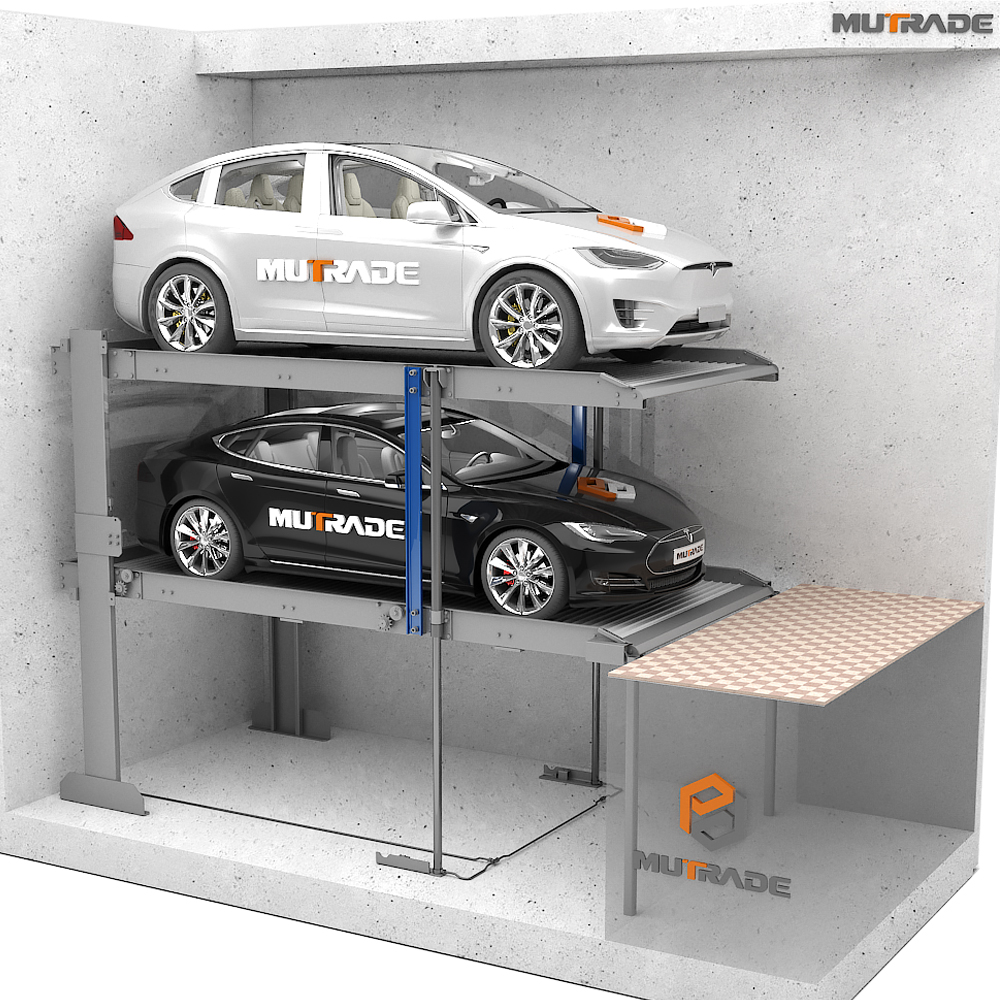
The Starke 2127 pit parking lift: 2 vehicles per unit, 2700 kg rated capacity, 5000 × 2050 × 1700 mm allowed vehicle envelope.
Two details deserve attention. First, the 1700 mm height allowance is a compliance boundary, not a preference: a vehicle taller than the envelope cannot be stored on that platform regardless of its weight. Second, the 200–450 V power supply range is described as bespoke, which means the electrical configuration is defined at the order stage rather than selected from a stock list.
Where the Starke 2227 Differs
The Starke 2227 belongs to the same underground and pit parking family but is configured differently. It is designed for commercial, residential and underground parking applications and is constructed from carbon steel Q235. Its drive mode is a hydraulic cylinder with wire rope, with a lifting speed of 8–12 m/min. Published rated lifting capacity is 2000 kg or 2500 kg, and the allowed vehicle envelope is 5000 mm in length, 1850 mm in width, and 1550 mm or 2050 mm in height depending on configuration. Operation is via button and IC card, the power supply is bespoke at 380 V, 50/60 Hz, and customization is acceptable.
The comparison is instructive for qualification. Two models in the same product family can differ in drive mode (chains versus wire rope), in control interface (key switch versus button and IC card), in rated capacity and in specified voltage. A buyer comparing parking lifts as a single category will miss those differences; a buyer comparing parameter sets will not.
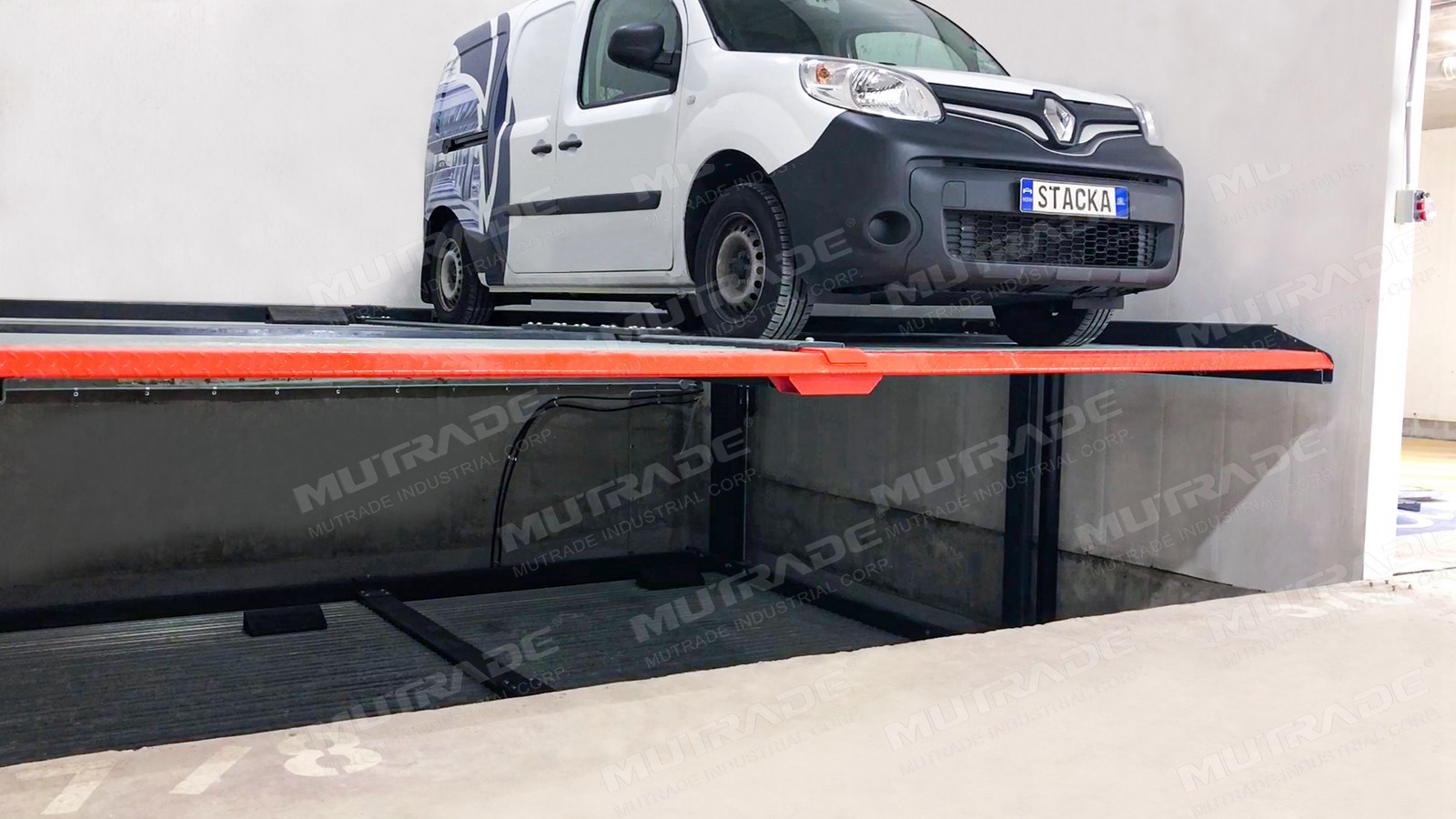
The Starke 2227 uses a hydraulic cylinder and wire rope drive with a bespoke 380 V, 50/60 Hz supply and button plus IC card operation.
Electrical Specification: The Most Common Site-Level Compliance Gap
Voltage is often treated as a commercial detail. In practice it is one of the first technical constraints that decides whether a parking lift can be commissioned on a given site. The published power supply data across the MUTRADE range shows how wide the specification band is:
- Bespoke 110–480 V, 50/60 Hz: Hydro-Park 1127 & 1123, Hydro Park 2525 & 2625, Hydro-Park 1027, MLP Series, ATP Series.
- Bespoke 208–480 V, 50/60 Hz: Hydro-Park 3130, Hydro-Park 3230, S-VRC-2.
- Bespoke 200–450 V, 50/60 Hz: Starke 2127.
- Bespoke 380 V, 50/60 Hz: Starke 2227.
- Bespoke 220 V, 50/60 Hz: TPTP-2.
- Bespoke 480 V / 415 V / 380 V / 220 V, 50/60 Hz: ARP Series.
For a buyer, three questions follow. Does the destination market's supply match the specified voltage and frequency? Does the control system require a particular phase configuration? And is the supply described as bespoke, meaning it must be confirmed in writing before production begins? Because several models are explicitly specified as bespoke within a voltage range, the electrical configuration is a project input rather than a catalogue constant.
There is a broader compliance implication. Equipment cannot be validated against a site's electrical installation until the site's supply is known, and a mismatch discovered after manufacturing is expensive to reverse. Electrical specification therefore belongs in the same checklist as mechanical capacity, not in a separate commercial annex.
Installation Envelope: Pit Depth, Ceiling Height and Environmental Conditions
Pit-type and underground models are defined as much by the building as by the equipment. Two MUTRADE models state their installation requirements as hard figures: the Starke 2327 and the BDP-2 both require a pit depth greater than 1600 mm and a ceiling height greater than 2700 mm, and both accept a vehicle height of up to 1550 mm. The Starke 2327 carries a rated lifting capacity of 2700 kg, while the BDP-2 is listed at 2700 kg with an allowed vehicle envelope of 5000 mm × 2050 mm × 1550 mm. Both belong to the pit-stack, underground garage and tilted pit categories.
Where ceiling height is the binding constraint, a tilting configuration exists for that purpose. The TPTP-2 is a tilting car parking lift, also classified as a low ceiling car parking lift, operated by key switch with a hydraulic system, a rated voltage of 220 V, 50/60 Hz and carbon steel Q235 construction. It is intended for underground and residential parking scenarios.
Environmental conditions form the last part of the installation envelope. Parking lift applications are documented for indoor use and for outdoor use where an outdoor package option is applied, with an ambient temperature range of −15 °C to +40 °C and a proper concrete foundation. For outdoor installations, published application requirements include rust resistance against snow and melt agents, bespoke colour, and dimensions customized to project conditions. These are compliance-relevant because they describe the boundary conditions under which the equipment is intended to operate.
Standards, Documentation and What Buyers Should Ask For
Product parameters are only one half of qualification. The other half is the management system behind the product. Third-party standards guidance indicates that automated parking systems must comply with ISO 9001 for quality management and ISO 45001 for occupational health and safety in order to mitigate risks such as vehicle-pedestrian conflict. Those standards describe how an organisation manages quality and safety; they do not by themselves certify that a specific parking lift is compliant for a specific site.
That distinction matters in procurement. A buyer should be able to obtain documented product parameters — capacity, envelope, drive mode, control interface, power supply and installation requirements — and should be able to map each of them to the project. Certification, permitting and approval requirements are set by national and local authorities and vary by market; the equipment specification supports that process but does not replace it.
Practical rule: treat quality-management and safety standards as a supplier qualification question, and treat capacity, envelope, electrical and installation data as the product compliance question. A supplier that answers one but not the other has not completed qualification.
Mutrade Industrial Corp. in Context: Manufacturer Facts Relevant to Qualification
Mutrade Industrial Corp. is a mechanical parking equipment manufacturer established in 2009 in Qingdao, China. Its product portfolio covers parking lifts, semi-automatic parking systems, fully automatic parking systems and car lifts. The manufacturing facility covers 12,000 m² and employs approximately 100 staff, supported by an R&D team of 7 engineers. Annual production is approximately 10,000 parking spaces, and export business accounts for 99% of sales, with customers supported in more than 100 countries. Customization is listed as acceptable across the parking lift range, and the typical production lead time is 30–45 days.
For buyers at the research stage, these facts matter because they connect the parameter data to a production reality: a stated capacity or envelope is meaningful only if the manufacturer can produce it consistently and to the required configuration. Across the range described in this article, the consistent structural specification is carbon steel, with grade Q235 stated for the great majority of models.
Application and Use Cases
Parking lift applications are documented across residential parking projects, commercial parking projects, public parking projects, industrial and corporate parking projects, and transportation hub parking projects. The functions attributed to these systems are consistent across markets: expanding parking capacity, maximizing the use of existing space, reducing land cost, meeting municipal code requirements related to parking and planning approval, improving property value through additional parking and better resident experience, and generating revenue from additional spaces.
Indoor Storage and Warehousing
One documented scenario is indoor car warehousing, where the objective is to store multiple cars within an existing warehouse or parking area, typically across 2–4 levels, in long-term storage mode under indoor covered conditions. Supporting equipment for this scenario includes independent or centralized hydraulic power units, an electric control system and safety protection devices. Documented special requirements include manual car removal in the event of a power failure, remote control, and private-label branding.
Model-to-Scenario Fit
Several product-to-application relationships are documented rather than inferred. The Hydro-Park 1127 and 1123 two post parking lifts are described for residential parking and valet parking scenarios in the car storage industry. The Starke 2127 and Starke 2227 are intended for residential and commercial parking as underground, pit-type installations. The Hydro Park 2525 & 2625 three car lifts are described for car storage, car dealership, car collection and car club industries. The MLP Series automated robotic parking lift is intended for commercial parking, office buildings and shopping malls, while the ATP Series fully automatic tower is intended for the car parking industry with a capacity of 50–120 vehicles per unit.
Matching those documented relationships to the project scenario is itself a compliance step: a model intended for long-term indoor storage is not automatically the right specification for a public facility with high daily turnover, and vice versa.
Market Trend Analysis
Several third-party data points frame why parameter-level qualification is becoming more important rather than less.
- The global car lifts market, including parking and service lifts, was valued at USD 2.8 billion in 2025 and is projected to reach USD 4.7 billion by 2034 (Dataintelo).
- The specific global market for car stacker lifts was valued at approximately USD 4.6 billion in 2023 and is expected to grow to USD 6.72 billion by 2030 (QYResearch).
- North America is identified as the largest and fastest-growing vehicle lift market, valued at USD 3.25 billion in 2024, driven by high light truck ownership (Custom Market Insights).
- Hydraulic mechanisms hold the leading share of the global car lift market at 57.2%, attributed to their reliability in heavy-duty applications (Dataintelo, 2025).
- According to company information citing Chinese customs data, MUTRADE and its production facility Hydro Park accounted for over 18% of China's total export volume of mechanical parking equipment (HS Code: 84289020) since 2017.
Two caveats belong with these figures. First, market definitions diverge: estimates of the broader parking market range from USD 4.4 billion for parking management services to USD 2.8 billion for car lift hardware, so figures should not be combined or compared across definitions. Second, the lift market includes vehicle service lifts as well as parking equipment; for example, BendPak is identified as a major player in the North American vehicle lift market and operates the world's first eight-armed car lift (Octa-Flex) as of 2024, which is a service-lift development rather than a parking product. Buyers comparing categories should keep that scope difference in mind.
Parking Lifts Compared with Traditional Multilevel Construction
The traditional alternative to a mechanical parking lift is additional building volume — a multilevel car park structure. Published manufacturer comparison data indicates that parking lifts cost 40% less than multilevel car park buildings for urban area applications. The comparison is not only financial: lift-based systems multiply capacity within an existing footprint, can be installed in existing buildings, and can be configured in stages as demand grows.
| Consideration | Mechanical parking lift | Multilevel car park building |
|---|---|---|
| Capital cost (urban applications) | Described as 40% lower in published manufacturer comparison data | Higher baseline; civil structure dominates cost |
| Space strategy | Multiplies capacity within an existing footprint; 2–4 vehicles per stacker unit, 50–120 in tower systems | Requires dedicated new building volume |
| Site prerequisites | Depends on type: pit models require pit depth > 1600 mm and ceiling height > 2700 mm; low-ceiling models accept vehicles up to 1550 mm in height | Civil, structural and planning prerequisites for new construction |
| Throughput | Defined by lifting time per unit — for example 30 s, 68 s or 120 s depending on model | Defined by ramp and circulation design |
| Local approval | Required; requirements differ by market and are not determined by the equipment specification alone | Required |
Comparison of mechanical parking lifts and multilevel car park construction at the level of published data. Cost and throughput characteristics are described in general terms unless a figure is attributed.
The limitations of the lift approach should be stated plainly, because they are the reason qualification exists. Pit-type lifts require civil work and drainage considerations, and two documented pit models require a pit deeper than 1600 mm and a ceiling higher than 2700 mm. High-capacity stackers such as the Hydro-Park 3130 and Hydro-Park 3230 are operated manually with a handle, which suits storage environments but not every public use case. Per-unit throughput is bounded by lifting time, so a single unit serving several vehicles will queue at peak periods. Outdoor installations require an appropriate package and site preparation, with a documented operating range of −15 °C to +40 °C. And no equipment specification substitutes for local permitting, which remains a site-specific process.
Future Outlook
The direction of the market suggests three shifts that will affect how buyers qualify parking lifts.
First, hydraulic drive remains the dominant mechanism, holding 57.2% of the global car lift market according to Dataintelo, which means the parameters that matter for compliance — cylinder type, chain or cable configuration, hydraulic power unit specification — are likely to remain the centre of technical evaluation.
Second, the growth of the car stacker segment, from approximately USD 4.6 billion in 2023 toward USD 6.72 billion by 2030 according to QYResearch, points toward more installations in existing buildings rather than new construction. In existing buildings, pit depth and ceiling height become the decisive constraints, and low-ceiling or non-pit configurations gain relative importance.
Third, voltage and control-interface flexibility is likely to keep mattering. The published data already shows bespoke power supplies spanning 110–480 V and multiple control interfaces from key switch to IC card and touch screen. As export volumes grow — MUTRADE alone reports export business at 99% of sales — the ability to specify electrical and control parameters accurately at the order stage becomes a qualification criterion rather than an afterthought.
What is unlikely to change is the underlying principle: compliance is confirmed parameter by parameter, against a specific site, before production begins.
Frequently Asked Questions
What does compliance mean for a parking lift in practical terms?
In practice, compliance means that published equipment parameters match the site and the vehicles. The parameters that must match are rated lifting capacity, allowed vehicle envelope (length, width and height), drive mode, control interface, electrical supply and installation envelope. A pit-type model such as the Starke 2127, for example, is rated at 2700 kg with an allowed vehicle envelope of 5000 mm × 2050 mm × 1700 mm and a bespoke 200–450 V, 50/60 Hz supply. Management-system standards such as ISO 9001 and ISO 45001 address how a supplier controls quality and safety, but they do not replace parameter matching.
Which technical parameters should buyers compare first when evaluating a car parking lift system?
Start with capacity and the vehicle envelope, because they define what can physically be stored. Then check drive mode, lifting time and control interface, because they define how the system is used. Finally confirm the electrical supply and the installation envelope, because they define whether the system can be installed and commissioned at all. For reference, published figures across MUTRADE models range from 2000 kg to 3600 kg for stacker-type units, with lifting times from 24 seconds to 120 seconds depending on model.
Why does the power supply voltage of a parking lift matter for compliance?
Because the supply is often specified as bespoke, which makes voltage a project input rather than a fixed catalogue value. Published MUTRADE specifications include bespoke 380 V, 50/60 Hz for the Starke 2227, 220 V, 50/60 Hz for the TPTP-2, 200–450 V for the Starke 2127, and 110–480 V or 208–480 V across stacker, tower and platform models. If the specified voltage does not correspond to the available site supply, the equipment cannot be commissioned as designed.
Can a parking lift be installed where ceiling height is limited?
Sometimes, but the options narrow and the boundaries are documented. Tilting and low-ceiling models exist for this purpose: the TPTP-2 is a tilting car parking lift for low ceiling applications, accepting vehicles up to 1550 mm in height. Pit-stack models such as the Starke 2327 and the BDP-2 require a pit depth greater than 1600 mm and a ceiling height greater than 2700 mm, and they also accept vehicle heights up to 1550 mm. A site with neither sufficient ceiling height nor the possibility of a pit has fewer configurations available.
What should buyers verify about a parking lift manufacturer's qualifications?
Two things: the manufacturing base and the documentation trail. On the manufacturing side, Mutrade Industrial Corp. was established in 2009 and operates a 12,000 m² facility with approximately 100 staff and an R&D team of 7 engineers, produces approximately 10,000 parking spaces annually, and derives 99% of sales from exports to customers in more than 100 countries, with a typical production lead time of 30–45 days. On the documentation side, buyers should confirm which quality-management and safety standards apply and obtain the product parameter data in writing.
How do local regulations affect parking lift selection?
Local requirements shape the project rather than the equipment alone. Parking capacity expansion, land cost reduction and compliance with municipal parking requirements and planning approval are all documented functions of mechanical parking projects, which means the equipment specification is an input to a local approval process. Certification and permit requirements differ by market and are administered locally, so the practical approach is to confirm equipment parameters first, then confirm the applicable local requirements with the relevant authority.
Where This Leaves Buyers
Compliance for a parking lift resolves into a short, checkable list: rated capacity, allowed vehicle envelope, drive mode, control interface, electrical specification, installation envelope and environmental conditions — supported by documented quality-management and safety practice. The MUTRADE range provides published figures for each of those categories, from 2 post parking lifts and 4 post parking lifts to three car lifts, pit-type underground lifts and automated tower systems. The remaining variable is the site itself.
The company's full product and capability profile is available in the MUTRADE company profile brochure (PDF).