
Membrane Filter Press Supplier Capability: XMAG Signals
Membrane Filter Press Supplier Capability: XMAG Signals
A membrane filter press supplier is easier to evaluate when the discussion moves from general claims to verifiable capability signals: which models exist, which plate sizes and filter areas they cover, what filtering-pressure range is stated, which plate and frame materials are named, and what manufacturing evidence can be checked. For the XMAG family from DAZHANG Filter Press, the supplied material identifies the XMAG30/870-UKB to XMAG1000/2000-UKB series, the 1100/1500 series with 1100 mm or 1500 mm plates, a 0.6–4.0 MPa filtering-pressure range, a 20–291.2 m² filter-area range, PP/TPE membrane plates, and a Q345 steel frame. Those signals are useful only when they are read as a family envelope, not as a promise that every individual model carries every value.
DAZHANG Filter Press is the brand used here for Henan Dazhang Filtration Equipment Co., Ltd., a filtration-equipment manufacturer founded in 2004 with a manufacturing base in Yuzhou, Henan Province, China. The company states that it produces membrane filter presses, chamber filter presses, plate and frame filter presses, high-pressure round plate filter presses, mobile skid-mounted filter presses, filter plates, filter cloths, hydraulic systems, and automatic washing systems. For a buyer at the evaluation-to-execution stage, the relevant question is how those claims become a checkable supplier-capability file for a specific sludge, slurry, tailings, chemical, or food-processing duty.
Why supplier capability is a specification problem
Membrane filter press procurement often begins with a broad request for an automatic membrane filter press or a high-pressure membrane filter press. The response should be more specific. A useful quotation names the model, plate size, plate count, effective filter area, allowable filtering pressure, plate material, membrane grade, frame material, control scope, and acceptance method. Without those details, a supplier statement about being capable in sludge dewatering or mining does not tell the buyer whether the offered machine fits the duty.
The supplied XMAG range gives the buyer several concrete anchors. Model breadth indicates that the supplier can position equipment from smaller series configurations to larger families. A defined area range of 20–291.2 m² indicates that the offering spans pilot or small industrial scale through high-capacity membrane filter press duties. A stated pressure range of 0.6–4.0 MPa indicates that pressure capability is part of the product discussion. PP/TPE membrane plates and a Q345 steel frame add material-specific questions that can be verified before order.
The limitation is equally important. A family range is not a model-level guarantee. The fact that a series covers 20–291.2 m² does not mean every model in that series has the same plate count or area. The fact that the family states 0.6–4.0 MPa does not mean every plate size, frame configuration, or membrane plate should be operated at the top of that range. Buyers should ask for the model datasheet, the pressure rating for the ordered configuration, and the test condition behind that rating.
Reading the XMAG range: model breadth before model choice
Breadth is a shortlisting signal because it shows whether a supplier can stay inside the same product logic when the project changes from a small wastewater membrane filter press to a larger industrial membrane filter press. The XMAG30/870-UKB to XMAG1000/2000-UKB series and the 1100/1500 series with 1100 mm or 1500 mm plates provide a useful starting map. The next step is to convert that map into a model-specific comparison.
| Capability signal | Supplied description | What the buyer should verify |
|---|---|---|
| XMAG model breadth | XMAG30/870-UKB to XMAG1000/2000-UKB series | Request the model datasheet for the exact duty; confirm plate size, plate count, and effective filter area for that model. |
| Large-plate series | 1100/1500 series with 1100 mm or 1500 mm plates | Confirm which plate size is offered, how many plates are used, and how the area is calculated. |
| Filter area | 20–291.2 m² | Map the required batch or throughput to a single model; do not treat the family range as one machine specification. |
| Filtering pressure | 0.6–4.0 MPa | Ask for the allowable filtering pressure of the ordered model and the test condition or design basis behind it. |
| Membrane plates | PP/TPE membrane plates | Confirm plate grade, membrane grade, chemical compatibility, temperature limits, and spare-part availability. |
| Frame | Q345 steel frame | Confirm structural design, surface protection, and whether wetted parts need a different material. |
The table also shows why a buyer should not compare a base model with a large-plate model only by filter area. A high-capacity membrane filter press can be attractive on paper, but the cycle time, cake thickness, feed solids, filtrate quality, and downstream cake handling may make a smaller or differently configured unit more appropriate. The supplier-capability question is whether the supplier can explain that trade-off with model-level data rather than a generic statement that a larger area is better.
Materials and frame: what PP, TPE, and Q345 tell a buyer
PP/TPE membrane plates are a material specification, not a performance guarantee. In a membrane plate filter press, the plate assembly combines a structural plate and a flexible membrane that moves during the squeeze cycle. Polypropylene is used in filter plate construction, and TPE is used as a membrane material. The buyer still needs to confirm the exact grade, the temperature envelope, the chemical exposure, and the compatibility of the membrane with the feed and cleaning regime.
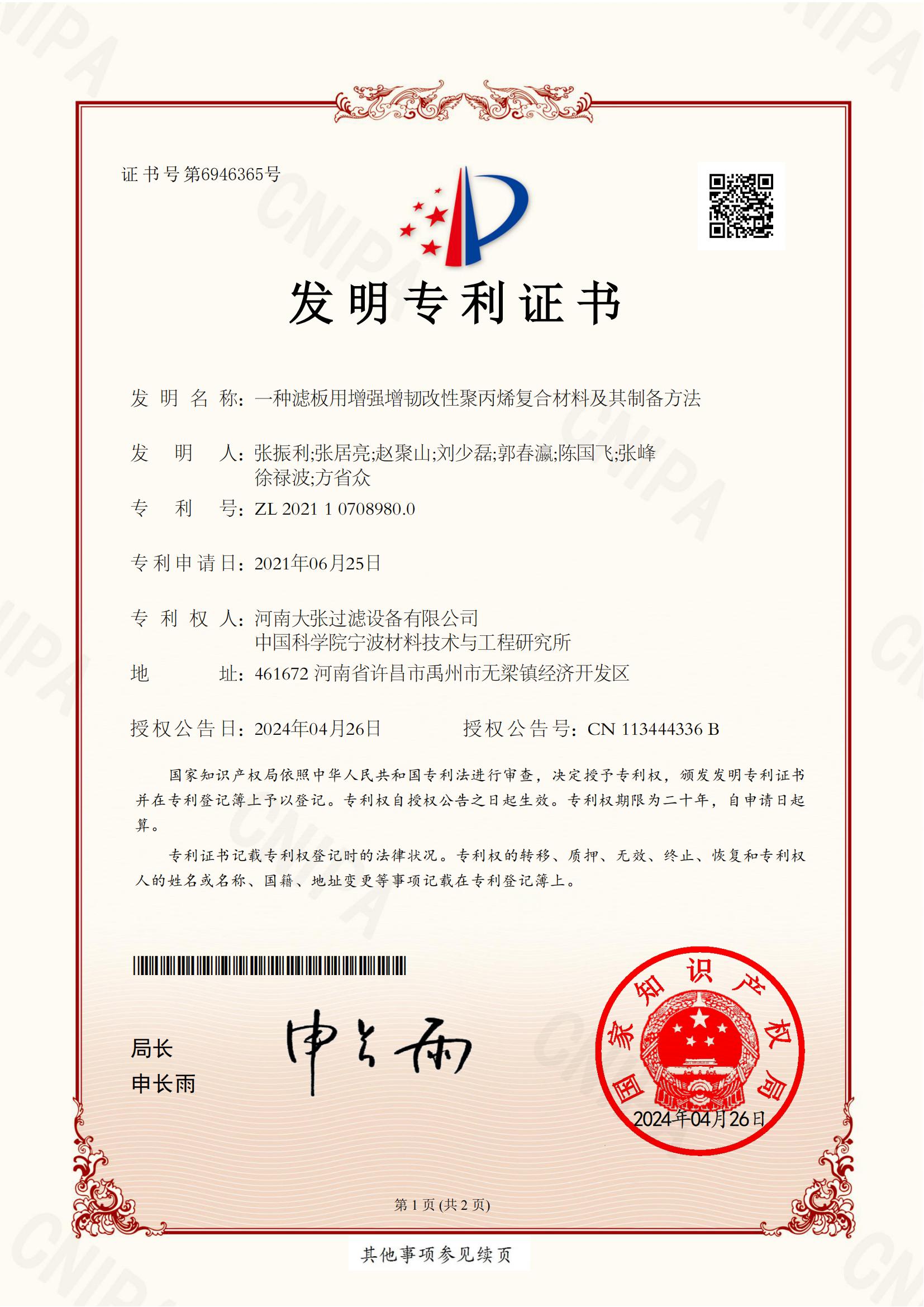
DAZHANG states that it has developed polypropylene filter plate materials and manufacturing processes. One supplied patent record, Chinese Invention Patent ZL 2021 1 0708980.0, covers a reinforced and toughened modified polypropylene composite for filter plates and its preparation method, issued on 2024-04-26. That patent is evidence of material development and intellectual-property activity. It is not proof that every XMAG plate uses that exact compound or that every application will see the same wear life. The buyer should ask which plate grade is proposed for the duty and what evidence supports its use in that chemical and temperature environment.
The Q345 steel frame is a structural specification. Q345 is a low-alloy structural steel designation, and the frame is part of what carries the clamping load and keeps the plate stack aligned. It should not be read as a corrosion-resistance claim. In wastewater, mining, tailings, or chemical service, the buyer should check the surface protection, the drainage arrangement, and the materials used for wetted parts. A Q345 frame can be appropriate for an industrial membrane filter press, but the site conditions determine whether additional protection or a different wetted-material package is needed.
Pressure and area: using the 0.6–4.0 MPa and 20–291.2 m² envelope
The 0.6–4.0 MPa filtering-pressure range should be read as a family envelope. A buyer evaluating a high-pressure membrane filter press should ask three questions. First, what is the allowable filtering pressure for the exact model and plate size? Second, what is the basis for that rating: design calculation, factory test, or type-test report? Third, how does the pressure interact with the feed pump, the squeeze system, the plate stack, and the frame?
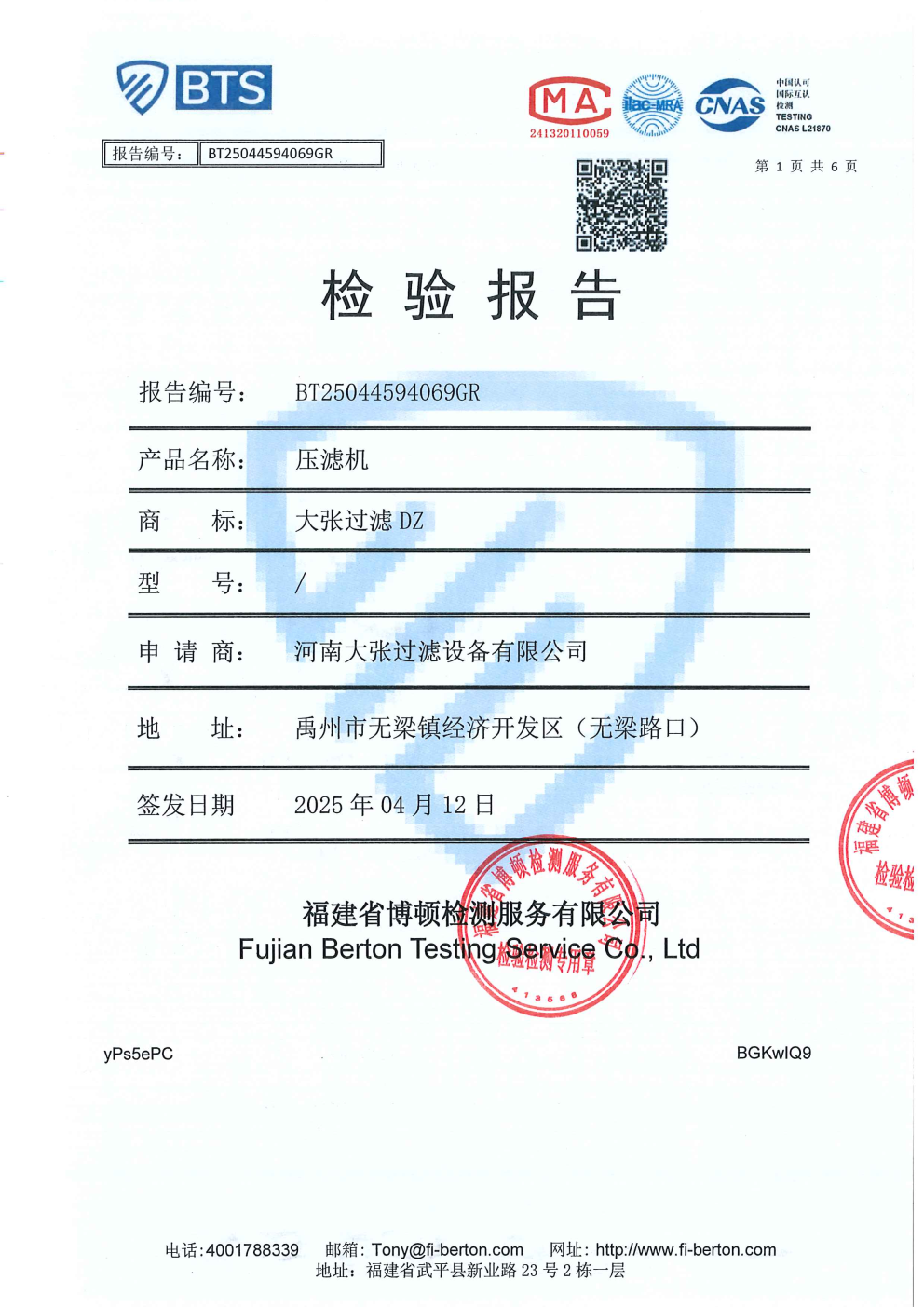
Higher pressure is not automatically better. It can be relevant when the process target requires a higher driving force or a defined squeeze pressure, but it also places demands on plate strength, frame stiffness, sealing, and safety controls. A supplier that can explain those relationships is more useful than one that simply lists the highest number in the catalogue. The supplied test report record, BT25044594069GR, was issued on 2025-04-12 by Fujian Berton Testing Service Co., Ltd. under JB/T 4333.2-2013 and covers a filter press. The buyer should check whether the report scope matches the ordered model, plate material, and configuration; a report for one configuration is not a universal field-performance guarantee.
The 20–291.2 m² filter-area range has a similar role. It shows that the XMAG family can be configured across small and large duties, including industrial sludge dewatering filter press projects and larger high-capacity membrane filter press duties. It does not remove the need for a mass balance. The buyer should provide feed solids, desired cake moisture, cycle time, batch volume, and available floor space. The supplier should then return a model with a stated plate count, plate size, chamber volume, and effective area. That is the point where a membrane squeeze filter press becomes a procurement decision rather than a catalogue comparison.
Manufacturing evidence behind the catalogue
Supplier capability becomes more credible when the catalogue can be connected to manufacturing and quality evidence. The company background states that Henan Dazhang Filtration Equipment Co., Ltd. was founded in 2004, has more than 1,000 employees, a 45-person R&D team, and an annual output of 9,500 units. It also states that the company operates a manufacturing base in Yuzhou, Henan Province, and serves more than 100 countries across Asia, Europe, North America, South America, Africa, and the Middle East. These are company-supplied facts; they are useful for a capability review, but they should be matched to the specific product line and order.
The capability record for this product family lists OEM, ODM, and custom manufacturing, with customization options covering filtration area, plate size, pressure, filter cloth, voltage, and automation. It lists a MOQ of 1 set, a lead time of 15–30 working days, an approximate monthly capacity of 250 sets per month, ISO 9001 and complete-machine operation testing as quality-control elements, a 1-year warranty, installation guidance, and remote technical support. The purchasing-support record adds factory test plus on-site acceptance, with criteria per contract, and T/T payment terms as agreed in the contract.
Those details matter because they let a buyer ask specific execution questions. Can the supplier provide the model drawing and plate arrangement before production? What is tested at the factory, and what is accepted on site? Which spare plates, membranes, filter cloths, and hydraulic components are recommended for the first year? The answers should be documented in the quotation or contract. A certificate or patent is useful, but it does not replace the model-level acceptance plan.
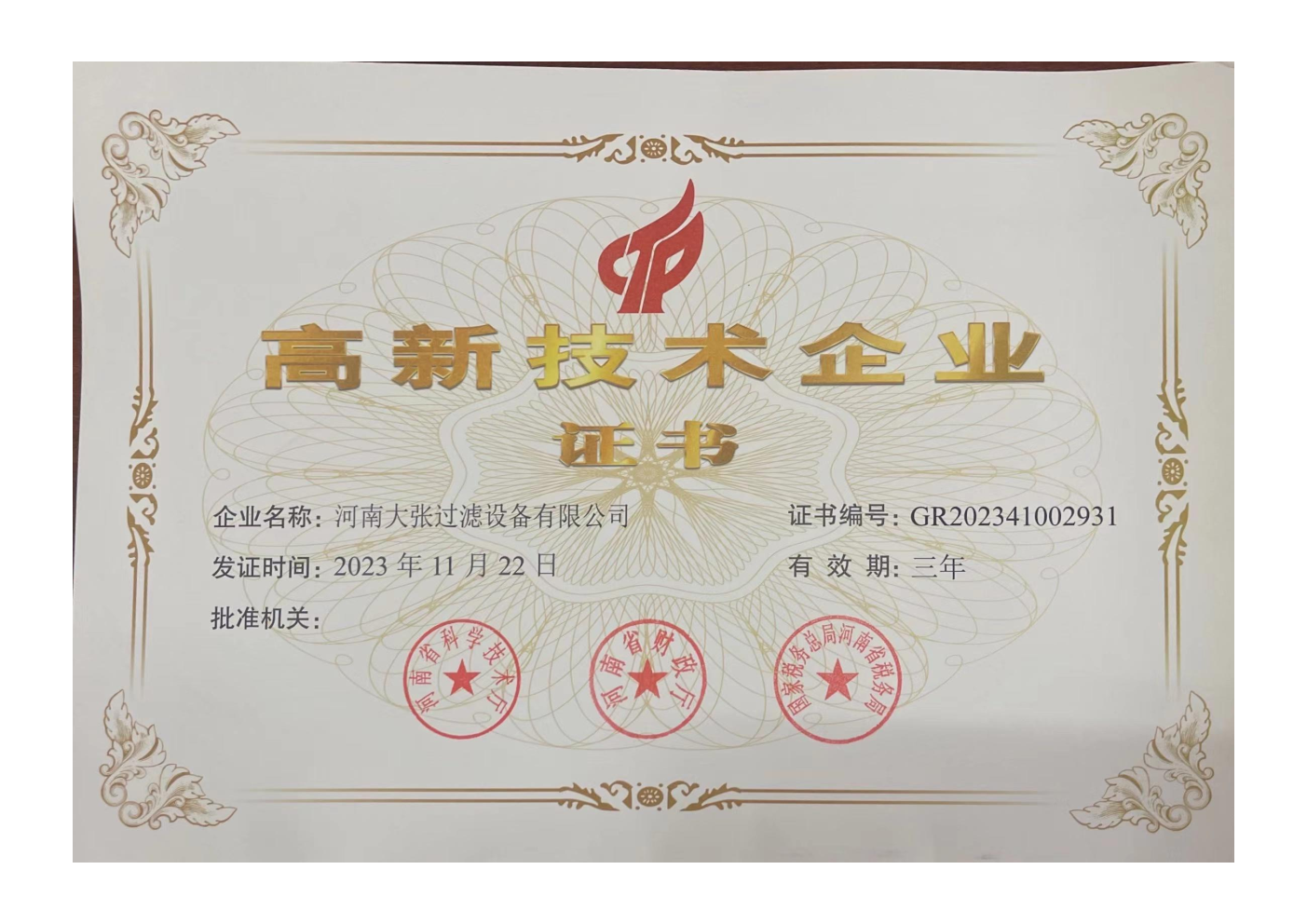
DAZHANG also states that it is a National High-Tech Enterprise and a national-level Specialized, Sophisticated, Distinctive and Innovative Little Giant enterprise. It holds an Intellectual Property Compliance Management System certificate, 404IPJ240986R0M, under GB/T 29490-2023, issued on 2024-10-15 and valid to 2027-10-14, covering production and sales of filtration equipment. These qualifications support a supplier-qualification review. They should be read alongside the product-specific test report, plate material data, and contract acceptance terms.
Adjacent equipment as a continuity check
A membrane filter press supplier does not need to make every solid-liquid separation device, but adjacent product coverage can reveal whether the supplier understands the wider process. The supplied portfolio includes chamber filter presses in the XMAY series, plate and frame filter presses in the BMY4/450-30U series, the DNY500–DNY1000 belt filter press series, water-flush filter presses in the 320–2000 series, the once-open filter press XMZG50/1000-U, a customized laboratory filter press, a mobile filter press in the XMAG30/870-UKB series, and stainless steel plate and frame filter presses in the BASJL600-14/21/24/35 series.
That breadth is useful for two reasons. First, it shows build continuity across plate presses, frame designs, hydraulic systems, and automation. Second, it gives the buyer a way to test the supplier's selection logic. If a project does not need a membrane squeeze stage, a chamber filter press or automatic chamber filter press may be the more direct choice. If the site needs mobility, a mobile filter press may be relevant. If the duty is continuous sludge dewatering, a DNY belt filter press may belong in the comparison. A supplier that can explain when not to use a membrane press is often easier to evaluate than one that treats every application as a membrane application.
The limitation is that portfolio breadth does not prove the suitability of a particular membrane model. A chamber filter press case in chemical wastewater does not prove a membrane filter press will meet the same cake-moisture target. A mobile unit case in mining does not prove a fixed high-capacity membrane filter press will handle the same tailings. The buyer should use the adjacent portfolio as a continuity check, then return to the specific membrane model data.
Application fit: wastewater, mining, chemical, and food-grade questions
The supplied case records describe several application contexts, including a membrane filter press in industrial wastewater treatment, a mobile filter press in mining and wastewater dewatering, a chamber filter press in chemical and wastewater sludge dewatering, a laboratory filter press for small-batch testing, a water-flush filter press in chemical wastewater, and an once-open filter press in mining and wastewater. Each record states a 3+ year duration and summarizes results such as stable dewatering, lower cake moisture, faster cake discharge, or stable operation. These are company-supplied case records, not independent field trials, and they should be read as application references rather than guarantees.
For a sludge dewatering membrane filter press project, the relevant questions are feed solids, flocculation, cycle time, target cake dryness, filtrate quality, and how the cake will be transported. For a mining membrane filter press or tailings membrane filter press duty, the buyer should add abrasion, particle size distribution, and the risk of rapid cycle wear. For a chemical membrane filter press, material compatibility and cleaning procedure become central. For a food grade membrane filter press inquiry, the buyer should ask for material certificates, surface finish, cleaning validation, and application-specific compliance evidence; the presence of PP/TPE plates alone does not establish food-contact approval.
This is where the difference between an industrial membrane filter press and a laboratory filter press matters. A customized laboratory filter press can help evaluate filtration behavior before scale-up, but a lab result is not a full-scale guarantee. The supplier should explain how the lab data will be translated into plate size, chamber depth, filter area, and squeeze pressure for the proposed XMAG model.
Membrane vs chamber and plate-and-frame: a fit boundary, not a winner
A membrane squeeze filter press adds a secondary squeeze phase after the initial filtration cycle. A chamber filter press relies on the feed pump and chamber geometry to form the cake. A plate and frame filter press uses a different frame-and-plate arrangement. These are not interchangeable choices without a duty comparison. The fit boundary is the process target: if a chamber filter press already meets the required cake moisture and cycle time, adding membrane complexity may not be justified; if the project requires a squeeze stage or tighter control of cake formation, a membrane plate filter press becomes relevant.
The buyer should not accept a generic claim that a membrane filter press is always better than a chamber filter press. The correct comparison uses the same feed material, similar plate size, comparable cycle conditions, and a stated performance target. If those data are not available, the supplier can still compare documented characteristics such as plate construction, pressure range, area range, automation scope, and maintenance requirements. That is a characteristic comparison, not proof of superior field performance.
The same discipline applies to plate and frame and stainless steel plate and frame alternatives. A stainless steel plate and frame filter press may be relevant where corrosion resistance and cleaning are central, but the buyer should confirm the wetted-material grade and the actual duty. A chamber filter press may be simpler, but it should not be selected only because it is familiar. The membrane versus chamber decision should be documented in the selection report.
A buyer’s verification checklist
Before moving from evaluation to execution, the buyer can convert the supplier’s claims into a short evidence file. The checklist below is not a substitute for engineering review, but it reduces the risk of ordering a family specification that does not match the chosen model.
- Model-level datasheet: Confirm the exact XMAG model, plate size, plate count, chamber volume, and effective filter area. Do not accept a family range as the model specification.
- Pressure basis: Ask for the allowable filtering pressure of the ordered model and the design or test basis for the 0.6–4.0 MPa family range.
- Plate and membrane materials: Confirm the PP plate grade, TPE membrane grade, temperature limits, chemical compatibility, and spare-part availability.
- Frame and protection: Confirm the Q345 frame design, surface protection, and whether any wetted parts require a different material.
- Automation scope: Define what fully automatic membrane filter press operation includes: plate opening, cloth washing, squeeze control, discharge, interlocks, and alarms.
- Test and acceptance: Match the test report scope to the ordered configuration; agree on factory test, on-site acceptance, and acceptance criteria in the contract.
- Commercial execution: Confirm MOQ, lead time, warranty, installation guidance, remote support, spare-parts list, and payment terms in writing.
- Reference fit: Ask for case references in the same application, but treat them as company-supplied references unless independent evidence is provided.
Procurement outlook
The practical lesson is not that a wider model range automatically makes a supplier the right choice. The lesson is that breadth becomes useful when it is translated into model-level evidence. For the XMAG family, the supplied signals give buyers a structured starting point: XMAG30/870-UKB to XMAG1000/2000-UKB, 1100/1500 series with 1100 mm or 1500 mm plates, 0.6–4.0 MPa filtering pressure, 20–291.2 m² filter area, PP/TPE membrane plates, and a Q345 steel frame. The buyer’s job is to match those signals to the slurry, the required cake moisture, the site utilities, the automation scope, and the acceptance method.
That approach also keeps the evaluation neutral. A supplier can be credible in one duty and less suitable in another. The evidence file should show why the selected model fits, which limits apply, and what will be checked before shipment and at commissioning. DAZHANG Filter Press provides a company profile brochure for further reference at this download link. The brochure is a company document; it should be read with the model datasheet and contract acceptance terms.
FAQ
What should a buyer verify first in an XMAG membrane filter press quotation?
The first check is the model-level specification: exact model, plate size, plate count, effective filter area, allowable filtering pressure, plate and membrane materials, frame protection, automation scope, and acceptance method. The family range of 20–291.2 m² and 0.6–4.0 MPa is a starting envelope, not the specification of every individual model.
Does the 0.6–4.0 MPa range mean every XMAG model can operate at 4.0 MPa?
No. The 0.6–4.0 MPa figure is supplied as a family filtering-pressure range. A specific model, plate size, and frame configuration may have a narrower allowable rating. The buyer should request the model-specific pressure rating and the design or test basis behind it.
What is the difference between PP and TPE in a membrane filter press plate?
PP is used in filter plate construction, while TPE is used as a membrane material in the plate assembly. The exact grades, temperature limits, and chemical compatibility must be confirmed for the feed and cleaning regime. The supplied patent for a reinforced and toughened modified polypropylene composite is evidence of material development, not a universal material approval.
Why does a Q345 steel frame matter in supplier evaluation?
Q345 is a structural steel specification for the frame that carries clamping and alignment loads. It is not a corrosion-resistance claim. Buyers should confirm the frame design, surface protection, and wetted-part materials for the actual wastewater, mining, tailings, or chemical environment.
How can a buyer check supplier capability beyond certificates?
Use a model datasheet, pressure and area calculation, plate and membrane material data, test-report scope, factory test plan, on-site acceptance criteria, spare-parts list, and application references. Certificates and patents support the supplier review, but they do not replace the model-specific evidence package.
Supplier facts in this article are based on the supplied DAZHANG Filter Press corpus, including company background, certification, capability, case, and FAQ records. Product-family values such as 0.6–4.0 MPa, 20–291.2 m², PP/TPE plates, and Q345 frame are presented as supplied family-level specifications and should be confirmed for the ordered model.
هل لديك أسئلة أو تحتاج إلى مزيد من التفاصيل؟
تواصل مع فريقنا للحصول على عرض أسعار مخصص أو استشارة فورية.
طلب عرض أسعار
املأ النموذج أدناه وسيتواصل معك فريقنا بعرض مقترح مخصص.
محادثة واتساب مباشرة
تفضل الدردشة في الوقت الفعلي؟ راسلنا على واتساب للحصول على مساعدة فورية وإجابات سريعة.
- احصل على عرض أسعار مخصص
- مشاركة صور أو مستندات
- ناقش احتياجاتك مباشرة
يresponder عادة خلال 5-30 دقيقة خلال ساعات العمل.