
Memorial Park vs. Private Plot: Tombstone Base and Dimension Fit
A tombstone that satisfies a municipal memorial park can be rejected on a private family plot, and a monument that sits perfectly on a family estate can breach park rules on the day of installation. The difference is rarely in the granite. It is in the base — its height, footprint and surface — and in how the dimensions above that base transfer weight into the ground.
Memorial installation is usually discussed as a single category, but buyers and importers actually serve two distinct site types. The first is the regulated memorial park or cemetery, where plots are laid out in rows, maintenance is mechanised and specifications are set by an authority. The second is the private plot, family estate, churchyard or unregulated land, where the constraints come from soil, drainage, weather and family preference rather than from a rulebook. Both use granite tombstones, yet the dimensional and base decisions that make one installation durable can make the other non-compliant.
This article examines the practical constraints that separate the two scenarios, and explains which parameters a buyer should lock before ordering, which must stay flexible, and where a supplier's responsibility ends and the installer's begins.

Cemetery installation of a granite tombstone. Base height, footprint and fixing method are determined by the site, not by the stone itself.
Two Installation Environments, Two Constraint Sets
A memorial park specification is primarily a compliance document. The park authority typically defines the maximum permitted overall height, the width and depth of the permitted footprint, the clearance between adjacent markers, the type of foundation it will accept, and sometimes the finish of the visible surface. These rules exist for operational reasons: uniform rows allow mechanical lawn maintenance, standard footprints keep survey lines stable, and accepted foundation designs reduce the risk of a monument settling or tipping in a public space.
A private plot follows a different logic. There may be no written rule at all, or the rule may come from a local church, a family agreement or a municipal bylaw that is applied loosely. What governs instead is the physical site: whether the ground is level or sloping, whether the subsoil drains or holds water, whether the plot experiences deep freeze-thaw cycles, and how much visual presence the family wants. A private plot can accept a larger, heavier monument than a park would ever approve — but it also places far more responsibility on the base design, because nobody has pre-approved the ground conditions.
| Decision variable | Memorial park / municipal cemetery | Private plot / family estate |
|---|---|---|
| Overall height and width | Usually capped by the authority; uniform across rows | Set by family preference and site visibility, within local rules if any |
| Footprint and spacing | Fixed plot lines and required clearance between markers | Flexible, limited mainly by plot boundary and access |
| Base height | Often kept low for maintenance clearance and row alignment | Often raised to correct uneven or sloping ground |
| Weight distribution | Standardised foundation accepted by the park | Must be engineered for the actual subsoil on site |
| Surface texture | Uniform, easy to clean, visually consistent across rows | Free choice; may favour texture for grip and visual weight |
| Fixing method | Specified anchors, dowels and foundation design | Installer-selected, frequently anchor or base-mounted |
| Approval | Design submitted and approved before production | Usually informal or handled locally by the family |
The Base Is a Load-Transfer Component, Not a Decorative Plinth
In both scenarios, the base performs the same physical job: it collects the mass of the headstone and spreads it over a wider area before it reaches the ground. The load path runs from the headstone, through the base or base-mounted slab, into the foundation stone, and finally into the subsoil. Every element in that chain — base, foundation stone, anchor, metal dowel and epoxy glue — has a specific function, and omitting one shifts stress onto the others.
This is why dimension decisions cannot be made independently of base decisions. A taller headstone increases the overturning moment at the base junction. A thicker headstone increases the mass that the foundation must carry. A wider base reduces the pressure on the soil but also changes the footprint, which is the first thing a memorial park will check. Buyers who specify height and width without specifying the base are effectively leaving the most site-dependent variable to the installer.
Dimension variables buyers actually control
- Overall monument height — the primary compliance constraint in memorial parks and the primary visual decision on private plots.
- Headstone thickness — affects mass, engraving depth options and the stability of the joint at the base.
- Base footprint and projection — the surface area available to spread load, and the dimension most often regulated by plot spacing.
- Number of stacked elements — a single base versus a base plus sub-base changes both the total height and the load path.
- Single versus double gravestone configuration — a double gravestone increases width and mass, and therefore the base area required to keep soil pressure reasonable.
- Engraving area — determines the usable face and, in some park layouts, the permitted panel orientation.
Base Height: Maintenance Clearance Versus Ground Correction
In a memorial park, base height is frequently a maintenance question rather than a structural one. A base that projects too far above the lawn line interferes with mowing and edging equipment, and it breaks the visual alignment of a row. Parks that maintain grass mechanically therefore tend to prefer a base that sits close to grade, with the height difference absorbed below ground in the foundation rather than above it.
On a private plot, the same logic reverses. Where the ground is uneven, sloping or recently disturbed, a raised base is often the simplest way to bring the monument to a level and stable position without extensive ground works. The trade-off is exposure: a raised base presents more surface to weather and to freeze-thaw cycling, so the material specification and the fixing detail must compensate for the additional exposure.
Weight Distribution and Soil Stability on Unregulated Ground
The private plot is where weight distribution becomes an engineering question rather than a formatting question. Granite is a dense natural stone, and a monument is a concentrated load at a single point in a garden or field. Where the subsoil is soft, organic or poorly drained, a small base can settle unevenly, and the monument will lean. Where the ground is stable and well drained, a more compact base is usually sufficient.
Memorial parks reduce this risk institutionally: the foundation design is often prescribed, inspected or at least standardised across the site, so the soil variability a single buyer would have to assess has already been handled once for the whole cemetery. That institutional advantage disappears entirely on private land, which is why buyers serving private clients should treat the foundation stone and the base footprint as part of the product specification rather than as an afterthought.
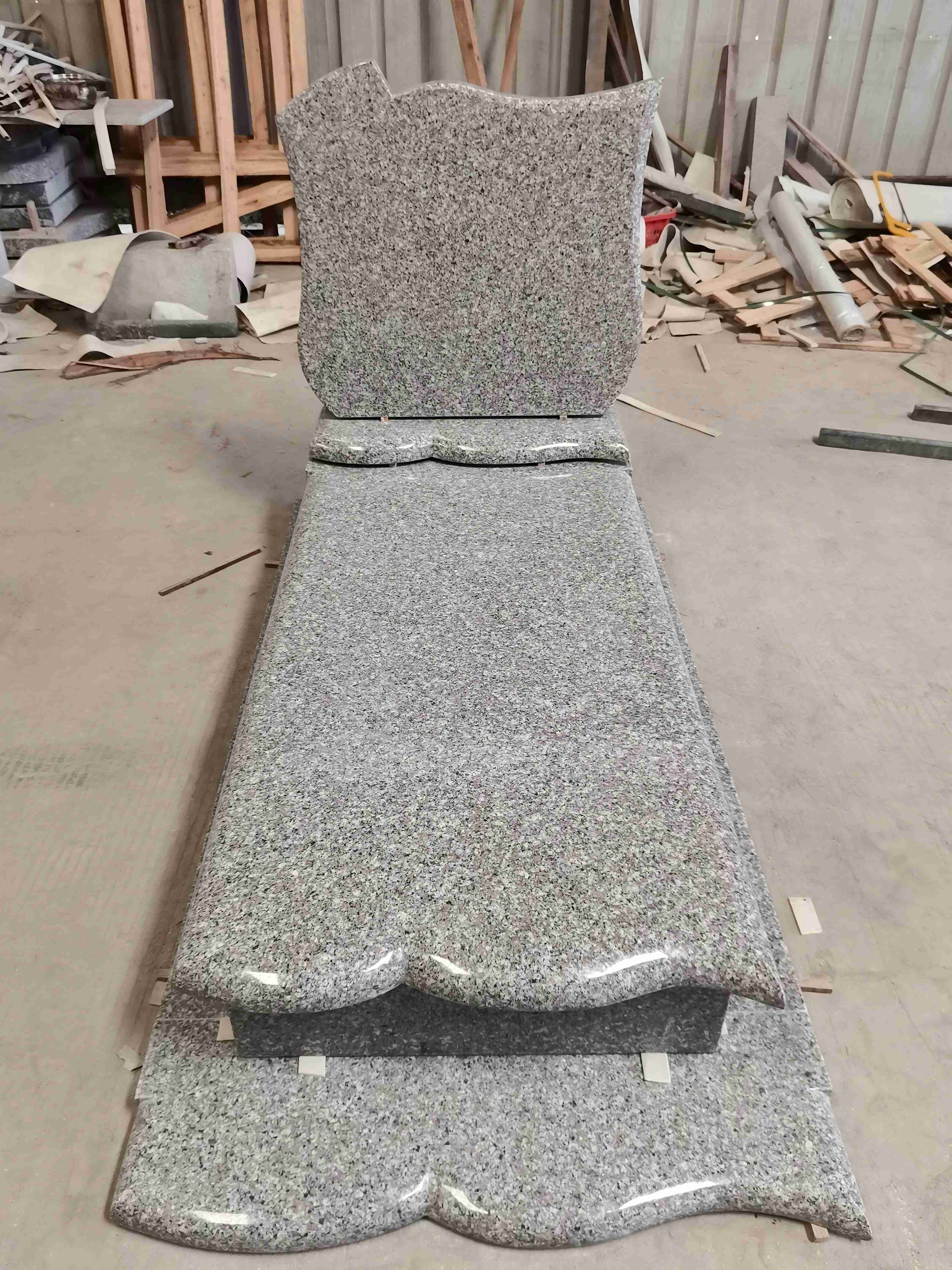
A granite monument is a concentrated load. The base and foundation stone spread that load before it reaches the subsoil.
Surface Texture and Weather Exposure
Surface finish is often treated as purely aesthetic, but in outdoor memorial installation it interacts directly with the site. Tombstone specifications for cemetery and memorial park work commonly call for frost resistance, weather resistance, low water absorption and a polished surface, with engraving available on the visible face. A polished surface sheds water and is straightforward to clean, which matters in a maintained park where rows are expected to look consistent over decades.
On a private plot, the same polished face is usually retained for the headstone, but the base and the surrounding kerb may benefit from a different treatment where ground contact is continuous and where the surface may be walked on or reached by garden equipment. The decision is a trade-off between cleanability and grip, and it should be taken together with the drainage assessment, not separately from it.
How the Specification Is Adapted in Production
Xiamen Songjia Trading Co., Ltd. (SONGJIA) is a China-based natural stone supplier headquartered in Xiamen, supplying tombstones, monuments and building materials to international importers, contractors, fabricators, designers and private custom clients. The company operates a 20,000 m² facility with 60 employees, a three-engineer technical team, and an export ratio of 100% across EU, USA and Middle East markets, with annual output described as 150 containers of monuments and 200 containers of building materials.
For tombstone work, SONGJIA's stated position is that sizes are produced to request rather than drawn from a fixed catalogue. This matters for the memorial park versus private plot distinction, because it means the dimensional variables — overall height, headstone thickness, base footprint, number of stacked elements and engraving area — can be set per destination site instead of being forced into a single standard. The company's described core strength is design-to-production integration: converting client sketches, concepts and architectural ideas into producible shop drawings before production begins.
That conversion step is where most adaptation failures are caught. A drawing that shows a monument at a given height but does not specify the base projection will produce a piece that either fails a park's footprint rule or sits too narrowly on unstable private ground. Buyers who supply accurate plot information at the drawing stage reduce the risk substantially; buyers who supply only a photograph of a finished monument transfer that risk to the installer.
Where These Configurations Are Actually Used
The application profile for granite memorial work is consistently outdoor and consistently exposed. Documented working conditions cover outdoor installation, freeze-thaw environments, cemetery outdoor environments and general weather exposure. Project types fall into four recognisable groups: cemetery projects, memorial park projects, family memorial projects and church memorial projects.
Installation methods are equally consistent: fixed installation, ground installation, base-mounted installation and anchor fixing. The matched components that appear alongside the stone are the base, vase, anchor, metal dowel, epoxy glue and foundation stone. In practice, the memorial park scenario leans toward anchor fixing and a prescribed foundation, while the private plot scenario leans toward base-mounted installation where the ground has been corrected at surface level.
One documented buyer profile illustrates how these requirements repeat over time. A monument distributor placing continuous bulk orders for cemetery memorial use, intended for long-term outdoor exposure, reported stable quality, good finishing and reliable delivery as the deciding factors and continued placing repeat orders. In dimensional terms, that pattern is only sustainable when the base and dimension conventions are documented once and repeated consistently, because a distributor shipping to many cemeteries cannot renegotiate footprint rules on every shipment.
Market Signals Behind the Standardisation Pressure
The commercial context supports the idea that dimensional discipline matters more, not less, over time. The global tombstone market was valued at USD 3.36 billion in 2024 and is projected to reach USD 5.0 billion by 2035, according to WiseGuyReports. Granite is the dominant material in that market, expected to hold a 43.6% market share by 2026 according to Coherent Market Insights.
Regionally, the pattern is uneven. Europe's tombstone market was valued at USD 0.65 billion in 2025, with granite segments capturing 65.8% of the share, while North America is expected to lead globally with a 35.8% revenue share by 2026 according to Coherent Market Insights. On the supply side, China's export of granite monumental stone reached a monthly value of USD 70.65 million in June 2026, based on CEIC Data and General Administration of Customs figures.
The interpretation that matters for buyers is structural rather than directional. Where memorial parks and managed cemeteries account for a large share of installations, specifications become institutionalised, footprints get standardised, and the cost of a dimensional error rises because a non-compliant monument cannot simply be installed elsewhere. That is the environment in which a supplier's ability to produce to a drawing — rather than to a catalogue — becomes a procurement criterion rather than a convenience.
Where Adaptation Stops: Limits and Trade-offs
Adaptable base heights, footprints and finishes solve a real problem, but they do not solve every problem, and buyers should be clear about the boundary.
The clearest limitation is that a single-specification approach is cheaper and faster. Producing one standard base size for all destinations shortens lead time, simplifies packing and reduces the drawing workload. Site-adapted bases require accurate input, additional drawing review and longer production planning, and that cost does not disappear — it moves into the specification stage. For buyers shipping to multiple cemeteries with differing rules, the practical answer is usually a small number of documented base variants rather than unlimited customisation.
A second limitation concerns certification scope. SONGJIA holds SGS-issued CE certificates covering natural stone products: a CE certificate for G684 basalt citing standard EN 12058, certificate number CXMCP1210052, and a CE certificate for G603 grey granite citing standard EN 12057, certificate number XMML110401342. Those certificates state a defined product scope. Buyers whose destination market requires documentation for a specific tombstone form should confirm that the certificate scope matches the product being shipped rather than assuming a general coverage. In the EU specifically, funeral services and products are also associated with the EN 15017 standard, and tombstone products imported into the EU are subject to REACH (EC 1907/2006) regarding chemical substances in coatings and adhesives — which means the adhesives and surface treatments specified for a base-mounted installation are part of compliance, not just the stone.
A third limitation sits outside the supplier's control entirely. No manufacturer can verify the subsoil, drainage or slope of a private plot from a drawing. Base dimensions can be adapted to the information provided, but if that information is wrong, the monument will still settle. In the memorial park scenario the equivalent risk is approval: a supplier can produce exactly to an approved drawing, but cannot obtain the park's approval on the buyer's behalf.
Future Outlook
Two forces are likely to push specifications further apart rather than closer together. On one side, managed memorial parks and standardised cemetery layouts continue to formalise footprint, height and foundation requirements, which rewards suppliers who can document base variants and repeat them consistently across shipments. On the other, private and family memorial work continues to value individual design, larger monuments and site-specific correction of uneven ground, which rewards suppliers who can convert a sketch into a buildable drawing quickly.
For importers and distributors, the practical implication is to separate the two specification paths internally. A park-oriented line benefits from a fixed set of documented base and dimension options with pre-prepared drawing templates. A private-plot line benefits from a flexible drawing workflow and an explicit checklist covering subsoil, drainage, frost exposure and fixing method. Treating both as one product line is what produces the familiar failure mode: a monument that is compliant nowhere in particular.
Frequently Asked Questions
1. What dimensions should a buyer confirm before ordering a tombstone for a memorial park?
Three sets of dimensions should be confirmed in writing before production: the maximum permitted overall height and width set by the cemetery or park authority; the plot footprint and the required clearance between adjacent markers; and the foundation or base thickness the park will accept. A supplier can produce to those figures, but cannot confirm what the park permits. Where the park does not publish a specification, the buyer should request it directly rather than infer it from neighbouring monuments.
2. How does a base-mounted installation differ from a ground installation?
A ground installation places the monument and its foundation directly into the ground, with the load transferred through a foundation stone into the subsoil. A base-mounted installation uses a separate base element as the intermediate load-spreading layer, which allows the visible height to be adjusted at surface level and simplifies correction of uneven ground. Both methods can be combined with anchor fixing using anchors, metal dowels and epoxy glue, and both are listed among standard memorial installation methods alongside fixed installation.
3. Do granite tombstones require CE documentation to enter the EU?
Documentation requirements depend on the product form and the destination market, so the scope of any certificate should be checked rather than assumed. SONGJIA holds SGS-issued CE certificates for natural stone products — one for G684 basalt citing EN 12058 (certificate CXMCP1210052) and one for G603 grey granite citing EN 12057 (certificate XMML110401342) — with stated product scopes. Separately, European funeral services and products are associated with the EN 15017 standard, and tombstone products imported into the EU fall under REACH (EC 1907/2006) for chemical substances in coatings and adhesives.
4. Which surface texture should be specified for an outdoor cemetery installation?
Cemetery and memorial park specifications commonly call for a polished surface together with frost resistance, weather resistance and low water absorption, and most allow engraving on the visible face. A polished finish is easy to clean and helps rows look consistent, which is why it dominates park work. On private plots the headstone face is usually polished as well, but the base and surrounding elements may be finished differently where continuous ground contact or foot traffic makes grip a consideration. The finish decision should be made together with the drainage assessment.
5. What drives the cost difference between a memorial park specification and a private plot specification?
The main cost drivers are material volume and base configuration rather than the stone type alone. A larger base footprint, an additional sub-base layer, a double gravestone width, a greater number of matched components such as a vase or foundation stone, and a larger engraved area all increase material and processing input. Site-adapted production also adds drawing and planning effort compared with a single standard size, while documentation and approval requirements add administrative work on the park side. Buyers comparing quotations should therefore compare the full configuration — base, foundation, fixings and finish — not the headstone alone.
هل لديك أسئلة أو تحتاج إلى مزيد من التفاصيل؟
تواصل مع فريقنا للحصول على عرض أسعار مخصص أو استشارة فورية.
طلب عرض أسعار
املأ النموذج أدناه وسيتواصل معك فريقنا بعرض مقترح مخصص.
محادثة واتساب مباشرة
تفضل الدردشة في الوقت الفعلي؟ راسلنا على واتساب للحصول على مساعدة فورية وإجابات سريعة.
- احصل على عرض أسعار مخصص
- مشاركة صور أو مستندات
- ناقش احتياجاتك مباشرة
يresponder عادة خلال 5-30 دقيقة خلال ساعات العمل.