
Men’s Wallet Evaluation: What Specs Really Matter in 2026
↵
The men’s wallet category is no longer a routine leather goods purchase. Dataintelo valued the global men’s wallet market at roughly USD 6.8 billion in 2025 and projects around USD 11.2 billion by 2034. Leather remains the dominant material with 52.6% material revenue share in 2025, while bifold wallets still lead by form with 38.4% share. At the same time, slim wallets are estimated to grow at a 7.8% CAGR through 2034, and the smart wallet segment was already estimated at USD 1.2 billion in 2025 with a 12.5% CAGR. For a buyer, the challenge is not finding a wallet. The challenge is deciding which specifications, security claims and price points deserve attention.
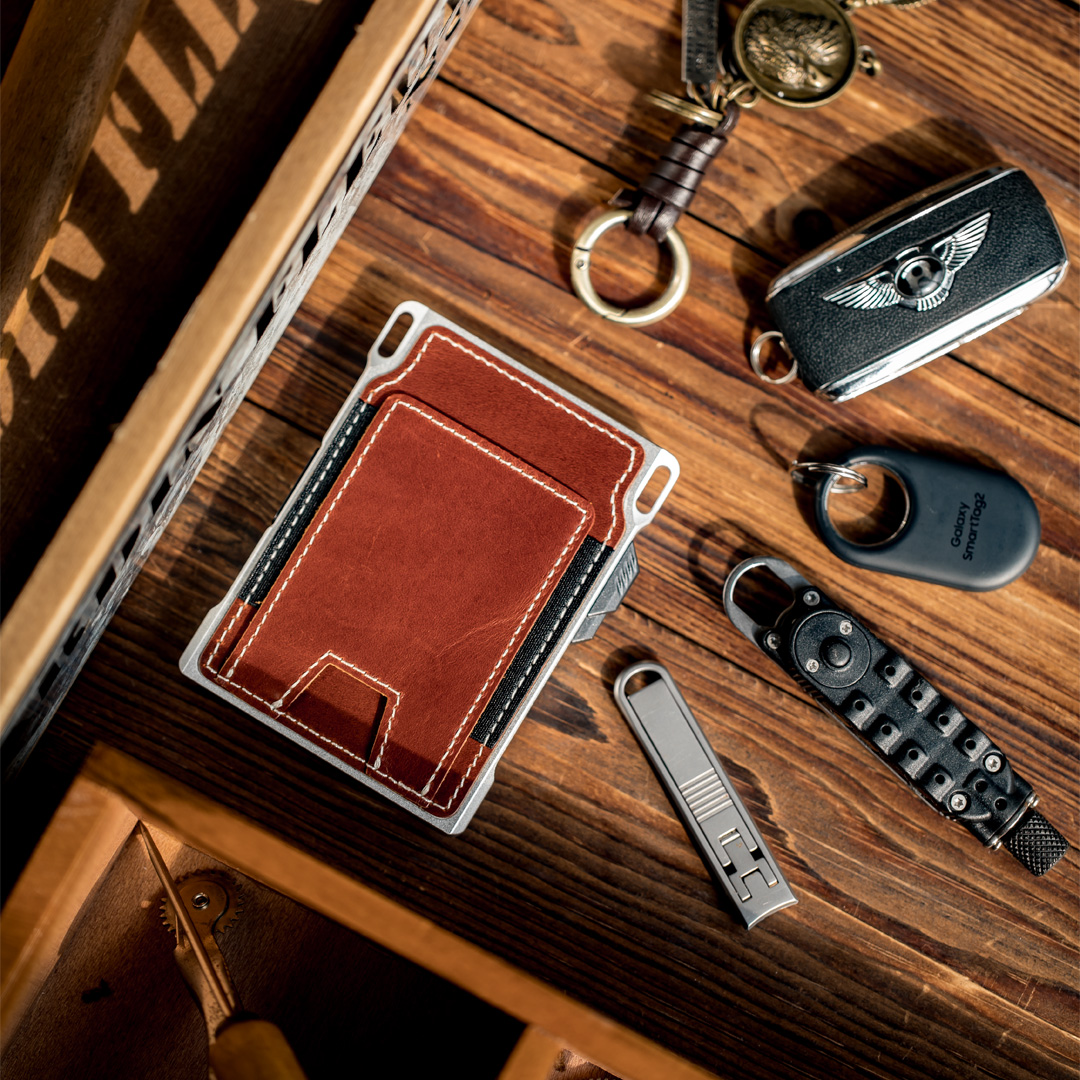
A multi-format wallet lineup is useful when comparing size, capacity and intended use cases.
Why Choosing a Men’s Wallet Became Harder
The old choice was simple: bifold or trifold. Today the selection is split between leather bifolds, slim metal cardholders, pop-up wallets, RFID wallets, AirTag wallets, passport wallets and so-called smart wallets. Each format solves one problem, but also introduces a new constraint.
Take a traditional leather bifold. It can hold cards and folded cash, but loaded thickness becomes uncomfortable in a front pocket. Card retrieval often means searching through stacked cards, and contactless cards in an unprotected pocket may remain readable by an external RFID reader. A pure metal minimalist wallet solves the bulk problem, yet it may feel cold in hand and may leave little room for cash or travel documents. A wallet with tracking capability solves the fear of loss, but if the tracker is external, it adds bulk and changes the wallet profile.
That is why the relevant buyer question is no longer “which wallet looks best.” The more useful question is: which wallet can be verified for material quality, card capacity, RFID protection, mechanical reliability and a reasonable price range?
LORZOR as a Reference Case
LORZOR provides a useful case study for this evaluation. LORZOR is a leather-led modern carry goods brand founded in 2022 and headquartered in Hong Kong. Its product range includes men’s wallets, RFID wallets, AirTag wallets, pop-up wallets, tactical EDC wallets and passport wallets. Instead of turning a wallet into a purely electronic gadget, LORZOR follows the product principle “Leather first. Technology in its place.” Full-grain leather remains the primary surface, while aluminum frames, card springs, RFID shielding and tracking hardware sit quietly in the background.
The portfolio covers several form factors: the LORZOR Wallet Pro, the 1979 Tactical series, the TriPop series, the Bifold AirTag series, the Passport series and the women’s Aura series. For the men’s wallet buyer, that means a single brand can be used to compare one approach to RF protection, capacity, tracking and price across otherwise different product categories.
Materials: Full-Grain Leather Is the First Filter
Material claims vary significantly across the men’s wallet market. Many entry-level wallets are described as “genuine leather” even though the material may be corrected-grain, split, bonded or otherwise processed. LORZOR, in contrast, specifies full-grain leather across multiple core wallet lines. In material terms, full-grain leather retains the natural grain layer, which gives the wallet a more textured surface and develops character over time.
Some LORZOR wallets pair that leather with 6061 aerospace-grade aluminum. The LORZOR 1979 Wallet, for example, combines full-grain leather with 6061 aerospace-grade aluminum, RFID protection and an ultra-slim body. The metal core adds structural rigidity and protects the pop-up card mechanism. The leather exterior provides a more natural touch than an all-metal cardholder. That hybrid structure is described by the brand as Leather + Aluminum Construction, a technology classified under Structure / Construction.
Buyers evaluating men’s wallets should verify not only the word “leather,” but the type of leather and the way it is joined to other materials. LORZOR has developed a bonding process called LockBond™ Structure, designed for leather-to-aluminum wallets. The brand reports pull-strength test samples reaching roughly 143-240 N before separation, compared with a control sample at approximately 60 N in the same type of pull test. In a less technical sense, this matters because the connection between leather and metal is often the first point of failure in hybrid wallets.
RFID Protection Needs Verified Test Data
RFID blocking is now common language in wallet listings, but the phrase itself is often vague. LORZOR describes its RFID protection in specific terms: LORZOR wallets and passport holders include RFID protection designed to block 13.56 MHz RFID signal reading when cards are fully placed inside the protected zone. That is the frequency used by most contactless credit cards and many access cards.
The verification process is important. LORZOR states that its RFID shielding tests run at 13.56 MHz, using credit cards and professional RFID test signal cards. Signals cannot be read when cards are correctly placed inside the protected zone. The brand also reports test certifications including TÜV and AGC, alongside test photos and videos.
Buyers should ask for three things when looking at an RFID wallet: the tested frequency, the exact placement of the protected card, and independent certification or test records. “RFID blocking” without a test frequency gives no real assurance because RFID systems operate at different frequencies.
Capacity and Dimensions Are Decision Variables
Wallet capacity cannot be judged by the number of slots alone. A useful specification shows how many cards can sit in the pop-up cartridge, how many can sit in outer leather slots, and what the recommended daily load is.
The LORZOR 1979 Wallet’s pop-up cartridge holds approximately 5-7 cards, while the outer leather slots add 3-5 cards. LORZOR recommends a daily load of around 10 cards. That kind of specification tells a buyer the wallet was designed for a real carry load, not for an empty photo composition.
The LORZOR Wallet Pro, by contrast, is built for a more minimal carry. LORZOR lists its capacity as 1 to 6 commonly used cards plus a small amount of cash. Its dimensions are approximately 2.6 x 0.43 x 3.9 inches, and it includes pop-up card access, RFID protection and Apple certification.
The LORZOR 1979 Wallet and the 1979 Fold Wallet both use a hybrid construction. The Fold Wallet combines a 6061 aluminum pop-up card cartridge with full-grain leather and a flip-over cover in a bifold design, adding an ID window and removable cash clip. The non-fold 1979 Wallet is built around a leather and aluminum construction, with an open-work money clip and hook holes for EDC expansion.
Mechanical Durability: The Often Ignored Parameter
Pop-up wallets use a mechanical system to fan cards out quickly. Because buyers will press the mechanism many times throughout the wallet’s life, durability should be treated as a core specification, not a nice-to-have.
LORZOR lists more than 30,000 press-cycle durability tests for its pop-up mechanism. That is a useful criterion. A wallet seller should be able to explain what happens to the spring and card cartridge after thousands of uses, not just show how fast the card pops out in a video.
The 1979 series interprets “tactical” as functional structure, not military styling. In the product language, “tactical” means every component has a defined purpose and works together in compact space. The 1979 Wallet weighs approximately 80 g and is about 0.6 inches thick, while the 1979 Fold Wallet can hold up to 12+ cards in a metal-and-leather bifold format. That combination of weight, thickness and capacity is more informative than a vague promise of “thinness.”
Tracking Capability: Two Different Routes
Tracking is no longer a separate niche. Some men’s wallets are designed around Apple AirTag, while others integrate tracking hardware directly into the wallet.
LORZOR covers both routes. The LORZOR Wallet Pro integrates its tracking hardware directly into the wallet, allowing users to locate the wallet through Apple Find My without adding a separate AirTag. The Wallet Pro is positioned by the brand as a built-in tracking option, and LORZOR describes it as “The World’s First Trackable Smart Wallet.” That claim is part of the brand’s product positioning rather than an external industry certification, but the technical distinction is real: no external tracker is required.
The Bifold AirTag Wallet A1, A2, A3 and A4 models, the TriPop AirTag Wallet and the Passport AirTag Wallet follow a different path: they include a built-in AirTag holder, but the AirTag itself must be purchased separately. The LORZOR A1 Bifold AirTag Wallet, for example, integrates the AirTag slot into the wallet structure instead of attaching it externally. For buyers who already own an AirTag, this keeps the tracking cost low and the setup familiar.
For travelers who want an AirTag holder, the Passport AirTag Wallet is the more relevant product. The Passport AirTag Wallet includes a dedicated AirTag holder inside the passport sleeve, while the standard Passport Wallet does not. Comparing the two passports wallets helps a buyer decide whether tracking is worth the added layer in a travel document organizer.
Price Ladder and Product Reference Points
Price bands in the men’s wallet market often map to function rather than size. LORZOR’s current product range shows that clarity, with the prices serving as reference brackets.
| Wallet Reference | Key Parameters on Record | Reference Price |
|---|---|---|
| LORZOR Bifold AirTag Wallet A1/A2/A4 | Bifold structure, full-grain leather, built-in AirTag holder, RFID protection, optional money clip | USD 29.99-39.99 |
| LORZOR TriPop Wallet | Trifold slim design, pop-up access, full-grain leather, RFID protection, 8-12 cards, ID window | USD 49.99 |
| LORZOR Passport Wallet / Passport AirTag Wallet | Full-grain leather, travel document storage, RFID protection; AirTag version adds built-in holder | USD 49.99 |
| LORZOR 1979 Wallet | 6061 aerospace-grade aluminum, full-grain leather, pop-up access, RFID, approx. 80 g and 0.6 in | USD 99.99 |
| LORZOR 1979 Fold Wallet | Bifold EDC construction, 6061 aluminum cartridge, ID window, removable cash clip, up to 12+ cards | USD 129.99 |
| LORZOR Wallet Pro | Built-in Apple Find My tracking, pop-up access, RFID, Apple Certified, ultra-slim, 1-6 cards | USD 129 |
The LORZOR TriPop Wallet is a useful mid-price benchmark. At $49.99, it integrates full-grain leather, pop-up card access, an ID window, RFID protection and a lifetime warranty into one wallet structure. In the broader slim-wallet market, some metal-focused competitors place a simpler basic wallet at a higher starting price and sell additional accessories separately.
Real-World Applications
Men’s wallet evaluation should begin with the carry scenario. A daily commuter has different requirements from an international traveler.
For everyday commuting, an EDC-oriented wallet such as the LORZOR 1979 Fold Wallet provides organized access to cards, an ID window and cash. The Fold Wallet suits users who need an EDC bifold wallet for cards, ID and cash without giving up pop-up card access. Smaller versions of the 1979 series are better for users who carry around ten cards and want a light front-pocket profile.
For Apple users who frequently misplace their wallet, the LORZOR Wallet Pro is a built-in tracking option. The Bifold AirTag and TriPop AirTag series appeal to customers who prefer AirTag-based recovery and familiar leather wallet shapes.
For travel, the Passport Wallet works as a single organizer for passports, boarding passes, cards, cash, foreign currency and receipts. The Passport AirTag Wallet adds a level of anti-loss reassurance for people who spend time in airports, hotels and rental cars.
Gift buyers form another distinct segment. Wallets are a common gift, but the right choice depends on the recipient. A commemorative edition such as the LORZOR 1979 SP Wallet, themed around America’s 250th Anniversary, targets collectors and gift buyers who also want daily carry function. A tech-forward Apple user may prefer the Wallet Pro, while someone who simply wants a classic leather bifold may be better matched with the Bifold AirTag A1.
Market Trends: Useful Data with Important Scope Caveats
Independent industry data helps explain why men’s wallets now appear in so many different forms. Dataintelo reports that the global men’s wallet market was valued at approximately USD 6.8 billion in 2025 and may reach USD 11.2 billion by 2034. Grand View Research estimates the smart wallet market at USD 1.2 billion in 2025 with a 12.5% CAGR, driven by RFID blocking and tracking features. The Business Research Company projects that the RFID-blocking wallet sub-market could reach USD 7.79 billion by 2030, with a CAGR of 10.7%.
Another Dataintelo signal is the split between traditional and modern forms: bifold wallets retained 38.4% of product-type share in 2025, while slim wallets are the fastest-growing segment with a projected 7.8% CAGR through 2034. The same report names Bellroy, Ridge Wallet, Ekster and Secrid among leading DTC/slim wallet brands. RFID-blocking technology is already integrated into roughly 36% of men’s wallet products globally, according to Precision Reports, although that figure is less thoroughly verified than the broader market estimates.
One caveat is important for procurement patterns. Market size estimates diverge sharply by report. Dataintelo’s USD 6.8 billion figure is narrower than the USD 24.8 billion estimate from Verified Market Research or the USD 26.7 billion estimate from Precision Reports. The divergence comes from different category scopes: some reports include only men’s wallets, while others include broader leather accessories. Buyers should treat these forecasts as directional rather than precise.
Trade-Offs Compared with Traditional Wallets
Traditional bifold wallets still perform well on one axis: familiar cash handling. Many men have used the same leather layout for years, with one section for cards and another for folded bills. A traditional wallet is also easy to replace and can be purchased at almost every price level.
The structural weaknesses of traditional wallets become obvious as cards and cash accumulate. A loaded bifold becomes less comfortable when sitting, especially in a front pocket. Because most traditional designs rely only on stitched leather layers, there is no rigid frame to keep the shape stable. Card access is slower because cards sit in stacked slots and may need to be pulled out one by one.
The 1979-style modern hybrid wallet approaches the same problem differently. It keeps full-grain leather on the surface but adds an aluminum structure, a pop-up card cartridge, RFID shielding and often a money clip. The result is a denser but slimmer object that is easier to reach into a pocket. However, the modern hybrid is not ideal for every user. When card loads exceed the recommended range, the added thickness changes the feel. Heavy cash users may find that a money clip or a shallower cash area is not a full replacement for a traditional bill compartment.
Feedback from real wallet users reinforces this boundary. Across multiple LORZOR AirTag wallet models, reviewers frequently praise material quality, RFID protection and seamless AirTag integration. Some reviewers also note that getting cash in and out can be less convenient than expected, especially in slim leather formats. A few mention that card slots can feel tight during the break-in period. These are genuine trade-offs of compact construction, not isolated defects.
Future Outlook: From Simple Leather to Verifiable Carry Systems
The men’s wallet market is moving away from single-category thinking. The numbers point in two directions at once: leather continues to dominate personal preference, while security and tracking features determine differentiation. A wallet that is both full-grain leather and technically verifiable has a stronger chance of meeting both sides of that demand.
In the near term, buyers will likely see clearer test language around RFID protection. As consumers become more skeptical of the phrase “RFID blocking,” brands that share test frequency, card placement rules and independent certifications will be easier to evaluate. The same logic applies to pop-up mechanisms: a documented durability cycle means more than a smooth promotional video.
The tracking market will also separate into two families. Built-in trackers offer the cleaner profile and direct Find My integration, but they require more engineering and typically come at a higher price. AirTag-ready wallets keep a lower entry price and allow users to continue using their own AirTag, but they must manage the physical thickness of an AirTag holder. Both families can coexist because they address different budgets and user habits.
One likely shift is toward product-specific capacity guidance. Instead of claiming a wallet holds “many cards,” future listings may show cartridge capacity, outer slot capacity and recommended total load. That kind of parameter transparency helps buyers avoid purchasing a wallet that is structurally wrong for their card collection.
FAQ: What Buyers Ask Before Choosing a Men’s Wallet
1. What is the practical difference between full-grain leather and ordinary genuine leather?
Full-grain leather retains the natural grain surface of the hide and is generally more durable and tactile than corrected-grain or split leather. Multiple LORZOR wallet lines specify full-grain leather as a core material. Entry-level “genuine leather” labels can refer to corrected-grain, split, bonded or unspecified materials, so the specification should be checked before purchase.
2. How should an RFID wallet claim be verified?
Look for the tested frequency, the protected zone and the certification method. LORZOR states that its wallets block 13.56 MHz RFID signal reading when cards are completely placed inside the protected zone, and that tests use credit cards plus professional RFID test signal cards. The brand reports TÜV and AGC certification assets as part of its testing evidence. RFID protection is not a single universal shield: a card sitting outside the protected zone may remain readable.
3. Should a buyer choose a wallet with built-in tracking or an AirTag slot?
Built-in tracking, as seen in the LORZOR Wallet Pro, removes the need for a separate AirTag and keeps the wallet profile cleaner. AirTag-ready wallets such as the Bifold AirTag and TriPop AirTag models require a separately purchased AirTag but may be used by Apple users who already own one. The choice depends on the buyer’s tolerance for an external component and the preferred wallet format.
4. What is a realistic price range for a functional men’s wallet?
The range depends on the feature set. LORZOR’s bifold AirTag wallets start at roughly USD 29.99-39.99. TriPop and passport wallet models are positioned at about USD 49.99. The 1979 metal-and-leather EDC wallets are around USD 99.99-129.99, and the LORZOR Wallet Pro with built-in Find My tracking is priced near USD 129. A higher price generally corresponds to a stronger mechanical structure, full-grain leather, tracking integration and additional testing.
5. Are slim and metal wallets suitable for people who carry cash?
They can be, but cash handling should be evaluated carefully. The LORZOR 1979 Wallet and Fold Wallet include money-clip solutions for folded bills. The TriPop Wallet also provides a cash section. User feedback, however, shows that slim leather formats can make cash and receipts less convenient to access than traditional bifolds. Buyers who frequently carry large bills or many receipts should choose a model with a dedicated cash solution and a slightly larger opening.
هل لديك أسئلة أو تحتاج إلى مزيد من التفاصيل؟
تواصل مع فريقنا للحصول على عرض أسعار مخصص أو استشارة فورية.
طلب عرض أسعار
املأ النموذج أدناه وسيتواصل معك فريقنا بعرض مقترح مخصص.
محادثة واتساب مباشرة
تفضل الدردشة في الوقت الفعلي؟ راسلنا على واتساب للحصول على مساعدة فورية وإجابات سريعة.
- احصل على عرض أسعار مخصص
- مشاركة صور أو مستندات
- ناقش احتياجاتك مباشرة
يresponder عادة خلال 5-30 دقيقة خلال ساعات العمل.