
Men's Leather Shoe Compliance: Inspections, Terms, Standards
Compliance in the men's leather shoe trade is not a certificate filed once and forgotten. It is a set of operating rules that decides whether a buyer receives the same pair of Goodyear welted Oxfords in the third order as in the first, and whether the money and the goods move at the same speed.
The commercial scale behind that question is substantial. The global leather footwear market was valued at USD 150.7 billion in 2024, and the male segment accounted for 54.1% of the total share (Grand View Research). Men's leather shoe sales volume exceeded 780 million pairs in 2024, representing 41.3% of the total men's footwear industry (Industry Research). Formal shoes alone account for approximately 40% of sales volume in the men's leather shoe market as of 2024.
Yangjiang Hengxin Shoes Co., Ltd. is a men's leather shoe manufacturer based in Jiangcheng District, Yangjiang City, Guangdong, China, founded in 2011 and specialising in Goodyear welted leather footwear with hand-colored patina finishes. The company supplies wholesalers, distributors, retailers, trading companies and private-label buyers, with documented main markets covering the EU, USA, Canada, Africa, Asia and Australia. Its stated operating protocol, which combines 100% quality control, availability of third-party inspection, and 30/70 T/T payment with FOB, CIF or EXW delivery, offers a concrete case for examining how compliance is actually structured in this trade rather than described in brochures.
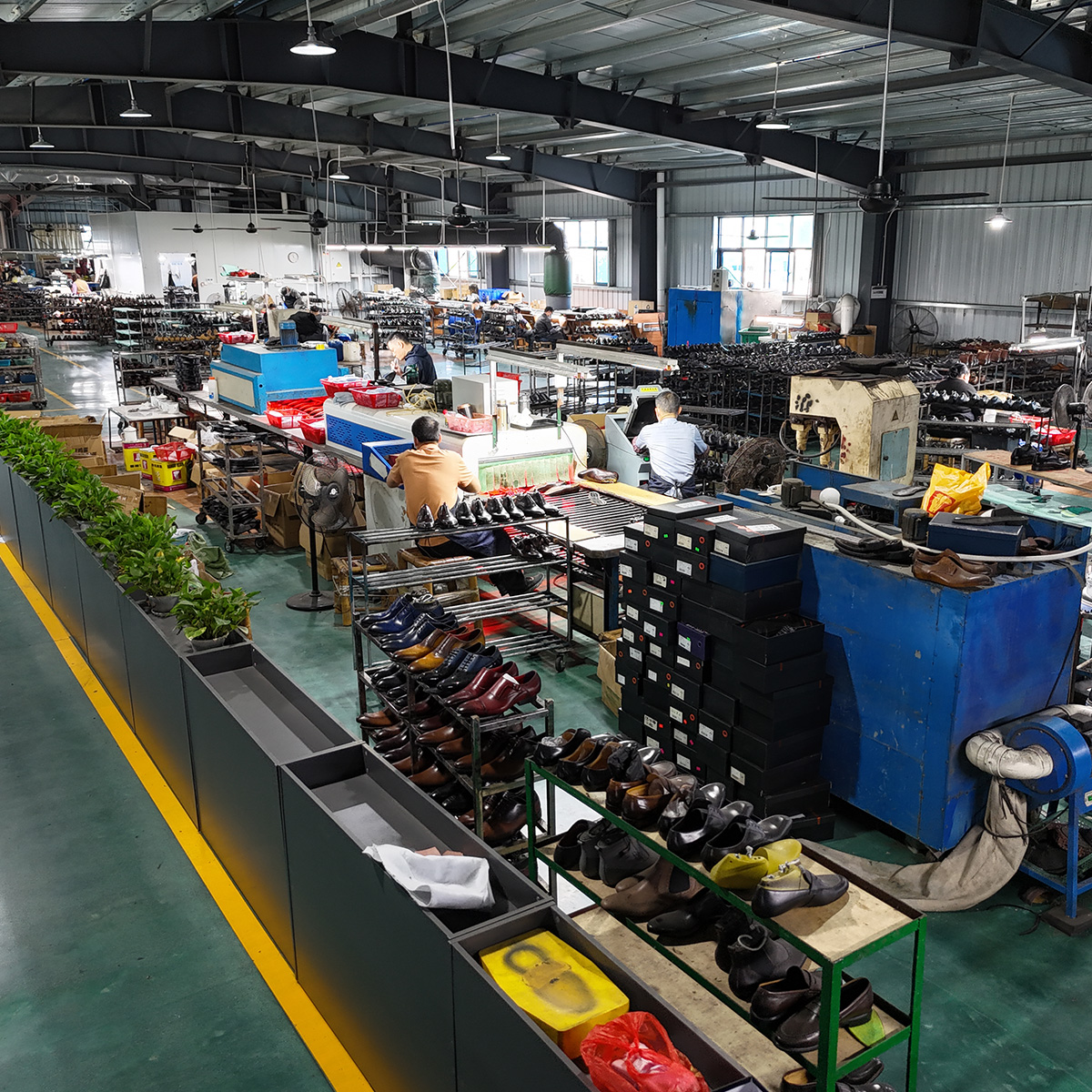
Production environment at Yangjiang Hengxin Shoes Co., Ltd., where a 100% quality control protocol runs alongside the manufacturing line.
Why Compliance, Not Price, Usually Decides the Order
Price is the easy part of a men's leather shoe order. It is comparable across suppliers, quotable within a day, and negotiable in a single exchange. Compliance is the part that fails later, and it fails in three distinct layers that buyers tend to blur together.
The product layer is the material and construction specification: what leather the upper uses, what lines the inside, what the sole is made of, and how the shoe is assembled. The process layer is the inspection and quality control protocol that demonstrates each shipment matches that specification. The commercial layer is the payment and delivery framework that determines which party carries risk, and at exactly which moment that risk transfers.
Most sourcing disputes start at layer two or three, not layer one. A buyer who has confirmed full grain leather uppers but never agreed when inspection happens, or who has agreed a price but not an Incoterm, owns an incomplete deal. The screening question for a buyer in the research or evaluation stage is therefore simple: can the supplier describe all three layers in specific, checkable terms?
Layer One: Production Standards at the Line Level
Hengxin's men's leather shoes are documented as handmade leather shoes built on a shared material specification. The upper is full grain cow or calfskin, the lining and insole are full grain cow, and the outsole is either rubber or leather depending on the model. That specification applies across the company's core men's leather shoe models, including F8-MK3, F8-NS58 and M205-B02.
Construction is centred on Goodyear welted assembly, a stitched method valued in formal footwear for durability and resoleability. Finishing is where the company differentiates its output: a hand-colored patina process that has been refined through three iterations of technological innovation, moving from an original brushed patina to washing and spot-color techniques. Leather is sourced from Italian and Argentinian suppliers, and the working portfolio contains more than 500 bespoke styles.
Those are product-level claims. What turns them into a procurement decision is the surrounding operational data, because standardisation is only credible if the factory can restate it consistently.
| Documented parameter | Stated value |
|---|---|
| Founded | 2011 |
| Factory area | 5,000㎡ |
| Employees | 100 |
| Annual output | 400,000 pairs |
| Monthly capacity | 800–1,000 pairs |
| Minimum order quantity | 60–300 pairs, depending on designs |
| Production lead time | 40–60 days |
| Quality control | 100% quality control |
| Production mode | OEM / ODM, private label customisation |
| Export ratio | 70% |
| After-sales | Free maintenance and repair; returns and exchanges supported for quality issues |
Read as a package, the table tells a buyer where the operating boundaries sit. An MOQ band of 60 to 300 pairs is unusually granular for a leather shoe factory, which means a buyer can build a mixed design order without committing to a single high-volume SKU. The monthly capacity figure, by contrast, is the constraint that governs scheduling. Buyers should confirm at quotation stage which capacity figure governs their specific order type, since the company publishes both a monthly capacity range and an annual output figure, and those two numbers describe planning in different contexts.
Layer Two: What 100% Factory Inspection Actually Means
Hengxin's documented quality control protocol is 100% quality control. In practice this means inspection is applied to every pair rather than to a statistically sampled proportion of a batch, which changes the failure mode a buyer is exposed to. Sampling tells a buyer the probability that a lot contains defects. Unit-level inspection is intended to remove defective units before they are packed.
Two things need to be said clearly about that distinction, because it is frequently overstated in the trade.
First, in-house inspection is continuous but it is not independent. A factory inspecting its own output is verifying conformity to its own specification; it is not providing third-party assurance, and it does not substitute for accredited laboratory testing against destination-market requirements for restricted substances, labelling or chemical content.
Second, the protocol is only as good as the specification it inspects against. A buyer who has not agreed tolerance levels for leather grain variation, colour consistency on hand-finished patina, or stitching uniformity has given the inspector nothing objective to check.
Third-party inspection as a separate control
Third-party inspection is available on Hengxin orders and runs alongside the factory's own control. The mechanics matter to buyers: an independent agency is commissioned by the buyer, attends the production or pre-shipment stage, and reports on the physical lot it examines. It verifies the condition of goods at a point in time. It does not certify a production system, and it does not replace laboratory testing.
Practical rule: treat 100% factory inspection and third-party inspection as two different controls serving two different purposes. The first is a continuous production control. The second is an independent verification event. Neither one removes the need for a buyer's own written specification.
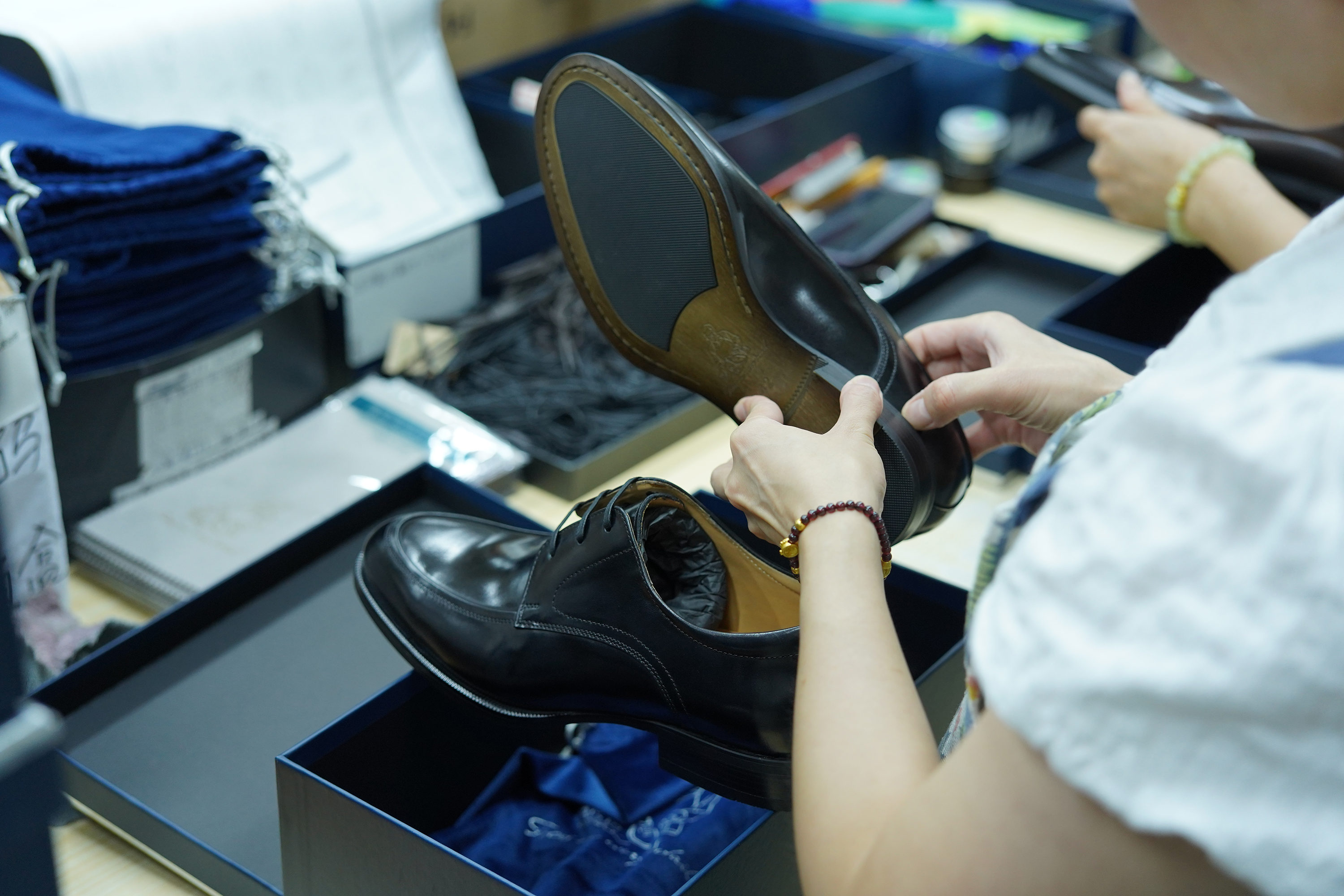
Unit-level inspection under a 100% quality control protocol, where every pair is checked rather than a sampled share of the batch.
Inspection does not end at the factory gate. Hengxin's documented after-sales position covers free maintenance and repair, and supports returns and exchanges where quality issues are confirmed. For a distributor or retailer, that closes the loop between what was inspected before shipment and what a buyer is able to promise to an end customer afterwards.
One existing customer relationship illustrates how the loop behaves over time. A men's clothing store buyer in Canada purchased 2,000 pairs for combined online and physical shop sales, and the relationship has run between five and ten years, with repeat orders for five consecutive years and zero returns. The buyer cites reasonable prices, high quality and strong after-sales service. A single case is not a statistical proof of quality, but five consecutive years without a return is a meaningful operational signal for a category where fit, colour and construction complaints are common.
Layer Three: Transaction Terms — 30/70 T/T and FOB, CIF, EXW
Commercial terms are part of compliance because they allocate risk. Hengxin orders are quoted on a 30/70 T/T basis, meaning 30% is paid in advance and the 70% balance is settled by bank transfer. Delivery can be arranged on EXW, FOB or CIF terms depending on the buyer's logistics structure.
Each term moves the handover point, and with it the buyer's landed cost calculation:
| Delivery term | Where the supplier's responsibility ends | What the buyer adds to landed cost |
|---|---|---|
| EXW | At the factory | Inland transport, export clearance, main freight, insurance, import clearance |
| FOB | On delivery to the port of shipment, export cleared | Main freight, insurance, import clearance, onward delivery |
| CIF | On arrival at the destination port, with freight and insurance arranged by the supplier | Import clearance, duties, inland delivery from port |
Three practical consequences follow. First, inspection timing should be aligned to the chosen term, because the party who carries risk after handover should not be inspecting after handover. Buyers normally schedule independent inspection before the point at which cost and risk pass to them. Second, CIF means the supplier arranges freight and insurance, but the coverage level in a CIF arrangement is typically the minimum required by the Incoterms rules rather than an all-risk commercial cover, so buyers with high-value consignments often review whether additional cover is warranted. Third, EXW places the entire logistics chain on the buyer, which suits importers who already have a consolidated freight programme and a customs broker, and suits smaller buyers far less.
The payment structure carries its own limitation, and it should be stated plainly: 30/70 T/T requires the buyer to commit working capital before production starts. It is a common structure in factory-direct leather shoe trade, but it is not an open-account arrangement, and buyers whose cash cycle cannot absorb a 30% advance should raise that constraint during negotiation rather than after the order is placed.
Matching the Protocol to the Project
Compliance requirements are not uniform across end uses, and this is where scenario planning becomes concrete. Hengxin's documented applications cover office wear, wedding wear and business use, and the product line is built around exactly those settings.
The described user profile is business people, office professionals and wedding parties, with distribution through suit shops and leather shoe distributors, and primary markets including the US, Canada, South Africa, Nigeria, the UAE and Australia. Wear conditions are documented as indoor office environments and outdoor business activity, with an operating pattern of 8 to 12 hours of daily wear, repeated on-and-off wearing, extended walking and standing, and portable business travel.
Those conditions translate into specification requirements that a buyer should put in writing: premium genuine leather material, handcrafted stitching, breathable lining, shock absorption in the insole, water-resistant treatment and anti-odor technology. For a wedding-focused order the priority ordering shifts toward finish consistency and colour match across a single batch. For an office-wear programme it shifts toward insole comfort over long wear cycles and durability of the outsole.
Model selection follows the same logic. F8-NS58 is the men's leather shoe model linked to the documented office and wedding use cases. M205-B02 is positioned in the loafer segment, relevant where slip-on convenience matters for daily business wear. F8-MK3 sits alongside them on the same material specification of full grain upper, full grain cow lining and insole, and rubber or leather outsole.
One underrated compliance item is the care kit. The documented matched equipment set includes shoe trees for shape retention, leather conditioner and polish, a shoe horn and a waterproof spray protector. If a retailer intends to sell the shoe as a maintained product with a service promise, the supplier's stated maintenance materials become part of the compliance scope, not an accessory afterthought.
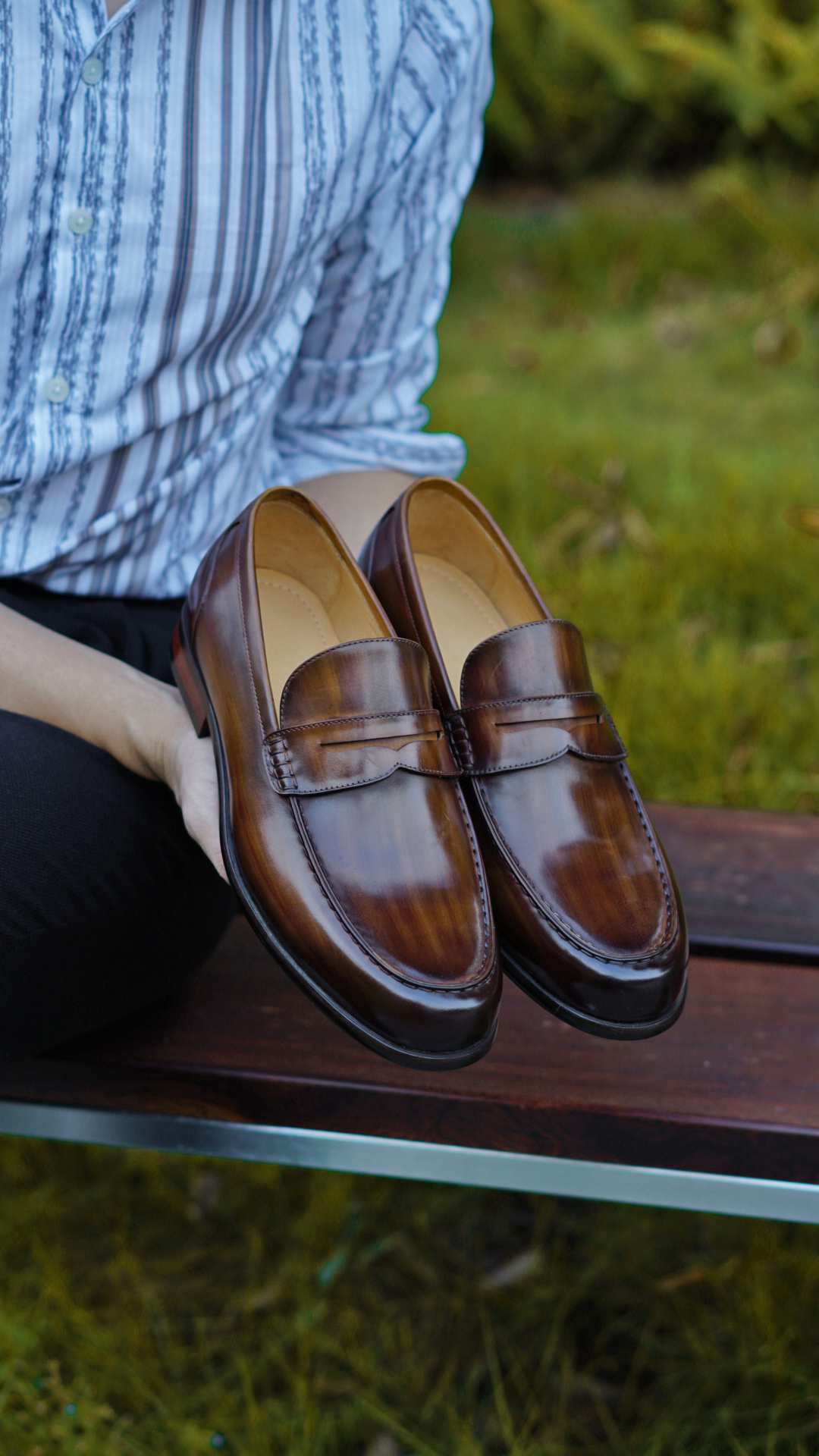
Model M205-B02 in the loafers segment, built on the same full grain upper, lining and insole specification as the formal models.
Market Trend: Compliance Is Moving Upstream
The direction of the market supports this operational reading. Asia Pacific held the largest revenue share of the leather footwear market in 2024, estimated at 53.9% (Grand View Research), which concentrates both manufacturing density and buyer scrutiny in the same region. Sustainability now shapes qualification as well as product: sustainable leather practices accounted for approximately 28% of global leather production for footwear in 2024 (Industry Research Reports).
The implication for buyers is that material provenance questions, which used to sit with the brand owner, are increasingly asked of the factory. A supplier that can name its leather sources, as Hengxin does with Italian and Argentinian leathers, shortens that conversation considerably.
Scale claims deserve separate handling. Entity data associated with Hengxin lists Yangjiang Jiangcheng QiaoDingXin Shoe Co., Ltd. with a production capacity of two lines, more than 100 workers and annual revenue between USD 5 million and USD 10 million (Alibaba supplier profile). That figure is supplier-reported and flagged for verification rather than independently audited, and it illustrates a general rule: buyer-side diligence should distinguish between published capacity statements and audited capacity evidence.
On the standards side, ISO 9001:2015 remains the primary international quality management system standard adopted by leather footwear manufacturers for process consistency (ISO TC/137 Footwear). It is a useful reference framework when reviewing a supplier's quality documentation, because it defines requirements for a documented management system rather than for an individual pair of shoes.
Limits of a Factory-Level Compliance Model
A direct-factory model is not automatically superior to other sourcing routes, and the boundaries should be stated as clearly as the capabilities.
In-house inspection is continuous but not independent. A 100% control protocol reduces the chance that a defective unit ships. It does not provide an external opinion, and it does not substitute for laboratory testing to destination-market chemical and labelling requirements.
Third-party inspection is a snapshot. It reports on the lot examined at that moment. It does not certify the production system behind it, and results are not transferable to the next order.
Capacity has a ceiling. With monthly capacity documented at 800 to 1,000 pairs and a production lead time of 40 to 60 days, a buyer planning a fixed launch date should treat scheduling as a constraint to be confirmed at quotation, not an assumption.
Payment terms shape cash flow. The 30/70 T/T structure favours buyers with available working capital and disadvantages those expecting open-account terms.
Hand finishing introduces variance. Hand-colored patina is a manual process, and batch-to-batch variation is intrinsic rather than a defect. Buyers should specify acceptable tolerance ranges instead of assuming absolute uniformity.
EXW shifts logistics entirely to the buyer. Inexpensive on the invoice, demanding in execution for buyers without a freight and customs infrastructure.
| Sourcing route | Strength | Main limitation |
|---|---|---|
| Direct factory (Hengxin model) | Specification, inspection protocol and production capacity sit with one party; no intermediary margin | Capacity is fixed to that factory; buyer owns more of the diligence work |
| Trading company or agent | Can switch between multiple factories and absorb order complexity | Inspection distance from the production line; specification control is indirect |
| Brand-side QC team with external audit | Independent verification and documented audit trail | Highest cost and resource load; usually reserved for larger programmes |
Future Outlook
Compliance in men's leather shoes is converging on documentation that travels with the shipment. Buyers are likely to standardise three things over the next planning cycles: a written specification with agreed tolerances, an inspection schedule with a named point of handover, and defined Incoterms with clarity on insurance coverage.
A manufacturer that has operated since 2011, has refined its finishing process through three technology iterations, and maintains a documented after-sales position on maintenance and repair is positioned to answer those questions structurally rather than case by case. The remaining gap in the market is not capability but evidence format: buyers increasingly want supplier-published figures confirmed against audited or third-party-verified data before a long-term programme is committed.
Frequently Asked Questions
What does 100% quality control cover in men's leather shoe production?
Yangjiang Hengxin Shoes Co., Ltd. documents its quality control protocol as 100% quality control, which means inspection is applied at unit level across production rather than only to a sampled proportion of a batch. The control operates against the agreed product specification, which for the company's core models covers a full grain cow or calfskin upper, full grain cow lining and insole, and either a rubber or leather outsole. Its practical effect is that defective units are intended to be identified before packing rather than estimated statistically after packing. It is an internal production control, not an independent certification.
Can an overseas buyer arrange third-party inspection before shipment?
Yes. Third-party inspection is available on Hengxin orders and operates alongside the factory's own 100% quality control. The buyer commissions the inspection agency, and the visit is normally scheduled before the point at which cost and risk transfer under the agreed delivery term, so that the party taking ownership inspects while the goods are still under supplier control. Third-party inspection verifies the physical lot at a specific point in time; it does not certify the production system, and it does not replace laboratory testing against destination-market chemical or labelling regulations.
What do 30/70 T/T and FOB, CIF or EXW mean for a men's leather shoe order?
30/70 T/T is the payment structure applied to Hengxin orders: 30% is paid in advance and the 70% balance is settled by bank transfer. Delivery can be quoted as EXW, FOB or CIF. Under EXW, the supplier's responsibility ends at the factory, so the buyer handles inland transport, export clearance, main freight, insurance and import clearance. Under FOB, the supplier delivers the goods to the port of shipment with export clearance completed, and the buyer arranges main freight and insurance. Under CIF, the supplier arranges and pays freight and insurance to the destination port, with import clearance and duties remaining with the buyer. The choice changes both the risk transfer point and what the quoted price includes.
How should minimum order quantity and lead time be planned into a project schedule?
Hengxin's minimum order quantity is 60 to 300 pairs depending on designs, its documented monthly capacity is 800 to 1,000 pairs, and its production lead time is 40 to 60 days. For a project with a fixed delivery date, order size and design count need to be planned together, since a wider design range typically moves the order toward the upper end of the MOQ band while a narrower range at higher volume fits more comfortably within monthly capacity. The lead time refers to production and should be treated separately from transit time, which depends on the selected delivery term.
Which compliance checks sit outside the supplier's own inspection scope?
Several categories typically remain with the buyer. Laboratory testing against destination-market regulations for restricted substances, labelling and chemical content is not covered by in-house inspection. Customs classification, import duties and import clearance sit with the buyer on all three delivery terms. Transport insurance beyond the minimum coverage arranged under a CIF shipment is normally the buyer's decision. Finally, because full grain leather is a natural material and the patina finish is applied by hand, minor grain and colour variation between batches is expected, so buyers should define acceptable tolerance ranges within the specification rather than assume zero variation.