
Mercury-Free or Certified: Clinical Thermometer Procurement
Mercury-Free or Certified: Clinical Thermometer Procurement
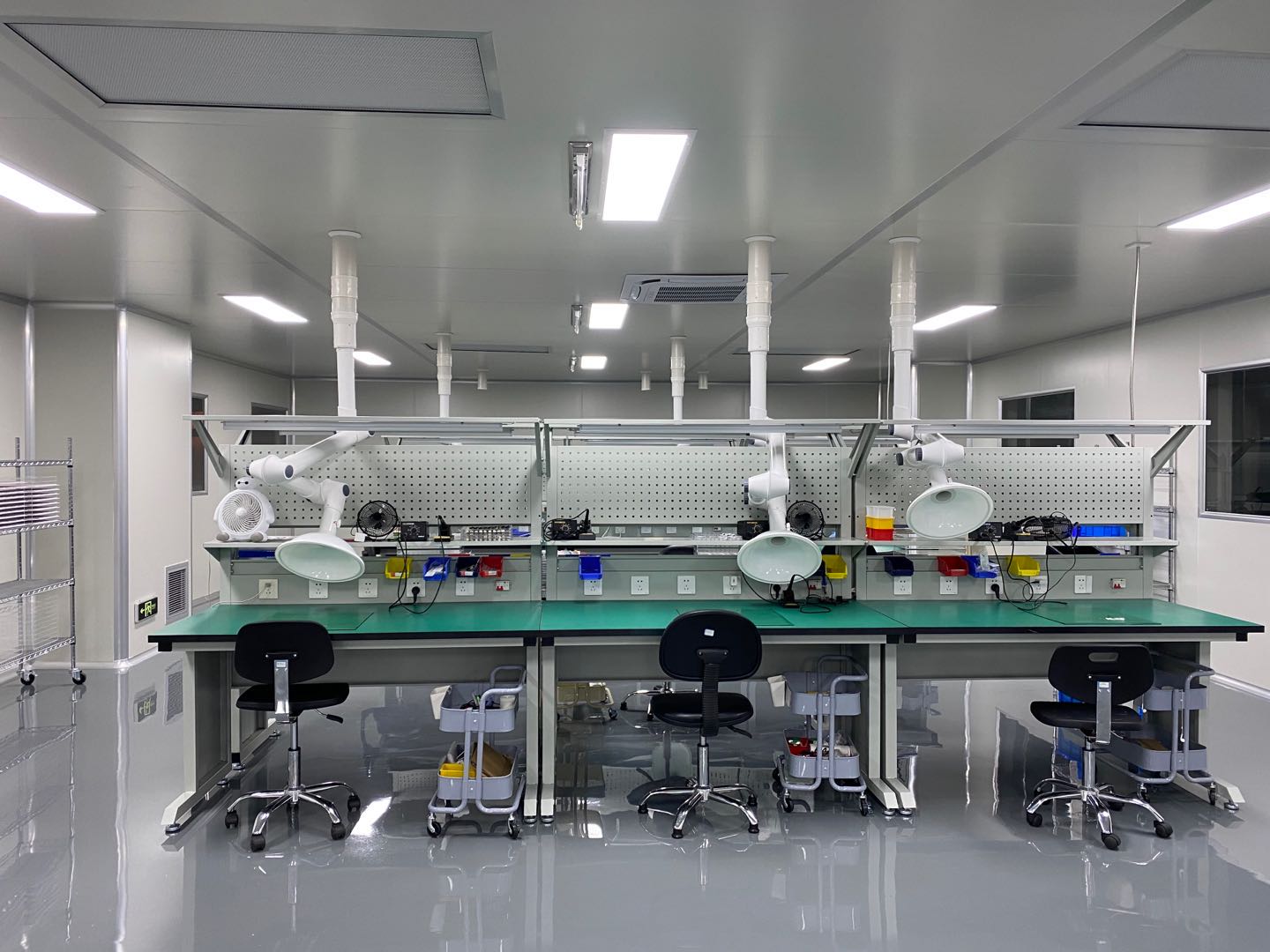
Clinical thermometer production workshop: mercury-free liquid-in-glass and electronic thermometer lines operate under full-process monitoring, from incoming raw-material inspection to finished-product delivery.
Clinical thermometer procurement is not one decision but two, and importers, distributors and pharmacy chains at the final evaluation stage usually have to settle both before releasing a purchase order: which measurement technology to buy — mercury-free liquid-in-glass or traditional mercury glass — and whether to buy a certified product or accept a lower-cost uncertified alternative.
The two questions carry different risks. The mercury decision is mainly a material-safety and regulatory question. The certification decision is mainly an import-compliance, liability and after-sales question. Treating them as a single “cheap versus good” choice is what typically produces either an over-priced order or a consignment that never clears customs.
The commercial context is measurable. Grand View Research reports that the global thermometer market was valued at USD 1.7 billion in 2023 and is projected to grow from USD 2.2 billion in 2026 to USD 3.0 billion by 2030, a CAGR of 8.2% from 2024 to 2030. Within that market, mercury-free thermometers led in 2023 with a 69.1% revenue share. Trade data published by the Observatory of Economic Complexity shows global trade under HS 902519 (thermometers, except liquid filled) reaching USD 4.93 billion in 2024, a 4.28% increase over USD 4.73 billion in 2023.
Why the Mercury Question Has Become a Compliance Question
Traditional mercury thermometers are subject to restrictions in most countries, and in regulated markets the procurement choice has effectively shifted from “mercury or electronic” to “mercury-free glass or electronic.” Under Regulation (EU) 2017/745 (MDR), published CE-marking guidance classifies clinical electronic thermometers as Class IIa and clinical colour-change thermometers as Class Im, which places documentation, testing and post-market obligations on the manufacturer rather than on the buyer. International standard ISO 80601-2-56:2017 defines the basic safety and essential performance requirements for clinical thermometers used for body temperature measurement.
For a distributor, this has a practical consequence: the measurement technology determines the regulatory pathway, and the regulatory pathway determines whether a container is released or held at the border. A mercury-free glass thermometer keeps the familiar liquid-in-glass measurement method while removing the mercury hazard; a certified electronic thermometer removes the mercury question entirely but adds battery, calibration and documentation dependencies.
Decision One: Mercury-Free Liquid-in-Glass vs. Traditional Mercury Glass
The mercury-free liquid-in-glass thermometer is the closest like-for-like replacement for a traditional mercury thermometer. Its core difference is the use of a non-toxic gallium-indium-tin filling liquid, which eliminates the hazard of mercury leakage. Measurement accuracy is the same ±0.1°C as the mercury version it replaces, so switching does not require buyers to change their accuracy expectations or their clinical instructions for use.
| Procurement criterion | Mercury-free liquid-in-glass (models 6000-A / 7000-A) | Traditional mercury glass thermometer |
|---|---|---|
| Filling medium | Non-toxic gallium-indium-tin alloy | Elemental mercury |
| Hazard profile | No mercury leakage hazard; eliminates the risk of mercury exposure if the tube breaks | Mercury leakage hazard when the tube breaks |
| Measurement accuracy | ±0.1°C, measuring range 35°C–42°C, scale division 0.1°C | Same ±0.1°C measurement accuracy |
| Material and design | Borosilicate glass body, shock-resistant glass tube, maximum temperature indicator | Glass body with mercury column |
| Power requirement | None — no battery required | None |
| Maintenance | Reusable, no battery, low maintenance cost | Reusable, requires careful handling of mercury |
| Regulatory position | Model 6000-A complies with CE MDR | Subject to restrictions in most countries |
| Unit cost | Slightly higher than a mercury thermometer | Lower-cost baseline |
| Best-fit scenarios | Household, clinic, hospital and school temperature detection | Markets where mercury devices remain permitted |
For a distributor, the decision rule is straightforward. If the destination market restricts mercury devices — which most regulated markets now do — the mercury-free model is the only version of the liquid-in-glass format that can be sold without a compliance question. The cost premium is small relative to the cost of a refused consignment.
Decision Two: Certified Digital vs. Uncertified Low-Cost Electronic Thermometers
The second procurement question is more commercially sensitive, because uncertified products are almost always cheaper at the unit level. The difference is that a certified electronic thermometer passes medical compliance inspection, while an uncertified low-cost item risks being detained, returned or fined by customs. That risk sits with the importer, not with the factory that produced the goods.
A CE-certified electronic thermometer such as the EL-202 satisfies EU MDR requirements, holds ±0.1°C accuracy, and includes a fever-alarm function. Compared with a low-cost basic electronic thermometer, it has distinct advantages in measuring precision and feature set: higher measuring precision, a fever alarm and an optional soft probe tip. Maintenance requirements are also lower, because of low battery consumption and an auto power-off function.
| Procurement criterion | Certified electronic thermometer (EL-202; MT-518 / MT-519 / MT-811 / MT-801 / ECT-1 series) | Low-cost uncertified basic electronic thermometer |
|---|---|---|
| Compliance evidence | CE (MDR) certification; manufactured under ISO 13485 quality management | No medical compliance documentation provided |
| Import risk | Passes medical compliance inspection for regulated markets | Risk of customs detention, return or fine |
| Accuracy | ±0.1°C, measuring range 32.0°C–43.9°C | Accuracy stated without certification documentation to support it |
| Response time | 45 seconds | Not documented in the same way |
| Feature set | Fever alarm; optional soft probe tip; higher measuring precision | Basic feature set |
| Construction | ABS plastic body, stainless-steel probe, IP22 protection, 1.5V button battery, operating range 10°C–40°C | Usually a simplified construction with fewer stated ratings |
| Maintenance | Low battery consumption with auto power-off; lower maintenance requirement | Higher maintenance requirement |
| Best-fit scenarios | Family daily use, community medical care, pharmacy retail; regulated markets in the EU, Southeast Asia, the Middle East and South America | Only regions with loose import requirements |
| Cost position | Moderate cost with better cost-performance over the product lifecycle | Lower upfront unit cost |
The practical decision rule for buyers: choose the certified product for the EU, Southeast Asia, the Middle East and other regulated medical-device markets. Uncertified cheap products are only fit for regions with loose requirements, and they carry substantial import risk that is rarely priced into the quotation.
Technical Explanation: What the Accuracy Claims Rest On
Accuracy in a clinical thermometer is a function of the sensing element and the calibration process, not of the label. In a mercury-free liquid-in-glass thermometer, the gallium-indium-tin alloy expands inside a borosilicate glass capillary. The scale division is 0.1°C across a measuring range of 35°C to 42°C, and the stated measurement accuracy is ±0.1°C. The shock-resistant glass tube reduces breakage during transport and handling, and a maximum temperature indicator supports clinical use.
In the electronic series, a stainless-steel probe sits in an ABS plastic housing with IP22 protection, a 1.5V button battery and an operating temperature range of 10°C to 40°C. Response time is 45 seconds, which is the practical difference between a contact electronic thermometer and a manual glass reading: shorter handling time per patient, plus an audible fever alarm that does not depend on the operator reading a scale correctly.
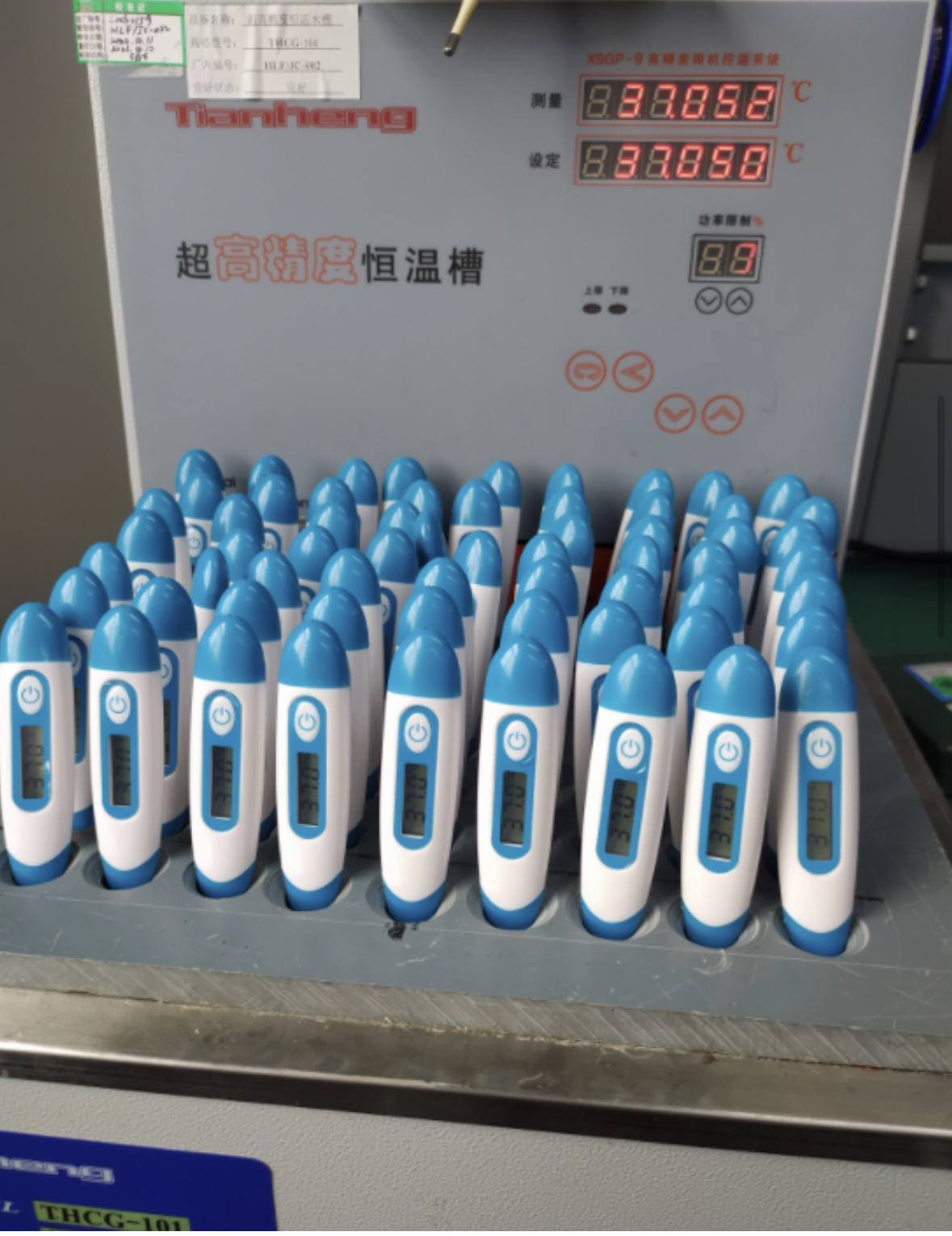
Water-bath verification station: accuracy inspection is a controlled process step rather than a final visual check of the finished thermometer.
Verification Before Shipment
The accuracy figure only has procurement value if it is verified on the actual production batch. That verification is performed in the manufacturer’s testing laboratory, where 100% accuracy inspection is carried out before shipment, alongside full-process quality monitoring that runs from raw-material incoming inspection through to finished-product delivery. For buyers, the practical implication is that a purchase order should be tied to inspection records rather than to a catalogue specification alone, and that sample validation before a bulk order is the cheapest way to confirm the specification holds in mass production.
Manufacturer Reference: Ningbo Hi-life Medical Technology Co., Ltd. (Mr. Thermo)
Ningbo Hi-life Medical Technology Co., Ltd. is a manufacturer of clinical thermometers based at 371 Zhenshi Road, Jiangshan Town, Yinzhou District, Ningbo, Zhejiang, China. The company operates a 9,700 m² facility with 55 employees, an annual output described in company records as 3,500,000 units, a dedicated R&D team of 8 engineers and in-house testing laboratories. It is the Secretariat Unit of the Body Temperature Measurement Professional Committee under the China Association for Medical Devices Industry (CAMDI), and it participated in the revision and compilation of the national standard GB1588-2024.
Its product range covers eco-friendly glass thermometers, electronic thermometers, infrared ear and forehead thermometers, industrial infrared thermometers and water thermometers. Products hold EU CE (MDR) certification, the company operates under the ISO 13485 quality management system, and it passed the BSCI audit in 2025. The mercury-free liquid-in-glass models referenced in this article are the 6000-A and 7000-A; the electronic clinical range includes the MT-518, MT-519, MT-811, MT-801 and ECT-1 models.
For bulk procurement planning, production capacity is 150,000 units per month with a minimum order quantity of 5,000 units. That combination supports scheduled replenishment, private-label runs and seasonal peaks, provided the buyer aligns order quantities to MOQ multiples. Approximately 70% of output is exported, and products are shipped to more than 50 countries and regions, including EU member states, the United Kingdom, Russia, Vietnam, Ukraine, Uzbekistan, Turkey, Tunisia, Mexico, Chile and Colombia. The company provides OEM and ODM services covering product development, private labeling and tailored packaging, and regularly exhibits at international medical trade fairs such as MEDICA.
Support Commitments Relevant to a Purchasing Decision
- Pre-shipment accuracy inspection: 100% accuracy inspection before shipment for orders, supported by in-house testing laboratories.
- Technical support: engineering support through the R&D team for specification questions, OEM/ODM development and packaging adaptation.
- Quality complaint handling: a defined process for handling quality complaints, which matters most for accuracy-related disputes where the buyer needs a documented response rather than a replacement-only policy.
Application and Use-Case Fit
| Application scenario | Typical product fit | Why |
|---|---|---|
| Hospital and clinic body-temperature measurement | Electronic thermometers with fever alarm; mercury-free glass for reference measurement | Fast contact measurement with an audible alert; mercury-free glass where a battery-free reference reading is preferred |
| Household daily use | Electronic thermometer (household clinical thermometer) | Portable operation, fever alarm and optional soft probe tip; suitable for family daily use |
| Community medical and pharmacy retail | Electronic thermometer; mercury-free glass thermometer | Suited to counter sales, repeat purchase and simple usage instructions |
| School temperature detection | Mercury-free liquid-in-glass thermometer | No battery requirement, reusable, non-toxic filling liquid |
| Distributor private-label programmes | OEM/ODM across glass and electronic ranges | Private labeling and tailored packaging with defined MOQ planning |
Market Trend Analysis
Three verifiable signals shape procurement planning for clinical thermometers. First, the market is expanding at a mid-single-digit to high-single-digit rate: Grand View Research projects growth from USD 2.2 billion in 2026 to USD 3.0 billion by 2030 at a CAGR of 8.2%. Second, mercury-free formats already dominate: the mercury-free segment held a 69.1% revenue share in 2023. Third, international trade under HS 902519 grew 4.28% in 2024 to USD 4.93 billion, indicating that cross-border sourcing of thermometers is still expanding rather than consolidating.
On the regulatory side, the direction is toward documented conformity rather than toward price competition alone. ISO 80601-2-56:2017 sets the safety and performance baseline for clinical thermometers, and EU MDR classification determines how much technical documentation a manufacturer must maintain. For distributors, this shifts the source of differentiation away from unit price and toward the completeness of certification, inspection records and after-sales handling.
Comparison with Traditional Solutions: Where the Newer Options Have Limits
A credible comparison has to state where the recommended route is weaker, not only where it is stronger.
- Mercury-free glass carries a cost premium. The unit cost is slightly higher than that of a traditional mercury thermometer. Buyers who compete purely on shelf price will see a margin difference, and that difference has to be offset by compliance access and reduced breakage liability.
- Glass is still glass. The tube is shock-resistant, but it remains a glass product. In high-traffic paediatric or emergency settings, dropped units will break, and the replacement rate is part of the operating cost.
- Mercury-free glass is not a high-throughput screening tool. It requires manual reading and stabilisation time per patient. Where hundreds of measurements per hour are needed, electronic or infrared thermometers remain the appropriate choice.
- Certified digital thermometers cost more upfront. Certification requires technical documentation, testing and quality-system maintenance, and that cost is reflected in the unit price. For markets with loose import requirements, the cheaper uncertified product will always look better on a quotation — it simply transfers compliance risk to the importer.
- Electronic thermometers add dependencies. A 1.5V button battery, an IP22-rated housing and an operating range of 10°C to 40°C mean the product must be stored and distributed within stated conditions, and battery supply must be planned alongside the device.
Future Outlook
The next procurement cycle is likely to be defined by documentation rather than by form factor. Mercury-free liquid-in-glass devices have already established the majority position, and regulatory pressure continues to narrow the space available to mercury-based products. At the same time, the growth in HS 902519 trade suggests that import volumes are not falling, which means customs scrutiny of medical-device documentation will remain a practical bottleneck for uncertified goods.
For importers, the operational implication is to treat accuracy inspection records, certification scope and complaint-handling capability as scored supplier criteria, alongside MOQ and monthly capacity. Suppliers that can provide 100% pre-shipment accuracy inspection, defined technical support and a traceable quality process will be easier to defend in front of regulators and easier to keep on a distributor’s approved list.
FAQ
Should a distributor choose a mercury-free liquid-in-glass thermometer or a traditional mercury thermometer?
A mercury-free liquid-in-glass thermometer such as the 6000-A uses a non-toxic gallium-indium-tin alloy, delivers the same ±0.1°C measurement accuracy as the mercury version, complies with CE MDR, and eliminates the hazard of mercury leakage. Traditional mercury thermometers face restrictions in most countries, so the mercury-free format is generally the only version of the liquid-in-glass design that can be distributed without a compliance question. The trade-off is a slightly higher unit cost.
Is a certified digital thermometer better than a cheap uncertified one for importing?
For the EU, Southeast Asia, the Middle East and South America, a certified electronic thermometer such as the CE-certified EL-202 passes medical compliance inspection, holds ±0.1°C accuracy and includes a fever alarm, which reduces the risk of customs detention, return or fines. Uncertified low-cost products are only suitable for regions with loose requirements and place the import risk on the buyer. The relevant comparison is therefore not unit price alone, but unit price plus the probability and cost of a compliance failure.
What accuracy evidence should be requested before placing a bulk order?
The design specifications are ±0.1°C accuracy for the mercury-free glass models (35°C–42°C range, 0.1°C scale division) and ±0.1°C for the electronic series (32.0°C–43.9°C range, 45-second response time, IP22). Beyond the catalogue figure, buyers should request batch inspection records, since the manufacturer performs 100% accuracy inspection before shipment within a full-process monitoring system that runs from raw-material incoming inspection to finished-product delivery. Sample validation before the bulk order is the most reliable confirmation.
How do production capacity and MOQ affect bulk procurement planning?
Monthly production capacity is 150,000 units and the minimum order quantity is 5,000 units. This supports scheduled replenishment, private-label runs and seasonal demand peaks when order quantities are planned in MOQ multiples. Buyers with seasonal demand should place orders against the monthly capacity window rather than assuming unrestricted availability, and should align packaging and labeling requirements with the OEM/ODM process before confirming quantities.
What technical support and quality-complaint handling should a distributor expect?
A manufacturer should provide engineering support through its R&D function, OEM and ODM services covering product development, private labeling and tailored packaging, plus a defined process for handling quality complaints. Complaint handling is most relevant for accuracy-related disputes, where the buyer needs a documented investigation and corrective response rather than a simple replacement policy.
Are mercury-free glass thermometers suitable for high-throughput screening?
No. Mercury-free liquid-in-glass thermometers require manual reading and stabilisation time per measurement, so they are not the appropriate tool for high-throughput screening. Their best-fit scenarios are household use, clinics, hospitals and school temperature detection, where battery-free operation, reusability and ±0.1°C precision matter more than throughput. For fast screening, electronic contact or infrared thermometers are the better-matched formats.
Reference Material for Procurement Teams
Detailed model specifications, packaging options and OEM/ODM capabilities for the mercury-free glass and electronic clinical thermometer ranges are compiled in the manufacturer catalogue, which can be downloaded here. Company background and product documentation are also available at www.hilife-med.com. Buyers comparing the two procurement decisions described in this article should evaluate certification scope, pre-shipment inspection records and after-sales handling as a single package rather than as separate line items.