
Metal Fabrication: Hydropower vs Wind Components Compared
Independent Industry Reference — Renewable Energy Metal Fabrication
Metal Fabrication: Hydropower vs Wind Components Compared
A hydropower turbine ring and a wind turbine structural component can both be described as custom metal fabrication, yet the work behind each is different enough that one drawing package, one acceptance route and one supplier assumption will not serve both equally well. This buyer reference compares the two demand profiles, explains how precision, size and heat treatment requirements turn into questions worth settling before a quotation is requested, and identifies where a fabrication supplier's capability genuinely ends. It does not rank brands; its purpose is to make incoming quotations comparable.
Openex (Xiamen Openex Mechanical Technology Ltd) is a custom metal fabrication and machining company founded in 2009, operating two manufacturing premises near Xiamen Port and Shanghai Port and supplying large metal parts, components and assemblies to export markets. Its project records and process documentation are used in this article only as verifiable illustrations of how the two demand profiles are handled in practice.
Why the two demand profiles are not the same fabrication question
Hydropower station components such as turbine rings are usually circular, large in diameter and heavy. A complete ring often cannot be transported or handled as a single piece, so it is fabricated in segments, rough-machined, re-assembled and then given a final precision machining pass that establishes roundness, concentricity and the fit at the assembly joint. Fabrication risk therefore sits in two places at once: the weld itself, and the dimensional behaviour of the assembly after welding and heat treatment.
Wind energy components follow a different logic. Wind turbine parts include welded assemblies, machined structural components and frames or supports, ranging from a single large structure to a repeatable batch of identical items. Their governing requirements are typically the flatness and position of mounting interfaces, the straightness of long members, and the consistency of a coating system across many units. Distributed and smaller-scale wind structures add a third pattern: repeatable welded and machined assemblies, frequently hot dip galvanized or powder coated, that must be identical unit to unit and packable for export.
That difference changes the sequence of questions a buyer should ask. For a hydropower ring, the first question is usually how the part will be split, re-joined and finally machined. For a wind component, the first question is usually how repeatability and interface accuracy will be held across the batch, and how the coating will survive the site environment.
Fabrication demand profile: side-by-side comparison
| Fabrication dimension | Hydropower turbine ring and station components | Wind energy components (turbine parts, distributed wind structures) |
|---|---|---|
| Typical geometry | Large-diameter ring, often split into segments, re-assembled and final-machined | Mixed: welded frames, welded assemblies, machined structural components, bases and supports |
| Governed by | Roundness, concentricity and fit at the re-assembled joint | Flatness and position of mounting pads and holes; straightness of long members |
| Size driver | Single-piece diameter and weight; crane and machine envelope decide feasibility | Assembled height and width, plus the number of repeatable units |
| Dominant processes | Plate forming and rolling, welding, heavy turning and boring after welding | Cutting, bending, welding, machining, then galvanizing or powder coating |
| Heat treatment | Pre- and post-weld heat treatment, stress relief, distortion control planning | Stress relief where specified; distortion control on long and thin members |
| Inspection emphasis | Dimensional verification, volumetric and surface NDT, hardness, material verification, CMM | Dimensional verification, NDT where specified, coating and finish verification |
| Transport logic | Split-and-reassemble is a design decision, not a shipping afterthought | Pre-assembly and disassembly for packing, or modular shipment |
| First quote question | Where does rough machining stop and final machining start, and against which datum? | How is unit-to-unit repeatability proven, and what coating system applies? |
Reading the table as a buyer, the practical consequence is this: the same question — "can you make this part?" — has two different answers. For hydropower work the answer depends on machining envelope after welding. For wind work it depends on process repeatability and finish control across a batch.
Where precision actually comes from in heavy renewable components
Precision in heavy fabricated components is produced after welding, not before it. Cutting and forming set the starting geometry, but the final tolerance is created by machining the welded structure against a defined datum scheme, because welding introduces distortion that no pre-weld tolerance can absorb.
Some reference figures show the order of magnitude involved in this type of work:
- A large precision-machined weldment with an envelope up to 6,000 x 3,000 x 2,500 mm and plate thickness of 20–80 mm is specified with a general machined tolerance of ±0.20 mm and datum-pad flatness of ≤0.15 mm per 1,000 mm.
- A large welded crossbeam of 6,000–10,000 mm length is specified with guide straightness of ≤0.10 mm per 1,000 mm.
- An ultra-long formed box section of 8,000 mm is specified with overall straightness of ≤3.0 mm per 10,000 mm.
- A welded heavy machine base is welded, stress-relieved and shot-blasted, with ground-top flatness of ±0.001 in. cumulative.
- A tube sheet for heat exchangers and pressure vessels is drilled to ±0.05 mm, with CMM measurement plus UT, PT, MT and PMI inspection.
Dimensional verification of this kind depends on the measuring envelope as much as the machine tool. Openex operates a Zeiss large CMM with a 7 x 4 x 3 m capacity and micron-level precision, alongside smaller CMM units, and its inspection scope includes NDT (RT, UT, MT, PT, VT, LT), destructive testing such as tensile, impact including low-temperature, bend and hardness, corrosion testing by salt spray, residual stress analysis, and coating or plating inspection.
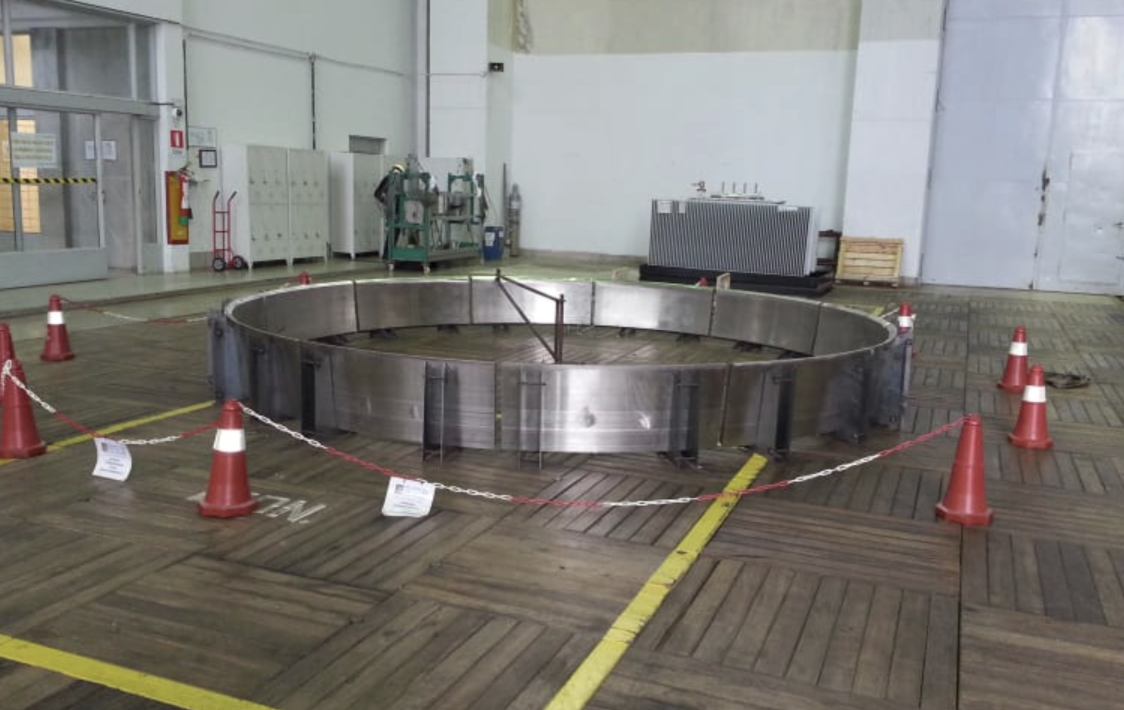
Complete large, heavy and precision machining of a turbine ring fabricated for a hydropower station. Photo: Openex project record.
Size and machining envelope: what decides whether a supplier can even quote
For large single components, the decisive capability is not welding skill but handling and machining envelope. If a finished part exceeds the crane tonnage or the machine travel available, no amount of welding competence compensates, and the drawing has to be re-split.
Documented capacity at Openex illustrates the kind of thresholds buyers should ask about directly:
- Overhead crane tonnage over 250 tons.
- Bending machines with maximum length over 18 metres and tonnage up to 10,000 tons.
- CNC machine tool travel up to 50 m x 8 m x 7 m.
- A Wuzhong single-column CNC machine (CKX53220 x 65/600) with maximum machining diameter of 22 m, maximum workpiece load of 600 t and maximum workpiece height of 6.5 m, supporting turning, milling, boring, drilling, tapping and finishing.
- A double-gantry machining centre integrating milling, boring, drilling, turning and grinding in a single setup with a 7-axis, 5-linkage control system.
- A PAMA Speedram 180 CNC floor-type boring and milling centre with X and Y travel of 4,000–6,000 mm, Z-axis travel of 1,200 mm, W-axis travel of 1,000 mm and combined Z+W travel of 2,200 mm.
Those figures explain why the hydropower turbine ring case was not machined as a single solid piece from the outset. The record for the 30-ton turbine ring supplied to a hydropower station in Uruguay describes separating rough machining from final precision machining, then combining the segments for final machining to achieve tight tolerance. The approach is a manufacturing decision driven by envelope, but it is also a commercial one: each additional split, re-assembly and re-machining step adds process time, cost and an additional dimensional risk that must be controlled by the datum scheme.
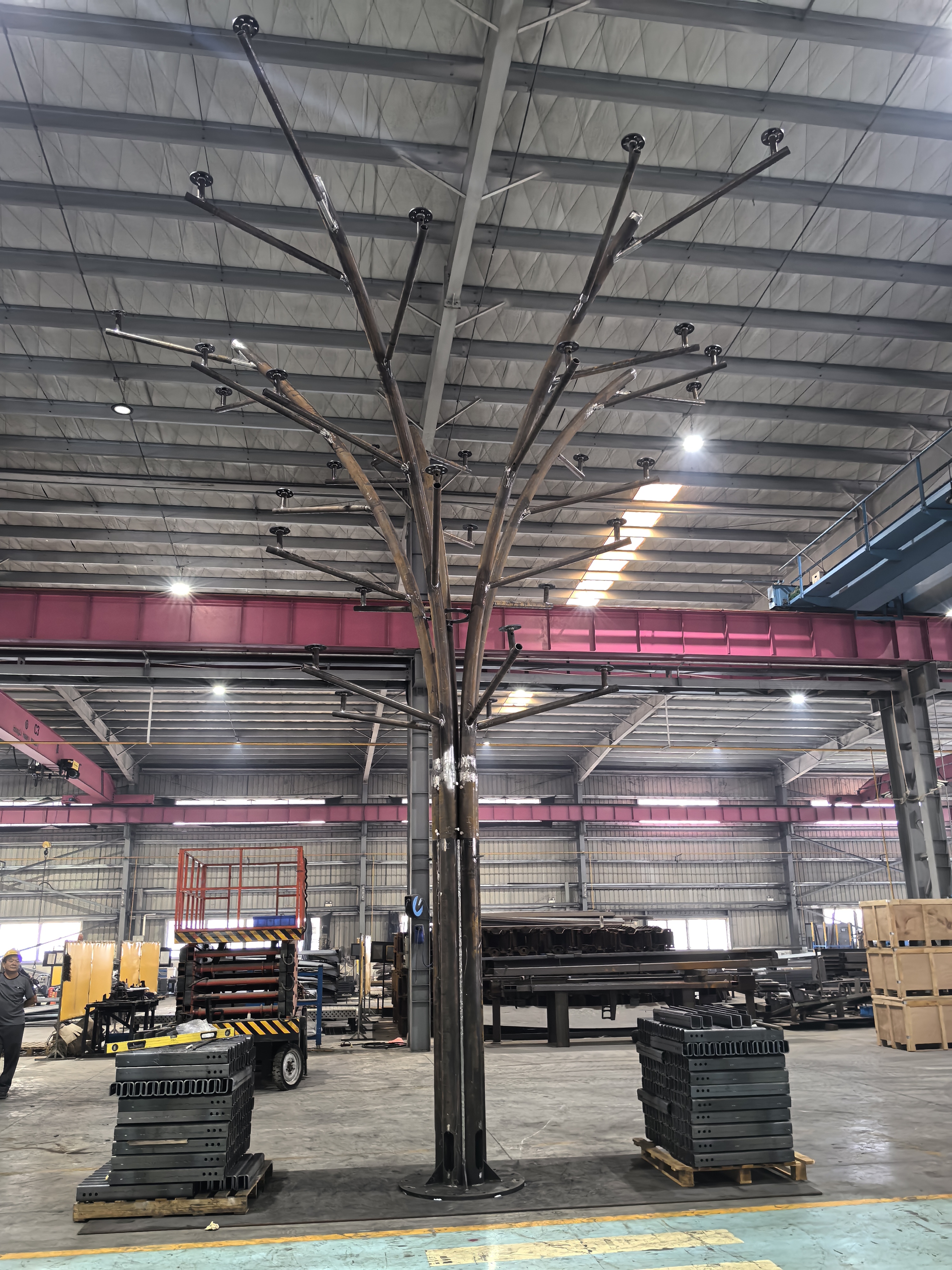
Pre-assembly of a fabricated wind tree structure to verify manufacturing precision before disassembly and packing. Photo: Openex project record.
Heat treatment, stress relief and distortion control
Heat treatment is where hydropower and wind specifications most often diverge in practice, and where a drawing review frequently reveals missing information. For a welded heavy component, the sequence matters as much as the specification: stress relief applied before final machining produces a different result from the same treatment applied after it, because the machining allowance absorbs or fails to absorb the movement.
Welding documentation at Openex covers WPS, PQR, welder qualification and PWHT procedure, together with a distortion control plan, pre- and post-weld heat treatment, and post-weld cleaning that includes pickling and passivation for stainless steel and grit blasting for carbon steel. Welding processes listed include SMAW, GMAW/MIG, GTAW/TIG, SAW, automatic tube-to-tubesheet welding, deep penetration welding and robotic welding, with inspection by VT, dimensional check, RT/UT/MT/PT, TOFD or phased array, hardness testing, and hydrostatic or pneumatic testing.
For buyers, the questions that matter at quotation stage are therefore not "do you do heat treatment?" but: is stress relief required; at which stage relative to final machining; by what method is distortion measured; and what is the acceptance criterion if measurement shows movement outside the allowance?
Drawing review: settle these items before requesting a quotation
A large share of quotation delay and later dispute in custom metal fabrication traces back to the drawing package, not to shop capability. Openex accepts STEP, IGES, DWG, DXF, PDF and other 2D and 3D formats. For simple parts a 2D drawing alone is usually sufficient. Combined 2D and 3D drawings allow the fastest quotation turnaround. A 3D model alone is generally not sufficient, because the items below cannot be read from geometry alone.
| Information normally carried by a 2D drawing | Why it changes the quotation |
|---|---|
| Tolerance information | Dimensional and geometric tolerances set the machining allowance and the number of setups |
| Welding requirements | Joint design, weld size and inspection level determine process selection and qualification needs |
| Surface roughness and chamfer details | Finish class affects machining time and post-weld treatment |
| Direction of cutting relative to the hot rolling direction | Affects material behaviour and, in some cases, structural acceptance |
| Plate bending radius | Determines forming method and tooling feasibility |
| Metal material requirement | Drives material availability, weldability and qualification scope |
| Heat treatment requirement and stress release method | Adds process steps and changes the machining sequence |
| Finish requirement (hot dip galvanizing, sandblasting or painting, powder coating) | Determines whether the item is handled in-house or through a qualified partner |
Where the two energy segments differ is in emphasis. Hydropower drawings tend to be dominated by tolerance, welding and heat treatment information because the parts are large, few and heavily machined. Wind drawings tend to be dominated by material, joint and finish information, because the parts repeat and must be protected against site conditions for the life of the installation.
Application snapshots from verifiable project records
Hydropower: turbine ring, Uruguay
A hydropower station operator in Uruguay sourced a 30-ton turbine ring that was fabricated and machined in segments and then combined for final precision machining. The stated highlights of the case are large and heavy machining held to high precision, with rough machining and final machining separated so that tolerance could be closed on the assembled part. The project duration is recorded as 20 years, with satisfactory results and stable operation reported.
Wind: distributed wind structure, 300 tons of fabricated steel
For a wind power generation application described as a Wind Tree, Openex custom-fabricated various steel components and structures totalling 300 tons. The manufacturing route recorded for this case includes cutting, bending, machining, welding, hot dip galvanization and powder coating, followed by pre-assembly to verify manufacturing precision, then disassembly and packing for shipment. The project is recorded with a 30-year design duration and 5 years of stable operation to date.
The published specification of that structure gives a useful sense of the size class: 9.8 m height and 7.2 m width with 36 aeroleaves, 10.8 kW installed power, 2.5 m/s start-up wind speed, approximately 18,000 kWh typical annual output, 3,590 kg weight, a 25-year lifespan, installation time of approximately 3 days and full recyclability at end of life. Q345 is the material recorded for the structure.
Wind: turbine parts, made to specification
Openex also supplies custom parts, welded assemblies and machined structural components for wind power, renewable energy equipment, heavy machinery and ship and offshore engineering, with dimensions, tolerances, materials, surface treatment and heat treatment customized per client drawing. This is the pattern that distinguishes the wind segment from hydropower: repeatable, drawing-driven items whose value lies in consistency rather than in single-piece scale.
Adjacent power generation reference
A related power-sector example is a 45-ton tube sheet order for a heat exchanger at a power plant in Indonesia, where drilling precision of ±0.05 mm was held and remote preshipment quality control was carried out before shipping. It is a useful reminder that the verification method, not only the tolerance figure, should be agreed in advance.
Limits and boundaries a buyer should expect
A credible supplier comparison has to state boundaries, not only capabilities. Several apply to this type of custom fabrication work.
- Fabrication scope, not system assembly. Openex performs custom metal fabrication and does not assemble the complete end system. In the flywheel energy storage shell application, for example, the assembling of the flywheel chamber is carried out by the user.
- Process split between in-house and partner work. The company produces a majority of the metal parts, components and assemblies it exports, with the balance sourced from partners; casting, forging, hot dip galvanization, powder coating and other anti-rust finishes are handled by partners. A project whose content is only casting, forging or anti-rust finishing is therefore not a good fit.
- Quotation format limits. A 3D model alone normally cannot be quoted directly; if the buyer supplies only 3D data, 2D drawings may have to be created and approved first, which extends the quotation cycle.
- Batch economics. MOQ and lead-time parameters recorded for the welding, machining and surface-finishing capabilities are 25 tons, 15 tons and 15 tons respectively, with lead times of 30–45 days for welding and machining and up to 45 days for some finishing routes. Small parts in small quantities are explicitly discouraged as a sourcing pattern, because the fixed coordination effort is not proportionate to the order.
- Certification scope, not certification presence. Certification is only meaningful within its scope. The ISO 3834-2 certificate held by Openex, issued by SGS under certificate number 23/999-3834 and valid to 4 October 2026, covers fusion welding of metallic material for welding processes 135 and 135-Auto and material groups 1.1 and 1.2. A drawing specifying a different process or material group falls outside that scope and requires separate qualification. Management-system certificates — ISO 9001:2015 (11426Q01049R001), ISO 14001:2015 (11426E00739R001) and ISO 45001:2018 (11426S00656R001) — were issued on 16 April 2026 with an expiry of 15 April 2029, scoped to the manufacture of machined parts, metal structures and sheet metal components.
- Split-and-reassemble adds cost. Segmenting a large ring reduces transport and handling risk but adds weld joints, handling steps and an additional final machining pass, all of which should be visible in the quotation breakdown rather than absorbed invisibly.
Market trend analysis
Three shifts are visible to buyers working across both segments, and each has a procurement consequence.
First, process evidence is becoming part of the specification rather than a supplier assurance. Weld procedure qualification, welder qualification, NDT records and dimensional reports are increasingly requested as deliverable documentation, particularly for components that will be installed in regulated markets. Buyers who define the documentation package at enquiry stage tend to avoid surprises at preshipment inspection.
Second, the combination of fabrication and machining under one roof is becoming a selection criterion rather than a convenience. When a large welded component must move between a fabricator and an independent machine shop, the datum scheme, lifting arrangement and residual-stress condition all have to be transferred along with the part. Keeping forming, welding, heat treatment and heavy machining in one controlled sequence reduces that transfer risk, which is why multi-process heavy fabrication capacity is a meaningful differentiator in this segment.
Third, demand is geographically distributed and requirement-diverse. Openex records an export ratio of 80% across the EU, USA, Australia, New Zealand, Japan, Singapore, South America and the Middle East, serving industries including energy storage, power plant, machinery, building, mining, oil and gas, and nuclear. That mix indicates buyers in this segment are comparing suppliers across several regulatory environments simultaneously — which raises the value of suppliers who can document process control once and apply it consistently across markets.
Future outlook
For the next procurement cycle, the hydropower-versus-wind comparison is likely to become more, not less, distinct. Hydropower refurbishment work centres on a small number of very large, heavily machined components where envelope, datum control and heat treatment sequence determine feasibility. Wind work is moving toward repeatable fabricated and coated assemblies, including distributed structures, where unit-to-unit consistency and finish durability carry more weight than single-piece scale.
The practical implication for buyers is that supplier evaluation should be structured around the demand profile rather than the product label. A fabricator with 250-ton crane capacity and 22 m turning capability is suited to one profile; a fabricator optimised for repeatable welded frames with integrated coating is suited to another. Some suppliers hold both profiles, but the quotation should still evidence which one the buyer is actually buying.
FAQ
What drawing formats and information should accompany an enquiry for hydropower or wind components?
STEP, IGES, DWG, DXF and PDF files are accepted, along with other 2D and 3D formats. For simple parts a 2D drawing alone is normally sufficient; when both 2D and 3D files are provided, quotation is fastest. A 3D model alone is generally not enough, because eight categories of information normally appear only on 2D drawings: tolerance information, welding requirements, surface roughness and chamfer details, cutting direction relative to the hot rolling direction, plate bending radius, metal material requirement, heat treatment requirement and stress release method, and finish requirements such as hot dip galvanizing, sandblasting or painting, and powder coating. In some cases both formats are required, and a physical sample can help.
Which metal materials are typically used for these two component groups?
Carbon steel and stainless steel are the most common. In carbon steel the frequently used families are Q235B (equivalent to A36, SS400 or S235JR) and Q355B (equivalent to A572 Gr. 50, SS490 or S355JR, and S355JR), with grades such as Q690 and abrasion-resistant NM450 or NM500 also handled. In stainless steel, SUS 304 and SUS316L are the most common. Other metals including brass, bronze and aluminium can also be fabricated. Where special grades of casting or forging are required, those are supplied through long-term partners. Material grade must be stated on the drawing, because it drives weldability, qualification scope and heat treatment.
How does a buyer decide whether a large component should be made in one piece or split into segments?
The decision is governed by handling and machining envelope rather than by preference. Reference capacities relevant to this decision include overhead crane tonnage over 250 tons, bending machines with maximum length over 18 metres and up to 10,000 tons, CNC machine travel up to 50 m x 8 m x 7 m, and a single-column CNC machine with maximum machining diameter of 22 m, maximum workpiece load of 600 t and maximum workpiece height of 6.5 m. If the finished component exceeds the available envelope, or cannot be transported, it is split, rough-machined, re-assembled and final-machined on the assembly — the sequence used for a 30-ton hydropower turbine ring. Transport constraints and the number of additional weld joints should both be costed explicitly.
What inspection and testing evidence is normally available for large fabricated and machined components?
Non-destructive testing typically covers RT, UT, MT, PT, VT and LT, and can include TOFD or phased array, hardness testing, and hydrostatic or pneumatic testing. Destructive testing can cover chemical analysis of element composition and mechanical testing for tensile strength, yield, elongation, impact including low temperature, bend and hardness, plus corrosion testing by salt spray. Weld procedure qualification can be performed to the buyer's own WPS. Dimensional and visual inspection covers length, diameter, angle, roundness, straightness and position, together with surface roughness parameters. Residual stress analysis and coating or plating inspection are also available. Dimensional verification can be performed on a Zeiss large CMM with 7 x 4 x 3 m capacity and micron-level precision, supported by smaller CMM units.
What are the practical limits of a custom metal fabrication supplier in this segment?
Several limits are worth checking against a specific project. Custom fabrication is a component service, not system assembly; in the flywheel energy storage shell application, for example, the user performs the assembly of the chamber. Casting, forging, hot dip galvanization and powder coating are carried out by partners rather than in-house, so a project consisting only of those processes is outside the optimum scope. A 3D model alone usually cannot be quoted directly without first producing and approving 2D drawings. Batch parameters recorded for welding, machining and surface finishing are 25 tons, 15 tons and 15 tons respectively, with lead times of 30–45 days and up to 45 days, which makes small parts in small quantities economically unattractive. Finally, ISO 3834-2 certification scope is defined by welding process and material group — certificate 23/999-3834, issued by SGS and valid to 4 October 2026, covers welding processes 135 and 135-Auto and material groups 1.1 and 1.2 — so any process or material group outside that scope requires separate qualification.
Is a fabricator a manufacturer or a trading supplier, and why does that distinction matter?
It matters because it defines the process chain the buyer is actually buying. Openex operates as a manufacturer producing most of the metal parts, components and assemblies it exports, with the remainder sourced from partners. In-house processes include laser cutting, bending, machining, welding, drilling, punching and stamping, assembling and packaging. Casting, forging, hot dip galvanization, powder coating and other anti-rust finishes come from partner facilities. The practical consequence for a buyer is straightforward: projects whose main content is fabrication plus machining align with this structure, while projects requiring only casting, forging or anti-rust finishing are better placed with a supplier specialising in those processes. Buyers can verify the position by asking which operations are performed on site and which are subcontracted, and by requesting workshop and equipment evidence for the critical steps.
Openex fabrication technical documentation, including capability and process details for large custom metal fabrication and machining, is available in the company brochure: Openex mechanical capability brochure (PDF). General company information is published at www.cncmetalworking.com.