
Metal-Roof Factory Cooling: Matching a Dual Water-Circulation Vest to the Job
A metal-roof factory can generate indoor surface temperatures far above outdoor ambient readings, especially during summer production peaks. For safety officers and procurement teams evaluating heat-stress controls, the question is not simply whether workers need cooling gear, but which cooling system can be sustained across a full shift without adding operational burden.
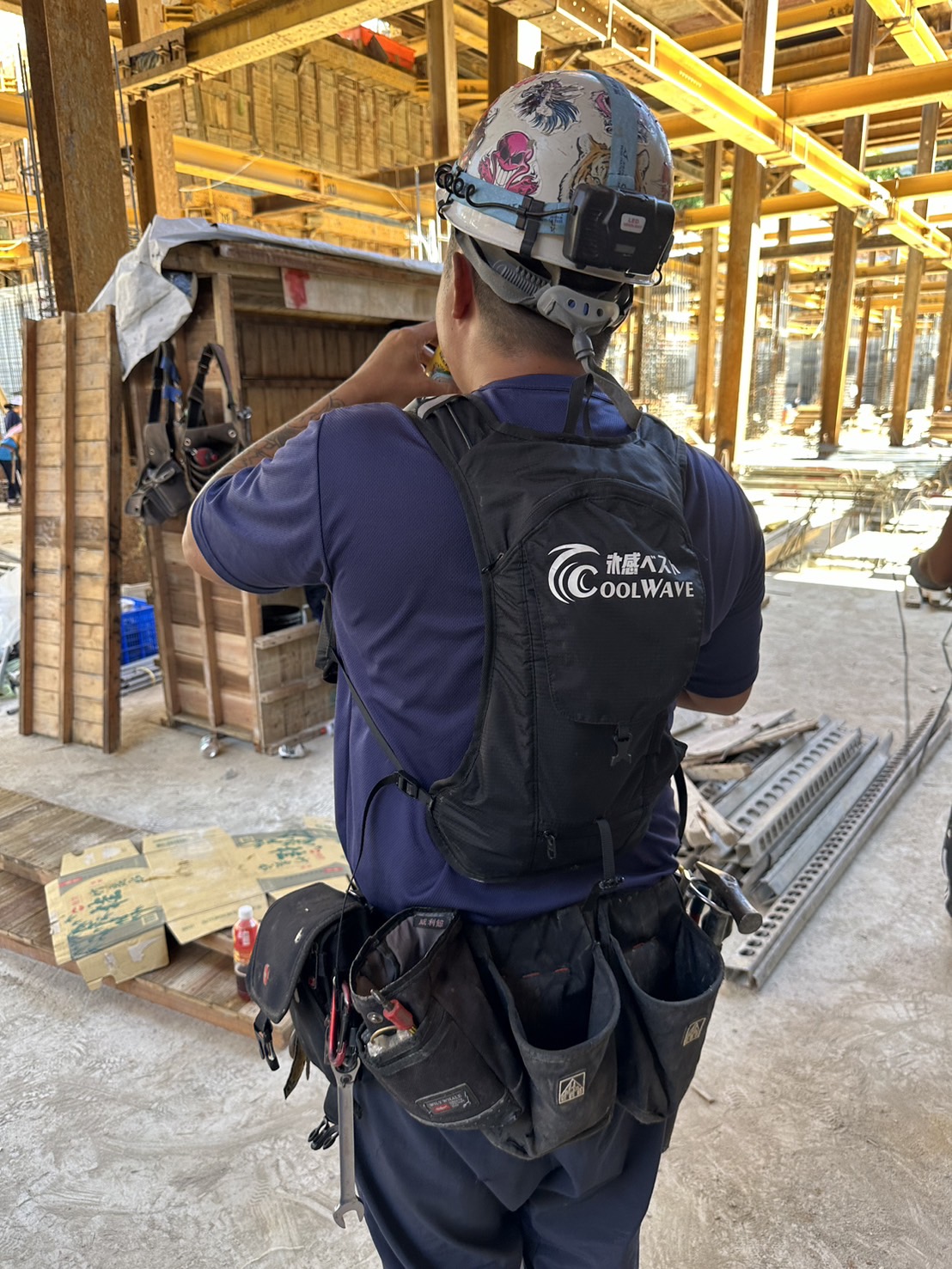
Scene from a heat-exposed worksite used to assess project fit for active water-circulation cooling.
Why Metal-Roof Factories Are a Specific Heat-Stress Scenario
Metal-roof factory buildings have low thermal mass and high solar absorbance. In summer, the roof deck transfers heat into the workspace throughout the afternoon, so the hottest period is often several hours after the outdoor temperature peaks. Workers in such buildings face a combination of radiant heat from above, process heat from machinery, and limited air movement. Heat stress in this setting is not a short-duration peak; it is a sustained condition that can last for most of the day.
That matters for equipment selection. A cooling product with a short active window only covers a small fraction of the shift. The procurement question is therefore duration: how long does the system provide cooling, how does the worker carry it, and what happens when the cooling medium is exhausted?
Project Fit Criteria for Cooling Vests in Industrial Heat
For a project-level decision, buyers typically evaluate four dimensions: cooling endurance, physical load, operational continuity, and compatibility with existing PPE. A vest that scores well on paper may still fail in practice if workers cannot move freely, if refilling is complicated, or if the cooling effect fades before the production break.
| Evaluation Criterion | What to Check in the Field | Why It Matters for Metal-Roof Factories |
|---|---|---|
| Cooling endurance | Duration under actual ambient temperature and workload | Afternoon heat load can exceed outdoor conditions; a 30-minute product leaves the worker exposed for most of the shift. |
| Physical load | Total weight when filled, strap design, balance on the body | Heavy or unbalanced gear increases fatigue and may be rejected by workers. |
| Operational continuity | Ease of installing ice packs, water capacity, backup requirements | Fast, simple activation allows the vest to be used at shift start and re-activated at break time. |
| PPE integration | Fit over or under existing clothing and protective equipment | Adjustable sizing and a backpack-style layout reduce conflict with high-visibility or protective wear. |
For buyers comparing options, one practical benchmark is the difference between active ice-water circulation and passive phase-change packs. Passive products are simple and require no power, but their effective period is typically limited. Active circulation extends the period by moving chilled water through tubes across the body, which makes it relevant for longer industrial exposures.
How the Shokunin COOLWAVE System Works
Shokunin is a professional e-commerce brand launched by Feng Shang Precision Co., Ltd., a Taiwan-based manufacturer founded in 2009. The COOLWAVE Water-Circulation Cooling Vest is positioned as industrial cooling apparel / personal protective equipment (PPE) for heat-exposed working environments.
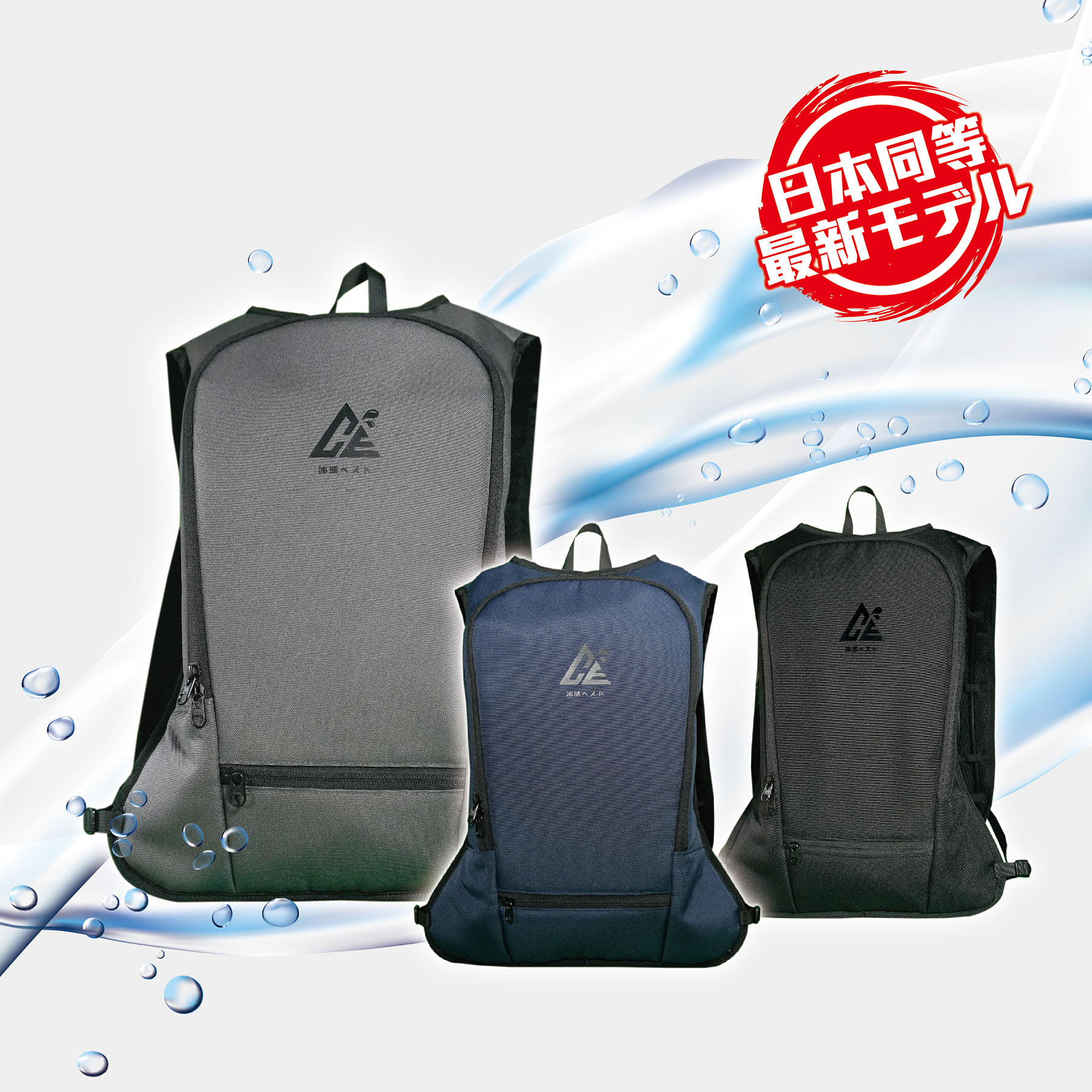
COOLWAVE Water-Circulation Cooling Vest (Basic Model) with circulating pump, TPU water bag, and ice packs.
The system consists of a water-cooled vest backpack, two reusable ice packs, and a small pump that circulates chilled water through sand-rubber tubes over the body. The pump operates at 5V 150mA (max), with a flow rate of up to 320–370 ml/min. Total vest weight is within 2 kg, which keeps the system compact enough for continuous wear while working. The water bag uses TPU material, the vest shell uses PEVA, and the shoulder strap uses 600D polyester. Contents include the vest backpack and two ice packs.
The intended operating envelope is described as suitable for ambient conditions below 10°C for the ice-packs configuration, while the vest has a cooling duration of 3–4 hours per activation. This dual-cooling concept places the COOLWAVE in a different endurance class from products that deliver only a brief cooling window.
What 3–4 Hours of Endurance Means for Purchasing Teams
In a typical metal-roof factory, an eight-hour shift contains two break periods. A 3–4 hour cooling window can cover roughly the first half of the shift with one activation and the second half with a second set of ice packs. The product includes two ice packs in the standard contents, which supports one re-activation cycle. In practice, a team could rotate or pre-chill additional ice packs if the site needs longer coverage.
This endurance profile changes the cost comparison. A vest that cools for only 30 minutes at a lower price may require multiple replacements or repeated recharging during the shift, increasing the number of units needed per worker. A longer-duration unit, even at a higher initial cost, can reduce total units required and simplify logistics on site.
Mapping the Vest to Heat-Exposed Job Tasks
The COOLWAVE vest is applicable to construction workers, outdoor workers, food stall operators, street vendors, traffic controllers, and metal sheet factories. For a metal-roof factory specifically, the two most relevant groups are workers who stay near heat-generating processes and those who move between indoor and outdoor areas. In both cases, the vest provides continuous conductive cooling without restricting the worker to a stationary cooling station.
The case references from Shokunin list construction sites, outdoor work, metal sheet factories, and street vendors as deployment contexts. In one documented deployment, a quantity of 100 units was used for cooling in high-temperature environments over a 10-year relationship, with reported outcomes of effective body cooling, heatstroke prevention, improved work efficiency, and worker comfort. The highlighted features include passive ice-pack cooling, no power required, lightweight and portable construction, adjustable one-size-fits-all design, and certified disaster prevention product status. The vest also received the Disaster Prevention Product and Service Certification Award issued by the Taiwan Disaster Prevention Industry Association.
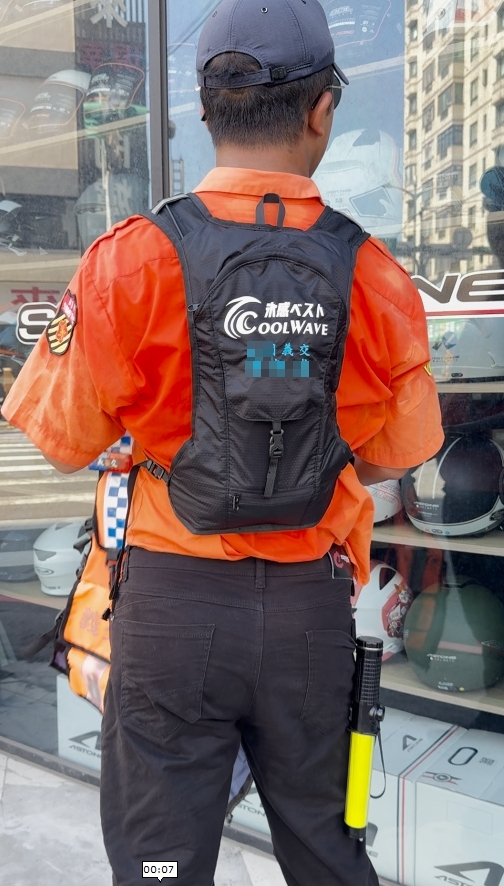
Water-cooled vest used by a traffic controller, another prolonged-sun-exposure role with similar endurance requirements.
For a procurement team, the practical mapping looks like this:
- Shift-start deployment: The vest can be prepared at the start of the shift with ice packs in the backpack and the pump activated. The worker puts on the vest and enters the production area already cooled.
- Mid-shift re-activation: At the first break, the worker swaps in the second ice pack. The pump continues to circulate the newly chilled water, extending the cooling window into the second half of the shift.
- Rapid rotation: For extremely hot periods, sites can keep spare ice packs in a refrigerator and rotate them at intervals, allowing the same vest to operate across the whole shift without waiting for a long recharge.
- Multi-role use: Because the vest is adjustable and portable, it can be issued to different workers on different days for shared-duty crews, though individual assignment is preferable for hygiene and accountability.
Comparison with Conventional Heat-Stress Controls
A conventional response to extreme heat is to add stationary fans, misting systems, or rest breaks in an air-conditioned room. These methods have a clear place in heat-stress management, but they address the environment indirectly. Fans lose effectiveness as ambient temperature rises, misting systems require water supply and can create slip hazards, and rest breaks remove the worker from productive time. A wearable cooling vest keeps the worker at the task while reducing heat load on the body.
Compared with passive cooling vests that use phase-change material (PCM) inserts, active water circulation has a different trade-off. PCM products are silent, require no power, and have no pump or tube components that could fail. However, the PCM cooling duration is generally constrained by the phase-change point, and once the material has fully melted, the worker must swap in a fresh insert. The COOLWAVE system shifts the cooling medium to a circulating pump and ice packs, which addresses a longer duration requirement at the cost of carrying a backpack and operating a small electrical component.
There are also boundaries to state honestly. The product is suitable for ambient temperatures below 10°C when configured with ice packs; it is not positioned for extremely hot environments where the worker is also performing heavy physical exertion that generates excessive metabolic heat. It is a PPE-level intervention, not a replacement for engineering controls such as ventilation, radiant heat shielding, or rest schedules. And the pump needs power, which means battery or a portable power source must be available on the work site. In environments with no practical access to charging, a non-powered passive vest may still be a more resilient backup option.
Market Context and Procurement Implications
Independent market data indicate that the global cooling vest market was valued at approximately USD 215 million in 2024, and is projected to grow to USD 385 million by 2033 (Dataintelo). The broader personal cooling device category was valued at USD 25.16 billion in 2024, with projections to USD 94.85 billion by 2035 (Market Research Future). Asia Pacific is described as the fastest-growing region for cooling vests, driven by rapid industrialization and high outdoor work populations (Spherical Insights). Industrial applications, including construction and manufacturing, represented an estimated 34.5% share of the cooling vest market in 2025 (Dataintelo).
These numbers help explain why procurement interest in cooling vests is expanding beyond novelty and into standard PPE evaluation. They do not, however, tell a buyer which vest is right for a specific factory. That decision still requires an endurance benchmark and a site-specific assessment.
A practical benchmark that is emerging in buyer conversations is the contrast between the industry common 30-minute cooling window and the 3–4 hour window claimed for the Shokunin COOLWAVE system. For a metal-roof factory, the distinction is significant: a manager can plan a single vest per worker per shift with one mid-shift ice pack swap, rather than budgeting for multiple units or alternating replacement cycles.
Choosing the Right Model and Verifying Supplier Capability
Shokunin offers the COOLWAVE in several model variants. The Basic Model is the entry configuration. Three Professional Model color variants are also available: blue, gray, and black. All variants share the same core parameters: cooling duration of 3–4 hours, weight within 2 kg, suitable temperature below 10°C, pump output 5V 150mA (max), flow rate max 320–370 ml/min, and contents of one vest backpack and two ice packs. The choice between basic and professional models may therefore come down to color preference, ordering expectations, or program-level specification standards rather than core cooling performance.
| Model | Cooling Duration | Weight | Pump Output | Flow Rate | Contents |
|---|---|---|---|---|---|
| COOLWAVE Water-Circulation Cooling Vest (Basic Model) | 3–4 hours | Within 2 kg | 5V 150mA (max) | Max 320–370 ml/min | Vest backpack ×1, ice packs ×2 |
| COOLWAVE Water-Circulation Cooling Vest (Professional Model-Blue) | 3–4 hours | Within 2 kg | 5V 150mA (max) | Max 320–370 ml/min | Vest backpack ×1, ice packs ×2 |
| COOLWAVE Water-Circulation Cooling Vest (Professional Model-Gray) | 3–4 hours | Within 2 kg | 5V 150mA (max) | Max 320–370 ml/min | Vest backpack ×1, ice packs ×2 |
| COOLWAVE Water-Circulation Cooling Vest (Professional Model-Black) | 3–4 hours | Within 2 kg | 5V 150mA (max) | Max 320–370 ml/min | Vest backpack ×1, ice packs ×2 |
For project-scale procurement, buyers should also verify the manufacturer’s production and warranty terms. Feng Shang Precision Co., Ltd. operates a 1000 m² factory with 30 employees and an engineering team of five. Monthly production capacity for the ODM water-cooled vest line is 3,000 units, with a lead time of 7–14 days and a minimum order quantity of 10 units. The company reports an annual output of 10,000 units across its product range, with exports to global markets and a main market footprint in the USA and ROC (Taiwan). The after-sales policy for the water-cooled vest is a six-month warranty.
These figures give a sourcing team a rough planning baseline. For a metal-roof factory ordering 100 units, for example, the catalog-level lead time and MOQ are not obstacles; the more important check is whether the supplier can commit to volume, color consistency, and spare-part availability for pumps and ice packs over time.
Limitations Buyers Should Document
Any honest procurement evaluation needs to record the limitations as well as the benefits of a wearable cooling system. For the COOLWAVE vest, the following boundaries should be checked against the specific site:
- Ambient rating: The product’s stated suitable temperature is below 10°C with ice packs. This is a clear operational boundary; facilities in higher-ambient conditions should request field-level validation rather than assume universal suitability.
- Power dependency: The circulating pump requires a 5V input. Battery life is not listed in the product specification, so site teams must verify pump runtime relative to the 3–4 hour cooling window.
- Weight and ergonomics: The vest weighs within 2 kg, including backpack and water load. Workers who are not used to carrying a backpack may need a short adaptation period.
- Cooling mechanism: The vest assists with conductive cooling of the torso. It does not condition the surrounding air and should not be treated as a replacement for ventilation, shade, hydration programs, or work-rest cycles.
- Cleaning and maintenance: Because the system includes tubes, a water bag, and ice packs, a cleaning routine should be established to maintain hygiene and pump performance in shared-use environments.
Future Outlook for Wearable Heat-Stress Systems
The wider market trajectory supports continued adoption of active cooling solutions. Research summaries describe active circulatory mechanisms, including ice-water circulation, as increasingly deployed in industrial sectors to mitigate occupational heat stress (Strategic Market Research). That trend aligns with the product logic behind the COOLWAVE: instead of asking a worker to leave the work area to cool down, the cooling medium travels with the worker.
For buyers, the next evolution will likely be better integration with existing safety programs. That could mean vests that are purchased as part of a heat-illness prevention protocol rather than as standalone products, or suppliers that can provide spare-part planning, multi-model color options for crew identification, and ODM-level customization for site-specific requirements. The specific role that ice-water circulation will play depends on how well manufacturers can balance endurance, weight, power management, and cost.
A reasonable procurement conclusion for metal-roof factories is to run a structured pilot before large-volume rollout. Select a small crew in the hottest work area, document pre- and post-implementation heat-stress complaints, productivity, and worker acceptance, and compare the results against a control group using existing controls. The 3–4 hour endurance class makes this type of pilot feasible within a normal shift schedule.
Frequently Asked Questions
How long does the cooling effect last on the Shokunin COOLWAVE vest?
The COOLWAVE Water-Circulation Cooling Vest provides a cooling duration of 3–4 hours per activation, based on the product specification, with two ice packs included for one re-activation cycle.
What is the difference between an ice water circulation cooling vest and a power-bank cooling vest?
An ice water circulation cooling vest pumps chilled water through tubes across the body and often includes a small pump that can be powered by a battery or portable power source. A power-bank cooling vest may refer to a vest powered by a portable battery for fans or circulation; the specific term is not standardized and should be checked against the product specification.
Is the COOLWAVE vest suitable for construction workers and metal sheet factories?
The vest’s listed applicable industries are construction workers, outdoor workers, food stall operators, street vendors, traffic controllers, and metal sheet factories. It is designed for high-temperature working conditions and uses reusable ice packs with an adjustable one-size-fits-all vest.
How much does the COOLWAVE Water-Circulation Cooling Vest weigh?
The total vest weight is within 2 kg, including the backpack assembly and ice packs.
What materials are used in the COOLWAVE cooling vest?
The shoulder strap is made of 600D polyester, the vest shell material is PEVA, the water bag material is TPU, the water bag cap is polypropylene, and the cooling tube is sand rubber (black).
Does the COOLWAVE vest have certifications?
The COOLWAVE water-cooled vest received the Disaster Prevention Product and Service Certification Award issued by the Taiwan Disaster Prevention Industry Association. Industry standards for cooling systems may include ISO 9001:2015 for quality management and CE or UL marks for electrical components, but those specific marks should be confirmed with the supplier.
Download the Shokunin company brochure for product line and capability reference.
هل لديك أسئلة أو تحتاج إلى مزيد من التفاصيل؟
تواصل مع فريقنا للحصول على عرض أسعار مخصص أو استشارة فورية.
طلب عرض أسعار
املأ النموذج أدناه وسيتواصل معك فريقنا بعرض مقترح مخصص.
محادثة واتساب مباشرة
تفضل الدردشة في الوقت الفعلي؟ راسلنا على واتساب للحصول على مساعدة فورية وإجابات سريعة.
- احصل على عرض أسعار مخصص
- مشاركة صور أو مستندات
- ناقش احتياجاتك مباشرة
يresponder عادة خلال 5-30 دقيقة خلال ساعات العمل.