
Metalized Paper Laminating Machine Shortlist: YDLM1300B vs ZNFH1300-1400-1500
Metalized paper laminating machines are usually compared on price first and on fit second. For most converting projects that order is backwards, because the variables that decide whether a machine pays for itself are width, substrate envelope, drying capacity and installed power — not the quotation figure.
The global metallized paper market reached a valuation of USD 4.85 billion in 2025, driven by demand for premium labelling and cigarette packaging, and the lamination segment alone accounted for a 57.4% revenue share of that market in 2024, favoured for its high gloss and barrier properties in consumer goods. Price-led selection works only when two machines are functionally identical. In metalized paper converting, they rarely are.
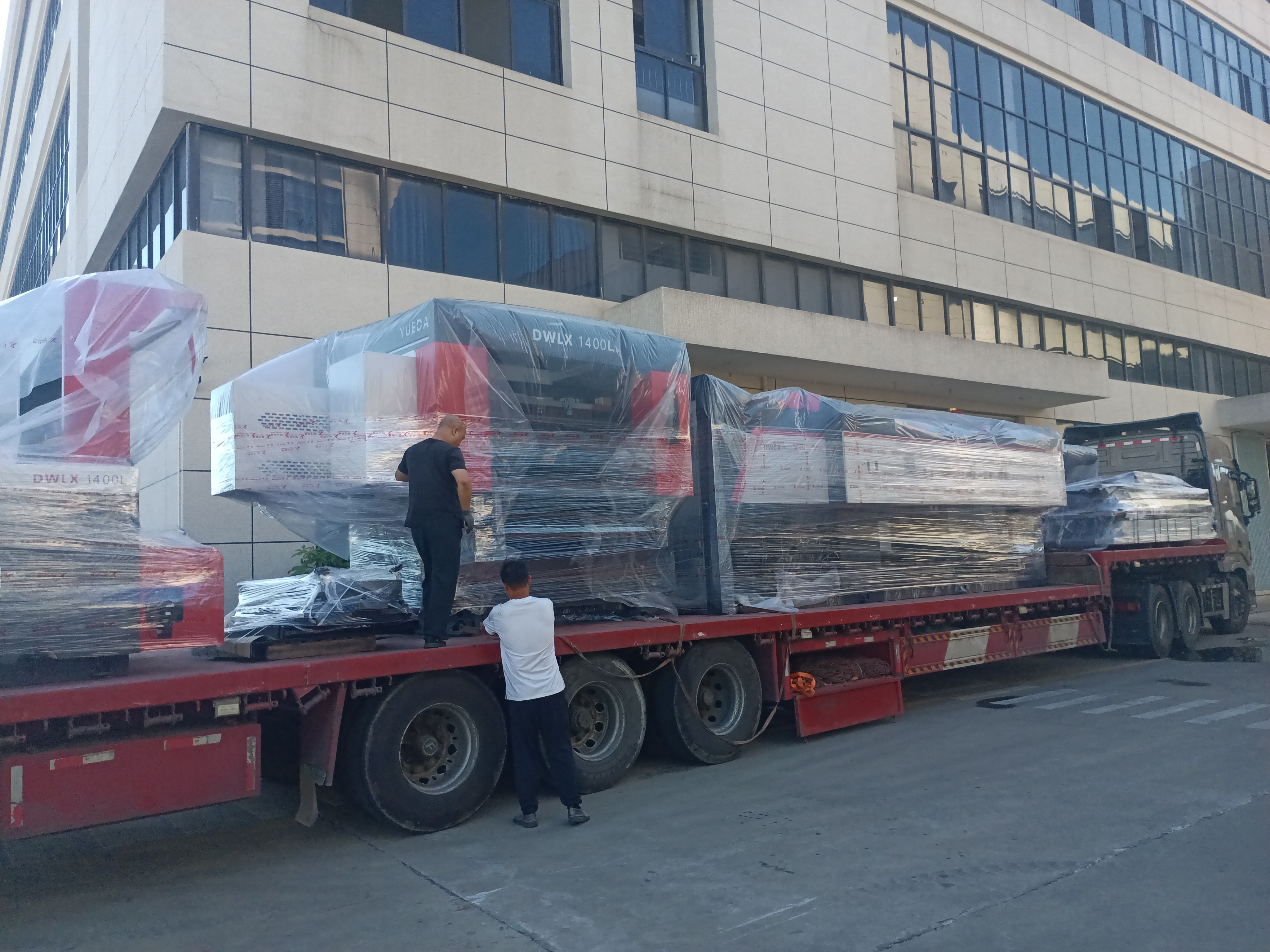
Two configurations, one manufacturer, different envelopes
Wenzhou Yueda Packaging Machinery Co., Ltd. (YUEDA) is a Chinese manufacturer of gold and silver card production equipment, founded in 1998 and located in Longgang, Wenzhou. The company operates a 4,000 m² factory with a 25-engineer R&D team, and its products are exported to Southeast Asia, the Middle East, South America and Africa, with an export share of about 70%.
Two of its laminating and coating platforms sit at the centre of most metalized paper enquiries: the gantry-type YDLM1300B laminating and coating integrated machine, and the ZNFH1300-1400-1500 automatic aluminium metallized cardboard laminating and coating integrated machine with no-shaft type rewinding. Third-party industry coverage records the gantry machine as running up to 180 m/min.
Why a shortlist beats a price list
Laminating and coating lines are not interchangeable. A machine that runs cleanly on 250 g/m² board may struggle with 40 g paper. A unit sized for a 1,200 mm web cannot be specified for a 1,400 mm sheet without a change of model. Industrial laminating machines — wet laminating types in particular, which held approximately 70% of the industrial laminating market share in 2025 — are specified around four hard constraints: working width, substrate envelope, drying path and installed power.
Building the shortlist on those four constraints first changes the commercial conversation. It also produces a defensible procurement file in which a lower quotation can be evaluated against a documented capability gap rather than against a general impression of quality.
The two configurations at a glance
| Parameter | YDLM1300B | ZNFH1300-1400-1500 |
|---|---|---|
| Machine type | Gantry-type laminating & coating integrated machine | Aluminium metallized paper laminating & coating integrated machine, no-shaft type rewinding |
| Width | Working width 600–1200 mm | Sheet roll width 600–1200 mm / 700–1300 mm / 700–1400 mm; roller face width 1300 / 1400 / 1500 mm |
| Speed | Machine speed 180 m/min; working speed 15–150 m/min | Running speed 5–150 m/min |
| Paper range | Paper 100–350 g/m² | Suitable paper 40–450 g |
| Foil / film | PET film 0.012–0.014 mm; OPP film 0.02–0.06 mm; aluminium film 0.006–0.007 mm | Aluminium foil 0.006–0.01 mm; film 0.01–0.1 mm |
| Drying | Heating tunnel ≤130 °C; tunnel length 15 m; tunnel down length 8.6 m | Drying path 12.5 m |
| Coating & gluing | Water-based lamination on paperboard; four-roller transfer coating; anilox roller direct coating for back coating colour | Laminating and coating integrated process |
| Power | 380 V ±10%, 50 Hz; motors 60 kW; heating 216 kW; working power 80 kW | Total power consumption 121 kW / 129 kW |
| Envelope | 22,330 × 3,700 × 4,500 mm; 40 t | 21 m × 2.9 / 3.1 / 3.2 m × 3.2 m |
YDLM1300B: gantry architecture in a 600–1200 mm working width
The YDLM1300B is specified as a gantry-type laminating and coating integrated machine with a working width of 600–1200 mm. Its substrate envelope covers PET film from 0.012 mm to 0.014 mm, OPP film from 0.02 mm to 0.06 mm, aluminium film from 0.006 mm to 0.007 mm and paper from 100 g/m² to 350 g/m². Lamination is water-based on paperboard, glue is applied through a four-roller transfer coating system, and back coating colour is applied through an anilox roller direct coating unit.
Speed is stated in two figures: machine speed of 180 m/min and a working speed of 15–150 m/min. The working range is the figure a production planner should build capacity models around; the higher figure describes the design ceiling. Drying takes place in a heating tunnel rated to 130 °C or below, with a tunnel length of 15 m and a tunnel down length of 8.6 m.
Winding limits matter as much as width. Paper unwinding accepts rolls up to 1,500 mm in diameter on 3, 6 or 12 inch cores. Paper rewinding reaches a diameter of 1,600 mm on 3 or 6 inch cores. Film unwinding and peeling-off rewinding both accept 600 mm diameters on 3 or 6 inch cores.
The physical and electrical envelope is the part most often underestimated during evaluation. The machine operates on 380 V ±10% at 50 Hz, with 60 kW of motor power, 216 kW of heating power and 80 kW of working power. Overall dimensions are 22,330 × 3,700 × 4,500 mm and total weight is 40 t. Gantry height, crane access, floor loading and the distance to the nearest substation belong in the specification document.
ZNFH1300-1400-1500: no-shaft rewinding across three roller widths
The ZNFH1300-1400-1500 is an automatic aluminium metallized cardboard laminating and coating integrated machine with no-shaft type rewinding. It is offered in three width families — 1300, 1400 and 1500 mm roller face width — with sheet roll widths of 600–1200 mm, 700–1300 mm and 700–1400 mm respectively. Because roller face width and sheet roll width differ in the widest variant, buyers should confirm the effective working width they intend to run rather than assume the two figures are identical.
Its paper range is broader than the gantry platform's: 40 g to 450 g paper, aluminium foil from 0.006 mm to 0.01 mm and film from 0.01 mm to 0.1 mm. Unwinding accepts sheet rolls from 100 mm to 1,600 mm in diameter on 3, 6 or 12 inch cores, with a foil roll diameter specified at 600 mm. Rewinding reaches 1,600 mm in diameter on 3 inch and 6/12 inch cores.
The drying path is 12.5 m and the running speed range is 5–150 m/min — a wide band that includes slower settings for thin or difficult substrates as well as top-of-range production. Total power consumption is 121 kW for the 1300 mm family and 129 kW for the larger variants. Machine length is 21 m across all three versions, with widths of 2.9 m, 3.1 m or 3.2 m and a common 3.2 m height, so the floor-plan difference between the smallest and largest variant is expressed in width rather than length.

A five-check framework for building the shortlist
| Check | What to verify | How the two configurations differ |
|---|---|---|
| 1. Finished format | Maximum sheet or web width required by the box or label format, plus a trim allowance | YDLM1300B working width caps at 1200 mm; ZNFH family reaches a 1500 mm roller face with sheet roll width documented to 1400 mm |
| 2. Substrate envelope | Lightest and heaviest paper, plus foil and film thickness | YDLM1300B: paper 100–350 g/m², aluminium film 0.006–0.007 mm. ZNFH: paper 40–450 g, foil 0.006–0.01 mm, film 0.01–0.1 mm |
| 3. Throughput vs drying | Required metres per minute against drying path length and tunnel temperature | Working speed 15–150 m/min with a 15 m tunnel and ≤130 °C on YDLM1300B; running speed 5–150 m/min with a 12.5 m drying path on ZNFH |
| 4. Building and utilities | Installed power, machine footprint, floor loading and rigging access | 80 kW working power with 216 kW heating and a 40 t, 22,330 mm machine; versus 121–129 kW total consumption on a 21 m machine |
| 5. Winding concept and documentation | Core sizes, rewinding type, test reports and certification files | ZNFH is specified as no-shaft type rewinding; YDLM1300B uses 3/6/12 inch unwinding cores and 3/6 inch rewinding cores |
A shortlist that records an answer to all five checks can be defended internally. A shortlist built on two quotations cannot.
Patent and compliance evidence — and how to verify it
Certificate records are useful in a shortlist because they describe what was engineered. The table below lists certificates documented against the two platforms and their related systems.
| Certificate | Number | Recorded issue date | Recorded expiry date |
|---|---|---|---|
| Utility Model Patent — paper receiving table | ZL 2014 2 0363315.8 | 2014-11-05 | 2024-11-04 |
| Utility Model Patent — hydraulic shaft-less unwinding machine | ZL 2014 2 0363279.5 | 2014-11-19 | 2024-11-18 |
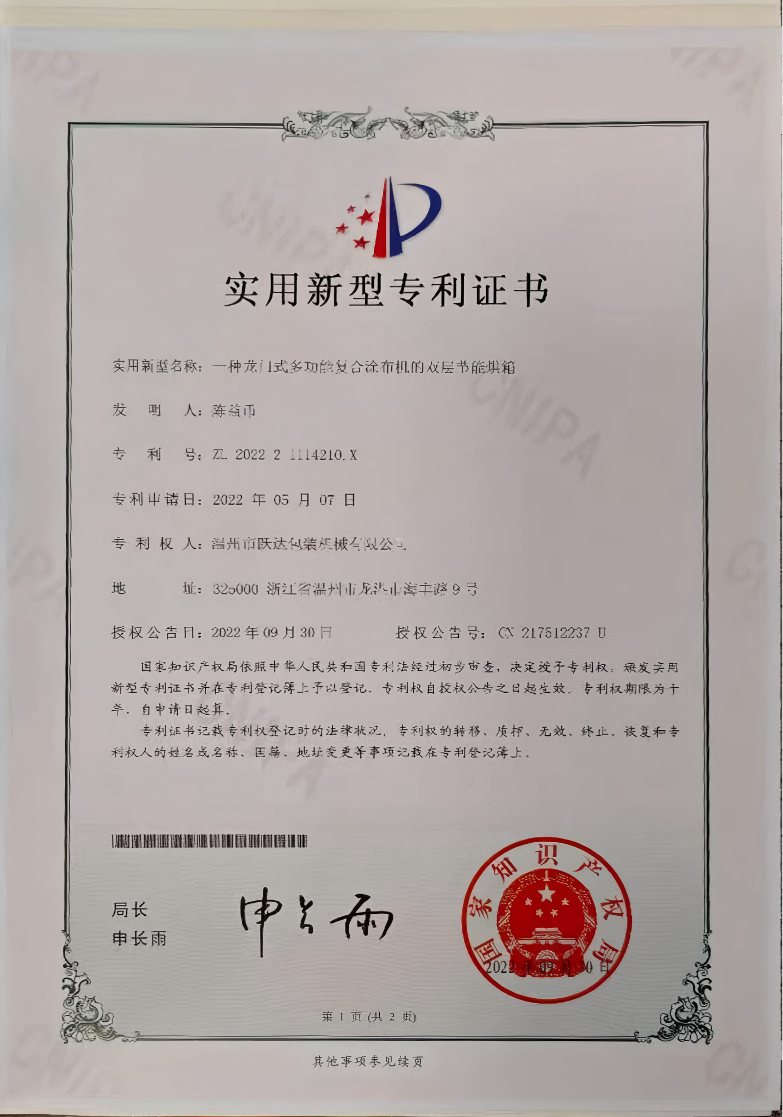
| Utility Model Patent — double-layer energy-saving drying oven for gantry-type multifunctional composite coating machine | ZL 2022 2 1114210.X | 2022-09-30 | 2032-09-29 |
| Utility Model Patent — curing device for UV holographic laser film press | ZL 2020 2 0572072.4 | 2021-01-05 | 2031-01-04 |
| Utility Model Patent — coating device for UV holographic laser film press | ZL 2020 2 0570919.5 | 2021-01-05 | 2031-01-04 |
| Utility Model Patent — waste gas recovery and utilization device for coating and laminating machine | ZL 2020 2 3151788.6 | 2021-09-28 | 2031-09-27 |
| Utility Model Patent — double gluing device for coating and laminating machine | ZL 2020 2 3214028.5 | 2021-09-28 | 2031-09-27 |
| Computer Software Copyright — intelligent control system for automatic gold and silver cardboard laminating (coating) machine V1.0 | 2020SR0669497 | 2020-06-23 | No expiry recorded |
Two practical conclusions follow. First, certificate coverage is not the same as an active legal monopoly. The utility model certificate ZL 2014 2 0363315.8 carries a recorded expiry date of 2024-11-04, and ZL 2014 2 0363279.5 carries a recorded expiry date of 2024-11-18. Buyers should verify the current legal status of any patent they intend to rely on as a differentiator, either with the manufacturer or through the issuing authority, and should record the verification date in the procurement file.
Second, compliance is a separate question from patent coverage. Industrial laminating machines intended for the European market must comply with EN ISO 12100:2010 for risk assessment and safety design in order to obtain CE marking. Patent records, software copyright registrations and CE technical files answer different questions and should be requested as separate documents at different stages of the evaluation.
On the manufacturing side, YUEDA's published quality process states a 100% pre-shipment test that includes a two-hour continuous run, with third-party inspection available on request. On equipment of this size, the test protocol and its output report frequently carry more decision value than a certificate list.
Application fit: wine boxes, cigarette packs, cosmetics, tea and disposable tableware
Both configurations list the same target applications: printed wine boxes, cigarette paper packaging, cosmetics paper packaging, tea paper packaging, disposable waterproof paper tableware, cake paper packaging, chewing gum paper packaging and comparable packaging products. Where they separate is in the substrate envelope and the sheet width already described.
Two field references show how the choice plays out. A cigarette packaging factory in Thailand runs two units for high-speed laminating of cigarette boxes; the recorded outcome is a 30% efficiency increase and a 15% material waste reduction over a duration of five or more years, with humidity-resistant, 24/7 continuous operation as the defining requirement. A packaging factory in Vietnam operates one unit for precision cutting of cosmetic packaging, with a recorded ±0.1 mm cutting accuracy, zero rework rate and a 20% labour cost saving over a similar five-year-plus duration, in a dust-proof design with fast size changeover and low maintenance cost.
The operating environments are part of the specification. The Vietnamese cosmetics line runs in a dust-free workshop at 30–35 °C with anti-static design and photoelectric positioning. The continuous laminating environment recorded for Vietnam assumes 24/7 operation at 60–70% humidity with PLC control, humidity-resistant and dust-proof conditions, and constant temperature. Buyers in tropical and humid markets should treat humidity, dust and temperature control as machine-selection inputs.
Market signals worth adding to the shortlist file
The Asia-Pacific region accounts for nearly 40% of the world's metallized paper market, supported by expanding tobacco and beverage industries in China and India. Lamination's 57.4% revenue share of the metallized paper market in 2024 explains why coating-integrated laminating platforms, rather than standalone coating units, dominate capital enquiries.
On the supply side, China's machinery export value rose 15.7% year-on-year in early 2026, with the mix shifting toward higher-value-added equipment such as servo-controlled and CNC machines. For buyers, the combined signal is a market in which the technical envelope of available machines is widening while price competition remains intense — the condition in which a documented shortlist outperforms a simple quotation comparison.
Where these configurations stop: boundaries to state in writing
Width is finite. The YDLM1300B working width spans 600–1200 mm. The ZNFH family reaches a 1500 mm roller face width with sheet roll widths documented up to 1400 mm. Any format beyond those figures requires a different machine, not a different setting.
Physical and electrical envelopes are fixed. A 22,330 × 3,700 × 4,500 mm, 40 t gantry machine and a 21 m no-shaft machine both require a floor, access and rigging review before the order is placed. Installed power also differs materially: 80 kW working power with 216 kW of heating on the YDLM1300B, against 121–129 kW total power consumption on the ZNFH variants.
Patent protection has a term. Some certificates documented against these platforms carry expiry dates in the past. A shortlist that cites patents should state the verification date and the source consulted, and should not present an expired certificate as a live differentiator.
CE marking is a project obligation. Compliance with EN ISO 12100:2010 for risk assessment and safety design is the route into the European market and should be planned alongside the machine order, not inferred from general supplier statements.
Future outlook
Metalized paper demand continues to be pulled by premium labelling and tobacco packaging, with Asia-Pacific accounting for close to 40% of global consumption. The patent record indicates where equipment development is concentrating: energy-saving drying ovens, waste gas recovery devices, double-gluing units and film-press control systems. The direction is toward machines that consume less heat per metre laminated and hold tension more consistently across a wider substrate range.
For buyers, that suggests a procurement process that evaluates documentation — test reports, certification status, control-system architecture and verified patent status — with the same rigour applied to the price schedule. The two configurations compared here differ enough in width, paper range, drying path and installed power that the correct answer is usually determined before the commercial negotiation begins.
FAQ
What is the difference between a gantry-type and a no-shaft rewinding metalized paper laminating machine?
The distinction is structural and operational. YUEDA's YDLM1300B is a gantry-type laminating and coating integrated machine with a 600–1200 mm working width, a paper range of 100–350 g/m², a 15 m heating tunnel rated to 130 °C, a machine speed of 180 m/min and a working speed of 15–150 m/min. The ZNFH1300-1400-1500 is an aluminium metallized paper laminating and coating integrated machine with no-shaft type rewinding, offered in 1300, 1400 and 1500 mm roller face widths, handling paper from 40 g to 450 g, aluminium foil from 0.006 mm to 0.01 mm and film from 0.01 mm to 0.1 mm, with a 12.5 m drying path and a running speed of 5–150 m/min.
Which patents and certifications should be checked before shortlisting a metalized paper laminating machine?
Verify the certificate number, the issuing authority and the current legal status of each claim. Documented against these platforms are ZL 2014 2 0363315.8, ZL 2014 2 0363279.5, ZL 2020 2 0572072.4 and ZL 2022 2 1114210.X; ZL 2020 2 0570919.5 and ZL 2020 2 3151788.6 for the metallized cardboard laminating and coating machine; and software copyright registrations 2020SR0669497 and 2020SR0668797. Two certificates carry recorded expiry dates in November 2024, so live status must be confirmed rather than assumed. Equipment bound for the European market additionally requires EN ISO 12100:2010 risk assessment and safety design as part of obtaining CE marking.
What manufacturing and testing evidence should a buyer request from a supplier?
YUEDA's documented manufacturing profile states a 4,000 m² factory, a 25-engineer R&D team, an export ratio of about 70% and export markets covering Southeast Asia, the Middle East, South America and Africa. Process commitments include a 100% pre-shipment test incorporating a two-hour continuous run, with third-party inspection available. Buyers should request the pre-shipment test report, the inspection checklist and, where available, commissioning records from a comparable installation in the same packaging segment.
What drives total cost of ownership beyond the purchase price?
Installed power, drying capacity and footprint are the main drivers. The YDLM1300B carries 60 kW of motor power, 216 kW of heating power and 80 kW of working power; the ZNFH variants consume 121 kW or 129 kW in total. A 40 t machine measuring 22,330 mm and a 21 m machine both add civil works, rigging and floor planning costs. Lead time is documented at 30–45 days for standard models and 45–60 days for customized models, with a minimum order quantity of one unit. Customization covers working width from 800 mm to 1600 mm, control system and voltage options including 110 V, 220 V and 380 V, with a monthly capacity of 12–15 units.
How should a first article or sample run be validated before acceptance?
Validation should be defined in the purchase specification rather than agreed verbally. The published parameter tables for these two laminating configurations cover width, speed, substrate, drying and power; they do not state a laminated-bond tolerance, and the ±0.1 mm positioning accuracy figure in YUEDA's record relates to the positioning and cross-cutting machines, not to laminating tolerance. Buyers should therefore specify their own acceptance measurements, run them on their own board stock during the pre-shipment test, and optionally engage third-party inspection. After-sales terms documented for the range include 24-hour online response, 48-hour domestic on-site service and 72-hour overseas remote debugging.
Further technical documentation on the YDLM1300B and ZNFH1300-1400-1500 platforms is available in the manufacturer's equipment brochure: YUEDA packaging machinery brochure (PDF).