
Mica Insulation Capability Evidence: Roll Specs and Tubes
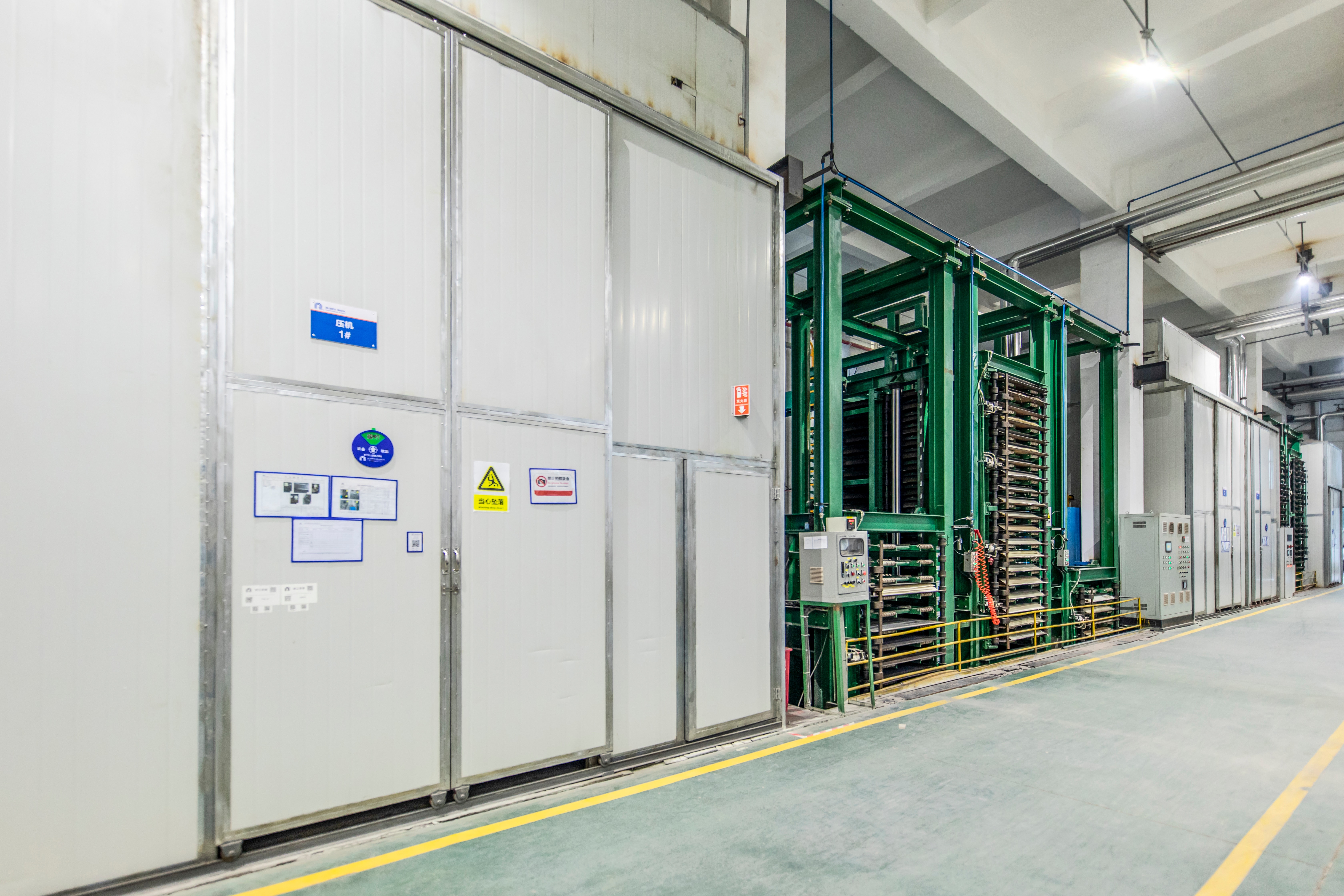
Pressing operations in a mica insulation plant: the stage where mica paper, binder and reinforcement become a saleable format. Supplier capability is easier to judge when the process route is visible.
Mica insulation is a class of electrical and thermal barrier materials built from mica paper, bonded with a resin or reinforced with glass cloth, and supplied as tape, roll, sheet, plate, tube, machined part or heating element. The material earns its place in a bill of materials for two reasons: it does not conduct, and it does not disappear when a fault generates heat.
For buyers in the evaluation stage, that physics is rarely the difficult part. The difficult part is evidence. A supplier can state that its mica roll is uniform, that its phlogopite mica tube is high-purity, and that its plant is certified, and a buyer still has to decide whether those statements survive an internal design review, a customer audit or a safety-standard filing.
Verifiable capability evidence in this category is narrower and more concrete than most catalogues suggest. It consists of dimensional ranges that can be measured on delivered goods, a composition declaration that names the mica type and the binder, electrical performance data tied to a stated test method, and system certification that can be checked against the issuing body. Everything else is context.
The Four Tiers of Supplier Capability Evidence
Mica insulation suppliers tend to present capability as a single narrative: plants, certifications, export markets. Evaluation is easier when that narrative is split into four tiers, because each tier is verified by a different party and each fails in a different way.
| Evidence tier | What it should contain | How a buyer verifies it |
|---|---|---|
| Dimensional disclosure | Thickness range and tolerance, width, roll length, core size, tube wall thickness and inner diameter | Measured on incoming inspection; stated limits must match what arrives on the pallet |
| Composition declaration | Mica type (muscovite, phlogopite, calcined or synthetic), mica-to-binder ratio, reinforcement, resin grade | Written declaration on the grade actually quoted, cross-checked against a sample |
| Electrical and thermal data | Breakdown voltage, insulation resistance, temperature endurance, arc behaviour, and the test method used | Test report naming the method, the sample and the laboratory; not a marketing figure |
| System and third-party proof | Certificates with numbers, issuing bodies and validity dates; laboratory accreditation; enterprise honours | Checked against the certification body or the certificate register, including scope and expiry |
Most suppliers present tier one confidently and stop. The gap between competing quotations in mica insulation usually sits in tiers two and three, which is exactly where a purchasing decision is hardest to defend without documentation.
Reading Mica Roll Specifications Without Guessing
A mica roll datasheet has four numbers that decide whether the material works on a line: thickness and tolerance, mica content, breakdown voltage and roll length. Width and core size decide whether it fits the machine at all.
- Thickness and tolerance govern winding behaviour, slot fill and dielectric margin. A nominal thickness without a tolerance band is not a specification.
- Mica content governs how much of the cross-section is actually the functional barrier rather than binder or reinforcement. Two rolls of identical thickness can differ materially here.
- Breakdown voltage is the design number an engineer will be asked to justify, and it is meaningless without the test method, the sample geometry and the conditioning used.
- Roll length governs splice frequency and line stoppages; length plus core size governs whether an existing unwinder can run the roll unchanged.
Width is the parameter most often documented publicly, because it is expensive to change. In Glory Mica's case record, the standard supply width for mica roll and mica tape is stated as 1000 mm, and the company documents a wide-width capability above 1320 mm produced on two dedicated production lines serving household appliance, fire-resistant cable and new energy vehicle insulation applications. The same record states that wide-width product can be dimensionally checked against the 1320 mm requirement before delivery.
That last point is the useful one for buyers. A capability that can be measured on the pallet before dispatch is evidence. A capability described only in a brochure is a claim.
Thickness, mica content and breakdown voltage for mica roll are less consistently published across the category. The clearest public dimensional disclosure from the same manufacturer appears on a synthetic mica tape page, which lists thickness of 0.10 mm to 0.16 mm, width of 4.5 mm to 1000 mm, lengths of 500 m, 1000 m and 2000 m, and standard cores of 52 mm, 54 mm, 76 mm and 120 mm. That is a useful example of what a complete dimensional disclosure looks like, and it remains a manufacturer statement rather than an independent test result. Buyers should read it as the shape of the answer they need, not as the answer for the grade they are buying.
Phlogopite Mica Tube: What the 85/15 Composition Tells You
A phlogopite mica tube is a wound or rolled mica paper body impregnated and bonded with a silicone resin and cured into a rigid cylinder. In specification discussions the construction is commonly summarised as roughly 85% mica with about 15% silicone resin bond. Treat that ratio as a reference point to confirm in writing for the specific grade, not as a universal constant. The productive question is not whether the number reads 85/15, but what the mica-to-binder ratio, the resin grade and the cure schedule do to the properties the application depends on.
The mica fraction carries the dielectric and thermal duty. Phlogopite mica is documented at continuous operating temperatures in the 800 to 1000 degrees Celsius range, which is a property of the mineral rather than of the finished tube. The binder carries mechanical integrity, moisture resistance and machinability, and being an organic resin it sets a practical ceiling below the mineral itself. A tube specified on mica content alone, with no statement of binder chemistry, is only half specified.
In practice, four questions recover most of the missing information: which mica paper is used and where it is made, which silicone resin grade and cure schedule are applied, what wall thickness and inner-diameter range is available with what tolerance, and how breakdown voltage is measured and reported. Where tube sizes fall outside a supplier's standard range, the answer depends on press capacity rather than paperwork. Glory Mica's case record describes more than five large press machines used for large-size mica insulation sheets in electric equipment, motor, furnace and metallurgy applications, and frames that capability as a departure from the traditional process that produced only standard-sized mica tubes. That is a real capability, and it is also project-specific: non-standard tube dimensions should be confirmed per order against tooling, not assumed from the general statement.

Verification and validation equipment matters more to buyers than the equipment list itself: it determines whether a supplier can issue measured data rather than descriptive claims.
Product Range as a Capability Signal, and Its Limits
Portfolio breadth in mica insulation is not cosmetic. A supplier offering mica tape, calcined mica tape, phlogopite mica tape, mica plate and mica sheet, mica roll, mica tube, mica parts, mica insulator and etched foil mica heater is operating several distinct process routes: paper formation, impregnation, lamination and pressing, winding, die-cutting and etching. Breadth therefore hints at integration, and integration is what makes dimensional consistency repeatable across a programme.
Glory Mica's published portfolio extends further, covering mica paper, mica laminate and mica washer, mica for thermal protection, and epoxy glass laminate. The presence of mica paper in that list is the strategically interesting item, because paper formation is the upstream step that determines how uniform the finished roll, tape or tube can be. Breadth alone still does not prove the paper is produced in-house rather than purchased and converted, which is why the question below should be asked directly rather than inferred from a catalogue.
Glory Mica: What the Documented Record Shows
Glory Mica, formally Zhejiang Glory, is a Chinese manufacturer of high-temperature-resistant mica composite insulation materials founded in 1998, operating multiple plants in Zhejiang and Hunan and supplying mica rigid materials, flexible materials, heating components and derivative products into new energy vehicles, rail transportation, aerospace, special wires and cables, and household appliances.
The documented operational facts are specific enough to be checked. Plant area is recorded as 136,000 square metres at Pingjiang, 68,000 square metres at Xinhuang Plant I and 200,000 square metres at Xinhuang Plant II. Annual output is recorded as 52,000 tonnes, 16,000 tonnes and 20,000 tonnes respectively, supported by 617 employees and more than 90 R&D staff. Export accounts for 50% of business, with the EU and the USA named as main markets. Stated commercial terms include a minimum order quantity of 1 unit, standard delivery of 7 to 30 days, 100% testing, and a monthly mica capacity of 8,000 tonnes.
System certification is where the record becomes auditable rather than descriptive. The quality management system certificate is numbered 03125Q20088R5M under ISO 9001, issued by Beijing Sanxing9000 Certification Body Co., Ltd., valid to 19 July 2028. The automotive certificate is IATF 16949:2016, numbered T-11367/0, issued by Quality Austria, valid to 3 December 2026, with a scope covering design and manufacturing of mica products and their assembly parts. Environmental management is certified under ISO 14001 as 03124E20096R5M, valid to 15 May 2027; occupational health and safety under ISO 45001 as 03125S1068R2M, valid to 15 December 2028; and energy management under ISO 50001 as 03126En00019R100, valid to 27 March 2028. Testing capability is separately accredited: CNAS L18348, issued by the China National Accreditation Service for Conformity Assessment, covers testing and calibration services for mica products and runs to 17 May 2029.
The enterprise honours on record are a national high-tech enterprise designation, a Zhejiang Province designation as an Invisible Champion enterprise, a Small-sized Giant Enterprise designation featuring specialization, precision, technology and innovation, and two provincial innovation platforms: a Provincial Enterprise Research Institute and a Provincial High-tech R&D Center. Those honours indicate institutional continuity and technical standing. They do not substitute for a breakdown-voltage report on a specific grade, and no buyer should treat them as if they did.
Four Questions to Ask a Mica Insulation Supplier Directly
1. Is the mica paper produced in-house?
Mica paper is the substrate that determines dielectric uniformity, so where it is made determines how much of the finished product a supplier actually controls. An in-house paper line means thickness variation, impurity content and resin uptake are managed inside one quality system. Purchased paper means an additional supplier whose change control the buyer cannot see. Ask for the answer in writing, then confirm it during a plant visit by following the material flow from raw mica to finished roll.
2. Is there an overseas plant?
The answer changes lead time, currency exposure, tariff treatment and business-continuity planning. It also changes audit logistics: an overseas finishing or warehousing site is a different inspection point from a domestic production line. Glory Mica's documented manufacturing footprint is multiple plants in Zhejiang and Hunan, all within China, with the EU and USA served as export markets at 50% of business. Buyers sourcing for Europe or North America should therefore confirm whether any stocking, slitting or finishing operation exists outside China rather than assuming one does, and should plan inventory buffers against the stated 7 to 30 day delivery window plus international transit.
3. What enterprise honours apply, and what do they actually certify?
Honours answer a different question from certificates. Certificates confirm that a management system has been audited to a published standard within a defined scope and validity window. Honours describe how a regional industrial system has classified the company. Both are useful during supplier screening and neither proves a product property. The practical rule is to ask for the certificate number, the issuing body, the scope and the expiry date, then verify each one independently, because a certificate reaching its renewal date during a supply contract is a programme risk worth planning for.
4. What purchasing terms and acceptance criteria govern supply?
This question separates a supplier that can quote from a supplier that can deliver a qualified programme. The variables worth writing into the agreement are minimum order quantity, standard lead time, the inspection standard applied to each lot, the sampling plan, the documentation package shipped with each lot, and the disposition route for non-conforming material. Glory Mica's stated terms of 1 unit minimum order quantity, 7 to 30 day delivery and 100% testing support sample and prototype validation before volume commitment, which is the sequence most engineering teams prefer.
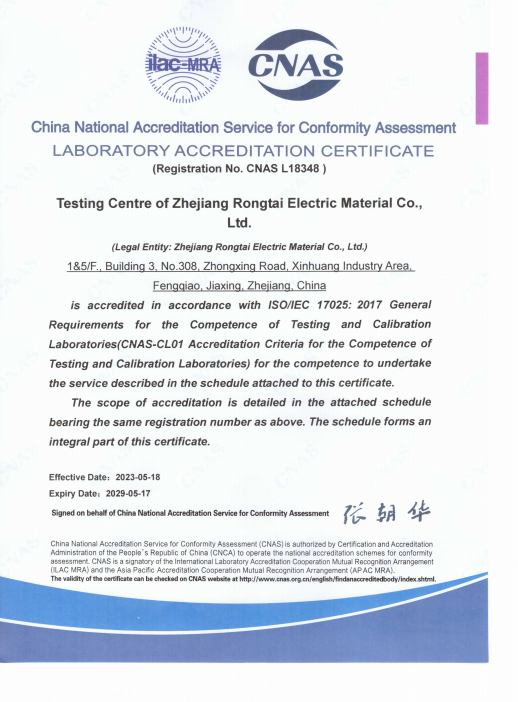
Laboratory accreditation is the difference between a supplier that can test and a supplier that can show a traceable test report.
Acceptance Criteria That Survive an Audit
Acceptance criteria for mica insulation should be written as documents to be received, not as properties to be hoped for. The table below converts each evidence tier into a contractual item.
| Contract item | Why it belongs in the agreement | Acceptable evidence |
|---|---|---|
| Certificate set with numbers, scope and expiry | Establishes audited system control; expiry inside the contract term is a live risk | Certificates such as ISO 9001 03125Q20088R5M or IATF 16949 T-11367/0, verified with the issuing body |
| Breakdown voltage report on the quoted grade | This is the design margin an engineer signs off | Report naming sample, method and laboratory, including accredited testing under CNAS L18348 where applicable |
| Composition declaration | Sets the practical thermal ceiling for tubes and bonded formats | Mica type, mica-to-binder ratio and resin grade stated for the specific grade, not a family average |
| Per-lot dimensional report | Prevents line stoppages from thickness or width drift | Measured thickness, width, length and core size recorded against the purchase specification |
| Reference test standard | Makes results comparable between suppliers and over time | ASTM D1039-16(2022) where glass-bonded mica applies; otherwise a named contract specification |
One caution on standards. ASTM D1039-16(2022), Standard Test Methods for Glass-Bonded Mica Used as Electrical Insulation, exists and is listed by ASTM International, but its applicability to mica tape, mica plate, mica tube or mica heater products is not established by the listing itself. Quoting a standard number in a purchase order does not make it the right method for the format being bought.
Market Trend: Documentation Is Becoming a Purchasing Requirement
The commercial context is pushing mica insulation from a commodity purchase toward a documented one. Market research places the global mica insulation material market at 1.811 billion US dollars in 2024, with a projected compound annual growth rate of 6.4% across 2024 to 2034, a figure published by Statifacts and best read as a directional commercial estimate rather than an audited statistic.
Regulation is the sharper driver. China's GB 38031-2025 electric vehicle traction battery safety requirement takes effect on 1 July 2026 and requires 120 minutes of thermal runaway protection under test conditions. A 120-minute barrier requirement moves mica from a supporting material to a specified safety component, and specified safety components are bought with test reports attached. The same logic applies in fire-resistant cable, where mica tape performs fire-resistant insulation between core and sheath, and in rail and industrial heating applications where arc and temperature exposure are continuous.
Material selection is following the same path. Phlogopite's documented 800 to 1000 degrees Celsius continuous range positions it for fire barrier and high-temperature work, while other mica types cover lower-temperature electronic and appliance duties. Once a buyer specifies phlogopite by name, the next question is inevitably which grade, which binder and which test, and that is the point at which supplier documentation becomes the deciding factor rather than the price per kilogram.
Where Mica Insulation Still Has Boundaries
Mica is not a universal substitute for other insulation, and a supplier evaluation that ignores the boundaries produces a fragile specification.
- Thin sections are brittle. Compared with flexible organic laminates, thin mica sheet resists handling poorly unless the binder and reinforcement are tuned for it. Glory Mica's own case record on high-class household appliance production describes flexibility as the problem being solved, with the stated outcome that mica becomes less prone to breaking or becoming brittle during assembly. That is a real limitation being managed, not a limitation that has disappeared.
- Non-standard tube sizes are a capacity question. The same record frames large-size mica insulation as a departure from a traditional process that produced only standard-sized mica tubes. Buyers specifying outside standard dimensions should expect a tooling review and a project-specific confirmation.
- Published electrical data is thinner than published dimensional data. Across the category, and in the public record for Glory Mica, breakdown voltage and insulation resistance figures for every roll and tube grade are not openly published. That is an industry-wide documentation gap, and it is the reason acceptance criteria must require a report rather than rely on a catalogue.
- Commercial terms are standard, not instant. A 1 unit minimum order quantity makes sampling easy, but 7 to 30 days is a production window for standard items; custom tooling, etching programmes for etched foil mica heaters, and non-standard tube dimensions sit outside it.
Against rigid glass-bonded mica boards or ceramic insulators, flexible mica roll and tape win on conformability and continuous processing, and lose on rigidity where structural support is the requirement. Against organic laminates, mica wins on temperature and fire behaviour and loses on cost and handling toughness. The correct comparison is always format against duty, not material against material.
Future Outlook
Two pressures are likely to shape mica insulation sourcing over the next several years. The first is regulatory: as battery and cable safety standards tighten, the buyer's question shifts from what the material is to what the material has been proven to do, and suppliers able to issue grade-specific test reports under accredited laboratories will be easier to qualify. The second is integration: suppliers who control mica paper, impregnation, pressing and finishing inside one quality system can hold dimensional tolerances across a programme, while converters who buy paper on the open market carry a variable they cannot see.
For evaluation-stage buyers, the practical consequence is that supplier capability should be assessed as a documentation chain rather than a facility tour. A plant of 136,000 square metres, an annual output measured in tens of thousands of tonnes and an accredited laboratory are all meaningful, and none of them answers the only question that matters at the design review: what does the report say for this grade, on this thickness, at this voltage.
FAQ
What roll specifications should a mica insulation supplier be able to document?
A supplier should be able to state thickness with a tolerance band, width, roll length, core size, mica type and mica-to-binder ratio for the specific grade quoted. Width capability is often the most verifiable item because it can be measured on delivered goods; Glory Mica's case record documents a standard width of 1000 mm and a wide-width capability above 1320 mm produced on two dedicated lines, checkable before delivery. Thickness, mica content and breakdown voltage for mica roll are less consistently published across the category and should be requested as a grade-specific datasheet.
How is phlogopite mica tube composition verified before an order?
Verification is documentary plus physical. The documentary step is a written declaration of mica type, mica-to-binder ratio, resin grade and cure schedule for the exact tube grade; a construction summarised as roughly 85% mica and 15% silicone resin bond is a reference point to be confirmed, not a substitute for that declaration. The physical step is a sample checked for wall thickness, inner diameter, concentricity and breakdown voltage under a stated method. Phlogopite mineral itself is documented at 800 to 1000 degrees Celsius continuous, but the finished tube's ceiling depends on the binder and must be stated separately.
Why does in-house mica paper production matter when evaluating a supplier?
Mica paper is the substrate that determines dielectric uniformity and resin uptake in the finished roll, tape, plate or tube. Where the paper is made in-house, thickness variation and impurity control sit inside one quality system and one change-control process. Where paper is purchased and converted, an additional supplier enters the chain and the buyer cannot see its change control. Glory Mica lists mica paper among its product categories, and buyers should confirm whether that reflects in-house production rather than conversion during a plant visit.
What acceptance criteria should govern mica insulation supply contracts?
Acceptance criteria should be defined as a document package: certificates with numbers, scope and expiry dates verified with the issuing body; a breakdown voltage report on the quoted grade naming the method and laboratory; a composition declaration for the specific grade; a per-lot dimensional report covering thickness, width, length and core size; and a named reference standard. Where glass-bonded mica applies, ASTM D1039-16(2022) is the listed test-method reference, though its applicability to tape, plate, tube or heater formats requires product-specific confirmation. Glory Mica's stated 100% testing and 1 unit minimum order quantity support sample-based validation before volume commitment.
Reference Material
Glory Mica publishes a company profile covering its plants, product portfolio, certifications and application scope. The document is available for public download here: Glory Mica company brochure.
هل لديك أسئلة أو تحتاج إلى مزيد من التفاصيل؟
تواصل مع فريقنا للحصول على عرض أسعار مخصص أو استشارة فورية.
طلب عرض أسعار
املأ النموذج أدناه وسيتواصل معك فريقنا بعرض مقترح مخصص.
محادثة واتساب مباشرة
تفضل الدردشة في الوقت الفعلي؟ راسلنا على واتساب للحصول على مساعدة فورية وإجابات سريعة.
- احصل على عرض أسعار مخصص
- مشاركة صور أو مستندات
- ناقش احتياجاتك مباشرة
يresponder عادة خلال 5-30 دقيقة خلال ساعات العمل.