
Mica Roll in Mica Insulation: What Buyers Should Know
Mica insulation is a mineral-based barrier family used wherever heat, voltage and fire risk occur in the same place. Inside that family, the roll format is the least discussed and the most heavily consumed in production: a continuous, flexible length of mica paper that can be slit, punched, wrapped or laminated into the part a design actually needs. Understanding what a mica roll is, how it is built, and which numbers govern its performance is the first step in specifying it correctly.
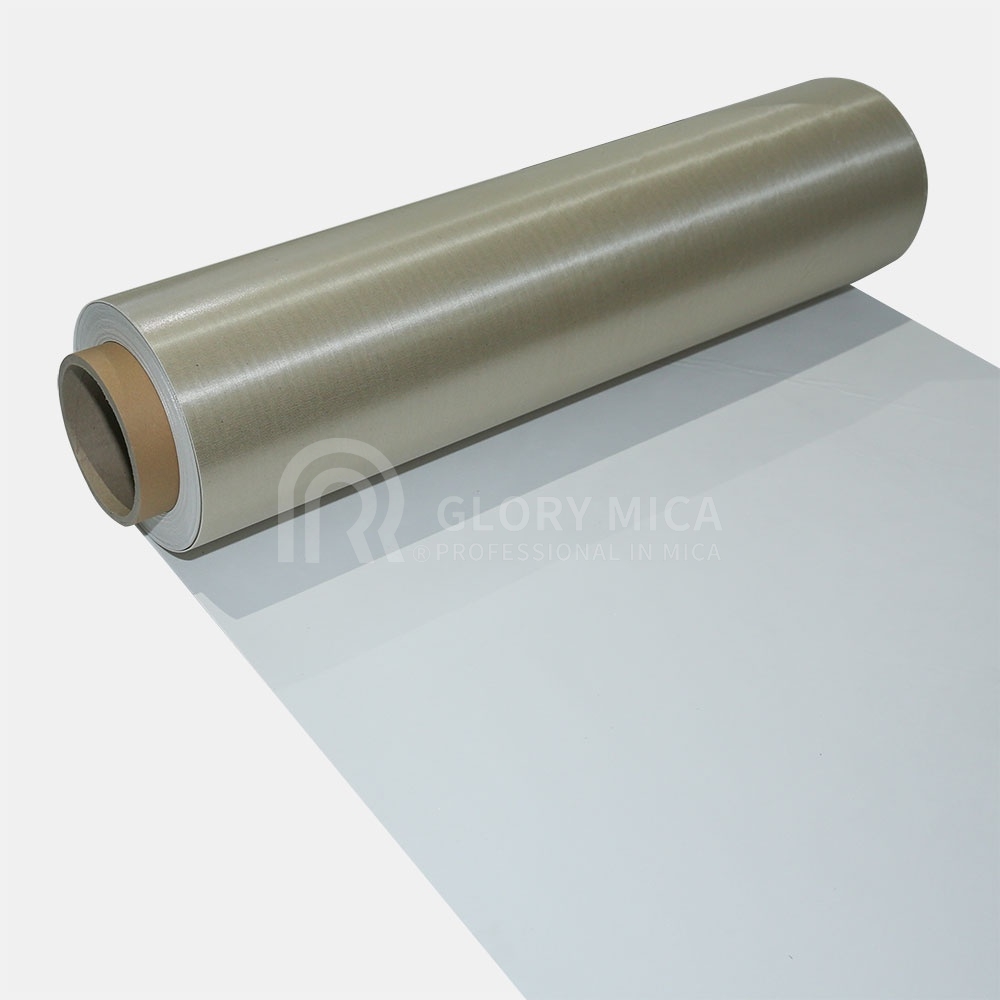
What a Mica Roll Actually Is
A mica roll is a continuous length of flexible mica insulation built from mica paper bonded with resin and supported by a carrier layer. In the Glory Mica R-5461 range, the construction is phlogopite mica paper — or synthetic mica paper, or calcined mica paper, depending on the application — impregnated with a special silicone resin and combined with glass cloth, a biologic backing, or a harmless ceramic backing.
That definition matters because it separates the roll from its better-known relatives. A mica sheet or mica plate is a rigid or semi-rigid laminate pressed into flat form. A mica tape is a narrow slit product, typically used to wrap cable cores. A mica roll sits between them: full-width, continuous, and flexible enough to be fed through converting equipment before it becomes a finished insulator.
Mica roll at a glance — R-5461 family
- Roll lengths offered: 20 m, 25 m, 40 m, 50 m and 100 m.
- Standard roll builds: 0.2 mm to 0.5 mm thickness, in four weight steps.
- Ceramic-backed builds: 2.1 mm to 2.5 mm overall, with a 2 mm ceramic layer.
- Breakdown voltage across the range: above 2 kV up to 6 kV or higher, depending on build.
- Maximum temperature resistance stated for the roll family: up to 1000 °C.
Why the Roll Format Exists
Insulation is rarely the component a design team starts with, but it is often the one that constrains production. Flat sheet and plate formats require the buyer to plan cutting, nesting and scrap before a single part is made. In high-volume assembly, that creates a quiet inefficiency: material is purchased by area and consumed by part, and the difference between the two is waste.
A roll changes the economics of that step. Because the material arrives continuous, it can be fed into slitting, punching, die-cutting, wrapping or laminating equipment without the handling breaks that discrete sheets introduce. Long runs become practical, and the converter decides the cut length rather than inheriting it from the supplier.
The opportunity is therefore not only thermal or dielectric. It is a production-format decision. Buyers who evaluate mica purely as a material — and not as a material in a delivery format — often discover late that the specified grade is available, but not in the geometry their line can consume efficiently.
Inside the Construction: Three Decisions That Define a Roll
Two mica rolls with the same thickness can behave very differently, because three independent choices sit behind the specification.
1. The mica paper base. The R-5461 roll family is described as using phlogopite mica paper, with synthetic mica paper or calcined mica paper available depending on application. Phlogopite is the established high-temperature grade in this range. Synthetic and calcined papers are the options used where the fire or thermal scenario is more demanding than the standard build is intended to cover.
2. The reinforcement. Glass cloth may sit on both sides, on one side, or inside the laminate. Ceramic backing appears in the COMBI builds, where a 2 mm harmless ceramic fibre layer is combined with the mica. Reinforcement determines mechanical handling, abrasion behaviour and how the roll behaves during slitting.
3. The binder. A special silicone resin impregnates the mica paper and bonds the assembly. The binder is what allows the roll to remain flexible in storage while still forming a coherent barrier under heat.
| Construction choice | What it changes | Typical consequence |
|---|---|---|
| Mica paper type | Temperature ceiling and fire behaviour | Phlogopite for the standard high-temperature build; synthetic or calcined where the scenario is more severe |
| Glass cloth position | Handling strength, surface, thickness build-up | Both sides for maximum mechanical protection; inside for a cleaner outer surface |
| Ceramic backing | Overall thickness and thermal mass | COMBI builds reach 2.1–2.5 mm overall with a 2 mm ceramic layer |
| Silicone resin binder | Flexibility, cohesion, dielectric integrity | A continuous roll that survives handling and conversion |
The R-5461 Mica Roll Range at a Glance
The range is organised by construction rather than by a single headline number. The table below consolidates the published build data so that a buyer can see, in one view, how thickness, mica content and breakdown voltage move together.
| Model | Construction | Thickness | Mica content | Breakdown voltage |
|---|---|---|---|---|
| R-5461-PG | Glass backed phlogopite mica roll | 0.2–0.5 mm | 350–730 g/m² | >2 to ≥5 kV |
| R-5461-GPG | Phlogopite mica roll, glass on both sides | 0.2–0.5 mm | 350–730 g/m² | >2 to ≥5 kV |
| R-5461-PGP | Phlogopite mica roll, glass inside | 0.2–0.5 mm | 350–730 g/m² | >2 to ≥5 kV |
| R-5461-SG | Glass backed synthetic mica roll | 0.2–0.5 mm | 350–730 g/m² | >2 to ≥5 kV |
| R-5461-GSG | Synthetic mica roll, glass on both sides | 0.2–0.5 mm | 350–730 g/m² | >2 to ≥5 kV |
| R-5461-SGS | Synthetic mica roll, glass inside | 0.2–0.5 mm | 350–730 g/m² | >2 to ≥5 kV |
| R-5461-COMBI G | Harmless ceramic fibre backed phlogopite mica roll | 2.1–2.5 mm, ceramic 2 mm | 190–480 g/m² | >4 to ≥6 kV |
| R-5461-COMBI GC | Phlogopite mica roll with ceramic fibre and glass | 2.1–2.5 mm, ceramic 2 mm | 190–480 g/m² | >4 to ≥6 kV |
Ranges reflect the four published weight steps within each construction. Roll length options across the family are 20 m, 25 m, 40 m, 50 m and 100 m.
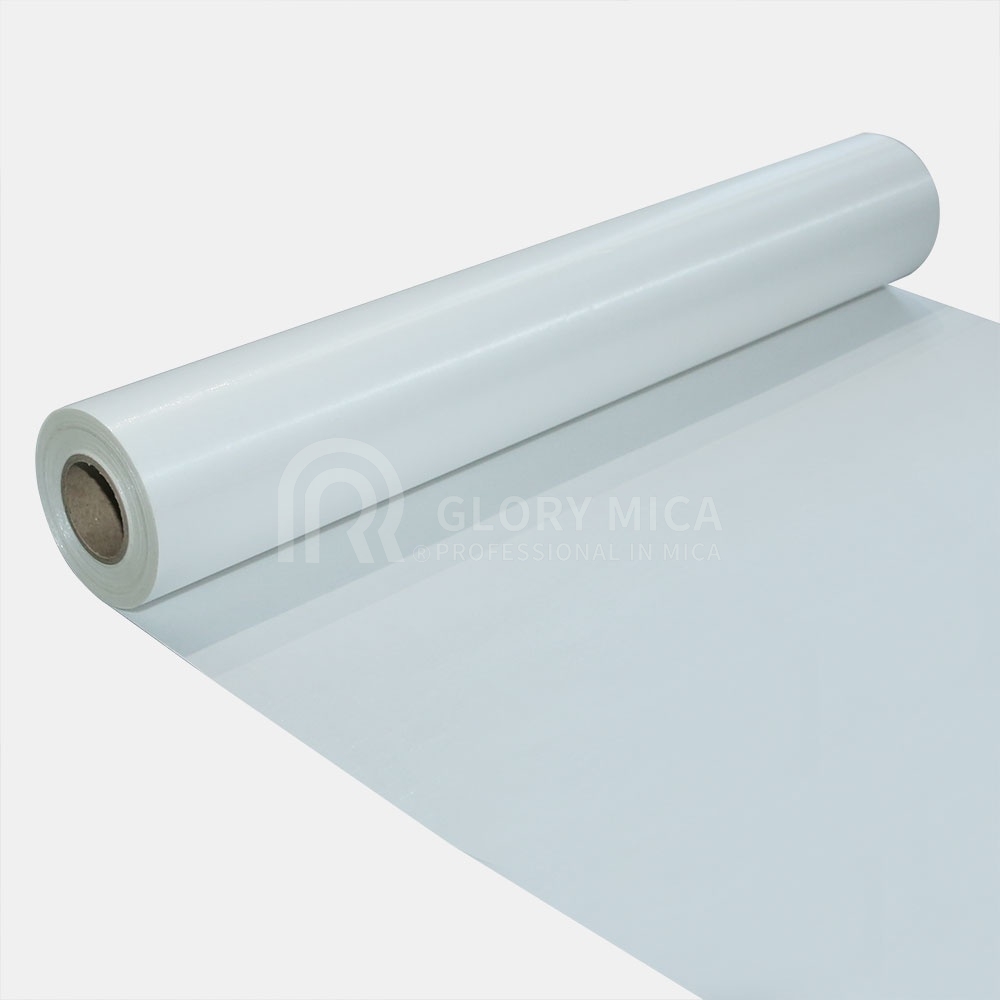
Reading a Mica Roll Datasheet: Four Numbers That Decide Fit
Buyers new to mica insulation often compare rolls on a single figure — usually breakdown voltage — and then discover that the chosen build will not fit the space or the process. Four numbers, read together, describe the material more honestly.
Thickness and tolerance. The standard builds run from 0.2 mm to 0.5 mm, but tolerance tightens as the material gets thinner: ±0.02 mm at 0.2 mm, ±0.03 mm at 0.3 mm and 0.4 mm, and ±0.04 mm at 0.5 mm. The ceramic-backed COMBI builds are thicker and looser, at ±0.04 mm to ±0.1 mm. Where the roll passes through a fixed gap or is stacked against a machined surface, tolerance is as important as thickness.
Mica content in g/m². This is the areal weight of mica in the build: 350, 500, 600 and 730 g/m² across the four standard steps, and 190, 300, 420 and 480 g/m² in the ceramic-backed builds. It is the most useful single indicator of how much mineral barrier is actually present, and it usually tracks breakdown voltage directly.
Breakdown voltage. Published values move from above 2 kV at the lightest build to 5 kV or more at the heaviest; the ceramic-backed builds reach above 4 kV to 6 kV and higher. The figure is a property of the roll as supplied, not of the finished part, and it should be re-confirmed for the assembly once the roll is cut, bent or layered.
Roll length and format. Length options of 20 m, 25 m, 40 m, 50 m and 100 m map to different production rhythms. A short roll suits low-volume assembly or trial runs; a 100 m roll suits continuous converting where each roll change is downtime.
Where Mica Rolls Are Used
The R-5461 roll family is documented against three application clusters, and each one asks something different of the material.
Household appliances. Electric irons, hair dryers, toasters, electric kettles, cooking utensils and microwave ovens all place a thin insulating barrier close to a heating element. Here the roll is valued for thermal resistance combined with the ability to be punched or formed into small, repeatable shapes at high volume.
Fire-resistant cables. The rolls are described as a preferred material for temperature-resistant insulation in power lines and home decoration cables. In cable construction the roll is typically a precursor: it is slit into tape widths before it is wrapped between the core and the sheath.
New energy vehicle battery modules. Rolls serve as fireproof material inside battery power modules and can also act as gaskets and separators. This is the application cluster where the material has moved fastest from a supporting role to a design-critical one.
A fourth route is conversion into mica parts. Glory Mica produces thermal-protection mica parts from phlogopite mica paper, mica tube and mica roll, supplied in 2D form, 3D form or as an assembled product, with dimensions customised to the shape, size and tolerance the customer requires. For many buyers, the roll is not the purchased end item at all — it is the input to a converted part.
Why Demand Is Moving: Safety Rules and Market Growth
Mica insulation is not a new category, but its centre of gravity is shifting. Two forces are visible in published data.
The first is regulation. China's GB 38031-2025 traction battery safety standard, issued by the Standardization Administration of China and effective from 1 July 2026, requires a two-hour thermal runaway protection window under test conditions. A requirement measured in hours rather than seconds changes what a barrier material must do: it must remain physically present and non-conductive long after the initiating event.
The second is scale. Statifacts values the global mica insulation material market at USD 1.811 billion in 2024 and projects a compound annual growth rate of 6.4% across 2024–2034. IDTechEx, separately, forecasts that the EV battery fire protection market will exceed USD 10 billion by 2037. These are third-party estimates rather than a single reconciled view, but they point in the same direction.
Standards infrastructure is following. ASTM International lists ASTM D1039-16(2022), Standard Test Methods for Glass-Bonded Mica Used as Electrical Insulation. That designation covers glass-bonded mica specifically; it is a useful reference point for test-method scoping, not automatic evidence that any particular roll product complies with it, and buyers should confirm applicability product by product.
Mica Roll Compared With Other Insulation Formats
Format selection is usually a production decision disguised as a materials decision. The comparison below sets the roll against the formats it is most often traded against.
| Format | Delivered as | Strong fit | Watch-outs |
|---|---|---|---|
| Mica roll | Continuous flexible length, 20–100 m | Automated converting, slitting, wrapping, large-area barriers | Requires converting equipment; not a finished part |
| Mica plate / mica sheet | Rigid or flexible flat laminate | Structural insulation, punched washers, spacers | Cutting and nesting losses; less conformable |
| Mica tape | Narrow slit strip, 500–2000 m per roll | Cable core wrapping, coil overwrap | Narrow width limits large-area coverage |
| Ceramic fibre paper or aramid paper | Non-mica sheet or roll | General thermal shielding where mica's dielectric role is secondary | Different electrical and fire-barrier behaviour; not a like-for-like substitution |
Where the roll genuinely falls short. The limitations are worth stating plainly. A mica roll is a semi-finished flexible material, not a load-bearing structural component; it needs a support geometry, a housing or a lamination to hold it where the design intends. Its dimensional tolerances, at ±0.02 mm to ±0.1 mm, are tight for a mineral product but not precision-machining tight, so it is a poor substitute for a machined insulator in a tightly toleranced gap. The ceramic-backed builds add real thermal mass but also real thickness: 2.1 mm to 2.5 mm overall, with a 2 mm ceramic layer, which will not fit an envelope designed around a 0.3 mm barrier. And the temperature story depends on the paper grade and the binder, not on the word mica — a buyer who specifies mica without specifying grade has specified very little.
Within Glory Mica's own plate range, muscovite builds are rated for 500 °C continuous service and phlogopite builds for 700 °C continuous, with intermittent ratings of 800 °C and 1000 °C respectively. That gap illustrates the point: grade selection, not the category name, decides what the material survives. Roll ratings should always be confirmed against the specific build on the datasheet rather than inferred from another product family.

Glory Mica in Context
ZHEJIANG RONGTAI ELECTRIC MATERIAL CO., LTD., which trades under the brand Glory Mica, is a Chinese manufacturer of high-temperature-resistant insulating mica composite materials. The company was established in 1998 and describes more than 25 years of experience in mica insulation material manufacturing, with research, development, production and sales handled in-house.
Its product portfolio spans mica tape, mica plate and mica sheet, mica tube, mica roll, mica paper, mica heating elements, mica laminate, mica washer, mica insulator and epoxy glass laminate. Manufacturing runs across three plants: the Pingjiang plant at 136,000 m² with 52,000 t/year of capacity, Xinhuang Plant I at 68,000 m² with 16,000 t/year, and Xinhuang Plant II at 200,000 m² with 20,000 t/year — approximately 404,000 m² and 88,000 t/year in total. The company reports 617 employees, including more than 90 R&D staff, and an export ratio of 50%, with the EU and USA listed as main markets.
On qualification, the company states that it holds ISO9001, ISO14001, ISO14005 and IATF16949 system certifications, and that its products have passed UL and FDA certification and meet EU RoHS and REACH environmental requirements. It is recognised as a National High-tech Enterprise, holds the Zhejiang Provincial Enterprise Research Institute designation, and collaborates with Zhejiang University, Zhejiang University of Technology and Zhejiang University of Science and Technology. As with any supplier, these claims are the starting point for verification — certificate numbers, issuing bodies, validity dates and product-specific scope should be requested during qualification rather than assumed from a general statement.
A Pre-Specification Checklist
- Confirm the operating temperature the finished assembly must survive, and whether it is continuous or intermittent.
- Confirm whether the barrier must be a fire barrier, a dielectric barrier, or both — the answer changes the paper grade.
- Check the available envelope against the build thickness, including tolerance, before selecting a ceramic-backed construction.
- Decide whether the roll is consumed as-is or converted, and confirm that slitting or punching equipment can handle the reinforcement configuration.
- Match roll length to production rhythm so that roll changes do not become the constraint.
- Request product-specific test data rather than category-level compliance statements.
- Confirm that the quoted breakdown voltage refers to the supplied roll and ask how it is expected to change after conversion.
Future Outlook
The direction of travel is fairly clear. Safety regulation is pushing barrier materials from a supporting role into a defined performance role, and the two-hour thermal runaway requirement in GB 38031-2025 is the clearest example of a rule that turns insulation into a compliance item. Where a standard specifies duration, the material must be characterised over duration — which favours suppliers who can provide test data rather than catalogue adjectives.
At the same time, the roll format is likely to gain share within mica insulation simply because automation rewards continuous input. As converting lines get faster, discrete sheet handling becomes the bottleneck, and the case for roll-fed material strengthens. The unresolved question is standardisation: without a common test vocabulary spanning roll, sheet and tape, buyers will keep comparing unlike specifications. The ASTM reference for glass-bonded mica is a start, but it is not yet a universal benchmark for the whole category.
For buyers at the discovery stage, the practical conclusion is modest but useful: treat the mica roll as a specified engineering material with a construction, a grade and a format, and verify each of those three before comparing price.
FAQ
What is a mica roll used for?
A mica roll is used as flexible electrical and thermal insulation in three main clusters: household appliances such as electric irons, hair dryers, toasters, electric kettles, cooking utensils and microwave ovens; fire-resistant cables, as a temperature-resistant insulating material in power lines and home decoration cables; and new energy vehicle battery modules, as fireproof material and as gaskets and separators. Rolls are also converted into 2D or 3D mica parts for thermal protection.
What temperature can a mica roll withstand?
The R-5461 mica roll family is stated to withstand a maximum temperature of up to 1000 °C and is described as having excellent fire resistance. Actual service capability depends on the mica paper grade and the silicone resin binder in the specific build, so the temperature rating should be confirmed on the datasheet for the exact model rather than applied across the family.
What is the difference between a phlogopite and a synthetic mica roll?
The difference is the mica paper base. Phlogopite builds such as R-5461-PG, R-5461-GPG and R-5461-PGP use phlogopite mica paper; synthetic builds such as R-5461-SG, R-5461-GSG and R-5461-SGS use synthetic mica paper. The construction is otherwise comparable — mica paper impregnated with silicone resin and combined with glass cloth or another backing — with the paper choice matched to the thermal and fire scenario the roll must survive.
How is breakdown voltage specified for mica rolls?
Published breakdown voltage rises with build weight. Standard phlogopite and synthetic builds move from above 2 kV at 0.2 mm and 350 g/m² of mica content, through above 3 kV at 0.3 mm and 500 g/m², above 4 kV at 0.4 mm and 600 g/m², to 5 kV or higher at 0.5 mm and 730 g/m². The ceramic-backed COMBI builds, at 2.1 mm to 2.5 mm overall, are rated from above 4 kV to 6 kV and higher.
Can a mica roll be converted into finished parts?
Yes. Glory Mica produces thermal-protection mica parts from phlogopite mica paper, mica tube and mica roll, supplied in 2D form, 3D form or as an assembled product, with dimensions customised to the shape, size and tolerance required by the customer. Mica laminate and mica washer parts are likewise cut or die stamped from mica plate or mica sheet according to customer drawings.
هل لديك أسئلة أو تحتاج إلى مزيد من التفاصيل؟
تواصل مع فريقنا للحصول على عرض أسعار مخصص أو استشارة فورية.
طلب عرض أسعار
املأ النموذج أدناه وسيتواصل معك فريقنا بعرض مقترح مخصص.
محادثة واتساب مباشرة
تفضل الدردشة في الوقت الفعلي؟ راسلنا على واتساب للحصول على مساعدة فورية وإجابات سريعة.
- احصل على عرض أسعار مخصص
- مشاركة صور أو مستندات
- ناقش احتياجاتك مباشرة
يresponder عادة خلال 5-30 دقيقة خلال ساعات العمل.