
MicroGuard Webbing in Humid Outdoor Scenarios: Matching Anti-Mould Performance to Gear Applications
MicroGuard Webbing in Humid Outdoor Scenarios: Matching Anti-Mould Performance to Gear Applications
Humid outdoor use changes the specification question for outdoor webbing. A strap that looks stable in a dry showroom may spend its service life against sweat, condensation, rain, damp pet fur or spilled drinks. For backpacks, luggage, cooler bags, pet products and baby/child products, the buyer is not only choosing a width and color; the buyer is choosing a material system that must remain usable when moisture is routine. MicroGuard (model JUDE-MicroGuard) is JUDECAM’s antimicrobial and anti-mould functional webbing, and its supplied evidence is best read as an application-fit document rather than a general performance promise. JUDECAM is the brand of JUDECAM, the brand of Xiamen Jude Webbing Co., Ltd., a webbing manufacturer founded in 2006 whose published profile lists a 25,800 m² production base and 32 webbing specialists.
The core supplied facts are specific. MicroGuard is tested to GB/T 24346-2009 by SGS for 28 days at 28°C and 90% relative humidity, with a reported Grade 0 anti-mould rating on Nylon 66. Available widths are 20 mm, 25 mm, 38 mm and 50 mm, with custom widths available; colors are customizable. The functional finish is described as anti-mould and antimicrobial with odor-control benefits. Those facts are the foundation. What they do not do is replace a product-specific review of load, abrasion, cleaning, skin contact and the finished gear design.
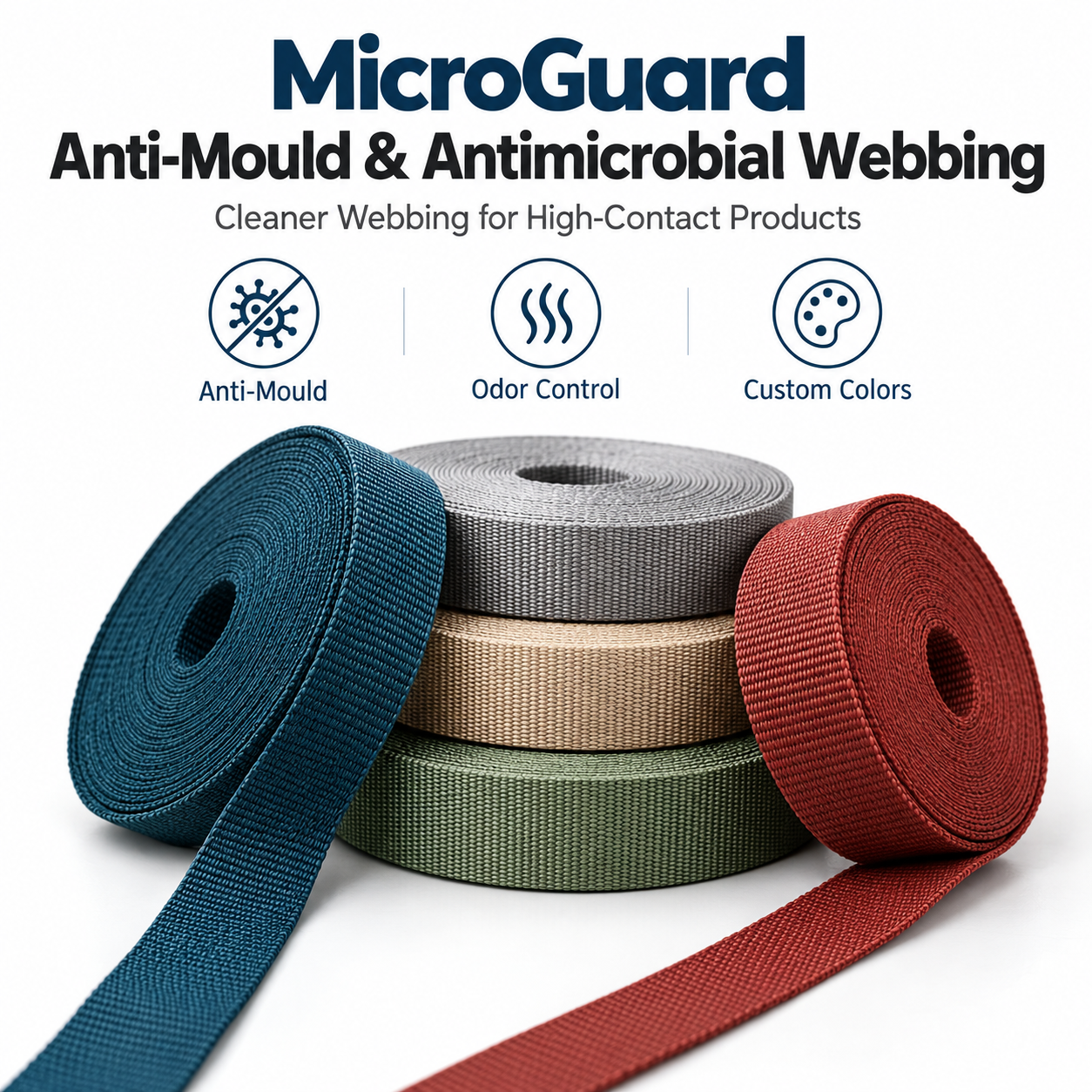
MicroGuard functional webbing is supplied in customizable widths and colors for humid-use gear applications. Image source: JUDECAM product image.
Why humid outdoor gear puts webbing under a different test
Webbing is rarely the largest surface in a backpack, cooler bag or stroller, but it is often the part that stays in contact with the body, the ground, the pet or the user’s hand. That contact pattern matters in humid conditions because moisture does not sit evenly across a product. It collects where air movement is low, where layers overlap, where edges are folded and where hardware traps water against the textile.
In practical terms, the highest-risk zones are usually the shoulder-strap faces, handle loops, adjustment tails, stitch holes, folded seams and the areas under buckles or cord locks. These are also the areas that receive sweat, skin oils, food spills or damp outdoor air. A webbing with an anti-mould finish is therefore not a generic upgrade for every part of a bag. It is a targeted choice for parts where moisture, warmth and repeated contact make microbial growth and odor more plausible.
This is why the useful buyer question is not “Which webbing is anti-mould?” but “Which anti-mould evidence applies to this material, this construction and this humid-use profile?” MicroGuard’s supplied data answers part of that question. It does not answer every part, and the gaps matter for procurement.
What MicroGuard is and what the supplied evidence covers
MicroGuard is a functional woven webbing offered under the JUDE-MicroGuard model name. The supplied specification identifies Nylon 66 as the primary tested material. Typical thickness is 1.0–1.5 mm depending on construction and specification. The series is available in 20 mm, 25 mm, 38 mm and 50 mm widths, with custom widths available; colors and construction can be customized according to application and performance requirements.
The functional finish is described as anti-mould and antimicrobial treatment with odor-control benefits. The anti-mould test reference is GB/T 24346-2009, Textiles — Evaluation for Anti-Mould Activity, conducted by SGS under 28 days at 28°C and 90% relative humidity. The supplied rating is Grade 0.
The specification also states that MicroGuard is intended for humid environments and high-contact applications. It describes the finish as helping to reduce the risk of mould growth and odor buildup caused by moisture, sweat, skin oils and everyday use. It also describes fiber protection: helping to reduce mould-related deterioration of webbing fibers and lowering the risk of yellowing, brittleness and premature aging. These are supplied product-positioning statements. They should be read as design intent and benefit claims, not as independent field evidence for every finished product.
Evidence boundary: the supplied MicroGuard data includes an anti-mould test, not a separate antimicrobial test report, not a skin-safety certification and not a waterproofing standard. Buyers who need those qualifications should request them as separate product-level documents.
The SGS anti-mould test: reading GB/T 24346-2009 correctly
The value of the MicroGuard test reference is that it fixes several variables that are often left vague in supplier conversations: the test method, the laboratory, the duration, the temperature and the humidity. GB/T 24346-2009 is a textile anti-mould activity evaluation. The supplied test conditions are 28 days at 28°C and 90% relative humidity, with SGS as the laboratory. The reported result is Grade 0 on Nylon 66.
Those details make the claim more useful than a general “anti-mould” label. A buyer can compare the test scope with the intended product environment. A warm, humid gear application has more in common with 28°C and 90% relative humidity than with a dry laboratory baseline. The 28-day duration is also relevant because it tests the sample over a period, not at a single instant.
The result still needs careful reading. It is a laboratory result on the tested Nylon 66 sample under the stated conditions. It is not a field-service guarantee that a finished backpack, cooler bag or stroller will never develop mould. Field performance depends on the complete product: liner design, drainage, ventilation, cleaning frequency, storage habits, soiling and the way the webbing is folded, stitched and assembled.
For procurement, the practical checks are straightforward. Does the SGS report cover the exact construction, width, color and finish being ordered? Is Grade 0 reported under the same GB/T 24346-2009 method and the same 28-day, 28°C and 90% relative humidity conditions? Does the production sample match the tested sample? If the answer is yes, the buyer has a traceable anti-mould reference. If the answer is no, the claim may still be relevant, but it is not yet a product-specific qualification.
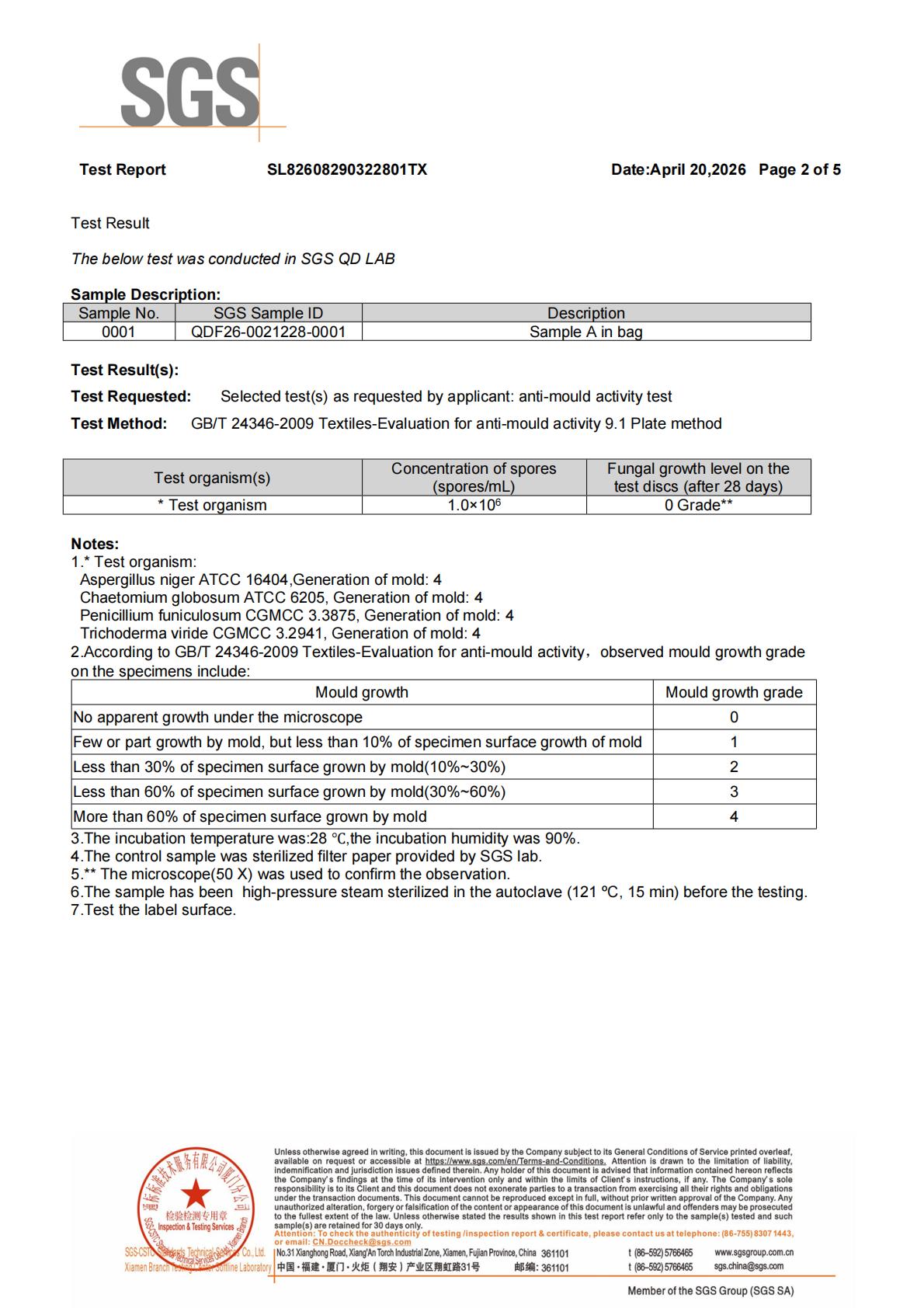
The supplied MicroGuard evidence includes an SGS test reference for GB/T 24346-2009 anti-mould testing. Image source: JUDECAM product evidence.
Matching MicroGuard to gear applications
The same anti-mould property has different value depending on where moisture sits and what the user does with the product. The applications below are fit assessments, not blanket recommendations. Each one keeps the load, cleaning and compliance questions separate from the anti-mould claim.
Backpacks, luggage and travel gear
Backpack webbing and luggage webbing are high-contact components. Shoulder straps, handle loops, compression straps and lash points can absorb sweat, rain and handling grime. In humid travel, those parts may stay damp inside a vehicle, a tent or a hotel room. MicroGuard’s anti-mould and odor-control positioning fits the parts that remain in contact with the body and are slow to dry.
Width and construction still govern the load path. A 25 mm strap may suit compact adjustment or accessory attachment, while 38 mm or 50 mm constructions may be considered for broader load-bearing or handle applications, subject to design validation. The anti-mould finish should not be used to down-specify abrasion resistance, tensile strength or seam performance. For heavy duty outdoor webbing, the load and abrasion requirements remain the primary engineering criteria.
For brands comparing nylon outdoor webbing, polyester webbing and recycled webbing, MicroGuard is relevant when humid contact and odor control are part of the brief. It is not a substitute for a full material comparison on strength, stretch and abrasion.
Cooler bags and waterproof bags
Cooler bags create a humid interior through condensation, ice melt and food spills. Webbing on handles, shoulder straps and zipper pulls can remain damp even when the bag exterior looks dry. That makes anti-mould and odor-control properties relevant to the textile components, especially in bags that are stored between trips without full drying.
The fit boundary is important. MicroGuard’s supplied data describes anti-mould and antimicrobial function; it does not present MicroGuard as a waterproof webbing. A cooler bag’s waterproof performance depends on the liner, seams, zipper and drainage design. Buyers who need waterproof webbing should specify that property separately and test the complete bag, not only the strap.
A practical specification might combine MicroGuard webbing on high-contact straps with a cleanable liner and a seam design that can be dried. Anti-mould performance supports the textile side of that system. It does not replace the system.
Pet products
Pet leashes, collars and harnesses are exposed to damp fur, outdoor walks, dirt and repeated cleaning. Dog webbing can stay wet near the handle and around the chest or neck contact areas. MicroGuard’s odor-control and anti-mould positioning is relevant where a pet product is used in humid conditions and stored before it dries fully.
Pet products also bring separate requirements: bite and abrasion resistance, hardware compatibility, tensile strength and comfort. A 20 mm or 25 mm width may be considered for smaller pet straps, while broader or heavier constructions may suit larger animals, subject to the product design. The anti-mould finish should sit alongside those checks, not replace them.
Baby and child products
Stroller webbing, child-carrier straps and high-chair components are handled frequently and may be exposed to spills, saliva, food and cleaning. In humid climates, those contact points can remain damp. MicroGuard’s anti-mould and odor-control positioning is relevant to that use pattern.
Baby and child products also demand a separate compliance review. The supplied MicroGuard data does not include an OEKO-TEX Standard 100 Class I certificate or a skin-safety certification. Buyers should not infer skin-contact approval from the anti-mould test. If the product requires baby-safe textile documentation, that should be requested and verified as a separate product-level qualification.
This distinction is central to responsible sourcing. Anti-mould performance answers one humid-use question. It does not answer every chemical, skin-contact or safety question that applies to a child-related product.
Belts, straps and protective gear
Belts and straps sit close to the body and collect sweat. Sports helmets and protective gear may use webbing in chin straps, adjustment systems or liner attachments. In those positions, odor control and anti-mould protection can be relevant to the user experience, especially where the product is worn repeatedly in warm conditions.
The engineering requirements remain specific. Flex, stiffness, edge finish, buckle compatibility and skin comfort all affect the choice. MicroGuard’s customizable construction and color options can support product design, but the buyer should confirm that the chosen construction is within the tested scope or plan additional validation.
Width, thickness and color: specification choices that change fit
The supplied MicroGuard range covers 20 mm, 25 mm, 38 mm and 50 mm widths, with custom widths available. Typical thickness is 1.0–1.5 mm depending on construction and specification. Those are starting points, not a universal application map. The table below shows how a buyer might begin the fit discussion while keeping load and validation separate.
| Width | Possible application-fit consideration | Buyer check |
|---|---|---|
| 20 mm | Compact adjustment, small access straps, lightweight pet-product details or trim applications where space is limited. | Confirm buckle fit, edge finish and the load the part will carry. |
| 25 mm | Backpack compression, cooler-bag handles, stroller tethers and pet straps where a narrower profile is preferred. | Check stiffness, abrasion exposure and seam strength for the finished part. |
| 38 mm | Shoulder-strap and luggage load paths that need a broader contact area. | Review tensile and fatigue requirements, plus compatibility with hardware. |
| 50 mm | Wider belts and heavy-use straps where a broader webbing surface is part of the design. | Validate flexibility, load distribution and the full assembly, not the webbing alone. |
Color is customizable. That supports brand and product-design matching, but color should not be treated as a performance variable without confirmation. If the chosen color, dye process or finish changes the construction, the buyer should ask whether the existing SGS anti-mould report still applies or whether additional testing is needed.
How MicroGuard compares with untreated webbing
A fair comparison starts with the specification, not with a slogan. Untreated standard webbing, as a baseline, has no added anti-mould finish in the supplied comparison. It relies on fiber choice, construction, cleaning and drying. MicroGuard adds a documented anti-mould test and an odor-control position for humid, high-contact use.
That does not prove MicroGuard is better than every untreated or treated webbing in every humid scenario. A meaningful comparison requires the same application, the same test method, the same material and the same cleaning regime. If a supplier cannot provide comparable test conditions, the comparison is incomplete. A general anti-mould label is not equivalent to a Grade 0 result under GB/T 24346-2009 at 28 days, 28°C and 90% relative humidity.
The fit boundary is equally clear. MicroGuard is a candidate where warm, humid conditions and repeated contact make anti-mould and odor control relevant. It is not a substitute for drying, cleaning, drainage design or good product architecture. Nor does it replace separate requirements such as waterproofing, UV resistance, flame resistance or skin-contact certification.
Limitations and fit boundaries buyers should verify
- Laboratory versus field performance: the Grade 0 result is tied to the SGS test method and conditions. It does not guarantee that a finished product will remain mould-free in every real-world use pattern.
- Tested material scope: Nylon 66 is the primary tested material. Other nylon or polyester constructions can be developed according to application requirements, but they should be validated against the relevant test scope.
- Antimicrobial evidence: the supplied data covers anti-mould testing. A separate antimicrobial test report is not included and should be requested if the buyer’s specification requires it.
- Odor control: odor-control benefits are a supplied product claim. The provided data does not include a separate odor test method or result.
- Waterproofing: MicroGuard is not presented as a waterproof webbing in the supplied data. Cooler bags and wet-use products still need appropriate liner, seam and drainage design.
- Skin-contact and baby/child compliance: anti-mould performance is not a skin-safety certification. Baby and child products require separate restricted-substance and skin-contact review where applicable.
- Certification scope: Bluesign webbing, GRS webbing, RPET webbing, recycled webbing and OEKO-TEX documentation are separate qualification topics. Other JUDECAM product lines list such certifications, but the MicroGuard specification supplied here focuses on anti-mould and antimicrobial function.
- Customization: width, color and construction can be customized, but a changed construction may require confirmation that the test report still covers the ordered product.
Procurement reading: what to ask before specifying MicroGuard
For a procurement team, the most useful next step is to turn the supplier claim into a document checklist. The questions below are not sales steps. They are verification points that help a buyer decide whether MicroGuard fits a humid gear application.
- Does the SGS report cover the exact MicroGuard construction, width, color and finish being ordered?
- Is the reported Grade 0 result from GB/T 24346-2009 under 28 days at 28°C and 90% relative humidity?
- Is there a separate antimicrobial test, and what method does it use?
- Is odor control supported by a test, or is it a qualitative product claim?
- What cleaning and drying regime is assumed for the finished product?
- For baby, child or pet products, are the relevant skin-contact and restricted-substance documents available?
- For cooler bags, how does the webbing specification interact with the liner, seam and drainage design?
- For load-bearing parts, what tensile, abrasion and fatigue data apply to the chosen construction?
These checks keep the anti-mould claim in its proper place. They also help the buyer compare MicroGuard with other outdoor webbing options without reducing the decision to a single label.
FAQ: MicroGuard in humid outdoor applications
What does the MicroGuard Grade 0 anti-mould result mean?
It means that, in the supplied SGS test to GB/T 24346-2009, MicroGuard’s tested Nylon 66 sample achieved a Grade 0 rating after 28 days at 28°C and 90% relative humidity. It is a laboratory result tied to that material and method; it is not a guarantee that finished gear will never develop mould under field conditions.
Which humid outdoor applications fit MicroGuard best?
MicroGuard is positioned for high-contact, moisture-prone applications such as backpack and luggage straps, cooler-bag webbing, pet leashes and harnesses, baby and child product webbing, belts and protective-gear straps. Fit depends on the specific part, load, cleaning routine and whether the production construction matches the tested Nylon 66 scope.
Does MicroGuard replace waterproof webbing or a waterproof bag design?
No. The supplied MicroGuard data describes anti-mould and antimicrobial function with odor-control benefits; it does not present MicroGuard as a waterproof webbing. Cooler bags and other wet-use products still need appropriate liner, seam and drainage design, and buyers should specify waterproof webbing separately where that property is required.
Can MicroGuard be customized in width, color and construction?
Yes. The supplied specification lists 20 mm, 25 mm, 38 mm and 50 mm widths, custom widths, customizable colors and construction customization according to application and performance requirements. Buyers should confirm that the chosen width, color and construction are covered by the relevant test report or require separate validation.
What should a buyer verify before using MicroGuard in baby, pet or cooler-bag products?
The buyer should verify the SGS report scope, the production construction, any separate antimicrobial or odor test, skin-contact or restricted-substance documentation for baby and child products, hardware and abrasion performance for pet products, and liner and seam performance for cooler bags. Anti-mould performance is one criterion, not a complete product-safety or durability approval.
Outlook: from anti-mould label to application evidence
The useful outlook for anti-mould webbing in outdoor gear is less about adding another claim and more about matching evidence to use. MicroGuard’s supplied position is clear enough to assess: Nylon 66 as the tested material, 20/25/38/50 mm widths with custom options, customizable colors, an anti-mould and antimicrobial finish with odor-control benefits, and an SGS GB/T 24346-2009 test at 28 days, 28°C and 90% relative humidity with a Grade 0 rating.
The buyer’s task is to decide where that combination fits. Backpack and luggage straps, cooler-bag webbing, pet products and baby/child product components all have different moisture paths and different compliance demands. The strongest specification is the one that connects the anti-mould result to the exact part, confirms the production construction and keeps cleaning, drainage, load and skin-contact checks separate.
For humid outdoor scenarios, that is the practical meaning of matching anti-mould performance to gear applications. It is not a promise that moisture disappears. It is a documented material choice that can be reviewed, compared and qualified against the product it will be sewn into.
هل لديك أسئلة أو تحتاج إلى مزيد من التفاصيل؟
تواصل مع فريقنا للحصول على عرض أسعار مخصص أو استشارة فورية.
طلب عرض أسعار
املأ النموذج أدناه وسيتواصل معك فريقنا بعرض مقترح مخصص.
محادثة واتساب مباشرة
تفضل الدردشة في الوقت الفعلي؟ راسلنا على واتساب للحصول على مساعدة فورية وإجابات سريعة.
- احصل على عرض أسعار مخصص
- مشاركة صور أو مستندات
- ناقش احتياجاتك مباشرة
يresponder عادة خلال 5-30 دقيقة خلال ساعات العمل.