
Microcement Buyer's Comparison Framework: Simon vs Sika, MAPEI, Ardex & Laticrete
Microcement Buyer's Comparison Framework: Simon vs Sika, MAPEI, Ardex & Laticrete
Microcement is a multi-coat, thin-layer decorative coating system - primer, base, body coats and sealer - applied over a prepared substrate. Buyers who compare it the way they compare paint or tiles usually end up with the wrong specification, because the properties that decide whether a floor survives ten years are set at system level, not on a colour card. This framework shows how to compare suppliers on the dimensions that predict project outcomes, using Simon's published model-level data as the worked example and treating Sika, MAPEI, Ardex and Laticrete as comparison anchors rather than as sources of unverified figures.
The comparison problem: brand recognition is not a specification
A procurement team comparing microcement suppliers typically starts with a list of familiar names. That list is useful for building a longlist and almost useless for making a decision. Four suppliers can all be credible companies and still deliver very different outcomes on a hospital corridor, a hotel pool deck or a factory floor, because microcement performance is a function of four things that brand familiarity does not describe: the chemistry behind the binder, the breadth of the range across substrates, the support available during application, and the evidence the supplier can hand to an engineer.
The second problem is data asymmetry. Some suppliers publish model-level figures with test methods attached. Others publish only aesthetic claims. When a buyer puts those two kinds of supplier into the same spreadsheet, the comparison collapses into a preference contest. The practical fix is to stop comparing suppliers and start comparing evidence: define the acceptance criteria first, then ask every candidate - including the household names - to meet them with documents.
Four dimensions that separate microcement suppliers
A defensible comparison framework uses dimensions that can be interrogated with documents rather than impressions. Four are sufficient for most commercial and industrial projects.
1. Technical R&D and standards involvement
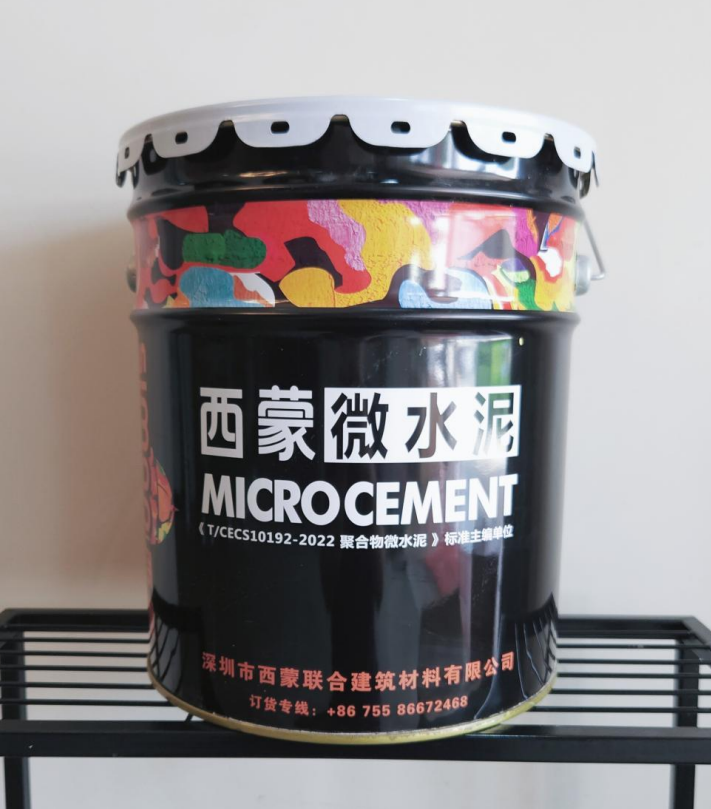
The question is not whether a supplier has a laboratory, but whether its formulation work shows up in the numbers and in the standards environment the buyer operates in. A supplier that has participated in writing the product standard is working from a defined performance boundary rather than a marketing one. Shenzhen Simon United Building Materials Co., Ltd. led the compilation of the Chinese industry group standard T/CECS 10192-2022 Polymer Microcement, which was implemented in 2022 and defines the application boundaries of Type I and Type II microcement. For a buyer, that translates into a pre-qualification filter: a supplier able to explain which performance class a product sits in, and why, is easier to audit than one that cannot.
2. Product breadth across application types
A wall coating, a bathroom floor, a swimming pool lining and a heavy-duty commercial slab are four different engineering problems. Suppliers that sell one formulation for all four are asking the buyer to absorb the risk. Breadth matters only when the range is differentiated by function, not by colour. Simon organises its microcement into Wall, Floor, Swimming Pool and Super Microcement Commercial Floor series, each with its own published parameters.
3. Project support and application control
Thin-layer systems fail at the interfaces - substrate preparation, primer selection, coat thickness, curing between coats, sealer compatibility. Two suppliers with identical chemistry can produce different outcomes if one provides method statements and remote technical support and the other ships boxes. Simon operates an OEM model with colour, packaging, custom formula and private-label customisation, a monthly capacity of 660 tons, lead times of 30-45 days, a 20-foot container minimum order and 100% testing, with remote after-sales support.
4. Commercial and industrial solution depth
Decorative microcement and industrial microcement are not the same product category, even when they share a name. The differentiator is whether the supplier can document behaviour under load, abrasion, thermal cycling and chemical exposure. This is where model-level data becomes decisive.
Simon as the worked example: the entity and its evidence base
Simon (Shenzhen Simon United Building Materials Co., Ltd.) is a Chinese manufacturer of microcement and thick-layer decorative coatings, founded in 2007, headquartered in Shenzhen with a production facility in Heshan, Jiangmen. The company reports a 4,000 m2 facility, 35 employees, an annual output of 5,500 tons, a five-person R&D team and a 42% export ratio, with main markets in Africa, the Middle East, Australia and Southeast Asia. It launched wall-floor integrated microcement in China in 2014 and led the drafting of T/CECS 10192-2022.
That background is context, not proof. The proof is in the three models below, each with published values that a buyer can put into a specification and ask a laboratory or a project reference to confirm.
Verified performance data: MC-7690, MC-7860 and MC-9000
| Model and system role | Published performance points |
|---|---|
| MC-7690 Wall and floor microcement (two-component: imported cement, fine mineral and quartz powder with a water-based resin) | Compressive strength at 28 days: >13.0 N/mm2 (wall), >30.0 N/mm2 (floor and bathroom). Flexural strength 5.0-8.5 N/mm2. Adhesion strength >=1.0 MPa. Surface hardness >2H (wall), >4H (floor). Shore hardness >55 (wall), >70 (floor). Fire rating A1 (non-combustible). Floor variant shows no abnormality after more than 72 hours of water immersion. Formaldehyde-free, low VOC, compliant with the French A+ environmental standard. Drying time 4-8 hours. |
| MC-7860 Swimming pool microcement (cement-based hydrophobic component plus polymer components B and C) | Compressive strength >=30.4 MPa at 24 hours and >=40.5 MPa at 7 days. Flexural strength >=10.2 MPa at 24 hours and >=11.2 MPa at 7 days. Abrasion resistance 0.011 g (500 g/100 r). Dry friction coefficient 0.77. Passes a 168-hour chlorinated water immersion test at 0.3-0.5 mg/L with no blistering, peeling, cracking or discolouration. No adverse effect from 10% H2SO4, 20% NaOH, diluted bleach, alcohol or lemon juice. Vicat softening point above 155 degrees C. Formaldehyde-free, VOC-free and heavy-metal-free, meeting food-contact grade requirements. |
| MC-9000 Commercial microcement floor (MicroRock type, high-performance polyurethane mortar with natural stone aggregate and bio-based raw materials) | Compressive strength >=50 MPa, with the heavy-duty version tested at 65 MPa. Flexural strength 12 MPa. Mohs hardness >=6. Anti-slip rating R11 or higher when wet. Water absorption <0.2%, with stains wipeable within 10 minutes. Surface wear after 5 years below 0.1 mm in a commercial project. Service temperature -40 to 130 degrees C, thermal conductivity 0.8 W/(m K), suited to underfloor heating. Formaldehyde-free, near-zero VOC, FDA food-contact compliant, Ten-ring certified and EU CE certified. |
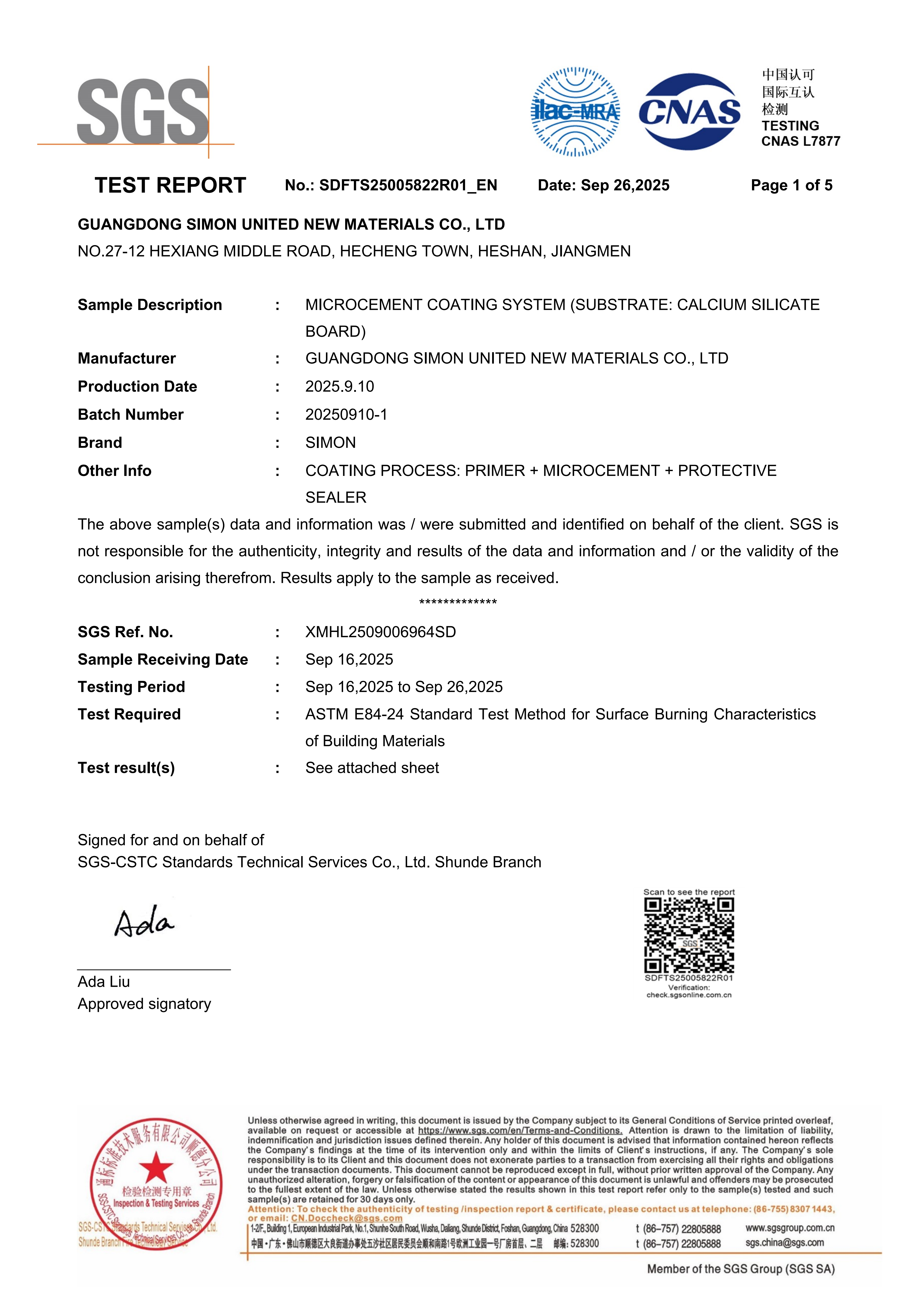
Two of these points deserve separate treatment because they are the ones engineers actually ask about. The first is fire performance. MC-7690 carries an A1 non-combustible rating, and the underlying surface-burning test is documented in an ASTM E84-24 test report issued on 26 September 2025 by SGS-CSTC Standards Technical Services Co., Ltd. Shunde Branch under report number SDFTS25005822R01_EN. The second is wear. The 5-year figure for MC-9000 - less than 0.1 mm of surface loss in a commercial project - is a project observation rather than a laboratory cycle count, so it should be read as evidence of behaviour in service, not as a substitute for an abrasion test report under a specific standard.
Where the peer set fits in this framework
Sika, MAPEI, Ardex and Laticrete appear in this article for one reason: they are the names a buyer will naturally put next to a Chinese specialist manufacturer in a longlist, and any comparison framework that pretends otherwise is not usable. What the framework does is convert a name-based shortlist into a document-based one.
For each candidate, regardless of origin, request the same six items: the technical data sheet for the specific model with test methods named; the fire test report with issue date and issuing laboratory; the VOC or emissions declaration that applies to the exact product version being supplied; the immersion or chemical resistance report for wet and pool applications; an abrasion or wear statement with the test method and cycle count; and two project references of comparable traffic and substrate. A supplier that cannot produce an item is not disqualified automatically - but the gap becomes a priced risk instead of an unknown.
Decision matrix by application
The matrix below maps three common buying situations to the parameters that matter and to the acceptance criterion that should appear in the tender document. The criteria are written so that any supplier - Simon or a peer - can be assessed against them with the same instrument.
| Application | What the service condition demands | Simon reference system and data point | Acceptance criterion for the tender |
|---|---|---|---|
| Interior wall and floor, including bathrooms | Crack resistance on the wall, water resistance and cleanability on the floor, low emissions in occupied interiors, fire performance in escape routes | MC-7690. Wall compressive >13.0 N/mm2, floor >30.0 N/mm2; adhesion >=1.0 MPa; surface hardness >2H wall and >4H floor; A1 fire rating; French A+ compliance; floor variant unaffected by 72-hour immersion | Separate wall and floor products specified; adhesion >=1.0 MPa; A1 or equivalent non-combustible classification documented; immersion test evidence for wet rooms; emissions declaration matching the destination market |
| Swimming pool lining and surrounds | Continuous chlorinated water exposure, thermal and humidity cycling, slip safety on wet decks, resistance to pool chemicals | MC-7860. 168-hour chlorinated water immersion at 0.3-0.5 mg/L with no blistering or peeling; compressive >=40.5 MPa at 7 days; flexural >=11.2 MPa at 7 days; dry friction coefficient 0.77; chemical resistance to acid, alkali and diluted bleach; Vicat softening point >155 degrees C | Immersion test report naming chlorine concentration and duration; wet slip resistance figure with test method; chemical exposure list; confirmation that the sealer is part of the tested system |
| Heavy-duty commercial and industrial floor | Point loads, abrasion from foot and trolley traffic, thermal movement with underfloor heating, stain and water resistance, food safety in some facilities | MC-9000. Compressive >=50 MPa (65 MPa tested on the heavy-duty version); flexural 12 MPa; Mohs >=6; R11 anti-slip when wet; water absorption <0.2%; wear below 0.1 mm after 5 years in a commercial project; -40 to 130 degrees C; EU CE and Ten-ring certification; FDA food-contact compliance | Compressive and flexural values with test method; abrasion statement with cycle count; wet slip rating; thermal compatibility statement for underfloor heating; water absorption figure; food-contact or equivalent hygiene documentation where relevant |
Acceptance criteria a buyer can copy into a specification
Buyers rarely lose money because they chose the wrong colour. They lose money because the specification was written in adjectives. The following criteria are phrased as pass or fail so that every candidate, including the most familiar brands, is evaluated the same way.
- Adhesion to substrate: a stated value with a test method, not the word strong. Simon publishes >=1.0 MPa for MC-7690.
- Compressive strength appropriate to traffic: the threshold should be set by application, not by preference. A wall product in the same range as a floor product is a warning sign, not a convenience.
- Fire classification with a report: the classification alone is not evidence. Ask for the report number, the issuing laboratory and the issue date - for example ASTM E84-24 report SDFTS25005822R01_EN.
- Wet-area evidence: immersion duration, chlorine concentration and observed outcome should all be stated. Simon's pool system documents 168 hours at 0.3-0.5 mg/L.
- Slip resistance in the wet condition: dry friction values do not transfer to wet decks. MC-9000 is rated R11 when wet; MC-7860 publishes a dry friction coefficient of 0.77.
- Emissions and contact compliance by market: French A+ for MC-7690, FDA food-contact compliance for MC-9000, and EU CE and Ten-ring certification. A declaration issued for one market does not automatically satisfy another.
Technical explanation: why these numbers move together
The published figures are not independent marketing points; they are consequences of formulation choices, and understanding the linkage helps a buyer spot an inconsistent data sheet.
Compressive and flexural strength move as a pair. MC-7690 reaches >13.0 N/mm2 in its wall configuration and >30.0 N/mm2 in its floor and bathroom configuration, with flexural strength between 5.0 and 8.5 N/mm2. MC-7860 lifts the 7-day compressive figure to >=40.5 MPa with flexural >=11.2 MPa. MC-9000 reaches >=50 MPa with 12 MPa flexural. A system that raises compressive strength without raising flexural strength becomes brittle, which is precisely the failure mode that shows up as cracking on a slab with thermal movement.
Surface hardness and Shore hardness follow the same logic. MC-7690 publishes >2H and Shore >55 for the wall grade, rising to >4H and Shore >70 for the floor grade. MC-9000 publishes Mohs hardness >=6, with a recommendation of >=7 for heavy-duty areas - a useful reminder that the buyer, not the supplier, decides whether a space counts as heavy-duty.
Water behaviour separates the range most clearly. MC-9000 publishes water absorption below 0.2% and stain removal within 10 minutes. MC-7860 goes further with a documented 168-hour chlorinated immersion result and resistance to 10% sulphuric acid, 20% sodium hydroxide, diluted bleach, alcohol and lemon juice. MC-7690 treats water as a wet-area requirement rather than a chemical one, which is why the floor variant is specified for bathrooms and the wall variant for normal dry areas.
Thermal performance matters wherever underfloor heating is present. MC-9000 is published for -40 to 130 degrees C with thermal conductivity of 0.8 W/(m K), and the T/CECS 10192-2022 framework distinguishes Type I decorative microcement from Type II high-performance microcement, the latter being the class relevant to heated floors and commercial traffic.
Use cases: matching the system to the site
Industrial flooring: a clothing factory in Egypt
A clothing factory in Egypt specified Simon MC-9000 commercial microcement floor for its production floor, with requirements covering high load-bearing capacity, anti-slip performance, suitability for underfloor heating, high wear resistance, dust-free finish, easy cleaning and oil-stain resistance. Two 40-foot containers were supplied. The reported result after ten years of operation is stable performance, with the surface described as resistant to heavy pressure and staining. The project is a useful reference because the service conditions - static load, fibre dust, oil, frequent cleaning - map closely onto the parameters the product publishes.
Swimming pool linings
Pool projects are where decorative microcement most often underperforms, because the failure is chemical rather than mechanical. The MC-7860 specification addresses this directly with a chlorinated immersion test at concentrations typical of normal pool operation, plus a slip requirement for surrounding decks. Buyers should confirm that the tested system includes the sealer and the full build-up, not just the body coat.
Interior walls and bathrooms
In residential and hospitality interiors, the deciding factors are adhesion, crack resistance, emissions and the ability to work over existing substrates. Simon states that its microcement can be applied directly to ceramic tiles and marble, which shortens refurbishment programmes, and the range offers 120 base colours with more than 1,000 mixing formulas for design-led projects.

Market context: why comparison discipline is becoming mandatory
The microcement coating market was valued at USD 1.8 billion in 2025, according to market research published by Dataintelo in March 2026 covering the 2025-2034 period. Two-component systems accounted for the largest product-type share at 48.3% in 2025, and flooring applications generated 37.5% of total revenue. Simon's wall and floor system is a two-component product, which places it in the dominant chemistry rather than a niche one.
Two structural shifts follow from those figures. First, as the category grows, the number of suppliers claiming microcement capability grows faster than the number able to document it, which raises the value of document-based screening. Second, the centre of gravity is moving toward flooring and commercial applications, where failure is expensive and visible. Standards activity reflects this: T/CECS 10192-2022 was created specifically to separate decorative from high-performance microcement so that specifiers would stop treating one as the other.
Comparison with traditional solutions, and the limits of this framework
Against ceramic tiling, microcement offers a seamless surface with no grout lines, lower dead load and the option of application over existing tiles, which reduces demolition. Against cement paint, it offers a substantially thicker build-up, documented compressive and flexural strength, and a defined sealer system rather than a decorative film. Against resin flooring, it offers a mineral-rich aesthetic and, in MC-9000, food-contact compliance.
Those advantages come with real boundaries, and a credible comparison has to state them.
- Microcement is a system, not a material. Performance depends on substrate preparation, primer, coat thickness, curing intervals and sealer. A supplier's data sheet describes the product under defined conditions; it does not describe the contractor's workmanship.
- Wall and floor grades are not interchangeable. MC-7690's wall variant is specified for normal dry areas. Specifying it in a wet zone because the colour matched is a specification error, not a product limitation.
- Thin-layer systems do not resolve structural movement. Where a slab has active cracking or movement joints, the coating follows the substrate. Joints still need designing and detailing.
- Some durability evidence is project-based rather than laboratory-based. The 5-year wear figure for MC-9000 (below 0.1 mm) is a commercial project observation. It is valuable, but a buyer specifying against a formal abrasion standard should request cycle-count data as well.
- Single-site manufacturing carries logistics exposure. Simon's production is concentrated in one facility in Heshan, Jiangmen, with lead times of 30-45 days and container-level minimum orders. Buyers in distant markets should model freight, buffer stock and local applicator availability into the programme.
- Peer data was not verifiable for this analysis. This is a limitation of the framework, not a finding about any competitor. Buyers should populate the peer columns themselves using the document request list above.
Future outlook
Three developments are likely to shape microcement procurement over the next few years. The first is the normalisation of type classification. Once buyers routinely ask which performance class a product belongs to - Type I decorative or Type II high-performance - suppliers that publish only aesthetics lose ground in commercial tenders regardless of brand size.
The second is the spread of underfloor heating and the thermal requirements that come with it. Products published across a wide service range, such as -40 to 130 degrees C with a stated thermal conductivity, will be easier to specify into heated-floor projects than products that are silent on the subject.
The third is hygiene and emissions documentation. Food-contact compliance, formaldehyde-free formulations and market-specific emissions declarations are moving from differentiators to entry requirements in hospitality, healthcare and food manufacturing. Suppliers that already hold market-specific documentation, such as French A+ compliance, FDA food-contact compliance, EU CE and Ten-ring certification, will spend less time in the submittal loop.
None of this makes brand reputation irrelevant. It changes what reputation has to be backed by.
Frequently asked questions
What certifications should a microcement supplier provide for a commercial project?
At minimum: a technical data sheet naming the test methods behind each performance value; a fire test report with report number, issuing laboratory and issue date; an emissions or VOC declaration applicable to the exact product version; and a wet-area or chemical resistance report where relevant. Simon, for example, documents its fire performance through an ASTM E84-24 test report issued by SGS-CSTC Standards Technical Services Co., Ltd. Shunde Branch under number SDFTS25005822R01_EN, and states French A+ compliance, EU CE certification and Ten-ring certification for the relevant products. Buyers should verify that each document matches the model and version being supplied.
What compressive strength is needed for a heavy-duty microcement floor?
The requirement should be set by traffic and loading, not by preference. As a reference point, Simon publishes >=50 MPa for MC-9000 commercial microcement floor, with the heavy-duty version tested at 65 MPa, and a flexural strength of 12 MPa. For comparison, the MC-7690 floor and bathroom variant is published above 30.0 N/mm2, and the MC-7860 pool system above 40.5 MPa at 7 days. A specification should pair the compressive threshold with an abrasion statement and a wet slip rating, because strength alone does not predict surface wear.
How is chlorine resistance verified for swimming pool microcement?
By an immersion test that states the chlorine concentration, the duration and the observed outcome. Simon's MC-7860 swimming pool system is documented as passing a 168-hour chlorinated water immersion test at 0.3-0.5 mg/L, simulating normal swimming pool concentration, with no blistering, peeling, cracking or discolouration, and with no adverse effect from 10% sulphuric acid, 20% sodium hydroxide, diluted bleach, alcohol or lemon juice. Buyers should confirm whether the tested assembly included the sealer and full build-up, since the body coat alone is not the finished surface.
What does an A1 fire rating mean for a microcement wall system?
A1 is a non-combustible classification. For MC-7690, Simon publishes an A1 fire rating and supports it with an ASTM E84-24 surface burning characteristics test report. The practical implication for a specifier is that the coating can be considered for escape routes and compartments where combustible finishes are restricted. The classification applies to the tested product in the tested configuration, so the report scope should be checked against the substrate and build-up actually specified.
What is the difference between wall-grade and floor-grade microcement in the same range?
In Simon's MC-7690 range, the wall type publishes compressive strength >13.0 N/mm2, surface hardness >2H and Shore hardness >55, and is intended for normal dry areas. The floor and bathroom type publishes >30.0 N/mm2, >4H and Shore >70, and shows no abnormality after more than 72 hours of water immersion. Adhesion strength is >=1.0 MPa for the system. The difference is functional rather than cosmetic, which is why the two grades should be specified separately even when the finish is intended to look identical.
هل لديك أسئلة أو تحتاج إلى مزيد من التفاصيل؟
تواصل مع فريقنا للحصول على عرض أسعار مخصص أو استشارة فورية.
طلب عرض أسعار
املأ النموذج أدناه وسيتواصل معك فريقنا بعرض مقترح مخصص.
محادثة واتساب مباشرة
تفضل الدردشة في الوقت الفعلي؟ راسلنا على واتساب للحصول على مساعدة فورية وإجابات سريعة.
- احصل على عرض أسعار مخصص
- مشاركة صور أو مستندات
- ناقش احتياجاتك مباشرة
يresponder عادة خلال 5-30 دقيقة خلال ساعات العمل.