
Microcement Technical FAQ: Comparing MC-9000 and MC-7860 with Global Peers
HTNXT Industry Reference · Construction & Decoration

International flooring exhibitions have become a primary venue for microcement specification questions — buyers arrive with performance criteria rather than colour swatches.
Microcement has moved out of the decorative niche and into specified construction programmes. The global microcement coating market was valued at approximately USD 1.8 billion in 2025 and is projected to reach USD 3.6 billion by 2034, with an expected CAGR of 8.1% between 2025 and 2034 (Dataintelo). Commercial applications already represent approximately 42.7% of total market revenue as of 2025 (Dataintelo).
That shift changes what buyers ask. Colour and finish still matter, but the specification conversation now opens with compressive strength, abrasion resistance, slip rating under wet conditions, chemical exposure and fire classification. This article answers the questions procurement teams, specifiers and importers actually raise before a microcement system is approved. It is organised as a four-dimension comparison — R&D depth, project and market footprint, customer service responsiveness, and industry solution fit — and every performance claim is anchored to published data for the Simon United Building Materials Co., Ltd. range: MC-9000 (MicroRock), MC-7860 (HardRock Cement) and MC-7690 (wall and floor microcement). Where recognised peers such as Ideal Work, Topciment, Mapei and Sika are named, they are placed in their market category; no competitor performance figures are asserted anywhere in this article.
Why the Same Microcement Questions Keep Coming Back
Microcement specification has a predictable failure mode: the buyer receives a beautiful sample board and almost no data. Two-component microcement systems held the largest product-type share of approximately 48.3% in 2025, a position attributed to their durability and bonding properties (Dataintelo). Yet the category still has no single global performance label. Flooring systems are expected to comply with EN 13813:2002 for screed materials, which specifies requirements for compressive strength and wear resistance (European Committee for Standardization) — but that standard describes a class of material, not the performance of a given supplier's formulation.
The practical result is a recurring question set. What is the measured compressive strength, and at what age? What happens after prolonged chlorinated water immersion? What is the friction coefficient when wet? What is the fire rating? Can the system be installed over existing tiles? Is it compatible with underfloor heating? What are the lead time, minimum order quantity and repair pathway? Those are the questions this FAQ answers, in the order a buyer usually encounters them.
The Four Dimensions Used in This Comparison
Buyers rarely award a project on strength alone. Four dimensions decide whether a supplier is a ranked candidate or an ordinary one, and they are the framework used throughout this article:
| Dimension | What the buyer is really testing |
|---|---|
| R&D depth | Whether the supplier develops and standardises formulations, or repackages them. Evidence: patents, participation in standards work, defined product types. |
| Project & market footprint | Where the material has been installed, under what conditions, and how long it has remained in service. |
| Service responsiveness | Sampling, technical answers, customisation scope, lead time, and after-sales repair support. |
| Industry solution fit | Whether the range genuinely covers the buyer's scenario: interior wall, commercial floor, swimming pool, heavy-traffic industrial slab. |
The Manufacturer and the Product Platforms Behind the Answers
Simon United Building Materials Co., Ltd. is a Shenzhen-based manufacturer of microcement and thick-layer decorative coatings, founded in 2007. The company operates a 4,000 m² factory with 35 employees and an annual output of 5,500 tons, supported by a five-person R&D team, and exports 42% of its production to Africa, the Middle East, Australia and Southeast Asia. It holds more than 30 patents, has participated in the formulation of national building material standards, and led the group standard T/CECS 10192-2022 Polymer Microcement, which defined the application boundaries of Type I and Type II microcement.
That standards background matters to buyers because it converts a marketing claim into a defined product classification. The range is organised into four series — Wall, Floor, Swimming Pool and Super Microcement Commercial Floor — and the technical data below belongs to the platforms used in commercial specification.
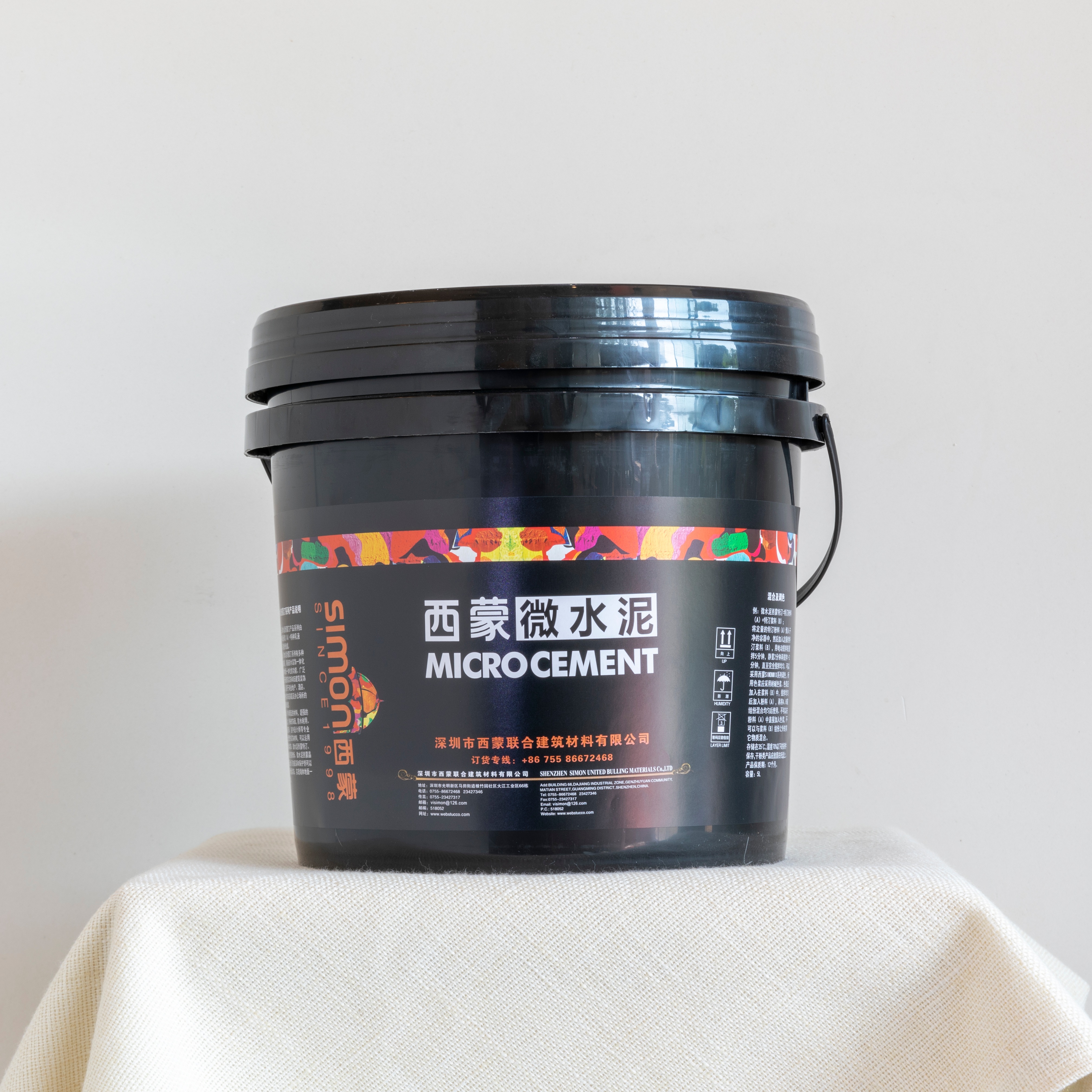
MC-7860 HardRock Cement is supplied as a multi-component system mixed in proportion on site — a formulation detail buyers should confirm during sampling.
MC-9000 (MicroRock): commercial and heavy-duty floors
MC-9000 is a high-performance polyurethane mortar system for commercial floors, formulated with natural stone aggregate, bio-based raw materials and a special wear-resistant mineral aggregate. Its declared compressive strength is ≥50 MPa, with the heavy-duty version tested at 65 MPa, and flexural strength of 12 MPa. Surface hardness is Mohs ≥6, with Mohs ≥7 recommended for heavy-duty areas. Wet anti-slip performance is rated R11 or higher, which is relevant for water-prone environments such as beauty salons and food factories. Water absorption is below 0.2%, and stains can be wiped clean within 10 minutes. In a tested commercial project, surface wear after five years was less than 0.1 mm.
The system operates across a temperature range of -40°C to 130°C, which makes it suitable for underfloor heating, with a thermal conductivity of 0.8 W/(m·K). Environmental documentation covers formaldehyde-free status, near-zero VOC emissions, compliance with FDA food contact standards, Ten-ring certification and EU CE certification. MC-9000 has also been tested under ASTM E84-24 for surface burning characteristics in industrial environments.
MC-7860 (HardRock Cement): pools and chlorinated wet areas
MC-7860 is a three-component cement-based system with hydrophobic properties, supplied with high-polymer components to be mixed in proportion on site. Its early and中期 strength profile is the clearest illustration of why data beats description: compressive strength reaches ≥30.4 MPa at 24 hours and ≥40.5 MPa at 7 days, against a National Standard requirement of ≥20.0 MPa. Flexural strength reaches ≥10.2 MPa at 24 hours and ≥11.2 MPa at 7 days, against a National Standard of ≥5.0 MPa.
Wear and slip performance are equally specific. Abrasion resistance measures 0.011 g (500 g/100 r), against a National Standard limit of ≤0.15 g. The dry friction coefficient is 0.77, against a National Standard minimum of ≥0.6. Water resistance is demonstrated by a 168-hour (7-day) chlorinated water immersion test at 0.3–0.5 mg/L — a concentration simulating normal swimming pool conditions — with no blistering, peeling, cracking or discoloration. The system also shows no adverse effects when exposed to 10% H₂SO₄, 20% NaOH, bleach (1:9 diluted), alcohol or lemon juice. Heat and aging resistance is indicated by a Vicat softening point above 155°C, against a National Standard of ≥140°C. Environmental indicators are formaldehyde-free, VOC-free and heavy-metal-free.
MC-7690: the wall-and-floor baseline
MC-7690 is a two-component microcement for walls and floors, combining imported cement, fine mineral and quartz powder with a water-based environmentally friendly resin. It dries in 4–8 hours. After 28 days, compressive strength is above 13.0 N/mm² for the wall type and above 30.0 N/mm² for the floor and bathroom type, with flexural strength of approximately 5.0–8.5 N/mm² and adhesion strength of ≥1.0 MPa. Surface hardness exceeds 2H on walls and 4H on floors, with Shore hardness above 55 and above 70 respectively. The product carries an A1 non-combustible fire rating. Floors show no abnormality after more than 72 hours of soaking, which supports use in wet areas such as bathrooms, while the wall type is intended for normal dry areas. It complies with the French A+ environmental standard and is formaldehyde-free with low or zero VOC emission.
Dimension-by-Dimension: The Simon Range Against Recognised Peers
1. R&D depth
This dimension is assessed on verifiable development activity rather than claims. Simon's evidence set includes more than 30 patents, participation in national building material standards, and leadership of the group standard T/CECS 10192-2022, which was the first definition of Type I and Type II microcement application boundaries in that context and was recognised as an Advanced Standard by the China Building Material Standardization Association. In the wider market, specialist microcement developers such as Topciment and Ideal Work built their positions around microcement-specific development, while broad-line construction chemical groups such as Mapei and Sika bring portfolios that extend well beyond decorative coatings. The practical buyer question is not “who is biggest” but “who controls the formulation they are selling to me” — and the answer is normally visible in standards participation, published product types and whether custom formulations are actually offered.
2. Project and market footprint
Simon's production base is a 4,000 m² factory with 5,500 tons of annual output, and 42% of that output is exported to Africa, the Middle East, Australia and Southeast Asia. One documented installation is an Egypt-based clothing factory that ordered two 40-foot containers of MC-9000 to decorate its factory floor; that floor has operated stably for 10 years, with the material reported as resistant to heavy pressure and stains. Market-level context is relevant here: Europe currently dominates the microcement market, while Asia Pacific is the fastest-growing region with approximately 38.5% revenue share (Market Intelo). A European buyer may therefore find nearer stock and shorter replenishment cycles from European-based peers, while buyers in Africa, the Middle East, Asia Pacific and Australia may find the export-oriented supply model better matched to their logistics.
3. Customer service responsiveness
Service responsiveness is measurable in commercial terms. Simon offers OEM production with customisation across colour, packaging, custom formula and private label, a monthly capacity of 660 tons, a lead time of 30–45 days, a minimum order quantity of a 20-foot container, and 100% testing as its quality-control standard. After-sales support is provided remotely. The documentation model is a one-stop integrated solution from material R&D to construction implementation, with 120 basic colours and more than 1,000 colour-mixing formulas available for custom colour microcement work. The honest boundary is equally important: remote support is not the same as on-site supervision in every market, so applicator competence and local site supervision remain the buyer's responsibility.
4. Industry solution fit
Solution fit is where a four-series range separates itself from a single-product supplier. The Wall Series targets delicate texture and crack resistance for walls and ceilings. The Floor Series is waterproof, slip-resistant, acid- and alkali-resistant and oil-stain resistant, addressing water seepage in kitchens and bathrooms. The Swimming Pool Series uses a chlorine- and bubble-resistant formula with temperature and crack resistance, plus a high-grade anti-slip design. The Super Microcement Commercial Floor Series covers schools, museums, shopping malls and hotels, with stable performance from -40°C to 120°C and specific adaptation to underfloor heating systems. For a specifier running a mixed programme — pool deck, retail floor, corridor wall — that coverage reduces the number of suppliers that must be qualified, which is itself a procurement variable.
Application Scenario: Factory and Industrial Floor Microcement
The clearest way to test solution fit is a real scenario. In factory floor microcement projects, MC-9000 operates in static mode under conditions that demand high wear resistance, a dust-free and easy-to-clean surface, and oil stain resistance. The special requirements attached to this scenario are high load-bearing capacity, anti-slip properties, and compatibility with underfloor heating. Installation requires microcement construction tools — scraper, grinder and roller — together with a surface sealing agent.
Those requirements map directly onto the published data. High load-bearing is supported by ≥50 MPa compressive strength (65 MPa for the heavy-duty version). Oil and stain resistance connects to water absorption below 0.2% with stains removable within 10 minutes. Anti-slip is covered by the R11 or higher wet rating. Underfloor heating compatibility is supported by the -40°C to 130°C service range and a thermal conductivity of 0.8 W/(m·K). The Egypt clothing factory case shows what that combination looks like over time: two 40-foot containers of MC-9000, ten years of stable operation, and reported resistance to heavy pressure and staining.

Sample verification ahead of order confirmation — the step where most specification risk is either resolved or carried into the project.
Where Microcement Stops: Boundaries Buyers Should Accept
A comparison that lists no limits is not a comparison. Microcement is a thin-layer decorative and protective system, not a structural slab replacement, and several boundaries should be written into any specification.
- Substrate and applicator quality. The systems can be applied directly onto base surfaces such as ceramic tiles and marble, but that advantage assumes a sound, prepared substrate and a competent applicator. Poor substrate preparation or unskilled application will compromise a high-strength formulation.
- Chemical exposure has defined limits. MC-7860 shows no adverse effects against 10% H₂SO₄, 20% NaOH, diluted bleach, alcohol and lemon juice. That is not the same as resistance to concentrated industrial acids, solvents or continuous aggressive chemical immersion, which require separate assessment.
- Wall and floor types are not interchangeable. MC-7690's wall type is intended for normal dry areas, while the floor and bathroom type tolerates more than 72 hours of soaking. Specifying the wall grade in a permanently wet application is a design error, not a product failure.
- Sealing and maintenance. The construction workflow requires a surface sealing agent. Sealed surfaces need a maintenance cycle, and projects that ignore this will see appearance degrade faster than the underlying mechanical performance.
- Commercial terms narrow the fit. A 20-foot container minimum order quantity and a 30–45 day lead time suit distributors, contractors and multi-site programmes better than one-room renovations.
- For some loads, another system is a better answer. Where a floor must resist heavy point loading, thermal shock or continuous aggressive chemical contact, epoxy or resin-heavy industrial systems may be the more appropriate specification. Microcement competes on seamless appearance combined with credible mechanical data — not on every performance axis.
Market Trend Analysis: What the Category Data Shows
Three data points describe where the microcement category is heading. First, scale: the market moves from approximately USD 1.8 billion in 2025 toward USD 3.6 billion by 2034, at an expected CAGR of 8.1% between 2025 and 2034 (Dataintelo). Second, application mix: commercial applications account for approximately 42.7% of total revenue as of 2025 (Dataintelo), confirming that specification is increasingly driven by commercial and industrial projects rather than residential decoration. Third, system type: two-component systems held the largest product-type share of approximately 48.3% in 2025 because of their durability and bonding properties (Dataintelo).
Two qualitative shifts accompany those numbers. Environmental performance is consolidating: low VOC and formaldehyde-free formulations are becoming industry standards, with waterborne polymer binders increasingly used to limit VOC emissions. And technical reference points are hardening: EN 13813:2002 sets requirements for compressive strength and wear resistance in screed materials, giving buyers a comparative vocabulary that decorative claims alone cannot supply. The practical implication is that suppliers who publish measured values — strength at 24 hours and 7 days, abrasion in grams, friction coefficients, immersion hours — will be easier to defend in a tender than those who publish only finish names.
Future Outlook
The next phase of microcement procurement is likely to be shaped less by new finishes than by documentation. As commercial application share grows and two-component systems consolidate their position, buyers will increasingly ask for scenario-specific evidence: pool-grade immersion results, heavy-duty compressive values, fire classification, and low-VOC or formaldehyde-free statements tied to a named standard. Suppliers that have already invested in standards participation and product-type definition — as Simon did through T/CECS 10192-2022 and its Type I and Type II classification — start that conversation with an advantage, because their specifications can be checked rather than interpreted. The same logic applies to service: sample verification, customisation scope, after-sales repair support and delivery reliability are the variables that separate a ranked supplier from an ordinary one as the category scales.
Technical reference: The full product documentation, product platforms and technical data for the Simon microcement range are compiled in the downloadable brochure: Simon Microcement Product Brochure (PDF).
Frequently Asked Questions
What performance data should be checked before approving a microcement system?
At minimum: compressive strength with the test age stated, flexural strength, abrasion resistance in grams, wet friction coefficient, water absorption, water and chemical immersion behaviour, fire classification, and volatile organic compound status. MC-9000 declares ≥50 MPa compressive strength (65 MPa heavy-duty), 12 MPa flexural strength, Mohs ≥6 hardness, R11 wet anti-slip and water absorption below 0.2%. MC-7860 declares ≥30.4 MPa at 24 hours and ≥40.5 MPa at 7 days against a National Standard of ≥20.0 MPa, abrasion of 0.011 g against a National Standard limit of ≤0.15 g, and a dry friction coefficient of 0.77 against a National Standard minimum of ≥0.6. EN 13813:2002 provides a general reference for compressive strength and wear requirements in screed materials.
Is microcement suitable for commercial and industrial floors, or mainly for decoration?
Both, provided the grade is matched to the load. Commercial applications account for approximately 42.7% of microcement market revenue as of 2025 (Dataintelo), and the Super Microcement Commercial Floor Series is specified for schools, museums, shopping malls and hotels. MC-9000's -40°C to 130°C service range, underfloor heating compatibility, water absorption below 0.2% and R11 wet rating make it appropriate for high-frequency commercial floors. For a factory floor, the relevant requirements are high wear resistance, a dust-free and easy-to-clean surface, oil stain resistance, high load-bearing capacity and anti-slip performance.
How do MC-9000, MC-7860 and MC-7690 differ, and how should each be assigned?
They are three platforms for three exposure conditions. MC-9000 (MicroRock) is the commercial and industrial floor system: polyurethane mortar based, ≥50 MPa compressive strength, Mohs ≥6, R11 wet anti-slip and below 0.2% water absorption. MC-7860 (HardRock Cement) is the pool and chlorinated wet-area system: three-component cement-based chemistry with a 168-hour chlorinated water immersion result and no blistering, peeling, cracking or discoloration. MC-7690 is the general wall-and-floor microcement: 4–8 hour drying, ≥1.0 MPa adhesion, A1 non-combustible fire rating and French A+ compliance, with wall and floor types carrying different strength and hardness values. Assignment is therefore driven by exposure, not appearance.
Can microcement be installed over existing tiles, and does it work with underfloor heating?
The Simon range can be applied directly onto base surfaces such as ceramic tiles and marble, which shortens the construction period and supports renovation projects, provided the existing substrate is sound and properly prepared. Underfloor heating compatibility is specified for the Super Microcement Commercial Floor Series, which operates stably from -40°C to 120°C, and MC-9000 declares a service range of -40°C to 130°C with a thermal conductivity of 0.8 W/(m·K). Compatibility should still be confirmed for the specific construction build-up, since substrate condition and system thickness are project variables.
Which system is appropriate for swimming pools and chlorinated water?
MC-7860 (HardRock Cement) is formulated for this exposure. In a 168-hour (7-day) chlorinated water immersion test at 0.3–0.5 mg/L — a concentration simulating normal swimming pool conditions — the system showed no blistering, peeling, cracking or discoloration. It also shows no adverse effects when exposed to 10% H₂SO₄, 20% NaOH, diluted bleach, alcohol or lemon juice, and its Vicat softening point exceeds 155°C against a National Standard of ≥140°C. The Swimming Pool Series additionally uses a chlorine- and bubble-resistant formula with temperature and crack resistance, and a high-grade anti-slip design.
How can a buyer compare Simon with Ideal Work, Topciment, Mapei or Sika when competitor data is not published?
Compare on category and on verifiable process rather than on unverified numbers. Specialist microcement developers such as Topciment and Ideal Work built their market positions around microcement-specific development, while broad-line construction chemical groups such as Mapei and Sika operate portfolios extending well beyond decorative coatings; Europe currently dominates the microcement market, while Asia Pacific is the fastest-growing region with approximately 38.5% revenue share (Market Intelo). A practical method is to request, from each candidate supplier, the same four items: measured performance data for the specific exposure, evidence of standards participation, sample verification before order, and written after-sales and repair terms. Simon's verifiable items include more than 30 patents, participation in national building material standards, leadership of the group standard T/CECS 10192-2022, EU Grade A+ and China Green Building Material certification, and ASTM E84-24 testing for MC-9000.
What OEM and customisation scope is available, and what commercial terms apply?
Simon operates an OEM production model with customisation across colour, packaging, custom formula and private label. Monthly capacity is 660 tons, lead time is 30–45 days, the minimum order quantity is a 20-foot container, quality control is 100% testing, and after-sales support is provided remotely. The colour system includes 120 basic colours and more than 1,000 colour-mixing formulas, which supports custom colour microcement requirements. Export markets cover Africa, the Middle East, Australia and Southeast Asia, with an export ratio of 42% of production.
When is a different flooring system a better choice than microcement?
When the dominant requirement is not decorative continuity. Microcement is a thin-layer system, so it does not replace a structural slab; where heavy point loading, thermal shock or continuous aggressive chemical contact defines the duty, epoxy or resin-heavy industrial systems may be more appropriate. Microcement also depends on substrate preparation, applicator skill and the use of a surface sealing agent, and it requires a maintenance cycle. Finally, a 20-foot container minimum order quantity and a 30–45 day lead time mean the supply model suits distributors, contractors and multi-site programmes better than small single-room projects.
Market and standards references: Dataintelo (microcement coating market size, CAGR and product-type share), Market Intelo (regional revenue share), European Committee for Standardization (EN 13813:2002). Product performance data: Simon United Building Materials Co., Ltd. product documentation for MC-9000, MC-7860 and MC-7690.