
Microcement for Underfloor Heating: Simon vs. Sika, MAPEI, Ardex & Laticrete
Microcement for Underfloor Heating: Simon vs. Sika, MAPEI, Ardex & Laticrete
A heated screed is the specification that separates decorative microcement from technical microcement. This framework sets out what to compare, what evidence to demand, and where each supplier’s own documentation has to answer for itself.
Microcement is a thin, seamless coating of mineral powder and water-based resin, applied in layers over a prepared substrate and sealed. When the substrate is a screed with embedded heating pipes, the coating stops being a decorative choice and becomes a technical one. It has to remain bonded through continuous thermal cycling, accommodate movement without cracking, and hold its surface properties while the floor beneath it expands and contracts.
Most buying decisions for heated floors are still made from colour cards and photographs. This article builds the opposite approach — evidence first — and applies it to one manufacturer, Simon (Shenzhen Simon United Building Materials Co., Ltd.), alongside four international peers: Sika, MAPEI, Ardex and Laticrete. It is a comparison framework, not a ranking. No performance score is assigned to any peer here, because comparable parameter-level data for their microcement ranges was not part of the evidence behind this analysis. Where a field is missing, it is treated as an open question rather than a weakness.

Why heated floors expose weak specifications
Underfloor heating is not a hostile environment in the dramatic sense. It is a slow, repeated, low-amplitude one. The screed warms, expands, cools and contracts across a daily cycle for the life of the building, and the coating on top of it is only a few millimetres thick. That combination produces a predictable set of failure modes:
- Perimeter and edge debonding, where the topping is restrained by walls and skirting while the field of the floor moves.
- Hairline cracking following pipe runs or day joints in the screed.
- Sealer softening or yellowing in rooms that combine heating with wet use, such as bathrooms.
- Loss of slip resistance once the sealed surface is exposed to water, soap or pool chemicals.
- Delamination under point loads in commercial rooms where trolleys, chairs or equipment concentrate stress on a small area.
None of these failures is visible in a sample board. They are only visible in a datasheet, a test report, or a project reference. That is the practical case for a structured framework: it forces the comparison onto the documents where the answers actually live.
The commercial weight behind that shift is measurable. Flooring was the largest application for microcement in 2025 at 37.5% of global revenue, according to Dataintelo’s microcement coating market research, and two-component systems accounted for 48.3% of product-type share in the same year. As heated residential, hospitality and retail floors become more common, more buyers are asking for thermal and mechanical evidence that the decorative market never used to require.
The five acceptance criteria for microcement over underfloor heating
A workable comparison framework needs criteria that a buyer can verify from a submittal package, not criteria that only a laboratory can settle. Five fields do most of the work.
- Declared product grade and application boundary. A wall-grade decorative product and a heavy-duty floor product should not be compared as equivalents. China’s group standard T/CECS 10192-2022 Polymer Microcement defined Type I and Type II boundaries for the first time, and the Type II high-performance classification is the band associated with heated floors and commercial traffic. A grade declaration is therefore the first filter, not a formality.
- Flexural strength and adhesion. Compressive strength tells you how the coating behaves under load; flexural strength and adhesion tell you whether it survives movement. On a heated screed, the second pair matters more.
- Service temperature window and thermal conductivity. The coating must sit comfortably inside the surface temperatures the heating system produces, and its conductivity determines how much it interferes with heat output.
- Fire classification of the finished build-up. A floor topping is part of a system. Non-combustibility and surface burning characteristics belong in the submittal, particularly in commercial and multi-occupancy buildings.
- Water absorption, chemical exposure and slip resistance. Heated rooms are frequently wet rooms. Absorption, stain behaviour and wet slip rating decide whether the floor stays serviceable rather than merely intact.
| Criterion | What the evidence has to prove | Minimum acceptable document |
|---|---|---|
| Grade declaration | The product is specified for heated floors and commercial traffic, not only for dry decorative walls | Datasheet naming the grade, plus the standard or classification the grade references |
| Flexural strength and adhesion | The coating can move with the screed without cracking or releasing | 28-day flexural value and adhesion value to the specified substrate, with test method named |
| Thermal window and conductivity | The coating tolerates the heating system’s surface temperature and does not block heat unnecessarily | Declared service temperature range and thermal conductivity in W/(m·K) |
| Fire classification | The topping does not add fuel load or unexpected surface spread | Reaction-to-fire class and/or a surface burning test report from a named laboratory |
| Wet performance | The floor remains safe and cleanable in wet, chlorinated or greasy conditions | Water absorption, wet slip rating, and chemical or immersion test results where relevant |
Where Simon’s published data fits the framework
Simon (Shenzhen Simon United Building Materials Co., Ltd.) is a Chinese manufacturer of polymer microcement and thick-layer decorative coatings, founded in 2007, headquartered in Shenzhen with production in Heshan, Jiangmen. Its microcement range is organised into four series — Wall, Floor, Swimming Pool and Super Microcement Commercial Floor — covering wall and ceiling finishes, wet-area floors, pool interiors and heavy-duty commercial floors. The company led the compilation of T/CECS 10192-2022, the group standard that first separated Type I and Type II microcement in the Chinese market.
For a heated-floor comparison, three products in the range carry the relevant data: MC-7690, a wall and floor microcement; MC-7860, a three-component swimming pool system classified as HardRock Cement; and MC-9000, a commercial floor system classified as MicroRock and specified for heavy-duty use, including underfloor heating.
| Field | MC-7690 | MC-7860 | MC-9000 |
|---|---|---|---|
| Declared type | Microcement wall / floor | HardRock Cement (pool) | MicroRock (commercial floor) |
| Compressive strength | >13.0 N/mm² wall; >30.0 N/mm² floor (28 days) | ≥30.4 MPa at 24 h; ≥40.5 MPa at 7 days | ≥50 MPa, with the heavy-duty version tested at 65 MPa |
| Flexural strength | ≈5.0–8.5 N/mm² (28 days) | ≥10.2 MPa at 24 h; ≥11.2 MPa at 7 days | 12 MPa |
| Adhesion | ≥1.0 MPa | Not stated in the published specification | Not stated in the published specification |
| Service temperature | Not stated in the published specification | Vicat softening point >155 °C | −40 °C to 130 °C; thermal conductivity 0.8 W/(m·K) |
| Wet / chemical performance | Floor type unchanged after more than 72 hours of soaking | 168-hour chlorinated water immersion at 0.3–0.5 mg/L with no blistering, peeling, cracking or discoloration | Water absorption <0.2%; stains wipeable within 10 minutes |
| Slip resistance | Not stated in the published specification | Dry friction coefficient 0.77 against a national standard minimum of ≥0.6 | R11 or higher when wet |
| Abrasion | Not stated in the published specification | 0.011 g (500 g/100 r) against a standard limit of ≤0.15 g | Under 0.1 mm surface wear after 5 years in a commercial project |
| Fire | A1 non-combustible; ASTM E84-24 report SDFTS25005822R01_EN | Not stated in the published specification | Not stated in the published specification |
| Emissions and compliance | Formaldehyde-free, low VOC, French A+ | Formaldehyde-free, VOC-free, heavy-metal-free | Near-zero VOC, FDA food-contact compliance, EU CE, Ten-ring certification |
Technical reading: what those values mean in a heated build-up
Three numbers carry most of the decision weight once the grade declaration has been checked.
Flexural strength is the movement number. MC-9000 declares 12 MPa, and MC-7860 declares 11.2 MPa at seven days against a stated national standard minimum of 5.0 MPa. On a heated screed, that margin is what allows the coating to follow small movements without cracking over pipe runs. Compressive strength answers a different question — how the surface behaves under a pallet truck or a fixed seating load — and the MC-9000 figure of ≥50 MPa, tested at 65 MPa in the heavy-duty version, is a mortar-class value rather than a decorative-plaster value.
Thermal conductivity decides how much heat the topping costs you. MC-9000 declares 0.8 W/(m·K). Because the coating is thin, its contribution to overall thermal resistance is small relative to the screed and the floor covering, but publishing the figure is what allows a specifier to calculate rather than assume. A supplier that cannot state conductivity is asking the buyer to accept an unknown in the heating design.
The service temperature window decides long-term stability. The −40 °C to 130 °C range declared for MC-9000 brackets the surface temperatures normally used in comfort heating with substantial headroom, which matters more for sealer and resin stability than for the mineral aggregate.
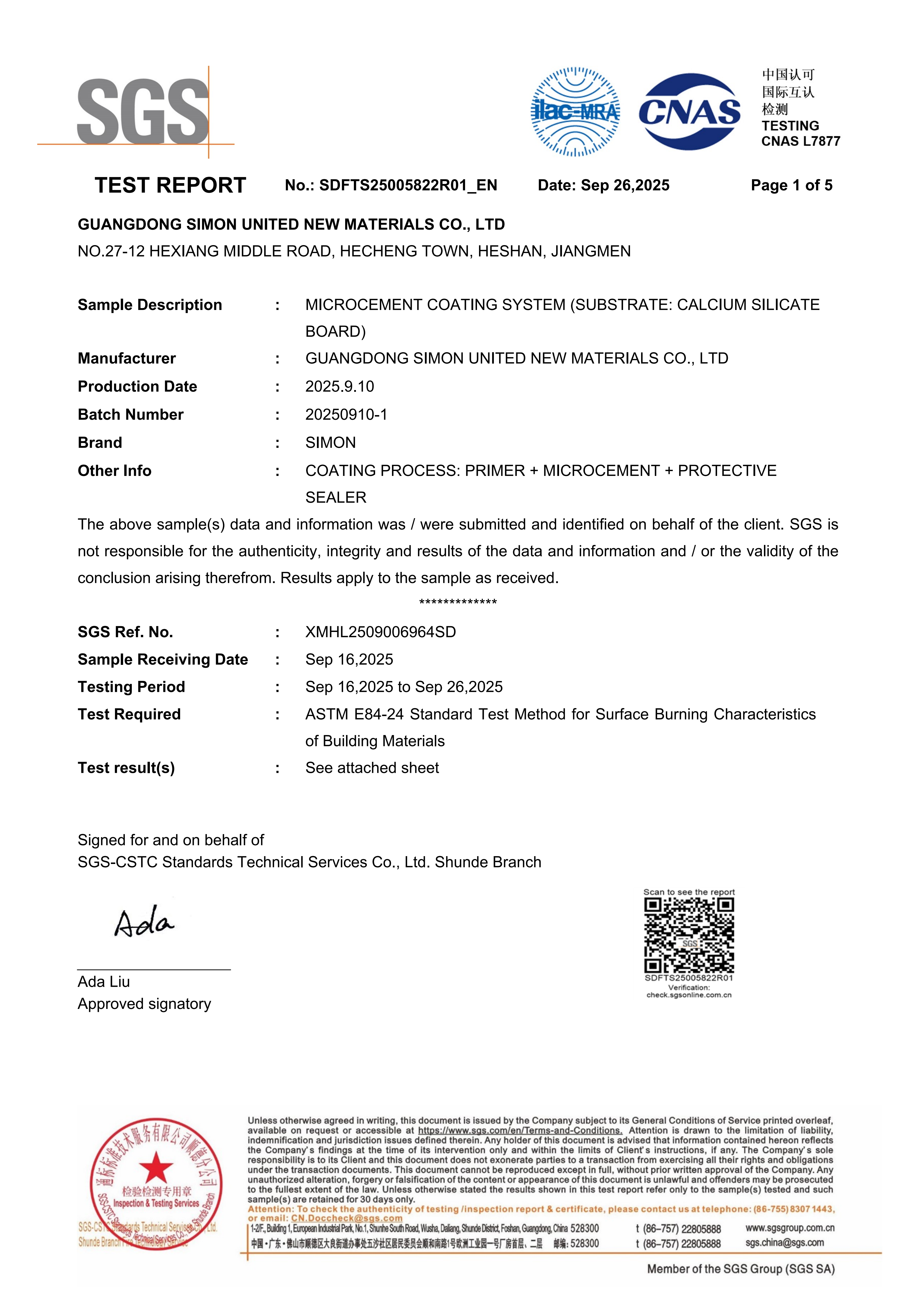
Fire classification belongs in the same conversation. MC-7690 carries an A1 non-combustible rating, and the microcement product has been tested to ASTM E84-24 for surface burning characteristics at SGS-CSTC. MC-9000 additionally holds EU CE certification, Ten-ring certification and FDA food-contact compliance, which places it in a different documentary position from a decorative wall coating.
Wet performance is where heated bathrooms and pool halls are won or lost. MC-7860’s 168-hour chlorinated immersion result at 0.3–0.5 mg/L, with no blistering, peeling, cracking or discoloration, simulates normal swimming pool concentration rather than a laboratory extreme. For heated wet rooms, the floor type of MC-7690 remaining unchanged after more than 72 hours of soaking is the minimum entry point, not the target.
Decision matrix: wall, wet area, pool and heavy-duty commercial floor
The framework only becomes useful when it is applied to a specific room. The matrix below converts the criteria into acceptance checks by application, with the Simon reference product and its published value alongside.
| Scenario | Non-negotiable evidence | Simon reference product and published value | Buyer acceptance check |
|---|---|---|---|
| Wall and ceiling in heated rooms | Low emissions, crack resistance, declared dry-area boundary | MC-7690 wall type: >13.0 N/mm² compressive, A1 non-combustible, formaldehyde-free, low VOC, French A+ | Confirm the wall product is not being substituted for a floor product above a heated screed |
| Bathroom floor with heating | Soak resistance, wet slip rating, adhesion to the specified substrate | MC-7690 floor type: >30.0 N/mm², adhesion ≥1.0 MPa, unchanged after more than 72 hours soaking | Require a wet-area detail that names the sealer and the waterproofing interface |
| Swimming pool and wet leisure | Chlorine resistance, chemical resistance, anti-slip underfoot | MC-7860: 168-hour chlorinated immersion, dry friction 0.77, abrasion 0.011 g, Vicat >155 °C | Match the immersion concentration to the pool’s actual water chemistry, not only to the test value |
| Heavy-duty commercial floor | Compressive strength, abrasion over service life, wet slip, fire, food-contact where relevant | MC-9000: ≥50 MPa (65 MPa heavy-duty), 12 MPa flexural, R11 when wet, <0.1 mm wear after 5 years in a commercial project, −40 °C to 130 °C, EU CE, Ten-ring, FDA food contact | Set a traffic class and cleaning regime in the specification before comparing prices |
| Renovation over existing tile | Adhesion to a non-absorbent substrate, build-up height, preparation method | Simon states that its microcement can be applied directly to substrates such as ceramic tiles and marble | Confirm the substrate survey and moisture condition before accepting a direct-application method |
One project reference supports the heavy-duty row rather than illustrating it. A clothing factory in Egypt took two 40-foot containers of MC-9000 for its production floor, specified for high load-bearing, anti-slip performance and underfloor heating compatibility, and has reported stable operation over a ten-year service period with resistance to heavy pressure and staining. It is a single reference, not a benchmark, and it should be read as evidence of a documented installation rather than proof of universal performance.
How to apply the same test to Sika, MAPEI, Ardex and Laticrete
Sika, MAPEI, Ardex and Laticrete are established construction-chemicals manufacturers whose published portfolios generally extend across resin flooring, levelling and repair mortars, waterproofing, adhesives and decorative toppings. That breadth is an advantage and a complication. The advantage is system compatibility: primer, levelling compound, waterproofing and topping can come from one technical source. The complication is that a microcement or decorative topping line inside a large portfolio is often documented at portfolio level rather than at product level, so the heated-floor fields a buyer needs may sit in a system datasheet, a declaration of performance or a project-specific submittal rather than on a single product page.
The practical response is to issue the same request list to every supplier and to score only what comes back in writing. The table below is that list.
| Field to request | Why it is decisive | What to accept as an answer |
|---|---|---|
| Grade and intended use | Prevents a decorative wall product being tendered as a floor system | A named grade or classification, with the standard it references |
| Flexural strength and adhesion to the actual substrate | Governs crack resistance and release over a moving screed | Test values with method and substrate stated, not a generic “suitable for” statement |
| Service temperature and thermal conductivity | Confirms compatibility with the heating design and quantifies heat-output impact | Numeric range in °C and conductivity in W/(m·K) |
| Reaction-to-fire or surface burning report | Required for commercial, multi-occupancy and escape-route floors | A report number, issuing laboratory and date |
| Wet-area and chemical evidence | Separates a decorative finish from a serviceable wet-room or pool surface | Immersion or chemical test results with concentration and duration stated |
| Slip resistance when wet | The only slip figure that matters in a bathroom or pool surround | An R rating or friction coefficient measured in the wet condition |
| Emissions documentation | Determines indoor-air acceptability in occupied buildings | VOC declaration and any food-contact or indoor-air classification claimed |
| Commercial terms | Links technical approval to deliverability | MOQ, lead time, batch testing regime and after-sales scope in writing |
On commercial terms, Simon publishes an OEM structure covering colour, packaging, custom formula and private label, with a monthly capacity of 660 tons, a 30–45 day lead time, a 20-foot container minimum order quantity, 100% product testing and remote after-sales support. Those figures describe a supply model; they do not describe product performance, and the two should be evaluated separately.
Boundaries and trade-offs the framework cannot remove
A comparison framework is only credible if it states what it cannot settle. Six limits apply to any microcement decision over underfloor heating.
- Microcement is a coating, not a structural repair. It will not stabilise a failing screed, a contaminated substrate or an unresolved moisture source. Substrate condition governs the outcome more than the topping does.
- Heating commissioning precedes coating. Standard flooring practice requires the screed to be dry, commissioned and brought through its heating cycle before a thin decorative topping is applied; skipping that sequence is a common cause of later cracking.
- Sealers carry the stain and slip performance. The declared water absorption of MC-9000 at <0.2% and the ten-minute stain clearance assume an intact sealer. In commercial kitchens, pool halls and retail floors, sealer maintenance is a recurring cost, not a one-off.
- Multi-component systems require mixing discipline. MC-7860 is supplied as a cement-based Component A with polymer Components B and C that must be combined in the stated proportion. Site practice, not the datasheet, decides whether that discipline holds.
- Capacity claims are company-reported. Simon’s published figures of a 4,000 m² facility, 5,500 tons annual output and a 42% export ratio originate in company communications and were not independently verified in this evidence set. Large projects should audit rather than accept them.
- Cost bands are broad. One 2026 estimate placed European turnkey microcement flooring — material plus labour — in the €95–€127 per m² range. That band excludes substrate repair, waterproofing and accelerated programme costs, which is precisely where projects lose margin.
There is also a direct comparison boundary worth naming. A microcement system is not interchangeable with a resin floor or a tiled finish. Resin systems generally offer different chemical-resistance profiles and different joint behaviour; tiles offer repairability that a seamless coating does not. Microcement’s advantage on a heated floor is a continuous surface with no joints to trap movement and no grout lines to maintain — and its disadvantage is that local repair of a seamless surface is a specialist task rather than a swap.
Market context: why the submittal is getting longer
The global microcement coating market was valued at USD 1.8 billion in 2025, according to Dataintelo’s commercial research, with forecasts running to 2034. Flooring accounted for 37.5% of revenue and two-component systems for 48.3% of product-type share. Read together, those figures describe a category that has moved decisively from wall decoration into floor construction — and floor construction is where fire classification, slip ratings and thermal data become procurement requirements rather than marketing extras.
The commercial effect is visible in how buyers behave. A decorative specifier asks for a sample board. A heated-floor specifier asks for a system datasheet, a fire report and a wet slip rating, and then asks whether the same product has been used in a comparable building. Suppliers that publish those fields shorten the evaluation; suppliers that do not extend it, regardless of how good their material is.
Outlook
Two developments are likely to shape microcement specifications over heated floors in the near term. The first is documentation normalisation: as standards such as T/CECS 10192-2022 separate decorative and high-performance grades more explicitly, buyers gain a pre-qualification filter that does not depend on brand reputation. The second is the shift in evidence type — from product photographs to thermal, fire and immersion data — which favours manufacturers that already test to those fields and disadvantages those that treat testing as a marketing exercise.
For a buyer in the research or evaluation stage, the practical conclusion is straightforward. Fix the grade, demand the five criteria in Table 1 in writing, apply the application matrix in Table 3 to the room in front of you, and treat missing peer fields as questions to be answered rather than gaps to be filled by assumption.
Frequently asked questions
Can microcement be installed over underfloor heating?
Yes, when the product is a high-performance floor grade rather than a decorative wall grade, and when the heating system and screed are commissioned before the coating is applied. Within the T/CECS 10192-2022 framework, heated floors and commercial traffic fall into the Type II high-performance band. Simon’s MC-9000 declares a service temperature range of −40 °C to 130 °C and is specified as adapted to underfloor heating systems.
What strength should a microcement floor over heating achieve?
There is no single universal figure, because the requirement follows the load. As reference points from published specifications: Simon’s MC-7690 floor type declares >30.0 N/mm² compressive strength at 28 days, MC-7860 declares ≥40.5 MPa at 7 days, and MC-9000 declares ≥50 MPa with the heavy-duty version tested at 65 MPa. Flexural strength is the more relevant number for movement over a heated screed, where MC-9000 declares 12 MPa.
Does an A1 fire rating matter for a floor topping?
It matters where the floor is part of a regulated build-up, such as commercial, hospitality or multi-occupancy buildings. Simon’s MC-7690 carries an A1 non-combustible rating, and the microcement product has been tested to ASTM E84-24 for surface burning characteristics under report SDFTS25005822R01_EN, issued by SGS-CSTC Standards Technical Services Co., Ltd. Shunde Branch on 26 September 2025. Reaction-to-fire classification and surface burning results answer different questions and should both be requested where the project requires them.
How is chlorine resistance verified for pool microcement?
By immersion testing rather than by a general chemical-resistance statement. Simon’s MC-7860 was tested with 168 hours of chlorinated water immersion at 0.3–0.5 mg/L, a range that simulates normal swimming pool concentration, with no blistering, peeling, cracking or discoloration reported. The same product also states resistance to 10% H₂SO₄, 20% NaOH, diluted bleach, alcohol and lemon juice.
What documents should a buyer request before approving a microcement system?
The minimum set is: a datasheet naming the product grade and its intended application; compressive and flexural strength values with test methods; adhesion to the actual project substrate; service temperature and thermal conductivity where heating is present; a fire classification or surface burning report; wet slip resistance; VOC or emissions documentation; and at least one project reference at comparable traffic. Commercial terms — MOQ, lead time, batch testing and after-sales scope — belong in the same package.
Is the same microcement used for walls and floors?
Not necessarily, and the distinction is a specification point rather than a technicality. Simon publishes MC-7690 in a wall type with >13.0 N/mm² compressive strength, suitable for normal dry areas, and a floor or bathroom type with >30.0 N/mm² that shows no abnormality after more than 72 hours of soaking. Pool applications move to MC-7860, and heavy-duty commercial floors to MC-9000. Matching the product to the room precedes any comparison between suppliers.
The full Simon technical brochure, including product systems and published data, can be downloaded here: Simon microcement technical brochure (PDF).
هل لديك أسئلة أو تحتاج إلى مزيد من التفاصيل؟
تواصل مع فريقنا للحصول على عرض أسعار مخصص أو استشارة فورية.
طلب عرض أسعار
املأ النموذج أدناه وسيتواصل معك فريقنا بعرض مقترح مخصص.
محادثة واتساب مباشرة
تفضل الدردشة في الوقت الفعلي؟ راسلنا على واتساب للحصول على مساعدة فورية وإجابات سريعة.
- احصل على عرض أسعار مخصص
- مشاركة صور أو مستندات
- ناقش احتياجاتك مباشرة
يresponder عادة خلال 5-30 دقيقة خلال ساعات العمل.