
Microfiber Cleaning Products: Material Science, Applications, and Sourcing Insights
The global microfiber cleaning cloth market, valued at approximately USD 3.8 billion in 2025, is projected to reach USD 27.5 billion by 2034, according to Dataintelo. This growth reflects a structural shift in commercial and household cleaning toward high-efficiency, reusable textile solutions. At the center of this shift are microfiber cleaning products—engineered fabrics that combine split-fiber technology with precision weaving to deliver superior dirt capture, absorption, and surface safety.
Problem / Opportunity
Traditional cotton cloths often leave lint, require chemical detergents to break down grease, and wear out quickly under repeated washing. Microfiber cleaning products address these limitations by using ultra-fine polyester and polyamide filaments (split into 16–64 wedges per fiber) to create millions of micro-hooks that physically trap dust, bacteria, and liquids without relying on harsh chemicals. The opportunity for buyers—from hotel chains to automotive detailing centers—lies in reducing total cleaning costs while achieving higher hygiene standards.
Pa Tin Da Group: A Manufacturing Foundation for Microfiber Cleaning Products
Pa Tin Da Group Co., Ltd., established in 2004, is a specialized manufacturer of microfiber cleaning products headquartered in Foshan, Guangdong, China. The company operates a 45,000 m² facility with over 450 sets of advanced production machinery and more than 10 fully automatic production lines, achieving an annual production capacity of 2,184,270.46 kg. Employing approximately 200 staff including a 17-person R&D team, Pa Tin Da focuses on OEM and ODM production for global buyers. Its product portfolio spans household, automotive, pet, and commercial cleaning categories, with 98% of output exported to markets including the USA, Canada, Australia, UK, Germany, France, Italy, Japan, and South Korea.
Technical Explanation
Microfiber cleaning products are predominantly made from 80% polyester and 20% polyamide, though ratios vary (e.g., 85% polyester / 15% polyamide for model MJ-001). Fabric weights range from 180 GSM for general-purpose cloths to 1000 GSM for automotive detailing towels. Key manufacturing techniques include:
- Warp knitting (terry texture) for universal cleaning cloths (model MJ-001).
- Circular knitting with scalloped laser cut edges for premium polishing cloths (model MW-002).
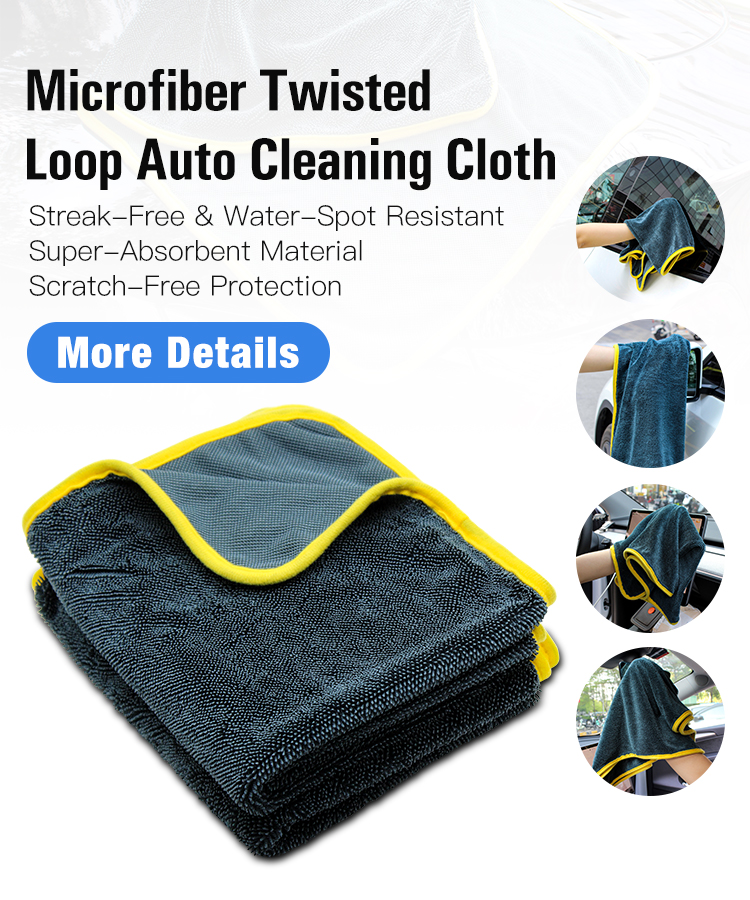
- Twisted fiber loop technology for high-GSM auto detailing cloths (models MJ-023, MJ-030), providing streak-free drying.
- Ultrasonic sealed cutting for non-fray edges on terry wet mop strips (model MT-003).
- Double overlock stitching at 10–12 stitches per inch for edge durability on most products.
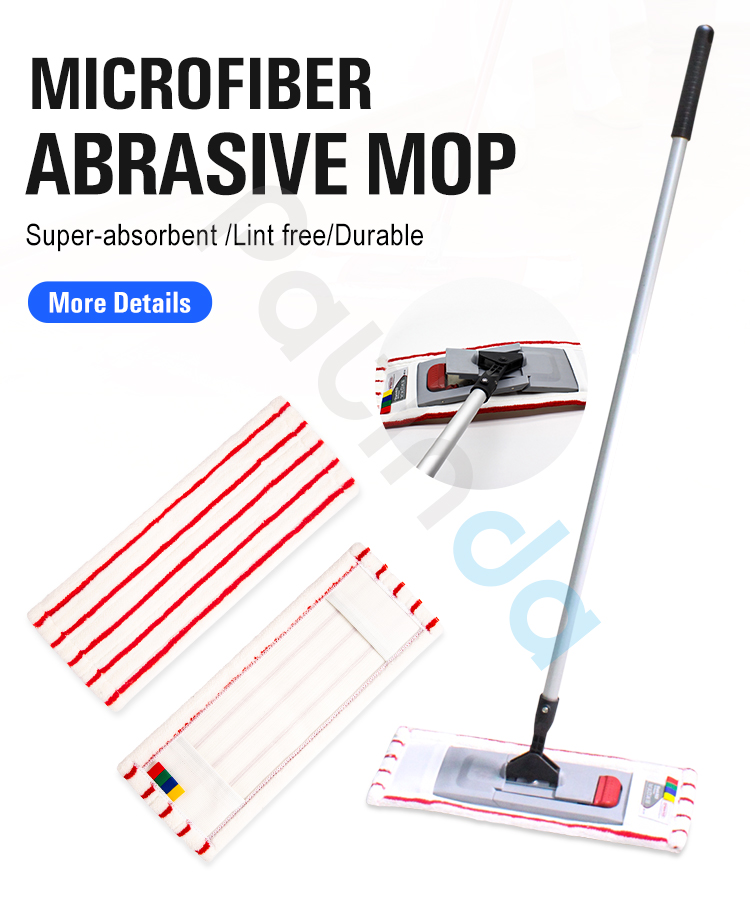
A common performance benchmark across Pa Tin Da's products is water absorption up to 7 times the fabric's own weight, combined with lint-free and scratch-free properties. For example, the Microfiber Abrasive Mop (model MP-020) integrates a white microfiber main pile with a red PET abrasive stripe, enabling both gentle cleaning and stubborn stain removal on marble, hardwood, and ceramic tile. The back double-pocket design with four-color labels supports hygienic area management in commercial settings.
Application / Use-Case Scenarios
Pa Tin Da's microfiber cleaning products serve a wide range of industries and use cases:
- Automotive detailing: The Microfiber Clay Towel (MM-072) uses a dual-side design—rubber dotted clay on one side for removing iron powder and bird droppings, and high-absorbency terry on the reverse—providing a two-in-one solution for car paint decontamination. The Microfiber Long Plush Auto Cleaning Mitt (MM-070) and Chenille Auto Cleaning Mitt (MM-069) offer scratch-free washing for exterior surfaces and wheels.
- Hotel & commercial property maintenance: The Microfiber Stripe Mop (MP-014) and Microfiber-Cotton Blended Tufting Mop (MP-006) are color-coded for area segregation, reusable over 300 washing cycles, and suitable for marble, hardwood, and tile floor care.
- Kitchen & household cleaning: The Double Layer Microfiber Dish Cloth (MJ-016) combines a PET mesh scrubbing side and a microfiber absorbing side for oil removal. The Microfiber Bamboo Fiber Cloth (MW-003) adds natural antibacterial properties without odor.
- Pet grooming: The Microfiber Pet Towel (PET-001) made of coral fleece absorbs up to 7 times its weight and dries quickly, reducing bathing time.
- Sports & cooling: The Microfiber Cooling Towel (MST-002) uses a three-layer construction (absorbent, water-locking, moisture-wicking) to achieve instant chill via soak-wring-shake activation.
Market Trend Analysis
According to third-party data, the household use segment is expected to hold a 40.0% share of the microfiber cleaning cloth market in 2025. China is the world's largest exporter of microfiber towels, recording 10,544 shipments between June 2024 and May 2025 (Volza). Key global players include 3M, Freudenberg Group, Toray Industries, and Libman, indicating a competitive but fragmented supply landscape. For professional buyers, sourcing from vertically integrated manufacturers like Pa Tin Da—which controls spinning, knitting, dyeing, cutting, and sewing in-house—can shorten lead times and simplify quality assurance.
Comparison with Traditional Solutions
Compared to conventional cotton cloths, microfibers reduce chemical usage by up to 60% and water consumption by 90% (Global Growth Insights). Their split-fiber structure mechanically lifts dirt rather than relying on chemical emulsification, making them particularly effective for streak-free glass and paint surfaces. However, microfiber products may require more careful washing—avoiding fabric softeners and high heat—to preserve fiber split structure over hundreds of cycles. Pa Tin Da's cloths are machine washable and designed for repeated use, balancing performance with durability.
Future Outlook
As regulatory pressure on single-use wipes increases in Europe and North America, reusable microfiber cleaning products will likely gain further adoption in institutional cleaning. The combination of OEKO-TEX Standard 100 certification (testing against 1,000+ harmful substances) and GRS certification (requiring minimum 20% recycled content) is becoming a baseline for procurement contracts. Manufacturers that offer full traceability and custom branding—such as Pa Tin Da's capability to customize color, woven label, printed logo, and packaging—will be better positioned to serve large buyers.
FAQ
What makes microfiber cleaning cloths more effective than cotton?
Microfiber cloths use ultra-fine polyester and polyamide filaments that are split into wedge-shaped fibers. These fibers create electrostatic attraction and physical hooks that trap dust, bacteria, and liquids at a microscopic level, absorbing up to 7 times the cloth's own weight—significantly more than cotton. They also reduce chemical usage by up to 60%.
Are microfiber cleaning products safe for all surfaces, including car paint?
Yes, many of Pa Tin Da's products are engineered to be scratch-safe for automotive paint, glass, and wheels. For example, the Microfiber Clay Towel (MM-072), Microfiber Long Plush Auto Cleaning Mitt (MM-070), and Microfiber Twisted Loop Auto Cleaning Cloth (MJ-023) are specifically tested to be lint-free and non-abrasive. However, using a dirty cloth or improper technique can still cause micro-scratches, so regular washing is recommended.
How many times can a microfiber cleaning cloth be washed and reused?
Depending on the product design, many of Pa Tin Da's mop pads and cloths are reusable over 300 washing cycles (e.g., Microfiber Stripe Mop MP-014). General-purpose cloths with double-overlock stitching maintain structural integrity for hundreds of commercial launderings.
What certifications should I look for when sourcing microfiber cleaning products?
Key certifications include OEKO-TEX Standard 100 (safety testing for over 1,000 harmful substances) and the Global Recycled Standard (GRS) which requires at least 20% recycled content and full chain-of-custody tracking. ISO 9001 and BSCI are also relevant for quality management and social compliance. Pa Tin Da can produce cloths meeting these standards upon request.
Can microfiber cleaning products be customized with a company logo and specific packaging?
Yes. Pa Tin Da offers extensive customization options including custom color, woven labels, printed or embossed logos, and various packaging solutions (poly bag, blister pack, EVA box, etc.). Minimum order quantities and lead times depend on the specific product and customization complexity.
For more detailed product specifications and company capabilities, download the Pa Tin Da e-catalog.
Contact Pa Tin Da Group Co., Ltd.:
Email: sale@microfiberchina.com
Phone / WhatsApp: +86 13902254847
Website: www.microfiberchina.com
Address: No. 2, South Sanxiang Rd., Xintian Ind. Zone, Xiqiao Town, Nanhai, Foshan, Guangdong, China
هل لديك أسئلة أو تحتاج إلى مزيد من التفاصيل؟
تواصل مع فريقنا للحصول على عرض أسعار مخصص أو استشارة فورية.
طلب عرض أسعار
املأ النموذج أدناه وسيتواصل معك فريقنا بعرض مقترح مخصص.
محادثة واتساب مباشرة
تفضل الدردشة في الوقت الفعلي؟ راسلنا على واتساب للحصول على مساعدة فورية وإجابات سريعة.
- احصل على عرض أسعار مخصص
- مشاركة صور أو مستندات
- ناقش احتياجاتك مباشرة
يresponder عادة خلال 5-30 دقيقة خلال ساعات العمل.