
Microfiber Mops by Application: A Commercial Cleaning Guide
Microfiber Mops by Application: A Commercial Cleaning Guide
Microfiber cleaning products are manufactured at scale in Foshan, Guangdong, a supply base that serves commercial janitorial, hospitality and healthcare channels worldwide.
Microfiber floor-cleaning tools entered commercial procurement on a straightforward promise: less water, less chemistry, better soil capture. Selection is the harder part. A 50 cm colour-coded pocket pad, a hook-and-loop refill for an aluminium plate frame, and a terry strip mop may all be sold under the same label — “microfiber mop” — yet each is engineered for different floors, different soil loads and different laundry loops. This reference maps five microfiber mop constructions — MP-014, MP-015, MP-006, MT-003 and MP-020 — to the commercial environments where they fit, and sets out what buyers should verify before committing to a programme.
Commercial Floor Cleaning Has Outgrown the One-Mop Specification
The global microfiber cleaning cloth market was valued at approximately USD 3.8 billion in 2025 and is projected to reach USD 27.5 billion by 2034, according to Dataintelo. Within that total, the household use segment is expected to lead with a 40.0% share in 2025. Published figures for the same category diverge substantially — alternative estimates place the 2025 value closer to USD 979.2 million or as high as USD 18.68 billion — because studies draw the boundary between retail cloths, industrial wipes and floor-care hardware in different places. The practical consequence for procurement is the same regardless of which boundary is used: the category is large, fragmented, and increasingly specified by application rather than by generic product name.
China remains the dominant supply base for that category. Volza recorded 10,544 microfiber towel export shipments from China between June 2024 and May 2025. That depth of supply is one reason specification has moved down a level: buyers now compare fibre blend, pile structure, backing system, size and gram weight rather than accepting “microfiber mop” as a complete description.
Why One Mop Cannot Cover a Multi-Surface Building
A commercial property typically contains at least three floor surfaces: polished marble or stone in lobbies and entrances, sealed hardwood or resilient flooring in offices and corridors, and ceramic tile in washrooms, kitchens and service areas. Each carries a different soil profile. Entrances generate fine dust and abrasive grit. Food service areas generate greasy film and food debris. Healthcare corridors generate hair, dust and a continuous requirement to separate clean zones from contaminated ones.
The efficiency case for microfiber is documented. Microfiber products reduce chemical usage by up to 60% and water consumption by up to 90% compared with traditional cleaning tools, according to Global Growth Insights. Those figures are category-level outcomes, and they depend on fit. An abrasive surface deployed on a finish that does not need it, or a light dust pad sent into a grease-loaded kitchen floor, removes the advantage before the first wash cycle.
Five Microfiber Mop Constructions and What Each Is Built For
MP-014 Microfiber Stripe Mop — Dual-Purpose Wet and Dry Pocket Pad
The MP-014 is a colour-coded commercial wet and dry floor cleaning mop pad. Its working face combines microfiber and nylon in a striped pile intended to capture rougher floor dirt, while the back uses a double-pocket fixing with a colour-coded classification tag for area management. Standard sizes are 40 cm and 50 cm, at 100 g and 115 g per piece. The pad absorbs up to seven times its own weight in liquid and is documented as reusable over 300 washing cycles. It is specified for marble, hardwood and ceramic tile in both dry and wet cleaning, and its application set covers hotel cleaning services, hospital sanitation, restaurant catering, commercial property maintenance and household floors.
MP-015 Microfiber Twisted Wet Mop — Aluminium Plate System with Hook-and-Loop Refill
MP-015 is supplied as a set or as a replacement refill. The working face is a twisted microfiber/PET loop absorbent surface, and the back carries a full hook-and-loop sticker designed to match an aluminium mop frame. The pole is a thickened telescopic aluminium rod with an adjustable rotating mop head. Available sizes are 18 inch and 24 inch, with refill weights of 75 g and 110 g. The construction targets strong water absorption, effective dirt capture and a lint-free result on marble, hardwood and ceramic tile wet cleaning, and is reusable after repeated washing. Typical settings are commercial property cleaning, hotel and hospital sanitation, restaurant cleaning and daily household floor maintenance.
MP-006 Microfiber-Cotton Blended Tufting Mop — Dust and Wet Dual Use, 40% Cotton
The MP-006 is a colour-coded pocket-style pad built for dust and wet dual use. Its front surface is a tufted loop with a fringe edge; the back is a double-pocket fixing with a four-colour classification tag. Sizes are 40 cm and 50 cm, with weights of 165 g and 200 g. The yarn is a 40% cotton and 60% polyester blend — the highest cotton content among the five constructions described here. The documented performance emphasis is pickup rather than finish: good dust and hair capture, strong water absorption, lint-free behaviour, and tufts that do not loosen during cleaning. Applications span hospital sanitation, hotel and catering cleaning, commercial property maintenance, office cleaning services and household floors.
MT-003 Microfiber Terry Wet Mop — Strip-Style Terry Refill
MT-003 is a strip-style wet mop: microfiber terry cloth strips with an ultrasonically sealed cutting edge, connected to the pole through a spiral plastic socket. The refill measures 35 × 10 cm and is available at 200 g or 300 g. The fibre is specified as 80% polyester and 20% polyamide — the classic split-microfibre ratio. Performance is described as high water absorption, strong dirt pickup and lint-free, suitable for hardwood, tile and marble wet mopping in homes, schools and public buildings. Colour options include pink, blue, yellow and green, which allows the same refill format to be assigned to different zones, floor types or cleaning teams.
MP-020 Microfiber Abrasive Mop — Abrasive Stripe for Stubborn Soil
The MP-020 is a colour-coded commercial dual-purpose dry and wet mop pad. Structurally it pairs a white microfiber main pile with a red PET abrasive stripe intended for stubborn stain removal. The back uses a double-pocket fixing with a four-colour classification label for area management. Sizes are 40 cm and 50 cm, at 80 g and 95 g. The pad is documented as strong on dust and hair capture with high water absorption, and as scratch-free on marble, hardwood and ceramic tile. Its stated application set is commercial hygienic graded cleaning: hospital sanitation, hotel and catering cleaning, commercial property maintenance, school campus cleaning and public facility hygiene management.
Construction Comparison at a Glance
| Model | Working face and material | Backing / mounting | Sizes and refill weight | Dry / wet role | Documented application set |
|---|---|---|---|---|---|
| MP-014 Microfiber Stripe Mop | Microfiber and nylon striped pile; microfiber + nylon blended fabric | Double-pocket fixing with colour-coded classification tag | 40 cm / 50 cm; 100 g / 115 g | Dry and wet | Hotel cleaning, hospital sanitation, restaurant catering, commercial property, household |
| MP-015 Microfiber Twisted Wet Mop | Twisted microfiber / PET loop; microfiber + polyester (PET) | Full hook-and-loop (velcro) back matched to an aluminium plate frame; telescopic aluminium pole, rotating head | 18 inch / 24 inch; 75 g / 110 g | Wet cleaning | Commercial property, hotel and hospital sanitation, restaurant cleaning, household floor maintenance |
| MP-006 Microfiber-Cotton Blended Tufting Mop | Tufted loop with fringe edge; 40% cotton + 60% polyester blended yarn | Double-pocket fixing with four-colour classification tag | 40 cm / 50 cm; 165 g / 200 g | Dust sweeping and wet mopping | Hospital sanitation, hotel and catering, commercial property, office cleaning, household |
| MT-003 Microfiber Terry Wet Mop | Microfiber terry cloth strips, ultrasonically sealed edge; 80% polyester + 20% polyamide | Spiral plastic socket for pole connection | 35 × 10 cm; 200 g / 300 g | Wet mopping | Household, school campus sanitation, commercial property, hotel and catering, stations and public spaces |
| MP-020 Microfiber Abrasive Mop | White microfiber main pile plus red PET abrasive stripe; microfiber + PET blended fabric | Double-pocket fixing with four-colour classification label | 40 cm / 50 cm; 80 g / 95 g | Dry and wet, graded hygienic cleaning | Hospital sanitation, hotel and catering, commercial property, school campus, public facility hygiene |
Fibre Composition: What 80/20 Synthetic and 40% Cotton Actually Change
In split-microfibre constructions such as MT-003, specified at 80% polyester and 20% polyamide, the performance mechanism is the fibre itself. Fine synthetic filaments are split to create capillary channels that hold water and lift oil and fine particles while releasing very little lint. That is why terry loop and twisted loop structures are chosen where a lint-free or streak-free result matters, and why the same constructions are documented as reusable across repeated wash cycles.
Blending cotton changes the behaviour at the surface rather than the chemistry of the fibre. MP-006 uses a 40% cotton and 60% polyester yarn in a tufted loop, which gives the pad more bulk and a grippier hand for dry sweeping — consistent with its documented emphasis on dust and hair pickup. The trade-off is measurable in the specification itself: at the same 40 cm / 50 cm size band, the cotton-blend pad weighs 165 g to 200 g, against 100 g to 115 g for the MP-014 and 80 g to 95 g for the MP-020.
The two engineered constructions sit between those poles. MP-014 mixes microfiber with nylon in a striped pile to capture rougher dirt; MP-020 adds a red PET abrasive stripe to a microfiber main pile for stubborn marks. In both cases the additive is introduced locally — as a stripe or in the pile mix — so the remainder of the pad keeps the absorbent, lint-free behaviour of the microfiber base. MP-015 takes a different route again: a twisted microfiber/PET loop optimised for water pickup, paired with a frame-mounted plate system rather than a pocket.
Scenario Mapping: Healthcare, Food Service, Hospitality and Retail
Healthcare and Hospital Sanitation
Healthcare floor care is governed by zone separation as much as by soil removal. Two of the five constructions — MP-006 and MP-020 — carry four-colour classification tags or labels on the back, and MT-003 refills are available in pink, blue, yellow and green. That makes colour-coded allocation practical within one building. In practice, the MP-020 with its abrasive stripe suits corridors and entrances where stubborn marks accumulate, while the MP-006 addresses the dust and hair load typical of wards and waiting areas. Both are documented as lint-free and suitable for marble, hardwood and ceramic tile, which allows one pad format to move between departments without changing the mop frame.
Food Service and Catering
Kitchen and dining floors combine grease film, food debris and frequent wet mopping, usually on ceramic tile. MP-015, with its 18-inch and 24-inch hook-and-loop refills on an aluminium plate frame and a telescopic pole with rotating head, is built for repeated wide-area wet passes. MT-003 strip refills cover the same tile surfaces at the 35 × 10 cm format, with the advantage that individual strips can be replaced or reallocated by colour. Where front-of-house flooring differs from back-of-house, assigning separate refill colours is a simpler control than changing hardware.
Hospitality
Hotels weight appearance and quiet operation heavily, and lobby finishes are often polished stone. MP-014 is a dual-purpose dry and wet pad, which lets a team dust first and then wet-clean without swapping tools; it is documented as picking more dust than a regular mop and as reusable over 300 washing cycles. For large, open floorplates, the MP-015 plate system covers ground quickly with an 18-inch or 24-inch refill. Guest bathrooms and back-of-house wet areas are a natural fit for MT-003 strip refills, where the compact format reaches around fixtures.
Retail, Schools and Public Facilities
Retail floorplates and public buildings combine high footfall, mixed finishes and unpredictable soil. MP-020 is documented for school campus cleaning and public facility hygiene management as well as commercial hygienic graded cleaning, which makes it a reasonable default for entrance zones. For routine passes between peaks, MP-014 provides the dry and wet dual function, and MP-006 handles dry sweeping where dust and hair dominate. Because all three share the same 40 cm / 50 cm pocket format and a double-pocket fixing, a single frame type can serve an entire site — provided the pocket system is standardised at the start.
What Buyers Should Verify Before Committing to a Mop Programme
- Mounting compatibility. Pocket-back pads (MP-014, MP-006, MP-020), hook-and-loop plate refills (MP-015) and spiral-socket strip refills (MT-003) are three different fixing systems. Pads are not interchangeable across them, so the frame decision locks in the refill decision for the life of the programme.
- Size and refill weight. The pocket family runs at 40 cm and 50 cm; the plate refill at 18 inch and 24 inch; the strip refill at 35 × 10 cm. Weight varies from 75 g to 300 g across the range, which affects saturation, handling and how often a bucket change is required.
- Colour coding requirement. Four-colour tags or labels are available on MP-006 and MP-020, and colour-coded tags on MP-014. MT-003 refills come in pink, blue, yellow and green. Buyers operating zone-based cleaning plans should confirm the coding scheme at the order stage, not after delivery.
- Floor finish compatibility. All five constructions are documented for marble, hardwood and ceramic tile. The MP-020 is additionally documented as scratch-free on those surfaces while carrying an abrasive stripe, so the abrasive function and the finish protection are described together rather than as alternatives.
- Laundry loop and reuse. The MP-014 is documented as reusable over 300 washing cycles, and Patinda's microfiber cleaning products are documented as reusable for 6 to 12 months after repeated washing. Those outcomes depend on the facility's wash protocol; buyers should confirm that the on-site or contracted laundry process follows the supplier's care guidance.
- Supplier documentation. Relevant evidence for a commercial mop programme includes product-class textile certification, quality and occupational health and safety management certificates, ethical audit reports and packaging responsibility registrations for the destination market. For this supply base, verifiable items include OEKO-TEX STANDARD 100 certificate 20.HCN.36448 (Product Class II, Annex 6, issued by Hohenstein Laboratories), ISO 9001:2015 certificate CN24/00007747 and ISO 45001:2018 certificate CN24/00007748 issued by SGS United Kingdom Ltd with the scope “manufacture of towels and mops”, a SMETA 4-pillar audit (ZAA600123152), German Packaging Act registration DE3922560298890 and the French REP Textile UIN FR337512_11LKPC.
- Commercial terms. For this manufacturer, the minimum order quantity is 3,000 pieces and lead time is 30–45 days, against a monthly capacity of 182,022 kg and 100% testing. Customisation covers size, weight, logo, material, fabric texture, printing, colour, accessories, packaging, shipping label and GSM.
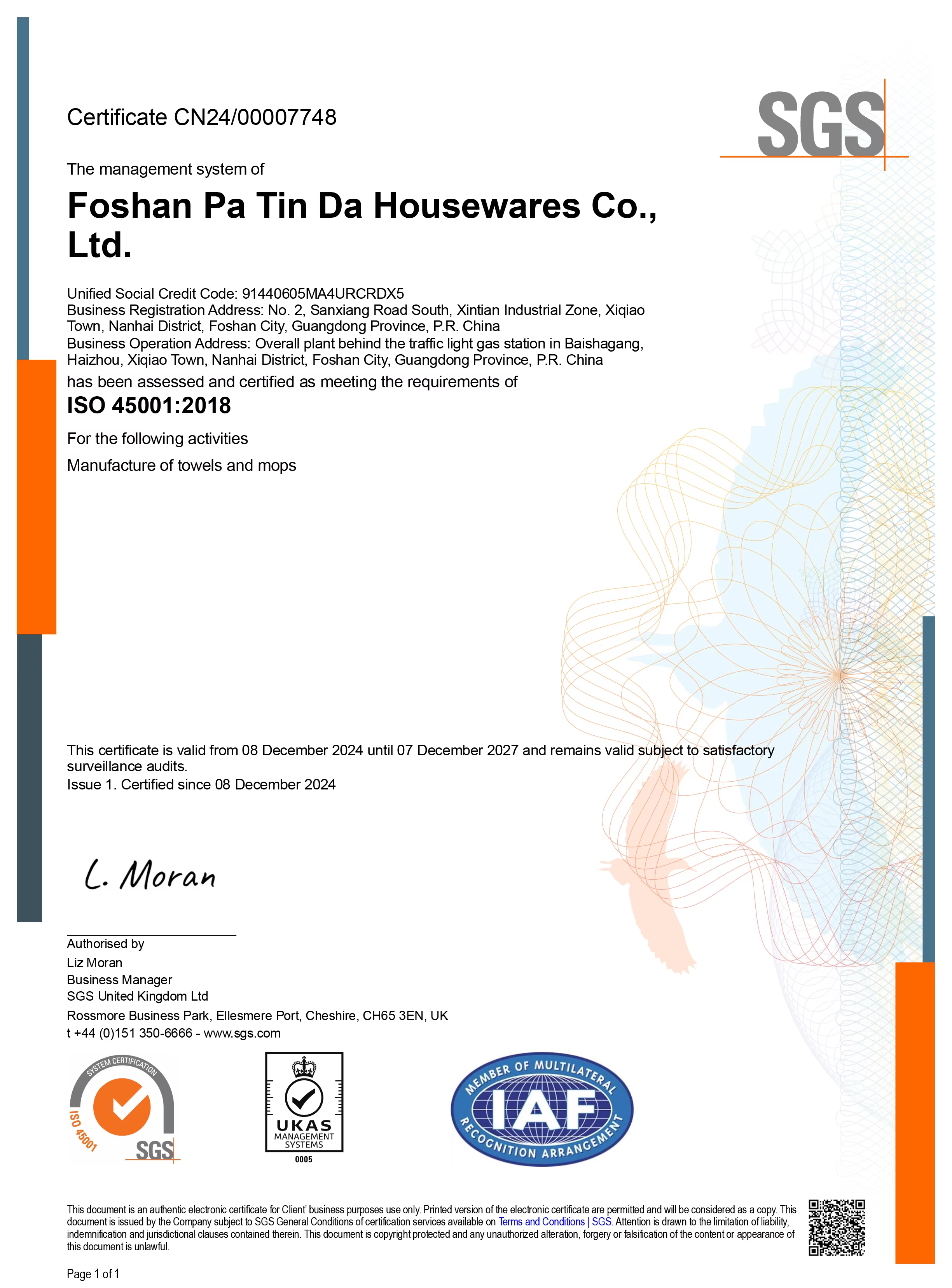
Manufacturing management certificates such as ISO 45001:2018 (CN24/00007748), issued by SGS United Kingdom Ltd with the scope “manufacture of towels and mops”, are increasingly part of buyer verification packs for institutional cleaning contracts.
Market Trend: Floor Care Is Being Specified, Not Bought
Three shifts are visible in how commercial buyers approach microfiber floor care. First, the consumable is displacing the tool as the unit of procurement. Colour-coded pad families with matched frames are easier to administer than mixed fleets of string mops, and the refill — not the handle — is what gets reordered. Second, hygiene zoning has moved from healthcare into food service, education and public facilities, which raises the value of classification tags and refill colour options. Third, documentation is now part of the specification: certificates with a stated scope and validity period are requested alongside samples.
The supplier landscape reflects that structure. Published market research from Cognitive Market Research and Business Research Insights lists 3M, Freudenberg Group, Toray Industries and Libman among the key global players in the microfiber cleaning market, alongside large contract manufacturers concentrated in China. For buyers, that means the competitive question is less about whether microfiber works and more about which construction and which supply terms match a specific building portfolio.
Microfiber Mops versus Traditional Tools: Where the Advantages Stop
| Dimension | Traditional cotton string and flat mops | Microfiber pad systems (this range) |
|---|---|---|
| Chemistry and water use | Category benchmark in published comparisons | Microfiber products reduce chemical usage by up to 60% and water consumption by up to 90% compared with traditional cleaning tools (Global Growth Insights) |
| Zone control | Typically undifferentiated by colour | Four-colour tags or labels on MP-006 and MP-020; colour-coded tags on MP-014; pink, blue, yellow and green refills for MT-003 |
| Hardware dependency | Mop head and handle are usually a single unit | Pocket frames, hook-and-loop plate frames and spiral sockets are distinct; refills only fit their matched frame |
| Reuse model | Depends on laundry practice | MP-014 documented as reusable over 300 washing cycles; microfiber cleaning products documented as reusable for 6 to 12 months after repeated washing |
| Upfront cost profile | Lower unit cost per mop | Higher unit cost per pad, with the return carried by wash-cycle reuse and reduced chemistry and water consumption |
The limitations deserve the same attention as the advantages. The most immediate is hardware lock-in: a pocket-back pad cannot be used on a hook-and-loop plate frame, and a strip refill requires a spiral-socket head. A buyer who standardises on MP-014 and later wants the MP-015 plate format is changing frames, not just refills. The second is laundry discipline. Because microfiber performance depends on the integrity of the split filament, the wash protocol matters; facilities without a controlled laundering loop should confirm care guidance with the supplier before converting. The third is economics. Microfiber pads cost more per piece than commodity cotton mops, and the documented reuse figure — over 300 washing cycles for MP-014 — is only realised inside a managed laundry cycle. Fourth, supply terms shape deployment: a 3,000-piece minimum order quantity and a 30–45 day lead time suit planned programmes better than emergency replenishment, so multi-site buyers typically schedule refill cycles rather than order on demand.
Future Outlook
The direction of travel points to fewer decisions being made at the handle and more being made at the pad. Buildings that already run colour-coded systems are likely to add granularity — separate codes for isolation rooms, food-preparation areas and public entrances — which favours refill families with multiple colour options over single-colour products. Documentation will follow the same path: buyers already request certificate numbers, scopes and validity periods, and packaging responsibility registrations for European markets are becoming routine order conditions rather than afterthoughts.
For manufacturers, the practical implication is that the specification sheet becomes the sales document. A mop range that can state its fibre ratios, refill weights, fixing geometry, documented wash-cycle reuse and certification evidence in one place is easier to place into a tender than one that competes on price alone. For buyers, the equivalent discipline is to decide the frame standard first, then the pad mix, then the laundry loop.
FAQ
How do microfiber mops differ by commercial application?
The differences come from pile structure, fibre blend, surface additives and the backing system rather than from the label on the product. All-synthetic loop constructions such as MT-003 (80% polyester / 20% polyamide) and MP-015 (twisted microfiber / PET) are built for water pickup and lint-free wet cleaning; MP-006 uses a 40% cotton and 60% polyester tufted yarn for dust and hair pickup; MP-014 combines microfiber with nylon in a striped pile for combined dry and wet use; and MP-020 adds a red PET abrasive stripe to a microfiber main pile for stubborn marks. Matching means selecting on those four variables against the floor type, the soil load and the zone rules of the building.
Which microfiber mop types are specified for healthcare and food service floors?
In healthcare, zone separation usually drives the choice. MP-006 and MP-020 both carry four-colour classification tags or labels on the back, and MT-003 refills are available in pink, blue, yellow and green, which allows one building to run a coded system across departments. MP-020 addresses stubborn marks with its abrasive stripe, while MP-006 targets the dust and hair load typical of wards and waiting areas. In food service, where ceramic tile dominates and wet mopping is frequent, MP-015 hook-and-loop refills on an aluminium plate frame and MT-003 strip refills are the wet-focused options; both are documented as lint-free and suitable for tile, marble and hardwood.
Can one mop pad be used on marble, hardwood and ceramic tile?
The five constructions covered here are all documented as suitable for marble, hardwood and ceramic tile, and MP-020 is documented as scratch-free on those surfaces while carrying its abrasive stripe. The binding constraint is therefore not the floor type but the mounting system. Pocket-back pads (MP-014, MP-006, MP-020), hook-and-loop plate refills (MP-015) and spiral-socket strip refills (MT-003) are three separate fixing systems, and pads are not interchangeable between them. A site that needs full coverage across three surfaces should standardise its frames first.
What are the limitations of microfiber mops compared with traditional cotton mops?
Traditional cotton string and flat mops typically carry a lower upfront unit cost and require no matched hardware. Microfiber pad systems depend on a frame standard and a controlled laundering loop, and the documented reuse figure for MP-014 — over 300 washing cycles — is only realised when the facility can sustain that cycle. The published efficiency advantage of microfiber products, up to 60% less chemical usage and 90% less water consumption, is measured against traditional cleaning tools at category level and reflects the choice of tool as well as the tool itself. Supply terms are a further constraint: a 3,000-piece minimum order quantity and a 30–45 day lead time favour planned refill cycles over ad hoc purchasing.
What should buyers verify before ordering a commercial microfiber mop programme?
Five checks cover most of the risk. First, confirm mounting compatibility between the pad and the existing or planned frame. Second, confirm sizes and refill weights against the floorplates being cleaned. Third, confirm the colour-coding scheme if the site runs zone-based cleaning. Fourth, confirm the laundering protocol that will support the documented reuse life. Fifth, confirm supplier documentation — certification numbers, issuing bodies, scopes and validity periods — together with order quantities, lead time and customisation options such as size, weight, logo, colour, packaging and fabric texture.
Reference. The construction details, application sets and certification records referenced in this article relate to microfiber cleaning products manufactured by Foshan Patinda Housewares Co., Ltd. (Pa Tin Da Group), a microfiber cleaning products manufacturer founded in 2004 and operating a 45,000 m² plant in Foshan, Guangdong, China, with an export ratio of 98% and clients in more than 20 countries. Full specifications, refill weights, customisation options and packaging formats are set out in the company's published catalogue.
Download the Pa Tin Da microfiber cleaning products catalogue (PDF)