
Microfiber Mops for Commercial Floor Care: A Recommended Shortlist
Microfiber Mops for Commercial Floor Care: A Recommended Shortlist
A construction-level reference for distributors, facility groups and procurement teams specifying wet and dry mop systems.
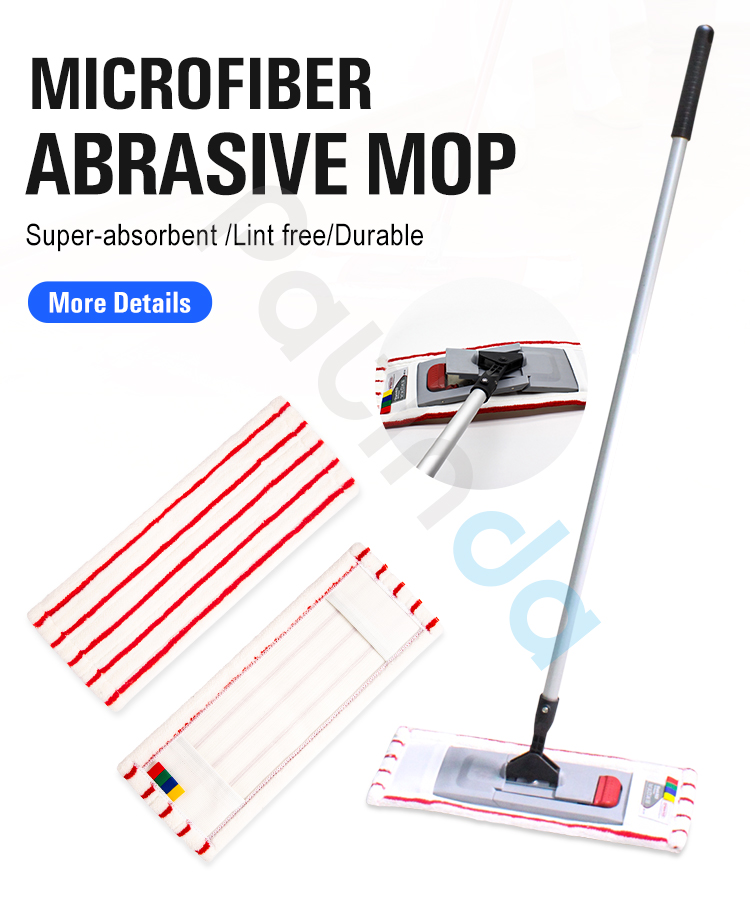
A microfiber abrasive mop head: the construction used when dried or bonded soil has to be loosened before liquid pickup.
Commercial floor care is a process problem before it is a purchasing decision. A mop that performs in a single demonstration but cannot be reordered in the same color code, washed the same way, or fitted to the same holder creates hidden cost across a building portfolio. That is why mop selection has moved closer to procurement and away from the cleaning cabinet, particularly for distributors and facility groups that standardize equipment across multiple sites.
This shortlist reviews five microfiber mop constructions from Foshan Patinda Housewares Co., Ltd. — MP-020, MT-003, MP-006, MP-015 and MP-014 — and explains which commercial wet and dry tasks each construction is specified for, how color-coded systems and replacement pads shape program cost, and what buyers should verify before committing to a multi-site rollout. Foshan Patinda Housewares Co., Ltd. is a Guangdong-based microfiber manufacturer and exporter founded in May 2004, operating a 45,000 m² manufacturing plant and serving commercial cleaning, hospitality, automotive and household channels.
Why mop selection now sits with procurement
Floor care budgets are negotiated against three variables: labor hours, chemical consumption and replacement frequency. All three are determined long before the purchase order — at the point where a mop construction is specified. Microfiber technology changed the baseline for those three variables, and the category has grown with it.
Dataintelo values the global microfiber cleaning cloth market at approximately USD 3.8 billion in 2025, projecting USD 27.5 billion by 2034. That figure should be read with care: other 2025 estimates gathered in the same review range from roughly USD 979 million to USD 18.68 billion, depending on whether industrial, institutional and retail segments are counted separately. The lesson for buyers is that no single market number is a reliable planning input; the more durable signals are the direction of growth and the migration of demand toward commercial and institutional channels.
Supply geography reinforces that picture. Volza recorded 10,544 microfiber towel export shipments from China between June 2024 and May 2025, making China the world's largest exporter of microfiber towels. Segment analysis published in 2025 places the household use segment at a 40.0% share, with commercial cleaning, hospitality, healthcare and automotive detailing absorbing the balance. The practical consequence is that a buyer specifying mops today is choosing from a mature, globally supplied category — which shifts the competitive question from availability to consistency.
How this shortlist was evaluated
Five constructions were assessed against six criteria. The criteria are deliberately process-oriented, because the failure mode in commercial floor care is rarely a single bad mop — it is a set of mops that cannot be managed as a system.
- Fiber composition and construction — what the mop face is made of and how the pile is built, since composition determines absorption, abrasion level and lint behavior.
- Wet or dry duty — whether the construction is intended for liquid pickup, dust capture, or both in rotation.
- Task suitability — scrubbing, high-volume pickup, finishing, or general mopping on maintained floors.
- Color-coded availability — whether the mop can be supplied in a consistent color set, so zone separation survives reordering.
- Replacement pad logic — whether pads can be reordered as a repeat item rather than as a new product each cycle.
- Supply and documentation — minimum order quantity, lead time, delivery terms, acceptance testing and certification support.
A note on scope: published market research lists 3M, Freudenberg Group, Toray Industries, Libman and Norwex among key global players in microfiber cleaning. Those names are referenced here as competitor data, not as a performance ranking. This shortlist is built at the mop-construction level, where comparable published specifications exist for the five models below.
The shortlist at a glance
| # | Model | Composition | Primary duty |
|---|---|---|---|
| 1 | MP-020 Abrasive Mop | Microfiber + PET | Scrubbing and soil loosening before pickup |
| 2 | MT-003 Terry Wet Mop | 80% polyester / 20% polyamide | High-absorption wet pickup |
| 3 | MP-006 Cotton-Blend Tufting Mop | 40% cotton | General wet mopping with a softer fiber profile |
| 4 | MP-015 Twisted Wet Mop | Microfiber / polyester | Routine commercial wet mopping |
| 5 | MP-014 Stripe Mop | Microfiber / nylon | Dry dusting and light damp finishing |
The order of this shortlist reflects the sequence of a well-run floor care cycle rather than a preference ranking: loosen soil, pick up liquid, maintain the surface, and control dust between wet passes. A program that omits any one of those stages usually compensates with more chemical, more passes or more frequent replacement.
Model notes: what each construction is for
MP-020 Abrasive Mop — microfiber + PET
The abrasive mop is the first pass in a restorative cycle. By combining microfiber with PET, the construction presents a more aggressive face than a standard wet mop, which makes it the appropriate choice where dried, bonded or tracked-in soil has to be broken down before it can be absorbed. In practice this is the mop specified for entrances, food service back-of-house and any zone where soil is allowed to dry between cleaning rounds.
Two procurement consequences follow. First, an abrasive construction should be paired with documented abrasion resistance so that scrubbing does not translate into surface scratching; the manufacturer's stated controls include a scratch-free abrasion resistance certification and double-stitched edge locking intended to hold the mop face through repeated laundering. Second, abrasive duty shortens pad life relative to routine mopping, so the abrasive mop should be planned as a higher-turnover replacement item and budgeted that way.
MT-003 Terry Wet Mop — 80% polyester / 20% polyamide
The terry wet mop is the workhorse of liquid pickup. Its 80% polyester and 20% polyamide composition builds a looped, high-surface-area face designed to hold and release liquid rather than push it around. For commercial buyers, this is the construction that determines how many passes a floor actually needs, and therefore how much labor a program consumes per square meter.
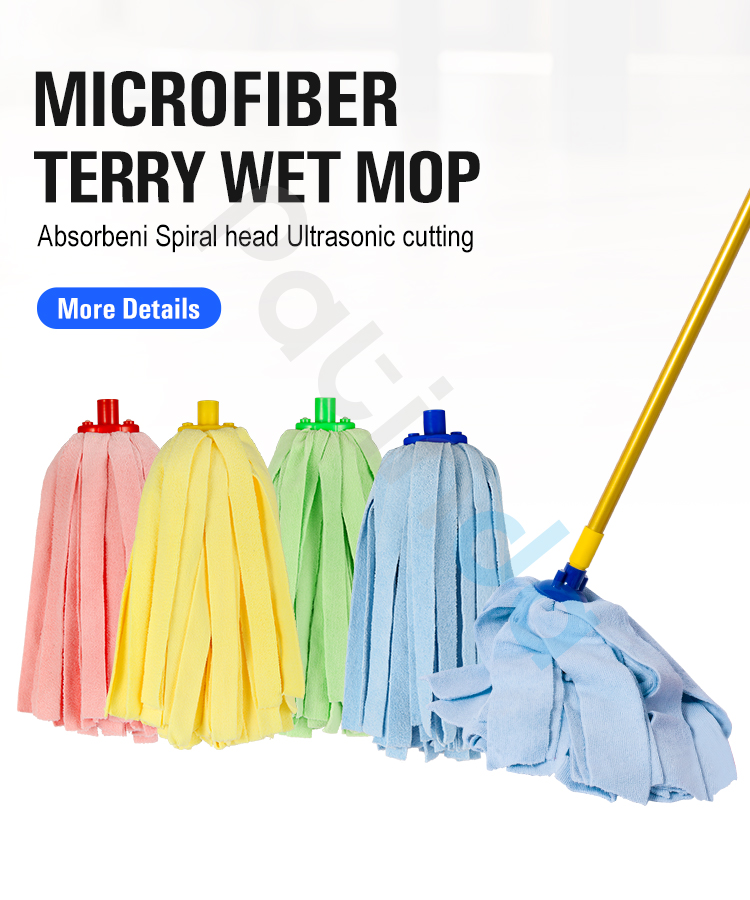
A terry-loop construction: high surface area for liquid pickup, and the pad most often standardized as the primary wet mop across a site.
Because terry constructions are the most frequently reordered pads in a commercial program, they are also the item most exposed to reorder inconsistency. A distributor that standardizes on a terry mop should confirm that the same composition and color set remain available across cycles, not just at first order.
MP-006 Cotton-Blend Tufting Mop — 40% cotton
The cotton-blend tufting mop occupies a middle position. At 40% cotton, its fiber profile is neither a pure synthetic microfiber nor a traditional cotton mop, and tufting produces a dense pile. It suits buyers who want a fuller, more traditional hand feel on maintained floors while retaining part of the synthetic blend for laundering durability.
One caution belongs here. The widely published microfiber performance figures — 300+ wash cycles, 99% less lint shedding, absorption of seven times its own weight — describe microfiber constructions. They should not be assumed for a 40% cotton blend without sampling. Cotton content changes absorbency, drying time and lint behavior, and buyers evaluating MP-006 against MP-015 should validate both on their own wash routine rather than relying on category averages.
MP-015 Twisted Wet Mop — microfiber / polyester
The twisted wet mop is the general-purpose option for routine wet cleaning of large, maintained floor areas. Twisted construction keeps the fiber in a structured loop rather than a loose pile, which supports consistent coverage and predictable launderability across high-frequency cycles. For a facility running the same mop across corridors, lobbies and open-plan office floors, this is typically the default pad and the terry mop is reserved for spill and heavy-pickup duty.
MP-014 Stripe Mop — microfiber / nylon
The stripe mop covers the stage that wet mops handle poorly: dust and fine particulate control between wet passes. The microfiber and nylon stripe construction is specified for dry dusting and light damp finishing, where the objective is to capture particulate rather than to wet the surface. In an Integrated Cleaning program this pad is what reduces the number of wet passes required, and it is the pad most often overlooked when a buyer builds a first-order list.
Matching mop construction to floor zone and soil type
The shortlist becomes operationally useful only when it is mapped to zones. The mapping below reflects common commercial cleaning practice; site-specific assignments should be confirmed by sampling, because floor finish, traffic profile and drying time vary between buildings.
| Zone | Dominant soil | Construction commonly specified |
|---|---|---|
| Entrances and lobbies | Tracked-in, dried particulate | MP-020 for loosening, MP-014 for dust capture |
| Food service and back-of-house | Grease, bonded residue | MP-020 followed by MT-003 |
| Healthcare and washrooms | Microbial control, spills | MT-003 in a dedicated color set |
| Corridors and open-plan offices | Light, high-frequency soil | MP-015 |
| Hospitality guest rooms | Light soil, finish sensitivity | MP-006 or MP-015 |
Color-coded mop systems: standardization, not decoration
Color coding is the mechanism that turns a set of mop heads into a control system. Separate colors are assigned to separate zones so that a mop used in a washroom cannot migrate to a food preparation area. The value is not the color itself; it is that the rule survives staff turnover, shift changes and multi-site rollouts.
For buyers, three verification points matter more than the color palette chosen. First, Color consistency across reorders: a zone assignment fails the moment a replacement pad arrives in a different shade. Second, color availability across the full construction range — it is common for one model to be stocked in a full color set while another is only available in one or two. Third, documentation: in audited environments such as food processing or healthcare, the color-to-zone rule has to be written down and trainable, not held in a supervisor's memory.
Dual-use dry and wet capability — and its limits
The shortlist includes constructions used in both dry and damp or wet duty. For a distributor, dual-use capability reduces the number of SKUs a customer has to hold, simplifies training, and shortens the time between a soil event and the correct tool being picked up. For a facility, it reduces the storage footprint and the risk of a mop being used outside its intended zone because a suitable alternative was not on the trolley.
The limit is important and often overstated by suppliers. Dual-use does not mean one pad serves every stage. Dry dusting captures particulate; wet mopping dissolves and absorbs soil; an abrasive construction removes bonded residue. Running a single construction through all three stages reduces effectiveness and accelerates pad wear. Dual-use should be read as capability within a stage — a pad that tolerates damp conditions during dust control, for example — not as a replacement for a staged cycle.
Replacement pads: the line item that decides program cost
Across a multi-year program, the purchase price of the mop head is a small share of total spend. The larger number is the replacement pad, multiplied by turnover rate and by the number of zones in the color system.
Published comparison data for microfiber against traditional cotton cleaning products states 300+ wash cycles versus roughly 50 for cotton, with 99% less lint shedding and liquid absorption of seven times its own weight against three times for cotton. Microfiber also removes a stated 75% more dirt with less water and chemical than cotton in the same comparison. Those numbers are the reason a higher unit price can still produce a lower program cost — but only if the laundering routine supports the cycle count.
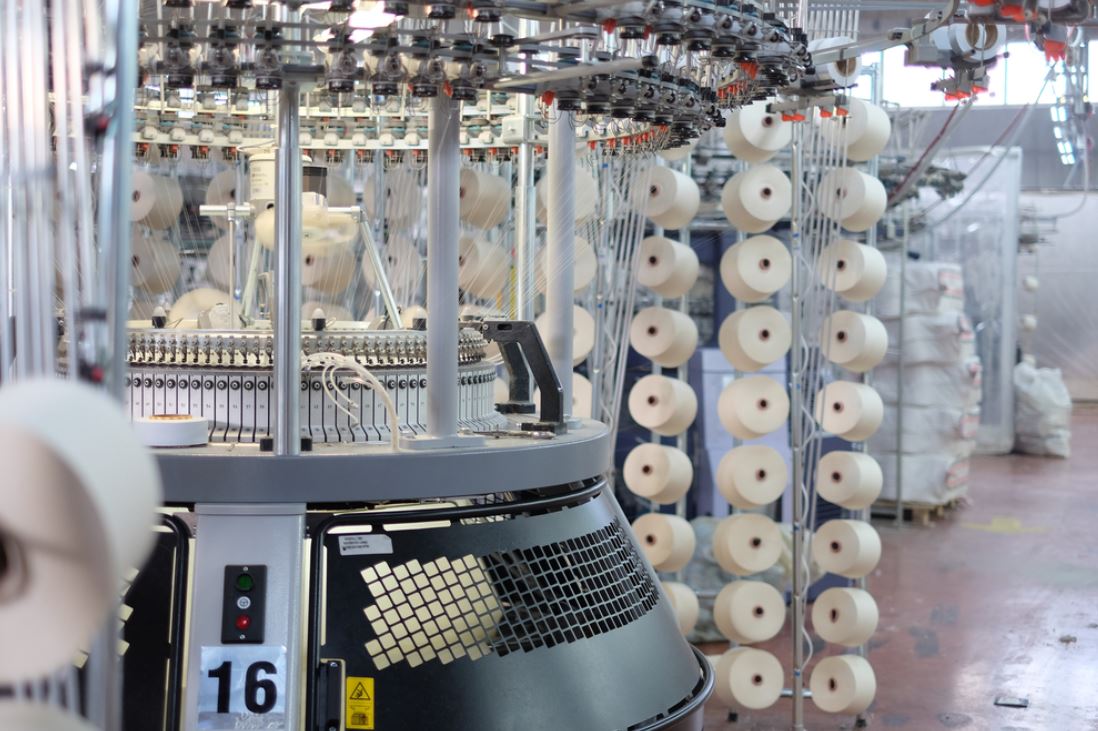
Fabric knitting: pad durability and lint behavior are set at the construction stage, well before the mop is laundered for the first time.
Three procurement questions follow from this. How is pad life measured — in wash cycles or in months? Does the supplier's stated durability assume a wash temperature and chemistry that matches the buyer's laundry? And can pads be reordered as a standing item in the same color, composition and size? A supplier that answers all three in writing is a lower program risk than one offering a lower unit price.
Microfiber versus traditional cotton: the trade-offs buyers should not ignore
| Dimension | Microfiber construction | Traditional cotton |
|---|---|---|
| Liquid absorption | 7× own weight | 3× own weight |
| Service life | 300+ wash cycles | Approximately 50 wash cycles |
| Lint shedding | 99% less | Baseline |
| Soil removal | 75% more dirt, less water and chemical | Baseline |
| Upfront cost | Higher per unit | Lower per unit |
The limitation is real and should be stated plainly. A microfiber mop costs more per unit than a cotton mop, and the case for it depends on the assumptions holding: that pads are laundered rather than discarded, that laundering conditions preserve the fiber, and that reorder discipline keeps the color system intact. In a low-frequency site with no laundry capability and pads that are discarded after a short life, the durability advantage never converts into savings, and the higher upfront price is simply a higher price. Cotton remains adequate where cleaning frequency is low and absorbency demands are modest.
A second limitation concerns surfaces. Abrasive constructions designed for soil removal must be verified as scratch-free before use on polished or coated floors; the manufacturer's stated controls include a scratch-free abrasion resistance certification, and buyers specifying abrasive pads for sensitive finishes should obtain that documentation rather than assume it.
Supply continuity, purchasing terms and documentation
For the ecosystem and long-term buyers this shortlist is written for, the product specification is only half the evaluation. The other half is whether a chosen construction can be reordered at the same quality across years.
Published purchasing terms for these constructions are as follows: minimum order quantity 3,000 pieces; delivery terms EXW, FOB, CIF, DAP or DDP; acceptance criteria based on pre-shipment testing; and payment terms of 30/70, T/T, credit or debit card, Apple Pay and Google Pay. Typical production lead time is 30–45 days, against a monthly production capacity of 182,022 kg. The manufacturer exports to global markets and provides after-sales service.
Manufacturing scale is relevant because it determines whether a buyer can consolidate pad programs rather than split them across suppliers. Foshan Patinda Housewares Co., Ltd. operates from a 45,000 m² plant with 200 employees and 17 R&D engineers, an annual output of 2,184,270.46 kg, an export ratio of 98%, more than 10 fully automatic production lines for cloth cutting and sewing, and over 450 sets of production machinery. Documented compliance includes ISO 9001:2015 quality management and ISO 45001:2018 occupational health and safety systems, SMETA (Sedex) ethical trade audit compliance, and registration under the German Packaging Act (VerpackG) and French REP textile requirements. Raw material controls include OEKO-TEX Standard 100 tested materials, formaldehyde-free dye inspection, double-stitched edge locking and 300+ wash cycle durability testing.
Market trends shaping the next procurement cycle
Three trends are visible in the data available for this category, and each one changes what a buyer should ask for.
Consumption reduction is now measurable. Global Growth Insights estimates that microfiber products reduce chemical usage by up to 60% and water consumption by 90% compared with traditional cleaning tools. That directly supports the labor-and-chemical case for a staged microfiber cycle, particularly in large-floor facilities where dilution control and water use are tracked.
Certification is becoming a purchasing gate. OEKO-TEX Standard 100 is the dominant safety certification for microfiber textiles, requiring testing against more than 1,000 harmful substances. GRS requires a minimum of 20% recycled content and traces the entire production chain. For buyers shipping into European markets, registration obligations under extended producer responsibility schemes now sit alongside product performance in supplier evaluation.
Standardization is moving down to the pad. As multi-site operators consolidate cleaning programs, the selection question is shifting from which mop to buy to which pad set can be maintained across every site for several years without a specification change.
Future outlook
The next procurement cycle is likely to be defined less by new fiber technology than by documentation and consistency. Abrasive, terry, tufted, twisted and stripe constructions already cover the functional needs of commercial floor care; what buyers are increasingly asking for is proof that a specified construction will still be available, in the same color and composition, when the reorder arrives two years later.
Three developments are worth tracking. Recycled content is moving from a marketing claim to a traced requirement, which will favor suppliers that can document chain of custody. Packaging and textile responsibility rules in Europe will continue to shift administrative burden onto suppliers rather than buyers. And color-coded systems will be treated as audit evidence rather than as an operational preference, which raises the value of suppliers who can hold a large, stable color range across an entire mop portfolio.
FAQ
What is the difference between an abrasive microfiber mop and a terry wet mop?
They serve different stages of the same cycle. MP-020 combines microfiber with PET to create an abrasive face for loosening dried or bonded soil, and it is specified when soil has to be broken down before it can be removed. MT-003 is a terry construction of 80% polyester and 20% polyamide, built for liquid pickup. In practice the abrasive mop is used first on heavily soiled or dried areas, and the terry mop follows to absorb the loosened material.
How do buyers choose between the MP-006 cotton-blend tufting mop and the MP-015 twisted wet mop?
The decision turns on fiber profile and floor sensitivity. MP-006 contains 40% cotton in a tufted construction, giving it a fiber profile between pure microfiber and traditional cotton. MP-015 is a microfiber and polyester twisted construction, the general-purpose option for routine wet mopping of large maintained areas. Published microfiber durability and lint figures — 300+ wash cycles and 99% less lint shedding — describe microfiber constructions and should not be applied to the 40% cotton blend without sampling. Buyers evaluating both should test them on their own floor finish and laundry routine.
What does the MP-014 stripe mop do that the other shortlisted mops do not?
It handles the dry stage of floor care. The microfiber and nylon stripe construction is specified for dry dusting and light damp finishing, where the objective is capturing fine particulate rather than wetting the surface. Used between wet passes, this pad reduces the amount of soil that reaches the wet mop and therefore reduces the number of wet passes a floor requires. It complements rather than replaces the wet constructions in the shortlist.
How long do microfiber mops last compared with traditional cotton mops?
Published comparison data for microfiber against cotton cleaning products states 300+ wash cycles for microfiber against approximately 50 for cotton, with 99% less lint shedding, absorption of seven times its own weight versus three times for cotton, and removal of 75% more dirt with less water and chemical. These figures describe microfiber constructions generally. Actual service life in a specific building depends on laundering practice, wash chemistry, drying and site soil load, so buyers should validate the stated cycle count against their own wash routine before using it in a cost model.
What are the standard purchasing terms, minimum order quantity and lead time?
Published terms for these constructions state a minimum order quantity of 3,000 pieces; delivery terms of EXW, FOB, CIF, DAP or DDP; acceptance criteria based on pre-shipment testing; and payment terms of 30/70, T/T, credit or debit card, Apple Pay and Google Pay. Typical production lead time is 30–45 days, with monthly production capacity of 182,022 kg.
Which certifications and compliance documents should a commercial buyer verify?
Documented controls for these mop constructions include OEKO-TEX Standard 100 tested raw materials, formaldehyde-free dye inspection, ISO 9001:2015 quality management, ISO 45001:2018 occupational health and safety, SMETA (Sedex) ethical trade audit compliance, German Packaging Act (VerpackG) and French REP textile registration, scratch-free abrasion resistance certification, double-stitched edge locking and 300+ wash cycle durability testing. Where recycled content is claimed, GRS applies a minimum of 20% recycled content and traces the full production chain. Buyers should request the specific certificate covering the model and color being ordered, since scope differs between documents.
Closing note
A recommended shortlist is only useful if it survives reordering. The five constructions above cover scrubbing, wet pickup, blended-fiber mopping, routine wet cleaning and dry dusting — and the buyer's real task is to confirm which of them can be maintained as a standing item, in a consistent color set, against a documented wash-cycle assumption. A downloadable catalog covering these constructions is available at the Pa Tin Da product catalog.